
I. Executive Summary
College athletics now runs on a compliance apparatus that did not exist fourteen months ago, and the apparatus publishes its own operating data. The College Sports Commission (CSC) — the enforcement body created by the House v. NCAA settlement — released its latest NIL Data Report on July 8, 2026, covering third-party name, image, and likeness (NIL) deal flow through June 30. The MindCast Clearance Ledger converts that material into a standing intelligence product: a living analytical model, run on the MindCast AI Proprietary Cognitive Digital Twin (CDT) Foresight Simulation engine (MP CDT FS), updated on intelligence events, and graded in public against each new evidence release. Issue 0 is the foundation document, and its principal results follow.
Core result. The current regime is not suspended pending Congress. The House settlement, the CSC, the NIL Go clearinghouse, and the arbitration path govern the live operating environment today. The Protect College Sports Act would change who holds enforcement immunity, whether federal law overrides the state patchwork, and how school-affiliated deals count against the revenue-share cap — without erasing the present need to create defensible records.
System equilibrium. The modeled environment is a repeated adaptive game: schools and counterparties — the brands, collectives, and sponsors on the other side of each deal — redesign deals, the Commission observes circumvention and shifts scrutiny, arbitration creates precedent, and both sides adapt with a lag. The likely next equilibrium concentrates scrutiny on high-dollar associated-entity deals while lower-value transactions clear faster.
Dominant strategy. Building an institution-controlled pre-submission record now survives all principal branches — federal passage, legislative stall, or appellate modification of House. Waiting creates irreversible evidentiary gaps and raises later restructuring, arbitration, and litigation costs.
Principal risk. The strongest failure mechanism in the system is not a lack of rules. Signal loss — between deal formation, institutional classification, approval rationale, clearinghouse submission, and later dispute — predicts avoidable denials and weak defensibility even under identical rules.
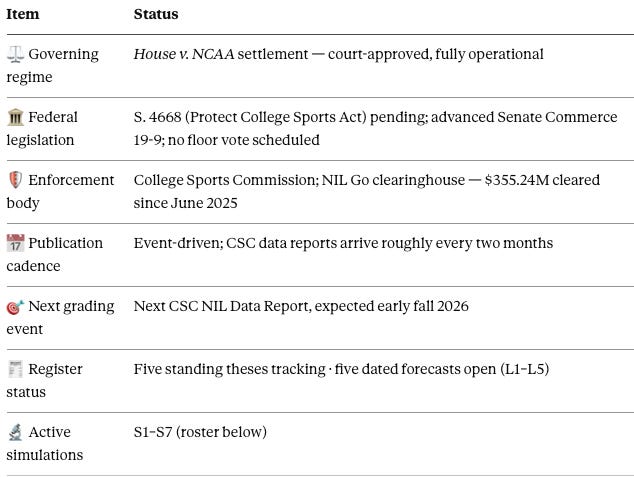
Current Intelligence Snapshot — July 2026
Major Predictions
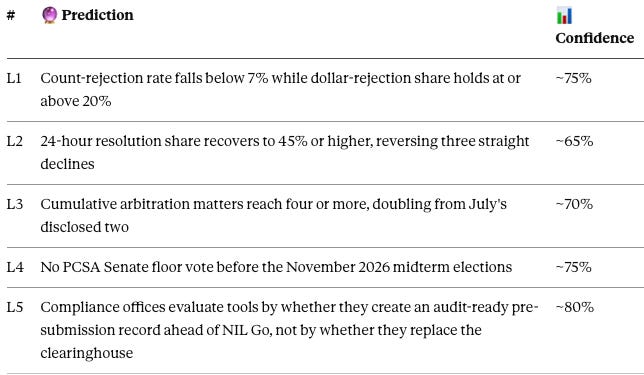
Five dated forecasts open the register, each graded at the next CSC NIL Data Report; Section VII carries the full mechanisms and falsification signals.
Stakeholder Implications
The findings translate directly by desk.
Athletic departments should treat NIL Go as the downstream clearinghouse, not the institution’s system of record — source-cited rules, classification rationale, reviewer attribution, and deliverable proof belong in institutional hands before submission.
Compliance offices own the daily workflow, and the audit-ready pre-submission record is becoming the standard by which the market evaluates tooling (forecast L5) — with escalation paths to general counsel and athletic leadership designed in, not improvised.
General counsel should recognize the fact pattern the model flags as most dangerous: a high-value denial combined with inconsistent internal rationale and a public-record contradiction. Contemporaneous reasoning, preserved at decision time, is the defense.
Brands, agencies, and collectives need their own records — arm’s-length business purpose, valuation logic, deliverables, funding source, affiliation status — built to survive both first review and a 14-day arbitration decision.
Issue 0 establishes the governing regime, maps the legislative branches, introduces the seven-simulation roster, reports the foundation run behind the findings above, and opens the prediction register that every subsequent installment updates. The through-line is MindCast AI’s standing thesis for the post-House era: the frontier of competition has moved from the size of the check to the integrity of the record behind it. Schools no longer win by paying the most; they win by documenting and defending every deal they touch.
II. Two Layers, One Stack
Every analytical product needs a stated vantage point, and the Clearance Ledger’s vantage is the foresight layer of a two-layer stack. The operating layer captures what happens at the transaction level — contract intake, classification, threshold checks, submission, audit trail — the institution-controlled infrastructure that sits upstream of the CSC’s NIL Go clearinghouse — the recordkeeping a school completes before a deal ever reaches the Commission for review. The foresight layer models where the enforcement regime moves next and what the records it demands will need to show. MindCast AI builds the foresight layer, and the Clearance Ledger is its public instrument.
The foresight method centers on Cognitive Digital Twins (CDTs): an actor-specific behavioral model that simulates how an institution, regulator, or counterparty perceives, decides, and adapts — calibrated against the actor’s published record and graded against its subsequent behavior. The CSC is the series’ primary CDT subject. The Commission’s data reports, its June 23 Enforcement Policy Memo, its arbitration positions in the Nebraska and Georgia matters, and its July threshold revisions together form a behavioral record dense enough to model: what it scrutinizes, how fast it adapts to circumvention patterns, where its capacity binds, and how it responds when an arbitrator rules against it.
Schools, collectives, agencies, and brand counterparties form the adaptive population on the other side of the game. Treating both sides as players in a repeated game — each observing the other’s last move, each adapting with a lag — converts a data release into a forecast rather than a recap. In practice, the models answer questions like: when a new circumvention pattern appears, how quickly does the Commission tighten its rules, and where does it tighten first?
The two layers reinforce each other without merging. Operating-layer data narratives — deal-structure patterns, submission outcomes, review-time distributions — feed the foresight models; foresight outputs flow back as specifications for what the operating layer should capture next. The Clearance Ledger is where the foresight layer’s outputs get published.
III. The Regime That Controls: House Until Congress Decides
A common misreading of the current moment treats NIL compliance as suspended animation — rules on hold until Congress acts. The operating reality runs the other way. The House settlement is a court-approved class action resolution, and its machinery has been live since June 2025: a revenue-share cap that grew to $21.3 million per school on July 1, the CSC as enforcement body, the NIL Go clearinghouse reviewing every third-party deal above $600, and a functioning arbitration path for contested denials. Schools opted in; the settlement binds them by consent and court order, not by statute.
The July 8 report shows the machinery at scale. Since NIL Go launched on June 11, 2025, the clearinghouse has cleared 34,195 deals worth $355.24 million and declined 1,812 deals worth $89.85 million. In the May–June 2026 window alone, 7,639 deals cleared ($112.89M) against 659 not cleared ($33.68M) — a rejection rate of 7.9% by count and 23.0% by dollar value. The asymmetry between those two figures is the single most analytically important fact in the report: the bigger the deal, the more likely the Commission is to reject it, so the athletes and counterparties with the most money at stake carry the most clearance risk.
Two structural fragilities sit beneath the operating stability, and both matter for foresight. First, the CSC is a creature of settlement, not statute. The Commission’s authority rests on contractual consent among the defendant conferences and member institutions, and its enforcement actions carry antitrust exposure of their own — the same exposure the Protect College Sports Act’s Section 118 immunity would extinguish. Second, the settlement itself faces pending appeals, including Title IX challenges to its allocation structure. Neither fragility has slowed the clearinghouse’s operations. Both define what is actually at stake in the legislative fight.
The interregnum — the stretch between the settlement regime and whatever framework Congress builds next — has a clear answer to what controls: House, operationally and enforceably, until Congress supersedes it or an appellate court modifies it. The open question is which rulebook will eventually judge today’s records, not whether schools must keep them. Records are being demanded now, under a regime that is fully operational.
IV. The Legislative Branches: If the Act Passes; If It Stalls
The Protect College Sports Act of 2026 (PCSA, S. 4668) would convert the settlement’s private governance into federal statute, and the conversion changes more than the letterhead. The series models the legislative future as a branch structure rather than a single path, because institutions are building compliance infrastructure now that must survive either branch.
Under passage, three statutory shifts dominate. Section 118’s antitrust immunity extinguishes the CSC’s own litigation exposure, converting a fragile consent-based enforcer into a statutorily shielded one. The immunity protects only conduct that followed the statute’s rules, so a school still has to prove each deal stayed inside those rules — the legal protection is only as strong as the documentation behind it.
Section 114, the second shift, pulls associated-entity deals toward the revenue-share cap even where they clear fair-market-value review. In plain terms, payments from boosters, collectives, and school-affiliated sponsors would count against the cap even when priced at market rates, which turns the question the Nebraska arbitration previewed — does a given sponsor count as school-affiliated? — into the industry’s central fight. Federal preemption, the third shift, replaces thirty-plus state regimes with one federal standard and ends the practice of shopping for favorable state rules.
A fourth shift hides inside the immunity itself. The shield creates a scrutiny gap precisely where private capital is acquiring collectives, agencies, and athlete-facing platforms — the operating-company channel Utah’s Crimson Brand Partners made operational on July 1. MindCast AI’s prior analysis, The Protect College Sports Act of 2026: Federal NIL Salary Cap, Antitrust Immunity, and the Private Equity Blind Spot, develops the full argument, building on the firm’s January firm-formation forecast.
Under stall, the settlement regime persists with its fragilities intact. The state patchwork continues fragmenting — thirty-plus divergent regimes with no preemption relief — which raises rather than lowers the documentation burden, because multi-state defensibility demands records that satisfy the strictest applicable regime.
Enforcement under stall keeps its own constraint. The CSC continues operating under antitrust exposure, which disciplines how aggressively it can act and keeps the arbitration path attractive. Pending appeals against House remain the lower-probability but serious scenario: an appellate ruling could rewrite specific settlement terms, yet Title IX, the Equity in Athletics Disclosure Act, and state statutes would keep their own record demands in force regardless.
The branches differ in legal form and converge in practical effect. Passage professionalizes the reporting channel; stall preserves fragmented enforcement that rewards schools controlling their own audit-ready records. The bill decides which report an institution files; the record decides whether the institution survives the filing. In concrete terms: legislation sets the reporting format, while the evidence a school keeps today determines whether its deals hold up when reviewers, arbitrators, or courts examine them later.
Contact mcai@mindcast-ai.com to partner with us on Predictive Game Theory AI in Law and Behavioral Economics. We specialize in predictive simulations for Complex Litigation, Innovation Economics and Geopolitical Risk Intelligence.
Recent projects: If the Protect College Sports Act Passes, Private Equity in College Sports Wins Differently | The Protect College Sports Act of 2026 (S. 4668) Becomes a Compliance-Infrastructure Bill | MindCast AI 2026 Prediction-Venue Comparison — Every Head-to-Head From Super Bowl LX and the FIFA World Cup, Scored Against the Field
To deep dive on MindCast works upload the URL of this publication into any LLM (preferably Google AI mode) and prompt ‘reconstruct MindCast framework with three degrees of cited sub links.’ See Live-Fire Game Theory Simulators, Runtime Predictive Infrastructure.
V. The Simulation Roster
An intelligence product should declare its instruments before it uses them, so the full simulation roster follows. Each simulation is mechanism-explicit: a model of how specific players adapt, producing forecasts with confidence bands and falsification signals — the observable outcomes that would prove each forecast wrong. The roster is extensible — new simulations enter through the candidate registry described in the update protocol — but these seven define the series at launch.
S1 · Clearance Trajectory. Forecasts the count-rejection and dollar-rejection rates each CSC reporting window, modeling the interaction between school-side deal structuring and Commission-side scrutiny calibration. The July 2026 threshold change — deals between $600 and $15,000 exempt from range-of-compensation review until an athlete accumulates $50,000 in associated-entity deals per academic year — enters as a known regime input.
S2 · Resolution Velocity. Forecasts the review-speed metrics (share resolved within 24 hours; share within 7 days), modeling review capacity against submission volume and complexity mix. Because most submissions are small deals, removing them from full review lifts the average speed even if large-deal review stays slow.
S3 · Arbitration Utilization. Forecasts contested-denial behavior through the 14-day arbitration window, modeling the expected-value calculation a school or athlete faces after a Not Cleared decision — restructure, arbitrate, or withdraw — as precedent accumulates.
S4 · Legislative Branch. Forecasts PCSA procedural milestones — committee action, floor scheduling, amendment fights, the 60-vote threshold — and maintains the passage/stall branch probabilities that condition every other simulation.
S5 · Deal-Structure Stress Test. Runs synthetic contract profiles against the CSC’s published failure taxonomy — associated entity, warehousing, valid business purpose, range of compensation — treating the Commission as an adaptive adversary. The first full run arrives in a future installment.
S6 · Capital-Formation Diffusion. Tracks the athletics operating-company channel against the January 2026 forecast of ten or more formations within twenty-four months of the Utah prototype, modeling which institutional profiles move next and under what underwriting patterns.
S7 · Allocation-Equity Claims Window. Forecasts when and where Title IX allocation-equity claims surface against revenue-share distribution decisions, conditioned on institutional scale — the claim class the series’ school-level snapshots identify as sharpest at FCS and Group of Five revenue tiers.
Not every installment runs every simulation. Each update runs the simulations its triggering event feeds, and the register below carries the standing state of all of them between installments.
VI. The Foundation Run: What the Model Says at Launch
Issue 0 does not launch with an empty model. A full foundation run executed the architecture before publication: a five-actor population of Cognitive Digital Twins — CSC enforcement, institutional compliance offices, collectives and associated entities, the congressional coalition, and plaintiffs or challengers — cycled through the firm’s stored Vision Functions under the Dynamic Predictive Game Theory Framework as master orchestration. The outputs below are structured the way the model produced them; the full simulation report accompanies this issue as a companion document.
Dominant Equilibrium
The modeled equilibrium is targeted enforcement plus pre-submission institutional filtering. In plain terms, the Commission concentrates its scrutiny on large deals while schools screen and correct deals internally before submission — and the July threshold exemption accelerates a shift already underway. The dominant school move is building an institution-controlled evidentiary record before NIL Go submission; the dominant counterparty move is strengthening arm’s-length proof, deliverables, and valuation support; the CSC’s best response refines classification and cumulative thresholds rather than expanding broad review.
Highest-Risk Failure Mode
The run’s sharpest finding concerns failure, not rules. The strongest failure mechanism in the system is signal loss — the gap between deal formation, institutional classification, approval rationale, clearinghouse submission, and later dispute. A typical version: a coach negotiates terms, the compliance office classifies the deal, nobody records the reasoning, and when the deal is denied months later the institution cannot reconstruct why it approved the structure. Programs whose desks work from different information and adapt slowly to new guidance show avoidable denials and weak defensibility even under identical rules. The most dangerous fact pattern combines a high-value denial, inconsistent internal rationale, and a public-record contradiction.
Primary Findings
Three structural conclusions emerged from the run at high confidence.

Secondary Findings
Contingent forecasts carry wider bands, and the dated ones feed the register’s graded set below.

Decision Robustness Summary
The run stress-tested the build-now decision across all three governance branches, and the result reads directly from the matrix.
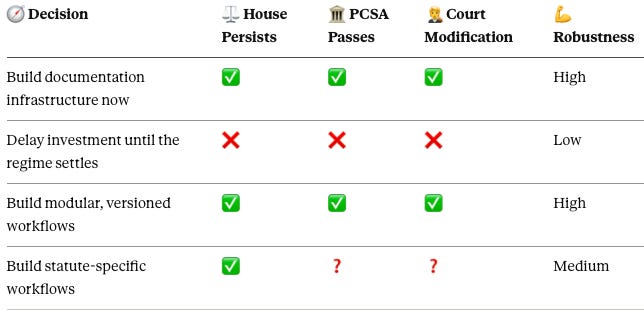
Acting now dominates waiting in every branch, because records retain value under any regime while missing contemporaneous evidence cannot be reliably recreated later. The one overinvestment risk the model flags sits in the matrix’s final row: rigid, statute-specific rule-building without versioning.
Two signals deserve reader attention between issues. First, the equilibrium’s instability trigger: an adverse arbitration or judicial ruling that weakens a central classification rule would require re-running every forecast in the register under new assumptions. Second, the capacity question inside L2: whether the review capacity freed by the threshold exemption actually improves resolution speed or gets consumed by large-deal complexity — the model expects recovery toward 45%, but no sustainable return above the early 53% level. The run’s new predictions enter the register below.
VII. The Living Prediction Ledger
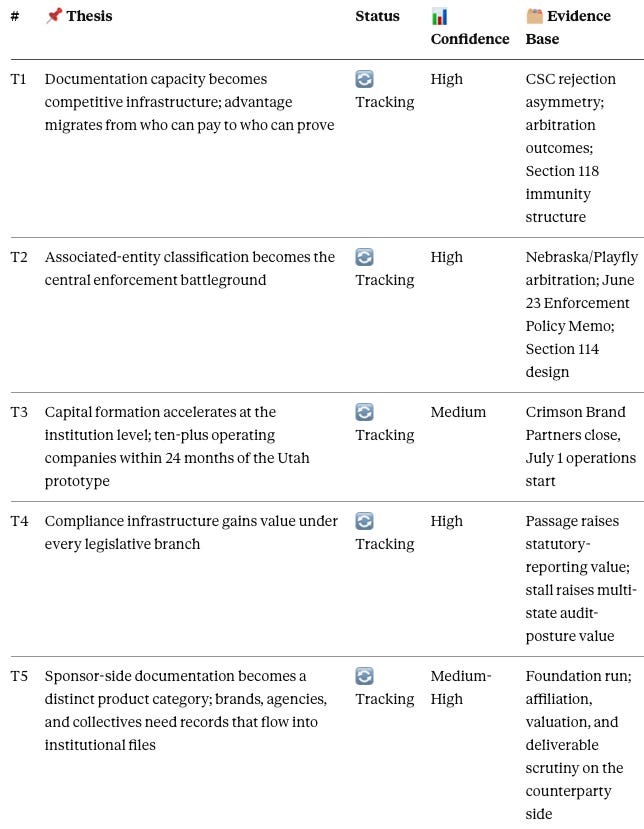
A single evolving register replaces the disconnected prediction sets that typically accumulate across a publication series. The register distinguishes two prediction classes, because they grade differently. Standing theses are directional claims tracked continuously against accumulating evidence; they strengthen, weaken, or retire, but no single event settles them. Locked forecasts are dated point predictions graded pass/fail at a defined checkpoint. Every installment updates both classes; nothing exits the register silently.
Standing Theses
Five thesis anchor the register at launch, each imported with its current evidence base.
Locked Forecasts
Five dated forecasts open the graded set. Each one grades against the next CSC NIL Data Report, expected in early fall 2026 on the Commission’s observed two-month cadence.
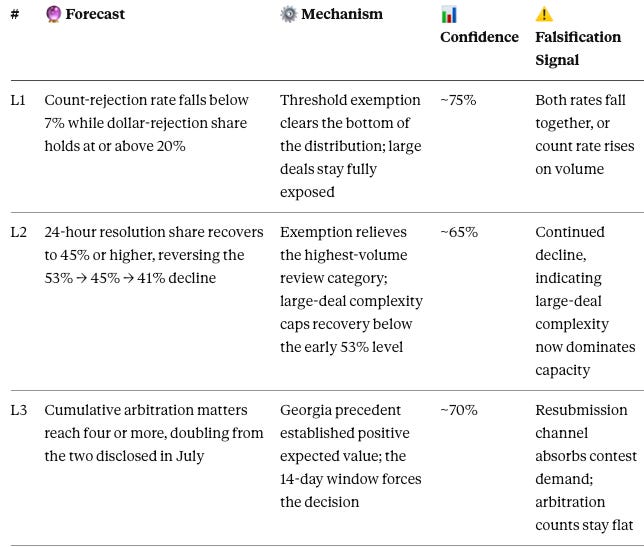
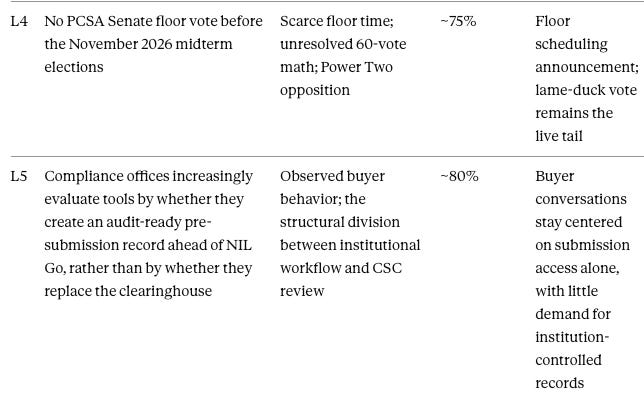
The register’s discipline is the series’ credibility mechanism. Forecasts lock and timestamp before outcomes resolve; observations suggesting model improvements enter a candidate registry during the cycle and receive verdicts only at the post-grading review, never mid-stream. When a forecast misses, the miss gets a mechanism-level autopsy in the next installment, because a graded miss teaches more than an ungraded hit.
VIII. The Update Protocol
An intelligence product publishes on intelligence events, not on a calendar, and six event types trigger Clearance Ledger installments — each feeding specific simulations rather than the full roster. CSC NIL Data Reports, arriving on the Commission’s observed cadence of roughly every two months, trigger full updates: S1 and S2 refreshes, re-scoring of the full forecast set, and trend analysis on associated-entity scrutiny. Major arbitration decisions trigger S3 special editions explaining the precedent and updating the CDT models.
Four further triggers round out the protocol. Significant Enforcement Policy Memos trigger S5 operational briefs on what the guidance changes for documentation practice. Congressional movement on S. 4668 — or major court decisions touching House — triggers S4 updates that revise the passage and stall probabilities on which every other simulation depends. Utah-like capital transactions trigger S6 diffusion-count updates against the January forecast. And allocation-equity challenges trigger S7 claims-window updates with school-specific analysis. The rhythm that falls out is roughly six to ten substantive installments per year, set by how active the regulatory environment becomes rather than by a publishing schedule.
Every recurring installment follows the same six-part structure, so readers know exactly what they are getting: what changed, the mini simulations the event feeds, prediction updates, implications for schools, implications for brands, agencies, and collectives, and the graded scorecard. Continuity lives in the structure and the register; freshness lives in the triggering event.
Issue 0 ends where the series begins its work. No announcement will mark the end of the interregnum: Congress may act, an appellate court may move first, or the settlement regime may simply become permanent as years pass without change. The register above states what MindCast AI expects on each path, and the next CSC data release grades the first forecast set. Readers can judge the model by its public record.
Next Installment
Issue 1 publishes when the next CSC NIL Data Report drops — expected in early fall 2026 on the Commission’s observed cadence. Contents are already defined by the protocol: a graded scorecard on all five forecasts (L1–L5), refreshed S1 and S2 runs against the new figures, an updated Current Intelligence Snapshot, and a fresh forecast set for the following cycle. Should a major arbitration decision, Enforcement Policy Memo, or Senate floor action arrive first, a special edition on that trigger precedes it.
Issue 0 ends where the series begins its work. No announcement will mark the end of the interregnum: Congress may act, an appellate court may move first, or the settlement regime may simply become permanent as years pass without change. The register above states what MindCast AI expects on each path, and Issue 1 delivers the first public grading. Readers can judge the model by its record.
Appendix — Sources & References
Primary Data: CSC NIL Data Report, July 8, 2026
CSC Releases NIL Data Report — NILNewsstand. Republishes the Commission’s July 8 release verbatim with the report graphic; source for the May–June window figures (7,639 cleared / $112.89M; 659 not cleared / $33.68M) and the cumulative totals since launch.
College Sports Commission, NIL Go have cleared $355 million in deals since launch — Yahoo Sports. Confirms the cumulative not-cleared figures ($89.85M across 1,812 deals) and discloses the two combined arbitration matters.
College Sports Commission, NIL Go have cleared $355 million in deals since launch — On3. Independent same-day confirmation of the May–June figures and the $21.3M revenue-share cap.
College Sports Commission Releases July 2026 Report on NIL Deals — Business of College Sports. Confirms the July 2026 threshold change ($600–$15,000 exemption; $50,000 academic-year trigger) and the 41% / 24-hour resolution figure.
Historical CSC Data Points (resolution-velocity trend line)
College Sports Commission Reports $87M in NIL Deals Approved — Athletic Business. November 2025 report; the 53% / 24-hour figure that anchors the L2 trend line.
The Latest Data on NIL Deals Submitted to NIL Go — Business of College Sports. November 2025 detail on not-cleared methodology and resubmission handling.
College Sports Commission NIL Go report: 63% of deals tied to school boosters in last two months — Yahoo Sports. March 2026 report; the 63% associated-entity share during the transfer portal window and CSC CEO Bryan Seeley’s remarks.
MindCast AI Publications Cited
MCAI Lex Vision: The Protect College Sports Act of 2026 — Federal NIL Salary Cap, Antitrust Immunity, and the Private Equity Blind Spot (June 2026). Relevance: supplies Section IV’s passage-branch analysis — the Section 118 immunity structure, the Section 114 associated-entity design, and the private-capital scrutiny gap the bill leaves untouched across all 124 sections.
MCAI Lex Vision: The Protect College Sports Act of 2026 (S. 4668) Becomes a Compliance-Infrastructure Bill(June 2026). Relevance: tracks the Senate Commerce 19-9 advancement and the hardened bill text behind forecast L4, and establishes the reading Issue 0 carries forward — clean documentation replacing the paycheck as the competitive edge.
MCAI Lex Vision: If the Protect College Sports Act Passes, Private Equity in College Sports Wins Differently (July 2026). Relevance: grades the January firm-formation forecast against Utah’s Crimson Brand Partners close, anchors simulation S6 and standing thesis T3, and states the series’ through-line — competition shifting from the size of the check to the integrity of the record behind it.
MCAI Lex Vision: NCAA Antitrust Exposure Snapshot (July 2025). Relevance: supplies the three-tier institutional risk-matrix methodology behind simulation S7’s school-level allocation-equity exposure analysis.
MCAI Lex Vision: Private Equity, NIL, Antitrust, and the Firm-Formation Phase of College Athletics (January 2026) — mindcast-ai.com. Relevance: the origin forecast for the capital-formation channel — named Utah the prototype and projected ten-plus athletics operating companies within twenty-four months, the count simulation S6 tracks and thesis T3 grades.
A note on primary sourcing. The College Sports Commission publishes its NIL Data Reports, Enforcement Policy Memos, and arbitration disclosures directly; the references above include the Commission’s release as republished verbatim (ref. 1) plus independent same-day coverage (refs. 2–4) that cross-confirms every figure used in the register. The June 23 Enforcement Policy Memo and the Nebraska and Georgia arbitration decisions are cited here through that coverage; direct document links will be added to the register as the Commission’s publication practices make them stable. Every forecast in the register grades exclusively against the Commission’s own published figures.