

⚽ The 2026 World Cup Final Simulation Validation
🏈 Super Bowl LX — AI Simulation vs. Reality
Executive Summary
Every Super Bowl and World Cup venue in 2026 answered the same question — who wins — and nearly all of them answered it correctly, because favorites won both marquee events. Answering who correctly settles nothing about method, since a champion pick carries no claim about why and teaches a reader nothing about the engine that produced it. The comparison that matters runs one layer deeper, and 2026 gave it a name.
MindCast's 2026 sports program established the Auditable Forecast Standard — a forecast becomes intelligence only when it passes four gates: state the mechanism, define the falsifier, preserve the commitment, and score the result in public. The gates generalize one level higher, to an Auditable Intelligence Standard that governs any predictive claim about an adaptive system — decision support, litigation simulation, geopolitical foresight. The forecast is the case that proved the gates are real, because only a forecast carries a scoring event that makes the fourth gate undeniable. Sports supplied that scoring event, so this paper argues the special case and earns the general one. Every venue comparison here measures a competitor against the four gates, and the finding holds across both events and roughly a dozen venues: exactly one venue passed all four.
Super Bowl LX put MindCast against a physics engine (Madden NFL 26), a three-model language ensemble (Sportsbook Review AI), and the betting markets. The FIFA World Cup put MindCast against a statistical supercomputer (Opta), two prediction exchanges (Kalshi, Polymarket), the sportsbooks, a video-game simulator (EA Sports FC 26), a proprietary trading desk (Susquehanna), a Moody’s Analytics tournament model, Wall Street Journal (WSJ) narrative synthesis, and multiple editorial panels. Seven of the eight World Cup quantitative venues, and every Super Bowl comparator, published no falsifier at all — failing gate two before either event began.
One clarification prevents a category error before the tables begin. The market and MindCast optimize different objectives. The market prices who wins; MindCast models why — the causal mechanism that produces the outcome, and whether it transfers to courts, regulators, and firms. On the market’s objective, probability calibration, a liquid market is hard to beat, and MindCast — which excludes market prices by architectural rule — deliberately carried the lowest championship number in the field. On MindCast’s objective — mechanism stated, falsifier named, commitment locked, result scored in public — no comparator in either event competes at all. MindCast also publishes the rounds where its own probabilities underperform; that discipline is what makes the ledger auditable. It is the evidence of integrity, not the headline.
The claim beneath every section that follows: in 2026, MindCast established the first publicly auditable methodology for validating predictive intelligence, and began proving it across adaptive systems — sports first, the institutional verticals next. Everything else in this paper is evidence for that claim.
The line that reframes every comparison below: sports validate the architecture; institutional reality is the application. Once that holds, the question stops being did you beat the market and becomes can this architecture model judges, regulators, CEOs, and legislatures — the only question an institution pays to answer.
Part 0. The Engine — What Produces the Number
The comparison that follows argues MindCast’s forecasts are principled rather than lucky, and that claim is only worth reading if the engine behind it has a disclosed structure. The structure is on file. MindCast filed a U.S. Provisional Patent Application on April 18, 2026, establishing a priority date for a nine-component architecture and its ordered combination — a System and Method for Multi-Agent Institutional Simulation Using Causal Validation, Adaptive Model Governance, and Dual-Equilibrium Foresight Prediction. MindCast runs that architecture as the MindCast AI Proprietary Cognitive Digital Twin Foresight Simulation (MP CDT FS). What follows describes that architecture at the level the filing already made public. The operating internals — how each Cognitive Digital Twin is constructed, the full Vision Function library and what each function computes, the causal-gate scoring functions, and the termination thresholds — are proprietary and available only under engagement.
Three deficiencies the architecture was built to fix. Prior multi-agent systems accept candidate causal relationships without upstream validation, propagating unsupported inferences downstream. Prior systems terminate on a single equilibrium condition — usually behavioral — producing agent-level convergence blind to institutional sufficiency. Prior systems treat governing rules as static parameters, unable to adapt when rules change mid-run. Each deficiency maps to a specific mechanism operating in ordered combination.
The nine-component pipeline, in order. Cognitive Model Interface Layer → Multi-Agent Cognitive Digital Twin (CDT) Representation → Causal Signal Integrity (CSI) Validation Gate → Game Regime Identification → Vision Function Architecture → Adaptive Strategic Simulation Engine → Cybernetic Feedback Control → Dual-Equilibrium Termination Architecture (DETA) → Foresight Prediction System. Each upstream output is a required input to the next stage, and the feedback control module recursively modifies every upstream module based on measured latency and adaptation velocity. Naming the sequence is the public disclosure; the contents of the CDT-construction stage and the Vision Function library are the retainer/license product.
Three mechanisms carry the differentiation. The CSI gate validates causal relationships represented as directed acyclic graphs and filters any that fail a validation threshold before they reach simulation, so only validated signals propagate. DETA refuses to terminate until both Nash behavioral equilibrium and Stigler institutional sufficiency converge, so an output reflects system-level equilibrium rather than agent-level convergence alone. A rule-mutability mechanism detects governing-rule changes during execution — legislative, regulatory, judicial, market, or endogenous — and updates CDT parameters, payoff structures, and pathways live.
The three intellectual layers underneath. Dynamic Predictive Game Theory (DPGT) models the adaptive actors as thinking opponents inside a system that rewrites itself, where the closure concept is not Nash equilibrium but Adaptive Coherence Equilibrium (ACE) — coherence preserved across successive game replacements faster than rivals can exploit the transition. Chicago-lineage law and economics (Coase, Becker, Posner) models the incentive structures. Behavioral Economics models the bounded decisions — loss aversion, reference dependence, installed habit, and the way a deficit converts patient circulation into hurried terminal action. Regulators enter as strategic agents with enforcement-discretion and rent-seeking parameters, enabling direct simulation of capture dynamics and Signal Suppression Equilibria.
The architecture stack, top to bottom. Eight layers run from the field down to the running system, each the implementation of the layer above it. A reader can place any term in this paper on the stack rather than guessing how the pieces relate.
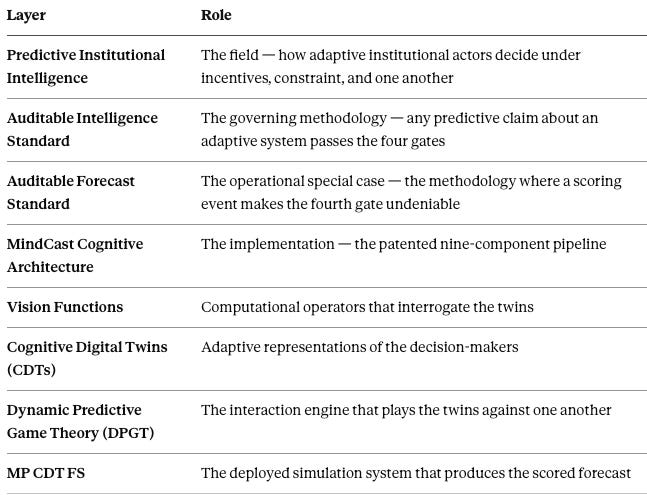
Why this belongs in a comparison paper. Every forecast in the sections below is an output of this engine, and the engine’s outputs are falsifiable by design: probability-weighted scenario distributions, trigger conditions tied to observable events, and falsification criteria fixed before observation, scored afterward to recalibrate the model. A high-level map of the architecture is a sales asset; the map is not the territory. The territory — the construction methods, the function library, the thresholds — opens under a retainer and license.
Part I. The Comparison Framework — The Auditable Forecast Standard
Forecasting has no shared standard for what a forecast owes a reader, and the absence is why a champion pick and a mechanism thesis get printed in the same table as if they were the same object. MindCast’s 2026 program proposes the missing standard, and the four gates run in the order a forecast passes them.
Gate 1 — Mechanism. State how the outcome is produced, not only who wins. A winner names a result; a mechanism names the causal system that generates it, and only a mechanism can be graded on the path rather than the endpoint.
Gate 2 — Falsifier. Define, before the event, what observation proves the reasoning wrong, independent of who wins. Naming a falsifier in advance is the line between data science and marketing, because a forecaster who names one cannot later claim he knew all along and cannot quietly move the number when the trigger fires.
Gate 3 — Commitment. Lock and timestamp the forecast, and log later information as scored shock evidence rather than as a quiet revision. A number that keeps moving preserves no earlier claim to grade.
Gate 4 — Public scoring. Grade the miss at the same scale as the win, and correct the method in the open. The Mechanism–Outcome Validation Doctrine — a right call arriving through a broken mechanism scores as a miss — lives inside this gate as the rule that stops directional wins from laundering mechanical error.
A venue that clears all four produces an auditable research object. A venue that clears none produces a quote. Measuring each competitor against the four gates requires five comparison properties, and every head-to-head in this paper resolves to them.
Object. Venues do not sell the same thing. Opta and MindCast publish a research probability. Kalshi and Polymarket publish a tradable price. Sportsbooks publish an odds line carrying a house margin. EA publishes a champion pick with no probability. Susquehanna publishes nothing and trades on a private number. Agreement across those objects looks like independent confirmation and is not.
Independence. Opta’s disclosed methodology ingests betting-market odds as an input; the exchanges arbitrage against the books; the books watch the exchanges. A market-informed model cited by the press as confirmation of the market has closed a loop, not opened a second window. MindCast excludes prediction-market prices from its engine by architectural rule, so its 54% and the market’s 58.5% disagree on evidence rather than share arithmetic. Confidence that the public quantitative numbers are substantially correlated rather than independent: 88–93%, driven by Opta’s own disclosure.
Falsifier. A pre-committed statement of what observation would prove the reasoning wrong, independent of who wins. Naming a falsifier before kickoff is the line between data science and marketing, because a forecaster who names one cannot later claim he knew all along and cannot quietly move the number when the trigger fires.
Auditability. A timestamped, locked forecast anyone can pull and score independently. Updating is not evasion — Opta re-simulating each round is legitimate practice — but a continuously updated number preserves no earlier commitment as a scored object, so nobody archives it and nobody grades it.
Stakes. What each venue risks on being wrong. Editorial risks nothing, EA risks a marketing line, Opta risks a citation, the exchanges risk capital they have already priced. MindCast risks the credibility of an engine sold into litigation, innovation economics, and geopolitical risk — the only venue in either field playing for whether the method transfers.
One ranking belongs above every table that follows, and candor requires stating it first: markets win on their objective, not MindCast's. Markets alone punish error with capital, which makes the closing line the only baseline whose defeat carries commercial meaning. Beating a video game proves category difference. Beating the close proves alpha.
Part II. Super Bowl LX — Full Venue Comparison
Final: Seattle Seahawks 29, New England Patriots 13. Seattle held New England scoreless for 47 minutes and 27 seconds, tied the Super Bowl team-sack record, and separated earlier and wider than any model specified.
II.A — The Four Venues Side by Side
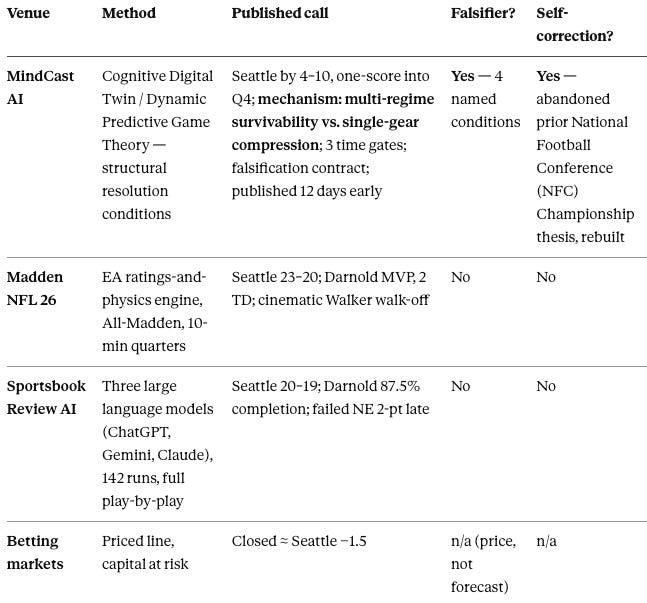
I.B — Line-by-Line, Scored Against Reality
MindCast — structurally right, not just directionally right. All three published gates cleared on schedule. No falsification condition fired for the entire game. New England produced zero points and zero red-zone appearances through 47:27 — the exact single-gear ceiling the CDT named, where compression proved a ceiling rather than a choice. The winning-branch terminal pattern (Seattle scores → NE scores under chase → Seattle re-imposes control → decision overload produces catastrophic error → garbage-time NE score → conversion fails) matched the published SEA-favorable branch step for step. The miss, scored and published: the band called Seattle by four to ten with a one-score fourth quarter; reality delivered sixteen points with separation arriving earlier and larger. Direction and mechanism held; magnitude and timing missed.
Madden — right winner, wrong mechanism. The engine identified pass-rush pressure as the defining variable, then assigned it to the wrong quarterback: Madden projected Darnold absorbing five sacks, while reality delivered Darnold sacked once and Maye sacked six times. Madden projected a New England defensive touchdown; the actual defensive touchdown went to Seattle on the Nwosu strip-sack return. Madden projected Walker at 76 rushing yards; Walker finished with 135. A variance model that needs drama to resolve produced a cinematic comeback, and Super Bowl LX offered no competitive tension after the first quarter.
Sportsbook Review AI — right shape, no structure. The ensemble sensed a low-scoring texture and eerily predicted a failed New England two-point conversion that actually occurred — genuine pattern recognition. The model then missed the two facts that decided the game: the completeness of New England’s collapse, and the possibility of one team imposing total structural control for three quarters. The ensemble’s cleanest statistical line, Darnold at 87.5% completion, met a reality of 50%, because the language models could not represent a quarterback completing half his passes as the correct strategic choice inside Walker-centric compression. Mean-reversion priors cannot represent an equilibrium-preservation game.
Betting markets — the baseline that matters, beaten. The close sat near Seattle −1.5. Seattle won by sixteen. MindCast’s pre-committed structural read pointed at a dominance the price had not found, which is the only comparison in this event carrying commercial meaning.
Super Bowl verdict: one model explained why Seattle won, when the outcome locked, and what would have disproved the thesis. The other two picked the winner — one for the wrong mechanism, one for no mechanism at all.
Part III. FIFA World Cup Final — Full Venue Comparison
Final: Spain 1–0 Argentina (after extra time, 106’). Ferran Torres, a substitute, finished a Nico Williams header. Argentina recorded zero shots across ninety minutes of regulation and played all of extra time a man down after Enzo Fernández’s 90+3 dismissal.
III.A — Eight Venues, One Match
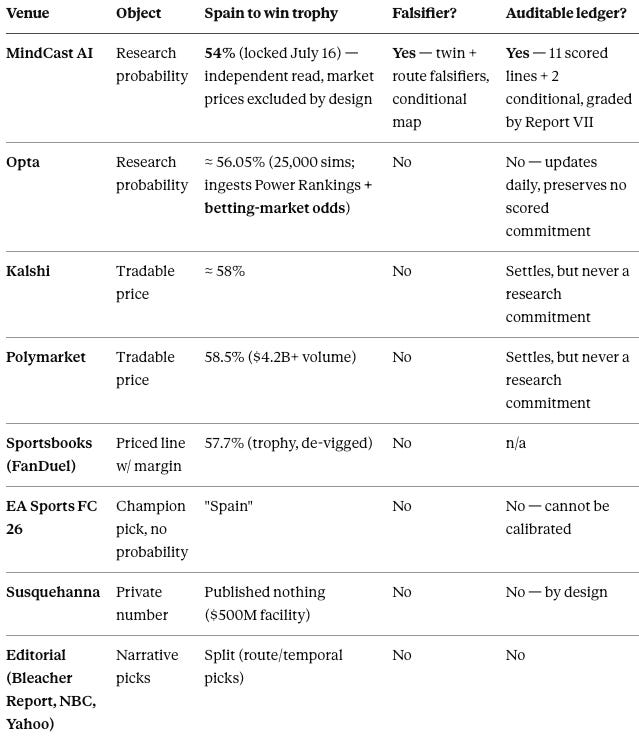
III.B — The Cluster Is Correlation, Not Confirmation
Five quantitative venues cluster within four and a half points, and the tightness is the tell rather than the reassurance. Opta ingests the books by disclosed design; MindCast excludes them by disclosed design; the exchanges arbitrage to a fraction of a point against those same books. Four numbers drawn from the same well are closer to one number with four bylines than to four independent reads. MindCast’s 54% is the only quantitative number in the field guaranteed not to share an input with the sportsbook line.
III.C — The Distinctive Call: MindCast Prices the Clock
Every venue answered who. Only MindCast priced the conditional inversion — the state in which the advantage changes sides. Backing the sportsbooks’ own two markets apart (FanDuel’s 90-minute line de-vigged to Spain 42.1%, its trophy line to 57.7%) implies the books price Spain near 49.4% once the match passes regulation — a coin flip nobody printed as a thesis. MindCast priced that same post-regulation state at Spain 45%, and Spain 39% after extra time — Argentina-favored late. The governing sentence: the consensus prices the match; MindCast prices the clock. Spain owns recurrence and wins the ordinary game; Argentina owns recovery and wins the game Spain fails to finish.
III.D — Scored Against Reality (Report VII, July 19)
Spain’s 1–0 win split MindCast’s two distinctive claims cleanly, and the honesty clause requires reporting both halves at the same size.
The mechanism call hit. Spain won through Recursive Pressure exactly as named: roughly two-thirds possession, Argentina held to zero regulation shots, and a substitute scoring off the replacement tree — Torres finishing Williams’s header — validating the renewable-mechanism logic that predicted a substitute could decide the match. Predicted winner, predicted cause, same result.
The distinctive late-state call missed. MindCast favored Argentina in the post-regulation and extra-time states, pricing Spain at 39% after extra time. The match did reach extra time, as a large share of runs projected — but Spain won it, not Argentina. Argentina’s recovery mechanism reached its precondition (compression, a scoreless regulation) and never reached its terminal phase (acceleration; zero regulation shots). MindCast over-weighted a recovery capability that was real historically but unavailable against Spanish suppression. Report VII grades that single, nameable miss at the same size as the hits.
Why the probability table is context, not a scorecard. MindCast is not a betting market, and it is not graded on betting-market units — margin of victory, point spread, or the probability gap between one favorite and another. Those are what a sportsbook exists to price; they are not MindCast’s product. MindCast’s unit is the mechanism — the causal engine that decides an event, named in advance and checked against what happened. On that unit the World Cup call is unambiguous: MindCast named Spain and named Recursive Pressure, and Spain won through exactly that mechanism. The championship probabilities are shown only for transparency:

Two to five hundredths separate them, and a single match cannot distinguish 54 from 58.5 — a validation report claiming victory on a 0.02 edge would earn the same criticism MindCast administered to itself after the semifinals. The center of the World Cup validation is causal alignment, not the winner probability, and MindCast’s own final report states this outright rather than banking on the champion everyone called.
III.E — Tournament-Level Comparators: Moody’s, the Economist, WSJ, and the EA Streak
Three further comparators forecast the tournament rather than the single final, and each fails a different gate in an instructive way.
Moody’s Analytics — the model that cannot represent its own author’s override. Moody’s ran a Poisson goal model across thousands of Monte Carlo simulations, scoring teams on Elo, recent form, squad quality, historical performance, and defensive stability, and ranked France the most probable champion. The tracker’s own author, Jesse Rogers, personally picked Argentina instead — citing the Western Hemisphere diaspora and effective home-field advantage that Elo-driven inputs cannot price. The gap between the model’s answer and its author’s answer is not a forecasting mistake; it is a behavioral-economics event the model has no layer capable of representing. MindCast builds that layer in — and France went out in the semifinal while Argentina reached the final, the direction the human override, not the statistical model, had named. Confidence the override read the tournament better than the model it overrode: 75–85%.
Wall Street Journal — narrative synthesis, no falsifier. WSJ named France the tournament’s most complete team after a 3–0 win over Sweden, citing thirteen goals in four games and Mbappé’s six. Elite narrative synthesis identifies visible dominance, star power, and momentum, and asks nothing about whether visible dominance survives adversarial constraint. France’s completeness did not survive Spanish suppression in the semifinal, and no WSJ falsifier existed to grade the reversal against.
EA Sports FC 26 — a champion streak that is 1-for-2 on everything checkable. EA simulated all 104 fixtures and named Spain, extending a run of correct champion calls since 2010. The streak has one hole nobody cites — the 2006 debut picked the Czech Republic, out in the group — and, more to the point, EA published no probability, so “Spain” can be checked and never calibrated. The same June simulation made two gradeable side-calls: it correctly called the United States out in the Round of 16, and it named Lamine Yamal the tournament’s top scorer, a call that failed with Yamal entering the final behind Messi and Mbappé. Confidence that call failed: 85–90%.
The distinction underneath the whole roster: betting AI versus foresight AI. Betting AI optimizes for lines, props, spreads, and expected value; foresight AI models Cognitive Digital Twins of players, coaches, and institutions under live stress. Market accuracy alone does not reveal causal mechanism — a price identifies consensus belief without explaining which behavioral system breaks, adapts, or stabilizes. Where crowd sentiment matters as a behavioral force, MindCast measures it from the crowd directly, never from the market’s aggregation of it, which is the architectural reason its number does not collapse into the correlated consensus.
The white paper maps the architecture; the retainer and a license opens it. The public face of the engine appears above — the nine-component pipeline, the three mechanisms, the three intellectual layers, the Auditable Forecast Standard, and the four resolved institutional forecasts. The proprietary internals that generate the numbers — CDT construction methodology, the full Vision Function library, and the calibration metrics and termination thresholds that govern them — are available under engagement across Complex Litigation, Legacy Innovation, Innovation Economics, and Geopolitical Risk Intelligence. Contact mcai@mindcast-ai.com.
To deep dive on MindCast works upload the URL of this publication into any LLM (preferably Google AI mode) and prompt ‘reconstruct MindCast framework with three degrees of cited sub links.’ See Live-Fire Game Theory Simulators, Runtime Predictive Infrastructure.
Part IV. The World Cup Tournament Run — The Cumulative Ledger No Comparator Kept
The final was one match inside a seven-round scored series, and the series is where the method separates from the field, because no comparator published a running validation ledger at all.
The pre-tournament prior graded honestly. The World Cup Championship Index (June 14) ranked Argentina the most likely champion and Spain fourth. Argentina reached the final exactly as projected; Spain arrived as the marginal favorite through an evidence-weighted update the model published rather than hid.
Confidence narrowed under better opposition — the signature of a model being graded. Spain’s advancement call fell every round and cleared every time it was graded: 70 (Round of 16) → 60 (quarterfinal) → 55 (semifinal) → 54 (final). Argentina’s fell alongside it: 67 → 60 → 54 → 46. Neither twin grew stronger on paper; the bands narrowed because the field improved, and MindCast published its shrinking confidence rather than defending a stale ranking. Confidence that never moves is the signature of a model that cannot be graded.
The public ledger caught its own weakest round and forced a rebuild. Validation Report VI graded the semifinal probability slate below a coin-flip baseline (a −0.434 Brier skill score) even as that same round’s mechanism reads graded two-for-two — the CDTs were right and the numbers hung on them were miscalibrated, a publication-discipline gap rather than a model failure. A venue without a public ledger never sees that gap; MindCast published it and rebuilt the rulebook around it: a 75% probability cap across every category, a split between scored event probability and unscored interpretive confidence, and structural claims published as reads rather than priced. Self-correction visible in the record is the feature, not the flaw.
The doctrine that prevents laundering. Report III established the Mechanism–Outcome Validation Doctrine: a correct directional call arriving through a broken mechanism counts as a miss, scored on a separate register. Belgium advancing past Senegal through a comeback that fired the forecast’s own mechanism-failure condition is the case that wrote the rule.
No comparator in either field has a Report VI. Opta re-simulates and never grades. EA cites a champion streak and scores nothing. The exchanges settle and move on.
Part V. Cross-Event Synthesis — The Five-Column Verdict
Reading Super Bowl LX and the World Cup together produces one finding that neither event produces alone: the two validations dissociate the winner from the mechanism in mirror-image registers. Super Bowl LX charged MindCast on magnitude with the mechanism intact. The World Cup Final charged it on competing-mechanism weight with the winner and the winning mechanism both correct. In both events the winner was the column every rival filled, and MindCast’s value and MindCast’s grading both lived in the register no comparator entered.
The master scorecard maps every venue against the four gates of the Auditable Forecast Standard, plus the market-independence property that determines whether a number is even its own:
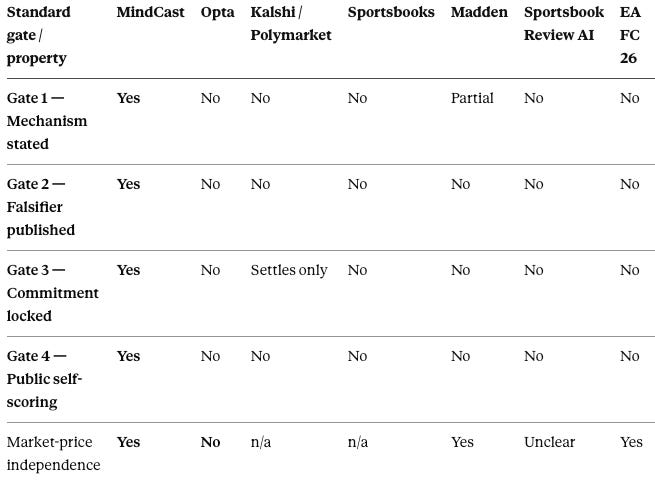
Read down the Gate 2 column: a single venue clears it, and every other forecaster in both events failed the falsifier gate before the ball was kicked. Gates 3 and 4 repeat the pattern. The scorecard is not close, and it is not close because no comparator was built to be graded — only MindCast was.
The distinguishing accomplishment is not a row of correct winners. Winners were cheap and universal. The accomplishment is a timestamped, falsifiable, self-graded ledger across seven World Cup rounds and one Super Bowl, in which the misses — the −0.434 semifinal, the Super Bowl magnitude, the final’s recovery weight — are published evidence for the instrument rather than against it. A framework that survives its own validation report by ignoring its weaknesses is not a framework.
Anyone can re-score the ledger. The slate is public, timestamped, and locked before kickoff; the scoring rule is named in advance; the lines are pullable and gradeable by any third party. Self-grading against a public locked ledger is doing the arithmetic first, in the open, where being wrong costs something — not a conflict, a commitment.
What MindCast is not. MindCast issues no contracts, takes no positions, and prices no events. MindCast borrows prediction-market discipline — timestamped, falsifiable, publicly scored forecasts — without entering the prediction-market business, and sits above the arc it maps rather than inside it.
Part VI. Sports Are the Stress Test — The Verticals Are the Business
Sports were never the product. Sports are the load test for an engine built for four institutional verticals, and the test exists for one reason: velocity. A knockout match scores its forecast in ninety minutes; a merger thesis waits three years and a docket waits five. Feedback that fast is the single property no institutional vertical can replicate, which is why the MP CDT FS is tuned on games before it is deployed where the cost of error is high and the scoreboard arrives late. The underlying problem never changes across domains: adaptive actors respond to incentives, constraints, uncertainty, and one another. A stadium simply resolves that problem faster than a courtroom.
MindCast’s cross-domain transfer is not a promise made for the first time here — the record already carries it. Four MP CDT FS forecasts across the four verticals have resolved, each dated before the event that settled it.
Complex Litigation. Parties enter with public arguments, private constraints, procedural clocks, forum-specific rules, judge-specific thresholds, and reputational stakes — a knockout structure more than conventional legal analytics admits. The engine asks when a narrative becomes structurally unrecoverable, when cross-forum contradiction destroys credibility, and when settlement behavior reflects constraint geometry rather than preference, with Signal Suppression Equilibria modeling the parties who strategically distort information. Resolved proof: the Kalshi remand — a federal court drew the exact federal-state allocation MindCast specified in advance, that authority over the trade does not displace authority over the activity.
Legacy Innovation. The question is not only whether an actor wins, but whether an identity, institution, or cultural system transmits across time under pressure. Teams carry national memory, civic narrative, and expectation burden into bounded events, and the same behavioral lens models cultural institutions, public trust, and symbolic capital where the outcome is transmission rather than victory.
Innovation Economics. Firms, investors, regulators, universities, incumbents, and infrastructure providers operate through feedback loops, platform incentives, capital timing, regulatory delay, and infrastructure bottlenecks. The engine asks how institutional talent fails when governance, capital timing, or a routing bottleneck breaks the pathway.
Resolved proofs: MindCast forecast the capacity and adoption bands of NVIDIA’s NVQLink quantum-AI interconnection, and the October 2025 launch confirmed the capacity bands (latency under 4 µs, 400 Gb/s) while exceeding the adoption forecast (9 national labs and 17 Quantum Processing Unit (QPU) builders, above the predicted ranges); and MindCast named the first hyperscaler, the venue (the Electric Reliability Council of Texas (ERCOT) region, outside Federal Energy Regulatory Commission (FERC) jurisdiction), and the bridge fuel (gas) in the Chevron–Microsoft Project Kilby deal in January 2026, which the June 2026 announcement cleared two quarters early.
Geopolitical Risk Intelligence. State actors alter payoff structures while operating inside them — export controls, sovereign compute policy, customs discretion, sanctions, alliance signaling — precisely the rule-mutation the architecture is built to track. Resolved proof: MindCast forecast that frontier-AI value would migrate from capability to authorization, and the June 2026 Commerce trusted-partner allowlist confirmed the access-over-capability thesis on the sequence itself.
Sports validate the architecture. Institutional reality is the application — and the four resolved forecasts are the receipts that the stress test transfers.
Part VII. The 2026 Record — Five Enduring Results
Widen the lens past the two scoreboards, and 2026 resolves into five results that outlast either game. The Auditable Forecast Standard proved the gates on events that end in ninety minutes; the Auditable Intelligence Standard is what those same gates become once they govern any predictive claim about an adaptive system. Sports earned the general standard by proving the special case, and the record breaks down as follows.
Predictive Institutional Intelligence became a named discipline — the study of how adaptive institutional actors decide under incentives, constraint, and one another, distinct from statistical forecasting because the unit of analysis is the decision system rather than the historical rate.
The Auditable Forecast Standard became its validation methodology — four gates a claim must pass (mechanism, falsifier, commitment, public score) that convert an internal method into a public bar competitors can be measured against.
The MP CDT FS architecture demonstrated in public across sports and institutional domains — the same nine-component pipeline that graded Spain–Argentina resolved NVQLink, Project Kilby, the Commerce-Anthropic allowlist, and the Kalshi remand.
The mechanism proved the durable claim. Super Bowl LX confirmed the winning mechanism — single-gear compression — with the margin running above the predicted band, and margin is not a unit the method grades. The World Cup final confirmed the winning mechanism — Recursive Pressure — while the one on-axis refinement, the weight given Argentina's competing mechanism, was over-set and logged. Two events, two mechanisms named correctly; the mechanism read is the claim that survives, and the reason the method is worth exporting to domains where no clean probability ever resolves.
Public self-correction strengthened credibility rather than eroding it. In the semifinal, the mechanism reads held while the probabilities hung on them ran over-confident; MindCast published that gap itself and rebuilt the rulebook around it — a probability cap, a split between scored event probability and interpretive confidence, and structural claims published as reads rather than priced. A method that logs and repairs its own weakest round in the open is the only kind a reader can trust on the strong ones.
The discipline, the property, and the venue stack in one order, so three labels stop competing for a single slot. The discipline is predictive institutional intelligence. Auditability is the property 2026 proved. Sports were the venue where the property was demonstrated. Read top to bottom — discipline, proven property, venue — no phrase fights another for the headline, and “auditable” describes what the intelligence is rather than serving as a rival brand.
History will not remember 2026 as the World Cup year if the architecture keeps validating. Should the same engine continue to clear its gates across litigation, innovation, and geopolitics, 2026 becomes the year MindCast established a scientific methodology for publicly validating predictive intelligence — and the sports simulations become the inaugural validation program rather than the principal achievement. The claim stays conditional on purpose: four institutional forecasts have resolved, which is a down payment on that history, not the whole of it.
The one line the Standard reduces to: in 2026, MindCast used sports to prove that prediction becomes intelligence only when it explains the mechanism, defines the falsifier, preserves the commitment, and learns publicly from the result.
Appendix A — Result Ledger

Appendix B —
MindCast Publications — The Auditable Record
Every claim in this paper traces to a timestamped, public source:
Super Bowl LX — AI Simulation vs. Reality — the pre-committed Super Bowl call (mechanism, gates, falsifier), scored against Seattle 29–13 (Part II).
FIFA World Cup Final Foresight Simulation — Spain vs Argentina — Spain Owns Recurrence, Argentina Owns Recovery — the locked 54% final and the Recursive Pressure mechanism, published before kickoff.
FIFA World Cup Final Validation — Report VII — the final graded in the open: the mechanism call scored a hit, the late-state probability a miss, each reported at the same size (Part III).
World Cup Final Prediction Methodology Matrix — Dynamic Predictive Game Theory + Behavioral Economics vs. Opta, Kalshi, Polymarket, EA Sports FC 26 — the eight-venue comparison and Brier scores behind the Part III scorecard.
MindCast Predictive Game Theory + Behavioral Economics Cognitive Digital Twin Foresight Simulations in the World Cup and Super Bowl — why sports are the fast, public falsification loop for markets, courts, and firms (Part VI).
World Cup Championship Index 2026 — the pre-tournament prior (Argentina first, Spain fourth), graded honestly as the field improved (Part IV).
MCAI Economics Vision: The Full Arc of Prediction Markets — the Kalshi regulatory series and the federal–state remand thesis that resolved (Appendix C).
MindCast’s Provisional Patent Application on Multi-Agent Institutional Simulation Architecture — the nine-component architecture and its April 18, 2026 priority date (Part 0).
World Cup Foresight Simulation Validation Reports I–VII — the round-by-round scored ledger, published alongside the World Cup pieces.
MindCast Institutional Forecasts — The Transfer Receipts
The resolved forecasts that prove the architecture works beyond sports, each dated before the event that settled it (Part VI, Appendix C):
How the Chevron–Microsoft Project Kilby Agreement Validated MindCast’s Firm-Power Forecast — Microsoft, the ERCOT region (outside FERC jurisdiction), and gas as the bridge fuel, named before the June 2026 announcement that cleared two quarters early (Innovation Economics).
Kalshi Loses Federal Forum — The Washington Remand Order — the federal–state allocation a federal court’s remand operationalized: authority over the trade does not displace authority over the activity (Complex Litigation).
If the Protect College Sports Act Passes, Private Equity in College Sports Wins Differently — the firm-formation structure confirmed by Utah’s June 2026 Crimson Brand Partners close: Otro minority stake, commercial rights partitioned (Legacy Innovation).
MindCast AI’s NVIDIA NVQLink Validation — the interconnection capacity bands confirmed (latency under 4 µs, 400 Gb/s) and the adoption forecast exceeded (9 national labs, 17 QPU builders) at the October 2025 launch (Innovation Economics).
The NSA–Anthropic Mythos Shock Led to the Commerce Allowlist MindCast Predicted — the authorization-over-capability thesis: the stronger model restored first, to vetted institutions like Anthropic, on a revocable government roster — confirmed by the June 2026 allowlist (Geopolitical Risk).
Field Sources
Opta / The Analyst — 25,000-simulation model with disclosed methodology (Part III).
Polymarket and Kalshi — World Cup winner exchange prices.
FanDuel and CBS Sports — sportsbook odds and closing lines.
EA Sports FC 26 — The World’s Game champion simulation.
Congressional Research Service — Kalshi volume-concentration data.
Madden NFL 26 (via CBS Sports) — physics-engine Super Bowl projection.
Sportsbook Review AI — three-large-language-model Super Bowl prediction.
Betting-market closing lines — the capital-at-risk baseline the paper ranks above all others.
Appendix C — Institutional Validation Exhibits
Part VI names four resolved forecasts in passing; the exhibits below give each one its record, so a reader can check the transfer claim rather than take it on faith. Every entry carries a dated forecast, the specific prediction, and the event that confirmed it — the same mechanism-first, pre-committed discipline the sports sections grade, applied where the payoff is commercial and the clock runs in quarters rather than minutes.
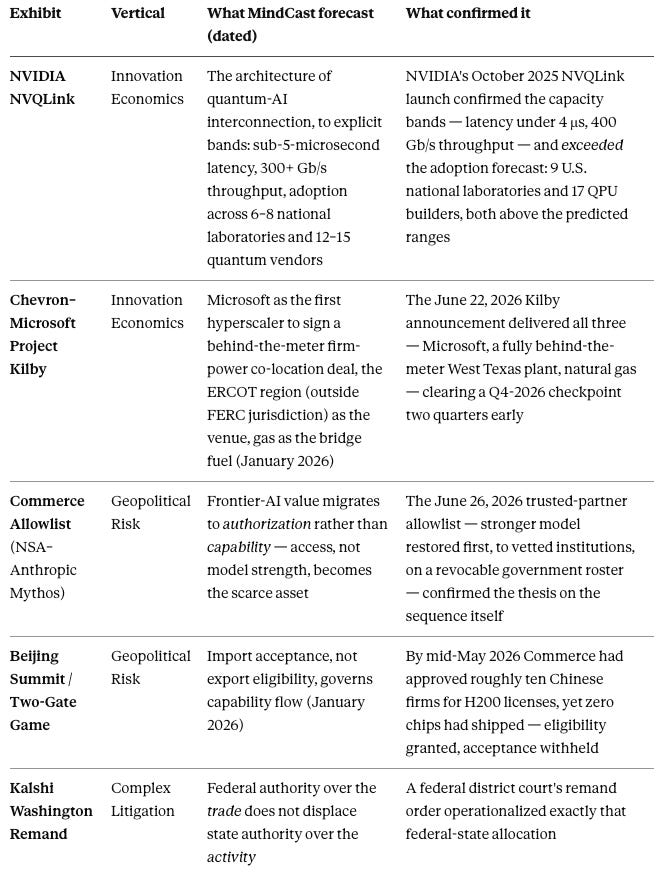

Six exhibits across all four verticals share one property with every graded forecast in this paper: MindCast named the mechanism and the observable outcome before the event, then let the record settle the call. The sports laboratory supplied the velocity to prove the method; these exhibits show the same method already paying out where MindCast sells it.
Every confidence band in this white paper is analyst judgment, not a computed statistic, and none enters any Brier aggregate. Market and sportsbook figures are snapshots and move continuously. Percentages derived from sportsbook odds are normalized estimates after removing the bookmaker margin. “No falsifier” means none was identified in a venue’s cited published methodology; it does not claim the venue lacks private testing.