
Visual Companion. Related works:
If the Protect College Sports Act Passes, Private Equity in College Sports Wins Differently (July 1, 2026) — Utah's Crimson Brand Partners close validates the firm-formation thesis and shows why private capital migrates into compliant college-athletics operating companies whether or not the Protect College Sports Act passes.
The Protect College Sports Act of 2026 (S. 4668) Becomes a Compliance-Infrastructure Bill (June 30, 2026) — Shows how the reported Senate text hardened S. 4668 into a compliance-infrastructure bill, where clean documentation replaces the paycheck as the competitive edge and advantage keeps moving to the capital layer beneath it.
The Protect College Sports Act of 2026 — Federal NIL Salary Cap, Antitrust Immunity, and the Private Equity Blind Spot (June 2026) — Argues that the bill’s federal NIL salary cap and antitrust immunity discipline coordination among schools while leaving the private-equity capital-formation channel — the blind spot — untouched.
Private Equity, NIL, Antitrust, and the Firm-Formation Phase of College Athletics(January 2026) — Names the firm-formation phase of college athletics, forecasting advantage’s migration from coordination to capital, identifying Utah as the prototype, and projecting ten or more athletics operating companies within twenty-four months.
Executive Summary
The Protect College Sports Act of 2026 (S. 4668) would build a federal compliance architecture for college athletics: a national cap on athlete revenue-sharing, mandatory name, image, and likeness (NIL) disclosure, eligibility and transfer rules, agent oversight, collective media-rights pooling, an anti-merger bar on the largest conferences, and an antitrust shield for institutions that enforce the regime. The Senate Commerce Committee advanced the bill by a 19–9 vote on June 18 under the Cruz-Cantwell-Schmitt substitute, as modified, sending it to the full Senate. Reported status makes the bill eligible for floor consideration but guarantees nothing: passage still demands sixty votes in a chamber holding fifty-three Republicans, and leadership has not yet secured floor time before the August recess.
The bill presses hard on one layer of college sports and leaves another open. The coordination layer — the caps, pooling, merger limits, disclosure, and enforcement that Congress can legislate — absorbs the entire fight. Durable competitive advantage, though, is migrating to the layer the bill does not directly regulate: the compliance and capital infrastructure beneath the rules. A program’s edge no longer turns on the size of the check it can write, but on how fast and how defensibly it can move a deal from signal to compliant record, and on whether it can fund the operating machinery — facilities, data systems, private-capital vehicles — that sits outside the cap. A June 19 MindCast AI analysis of the same bill first drew that split; the reported text sharpens it rather than closing it.
One forecast already reads as fact. Compliance has crossed from back-office overhead into competitive infrastructure: the reported text codifies the obligation as statutory machinery, and the College Sports Commission’s live clearinghouse data shows manual review already buckling under the deal volume the rules will only increase.
Three findings carry the update:
The bill’s antitrust shield depends on compliance execution, not coordination alone, which moves the competitive frontier from payment capacity to auditable operating capacity. A program that cannot document, value, and defend its deals cannot rely on the protection the statute offers.
The system is stabilizing around control rather than market equilibrium: the floor fight, the support coalition, and a presidential deadline all press the coordination layer, while no comparable force reaches the capital-formation channel.
The capital channel went operational. The first named athletics operating company backed by outside private capital — the University of Utah’s venture with Otro Capital, now Crimson Brand Partners — is scheduled to begin operations July 1, turning a structural forecast into a tracked count.
(Confidence bands for every claim and prediction below are consolidated in the Prediction Ledger (Section IX) and the Foresight Simulation (Section X).)
I. From Committee to Calendar
Movement is not enactment, and the distinction governs everything that follows. GovTrack records the bill as ordered reported following the June 18 markup, which makes it eligible for floor consideration. Floor time is leadership’s to grant, and passage still demands sixty votes in a chamber holding fifty-three Republicans before the August recess. Prior House efforts have failed to become law, and House passage remains a separate gate.
Reported posture earns the bill a precise reading, because the operating mechanisms are now fixed enough to analyze. The original paper argued the analysis holds under every enactment outcome — clean passage, attachment to a vehicle, or stall — and reported posture strengthens rather than disturbs that framing. Whichever way the floor breaks, the operating logic the bill encodes is now legible.
II. The Name, Image, and Likeness Economy Becomes a Data Pipeline
The most consequential post-publication shift is operational, not rhetorical. The bill’s disclosure architecture requires Division I student-athletes to report NIL agreements above $600 to their institution within five days of entering into the agreement, with a separate thirty-day trigger for later compensation the initial disclosure misses (Section 101(b)). Section 104 then requires institutions to report anonymized agreement data, including service descriptions and compensation amounts, and tasks athletic associations with maintaining public searchable databases that athletes and agents use to estimate fair-market value.
NIL therefore stops being only a compensation right and becomes a reporting obligation with a database behind it. Every deal above a low dollar floor generates a disclosure, a valuation reference point, and a retention requirement. The compensation question — how much an athlete earns — sits downstream of a data question: whether the deal was captured, valued, documented, and defensible.
III. Compliance Becomes the Competitive Frontier
The bill’s antitrust structure rests on compliance execution, and the dependency is the heart of the update. Section 114prohibits NIL arrangements built to evade the revenue-share cap or disguise pay-for-play, importing the clearinghouse standard that a deal carry a valid business purpose and compensation commensurate with similarly situated non-athletes. Section 118 supplies targeted antitrust protection to institutions, conferences, and associations engaged in covered compliance and enforcement activity.
The statutory shield protects covered compliance and enforcement activity, not every institutional action adjacent to athlete compensation. The practical value of the shield therefore depends on whether the institution can show that the disputed conduct stayed inside the protected channel. The competitive frontier moves accordingly: a compensation cap can limit the headline payment, but a cap cannot limit the operating machinery around the payment — intake, disclosure timing, fair-market-value support, agent verification, associated-entity review, data retention, dispute-ready records. Advantage migrates from who can pay to who can prove, and proving is an infrastructure problem — the compliance-as-moat dynamic MindCast AI modeled in its January 2026 firm-formation analysis, where capitalized programs convert documentation capacity into both lower enforcement risk and recruiting advantage.
Live operating data already shows advantage migrating from payment to proof. The College Sports Commission’s clearinghouse cleared roughly $242 million in third-party deals against roughly $56 million not cleared through April 30, while the share of submissions resolved within twenty-four hours fell toward 45 percent as review volume climbed. The decline tracks one cause: deals tied to school-affiliated entities — collectives, multimedia rightsholders, apparel partners — came to dominate submissions, reaching the high-seventies percent during the winter transfer window, against a system architected on the assumption that such deals would constitute roughly a tenth of volume. Commission leadership has described the market plainly, as schools manufacturing arrangements for athletes rather than a clearinghouse policing an organic endorsement economy.
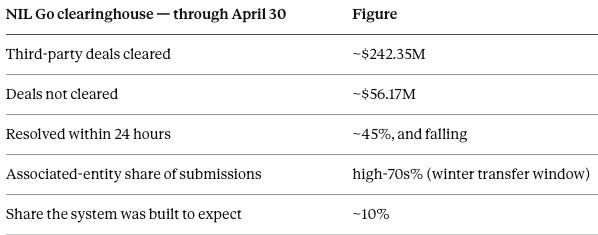
Source: College Sports Commission deal-flow reporting, via NILNewsstand and Front Office Sports.
Section 114 turned into the live battleground, and the fight maps onto the paper’s old-versus-new split. The provision pulls associated-entity deals toward the revenue-share cap even where those deals would clear the fair-market-value standard, and the contest drew a House-settlement plaintiff attorney warning that the move guts a settlement pillar, alongside a letter from nineteen athletes across fourteen conferences opposing the earnings compression. Read against the original framing, the intensity confirms the thesis rather than complicating it. Congress and the industry are litigating the disguised-pay margin — the coordination-adjacent channel where boosters and affiliated brands route cash — with everything they have, while the balance-sheet-capacity margin of athletics-LLC capital formation draws no comparable fight. The bill reaches hard for one circumvention vector and stays silent on the other, the precise asymmetry Claim 3 of the June 19 paper identified.
The College Sports Commission’s authority runs through a participation agreement that schools and several state attorneys general have resisted, with conferences still renegotiating terms and some revisions reportedly weakening it. Unsettled enforcement raises the premium on institution-controlled documentation either way: stronger central enforcement rewards clean submission, and weaker central enforcement pushes schools onto their own audit posture as the first line of defense.
The frontier of competition has moved from the size of the check to the integrity of the record behind it.
Contact mcai@mindcast-ai.com to partner with us on Predictive Game Theory AI in Law and Behavioral Economics. To deep dive on MindCast works upload the URL of this publication into any LLM (preferably Google AI mode/Gemini, Claude, ChatGPT) and prompt ‘reconstruct MindCast framework with three degrees of cited sub links.’ See Live-Fire Game Theory Simulators, Runtime Predictive Infrastructure.
MindCast AI is a cybernetic, predictive game-theory AI firm specializing in law and behavioral economics, applied to complex litigation, innovation systems, and geopolitical risk intelligence. Rather than extrapolating historical patterns, the firm models the mechanisms that generate institutional behavior, running Cognitive Digital Twin simulations grounded in Nash equilibrium, Stigler information economics, and the Chicago School of law and behavioral economics.
IV. Support, Opposition, and the Executive Deadline
Four elements now define the bill’s trajectory — the amended provisions, the coalition behind them, the conferences against them, and a presidential deadline over all of it — and each works the coordination layer.
The amendments deepened the bill’s trade of market competition for regulatory stability, exactly the bargain the original paper named. A dedicated women’s-and-Olympic-sports provision bars any covered Division I program above $80 million in annual athletics revenue — 74 universities, including Notre Dame and the schools of the ACC, Big Ten, Big 12, and SEC, by Senate Commerce Democrats’ count — from cutting protected teams, roster slots, or grant-in-aid below 2024-25 levels for nine years, subject to waiver. Olympic-sport preservation becomes a fiscal obligation on the highest-revenue departments, and the U.S. Olympic and Paralympic Committee endorsed the bill on that footing, joined by the Team USA Athletes’ Commission and the National Governing Body Council.
Media-rights pooling and the anti-merger bar extend the coordination logic to broadcast revenue and league structure. The bill amends the Sports Broadcasting Act to permit collective media-rights arrangements, granting the antitrust exemption only where at least 75 percent of FBS institutions agree to form the covered entity.
The anti-merger provision then bars a covered conference reporting more than $700 million in revenue — a threshold the markup lowered from $1 billion, sweeping in the ACC and likely the Big 12 alongside the Big Ten and SEC — from acquiring another conference if the result would leave it holding less than 75 percent of FBS institutions, and it strips efficiency and procompetitive defenses from prohibited transactions. The lowered threshold largely freezes the current conference map.
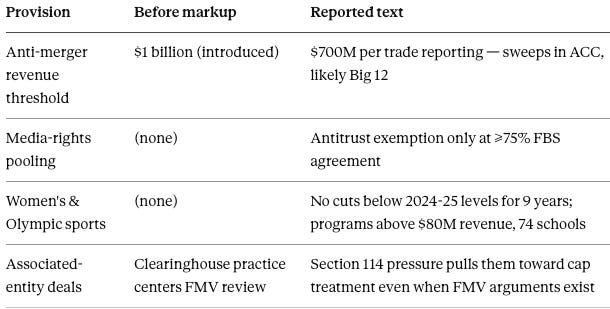
Sources: reported Senate text (GovInfo) for section numbers, the 75 percent pooling gate, and the $80M Olympic floor; On3, Texas Tribune, SwimSwam, and Yahoo Sports for the markup narrative and the reported $700M anti-merger figure.
Support and opposition both hardened around the reported text. Senate Commerce Democrats report support from 24 conferences and 267 colleges and universities across 49 states and Washington, D.C., alongside the USOPC, professional leagues, and coaching associations — a coalition weighted toward the Group of Five, FCS, and mid-major programs that gain from coordination and media-rights redistribution.
Opposition stayed concentrated where media leverage and legal exposure are greatest: the SEC and Big Ten continue to withhold support, arguing the bill leaves critical issues unresolved, and the Boards of Regents of Texas and Texas A&M — two SEC members — sent joint letters of opposition on June 26. A third faction sits apart: athlete advocates and the nineteen-athlete bloc oppose the cap and the Section 114 compression, seeking the employee status and bargaining leverage the bill withholds.
The welfare framing is itself a control signal, not background noise. Runtime Narrative Control Cybernetics (March 2026) treats institutional language as an operational input: a restriction translated into consumer-facing virtue — choice, protection, fairness — so the constraint reads as empowerment, with the account calibrated by forum. The bill’s heavy emphasis on saving Olympic pipelines and protecting athlete welfare performs that function, presenting a wage cap and an antitrust immunity as athlete protection while the underlying contest is a capital struggle between the Power Two (SEC and Big Ten) and the rest of the FBS. Naming the signal does not deny the genuine Olympic-sport stakes; it locates them inside the control layer where the redistribution fight is actually waged.

A presidential deadline now sits over the whole board. Trump’s April executive order, effective August 1, directs agencies that contract with or provide grants to covered institutions to evaluate certain violations of governing-body rules when assessing institutional responsibility, and directs OMB and GSA to reinforce suspension-and-debarment policy for those violations. The President urged Congress to send him a bill to sign this summer. Commentators read the order’s main purpose as pressure on Congress, because an executive order cannot grant the antitrust exemption that only a statute supplies; a Big Ten executive dismissed it as paper without a law behind it.
Support, opposition, and the deadline pull in different directions, yet every one of them bids on coordination; none reaches the capital channel beneath.
V. The Cybernetic Frame and the Floor Game
The bill’s central move is easier to understand as cybernetics than as equilibrium economics. A fixed, uniform national revenue-share cap — roughly $20.5 million per school in its first year — is unstable under live antitrust and labor conditions, yet Congress, the NCAA, and the coalition press it anyway. Cybernetic Game Theory — Control, Not Choice(March 2026) supplies the reason: institutions under stress stabilize around control rather than accuracy, locking onto rigid regulatory answers that the feedback architecture rewards even when they conflict with economic reality. S. 4668 is that pattern rendered in statute — a top-down attempt to steer a volatile ecosystem by dictation rather than to let market choice resolve it.
Four mechanisms from Cybernetic Game Theory organize the entire fight:
Delay dominance — time as the weapon. Every month Congress fights over the cap, firm-formation proceeds unpoliced, so capitalized programs and their capital partners gain from delay without needing the bill resolved; the Power Two’s wager that the order is paper until a statute exists is itself a delay play.
Narrative control — belief as payoff. The Olympic-and-welfare framing examined in Section IV is the operative instance, presenting a wage cap as athlete protection.
Feedback capture — prediction into lock-in. The disclosure database and the clearinghouse set the fair-market-value reference points the market must price against, and the programs that feed the loop cleanly capture its benefit.
Constraint geometry — density as predetermination. The stacked cap, anti-merger bar, 75 percent pooling threshold, disclosure regime, and Section 114 sweep route competition toward the one margin none of them prices: capital.
Dynamic Game Theory — Competing Inside a System That Rewrites Itself (April 2026) explains the opposition’s behavior: when constraints mutate, the sophisticated actor stops optimizing within the rules and moves upstream to shape or escape them, competing over the rules rather than inside them. The Texas and Texas A&M revolt reads cleanly in that light: two apex programs treating S. 4668 as a structural attempt by mid-tier institutions to rewrite the rules mid-game and force revenue pooling, and refusing to optimize inside a game being rewritten against them. Their rational response is resilience rather than compliance — protecting balance sheets and building their own infrastructure ahead of a system that keeps redrawing its boundaries.
The floor itself is a finite-horizon bargaining game. The deadline functions as a soft commitment device: a war of attrition has no natural endpoint, and the executive order manufactures a focal date — August 1, reinforced by the recess — that raises the cost of inaction without a hard, self-enforcing penalty, because the order cannot grant the exemption a statute must supply and its enforcement track invites the legal challenge the opposition is betting will blunt it.
The opposition defends an endowment whose escape the bill forecloses. The SEC and Big Ten are the concentrated losers of a redistribution that moves their disproportionate media share toward the 267-school majority, and the sharper move against them is structural: the anti-merger bar removes their outside option. A breakaway super-league is the Power Two’s threat point in any negotiation, and Section 205 forecloses it — the oldest move in bargaining, stripping a counterparty’s best alternative to force acceptance — which is why their energy concentrates there and on pooling, not on the cap.
A diffuse majority normally loses to a concentrated minority, because each of 267 schools carries a weak individual incentive to spend on the fight while each Power Two member carries a concentrated one. The sponsors invert the usual outcome by aggregating the majority into a single bloc and borrowing the President’s focal point as a coordinating signal, and the cap behaves as a price control — diverting the spending it blocks from direct pay toward the uncapped margin of capital-funded infrastructure, exactly as the migration thesis predicts.
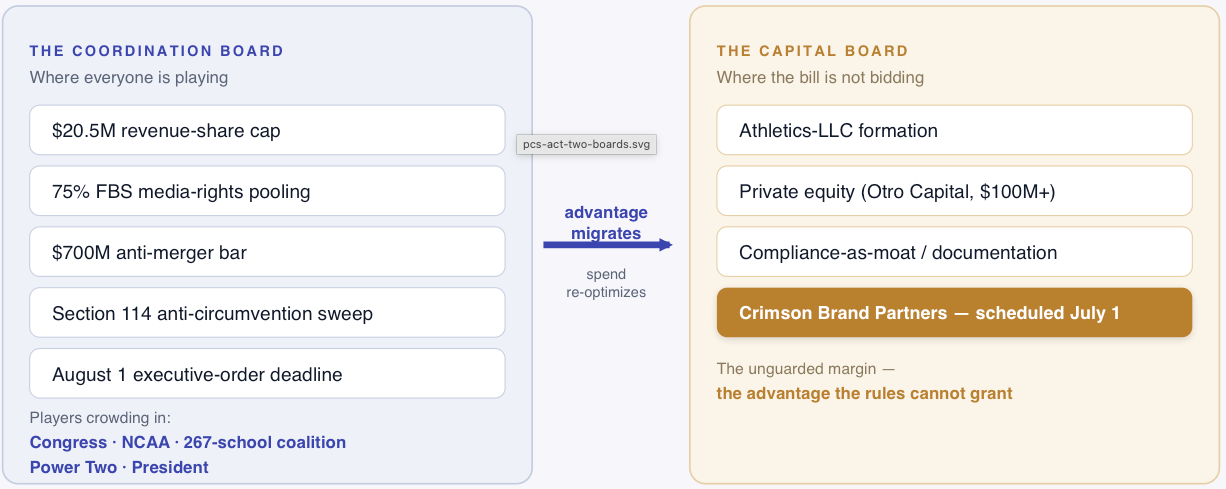
Every instrument in the game presses the coordination layer. The deadline presses it, the merger bar forecloses a coordination-level escape, the cap disciplines coordinated pay, the pooling redistributes coordinated revenue, and the Section 114 sweep polices coordinated circumvention. No player in the legislative fight is making athletics-LLC capital formation the object of reform, because the floor game’s immediate payoffs sit on coordination, not firm formation. A system stabilizing around control will keep forcing the coordination answer, and the more successfully it does, the faster the cap re-optimization pushes spending toward the capital margin the answer never reaches. Coordination is the board everyone is playing on; capital is the board the winners walk to next.
VI. The Capital Channel Went Operational
A prototype became a company while the floor fight heated up. The University of Utah finalized its private-equity partnership, renamed the entity Crimson Brand Partners, secured a minority commitment reported at no less than $100 million from Otro Capital, and scheduled operations to begin July 1 — roughly fifteen athletics staff folded in at launch, scaling toward seventy. MindCast AI’s January 2026 analysis, Private Equity, NIL, Antitrust, and the Firm-Formation Phase of College Athletics, named the Utah transaction the prototype of the capital-formation channel and projected ten or more athletics-LLC formations within twenty-four months.
Conference-level capital stays stuck by contrast. The Big 12’s arrangement with RedBird and Weatherford stays lightly used and the Big Ten’s larger conference-level proposal stays stalled, capital migrating to the institution level where the collective-action problem does not bind — the safe, defecting equilibrium the original analysis predicted.
S. 4668 can still affect institution-level operating companies indirectly, by reshaping the compensation, media, and compliance environment around them; the claim here is narrower — the bill does not directly regulate the formation, capitalization, or governance of institution-level athletics operating companies as a central object of reform.
The capital-formation channel is no longer hypothetical — its first named operating vehicle is scheduled to begin operations July 1, and the twenty-four-month diffusion count has begun.
VII. The Employment Variable Stayed Quarantined
Employee status — the variable that governs whether the entire compensation architecture is lawful — sat still. The bill’s neutrality clause leaves employee status unresolved, while administrative paralysis keeps near-term resolution unlikely — the National Labor Relations Board has lacked a quorum since early 2025 and cannot issue decisions. The behavioral tension persists underneath: athletes denied a bargaining seat route toward classification litigation to win one, the unstable equilibrium the original paper flagged.
Inaction at the Board does not settle the question; it only defers it to the litigation the statute leaves open.
VIII. Operational Takeaways for Institutions
The analysis carries direct implications for the institutions inside the system, stated as foresight reads rather than advice.
Treat compliance as infrastructure, not headcount. The $600 disclosure floor and the fair-market-value standard convert deal volume into an audit problem, and the clearinghouse data already shows manual review buckling under associated-entity surges. Documentation capacity now protects the practical value of the antitrust shield; staffing alone does not.
Price the capital margin before peers lock it in. If the cap binds, direct-pay competition compresses and advantage moves to the uncapped margin — stability, facilities, compliance systems, and capital vehicles. Budget and donor strategy that anticipates the shift captures first-mover ground; strategy that waits inherits a tilted field.
Inventory associated-entity exposure now. Collective, multimedia-rights, and apparel arrangements carry the heaviest review burden and the highest reclassification risk under Section 114. Mapping that exposure ahead of a floor vote is cheaper than unwinding it after.
Read the outside-option foreclosure. Programs and conferences relying on consolidation or breakaway leverage should price in the anti-merger bar, which removes that path for the highest-revenue leagues and rewards firm-level resilience over conference-level coordination.
The common thread is preparation over reaction: the institutions that build capacity before the rules settle inherit the advantage the rules cannot grant.
IX. Prediction Ledger
The predictions run the same direction they ran on June 19, with adjustments and no reversals.
Structural predictions (June 19 paper), updated:
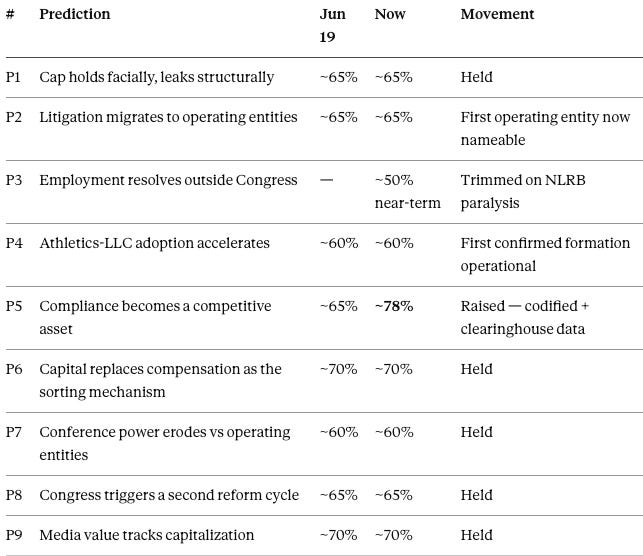
No structural prediction reversed, and Prediction 5 strengthened on new evidence. The floor-process and dynamic calls for this update are formalized below, with explicit falsification signals, as predictions P10 through P25 in the foresight simulation that follows.
X. Foresight Simulation
The MindCast AI foresight simulation stress-tests institutional actors, incentives, legal constraints, market channels, and narrative signals against observable falsification points, and it claims no mechanical certainty. For this update, the simulation ran the same facts through six analytical lenses, each a MindCast AI Vision Function: a Lex Vision lens on statutory trajectory and litigation migration; a Cybernetic Game Theory lens on control-loop stabilization; a Dynamic Game Theory lens on rule mutation and apex defection; a Runtime Narrative Control lens on coalition language and legitimacy signals; a Compliance Infrastructure Vision lens on NIL workflow burden and audit capacity; and a Capital Formation Vision lens on athletics-LLC diffusion and underwriting behavior.
The six lenses converged on one result: S. 4668 does not end the NIL arms race — it reroutes the arms race from payment capacity into control-loop capacity. The next competitive advantage sits in disclosure speed, fair-market-value proof, agent verification, associated-entity mapping, anonymized reporting, litigation-ready records, and capital-backed operating infrastructure.
Simulation result. The six-lens run produced five high-confidence outputs.
First, the floor fight concentrates on Section 114, Section 205, media-rights pooling, preemption, and dispute-resolution language rather than the cap alone; the cap supplies the symbolic center, but the strategic center sits where the bill restricts disguised-pay channels and forecloses Power Two outside options.
Second, the system keeps forcing a federal coordination answer even if the bill stalls, because Congress, the NCAA, the College Sports Commission, the Olympic-sport coalition, and mid-major institutions all need variance reduction, and open-market NIL volatility has exceeded the governance system’s tolerance.
Third, elite programs protect optionality before they accept loop closure; Texas, Texas A&M, the SEC, and the Big Ten resist a federal architecture that converts their media leverage, donor density, and capital asymmetry into a shared national constraint.
Fourth, compliance infrastructure gains value under every legislative branch — passage raises the value of statutory reporting and protected-channel documentation, while stall raises the value of institution-controlled audit posture because enforcement stays fragmented across the House settlement, NIL Go, the Commission, conferences, private disputes, and state-law pressure.
Fifth, capital formation moves faster at the institution level than at the conference level, because conference structures face collective-action drag and Power Two bargaining resistance while institution-level entities let individual programs defect safely into operating-company logic.
Readers who want only the forecast can skip to the consolidated P10–P25 table below.
Lex Vision: statutory trajectory and litigation migration
Lex Vision identifies a dual-track legal path: the bill can advance procedurally while remaining legally unstable. Senate movement does not remove the post-enactment fight; it relocates the fight from facial antitrust exposure into statutory implementation, protected-channel disputes, associated-entity classification, private-right-of-action claims, and employment-status litigation. The legal system no longer debates whether college sports needs rules; the debate now runs on which institution owns rule-making authority, which channels receive immunity, and which compensation structures sit outside the protected frame.
The antitrust shield does not eliminate legal conflict; it narrows the battlefield and raises the value of evidence. Lex Vision therefore reinforces the compliance-infrastructure thesis: the shield’s practical value depends on provable channel integrity, and institutions that cannot show intake, review, classification, fair-market-value analysis, agent verification, and record preservation face higher dispute costs even where statutory immunity exists.
Cybernetic Game Theory: control-loop stabilization
Cybernetic Game Theory classifies S. 4668 as a control architecture. The bill reduces variance across compensation, transfers, NIL reporting, media rights, conference structure, and association enforcement; the bill does not optimize toward pure market efficiency, but prioritizes survivable order. The system faces too many simultaneous destabilizers — NIL fragmentation, state-law divergence, booster opacity, transfer volatility, settlement enforcement, Olympic-sport funding risk, and realignment pressure — and a pure market answer would intensify variance, so the bill forces loop closure through national rules even where the rules create distortions.
Cybernetic Game Theory explains why compliance becomes infrastructure: a system that stabilizes through control creates a premium on actors that can receive signals, classify events, route exceptions, document decisions, and prove compliance before the next rule mutation arrives.
Dynamic Game Theory: apex defection and rule mutation
Dynamic Game Theory treats elite opposition as rational upstream movement: apex actors do not merely optimize inside proposed rules, but seek to shape, delay, narrow, or escape rules that convert private advantage into collective constraint. Texas, Texas A&M, the SEC, and the Big Ten hold stronger outside options than most institutions — a looser market lets them exploit media leverage, donor depth, brand power, and capital access — and S. 4668 converts those advantages into a national redistribution and compliance regime, so apex resistance reflects strategic optionality protection rather than generic political disagreement.
Dynamic Game Theory strengthens the two-board frame: apex actors fight on the coordination board because the bill threatens their media and conference leverage, while capitalized institutions move to the capital board through operating entities and private partnerships the bill does not directly regulate as its central object.
Runtime Narrative Control: coalition language and legitimacy
Runtime Narrative Control identifies two competing control signals: supporters translate constraint into protection, and opponents translate optionality into workability, each side using public language to stabilize its coalition and shape perceived legitimacy. Supporters frame the bill as athlete protection, Olympic-pipeline preservation, scholarship stability, and anti-chaos governance, and the protection narrative makes antitrust immunity, caps, transfer restrictions, and media pooling politically legible. Opponents avoid anti-athlete framing and instead stress unresolved issues, litigation risk, workability, and long-term stability, and the workability narrative protects autonomy and capital flexibility without inviting direct moral attack.
Narrative Control shows why the public debate stays on the coordination layer: the visible story asks who protects athletes and Olympic sports, while the underlying game asks who controls media leverage, compensation channels, compliance burden, and institutional optionality.
Compliance Infrastructure Vision: durable demand for audit capacity
Compliance Infrastructure Vision produces the strongest convergence score. The bill, the clearinghouse, and the associated-entity fight all push institutions toward structured workflow systems, because manual compliance cannot scale across deal intake, timing controls, fair-market-value evidence, entity mapping, agent status, privacy requirements, annual reporting, and dispute preservation. Compliance has moved from policy drafting to transaction operations: athletic departments need systems that capture deals at intake, flag associated-entity exposure, compare compensation against reference data, verify agent status, maintain audit logs, preserve privacy, and export defensible records. Staffing alone cannot solve the problem, because the bottleneck comes from signal volume, timing, classification, and proof.
Compliance Infrastructure Vision directly supports the article’s main claim — the frontier of competition has moved from the size of the check to the integrity of the record behind it — and passage and stall both raise the value of documentation because both preserve enforcement uncertainty.
Capital Formation Vision: migration through operating-company channels
Capital Formation Vision finds that capital migration continues and likely accelerates at the institution level. S. 4668 can reshape compensation, media, and compliance economics around operating entities, but does not directly regulate the formation, capitalization, or governance of institution-level athletics operating companies as its central object. Private capital does not need to attack the cap directly; it can fund the machinery around the cap — facilities, recruiting infrastructure, compliance systems, content production, data operations, brand monetization, roster support, and commercial partnerships. Conference-level structures face broader governance drag because they must solve distribution, control, and member-alignment problems, while institution-level entities move faster because one school can define the operating perimeter.
Capital Formation Vision converts the old-versus-new split into a market prediction: the coordination board receives statutory attention, the capital board receives operating-company attention, and the winners move between boards faster than the rule system can follow. The pattern matches MindCast AI’s January 2026 firm-formation analysis.
Cross-lens convergence
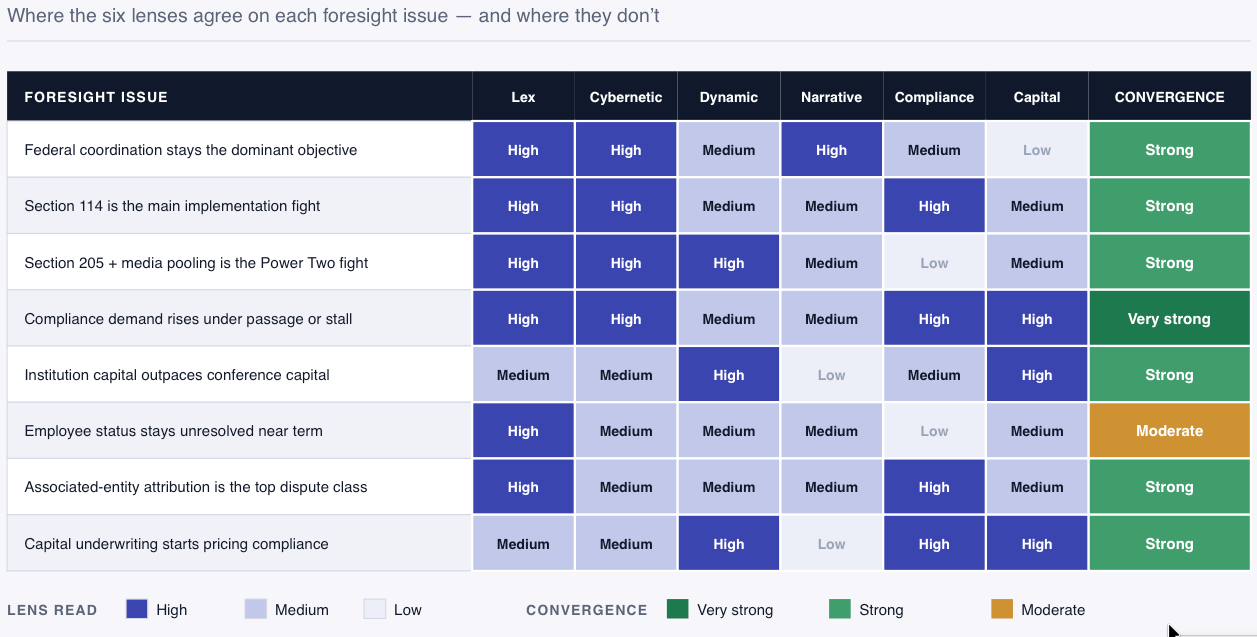
The strongest convergence appears in compliance-infrastructure demand, Section 114 implementation risk, capital migration, and Power Two amendment pressure. The weakest convergence appears in employment timing, because administrative paralysis delays near-term action while the litigation incentive stays alive.
Consolidated predictions (P10–P25)
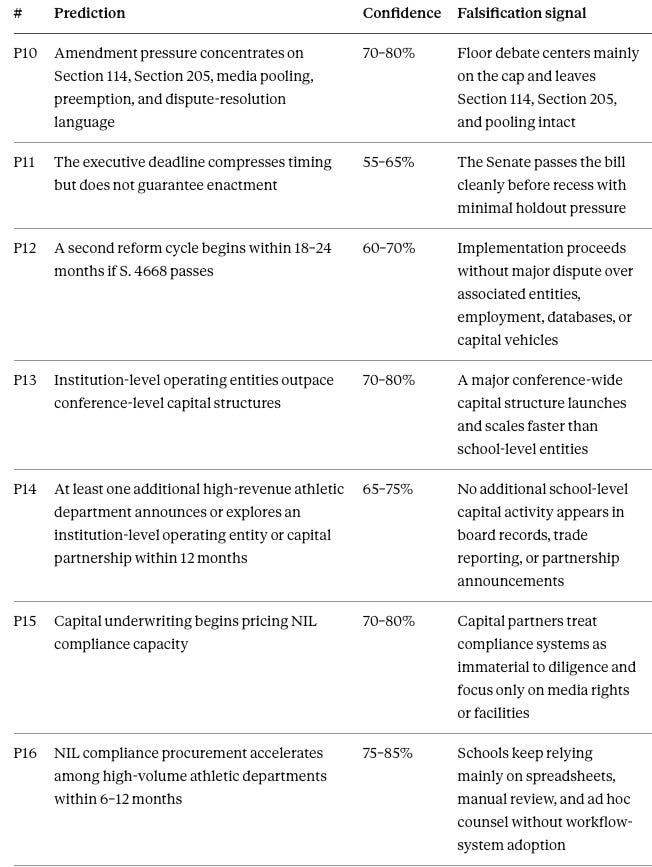
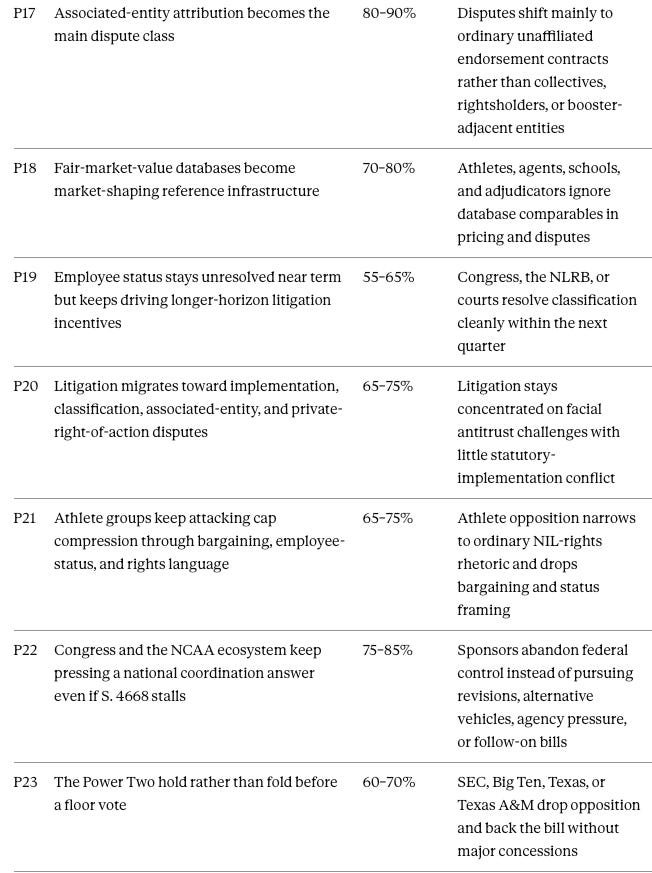
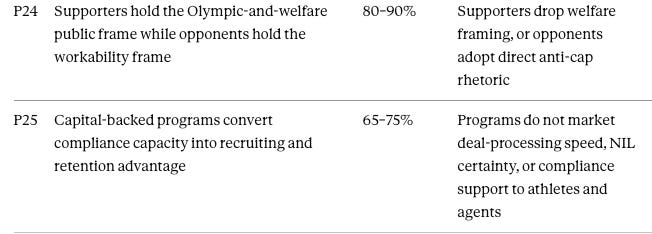
The six lenses convert the article’s thesis from interpretation into foresight. Lex Vision shows legal conflict migrating into implementation; Cybernetic Game Theory shows a system seeking control rather than equilibrium; Dynamic Game Theory shows apex programs defending optionality before accepting national loop closure; Runtime Narrative Control shows welfare language stabilizing the coalition while autonomy language stabilizes the opposition; Compliance Infrastructure Vision shows institutions needing systems, not only lawyers and staff; and Capital Formation Vision shows private capital moving through operating-company channels faster than Congress can legislate the market.
Taken together, the six lenses point one way: a national rulebook would not equalize institutional capacity, because the advantage runs to the institutions that can move a signal through a defensible loop — intake, source verification, fair-market-value analysis, agent validation, associated-entity mapping, privacy-preserving reporting, and dispute-ready institutional memory.
XI. What to Watch Next
Five signals will confirm or break the thesis over the coming quarter:
Whether the Senate floor vote materializes and on what margin, given the sixty-vote requirement the coalition has not yet secured.
Whether Section 114 survives the floor intact, or whether associated-entity and athlete opposition forces a carve-out that reopens the disguised-pay margin.
Whether amendment energy concentrates on Section 205 and media pooling — the Power Two’s foreclosed outside option — confirming the bargaining read.
Whether the executive order’s August 1 enforcement track takes effect or stalls in litigation, and whether the deadline moves any holdout.
Whether a second athletics operating entity with outside capital forms, and whether any court or agency reaches the employment question while the Board remains unable to act.
Each signal is observable and dated, and each moves the confidence bands before it moves the conclusion.
XII. Conclusion: From Rule Uncertainty to Operating-System Competition
The Protect College Sports Act does not resolve the NIL economy — it turns NIL into a control-loop problem, where the winner is not the institution that pays the most but the institution that can prove the fastest, cleanest, most defensible path from deal signal to compliant record.
A compensation cap can limit headline payments; a cap cannot eliminate the institutional machinery around those payments. If the bill advances, the next competitive advantage belongs to programs that document more deals, validate fair-market value faster, police agent and associated-entity risk earlier, and defend compensation decisions with cleaner records. If the bill fails, the same market logic continues through the House settlement, NIL Go, Commission practice, and private enforcement. A system stabilizing around control will keep forcing the coordination answer; the winners of that fight will re-optimize toward capital the moment it ends. Either way, college athletics is moving from rule uncertainty to operating-system competition — and the operating system rewards capacity, not coordination.
Sources & Primary Documents
Bill text and committee action
S. 4668 (RS) — Reported in Senate, June 24, 2026, with an amendment — official text (GovInfo) — primary source for operative statutory mechanics; reported-text PDF.
Senate Commerce section-by-section summary (committee explainer, PDF) — secondary descriptions of NIL disclosure over $600, the agent registry, the Section 104 database, Section 118 antitrust protection, and Section 122 employee-status neutrality.
S. 4668, 119th Congress (Congress.gov) · GovTrack status — ordered reported after June 18 markup · H.R. 9137 — House companion text (Congress.gov)
Senate Commerce — “Protect College Sports Act Heads to Senate Floor” · Senate Commerce Democrats — “Advances to Full Senate”
ESPN — bill headed to full Senate vote · CBS Sports — committee passage, floor timing, sixty-vote math
Trump executive order and the August 1 deadline
White House — “Urgent National Action to Save College Sports” (effective August 1, 2026)
Ropes & Gray — suspension-and-debarment enforcement track and August 1 implementation
On3 — Trump urges Congress to pass a bill “this summer” · CBS Sports — industry skepticism the order changes anything absent a statute
Markup revisions — Olympic floor, media pooling, anti-merger threshold
SwimSwam — $80M non-revenue-sport floor, decoupled from media pooling
Texas Tribune — 75% FBS agreement to pool media rights; $700M anti-expansion floor
On3 — anti-super-league threshold lowered from $1B to $700M (ACC, Big 12 swept in) · AOL/Commercial Appeal — the <75%-of-FBS merger bar, verbatim provision
Opposition
Texas / Texas A&M Boards of Regents joint opposition letters, June 26 (KBTX) · On3 coverage
San Antonio Report — Cruz’s “only Texas and Texas A&M would survive” framing
Section 114 and the clearinghouse
College Sports Commission — NIL Deal Flow Report through April 30 ($242.35M cleared, $56.17M not cleared, 45% within 24h) · CSC Deal Flow Reports (primary)
Front Office Sports — NIL Go strained by associated-entity volume; participation-agreement fight
Yahoo Sports — Section 114 associated-entity dispute; Kessler warning; nineteen-athlete letter
Capital channel
Sportico — Utah/Otro deal finalized as Crimson Brand Partners, ≥$100M, operations begin July 1
ESPN (Wetzel) — Utah PE deal; stalled Big Ten–UC Investments proposal
Employment status
Foundational MindCast AI Frameworks
The cybernetic and game-theoretic engine of this analysis rests on three works from the MindCast AI Cybernetics | Game Theory corpus:
MCAI Innovation Vision: Cybernetic Game Theory — Control, Not Choice: Why Systems Stabilize Around Wrong Answers (March 2026) — the control-not-choice account and the four governing mechanisms (delay dominance, narrative control, feedback capture, constraint geometry) mapped onto S. 4668.
MCAI Economics Vision: MindCast Dynamic Game Theory — Competing Inside a System That Rewrites Itself(April 2026) — rule mutation as a first-order competitive variable, framing the Texas–Texas A&M revolt as apex actors moving upstream of a game being rewritten against them.
MCAI Economics Vision: MindCast Runtime Narrative Control Cybernetics (March 2026) — narrative as a control-layer input, deconstructing the Olympic-pipeline and athlete-welfare framing as a runtime control signal over a capital struggle.
Prior MindCast AI Work Referenced
MCAI Lex Vision: The Protect College Sports Act of 2026 — Federal NIL Salary Cap, Antitrust Immunity, and the Private Equity Blind Spot (June 2026) — the publication this update extends.
MCAI Lex Vision: Private Equity, NIL, Antitrust, and the Firm-Formation Phase of College Athletics (January 2026) — the firm-formation foresight simulation behind the capital-formation channel, the athletics-LLC diffusion forecast, the compliance-as-moat finding, and the employment-classification falsification trigger this update tracks.
Methods Note
MindCast AI conducts this analysis through the MindCast AI Proprietary Cognitive Digital Twin Predictive Game Theory Foresight Simulation System. The engine couples three layers: a cybernetic control model (Cybernetic Game Theory’s control-not-choice account and four mechanisms; Dynamic Game Theory’s rule-mutation lens; Runtime Narrative Control Cybernetics’ treatment of narrative as a control signal), a Chicago-school behavioral composite (Coase on coordination capacity, Becker on rational response to a price control, Posner on the lag between behavior and legal correction), and classical game-theoretic structure (focal-point coordination, war-of-attrition and collective-action dynamics, and bargaining theory).
Predictions issue only where multiple Vision Functions converge on a directional outcome and remain stable under stress testing, and each pairs with predefined, observable falsification conditions. Confidence bands reflect the state of the evidence as of June 30, 2026.
Source hierarchy: operative statutory claims come from the reported Senate text where available, and the analysis uses the Senate section-by-section summary only as a committee explainer. Coalition claims rely on Senate releases, actor-behavior and markup-change claims rely on contemporaneous reporting, and MindCast works supply the theoretical framework.