
Companion publications: The Duty to Foresee, AI Deployment Readiness as Prospective Governance, and the Arrival of Agentic Duty of Care (2026) · AI Governance Equilibrium (2026) · AI Accountability, When AI Promises Meet the Courts (2026) · Decision Modeling and Foresight Simulation (2026)
Related series: AI Governance Economics · Competition for AI Governance (2026) · Anthropic, Mythos, and the NSA, The First Sovereign Governance-Scarcity Event (2026) · AI Repricing Cycle 2026 (2026) · How Mozart Predicts Game Mutation (2026)
Newshook: FinCEN Assesses $1.2 Billion Penalty against Bank of America (October 13, 2026) · FinCEN Consent Order
Thesis. Bank of America kept a money-laundering threshold its own tests showed was missing most of the suspicious activity in the samples it tested, with investigation capacity the concern its files name, and the bank later admitted a willful violation in a consent order that counts the unremediated test among the repeated warnings it left unaddressed. The next enforcement contest decides whether supervisors can force capacity to follow risk, and the highest-confidence prediction falls on supervisors specifying the test rather than ordering general improvement.
I. Executive Summary
Bank of America’s compliance failure began with a problem its own testing had already exposed: the monitoring system missed suspicious activity that a more sensitive threshold could have surfaced. The bank’s own testers measured the blind spot in 2022, and management kept the threshold; the concern its files name is the investigation volume a wider net would push to cases. A 2024 lookback later sized the deferred staffing at roughly 750 people. Three separate facts then follow in the October 13 consent order: the bank admitted that it willfully violated the Bank Secrecy Act, FinCEN assessed a $1.2 billion penalty, and the order rests willfulness on a course of conduct rather than on one test. The violations continued “despite repeated internal warnings from the Bank’s own personnel performing compliance and testing functions“ and external concerns from law enforcement and other institutions, and the 2022 result is the most quantified of those warnings. Once foresight reveals a governance requirement, declining to fund it can become the evidence against the institution.
The Financial Crimes Enforcement Network (FinCEN) found that the bank missed or delayed detection and reporting of more than $5 billion in suspicious activity between 2018 and mid-2025, with roughly $1 billion tied to national-security risk. The Office of the Comptroller of the Currency (OCC) imposed a $750 million penalty, its largest ever, credited toward the total. The consent order quotes one of the bank’s 2022 concerns about widening its alert threshold: “Yield may exhaust the investigation resources.” The unremediated result sits inside the course of conduct the order treats as reckless disregard, a civil standard that footnote 13 says requires no improper motive or bad purpose.
The mechanism is capacity-calibrated detection. An institution sizes what its monitoring can see to the review capacity it chose to fund, rather than sizing capacity to the risk the monitoring reveals. Bank of America also described its controls in public, stating that it maintained systems to identify and report suspicious activity while the deficient threshold still ran. Liability can therefore run through two channels: regulators enforce the statute, and private parties may pursue the representation if they can prove the elements of their own claims.
The next regulatory contest decides whether supervisors can force the relationship to reverse, so that capacity follows tested risk. The highest-confidence prediction falls on supervisors specifying the test, the threshold or the lookback rather than ordering general improvement. Whether artificial intelligence (AI) changes the cost of that reversal without creating new governance failures remains unresolved.
MindCast AI applies Predictive Behavioral Economics + Dynamic Game Theory through MindCast AI Proprietary Cognitive Digital Twin Foresight Simulations (MP CDT FS). Behavioral Economics supplies the decision rules. Game Theory supplies the payoff structure. Predictive simulations emerge from the combination.
MindCast’s distinction is mechanism-level foresight built on its own prior work. The Duty to Foresee (2026) separated the duty to look before acting from the duty to govern to what the look reveals, and the Bank of America order illustrates the second duty with unusual clarity: an existing Bank Secrecy Act obligation, enforced against a bank that looked and did not act. AI Governance Equilibrium (2026) supplied the measure of governance debt that the bank’s own 2024 capacity estimate approximates. AI Accountability, When AI Promises Meet the Courts (2026) supplied the sequence from public promise to underlying system to the enforcer who tests one against the other; here the program letter is the promise and the threshold is the system. Noel Le’s work on institutional economics has appeared in CPI Antitrust Chronicle.
Six sections carry the argument. Section II reconstructs the enforcement findings, the bank’s public control statements and the question the paper answers. Section III states six MindCast Foresight Simulation Predictions. Sections IV and V convert the predictions into stakeholder moves and draw the implications for agentic AI, including a proposed extension of the accountability taxonomy to control representations. Section VI traces the framework to the MindCast publications that built it.
Four audiences need the paper now. Bank boards and compliance leaders hold validation files that the order shows regulators will read, and counsel must reconcile public control statements with those files. Investors need the remediation cost, not the penalty line. AI deployers face the same decision structure as their agent fleets outrun review queues.
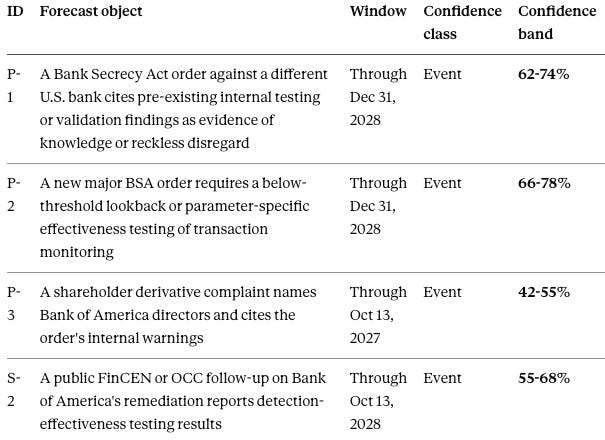
Prediction highlights. Six Simulation Predictions in total: three primary (P) and three secondary (S), with the four highest-value entries below.
Stakeholder readout
🏛️ Policymakers. The order already contains the template for agentic AI oversight: test files, warnings and a capacity rationale. Specifying the test in each repeat case converts one order into practice, and the decision window opens with the next major order (P-1, P-2).
💼 Executives. Validation reports your teams write are candidate evidence in any examination or litigation that reaches them. Fund the governance it reveals, or document a risk-based reason for declining that survives a reckless-disregard reading (P-1).
⚖️ Counsel. Willfulness rested on unremediated internal warnings, not on absent controls. Public program letters that describe controls in process language still carry exposure for omitting the tests that undercut them once a plaintiff can also plead materiality, scienter and loss (S-1, P-3).
📊 Investors. The direct penalty cost about 17 cents per share. The continuing exposure sits in remediation: the bank’s own 2024 estimate projected doubled investigation volume and 750 added staff, so remediation disclosures carry more information than the penalty line (S-3).
II. The Bank Measured the Gap and Kept the Threshold
The Bank of America consent order documents a decision rather than a failure. Most enforcement findings describe what a bank missed. The order describes what the bank measured, what its testers recommended and why management declined.
A. The Order Documents a Decision, Not a Failure
FinCEN, the OCC and the Office of Foreign Assets Control (OFAC) announced coordinated actions on October 13, 2026. FinCEN assessed $1.2 billion, the third-largest penalty in Treasury history, with the $750 million OCC penalty credited against it. The bank admitted it willfully violated the Bank Secrecy Act (BSA). OFAC added an $11.6 million resolution for apparent sanctions violations.
The OFAC findings cover 475 apparent violations tied to alert prioritization, delayed watchlist updates and human error. The paper keeps those findings separate from the FinCEN and OCC detection failures. The two sets share a bank but not a mechanism.
The consent order centers on Event Processor, a proprietary monitoring system the bank designed in 2010 and launched through a proof of concept. Each rule hit carried 0 to 20 risk points. Alerts grouped by customer became a case only when the group reached 20 points within 13 months of its oldest active alert. Older alerts retired and stopped counting.
Event Processor’s design carried three facts that drive the analysis. The 20-point threshold was “initially set by stakeholder judgment“ and stayed in place until December 2023. A 2021 Risk Factor Calibration Model cut weights for 106 risk factors and raised 17, reducing cases by more than 8,200. Rescoring logic touched about 150,000 event groups and lowered point totals until regulators intervened in December 2023.
The 2022 testing supplies the decisive evidence. The bank ran the comparison itself after an internal testing finding. On below-the-line samples, activity falling under the 20-point threshold, an unconstrained threshold would have surfaced 85.4% of suspicious activity against 20.2% under the existing rule. The figures describe the samples tested, not the bank’s overall detection rate. The bank rejected the change, citing a “practical concern of pushing too many below-the-line event groups to cases.”
The 2024 lookback found nearly 8,900 unreported suspicious activity reports (SARs) covering almost $4 billion. The revised threshold was estimated to add 16,000 U.S. investigations each month, doubling prior volume. The bank estimated it needed an incremental 750 personnel.
Referrals substituted for the bank’s own detection. Cases prompted by seizure warrants, grand jury subpoenas and employee referrals rather than by the monitor’s own alerts made up more than one-third of cases in several years, peaking near 50% in 2023. Steady case counts masked a weakening internal monitor and gave management false assurance.
Board-level knowledge of the 2022 decision, peer-bank practice and the full text of the OCC order remain open questions. The confirmed findings already establish knowledge, a quantified gap and a documented choice. Every prediction in Section III rests on the confirmed findings alone.
B. The Bank Described Controls Its Own Tests Contradicted
Bank of America described its controls in public while the threshold still ran. The bank’s Global Financial Crimes Risk Executive signed a January 2025 anti-money laundering (AML) program letter. The letter states that the bank maintains “procedures, processes and systems to identify and report suspicious activity.” The letter uses process language throughout, describes the sanctions program as “reasonably designed” and discloses the December 2024 OCC consent order.
The bank’s AI claims concern fraud rather than AML. At its November 2025 investor day, the bank said it runs 270 AI and machine-learning models, and said models that detect abnormal behavior had cut its fraud loss rate in half. The consent order never mentions AI, and Event Processor runs on rules and points.
Public representations matter because the BSA gives private parties no right to sue. A public statement about controls opens a potential second channel, but each claimant must establish its own elements. Securities plaintiffs must plead materiality, scienter and loss causation. Derivative plaintiffs must show demand futility and bad-faith oversight, and counterparties need a contractual or reliance basis. The duty predates the statement, and the statement adds candidate enforcers rather than automatic ones.
C. Foreseen Gaps Become Liability Through Two Channels
The paper answers one question in three parts. When an institution’s own foresight reveals a governance requirement it declines to fund, how does enforcement convert that gap into liability? Which private enforcers can reach the gap once the institution represents its controls publicly? Does AI investigation capacity then change what counts as reasonable?
The target system covers large U.S. banks under BSA supervision, with enterprise AI deployers as the forward population. The horizon runs through 2028. Criminal exposure and individual officer liability sit outside scope.
The argument runs in four stages. Internal testing makes the risk foreseeable. The institution calibrates detection to available capacity, so governance debt accumulates despite knowledge. Enforcement exposes the shortfall through the regulatory channel, private channels may follow, and institutions then decide whether to change their governance architecture.
D. Predictive Behavioral Economics Explains the Threshold Decision
Behavioral economics explains why the 2022 decision looked rational from inside. Investigation staff carried a fixed budget, and case volume was the salient operating metric. The cost of missed SARs stayed invisible until an examiner surfaced it, so bounded rationality led managers to optimize yield per case while coverage went unmeasured.
The Risk Factor Calibration Model makes the decision rule explicit. An internal presentation set its goal to “calibrate [risk factors] so the whole system of weights has a better SAR yield.” Efficiency became the target. Goodhart’s law then applied: a measure that becomes a target stops measuring what it was built to measure.
The broader pattern is a metric trap. Alert counts, closed cases and remediation milestones measure activity. False-negative exposure, escalation time and durable correction measure effectiveness, and referral-driven cases kept the activity numbers steady while effectiveness fell.
E. Dynamic Game Theory Explains the Peer Response
Game theory explains why the order changes behavior beyond Bank of America. The order creates no new duty; it makes the consequences of ignoring internal validation findings more visible and more costly for every peer that keeps such files. The legal standard did not change: footnote 13 applies the long-standing test of reckless disregard or willful blindness, requires no improper motive, and treats documented warnings left unaddressed as satisfying it.
Peers now choose between adding review capacity and narrowing documentation. Willful-blindness doctrine and mandatory model validation raise the cost of the second route. Which equilibrium peers select stays an open question, because the order documents one bank’s decision and not the population’s response. AI triage tools could lower the cost of capacity, but they bring their own validation, false-positive and escalation burdens.
Predictive behavior emerges from combining the two disciplines. Behavioral economics supplies the decision rule that produced the threshold, and game theory supplies the raised cost of ignoring what the files show. Neither alone predicts how peers will respond.
F. Ten Actors Drive the Outcome and Four Explanations Compete
Ten Cognitive Digital Twins (CDTs) represent the actors whose decisions drive the predictions. The table states each actor’s objective, constraints and update trigger. Two of the ten, correspondent banks and consumers of AI-marketed controls, exist because the representation channel reaches parties the statute never did.
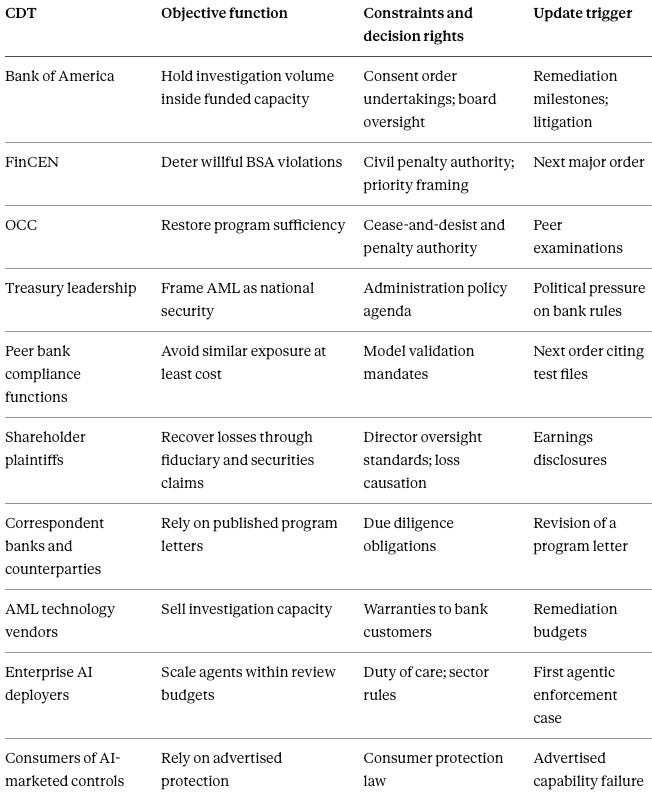
Four competing explanations fit the enforcement findings, each with its own falsifier. Capacity calibration is the paper’s thesis, and the other three are the alternatives a skeptic would press. The predictions in Section III discriminate among them.
Capacity calibration. The bank sized detection to funded investigators, and calibration files become routine enforcement evidence. Falsifier: later orders rest on program-absence findings without citing internal testing.
Case selection. Customer A (the unnamed client whose activity the order ties to national-security exposure) drove the penalty, and the finding stays specific to Bank of America. Falsifier: a peer order without national-security facts cites the same evidence class.
Technical defect. A 2010 system failed regardless of capacity choices. Falsifier: remediation that adds investigators without replacing the system closes the detection gap.
Null explanation. The order changes nothing outside Bank of America. Falsifier: any peer order or guidance that references threshold testing within the window.
Three mechanisms carry the argument. Capacity-calibrated detection explains the bank’s own decision. The evidentiary salience of validation files explains how the decision becomes liability. Parameter-specific supervisory leverage explains which enforcement produces correction.
III. MindCast Simulation Predictions
Six Simulation Predictions follow in numeral order. Three are primary (P, Primary Simulation Prediction) and three are secondary (S, Secondary Simulation Prediction). Each identifier recurs in the stakeholder, implications and monitoring sections.
The predictions date from October 14, 2026, on sources through that date. The sources are the FinCEN consent order, the agency releases and the January 2025 Bank of America AML program letter.
Four scenarios frame the predictions. In the propagation scenario, peer examinations reuse the testing-evidence template, a second major order cites internal testing and peers fund validated capacity. In the outlier scenario, regulators treat Customer A’s national-security exposure as the driver and remediation stays specific to Bank of America. In the amplification scenario, AI triage spreads faster than validation and review, and throughput rises while verified detection stalls. In the deregulation scenario, a reset narrows BSA program expectations and peers defer capacity investment.
III.A Primary Predictions
Each headline carries the prediction and its band. The paragraph beneath it states the forecast, the trigger and source that resolve it, the falsifier and the exposure.
P-1 · FinCEN or the OCC cites a second U.S. bank’s own testing files as evidence of knowledge or reckless disregard by December 31, 2028 (62-74%)
A FinCEN or OCC BSA enforcement order against a different U.S. insured bank is issued by December 31, 2028 and expressly cites pre-existing internal threshold tests, below-the-line sampling or model validation findings as evidence of knowledge or reckless disregard. Peer examinations of monitoring systems and OCC follow-on actions are the trigger, and the text of each new order on the FinCEN and OCC enforcement pages resolves it, checked monthly. Falsifier: no qualifying order text by the window close. Exposure falls on peer bank boards and compliance functions.
P-2 · FinCEN or the OCC issues a new major BSA order requiring a below-threshold lookback or parameter-specific effectiveness testing by December 31, 2028 (66-78%)
A new major BSA enforcement order (penalty at or above $100 million) issued by December 31, 2028 requires a below-threshold lookback or parameter-specific effectiveness testing of transaction monitoring. Repeat-failure cases at large banks are the trigger, and the undertakings language in each new FinCEN or OCC order resolves it, checked monthly. Falsifier: no qualifying order. Exposure falls on large-bank compliance functions and independent reviewers.
P-3 · Shareholders file a derivative complaint naming Bank of America directors and citing the order’s internal warnings by October 13, 2027 (42-55%)
A shareholder derivative complaint naming Bank of America directors and citing the October 2026 order’s internal warnings as red flags is filed by October 13, 2027. A shareholder demand to inspect board materials or a remediation cost disclosure is the trigger, and the Delaware Court of Chancery and federal dockets resolve it, checked weekly. Falsifier: no such filing by the window close. Exposure falls on Bank of America directors and their insurers.
III.B Secondary Predictions
The three secondary predictions resolve on different actors. S-1 turns on private securities plaintiffs, S-2 on supervisory follow-through at Bank of America and S-3 on the bank’s own disclosures. None depends on peer-bank propagation, although all three run higher in that scenario. S-1 and S-2 carry bands; S-3 is interpretive and resolves on a rubric.
S-1 · Shareholders file a securities class complaint targeting a specific Bank of America control statement by October 13, 2027 (25-38%)
A securities class complaint filed by October 13, 2027 alleges that a specifically identified Bank of America AML control representation omitted contradictory testing or remediation information. A corrective-disclosure share reaction is the trigger, and federal district court dockets resolve it. Falsifier: no qualifying complaint, or one limited to generic risk-culture statements.
S-2 · FinCEN or the OCC publicly reports detection-effectiveness results on Bank of America’s remediation by October 13, 2028 (55-68%)
By October 13, 2028, a public FinCEN or OCC follow-up on Bank of America’s remediation reports detection-effectiveness testing results rather than written-control attestation alone. Completion of the independent review is the trigger, and FinCEN and OCC releases, order amendments or terminations resolve it. Falsifier: the follow-up cites documentation only, or no public follow-up exists.
S-3 · Bank of America’s remediation disclosures through 2027 name added investigators before or alongside technology (interpretive, no band)
Bank of America’s remediation disclosures through December 31, 2027 describe added investigator headcount before or alongside technology, and no disclosure attributes the fix to technology alone. The rubric is the presence of headcount language in each remediation disclosure in earnings transcripts and SEC filings, which resolve it. Falsifier: a disclosure attributes closure of the detection gap to technology without added review capacity.
III.C What Would Break the Thesis
Event Processor runs on rules and points rather than machine learning, so the bridge to agentic AI rests on mechanism similarity, and AI’s net effect on detection cost remains unresolved. None of the six predictions depends on an AI claim.
The 2022 comparison reports results on specified below-the-line samples rather than population-wide detection. The thesis weakens if those samples prove unrepresentative, if net detection fails to improve once investigation constraints bind, or if the technical-defect explanation proves more complete than capacity calibration. A shift between the propagation scenario and the outlier scenario changes which predictions resolve true and falsifies nothing by itself.
Working With MindCast
Published analysis can map the mechanism but cannot audit a specific institution’s thresholds or statements. Whether a calibration choice survives a reckless-disregard reading depends on the institution’s own validation files, staffing models and risk appetite. Whether a public control statement survives depends on what those files contain.
MindCast builds Cognitive Digital Twins of the institution’s monitoring and governance system, ingests its testing history and reruns the enforcement environment against the institution’s actual options. Commissioned work delivers three things. The first is a governance-capacity assessment of the client’s own monitoring or agent-review system. The second is a set of exposure scenarios with low, median and high cases, and the third is a set of monitoring thresholds that tell the client when a scenario has begun.
The prediction set yields three engagements. For bank boards and compliance functions, a validation-file audit simulates which open findings carry willfulness exposure under P-1 and what capacity closes them under P-2. For disclosure counsel, a representation audit simulates which public control statements break first under S-1. For AI deployment leaders, a review-capacity simulation tests whether the agent-review queue can absorb what pre-deployment evaluation surfaces, before the first precedent case lands.
MindCast takes one bounded next step at a time. Contact mcai@mindcast-ai.com or visit mindcast-ai-simulation.com to schedule the diagnostic session. No engagement proceeds without a named decision to resolve.
IV. Every Stakeholder Move Traces to a Prediction
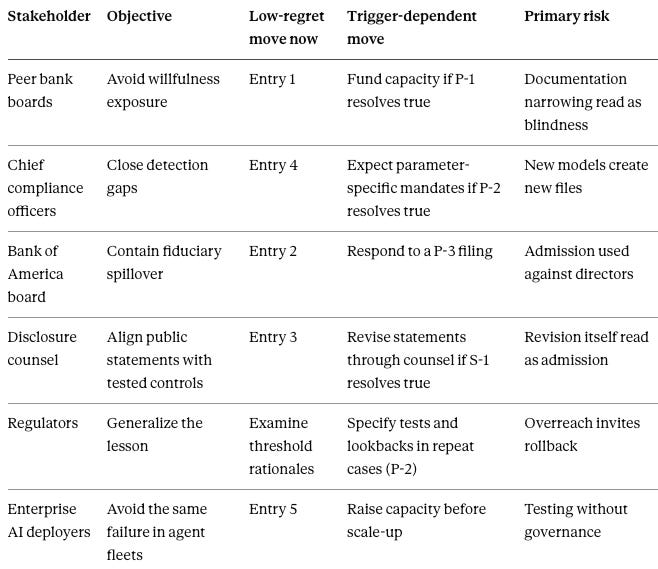
Stakeholder strategy follows the predictions. Every move below traces to a prediction identifier, and the Risk Mitigation Layer separates what each audience can do from what the findings mean for it. Each stakeholder class receives one posture and one set of actions.
Stakeholder strategy matrix. Low-regret moves point to the Risk Mitigation Layer entry that states them.
Strategic Posture by Stakeholder
🏛️ Policymakers. Regulators face a rollback risk the order does not remove. A parameter-specific mandate gives peers a test they can meet and gives a deregulatory reset less to strike, while a general improvement order offers neither, so the remedy’s precision shapes whether P-2 holds through the window.
💼 Executives. Boards hold the decisive lever because Caremark liability (the Delaware doctrine holding directors liable for red flags they ignore) attaches to warnings the order now lists by year. The list gives every peer board a checklist for its own files (P-1, P-3). Compliance leaders face the narrowest corridor, because removing documentation fails under willful-blindness doctrine.
⚖️ Counsel. A complaint survives only where it ties a specific public statement to a specific contrary test, so the statement review in Entry 3 is the move that closes the gap before a plaintiff finds it (S-1). The opinion doctrine in Section V.F governs a “reasonably designed” statement.
📊 Investors. Each quarterly disclosure answers one question: does the bank name investigator headcount or technology alone? Headcount first signals that the remediation cost persists beyond the penalty year (S-3).
Agentic adoption deserves its own decision gate. A bank can approve a bounded pilot without authorizing expansion across workflows. Review capacity and emergency intervention authority belong in the approval file before the system scales.
Risk Mitigation by Time Gate
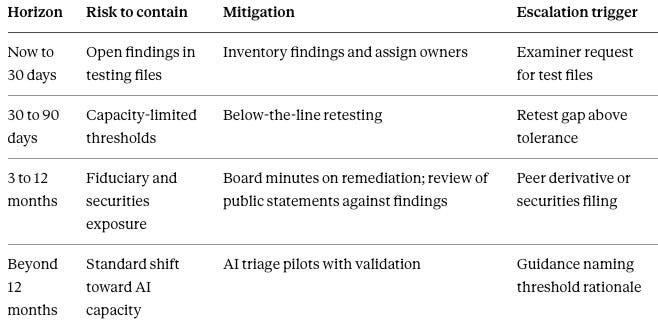
Risk Mitigation Layer
The Risk Mitigation Layer pairs each prediction with one audience. Severity and probability stay separate axes. The entries describe decision considerations, not legal, investment or fiduciary advice.
Entry 1 · P-1 · 💼 Peer bank chief compliance officers.
Prediction and band. A later major order cites calibration files as evidence of knowledge. 62-74%.
Exposure. Discovery scope expands to every validation report and below-the-line test since 2018. Bank of America’s own 2024 estimate of 750 added investigators is the benchmark examiners now carry, while each peer’s requirement depends on its own transaction volumes, monitoring architecture and investigative assumptions. Severity: high. Probability: 62-74%.
Mitigating actions. The compliance function inventories open validation findings within 30 days. Model risk management reruns below-the-line tests on current thresholds within 90 days. The chief compliance officer presents a funded closure plan to the board risk committee before the next examination cycle.
Residual exposure. Historical files from 2018 forward remain discoverable, and closure plans document knowledge of the gap they close.
Entry 2 · P-3 · ⚖️ Bank of America board counsel.
Prediction and band. A derivative complaint names directors and cites the order’s warnings. 42-55%.
Exposure. Director defense costs and insurance retention, plus books-and-records production covering board materials from 2019 forward. Severity: high. Probability: 42-55%.
Mitigating actions. The corporate secretary assembles a chronology of board oversight of the 2019, 2020 and 2022 warnings within 30 days. The risk committee documents its remediation oversight at each consent order milestone.
Residual exposure. The willfulness admission stands, and the chronology may confirm gaps it was meant to close.
Entry 3 · S-1 · ⚖️ Disclosure counsel at peer banks.
Prediction and band. A securities complaint challenges a specifically identified control representation on an omitted-basis theory. 25-38%.
Exposure. Every public program letter, Wolfsberg questionnaire (the standard due-diligence form banks exchange with correspondents) and annual report statement on controls becomes a potential misstatement wherever internal tests contradict it. Severity: medium to high. Probability: 25-38%.
Mitigating actions. Disclosure counsel reconciles each public control statement against open validation findings within 60 days. Any revision routes through the disclosure committee rather than through compliance alone, which avoids creating an unreviewed admission.
Residual exposure. Statements already published during an open finding remain exposed, and a revision invites scrutiny of the prior version.
Entry 4 · P-2 · 💼 Large-bank chief compliance officers.
Prediction and band. A new major order requires a below-threshold lookback or parameter-specific effectiveness testing. 66-78%.
Exposure. A mandated lookback at Bank of America’s scale required 800 consultants and doubled monthly investigations. A peer facing the same mandate absorbs a one-time cost sized to its own volumes plus the permanent capacity the lookback reveals. Severity: high. Probability: 66-78%.
Mitigating actions. Model risk management runs a self-directed below-threshold sample within 90 days and documents the yield. The compliance function funds investigation of what the sample surfaces before the next examination, so the first lookback is the bank’s own.
Residual exposure. A self-directed sample that surfaces activity creates its own reporting obligations, and the yield figure becomes discoverable.
Entry 5 · Open AI question · 💼 Enterprise AI deployment leaders.
Prediction and band. None. The AI question carries no band (Section V.E).
Exposure. Pre-deployment test files that show unaddressed risk become primary evidence if a precedent case lands, expanding discovery to every red-team and evaluation report. Severity: high. Probability: no band.
Mitigating actions. The deployment owner sizes the agent-review queue to tested risk before each scale-up gate. The governance function documents a funded response to every open evaluation finding before production approval.
Residual exposure. Novel failure modes outside tested scenarios remain, and documented tests raise the standard the deployer is held to.
V. Artificial Intelligence Governance Inherits the Bank’s Decision Structure
Bank of America’s order reaches beyond banking because it shows how enforcement reads any automated decision system. Each implication below links to a prediction identifier. The agentic analog is stated where the evidence holds and left open where it stops.
A. The Order Illustrates the Second Duty
The Duty to Foresee separated the duty to look from the duty to act. Bank of America shows the second duty carrying more exposure than the first, because looking created the evidence. The paper warned that foresight “manufactures discoverable knowledge,” and the consent order cites testing reports from 2019, 2020 and 2022 as knowledge evidence (P-1).
Bank of America’s order illustrates an existing enforcement principle with unusual clarity. Whether it marks a change in practice depends on the orders that follow. The paper’s forecast covers autonomous agents, so the Bank of America case marks a pre-agentic precedent tier rather than a confirming instance.
B. Governance Debt Received a Number
AI Governance Equilibrium (2026) models governance debt as the balance that accrues when pressure on an organization outruns its control, stated as a ratio of pressure to control. The paper supplies the measure this case puts a number on. Event Processor generated more signals than funded reviewers could clear, and the bank closed the gap by shrinking the signal.
The bank’s own 2024 planning then measured the deferred requirement: 16,000 added monthly investigations and roughly 750 staff. The figure is a quantified capacity shortfall under the bank’s own 2024 assumptions, not a validated or legally required staffing level. MindCast runs the same measure in reverse to size the capacity a deployment owes before it launches rather than after enforcement.
C. The Accountability Sequence Runs Inside a Bank
AI Accountability, When AI Promises Meet the Courts (2026) traces a sequence from a public promise (the signal) through the system behind it (the substrate) to the party that tests one against the other (the forcing function). The series supplies the structure this case extends from AI claims to control claims. The bank’s signal was a functioning compliance program, its substrate a monitor calibrated to staffing, and supervisory examination served as the forcing function.
Bank of America made no AI representation and suffered no agent failure, but it made a control representation whose substrate failed. The case suggests adding supervisory examination to the series’ forcing-function taxonomy. Enforcement data arrives faster in regulated industries than in securities litigation, which makes banking the natural testbed (P-1, P-3).
D. The Bank’s Decision Served Efficiency but Failed the Compliance Objective
Decision Modeling and Foresight Simulation (2026) treats information quality, alignment and transparency as separate inputs to a Decision Quality Index (DQI). The paper supplies the decision-quality frame the order tests, and it predicts that alignment and transparency prove especially vulnerable under competitive pressure. The Bank of America findings fit the prediction: a yield target set the weights, the weights set what the system could see, and the decision served efficiency while failing the compliance objective it was built for.
One enforcement case cannot establish that alignment failed before information quality. The DQI framework can absorb the finding by treating information quality as partly downstream of alignment, and later analysis can test that ordering across the enforcement set once P-1 and P-2 supply comparator orders. Comparator orders would show whether a yield target precedes a coverage failure in each case.
E. Agentic Artificial Intelligence Could Correct or Reproduce the Failure
The bank’s 2022 defense depended on investigation cost. AI changes the reasonable balance among detection coverage, investigative capacity and governance cost. Whether it lowers total cost depends on validated performance and the controls required to supervise it.
Two outcomes for AI stay open. On the correction path, validated AI triage clears below-the-line volume and the logic of The T.J. Hooper (1932) applies: an available precaution becomes expected before the industry adopts it. On the amplification path, AI raises throughput faster than independent review, and the institution reproduces capacity-calibrated detection at machine speed.
Neither path carries a band, because the claim that AI lowers total cost per resolved case lacks validated evidence. An agent fleet that outruns its review queue still faces the bank’s 2022 decision. The order shows how enforcement will read the files.
F. Control Representations Extend the Accountability Taxonomy
Control representations enter the accountability taxonomy as a candidate category, pending a case in which an AI-related control claim fails. Apple and Tesla answered for product capability claims, while Oracle and Microsoft answered for capacity and governance disclosures. Bank of America represented its internal controls, and the duty behind those controls existed before any statement.
The representation channel turns on opinion doctrine. Under Omnicare, Inc. v. Laborers District Council Construction Industry Pension Fund (2015), an opinion such as “reasonably designed” becomes actionable when the speaker omits facts that conflict with what a reasonable investor would infer about its basis. The Supreme Court decided Omnicare under Section 11 of the Securities Act, and Tongue v. Sanofi (2d Cir. 2016) applied its reasoning to fraud claims, where plaintiffs must also plead scienter and loss causation.
The doctrine cuts both ways for Bank of America. The 2022 sample result of 85.4% against 20.2% could qualify as an omitted fact under the doctrine, depending on the wording and context of the statement it contradicts and on what a reasonable investor would understand. Contradictory testing alone establishes no actionable omission without materiality, scienter and loss. Singh v. Cigna Corp. (2d Cir. 2019) cuts the other way by treating generic compliance statements as puffery, so a complaint succeeds only where it ties a specific statement to a specific contrary test (S-1).
Advertised AI capability raises a question rather than a conclusion. The bank’s 270 models concern fraud, and their existence does not show a validated substitute for Event Processor or the investigators needed to clear more alerts. Whether demonstrated AI capability lowers the future cost of reasonable precaution in adjacent controls stays an open question.
The BSA functions as a statutory fitness-for-purpose standard owed to the government. A program must detect and report, not merely exist on paper, and the order’s independent effectiveness reviews test that fitness (S-2). The Uniform Commercial Code (UCC) warranty of merchantability does not reach bank services. Warranty law applies one layer up, where AML software vendors warrant performance to the banks that buy their systems.
G. What Each Miss Would Mean
If P-1 resolves false, the order stays a single case and the second-duty reading loses its enforcement anchor. Stakeholders should then plan for the outlier scenario, and the prediction stands as a miss. If P-2 resolves false while P-1 resolves true, regulators cite evidence without specifying remedies, and the parameter-specific mechanism loses its support. If S-1 resolves false, the representation channel stays theoretical for control statements written in process language. If the technical-defect explanation dominates, the lesson narrows to system modernization.
VI. Ten MindCast Publications Built the Framework Before the Fine
The Bank of America order lands on a line of MindCast work that circled one idea from several directions before any bank was fined. Four of those publications already do their work in Section V, so this section credits them in one line each and develops only the publications Section V does not use. Each piece traces to a prediction.
A. Governance Is the Scarce Input
What Goethe’s Faust Reveals About the AI Alignment Problem (2026) argued that no optimizer can audit its own objectives from inside, so an institution racing to ship reads its own grave-digging as progress. Why AI Commoditizes Raw Prediction, Why Governance Stays Scarce, and How MindCast Prices the Gap Between Them (2026) then named governance, not capability, as the scarce input in the AI economy. Bank of America’s 2022 decision is the Faust problem at a bank: the yield metric read as progress while coverage failed, and the scarce input was review capacity (P-2).
B. Section V Already Runs Four of the Publications
AI Governance Equilibrium built the governance-debt measure that the bank’s 2024 capacity estimate approximates (Section V.B). The Duty to Foresee separated the two duties and warned that foresight manufactures discoverable knowledge (Section V.A). AI Accountability, When AI Promises Meet the Courts supplied the promise-to-system-to-enforcer sequence that the program letter and the threshold fill (Section V.C). Decision Modeling and Foresight Simulation separated a decision well formed by its own metric from a decision that survives examination, the gap the bank’s threshold fell into (Section V.D). The AI cost question applies that last split: the cost argument’s integrity is unproven, so its survivability stays untested.
C. Competition Creates the Debt and Correction Arrives All at Once
Competition for AI Governance (2026) carried the equilibrium into market structure, arguing that unmanaged competition produces governance debt faster than institutions can absorb it. Anthropic, Mythos, and the NSA (2026) showed the correction arriving all at once and sized to how long the gap went unmanaged. A 2018-to-2025 violation period collapsing into one order fits that pattern. AI Repricing Cycle 2026 (2026) moved the duty to foresee from the deployment decision to the capital-allocation representation, which the control-representation channel in Section V.F extends to compliance statements (S-1).
D. P-1 Tests Whether the Enforcement Method Spreads
How Mozart Predicts Game Mutation (2026) and its Nietzsche companion forecast that AI governance turns from a cost of doing business into a condition of market access through contracts and insurance terms before the law moves. The Bank of America order applies existing doctrine, so no mutation has occurred yet. P-1 is the first test: a second order citing a bank’s own testing files would show the method diffusing, while a changed game requires changed supervisory practice and peer behavior across the window, which P-2 and S-2 track.
Ten publications carry one discipline. Governance scarcity supplies the economics and the equilibrium supplies the measure. The duty to foresee supplies the obligation and the accountability series supplies the litigation path. The Bank of America order brings those frameworks into one concrete compliance failure, while the prospective agentic AI question remains open.
What to Watch
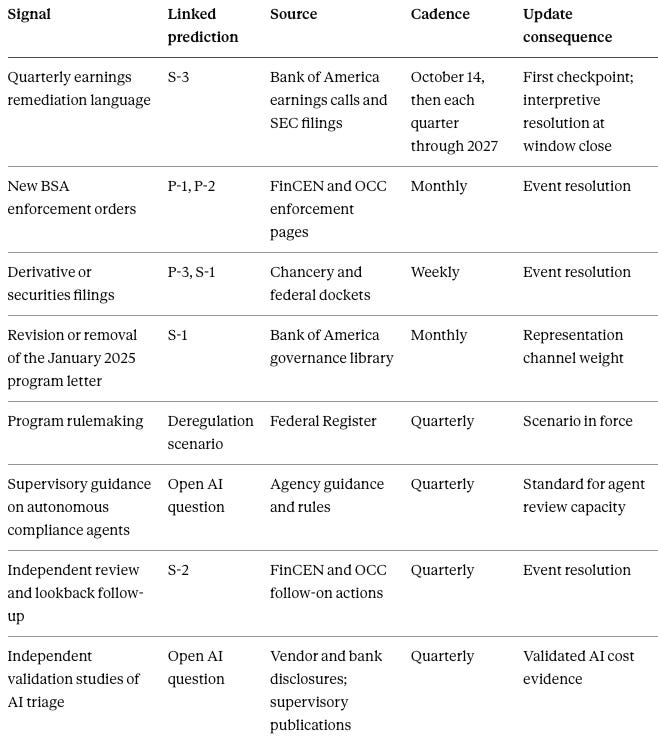
The dominant fork is the next major BSA enforcement order: whether it cites a bank’s own testing files and specifies the remedy (P-1, P-2). Four dated observables follow, each tied to a prediction. Any one of them can change which scenario is in force before the fork resolves.
October 14, 2026: Bank of America’s third-quarter earnings call, the first checkpoint for headcount language in remediation (S-3). The prediction resolves on the full run of disclosures through December 31, 2027, not on this call alone.
Through October 13, 2027: Delaware Chancery and federal dockets, for derivative and securities filings (P-3, S-1).
Through October 13, 2028: FinCEN and OCC follow-up actions, for detection-effectiveness results (S-2).
Through December 31, 2028: FinCEN and OCC order text, for testing-file citations and parameter-specific mandates (P-1, P-2).
Each Signal Maps to a Prediction
The signal table links each observable to a prediction and names its source. Cadence sets how often the source is checked. The update consequence states what an observation can change.
Conclusion
Bank of America answered the governing question with its own documents. The bank looked, measured the gap and kept the threshold, with investigation capacity the concern its files name. The order placed that unremediated choice inside a course of conduct it treats as willful, and the bank’s own planning then quantified the capacity shortfall under its own assumptions.
The bank’s public description of its controls opens a potential second channel the BSA never provided, subject to each claimant proving its own case. Stakeholders should act now on open testing findings and reconcile public control statements against them. Guidance and peer orders should govern larger commitments.
The decisive signal is the next major BSA enforcement order. If it cites a bank’s own calibration files and specifies the test, supervisors have adopted parameter-specific methods and begun requiring institutions to demonstrate effective detection and sufficient investigative capacity. Such an order would confirm the enforcement mechanism the paper predicts, while the broader duty to foresee for autonomous agents would still await its first case. Whether AI lowers or raises the cost of meeting that demand remains unresolved.
Sources
MindCast Works
What Goethe’s Faust Reveals About the AI Alignment Problem (2026). Supplies the alignment foundation: an optimizer cannot audit its own objectives from inside.
Why AI Commoditizes Raw Prediction, Why Governance Stays Scarce, and How MindCast Prices the Gap Between Them (2026). Names governance as the scarce input.
The Duty to Foresee, AI Deployment Readiness as Prospective Governance, and the Arrival of Agentic Duty of Care (2026). Supplies the two-duty structure and the discoverable-foresight warning.
AI Governance Equilibrium (2026). Supplies governance debt and the inverted equilibrium.
AI Accountability, When AI Promises Meet the Courts (2026). Supplies the signal-to-substrate sequence and the accountability taxonomy extended in Section V.F.
Decision Modeling and Foresight Simulation (2026). Supplies the decision-quality frame tested in Section V.D.
Competition for AI Governance (2026). Supplies the governance-scarcity economics behind the capacity argument.
Anthropic, Mythos, and the NSA, The First Sovereign Governance-Scarcity Event (2026). Supplies the discontinuous correction dynamic seen in the enforcement timeline.
AI Repricing Cycle 2026 (2026). Moves the duty to foresee to the capital-allocation representation, extended here to control statements.
How Mozart Predicts Game Mutation in Predictive Behavioral Economics + Dynamic Game Theory (2026). Supplies the market-access forecast that P-1 begins to test.
AI Governance Economics Series synthesis. Collects the series this paper extends.
Primary Sources
FinCEN, FinCEN Assesses $1.2 Billion Penalty against Bank of America (October 13, 2026)
FinCEN, Consent Order Imposing Civil Money Penalty, Bank of America, N.A. (2026)
Bank of America, Anti-Money Laundering Program Document (January 2025)
Cases and Doctrine
Omnicare, Inc. v. Laborers District Council Construction Industry Pension Fund, 575 U.S. 175 (2015)
Singh v. Cigna Corp., 918 F.3d 57 (2d Cir. 2019)
Tongue v. Sanofi, 816 F.3d 199 (2d Cir. 2016)
The T.J. Hooper, 60 F.2d 737 (2d Cir. 1932)
In re Caremark International Inc. Derivative Litigation, 698 A.2d 959 (Del. Ch. 1996)
Secondary Reporting
CIO Dive via Yahoo Finance, Bank of America runs 270 AI models across operations (November 10, 2025)
The National, Bank of America fined $1.2bn over claimed sanctions breaches (October 13, 2026)