


See Super Bowl LX — AI Simulation vs. Reality | Dynamic Predictive Game Theory From the 2026 🏈Super Bowl and ⚽World Cup
Same postseason. Different games. Three simulations. Three entirely different theories of reality.
Every model picked Seattle. The interesting question isn’t who wins — it’s how each AI believes football actually works, and why radically different methods still converge on the same champion.
The three Super Bowl AI simulations under comparison:
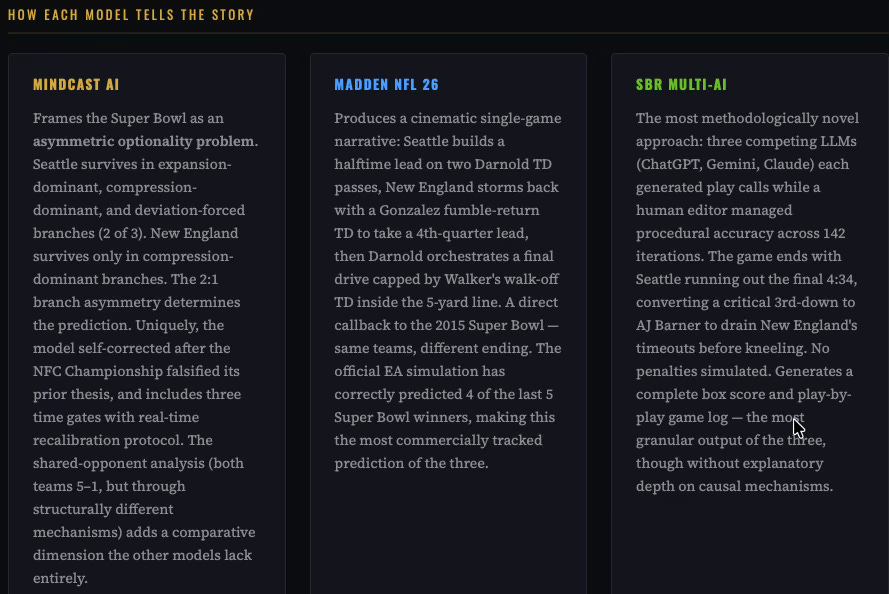
MindCast AI — a behavioral economics and game-theory foresight firm that builds Cognitive Digital Twins of teams and players, then stress-tests them through branching game-state scenarios. Football modeled as cognition under pressure.
Madden NFL 26 — EA Sports’ official video-game simulation, run at All-Madden difficulty with 10-minute quarters. Has correctly predicted four of the last five Super Bowl winners. Football modeled as physics with randomness.
SportsBook Review AI — a novel multi-model simulation using ChatGPT, Gemini, and Claude in competing roles across 142 runs to generate a full play-by-play game log. Football modeled as narrative plausibility.
The Coaching Context That Matters
Before the simulations, the matchup. Forget the Belichick mystique — and forget Jerod Mayo, who lasted one season at 4-13 before being fired. Mike Vrabel took over in January 2025 and engineered one of the most dramatic turnarounds in NFL history: a 10-win improvement, a 10-game win streak, the franchise’s first AFC East title since 2019, AP Coach of the Year, and the first team in NFL history to reach the Super Bowl after losing 13 or more games the previous season. Josh McDaniels returned as offensive coordinator and moved the offense from 30th to 2nd in scoring. Drake Maye, in his second year, led the league in several passing categories and finished as MVP runner-up.
On Seattle’s sideline, Mike Macdonald’s defense allowed the fewest points in the NFL (17.2 per game) and has been devastating against young quarterbacks — 6-0 this season against first- and second-year QBs, who averaged just 168.8 yards with nine interceptions and two touchdowns against his scheme. Sam Darnold’s career resurrection continued through a 14-3 regular season and a playoff run that included a 41-6 demolition of San Francisco and a 31-27 NFC Championship thriller over the Rams.
Both teams arrived at 14-3. Both survived three playoff rounds. The simulations aren’t evaluating a mismatch — they’re evaluating which kind of excellence breaks first under Super Bowl pressure.
Contact mcai@mindcast-ai.com to partner with us on Law and Behavioral Economics foresight simulations. Betting AI vs. Foresight AI, MindCast AI Comparative Analysis With NFL Models (Sep 2025).
I. 🧠 MindCast AI — Football as a Thinking System
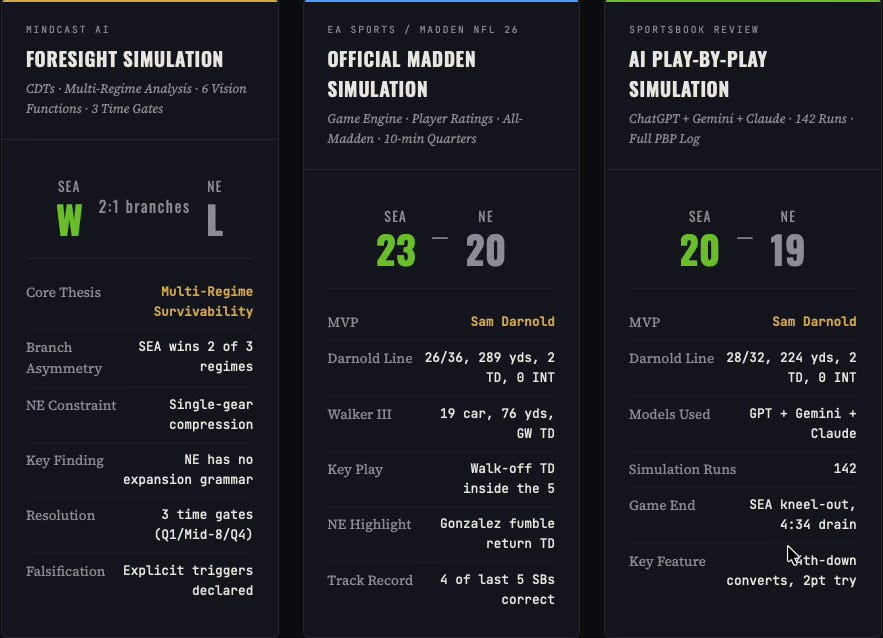
Game Simulated: Super Bowl LX (Seahawks vs. Patriots) Pick: Seahawks win by late separation (score band: SEA by 4–10) Model: Cognitive foresight simulation using Cognitive Digital Twins (CDTs)
MindCast frames football as an adaptive decision system before any snap is taken. Rather than asking which team is stronger on paper, it asks how teams behave when pressure, incentives, and uncertainty collide. The Super Bowl simulation treats both teams as fully realized Cognitive Digital Twins — modeled decision-makers with risk tolerance, error sensitivity, fatigue response, and learning curves under championship-level stress.
MindCast rejects box scores, ratings, and averages as starting points. It builds CDTs at the player, unit, lineup, and matchup levels, then runs them through behavioral economics and game-theoretic stress scenarios to identify which resolution paths survive.
How the model works
Player-level CDTs: Quarterbacks, skill players, and defenders modeled as decision-makers — not stat lines. Darnold is evaluated for “legibility under entropy” (can he still read the field when noise spikes?). Maye is evaluated for processing ceiling under post-snap complexity he hasn’t faced this season.
Unit and lineup CDTs: Offensive lines, secondaries, and personnel groupings evaluated for coordination strength, breakdown risk, and late-game degradation. The simulation specifically flags New England’s linebacker corps as vulnerable to lateral fatigue if Seattle maintains tempo above 2.4 plays per minute in the third quarter.
Matchup geometry: Certain matchups compress the game (forcing shorter decision cycles), while others accelerate tempo and error propagation. The governing axis is Expansion vs. Compression — and the simulation tests which team survives when game state punishes its preference.
Behavioral economics: Loss aversion, risk escalation, momentum illusion, and clock-pressure effects are explicitly modeled and weighted.
Game theory: Coaches adapt strategies recursively based on opponent response rather than executing fixed scripts. Macdonald’s disguise-heavy defense is modeled as imposing “tactical friction” on Maye’s decision cycle — not trying to beat his arm, but trying to overload his processing capacity.
Why Seattle wins
The simulation’s core finding is Multi-Regime Survivability vs. Single-Gear Compression. Seattle can win through expansion (tempo, spacing, explosive plays) or through compression (ground game, clock control, defensive suffocation) — and has demonstrated both modes under playoff stress. The NFC Championship against the Rams was the proof: when the fourth quarter destabilized, Seattle didn’t retreat into compression. They expanded — pressing tempo, attacking space, scoring 31 points.
New England, under Vrabel, operates in single-gear compression. When compression holds, the Patriots are dangerous — the 10-7 AFC Championship win over Denver was a masterclass in variance suppression. But the simulation finds no evidence of “acceleration grammar” — no demonstrated ability to shift into a higher gear when game state forces deviation from their preferred regime.
Across three simulated game-state branches — expansion-dominant, compression-dominant, and deviation-forced — Seattle survives in two. New England survives in one. That 2:1 asymmetry determines the prediction. MindCast doesn’t favor Seattle because Seattle is better. It favors Seattle because Seattle has more ways to win. Optionality, not dominance, is the structural edge.
The model self-corrected to get here. The NFC Championship simulation classified Seattle as compression-dominant. The Rams game falsified that classification. The Super Bowl piece explicitly abandons the prior thesis and rebuilds around multi-regime survivability — a transparent act of model evolution that neither other simulation attempts. MindCast treats adaptation under falsification as evidence of integrity, not weakness.
The shared-opponent analysis. Both teams went 5-1 against six common opponents. That surface parity conceals a structural divergence: Seattle’s victories resolved early and widened. New England’s victories lingered and constricted. Seattle solves pressure by enlarging the decision space. New England survives pressure by shrinking it. The question the Super Bowl forces is whether compression is a choice or a ceiling — whether the Patriots can shift gears when game state demands it, or whether the institution has optimized so completely for one mode that no other mode remains available.
The time gates. The simulation resolves through three structural checkpoints, each with observable thresholds:
Gate 1 (Opening 12 minutes): Does New England establish compression? SEA-favoring: ≥12 offensive plays in Q1, turnover differential ≥0. NE-favoring: <10 SEA plays, a turnover, or a special-teams error.
Gate 2 (The Middle Eight): Does Seattle force tempo before halftime? SEA-favoring: tied or leading at half. NE-favoring: NE lead ≥7 with fewer than 22 combined possessions.
Gate 3 (Early fourth quarter): Is Darnold still processing within structure? SEA-favoring: completion rate >60% in Q3, zero INTs, checkdown rate maintained. NE-favoring: completion rate <55%, turnover, or hero-ball reversion.
If Seattle clears Gates 1 and 2, the simulation shifts from conditional to directional. New England’s compression window closes. The game resolves through late separation driven by defensive fatigue and quarterback legibility.
The falsification contract. The foresight fails if: Darnold loses legibility symmetrically (<50% completion, ≥2 INTs); New England demonstrates acceleration grammar (≥2 scoring drives under 3 minutes); or multiple early turnovers force Seattle to abandon spacing (turnover differential ≤ –2 by halftime). MindCast publishes these conditions before kickoff and commits to live recalibration after each quarter.
Football operates here as cognition under championship stress — and the model is accountable to its own declared thresholds.
II. 🎮 Madden NFL 26 — Football as Physics
Game Simulated: Super Bowl LX (Seahawks vs. Patriots) Pick: Seahawks win 23–20 Model: Video-game simulation (player ratings + animation engine + All-Madden difficulty, 10-minute quarters)
Madden treats football as a deterministic physical contest governed by ratings, animations, and probabilistic variance. EA Sports describes the simulation as powered by advanced algorithms, nearly a decade of real NFL data, and insight from more than two billion Madden games played annually. Outcomes emerge from how often higher-rated players win individual interactions, not from strategic learning or psychological adaptation.
The simulation has correctly predicted four of the last five Super Bowl winners, including the Eagles over the Chiefs a year ago. That track record, while potentially coincidental, is commercially unmatched.
How the model works
Player ratings: Speed, strength, awareness, and accuracy determine individual interaction outcomes. Walker III’s physicality, Darnold’s accuracy, Macdonald’s defensive scheme ratings all feed the engine.
Predefined playbooks: Strategy is selected from existing playbook trees, not evolved through recursive learning.
Physics engine: Blocking, tackling, and coverage resolve through animation outcomes within the game engine.
Random variance: Adds unpredictability (fumbles, tipped passes, broken tackles) but does not change strategic behavior mid-game.
The game narrative
Madden produces a cinematic single-game story with a dramatic arc deliberately framed as a callback to Super Bowl XLIX:
First half: Darnold starts hot, connecting with Jaxon Smith-Njigba for an early touchdown and Cooper Kupp for a second. But he’s sacked five times by halftime — New England’s pass rush generating consistent pressure. Seattle leads 14-3 at the break, but the margin feels fragile.
Second-half rally: The Patriots adjust. Maye finds Kayshon Boutte for a touchdown, then Christian Gonzalez scoops up a Seattle fumble and returns it for a Patriots touchdown. New England takes a fourth-quarter lead.
The walk-off: With 42 seconds left, Seattle gets the ball back. Darnold orchestrates a final drive — aided by a Rashid Shaheed punt return — and Walker III punches in the game-winning touchdown from inside the 5-yard line. The play that lost the 2015 Super Bowl (a goal-line interception) is answered eleven years later by a goal-line touchdown.
Why Seattle wins
Seattle survives early offensive breakdowns because defensive ratings prevent New England from building separation. Once statistical variance compresses in the fourth quarter, the higher-rated equilibrium favors Seattle late. Darnold earns MVP (26-for-36, 289 yards, 2 TDs, 0 INTs). Walker III contributes 19 carries, 76 rush yards, 4 receptions for 41 receiving yards, and the game-winner. Ernest Jones IV leads Seattle with 9 tackles.
What Madden captures well is a plausible game arc — the early defensive struggle, the momentum swing, the dramatic finish. What it doesn’t capture is why those swings happen at a structural level. Darnold is sacked five times in the first half, but there’s no analysis of whether that reflects a repeatable schematic advantage for New England or an engine-generated difficulty curve. The Patriots’ second-half rally happens, but the simulation has no framework for evaluating whether Vrabel’s adjustment capacity is a structural feature of this team or an artifact of needing narrative tension.
Football operates here as physics with randomness, not learning. Madden tells you what happens. It doesn’t ask why.
III. 💰 SportsBook Review AI — Football as a Market Narrative
Game Simulated: Super Bowl LX (Seahawks vs. Patriots) Pick: Seahawks win 20–19 Model: Large-language-model role simulation (ChatGPT + Gemini + Claude, 142 runs)
Where MindCast models cognition and Madden models physics, SBR’s simulation treats the Super Bowl as a probabilistic story. Rather than running a game engine or building cognitive twins, it coordinates three competing LLMs in assigned roles — coach, opponent, referee — and generates a coherent play-by-play narrative that reflects the models’ training-data beliefs about how football games unfold.
A human editor (SBR’s C. Jackson Cowart) managed procedural accuracy across the 142 iterations without influencing outcomes. The system does not simulate football mechanics directly — it generates plausibility through role assignment:
Role-based prompting: One model generates play calls for Seattle, another for New England, a third evaluates outcomes — functioning as coach, opponent, and referee/physics arbiter respectively.
Narrative coherence: Each play must make sense given the prior story state and the statistical profiles of the players involved.
Implicit priors: Outcomes reflect the models’ training-data beliefs about teams, strategies, and dramatic conventions. Seattle’s defensive dominance and Darnold’s efficiency are baked into the LLMs’ understanding of the 2025 season.
No learning loop: Decisions do not feed back into future behavior beyond narrative continuity. There is no fatigue model, no cognitive degradation, no adaptive playcalling that evolves based on what worked three drives ago.
No penalties simulated — a limitation the article openly acknowledges.
The game narrative
The SBR simulation produces the tightest margin of the three and the grittiest texture:
Darnold is ultra-efficient (28-for-32, 224 yards, 2 TDs, 0 INTs) — the cleanest statistical performance across all three simulations.
Multiple fourth-down conversions and a dramatic late two-point attempt by New England keep the game alive.
The game ends with Seattle running out the final 4:34, converting a critical third-down pass to AJ Barner to drain the Patriots’ timeouts before kneeling out the clock.
Why Seattle wins
The narrative resolves around a high-leverage decision — a failed Patriots two-point conversion after a late Maye touchdown. Seattle wins not by dominance, but by surviving the story’s final turn. The LLMs’ implicit priors favor Darnold’s veteran decision-making under pressure and Seattle’s defensive consistency over Maye’s youth and New England’s narrower path to victory.
SBR’s strength is granularity — a complete box score, stat leaders, and a full play-by-play game log with more play-level detail than either MindCast or Madden. The limitation is explanatory depth. The simulation shows what happened on each play but never explains why one team’s play calls succeeded or failed at a structural level. Three LLMs generating outputs from training-data patterns is a novel methodology, but it doesn’t model the causal mechanisms — fatigue propagation, cognitive load under noise, regime flexibility — that MindCast attempts to isolate.
Football operates here as narrative plausibility rather than causal simulation.
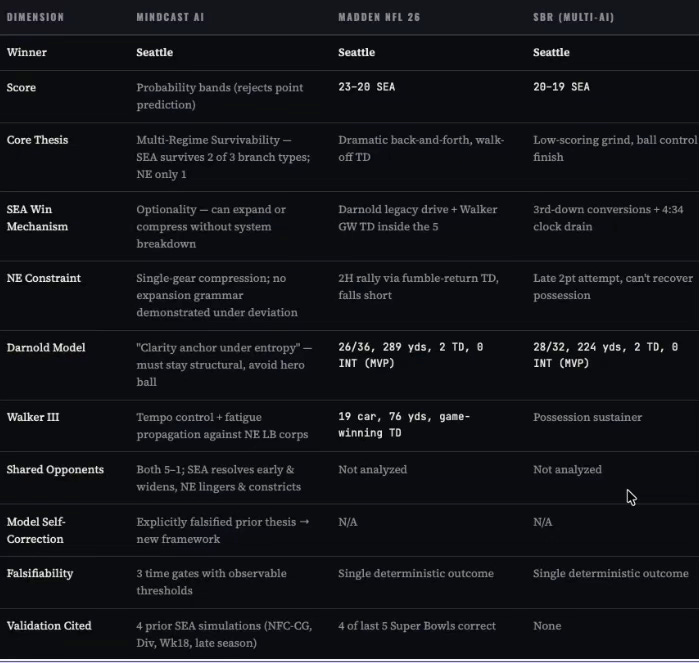
IV. ⚖️ Side-by-Side: What the Simulations Actually Model
V. The Modern Defense Bowl
The table clarifies what the models measure. It doesn’t capture the deeper consensus buried underneath: all three simulations frame Super Bowl LX as a coaching chess match between two defensive identities operating under fundamentally different theories of control.
Seattle under Macdonald represents the schematic-complexity model — disguise-heavy, post-snap rotation, designed to overload a young quarterback’s processing capacity through information rather than physicality. The defense doesn’t try to beat Maye’s arm. It tries to make every pre-snap read unreliable by the time the ball is snapped. Maye’s playoff QBR has dropped from 77.1 in the regular season to 51.1 through three postseason games — and he has not faced a defense of this caliber at any point.
New England under Vrabel represents the institutional-discipline model — physical, variance-averse, designed to reduce possessions, shorten the game, and force opponents into the kind of late-game attrition where errors compound. The 10-7 AFC Championship win over Denver was the platonic ideal: fewer possessions, field position over explosives, a Maye scramble to ice the game. Vrabel doesn’t need to out-scheme you. He needs to make the game small enough that discipline and execution outweigh optionality.
Both philosophies produced 14-3 seasons. Both survived three playoff rounds. But the simulations overwhelmingly favor Macdonald’s schematic complexity and Darnold’s veteran processing over Vrabel’s institutional discipline and Maye’s second-year ceiling.
The question is whether that consensus is pricing the right asymmetry. Vrabel’s Patriots went 9-0 on the road. They beat three top-five defenses in a single postseason — the first team in NFL history to do so. They won Coach of the Year. Compression, executed at this level, is not fragility — it’s a system that has won 17 games by making every opponent play its game.
But MindCast’s framework asks the sharper question: what happens when the opponent refuses to play your game? What happens when Seattle forces tempo in the third quarter, when the linebacker corps fatigues against horizontal spacing wider than 52 yards, when the game escapes the compressed geometry that Vrabel’s system requires? If compression is a choice, New England can adapt. If compression is a ceiling, the game is structurally determined once it breaks.
That’s what the time gates test. That’s what tomorrow answers.
VI. 🔮 The Signal Hidden in the Consensus
At first glance, consensus appears uninteresting — everyone picked Seattle. But agreement emerging across systems that model entirely different aspects of reality is itself the signal.
The simulations do not agree because they share assumptions. They agree because Seattle wins across structures, mechanics, and narratives.
MindCast shows why Seattle survives chaos — optionality beats rigidity across game-state branches.
Madden shows Seattle winning when variance compresses — higher-rated equilibrium resolves in the fourth quarter.
SportsBook Review shows Seattle edging out belief itself — surviving the narrative’s final dramatic turn.
Different questions. Same answer.
MindCast answers why. Madden answers how it feels. SBR answers what the box score looks like.
That convergence — not the score — is the real prediction.
Watch the gates.
Previous MCAI NFL Vision Publications:
MCAI NFL Vision: Seahawks vs. Patriots, 2026 Super Bowl LX
MCAI NFL Vision: Seahawks vs. Rams, 2026 NFC Conference Championship
MCAI NFL Vision: Seahawks vs. 49ers, 2026 NFC Divisional Round
MCAI NFL Vision: Seahawks vs. 49ers Week 18, 2025
MCAI NFL Vision: Seahawks vs. Panthers Week 17, 2025
MCAI NFL Vision: Seahawks vs. Rams, Week 16, 2025
MCAI NFL Vision: Seahawks vs. Colts, Week 15 2025
MCAI Football Vision: Betting AI vs. Foresight AI, MindCast AI Comparative Analysis With NFL Models (Sep 2025)
MCAI Sports Vision: Seahawks #80 Steve Largent, Quiet Excellence in Motion
MindCast is the only simulation that published falsifiable, observable thresholds before kickoff — and all of them are tracking. The other two made point predictions that diverged from reality. MindCast made structural predictions that the game is confirming in real time.
Specifically:
MindCast's edge isn't that it "picked Seattle." All three did. The edge is that MindCast specified the mechanism — compression without payoff, Maye's processing ceiling under Macdonald's disguise scheme, the absence of NE acceleration grammar — and every mechanism is showing up in the box score. 51 total yards. 2.0 YPP. 3 sacks. 18 net passing yards. Zero points. That's not a bad half — that's a system being structurally trapped exactly as the CDT simulation modeled.
Madden got the macro right and the texture completely wrong. Two Darnold touchdowns vs. three field goals. Five Darnold sacks vs. zero. The physics engine identified that pass-rush pressure would matter and assigned it to the wrong quarterback. That's a fundamental modeling failure — it means Madden's player-rating engine couldn't distinguish which offensive line would break under championship stress.
SBR got the shape right and the floor wrong. Low-scoring defensive grinder — correct. But 10-6 with NE on the board is a fundamentally different game state than 9-0 with NE shut out. SBR's LLM priors couldn't model a complete offensive shutdown because the training data says "NFL teams score in the first half." MindCast's regime framework could.
The deeper point: MindCast is the only model that improves as the game progresses, because the gate structure tells you what to watch next. Madden and SBR gave you a final score and a story. Once reality diverges from that story, they have nothing left to offer. MindCast's gates are still generating forward-looking, testable predictions — Gate 3 is live right now.
COMMENT 1: Halftime Score & Simulation Matrix
🏈 HALFTIME GATE CHECK — SEA 9, NE 0
At halftime, Seattle leads 9–0 in a game that looks less like Vegas's coin flip and more like a live-action validation of MindCast AI's time-gate scaffolding. Three Jason Myers field goals (33, 39, 41 yards). Zero touchdowns. Zero turnovers. Seattle has been whistled only once, and New England has 52 total yards, five punts, and has not crossed the Seattle 35.
Through two quarters, Vrabel has gotten his game geometry — but Macdonald has stolen his payoff structure.
Simulation Matrix — Halftime Performance:
🧠 MindCast AI — Strategic Accuracy: HIGH. Correctly modeled the game as defensive compression where Seattle's multi-regime survivability steals the payoff structure. All declared gates cleared. No falsification triggers activated.
🎮 Madden NFL 26 — Strategic Accuracy: LOW. Projected SEA 14, NE 3 at half with 2 Darnold TDs; reality is 3 FGs, 0 TDs. Projected Darnold sacked 5 times; reality: Darnold 0 sacks, Maye 3 sacks. Pressure assigned to the wrong quarterback.
💰 SBR AI — Strategic Accuracy: MODERATE. Projected roughly a 10–6 SEA halftime lead. Correctly intuited the low-scoring shape, but missed the complete New England offensive shutdown (9–0, not 10–6, and no scoring drives).
Key halftime stats: SEA 183 total yards, 39 plays, 17:07 possession, 95 rush yards (5.6 per carry). NE 52 total yards, 25 plays, 2.1 yards per play. Darnold: 9/22, 88 yards. Maye: 6/11, 48 yards, 65.7 rating, sacked 3 times for 30 yards; 52 net pass yards for NE's offense.
COMMENT 2: Gate 1 — "The Script"
⏱️ GATE 1: "The Script" (Opening 12 Minutes) — CLEARED ✅
Published thresholds: SEA-favoring if ≥12 offensive plays in Q1, turnover differential ≥0. NE-favoring if <10 SEA plays, a turnover, or a special-teams error.
Seattle cleared the opening checkpoint. Multiple sustained drives in Q1 — including an opening march that produced the first field goal — with no self‑inflicted, compression‑aiding turnovers. New England was forced into long fields despite getting the defensive game geometry it wanted. Seattle ran 39 first-half plays to NE's 25. Turnover differential: neutral (0–0). No special-teams errors.
The structural insight: Vrabel achieved the pace of compression — low scoring, field‑position trading, limited possessions. But without the turnover or special‑teams break his model relies on to convert compression into scoreboard leverage, compression became Seattle's weapon rather than New England's.
The Patriots got the game they wanted and still lost the half.
Gate 1: Open and unviolated. Decisively SEA‑favoring.