

Cultures Under Shared Rules — The Seattle Lab at FIFA World Cup 2026 series
Belgium vs Egypt, The Seattle Lab Opens: Plural Coordination Meets Civilizational Memory at Lumen Field
USA vs Australia, The Seattle Lab Under a Home Crowd: Recombinant Innovation Meets Resilient Pragmatism on Juneteenth
MindCast Special Series — a deliberate stress test of the MindCast system beyond the controlled venue of the MindCast Seattle Lab
World Cup Championship Index 2026, Championship Prior Edition — Why France Can Be the Strongest Team and Argentina the Most Likely Champion
When a FIFA World Cup Model Picks France and the Economist Picks Argentina
Match: 🇲🇽 Mexico vs South Korea 🇰🇷 · Group A Venue: Estadio Akron, Zapopan (Guadalajara), Mexico Date: June 18, 2026 · 9:00 PM CT Series: MindCast Special Series — a deliberate stress test of the MindCast system beyond the controlled venue of the MindCast Seattle Lab Published before kickoff. Time gates and falsification contract committed below.
Methodological provenance: The simulation inherits the validated foresight discipline of MindCast AI’s NFL Vision series — mechanism before score, pre-committed time gates, a falsification contract, and documented self-correction — built across seven consecutive structural calls and a 29-for-29 cross-domain prediction record. The discipline transfers; the accuracy record stays with its source domains. (See Super Bowl LX — AI Simulation vs. Reality and Seahawks 2025–2026 Season Validation.)
🧭 Founder’s Note: The Home Field on My Street
I arrived in Bellevue, Washington in 1979. Mexican families were the largest minority group in the Bellevue I came into, and the culture sat woven through daily life long before I had a framework to name what I was seeing. Over the past few days, walking the same streets, I have watched Mexican jerseys appear everywhere — green shirts two thousand miles from Guadalajara, worn by people who will never set foot in Estadio Akron yet carry it with them anyway.
The observation is not sentiment. The observation is the thesis. The MindCast Seattle Lab argued across two simulations that home advantage detaches from geography and attaches to whoever fills the room — a co-produced home field rather than a fixed one. A diaspora is that claim made flesh. Mexico’s home field does not stay in Guadalajara; it travels, and it reassembles on a sidewalk in Bellevue. Culture carries the stadium with it.
The Special Series exists to test exactly that kind of claim under conditions the controlled Lab cannot produce, which is where this simulation begins.
🔬 I. Why This Match Stress-Tests the System
The MindCast Seattle Lab runs a controlled experiment, holding one stadium constant across six matches so that culture and environment become the only moving variables. A controlled experiment proves an instrument works. A stress test probes where the instrument bends. The MindCast Special Series does the second job — it removes the controls deliberately and watches the system operate under load.
Mexico versus South Korea removes four controls at once, and each absence is a test condition the standard slate cannot generate:
The venue is no longer fixed at the point of observation. The founder reads the match from Bellevue while the diaspora carries the home field outward.
The host is no longer an unsettled side lifted by its crowd. Mexico arrives settled and heavily burdened, which flips the crowd effect from amplifier toward pressure.
The visitor is no longer venue-naive. South Korea already won inside Estadio Akron five days earlier, blunting the home edge.
The two cultures mirror each other. Both funnel through a single talisman, so the read loses the sharp contrast earlier matches supplied.
Each removed control is a stressor, and the simulation reports how the MindCast system reads a match built to be hard to read. (For the controlled baselines this entry departs from, see Belgium vs Egypt and USA vs Australia.)
Beneath the four removed controls runs the variable that matters most, and it is not the crowd. The crowd is visible; memory is not. Mexico carries three decades of reaching the Round of 16 and never clearing it, a group-stage collapse in 2022, and a “this is our year” expectation that never fully resolves. South Korea carries almost none of it. The truest framing of the match is therefore burdened memory against freedom from expectation, and the crowd’s real function is to amplify the burden rather than create it. Home field against road team is the surface; memory against freedom is the mechanism.
The simulation reads each side through MindCast AI’s Cultural Innovation Vision and scores both on the four-metric Cultural Signal Integrity Model defined in the next section.
🧬 II. The Two Cognitive Digital Twins Entering the Test
Each Cognitive Digital Twin models a national footballing culture as an operating system — the grammar a federation uses to coordinate talent, absorb pressure, and express identity under stress. Mexico and South Korea both run concentrated systems built around a single attacking apex, which makes their differences a matter of burden and freedom rather than structure. The profiles below read each as it stands after Matchday 1.
🇲🇽 Mexico — Home Expectation Under a Thirty-Year Ceiling
Mexico operates through concentrated experience under enormous national weight. Javier Aguirre, 67 and in his third spell, fields a settled 4-1-2-3 anchored by captain Edson Álvarez and led by Raúl Jiménez, whose comeback from a fractured skull to a strong Premier League season carries the line. Santiago Giménez waits behind him, Johan Vásquez and César Montes hold the back, and a 17-year-old, Gilberto Mora, supplies the spark. Raúl Rangel started the opener in goal ahead of 40-year-old Guillermo Ochoa, now a symbolic presence on a record-equaling sixth World Cup. El Tri opened by beating South Africa 2–0 at the Azteca.
The structural signal sits in the burden. Mexico reached the Round of 16 in eight consecutive World Cups and never advanced past it, then crashed out in the group stage in 2022 — a thirty-year ceiling the country calls the Quinto Partido. Guadalajara sharpens the symbolism, because Estadio Akron is the home of Chivas, a club that fields only Mexican players, the purest expression of national footballing identity. A home World Cup hands Mexico the loudest possible affirmation and the heaviest possible expectation in the same breath.
Operating grammar: concentrated experience expressed under national weight. Special Series role: whether a settled home favorite reads its own crowd as fuel or as the pressure that has capped it for three decades.
🇰🇷 South Korea — The Giant-Killer, Already at Home in the Room
South Korea operates through disciplined collective coherence with a concentrated attacking apex. Hong Myung-bo, captain and icon of the 2002 semifinal side, returned as manager in 2024 to open jeering and a contested mandate, and has since shifted the team toward a back three. Son Heung-min, 33 and likely in his final World Cup, is the undisputed focal point, supported by genuine quality in Kim Min-jae, Lee Kang-in, and the midfielder Hwang In-beom, whose display drove the opening 2–1 win over Czechia — played inside this same Estadio Akron.
The structural signal sits in the overachievement and the familiarity. South Korea is Asia’s most successful World Cup nation, a serial toppler of European powers across Germany in 2018, Portugal in 2022, and Czechia in 2026, and a side that plays free of expectation precisely because no one outside Korea hands it any. Five days before facing Mexico, the Taeguk Warriors won in the exact stadium that will host the match, a rare gift of venue familiarity to a visiting team.
Operating grammar: collective discipline carrying a concentrated apex, free of expectation. Special Series role:whether a venue-tested giant-killer can convert a hostile, saturated room into the conditions it thrives in.
📊 III. Cultural Signal Integrity Model — Scorecard
Scores run 0–100. Both teams played their openers on June 11, so Recursion Strength reads as a live measurement rather than a baseline prior — Mexico adapting from the South Africa win, South Korea from the Czechia comeback.
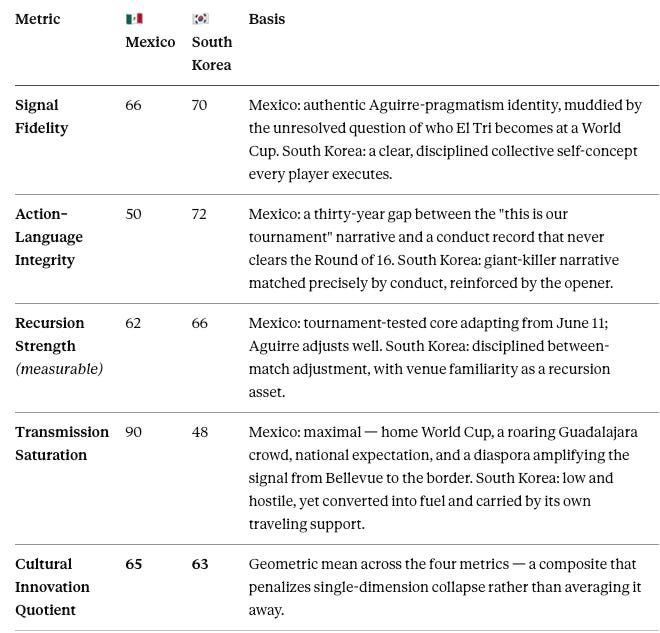
Each number rests on evidence, not assertion:
Signal Fidelity (66 / 70). Mexico shows a coherent identity under Aguirre, still shadowed by an unresolved tournament self-image; South Korea shows a disciplined collective every player executes the same way.
Action–Language Integrity (50 / 72). Mexico’s 50 reflects thirty years of “this is our year” rhetoric that never once translated past the Round of 16; South Korea’s 72 reflects a giant-killer narrative its conduct keeps matching, Czechia now alongside Germany and Portugal.
Recursion Strength (62 / 66). Both adapted inside their openers, with South Korea credited slightly higher for carrying that adaptation into a stadium it already knows.
Transmission Saturation (90 / 48). Mexico draws a home World Cup amplified by the largest diaspora in North America; South Korea draws a hostile road environment its identity converts rather than absorbs.
The geometric-mean composite is deliberate. A culture strong on three dimensions and brittle on one does not earn a high synthesis score, because role-ratio logic holds that systems fracture at their weakest coordinating dimension, not at their average.
One column carries the asymmetry. Strip Transmission Saturation away and South Korea reads as the more coherent system — higher fidelity, far tighter narrative-conduct alignment. Add the home crowd back and Mexico edges the composite, because saturation lifts the Mexican reading while its lowest dimension, the Quinto Partido gap, drags beneath. The home crowd inflates El Tri’s signal and exposes its wound at the same time.
Synthesis Cultural Innovation Quotient for the interaction: 62. The figure estimates signal yield from the encounter, not a scoreline, and reads against the fixed interpretive scale reused across the series:
Below 50 — weak differentiation between operating grammars; low experimental value.
50–59 — moderate differentiation; a usable reading, though not a headline experiment.
60–69 — strong differentiation; the match generates clear cultural signal regardless of result.
70 and above — extraordinary contrast; a flagship fixture where opposing grammars collide at maximum separation.
Mexico–South Korea opens at 62, the lowest interaction figure in the project so far, and the low reading is the point. Belgium–Egypt scored 64 as a pure clash of opposed grammars. USA–Australia scored 63 as the home crowd began to intrude between the cultures and the measurement. Mexico–South Korea drops further still, because two concentrated systems mirror each other rather than contrast, and a diaspora-carried home field loads the read more heavily than any prior fixture. A stress test should compress the signal, and the MindCast system registers the compression honestly rather than inflating it — the instrument reporting its own difficulty.
Contact mcai@mindcast-ai.com to partner on Predictive Game Theory in Law and Behavioral Economics.
🎭 IV. Role-Ratio Profiles
Role ratios break each squad into the four functions that decide whether a system scales, stalls, or fractures: Signalers who generate the decisive creative output, Transmitters who move it through the side, Hybrids who translate between roles and contexts, and Absorbers who hold structure under pressure. The mirror this match produces — two concentrated systems — shows up directly in the apex-heavy Signal share and the deep Absorber base on both sides.
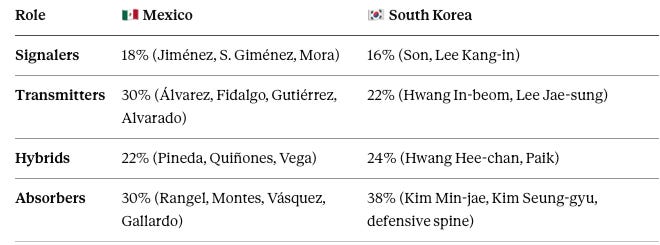
Mexico carries a balanced profile with a concentrated apex and a solid Absorber base built from experience. South Korea runs more Absorber-heavy still, the disciplined block that defines its giant-killing record, beneath an even narrower Signal apex in Son. The diagnostic prediction follows from the mirror: with neither side dispersed, the match turns on which talisman breaks free and which Absorber base holds, and Mexico’s home crowd is the variable that decides whether Jiménez plays liberated or pressured.
🌎 V. The Environmental Variable — A Home Field That Travels
The MindCast Seattle Lab treats the venue as an experimental control, fixed so that culture moves against a constant backdrop. The Special Series breaks that control on purpose, and Mexico versus South Korea breaks it twice over.
The first break is the diaspora. Mexico’s home field does not end at the walls of Estadio Akron; it extends across the United States and reassembles wherever Mexican supporters gather, including the Bellevue streets where the founder counted green jerseys this week. A Moody’s Analytics economist recently overrode his own model to pick Argentina precisely because a Western Hemisphere World Cup hands Latin American nations a home field their fan base carries into neutral stadiums. (See the MindCast commentary on that override.) Mexico is the purest case of the effect, because no nation’s diaspora saturates North America more completely.
Expected crowd composition at Estadio Akron:

The second break inverts the saturation effect. The United States entered its home crowd as an unsettled, recombinant side that the noise could lift. Mexico enters as a settled, burdened side carrying a thirty-year ceiling, so the same saturation reads as expectation-load — a crowd that affirms and pressures in one sound. The crowd amplifies; memory is what it amplifies. A home favorite that needs to win, in front of a country that has waited three decades, is the most loaded version of the variable the project has measured.
South Korea complicates the read once more. A visitor that already won in the building is the first away side in the series to arrive venue-tested, so Mexico’s home advantage runs lower than the raw crowd share suggests. The Special Series therefore measures the home field at its most powerful and its most compromised at the same time — exactly the kind of confounded condition the controlled Lab excludes by design, and the stress test invites by design.
The effect deserves a name, because it reaches past this match. The Portable Home Field is the MindCast construct for cultural presence that detaches from geography and stays operational through diaspora networks — a home advantage that reassembles wherever a nation’s supporters concentrate rather than residing in a stadium. Mexico is the first formal case study, the clearest instance available, yet the construct generalizes: Argentina and Brazil carry the same advantage across a Western Hemisphere World Cup, and any institution with a dispersed, identity-bound community carries a version of it. A model that prices only the building underrates every culture whose field travels.
🌫️ VI. Game Regime Classification: TRAP
The four regimes are Arena, Fog, Labyrinth, and Trap. Mexico versus South Korea classifies as Trap, the regime where a side’s apparent strength becomes the lever an opponent turns against it. The structure is textbook. A burdened home favorite expected to win, carrying thirty years of ceiling and the weight of a watching nation, faces a disciplined giant-killer that specializes in toppling favorites and already owns the room. Mexican dominance becomes a liability the moment it fails to produce an early goal, because the crowd’s expectation curdles into pressure, and South Korea’s organized block converts that pressure into counters through Son.
The classification carries its own falsification. An early Mexican goal that releases the burden and opens the match into a free-flowing contest would read as Arena, not Trap — the favorite’s strength expressed cleanly rather than turned against it. The opening half-hour decides which regime governs, and the Quinto Partido history weights the Trap.
🔮 VII. Match Forecast (Secondary Output)
The simulation’s primary prediction is structural, not numeric. Mexico imposes territory and shot volume through home saturation and Jiménez; South Korea holds its disciplined block, stays within one goal past the hour, and converts Mexican impatience into counters through Son. The football scoreline rides beneath that mechanism as a secondary output — the discipline the NFL Vision series applied when it published resolution conditions first and a score band second.
Primary prediction (structural): a Trap-regime match resolving toward a Mexican win only if El Tri scores early and plays free of the ceiling, and toward a draw or upset if the half stays level and expectation becomes weight.
Secondary output (scoreline probabilities):

Most likely scoreline: 1–1 — the modal Trap outcome, a disciplined visitor frustrating a burdened host. Most likely result category: a Mexico win, across the 1–0, 2–1, and 2–0 paths combined.
Alternative outcomes: Mexico 2–1 · Mexico 1–0 · South Korea 1–0.
Primary driver: Mexico manufactures more chances through home saturation and a settled attack, but South Korea’s organized block, venue familiarity, and counter threat through Son raise the draw and upset paths well above a normal home favorite’s. The burden does the rest.
The forecast and the scorecard pull in instructive directions. South Korea holds the higher Action–Language Integrity and the cleaner identity, yet Mexico is favored — moderately, not commandingly. Coherence and victory remain different properties, as in both prior simulations: the burdened favorite’s saturation lifts its win probability while its narrative-conduct wound, the ceiling, suppresses the freedom it needs to convert.
🔀 VIII. Three Futures and the Conditions That Trigger Them
A point forecast names one outcome. A foresight reads the branches — the futures available to the match and the observable conditions that select among them. Mexico versus South Korea resolves into three futures, each triggered by a moment in the opening hour and each routed by the memory variable.
Future 1 — Mexico Plays Free. Trigger: Mexico scores inside the first 25–30 minutes. Mechanism: An early goal lifts the burden before it can settle. The crowd turns from anxious to roaring, the players stop carrying thirty years of ceiling, and El Tri controls tempo through Jiménez and a freed midfield. The regime reads Arena rather than Trap. Likely outcome: a Mexico win.
Future 2 — Mexico Feels the Weight. Trigger: the match stays scoreless into the second half. Mechanism: Expectation converts to pressure exactly as memory predicts. Decision-making tightens, Mexico forces rather than builds, and South Korea’s disciplined block gains leverage with every minute the score holds. The Trap deepens. Likely outcome: a draw, with a late South Korea opening.
Future 3 — South Korea Strikes First. Trigger: South Korea scores first. Mechanism: The emotional structure inverts in an instant. Mexico chases under the weight of a watching nation, the crowd turns nervous, and South Korea defends a lead it has the discipline and venue familiarity to protect while Son threatens the counter. Likely outcome: the highest upset probability on the board.
The three futures share one engine. Memory decides how Mexico answers the scoreboard, and the scoreboard in the opening hour decides which future the match enters. The time gates below are the instruments that read, live, which branch is unfolding.
⏱️ IX. Time Gates and Falsification Contract — Committed Before Kickoff
Two accountability instruments govern the simulation, both imported from the validated NFL method: in-match time gates that lock the structural read while the match is still in progress, and a falsification contract specifying what would prove the model wrong. The NFL Vision series established the gate logic — watch the gates, not the score.
In-Match Time Gates — crossed during play
Time Gate A — Opening 25 minutes (which regime governs). An early Mexican goal that releases the burden and opens the match reads Arena, the favorite’s strength expressed cleanly. A scoreless, compact opening with South Korea’s block intact engages the Trap, and the crowd’s expectation starts to weigh.
Time Gate B — The Halftime Eight (four minutes before and after the break). The point where home expectation either pays off or turns. Mexico-favoring if El Tri leads at the interval and the crowd reads as a twelfth man. South Korea-favoring if the match stays level or the visitor leads, and Mexican possession begins to look anxious rather than incisive.
Time Gate C — The 60th-Minute Fork (the Quinto Partido point). The hour mark resolves the regime, at the exact stage Mexico has historically tightened. Mexico-favoring if a multi-goal cushion relaxes the building. South Korea-favoring if the margin holds within one and the disciplined block survives while Son threatens on the break. A Mexican second goal before roughly the seventieth minute reaches terminal resolution — the point where the outcome locks and the remaining minutes only confirm it.
Falsification Contract — what would prove the simulation wrong
Each condition below is numeric and observable on June 18 or in the June 19 validation. Pre-commitment is the discipline. Falsification is the contract.
Gate 1 — Mexico’s burden. The expectation-load reading holds if Mexican chance quality drops while the score stays level late, the signature of a side forcing under pressure. Mexico playing progressively freer when level past the hour falsifies the reading and confirms a team that has shed the ceiling.
Gate 2 — South Korea’s resilience. The giant-killer identity holds if South Korea concedes no more than one goal and stays within a single goal past the seventieth minute. An early multi-goal collapse falsifies the resilience reading.
Gate 3 — Game Regime. The Trap classification holds if the match stays within one goal past the hour with visible Mexican anxiety and Korean counter-threat. A comfortable Mexican lead built through open play by halftime falsifies Trap and reads Arena.
Gate 4 — Transmission Saturation. Measurement protocol: sample 20 pre-match articles published June 13–18 across FIFA.com, ESPN, BBC Sport, Reuters, The Athletic, and one national outlet per side. Code each headline and lead paragraph for primary frame. The gate clears if home-nation framing — El Tri expectation, the Quinto Partido, the home crowd, must-win pressure — claims at least 60 percent of headline and lead emphasis, and if in-match Mexican territorial dominance reaches at least 55 percent possession. The diaspora dimension, the home field carried to Bellevue, resists numeric capture at the venue and stands as the qualitative stressor this entry exists to surface — a limit the Special Series names rather than hides.
Gate 5 — Recursion (measurable). The recursion read holds if Mexico visibly adjusts its structure from the June 11 South Africa win and South Korea carries forward a coherent adaptation from the Czechia comeback. Identical, unadjusted patterns across consecutive matches falsify positive recursion.
Series-level gate. The simulation weakens the framework if public narrative, supporter behavior, media framing, and on-pitch expression remain purely tactical and commercial, surfacing none of the burden, giant-killing, or diaspora-saturation themes specified above.
🔁 X. Forward Recursion Prediction
Mexico plays Czechia at the Azteca around June 24, and South Korea plays South Africa at Monterrey the same day, so the adaptation arc across three matches becomes measurable. The simulation commits the bridge in advance, partitioning the outcome space so no result escapes the prediction.
A Mexican performance that constructs goals freely should raise El Tri’s Signal Fidelity and signal a side shedding the ceiling, the burden converting to release.
A labored Mexican result built on forcing and set pieces should hold Signal Fidelity flat — a result without freedom.
A Mexican failure to break South Korea down should lower Signal Fidelity, confirming the Quinto Partido weight pressing again.
One measured quantity does double duty. Mexican chance quality when the score is level — the expectation line drawn in Gate 1 — resolves a gate here and seeds the read on whether El Tri carries freedom or weight into its final group match. One measurement, a running arc. The connective tissue makes the Special Series a designed probe rather than a one-off preview.
🔄 XI. Model Evolution Protocol and the Stress-Test Mandate
A foresight system that never updates cannot stay accurate, and a system that updates without admitting error carries no integrity. The NFL Vision series treated self-correction as its strongest credibility exhibit, abandoning a falsified thesis and rebuilding it openly before kickoff. The MindCast Special Series extends that discipline in a specific direction: where the MindCast Seattle Lab proves the instrument works under control, the Special Series probes where the instrument bends under conditions the control excludes.
The entry stress-tests four parts of the MindCast system at once:
The diaspora-carried home field tests whether the crowd reading still holds when the venue is not fixed at the point of observation.
The burdened favorite tests whether a home crowd registers as load rather than lift.
The venue-tested visitor tests whether the home-advantage estimate degrades gracefully when an away side already knows the room.
The mirrored matchup tests whether the interaction score behaves sensibly when two cultures contrast weakly.
The answer to the last, a series-low 62, shows the system reporting reduced signal rather than manufacturing it.
One honest boundary still travels with the borrowed discipline. The validated track record belongs to the NFL and cross-domain work; the Cultural Signal Integrity Model is early, and the Special Series deliberately points it at the hardest available conditions. The system earns its credibility not by reading easy matches cleanly but by reporting honestly when a match is hard to read.
🌐 XII. Forward Implications
The Mexico–South Korea contrast travels beyond football, because burden, freedom, and a capability carried by a dispersed community recur wherever culture has to produce outcomes. Four domains read the match through their own lens.
Law and institutional design. A burdened incumbent expected to deliver maps onto institutions carrying a long record of falling short at the final stage; a free challenger with nothing assumed maps onto the insurgent that performs because no one is watching for failure. Expectation operates as an institutional liability, not an asset.
Behavioral economics. Mexico’s ceiling is a textbook case of choking under accumulated expectation, the favorite’s loss-aversion tax; South Korea plays on house money. A diaspora carrying a home field is a network effect — value created by a dispersed community rather than a fixed location.
Predictive game theory. Trap formalizes as a game in which the favorite’s dominant strategy is exploited by a disciplined counter, with expectation as a strategic variable rather than a backdrop.
Artificial intelligence and cognitive systems. A capability that travels with a community rather than residing in a place maps onto distributed systems whose value emerges from the network rather than the node — and a model that reports lower confidence under genuine confound, rather than inflating certainty, is the behavior a trustworthy instrument should show under load.
📋 XIII. Performance Dashboard
The dashboard records every committed forecast in one place and converts on June 19. The three in-match time gates resolve into these rows; the scorecard, the regime call, and the recursion read supply the rest. Reused across every MindCast simulation, the dashboard accumulates into a visible cumulative record of model performance.
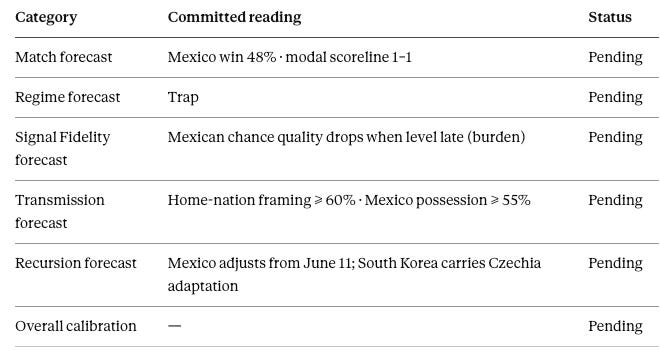
June 19 converts each Pending to Cleared, Triggered, or Revised — cleared when the committed reading holds, triggered when a falsification condition fires, revised when the Model Evolution Protocol rebuilds a classification.
📅 XIV. Validation Schedule
The simulation commits before the match and grades itself after, on a fixed three-step cadence. The schedule below pins each date to the deliverable attached to it, so accountability runs on a calendar rather than on convenience.

The June 19 calibration scores each committed gate as cleared or triggered, grades the match forecast against the result, recalibrates the baseline Cultural Signal Integrity Model readings against observed signal, and records how the system performed under the four removed controls — the core purpose of a Special Series entry.
🧭 Founder’s Note: Back on the Street
The simulation runs in Guadalajara, but the home field reaches Bellevue. When the match kicks off, the green shirts I have watched all week will gather around screens two thousand miles from Estadio Akron, and the crowd that matters for this culture will not all be inside the stadium. A model that prices only the seats in the building misses the country in the streets.
I came to Bellevue in 1979 and learned the culture before I had the language to measure it. The MindCast Special Series is the attempt to measure what I saw then and see again now — the Portable Home Field, a home field that no map contains, carried by the people who keep it alive wherever they stand.