

Cultures Under Shared Rules — The Seattle Lab at FIFA World Cup 2026 series
Belgium vs Egypt, The Seattle Lab Opens: Plural Coordination Meets Civilizational Memory at Lumen Field
USA vs Australia, The Seattle Lab Under a Home Crowd: Recombinant Innovation Meets Resilient Pragmatism on Juneteenth
MindCast Special Series — a deliberate stress test of the MindCast system beyond the controlled venue of the MindCast Seattle Lab
World Cup Championship Index 2026, Championship Prior Edition — Why France Can Be the Strongest Team and Argentina the Most Likely Champion
When a FIFA World Cup Model Picks France and the Economist Picks Argentina
Mexico vs South Korea, The MindCast Special Series — Home Field, Carried: A Diaspora Stress Test in Guadalajara
MindCast AI Proprietary Cognitive Digital Twin Foresight Simulation Match: 🇧🇪 Belgium vs Egypt 🇪🇬 · Group GVenue: Lumen Field (FIFA: Seattle Stadium), Seattle Date: June 15, 2026 · 12:00 PM PT Simulation: Opening experiment of the Seattle Lab — first of six matches Published before kickoff. Time gates and falsification contract committed below.
Methodological provenance: The opening simulation inherits the validated foresight discipline of MindCast AI’s NFL Vision series — mechanism before score, pre-committed time gates, a falsification contract, and documented self-correction — built across seven consecutive structural calls and a 29-for-29 cross-domain prediction record. The discipline transfers; the accuracy record stays with its source domains, and the Seattle Lab earns its own. (See Super Bowl LX — AI Simulation vs. Reality and Seahawks 2025–2026 Season Validation.)
I. 🔬 Why This Match Opens the Lab
Two footballing cultures arrive at Lumen Field carrying the same wound through opposite mechanisms. Belgium accumulated more than a decade of elite individual talent and never synthesized it into a title — failure by dispersion. Egypt won the African continent more times than any nation in history and never won a single World Cup match across three prior appearances — capability that never scaled to the global stage. Belgium fails when world-class parts refuse to cohere. Egypt risks failing when collective strength funnels through one player.
The opener therefore calibrates the two endpoints of the axis the entire six-match Seattle slate will measure against: too distributed to cohere versus too concentrated to scale. Every subsequent simulation reads against the poles the opener establishes. Egypt’s second appearance on June 26 converts the opener into the first half of a longitudinal recursion measurement — the cleanest in the tournament.
A single experimental move separates the Seattle Lab from every conventional World Cup forecast. Conventional previews treat venue as backdrop and nation as destiny — home advantage, travel fatigue, climate, altitude. The Seattle Lab inverts that design. Holding one civic environment constant across six matches converts geography from a confounding variable into a fixed constant, which leaves culture as the primary variable under observation. Belgium and Egypt meet on identical ground under identical rules, so any divergence in how the two systems generate coherence reads as a cultural signal rather than a geographic artifact. Culture, not place, becomes the measured quantity.
The Cultural Innovation Vision instrument runs through Cultural Vision, Strategic Behavioral Coordination Vision, Chicago Strategic Game Theory Vision, Game Regime Identification Vision, Cybernetic Control Vision, Field-Geometry Reasoning Vision, Installed Cognitive Grammar Vision, and MindCast Foresight Vision, scored against the four-metric Cultural Signal Integrity Model.
II. 🧬 The Two Cognitive Digital Twins Entering the Lab
Each Cognitive Digital Twin models a national footballing culture as an operating system — the grammar a federation uses to coordinate talent, absorb pressure, and express identity under stress. Belgium and Egypt enter the opener running opposite operating systems, and the profiles below read each one as it actually stands in June 2026 rather than as reputation remembers it.
🇧🇪 Belgium — Plural Coordination Under Final-Cycle Pressure
Belgium operates through plural institutional balance, multilingual negotiation, and coalition coherence. The footballing instantiation reads with unusual precision in June 2026. Rudi Garcia, in his first international role, fields a 4-2-3-1 built around an aging spine — De Bruyne at 34 operating as the number ten, Lukaku as the all-time scorer carrying an injury-wrecked season, Courtois behind them. Garcia handed the captaincy to Youri Tielemans, a connector rather than the apex creator, and introduced young translators around the veterans.
The structural signal surfaces immediately. A federation in transition rebuilt its coordination architecture around a fading generation while shifting symbolic authority from the Signaler — the apex creator — to the Hybrid, the connector who translates across the squad. Belgium qualified unbeaten and enters Group G as favorite, yet arrives priced as an outside contender overall — the gap between accumulated talent and converted achievement made numeric.
Operating grammar: synthesis across internal difference; coordination among plural parts. Seattle synthesis role: how systems remain functional without becoming culturally uniform — and what happens when the coordinating layer ages faster than the talent it must organize.
🇪🇬 Egypt — Civilizational Memory Through a Concentrated Channel
Egypt operates through civilizational continuity, symbolic depth, and institutional memory. Hossam Hassan, Egypt’s all-time top scorer turned head coach, fields a predominantly domestic squad anchored to Al-Ahly and Zamalek, built for high-synchronization press-and-transition sequences. Qualification expressed that authentic collective identity emphatically — twenty goals scored, two conceded across ten matches, top of CAF Group A.
The concentration risk lives one layer up. Mohamed Salah captains and leads the attack; Hossam Hassan added Omar Marmoush explicitly to reduce single-player dependency. Egypt’s documented history under World Cup pressure tells the cautionary version: in 2018 Salah scored both Egyptian goals and the team lost all three matches. The authentic Egypt is the synchronized domestic machine; the borrowed template is “give it to Mo.” Which identity surfaces under Belgian pressure is the central question of the opener.
One symbolic node carries unusual weight. Salah’s 67 international goals sit two behind Hossam Hassan’s national record of 69. A single brace on June 15 makes the talisman surpass the institutional-memory holder standing in his own technical area — civilizational memory eclipsed in real time, on the field, inside this simulation’s window.
Operating grammar: coherence across long temporal horizons; continuity under transformation. Seattle synthesis role:how systems retain identity across deep memory — and whether concentrated signal scales when the stage widens.
III. 📊 Cultural Signal Integrity Model — Baseline Scorecard
Scores run 0–100. The opener establishes the baseline before any recursion effect exists. The simulation declares Recursion Strength a prior, not a measurement — recursion becomes observable only from the second cycle (Egypt’s June 26 appearance), and no Recursion Strength claim is falsifiable on June 15.
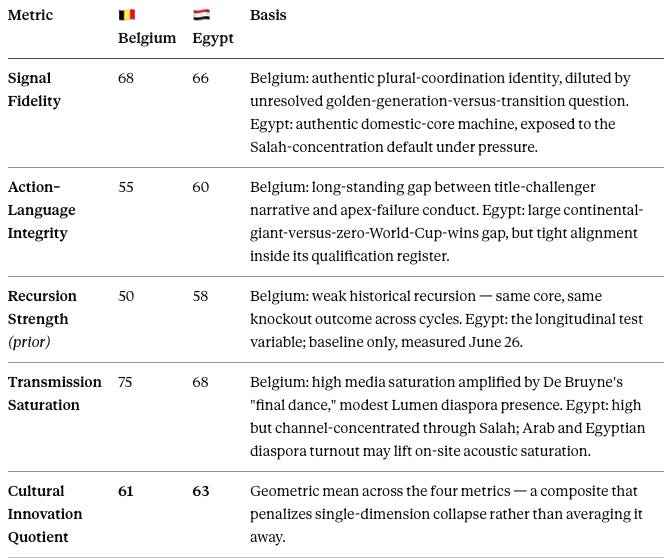
The geometric-mean composite is deliberate. A culture strong on three dimensions and brittle on one does not earn a high synthesis score, because role-ratio logic holds that systems fracture at their weakest coordinating dimension, not at their average.
Synthesis Cultural Innovation Quotient for the interaction: 64. The figure estimates signal yield from the encounter, not a scoreline, and reads against a fixed interpretive scale reused across all six Seattle simulations:
Below 50 — weak differentiation between operating grammars; the cultures resemble each other too closely to produce clean signal, and experimental value runs low.
50–59 — moderate differentiation; a usable reading, though not a headline experiment.
60–69 — strong differentiation; the match generates clear cultural signal regardless of result.
70 and above — extraordinary contrast; a flagship fixture where opposing grammars collide at maximum separation.
Belgium–Egypt opens at 64 because dispersion-versus-concentration sets two coordination architectures against each other at unusually clean separation — strong experimental value, with headroom left for a later knockout synthesis match to register higher across the slate. The interaction figure sits above both individual Quotients (Belgium 61, Egypt 63) for a structural reason: the contrast between the two grammars carries signal that neither culture generates in isolation. Measuring the collision yields more than measuring either system alone, which is the entire justification for running the Seattle matches as paired experiments rather than separate national profiles.
Contact mcai@mindcast-ai.com to partner on Predictive Game Theory in Law and Behavioral Economics.
IV. 🎭 Role-Ratio Profiles
Role ratios break each squad into the four functions that decide whether a system scales, stalls, or fractures: Signalers who generate the decisive creative output, Transmitters who move it through the side, Hybrids who translate between roles and contexts, and Absorbers who hold structure under pressure. The mix matters more than the raw talent, because a federation rich in one function and thin in another breaks at precisely the seam the table below exposes.
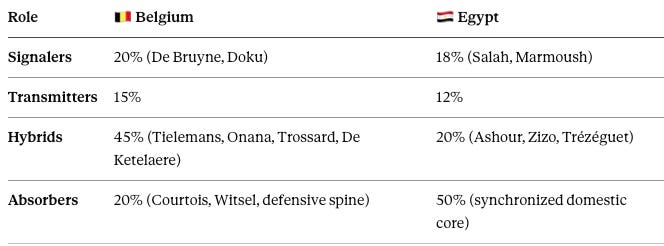
Belgium reads Hybrid-heavy — a structure built for tactical translation across European leagues, which explains why the federation produces players who adapt anywhere yet historically struggles to generate a single unifying Signal at the decisive moment. Egypt reads Absorber-heavy with concentrated Signal — deep collective synchronization beneath a narrow attacking apex, which explains both the qualification dominance and the World Cup scarcity. The diagnostic prediction: Belgium’s coordination strains if the Hybrid layer cannot manufacture penetration without a reliable Signal source, and Lukaku’s fitness is the variable that decides it.
V. 🌧️ The Seattle Environmental Variable
Seattle functions as an experimental control, not a backdrop. The venue holds physical conditions constant across all six Seattle matches — pitch, acoustics, light-rail access, civic transmission profile — while the crowd that fills it changes by fixture. The transmission field is therefore co-produced: the physical instrument stays fixed, and whichever cultures arrive determine the partisan weighting of the room. The opener draws an unusually neutral co-produced field.
Expected crowd composition:

A plurality of neutrals and the absence of any dominant partisan bloc drive the predicted effect. Seattle reduces home-field distortion and amplifies cultural transmission quality. Both Cognitive Digital Twins express identity under near-neutral acoustic conditions rather than national-stadium conditions, which means the opening readings isolate culture more cleanly than any partisan venue could permit. Neutrality is the gift of the opener.
The neutrality is specific to this fixture, and the contrast is itself a measurable cross-match variable. USA versus Australia on June 19 will skew heavily toward a single partisan bloc, raising home-field distortion and shifting the co-produced transmission field sharply. Reading the same physical instrument under a near-neutral field (June 15) and a heavily partisan field (June 19) gives the Seattle Lab a designed contrast in transmission conditions across consecutive simulations.
VI. 🌫️ Game Regime Classification: FOG
The four regimes are Arena, Fog, Labyrinth, and Trap. The opener classifies as Fog — the maximum information-deficit regime, by structural necessity. No in-tournament data exists for either culture. Belgium runs an untested transition under a first-time international coach with an open question at center-forward. Egypt’s domestic-core system has not been read against this caliber of European opposition in this environment. Both sides enter with incomplete information about each other and about themselves under these specific conditions.
The Seattle Lab opens in Fog and migrates toward Arena and Labyrinth regimes only as recursion data accumulates across the slate. Fog is not a weakness of the opener; Fog is the correct reading of a first contact.
VII. 🔮 Match Forecast (Secondary Output)
The opener’s primary prediction is structural, not numeric. Belgium imposes its coordination regime and converts distributed creation into chance volume; Egypt advances only if its synchronized collective identity surfaces over the Salah-concentration default. The football scoreline rides beneath that mechanism as a secondary output — the same discipline the NFL Vision series applied when it published resolution conditions first and filed a score band second. (See Seahawks v. Patriots, Super Bowl LX.)
Primary prediction (structural): a Fog-regime opener resolving toward Belgian control through superior goal-creation pathways, unless Egypt’s collective press imposes its regime first.
Secondary output (scoreline probabilities):

Most likely score: Belgium 2–1 Egypt.
Alternative outcomes: 1–1 draw · Belgium 1–0 · Egypt 2–1.
Primary driver: Belgium’s Hybrid layer manufactures more pathways to goal creation than Egypt’s concentrated signal architecture. Distributed creation generates repeatable chance volume; concentrated creation generates fewer, higher-variance chances dependent on a single channel staying live.
The forecast and the scorecard appear to disagree, and the disagreement is the point. Egypt carries the marginally higher Cultural Innovation Quotient (63 versus 61), yet Belgium is favored to win. The Quotient measures cultural coherence — how authentically and consistently a system expresses its identity. Win probability measures football outcome. Egypt’s higher coherence reflects an authentic, synchronized collective; Belgium’s higher win probability reflects more routes to goal. The gap between the two is the opener’s thesis rendered in miniature: high cultural coherence does not convert to match dominance when the architecture concentrates rather than distributes its attacking signal. Coherence and scalability are different properties, and the opener measures both.
VIII. ⏱️ Time Gates and Falsification Contract — Committed Before Kickoff
Two accountability instruments govern the opener, both imported from the validated NFL method: in-match time gates that lock the structural read while the match is still in progress, and a falsification contract specifying what would prove the model wrong. The NFL Vision series established the gate logic — watch the gates, not the score — and recorded every committed gate cleared on schedule. (See Seahawks v. Patriots, Super Bowl LX and Super Bowl LX — AI Simulation vs. Reality.)
In-Match Time Gates — crossed during play
Time Gate A — Opening 25 minutes (first contact). The Fog read holds if neither side imposes tempo early and the match stays cagey. Belgium-favoring if Belgium establishes possession control above 55 percent and pins Egypt’s domestic-core press. Egypt-favoring if its synchronized press disrupts Belgian build-up and forces turnovers in the middle third.
Time Gate B — The Halftime Eight (four minutes before and after the break). The inflection window deciding which regime carries into the second half. Egypt-favoring if Salah’s share of final-third actions sits at or below 35 percent — the collective machine is live. Belgium-favoring if Belgium leads or holds possession-plus-expected-goals control entering the interval. Salah’s share above 50 percent by halftime flags the concentration default.
Time Gate C — The 60th-Minute Fork (fatigue and cognitive threshold). The point where structural outcome begins to lock. Belgium-favoring if it has forced tempo and manufactured chances without depending on a single Signal source, even when chasing a deficit. Egypt-favoring if the domestic-core synchronization holds under fatigue rather than collapsing into Salah-dependency. A side that establishes control here and is not overturned reaches terminal resolution before the whistle — the point where the structural outcome locks and the remaining minutes only confirm it.
Falsification Contract — what would prove the simulation wrong
Each condition below is numeric and observable on June 15 or in the June 16 validation. Pre-commitment is the discipline. Falsification is the contract.
Gate 1 — Egypt Signal Fidelity. Egypt’s authentic collective identity holds if Salah’s share of Egypt’s final-third entries stays at or below 35 percent. The model reads a default to the borrowed “Salah carries us” template if Salah involvement in final-third actions reaches 50 percent or higher. Match event data supplies the count.
Gate 2 — Belgium Action–Language Integrity. Belgium closes its narrative-conduct gap if it both controls tempo (possession at or above 55 percent) and converts territorial control into at least 1.5 expected goals. Belgium dominating possession yet underperforming expected goals and failing to win confirms the historical golden-generation pattern.
Gate 3 — Game Regime. The Fog classification holds if the opening thirty minutes show mutual feeling-out — controlled tempo, few clear chances before in-match adjustment. A match that runs open and end-to-end from kickoff falsifies the regime call, reading Arena rather than Fog.
Gate 4 — Transmission Saturation. Measurement protocol: sample 20 pre-match articles published June 8–15 across FIFA.com, ESPN, BBC Sport, Reuters, The Athletic, and one national outlet per side (Het Nieuwsblad for Belgium, Ahram Online for Egypt). Code each article’s headline and lead paragraph for primary subject. The gate clears if De Bruyne and Salah together account for at least 60 percent of headline references and lead-paragraph emphasis — saturation running through two individuals rather than two systems. Collective or tactical subjects — squad structure, the Garcia transition, federation narrative, Hossam Hassan’s domestic-core system — claiming the majority of headline and lead-paragraph emphasis falsify the reading.
Gate 5 — Recursion baseline. The opener commits Recursion Strength as an unmeasurable prior. No Recursion Strength claim in this simulation is falsifiable on June 15. The variable becomes measurable in the Egypt–Iran simulation on June 26, where Egypt’s between-cycle adaptation produces the slate’s cleanest recursion read.
Series-level gate. The opener weakens the Seattle Lab framework if public narrative, supporter behavior, media framing, and on-pitch expression remain purely tactical and commercial, surfacing none of the identity-preservation, plural-coordination, or concentration-versus-dispersion themes specified above.
IX. 🔁 Forward Recursion Prediction
Egypt returns to Lumen Field on June 26 against Iran, and the second appearance converts Signal Fidelity from a static reading into a measured trajectory. The opener commits the bridge in advance, partitioning the full outcome space so no result escapes the prediction.
A positive Egyptian result against Belgium — win or draw — should raise Egypt’s Signal Fidelity by at least 5 points entering the June 26 simulation.
An Egyptian loss in which Salah accounts for more than 50 percent of final-third actions should lower Signal Fidelity, confirming regression toward the concentrated-signal template.
An Egyptian loss in which Salah accounts for 50 percent or less should hold Signal Fidelity roughly stable, because authentic collective identity surfaced even in defeat — result and identity-expression are distinct measurements.
One measured quantity does double duty. Salah’s share of final-third actions — the 50 percent line drawn in Gate 1 — resolves an opening-simulation gate and seeds the June 26 forecast simultaneously. A single data capture on June 15 closes the opener and opens the recursion measurement. One measurement, two simulations. The connective tissue makes the Seattle slate a designed experiment rather than six standalone previews.
X. 🔄 Model Evolution Protocol
A foresight system that never updates cannot stay accurate, and a system that updates without admitting error carries no integrity. The NFL Vision series treated self-correction as its strongest credibility exhibit: the NFC Championship simulation classified Seattle as compression-dominant, the Rams game falsified that read, and the Super Bowl simulation openly abandoned the prior thesis and rebuilt around multi-regime survivability — documented and timestamped before kickoff. (See Seahawks 2025–2026 Season Validation.)
The Seattle Lab builds the same discipline into its architecture. The opener’s cultural classifications are baseline priors, not fixed verdicts. Should June 15 falsify a reading — Egypt expressing concentrated identity where the model expected collective synchronization, or Belgium cohering where the model expected dispersion failure — the Egypt–Iran simulation will publish the revision openly on June 26, showing the prior reading, the falsifying evidence, and the rebuilt classification side by side. An early misclassification is not a blemish to bury; documented correction under falsification is the proof of method. The recursion bridge in Section IX is the structural slot that records that correction once earned.
One honest boundary travels with the borrowed discipline. The validated track record belongs to the NFL and cross-domain work; the Cultural Signal Integrity Model enters the opener with zero validated predictions of its own. The Seattle Lab inherits the method, not a transferred accuracy rate, and earns its ledger entry only by surviving the gates committed here.
XI. 🌐 Forward Implications
The Belgium–Egypt contrast travels well beyond football, because dispersion-versus-concentration recurs wherever capability has to be organized into outcomes. Four domains read the same opener through their own lens, and each finds a familiar structural problem underneath the scoreline.
Law and institutional design. Plural coordination versus concentrated authority maps directly onto governance architecture — federated bodies that distribute decision rights versus principal-dependent structures that concentrate them. Belgium models the coordination cost of distributed authority; Egypt models the continuity risk of concentrated authority.
Behavioral economics. Egypt’s Salah concentration is a textbook key-person dependency and single-point-of-failure exposure; Belgium’s golden generation is a textbook team-production failure where the collective output trails the sum of individual quality. Both are recognizable principal-agent and coordination pathologies rendered on grass.
Predictive game theory. Fog formalizes as an incomplete-information game. First-mover information revelation carries outsized value — the side that forces the other to disclose its adapted shape first gains the cleaner read for the rest of the group stage.
Artificial intelligence and cognitive systems. Concentration versus dispersion maps onto the monolithic-capability-versus-orchestration tradeoff in machine systems — a single high-capability model versus a coordinated multi-agent ensemble. Belgium’s dispersion failure and Egypt’s concentration risk are the two canonical failure modes of any composite cognitive architecture, which is precisely why an instrument built on multi-agent Cognitive Digital Twins can read them.
XII. 📋 Performance Dashboard
The dashboard records every committed forecast in one place and converts on June 16. The three in-match time gates resolve into these rows; the scorecard, the regime call, and the recursion bridge supply the rest. Reused across the five simulations that follow, the dashboard accumulates into a visible cumulative record of model performance across the Seattle slate.
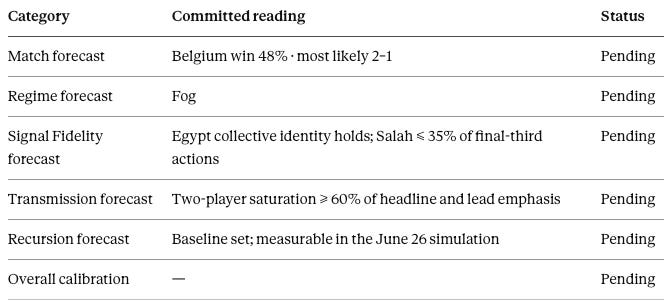
June 16 converts each Pending to Cleared, Triggered, or Revised — cleared when the committed reading holds, triggered when a falsification condition fires, revised when the Model Evolution Protocol rebuilds a classification.
XIII. 📅 Validation Schedule
The simulation commits before the match and grades itself after, on a fixed three-step cadence. The schedule below pins each date to the deliverable attached to it, so accountability runs on a calendar rather than on convenience.

The June 16 calibration scores each committed gate as cleared or triggered, grades the match forecast against the result, recalibrates the baseline Cultural Signal Integrity Model readings against observed signal, and records Egypt's opener values as the zero-point for the June 26 recursion measurement. The zero-point is the foundation of the experiment — culture measured first under near-neutral conditions, then tracked as the variable while the civic environment holds constant.