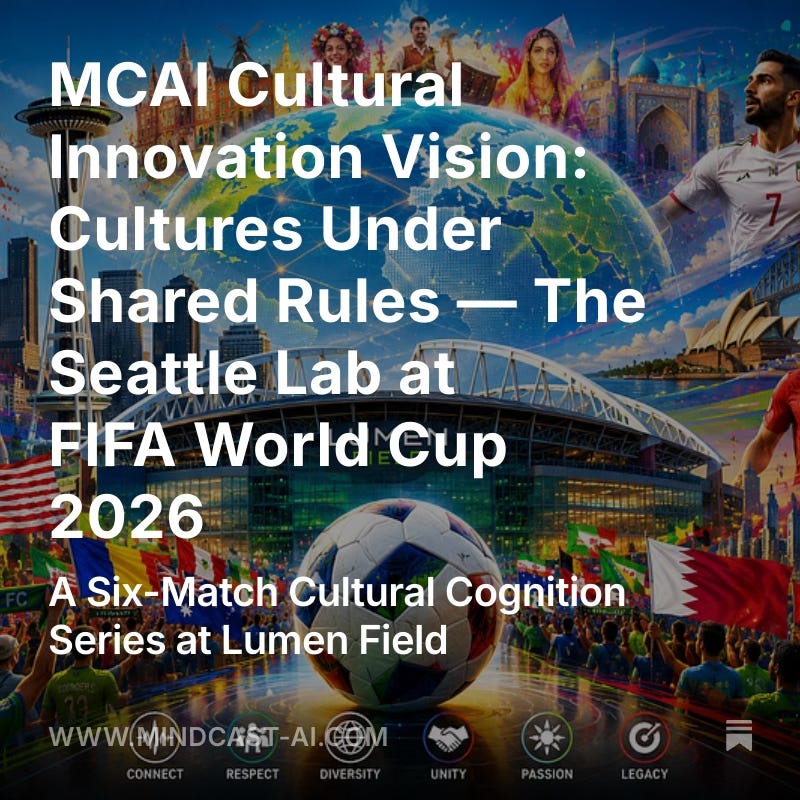

Cultures Under Shared Rules — The Seattle Lab at FIFA World Cup 2026 series
Belgium vs Egypt | USA vs Australia | Qatar, Bosnia, Egypt, Iran | Three Group Winners Enter the Round of 32 🇲🇽 Mexico vs Ecuador 🇪🇨 · 🇺🇸 US vs Bosnia 🇧🇦 · 🇧🇪 Belgium vs Senegal 🇸🇳
Validation Reports World Cup Validation Report I — USA, Belgium-Egypt, Mexico | World Cup Validation Report II — Bosnia, Egypt-Iran, Mexico, Türkiye | World Cup Validation Report III — Special US | Mexico Series, Seattle Lab 🇲🇽 🇺🇸 🇧🇪 | FIFA World Cup Validation Report IV — Round of 16 Complete, Calibration Review, and Quarterfinal Method 🇫🇷 🇪🇸 🇦🇷 🇲🇦 🇳🇴 🏴 🇧🇪 🇨🇭
MindCast Special Series — a deliberate stress test of the MindCast system beyond the controlled venue of the MindCast Seattle Lab
World Cup Championship Index 2026 | When a FIFA World Cup Model Picks France and the Economist Picks Argentina
Mexico vs South Korea | Mexico and USA | Three Group Winners Enter the Round of 32 🇲🇽 Mexico vs Ecuador 🇪🇨 · 🇺🇸 US vs Bosnia 🇧🇦 · 🇧🇪 Belgium vs Senegal 🇸🇳
Forthcoming
Round of 16 — the eight-match slate — July 4–7 (Matches 89–96). Full coverage begins here. Each commits only after its two Round of 32 feeders resolve, so they publish in a rolling wave July 2–4 rather than in one drop.
I. The World Cup as Cultural Event
The opening section reframes FIFA World Cup 2026 away from sports coverage and toward cultural cognition. Forty-eight national systems interacting under shared rules constitute a measurement environment, not a spectacle.
FIFA World Cup 2026 is not a sporting tournament. The competition operates as the most concentrated cultural cognition event of the decade — forty-eight national systems interacting under shared rules, across twenty-two days of compressed global attention, with every match producing observable signal about how cultures encode identity, coordinate behavior, and adapt under pressure.
National teams arrive carrying more than tactical preferences. Each federation transmits a cultural grammar built across decades of footballing history, institutional memory, and supporter ritual.
Belgium’s golden-generation aftermath reads differently than Egypt’s signal-concentrated relationship with Mohamed Salah. Iran’s domestic football culture transmits differently than its diaspora supporter base. Qatar’s federation architecture reflects a deliberately engineered cultural project unlike any predecessor in the modern game. Argentina’s relationship with Lionel Messi and Brazil’s relationship with its post-Pelé identity register at completely different signal frequencies despite sharing a continent.
MindCast treats the tournament as a staged cultural synthesis engine. The Seattle Lab is the controlled experiment.
II. Continuity With the Bellevue Civic Framework
This section anchors the Seattle Lab inside MindCast’s published methodological lineage. The instrument is established; the application is new.
The methodology underwriting the Seattle Lab is not new. MCAI Culture Vision: BellevueAI Driving Cultural Innovation, published May 2025, established a Cognitive Digital Twin (CDT) of Bellevue’s civic architecture and introduced the Cultural Signal Integrity Model (CSIM) — Signal Fidelity, Action–Language Integrity, Recursion Strength, and Transmission Saturation, combined into a Cultural Innovation Quotient (CIQ). The framework measured how a single city encodes, transmits, and evolves cultural intelligence across decades.
The Seattle Lab runs the same instrument outward. Where BellevueAI modeled one civic CDT longitudinally, the Seattle Lab models multiple national CDTs interacting laterally — inside a single civic environment, across a compressed twenty-two-day window. Same instrument. Wider aperture. Higher signal density per unit of time. Sophisticated readers of MindCast’s civic work will recognize the move: the Cultural Innovation Quotient that read Bellevue’s institutional coherence now reads Belgium’s, Egypt’s, Iran’s, and the rest of the visiting cultural systems.
III. The Seattle Synthesis Theme
The central analytical question of the series surfaces here. Every match simulation that follows orbits this thesis.
The seven cultures arriving at Lumen Field produce a single dominant synthesis theme across the group-stage slate:
How institutional identities adapt under compressed feedback cycles inside a fixed civic environment.
Belgium, Bosnia and Herzegovina, the United States, and Iran each carry contested identity at the federation level — managed through different institutional architectures. Australia, Qatar, and Egypt contribute contrasting models of resilience, acceleration, and memory. The signal surfaces through observable behavior: supporter conduct, federation governance, media framing, tactical adaptation between matches, crowd acoustics, and diaspora turnout patterns.
The cultural dialogue is not a competition for superiority. The dialogue is a comparative test of how identity systems generate coherence under shared rules — the exact question facing every multilateral institution, regulatory body, and AI governance framework operating today.
IV. The Operating Instrument
The Seattle Lab runs on MindCast’s proprietary simulation architecture. This section names the instrument before readers encounter its outputs.
Each match runs through the MindCast AI Proprietary Cognitive Digital Twin Foresight Simulation, integrating Cultural Vision, Strategic Behavioral Coordination Vision, Chicago Strategic Game Theory Vision, Game Regime Identification Vision, Cybernetic Control Vision, Field-Geometry Reasoning Vision, Installed Cognitive Grammar Vision, and MindCast Foresight Vision.
The MindCast stack resolves cultural grammar, coordination dynamics, feedback loops, environmental constraint, and forward implications into a single synthesis output, scored against the four-metric Cultural Signal Integrity Model — Signal Fidelity, Action–Language Integrity, Recursion Strength, Transmission Saturation — with pre-committed falsification gates published before kickoff.
Contact mcai@mindcast-ai.com to partner with us on Predictive Game Theory in Law and Behavioral Economics. To deep dive on MindCast work upload the URL of this publication into any LLM and prompt ‘parse MindCast framework with three degrees of cited sub links.’ Or simply Google MindCast, switch to Google AI mode and prompt to apply MindCast frameworks to your business issues. See Live-Fire Game Theory Simulators, Runtime Predictive Infrastructure | MindCast Predictive Game Theory + Behavioral Economics Cognitive Digital Twin Foresight Simulations in the World Cup and Super Bowl
Recent projects:
MCAI Culture Vision: BellevueAI Driving Cultural Innovation — establishes the Cultural Signal Integrity Model and role-ratio framework.
MindCast AI NFL Vision: Super Bowl LX — AI Simulation vs. Reality — documents the head-to-head validation of MindCast Cognitive Digital Twin methodology against Madden NFL 26 and Sportsbook Review AI.
V. The Constraint Is the Discipline
Six matches at one venue is not a scope limitation. The constraint is the methodological backbone of the series.
FIFA World Cup 2026 spans 104 matches across sixteen host cities in three countries. MindCast will simulate six.
Every match plays at Lumen Field in Seattle between June 15 and July 6. Four group-stage fixtures, one Round of 32 match, one Round of 16 match. One venue. One civic environment. One observable lab.
Sophisticated readers of the global game already know the trap: 104-match coverage produces commentary, not signal. Tactical pundits multiply outputs and dilute meaning. Six controlled matches at one venue, played under identical rule architecture, isolate what cross-cultural interaction actually produces when the civic environment is held constant. Germany’s pressing identity reads differently in Doha than in Belo Horizonte. Egypt’s possession grammar reads differently in Cairo than at Lumen Field. Holding the venue constant exposes the cultural variable.
VI. Why Lumen Field
Lumen Field is not a neutral host site. The venue carries its own measurable transmission profile before any visiting culture arrives.
Lumen Field functions as one of the most acoustically dense sports venues in North America, engineered for crowd transmission and tested across two decades of NFL and MLS occupancy. Sounders supporters built a documented match-day culture — Emerald City Supporters tifo work, the March to the Match, a continental reputation for noise architecture — giving the venue a measurable Transmission Saturation profile before any World Cup whistle blows.
Visiting national Cognitive Digital Twins will not interact in abstraction. Each enters a specific civic transmission environment with its own grammar, its own acoustic memory, and its own historical relationship to the global game. Seattle is the observation lens. The visiting cultures are the signal. The Pacific Northwest civic system — Bellevue’s recursive discipline across the lake, Seattle’s high-amplitude transmission at the waterfront — provides the calibrated instrument.
VII. The Cultural Signal Integrity Model Applied to Visiting Cultures
Four metrics, originally calibrated against Bellevue’s civic culture, now read against seven national footballing cultures.
Each visiting culture receives the same four-metric reading the Bellevue framework established. Signal Fidelity measures whether a culture expresses authentic identity under tournament pressure or defaults to borrowed templates — Egypt’s Salah-concentrated signal reads differently than Belgium’s post-golden-generation institutional identity. Action–Language Integrity measures alignment between federation rhetoric and federation conduct, between supporter narrative and on-pitch decision-making — Qatar’s stated and observable football identities diverge by measurable margins. Recursion Strength measures how a culture learns from itself across the tournament; group stage produces the cleanest readings because cultures face three forced learning cycles in eleven days. Transmission Saturation measures the noise environment around each culture — Brazilian and Argentine supporter cultures saturate their own channels, while smaller federations operate where signal travels further per unit of broadcast. Lumen Field’s acoustic architecture interacts with each visiting saturation profile differently.
VIII. Role Ratios as National Signature
Role distribution inside a cultural system determines whether the system scales, stalls, or fractures under pressure.
Role ratios determine whether a culture scales, stalls, or collapses under pressure. The Bellevue framework established that healthy cultural ecosystems balance Signalers, Transmitters, Hybrids, and Absorbers in measurable ratios. National footballing cultures distribute the same roles differently across squads, federations, and supporter ecosystems.
Belgium’s federation produces a Hybrid-heavy structure built for tactical translation across European leagues. Egypt’s structure concentrates Signal in a small number of marquee players while building Absorber depth at the federation level. The United States runs a Transmitter-saturated supporter culture against a developing Signaler base. Iran operates under institutional constraints that compress its Signaler-Absorber ratio. Australia balances Hybrid and Absorber roles through its A-League integration with European pathways. Qatar exhibits the most engineered role distribution of any host-experienced federation in the modern game. Bosnia and Herzegovina concentrates Signal in diaspora pathways while Absorber capacity remains anchored to domestic post-conflict institutions.
The Seattle Lab will publish a role-ratio profile for each visiting culture alongside its Cultural Signal Integrity Model scorecard. Sophisticated readers of the game will recognize the diagnostic value: role ratios explain why certain federations produce coaches who travel and others produce only players, why some supporter cultures generate global tifo movements and others stay regional, why some national teams adapt across managers and others collapse with personnel turnover.
IX. The Seven National Cognitive Digital Twins
Each profile establishes the baseline operating grammar and synthesis role that match simulations will read against. Read the profiles as instrument calibration, not as cultural verdicts.
Each Seattle-bound culture enters the lab with a defined operating grammar and a synthesis role within the field. The seven profiles below establish the baseline readings each match simulation will read against.
🇧🇪 Belgium
Belgium operates through plural institutional balance, multilingual negotiation, and coalition-based coherence — a culture managing complexity through accommodation rather than domination. Rules function as coordination instruments among plural communities. Trust forms through institutional bargaining and procedural accommodation across linguistic and regional identities. Innovation arrives through synthesis across internal difference.
Seattle synthesis role: Belgium contributes the logic of plural coordination — how systems remain functional without becoming culturally uniform.
🇪🇬 Egypt
Egypt operates through civilizational continuity, symbolic depth, and institutional memory — a long-horizon identity compressing ancient legitimacy, modern nationalism, and regional influence. Rules gain force when they connect formal authority to historical continuity. Trust forms through symbolic authority, family structures, and institutional memory. Innovation arrives through continuity under transformation.
Seattle synthesis role: Egypt contributes the logic of civilizational memory — how systems retain coherence across long temporal horizons.
🇺🇸 United States
The United States operates through plural experimentation, frontier adaptation, and institutional contestation — a culture turning disagreement into productive system pressure. Rules function as contested frameworks inviting interpretation, litigation, and redesign. Trust forms through performance, transparency, market validation, and peer networks. Innovation arrives through recombination, risk-taking, and rapid scaling.
Seattle synthesis role: the United States contributes the logic of adaptive recombination — how heterogeneous inputs become scalable systems.
🇦🇺 Australia
Australia operates through pragmatic resilience, egalitarian directness, and team-oriented competence under environmental constraint. Rules gain legitimacy when they remain practical, fair, and usable under real-world pressure. Trust forms through competence, mutual reliance, and low-theater execution.
Seattle synthesis role: Australia contributes the logic of resilient pragmatism — how systems perform when resources, conditions, or expectations become unstable.
🇧🇦 Bosnia and Herzegovina
Bosnia and Herzegovina operates through layered identity, post-conflict memory, and resilience under fractured institutional conditions. Rules manage memory, identity, and legitimacy across communities with different historical experiences. Trust forms slowly through local relationships, negotiated coexistence, and credible restraint.
Seattle synthesis role: Bosnia and Herzegovina contributes the logic of fragile-coherence design — how systems operate despite unresolved historical complexity.
🇶🇦 Qatar
Qatar operates through strategic centralization, resource-backed modernization, and rapid institutional scaling. Rules function as instruments of state capacity, reputation management, and strategic modernization. Trust forms through patronage, institutional delivery, and resource-backed commitment.
Seattle synthesis role: Qatar contributes the logic of strategic acceleration — how concentrated resources create rapid institutional visibility.
🇮🇷 Iran
Iran operates through civilizational depth, strategic patience, and high-context social intelligence — poetic identity combined with institutional endurance and adaptive indirectness. Rules operate within layered systems of formal authority, social interpretation, and historical memory. Trust forms through loyalty, community networks, and endurance under pressure.
Seattle synthesis role: Iran contributes the logic of strategic endurance — how systems preserve identity and maneuver under constraint.
X. The Six-Match Slate
The fixture list reads as a designed experiment. Egypt’s dual group-stage appearance and the Group G knockout pathway through Seattle produce longitudinal rather than single-shot readings.
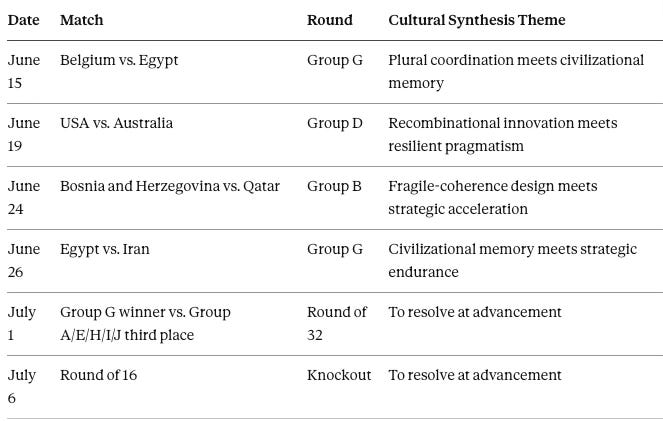
Egypt appears twice in the group stage. A Group G winner advances into the July 1 fixture at Lumen Field. The Belgium–Egypt–Iran cultural system therefore registers across multiple synthesis encounters in the same venue, producing longitudinal Cultural Signal Integrity Model readings rather than single-match snapshots. The slate behaves as a designed experiment, not a coincidental sample.
XI. Pre-Commitment: Seattle Cultural Predictions
Four predictions publish before the tournament begins. Each carries a measurement criterion and a falsification condition. Readers track the framework against reality match by match.
The series commits to four cultural predictions before kickoff. Each carries a falsification condition observable across the six-match slate.
Prediction 1. Plural coordination systems — Belgium, Bosnia and Herzegovina, the United States, and Iran — will outperform purely centralized or purely symbolic systems in adaptability across matches, measured by Recursion Strength readings between fixtures.
Prediction 2. High Transmission Saturation cultures will dominate early narrative cycles but decay faster under repeated exposure, measured by media salience curves across the twenty-two-day window.
Prediction 3. Hybrid systems combining structured coordination with adaptive flexibility will produce the highest synthesis Cultural Innovation Quotient by July 1, measured against the seven baseline operating grammars in Section IX.
Prediction 4. Egypt’s dual group-stage appearances will produce the clearest Recursion Strength signal in the entire tournament, measured by tactical, narrative, and supporter adaptation between June 15 and June 26.
Falsification conditions. The model fails if rigid centralized systems outperform plural adaptive systems across the slate. The model fails if no measurable Recursion Strength signal appears in Egypt’s dual appearances. The model fails if Transmission Saturation produces durable rather than decaying narrative dominance. The model fails if hybrid coordination architectures underperform their pre-committed Cultural Innovation Quotient projections.
Pre-commitment is the discipline. Falsification is the contract.
XII. Output Architecture
Each match generates the same six output components, producing a comparable dataset across the slate and a final synthesis publication on July 6.
Each match produces a published MindCast AI Proprietary Cognitive Digital Twin Foresight Simulation containing a Cultural Signal Integrity Model scorecard for each visiting culture, a synthesis Cultural Innovation Quotient for the interaction, a role-ratio profile, a Game Regime classification — Arena, Fog, Labyrinth, or Trap — a falsification condition observable during or after the match, and forward implications for law, behavioral economics, predictive game theory, and artificial intelligence and cognitive systems.
The series concludes on July 6 with a synthesis publication mapping the full six-match dataset back into the Bellevue civic frame — what the visiting cultures revealed about Seattle as a host environment, and what Seattle revealed about itself as an observation lens.
XIII. Methodological Provenance
The Seattle Lab inherits its falsification discipline from a validated antecedent. Super Bowl LX served as the public proof event.
The falsification discipline carrying through the Seattle Lab inherits directly from MindCast’s published validation record. MindCast AI NFL Vision: Super Bowl LX — AI Simulation vs. Reality, published February 9, 2026, tested MindCast’s Cognitive Digital Twin methodology head-to-head against Madden NFL 26 and Sportsbook Review AI. MindCast published falsifiable gates and a falsification contract before kickoff; every gate cleared, no condition triggered. Structural cognition beat physics simulation and narrative LLM coherence. The Seattle Lab applies the same epistemic posture to cultural rather than competitive analysis.
XIV. Why Sophisticated Soccer Audiences Should Care
Football tactics writing has matured. Cultural analysis has not. This section stakes the methodological territory.
Football tactics writing has matured into a serious discipline over the past fifteen years — expected goals, possession-value models, pressing intensity metrics, line-breaking pass classifications. Cultural analysis has not kept pace. National team coverage still defaults to romantic stereotype (Brazilian flair, German efficiency, Italian catenaccio) or to scouting-report reductionism (left-footed center-back, ball-progressing midfielder, late-arriving eight).
The Cultural Signal Integrity Model offers something the existing literature does not: a falsifiable framework for measuring why cultural systems behave the way they do under shared rules, with metrics that produce numbers, scorecards that publish before kickoff, and falsification conditions holding the analyst accountable. Readers who already follow Michael Cox, Jonathan Wilson, John Muller, or Tifo Football will recognize the analytical posture. Readers who came to the game through institutional foresight, behavioral economics, or AI architecture will recognize the methodological discipline.
Six matches. One venue. One framework. One falsification contract.
XV. Falsification Condition for the Series
The series-level falsification gate sits above the per-match gates. Either the framework surfaces measurable cultural signal across six matches or the framework recalibrates in public.
The Seattle Lab framework weakens if observed public narratives, fan behavior, media framing, and team expression remain purely tactical or commercial across the six-match slate, failing to surface measurable themes of identity preservation, plural coordination, trust formation, or strategic adaptation. The framework strengthens when match-by-match cultural signals confirm the operating grammars specified in Section IX, and when synthesis themes survive their pre-committed gates.
XVI. Closing Thesis
The series closes where it opened — with the World Cup as cultural cognition event and Seattle as the controlled experiment.
The 2026 FIFA World Cup will produce 104 matches of global cultural interaction. MindCast extracts the highest-signal six — the matches playing on Seattle ground — and converts them into durable cultural intelligence for institutions, markets, strategy, and AI design.
Belgium’s plural coordination meets Egypt’s civilizational memory on June 15. The United States’ recombinational innovation meets Australia’s resilient pragmatism on June 19. Bosnia and Herzegovina’s fragile-coherence design meets Qatar’s strategic acceleration on June 24. Egypt’s civilizational memory meets Iran’s strategic endurance on June 26. The knockout rounds compress the surviving cultures into peak-intensity synthesis on July 1 and July 6.
Six matches at Lumen Field. The instrument is calibrated. The gates publish before kickoff.