
Cultures Under Shared Rules — The Seattle Lab at FIFA World Cup 2026 series
Belgium vs Egypt | USA vs Australia | Qatar, Bosnia, Egypt, Iran | Three Group Winners Enter the Round of 32 🇲🇽 Mexico vs Ecuador 🇪🇨 · 🇺🇸 US vs Bosnia 🇧🇦 · 🇧🇪 Belgium vs Senegal 🇸🇳
Validation Reports World Cup Validation Report I — USA, Belgium-Egypt, Mexico | World Cup Validation Report II — Bosnia, Egypt-Iran, Mexico, Türkiye | World Cup Validation Report III — Special US | Mexico Series, Seattle Lab 🇲🇽 🇺🇸 🇧🇪 | FIFA World Cup Validation Report IV — Round of 16 Complete, Calibration Review, and Quarterfinal Method 🇫🇷 🇪🇸 🇦🇷 🇲🇦 🇳🇴 🏴 🇧🇪 🇨🇭
MindCast Special Series — a deliberate stress test of the MindCast system beyond the controlled venue of the MindCast Seattle Lab
World Cup Championship Index 2026 | When a FIFA World Cup Model Picks France and the Economist Picks Argentina
Mexico vs South Korea | Mexico and USA | Three Group Winners Enter the Round of 32 🇲🇽 Mexico vs Ecuador 🇪🇨 · 🇺🇸 US vs Bosnia 🇧🇦 · 🇧🇪 Belgium vs Senegal 🇸🇳
Forthcoming
Round of 16 — the eight-match slate — July 4–7 (Matches 89–96). Full coverage begins here. Each commits only after its two Round of 32 feeders resolve, so they publish in a rolling wave July 2–4 rather than in one drop.
Executive Summary
World Cups reward more than talent. Elite rosters create contenders, but championships emerge when capability, identity, adaptation, environment, and tournament resilience align at the same moment. France may hold the strongest player pool while Argentina holds the strongest championship profile, and neither claim contradicts the other.
Football capability answers one question: who can win? Championship alignment answers a different one: which culture innovates best across seven consecutive rounds of pressure, adaptation, identity stress, environmental variation, and elimination risk? MindCast AI built the Championship Index to measure that second question directly.
Conventional forecasting ranks teams on observable football strength. The Championship Index evaluates the interaction between that strength and the cultural, environmental, and adaptive forces that decide tournaments — because championships emerge from alignment rather than capability alone.
Cultural innovation supplies the organizing idea. A footballing culture innovates when it generates new solutions under competitive pressure — adapting between matches, producing advantage from sources rivals cannot copy, and holding identity when the environment turns hostile. The Championship Index measures which cultures innovate most effectively across a tournament, and the championship ranking follows as a consequence rather than the goal.
MindCast AI is a predictive game theory firm working at the intersection of law and behavioral economics, with verticals in complex litigation strategy, innovation systems, and geopolitical risk intelligence. The firm models institutions and actors as systems and forecasts the mechanism that drives what they do next — directional, falsifiable predictions committed before resolution rather than explanations after it. Football is the public proving ground: a match resolves in ninety minutes on a fixed schedule with a scoreboard anyone can read, so the World Cup work stress-tests the same engine on a stage where every prediction can be checked, confirmed, or broken in the open.
Methodological provenance: The simulation inherits the validated foresight discipline of MindCast AI’s NFL Vision series — mechanism before score, pre-committed time gates, a falsification contract, and documented self-correction — built across seven consecutive structural calls and a 29-for-29 cross-domain prediction record. The discipline transfers; the accuracy record stays with its source domains. (See Super Bowl LX — AI Simulation vs. Reality and Seahawks 2025–2026 Season Validation.)
I. Why Existing Models Leave Signal Behind
Most forecasting systems rely on Elo ratings, FIFA rankings, betting markets, squad valuations, historical performance, and goal differentials. Those inputs identify strong teams accurately, so the same names crowd the top of nearly every forecast. Meaningful differentiation begins only once several elite teams enter the same tournament, and at that point talent stops separating outcomes. Environment, identity, and adaptation begin separating them instead.
Moody’s Analytics recently illustrated the gap. The firm’s model selected France; the economist running it selected Argentina, citing supporter ecosystems, geography, diaspora density, and Western Hemisphere advantage. One model produced a forecast, one analyst supplied the context the model could not price, and MindCast AI treats the distance between those two answers as measurable signal. (See When a FIFA World Cup Model Picks France and the Economist Picks Argentina.)
II. Championship Prior Construction
The Championship Index combines five dimensions under explicit weights. Every score stays visible, every composite stays reproducible, every revision stays traceable, and every calibration stays public.
Football Capability — 30%. Measures player quality, squad depth, tactical flexibility, replacement capacity, and elite talent concentration. The question it answers: can the team physically compete with the strongest nations?
Cultural Signal Integrity — 20%. Measures identity coherence, narrative-conduct alignment, institutional continuity, and stability under stress. The question it answers: does the team know who it is?
Recursion Prior — 20%. Measures historical adaptation, tournament learning, institutional adjustment, and resilience after setbacks. The question it answers: can the team improve during the tournament? The Championship Prior Edition uses a Recursion Prior built from history, and Measured Recursion replaces it after Matchday One.
Environmental Alignment — 15%. Measures positive and negative environmental forces together. Positive forces include crowd support, diaspora density, venue familiarity, and cultural transmission. Negative forces include expectation burden, historical pressure, national anxiety, and narrative weight. The question it answers: does the environment help the system or distort it? Environmental Alignment replaces the earlier single-direction concept of Transmission Saturation, because support alone is not inherently beneficial — the environment amplifies whatever already exists.
Tournament Path Resilience — 15%. Measures knockout survivability, stylistic adaptability, elimination-game performance, and path independence. The question it answers: can the team survive seven consecutive tests?
Together the five dimensions convert a vague intuition — that championships need more than talent — into five measurable inputs, each scored 0 to 100 and combined through the formula that follows.
III. Championship Index Formula
The five dimensions combine into a single score through a weighted sum, with capability carrying the heaviest share and the cultural, environmental, and adaptive dimensions together carrying the rest.
Championship Index = (0.30 × Capability) + (0.20 × Signal Integrity) + (0.20 × Recursion Prior) + (0.15 × Environmental Alignment) + (0.15 × Path Resilience).
Scores range from 0 to 100, and composites round half-up to one decimal place. Every future revision remains publicly logged.
Contact mcai@mindcast-ai.com to partner on Predictive Game Theory in Law and Behavioral Economics. See MindCast Predictive Game Theory + Behavioral Economics Cognitive Digital Twin Foresight Simulations in the World Cup and Super Bowl
IV. Disciplinary Foundations
The Championship Index is a game-theoretic instrument before it is a ranking. Classical game theory produces conditional equilibria — it names which team wins under which assumption and leaves the reader to judge which assumption holds. MindCast Game Theory makes the opposite move, committing directional, falsifiable forecasts before resolution, with probability bands, observable triggers, and conditions that would prove the forecast wrong. The falsification contract and seven-stage calibration schedule below put that commitment into operation. (See How MindCast Game Theory Differs from Textbook Game Theory.)
Behavioral economics supplies the Environmental Alignment dimension. Strength models treat a roster as a fixed quantity and a crowd as uniform support, but real tournament actors misperceive incentives, overweight losses, and respond to framing. The MindCast National Innovation Behavioral Economics framework integrates Kahneman-Tversky prospect theory, loss aversion, and status quo bias as calibrated adjustments to a capability baseline rather than replacements for it. Environmental Alignment applies that adjustment to football: a favorite carrying decades of expectation pays a loss-aversion tax, while a side no one expects to win plays on house money. (See MindCast AI Emergent Game Theory Frameworks.)
Tournament Path Resilience completes the picture as a sequential-survival measure. A World Cup is not one game but seven consecutive ones, each a fresh strategic problem against a new opponent under rising elimination pressure, so a champion must hold its equilibrium across a repeated game rather than win a single match. The dimension scores that durability directly.
Cultural innovation is the idea running underneath all three lenses, and the concept the series is named for. Recursion Strength measures a culture inventing new solutions between matches — innovation under tournament pressure, scored directly. The Portable Home Field is itself a cultural innovation in how advantage gets produced, detaching it from geography and carrying it through diaspora networks. Environmental Alignment then tests whether those innovations survive contact with expectation and crowd. The index rewards the cultures that innovate fastest and protect what they invent.
V. Reading the Championship Index
The tiers describe archetypes, not score bands. Contenders pair elite capability with elite alignment. Challengers hold elite capability checked by one limiting variable. System Teams convert alignment, identity, and environment into a profile that outruns their raw talent.
A team’s archetype and its score therefore measure different things, and the two can cross. Morocco, a System Team, scores inside the Challenger range — above England and just behind the Netherlands — a deliberate result rather than an error. The index rewards alignment, so a disciplined side carrying a strong Portable Home Field can sit level with bigger names still searching for coherence. The crossing is the thesis working, not breaking.
VI. Tier One — Championship Contenders
Tier One holds the four systems that pair elite capability with elite alignment — nations that can win the tournament and are built to withstand it. Each profile below lists the five dimension scores, the weighted composite, and the reading behind the number.
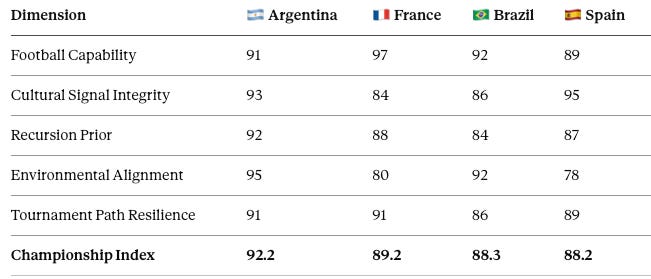
🇦🇷 Argentina enters as the most aligned system in the field, with no dimension below 91. Elite capability meets elite identity coherence, exceptional tournament memory, and one of the strongest Portable Home Field environments at the tournament.
🇫🇷 France leads the field on raw capability at 97, with replacement depth no other nation matches. Alignment trails Argentina because the environment offers less support and the identity reads less settled, which is exactly why the strongest roster sits second in a championship measure.
🇧🇷 Brazil pairs elite attacking capability with one of the tournament’s strongest Portable Home Field effects, its support traveling naturally across North America. A lower recursion prior keeps it just behind the top two.
🇪🇸 Spain enters as the most institutionally coherent system in the field, its 95 on Signal Integrity the highest of any nation. Identity and execution align unusually tightly, and a thinner environmental profile is the only thing separating it from the leaders.
Across Tier One the separation is small and instructive. France leads on raw talent yet trails Argentina on alignment, while Brazil and Spain arrive nearly level by opposite routes — Brazil on environment, Spain on coherence. Capability sets the floor; alignment orders the four.
VII. Tier Two — High-End Challengers
Tier Two holds the high-end challengers — nations with genuine capability checked by a single limiting variable the index exposes. Each carries one dimension well below its strengths, and that gap is the story of its ceiling.
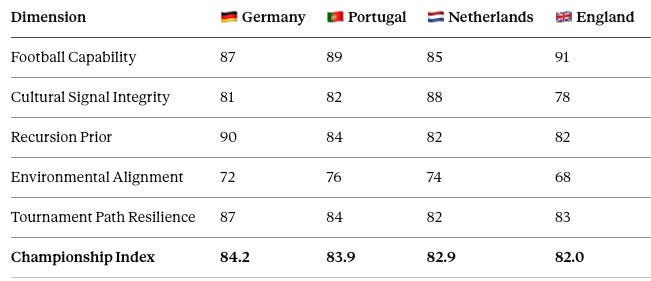
🇩🇪 Germany’s defining asset is recursion — a 90 prior reflecting a tournament-adaptation record among the strongest in the sport. Capability and environment sit a step below the contenders.
🇵🇹 Portugal combines elite experience with strong tournament adaptability, a veteran core that raises its floor in knockout football.
🇳🇱 The Netherlands holds consistently high organizational quality and a strong identity, though its overall ceiling trails Tier One.
🇬🇧 England’s defining variable is the expectation burden — elite capability at 91 paired with the lowest Environmental Alignment in the tier at 68, the weight of a watching nation pressing against conversion, the same loss-aversion tax that caps Mexico.
One pattern runs through the tier. Capability rarely fails these nations, but a single soft dimension — Germany’s environment, England’s expectation burden — caps the composite. A challenger becomes a contender by closing that gap, not by adding talent.
VIII. Tier Three — System Teams
Tier Three holds the System Teams — nations whose alignment, identity, and environment lift them above their raw talent. Capability sits below the contenders, yet coherence and the Portable Home Field carry each system into territory its squad value alone would not reach.
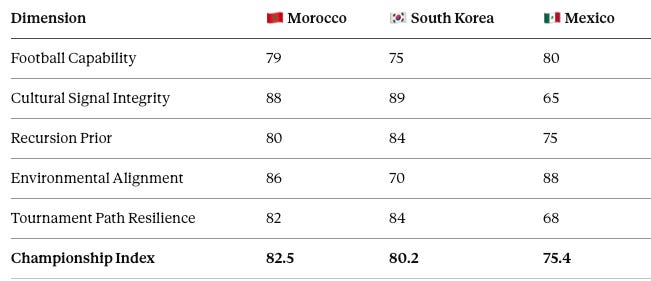
🇲🇦 Morocco may be the strongest Portable Home Field validation case outside Latin America. Diaspora density across Europe and North America builds an unusually powerful environmental profile, amplified by a side playing on house money rather than under burden; an 88 on Signal Integrity reflects the identity coherence behind the 2022 semifinal run. Its 82.5 lands inside the Tier Two scoring range, above a Challenger and just behind another — the clearest demonstration that alignment can lift a system team to the level of bigger names.
🇰🇷 South Korea outperforms its capability profile through coherence, adaptation, and tournament discipline. Raw talent sits below Tier One, but identity and recursion carry the system well beyond its ranking, and a side no one expects to win plays on house money.
🇲🇽 Mexico receives the largest Portable Home Field boost at the tournament, an 88 on Environmental Alignment. The thirty-year expectation burden simultaneously suppresses conversion — the loss-aversion tax of a favorite playing not to fail — dragging Signal Integrity to 65 and Path Resilience to 68. No nation demonstrates the dual nature of Environmental Alignment more clearly — the same crowd that lifts also weighs.
A note on Belgium. Belgium opened the Seattle Lab series yet misses the Top Ten here, because elite individual capability no longer offsets a persistent alignment deficit — a plural, dispersed system that has never resolved into a single coherent identity, scoring high on talent and low on the Signal Integrity and Recursion that championships reward. The omission is itself a reading: capability without alignment does not clear the field in a tournament measure. The opening simulation, Belgium vs Egypt, The Seattle Lab Opens: Plural Coordination Meets Civilizational Memory at Lumen Field, profiled that plural-coordination system in full.
IX. The Portable Home Field
Traditional forecasting assigns home-field advantage to geography. MindCast AI assigns it to cultures. The Portable Home Field describes cultural presence that detaches from geography and stays operational through dispersed supporter networks — supporter ecosystems crossing borders, diaspora communities carrying identity into new environments, and crowd advantage becoming distributed rather than localized.
Mexico is the clearest example, Argentina and Brazil benefit substantially, and Morocco provides the strongest non-Latin American case. The variable may prove to be the single largest forecasting input conventional models systematically undervalue. The construct was introduced in the Special Series simulation Mexico vs South Korea, Home Field, Carried: A Diaspora Stress Test in Guadalajara.
X. Championship Index Falsification Contract
The Championship Index weakens materially if:
The eventual champion finishes outside the Top Five.
Fewer than three semifinalists appear inside the Top Ten.
The index underperforms both Elo rankings and betting-market implied probabilities across knockout-qualification forecasts.
Environmental Alignment fails to provide measurable explanatory value beyond conventional football-strength metrics.
Clause 1 intentionally sets a high bar, because the Championship Index exists to identify contenders before the tournament begins rather than to explain outcomes afterward. A prior that cannot be embarrassed by the result is not a prior.
Pre-commitment remains the discipline. Falsification remains the contract.
XI. Calibration Schedule
The Championship Prior Edition sets the starting position, and each calibration that follows records score changes, dimension changes, model revisions, and falsified assumptions.
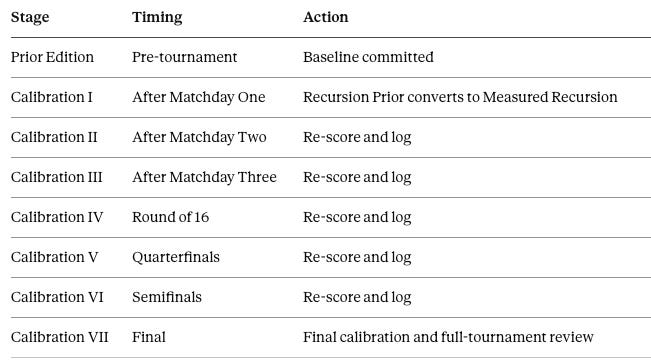
Each calibration publishes the revised scores against the prior, so the index is judged not by whether it was right on day one but by whether it learns at the right speed as the evidence arrives.
XII. The Championship Question
France may be the strongest team. Argentina may be the most likely champion. Capability answers who can win; the Championship Index answers which culture innovates best across seven consecutive rounds of pressure, adaptation, identity stress, environmental variation, and elimination risk. World Cups reward the second question more often than the first.
The Championship Prior Edition establishes the starting position, Matchday One converts recursion from theory into measurement, and every subsequent calibration either strengthens or weakens the prior. The objective is not to defend the ranking. The objective is to improve it.
Every forecast contains a hidden theory of human behavior. The MindCast AI World Cup Championship Index makes that theory visible.