


Cultures Under Shared Rules — The Seattle Lab at FIFA World Cup 2026 series
Belgium vs Egypt | USA vs Australia | Qatar, Bosnia, Egypt, Iran | Three Group Winners Enter the Round of 32 🇲🇽 Mexico vs Ecuador 🇪🇨 · 🇺🇸 US vs Bosnia 🇧🇦 · 🇧🇪 Belgium vs Senegal 🇸🇳
Validation Reports World Cup Validation Report I — USA, Belgium-Egypt, Mexico | World Cup Validation Report II — Bosnia, Egypt-Iran, Mexico, Türkiye | World Cup Validation Report III — Special US | Mexico Series, Seattle Lab 🇲🇽 🇺🇸 🇧🇪
MindCast Special Series — a deliberate stress test of the MindCast system beyond the controlled venue of the MindCast Seattle Lab
World Cup Championship Index 2026 | When a FIFA World Cup Model Picks France and the Economist Picks Argentina
Mexico vs South Korea | Mexico and USA | Three Group Winners Enter the Round of 32 🇲🇽 Mexico vs Ecuador 🇪🇨 · 🇺🇸 US vs Bosnia 🇧🇦 · 🇧🇪 Belgium vs Senegal 🇸🇳
Forthcoming
Round of 16 — the eight-match slate — July 4–7 (Matches 89–96). Full coverage begins here. Each commits only after its two Round of 32 feeders resolve, so they publish in a rolling wave July 2–4 rather than in one drop.
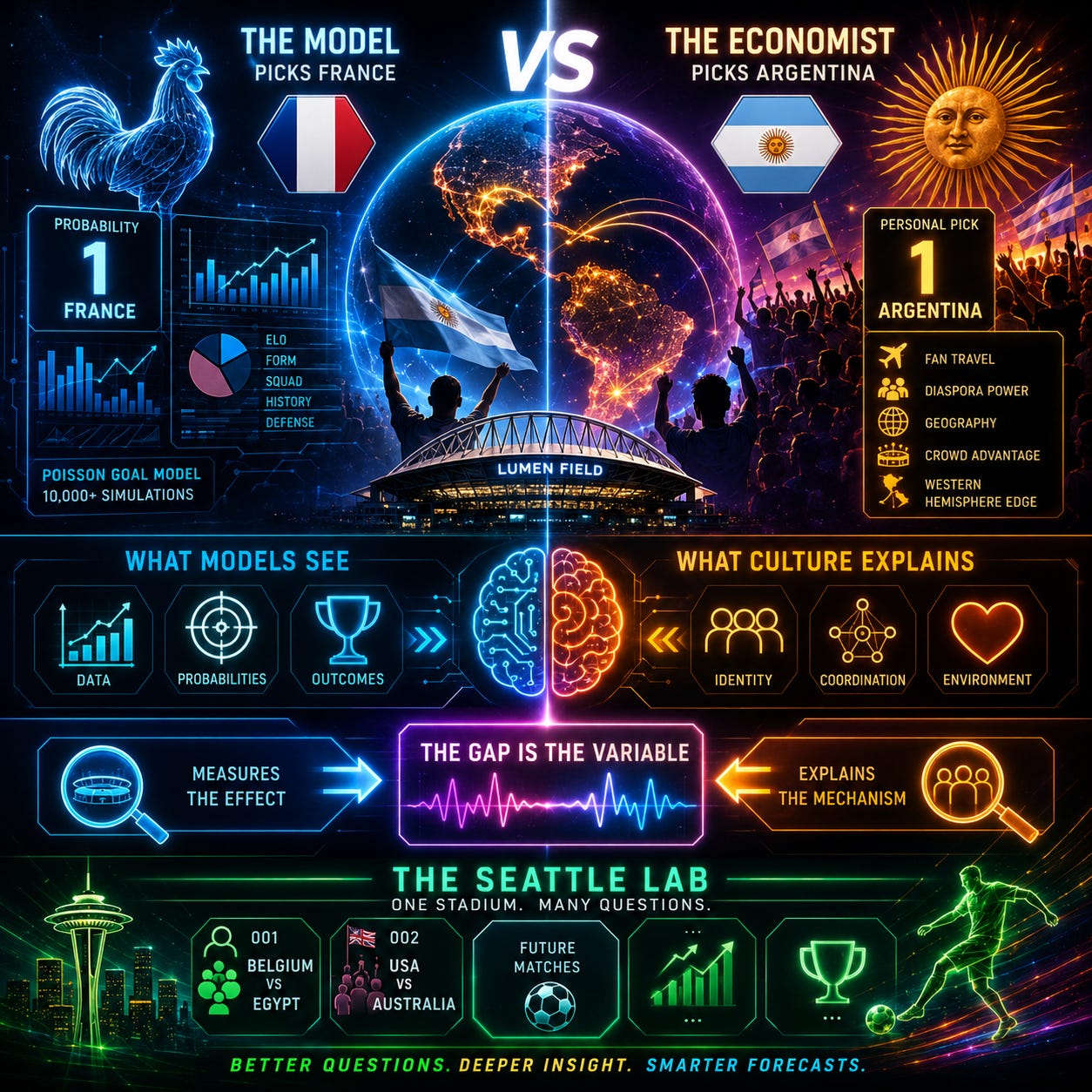
Source: Jesse Rogers, Head of LatAm Economics at Moody’s Analytics, published the World Cup Tracker (Economic View, Latin America) on June 9, 2026. The tracker is primarily an economic-impact report, estimating the tournament’s contribution to 2026 GDP growth across the host nations — Mexico 0.14 percent, Canada 0.08 percent, and the United States 0.05 percent. Its forecasting sidebar, which Moody’s economist Tadeu Marcon Teles built, runs a Poisson goal model across thousands of Monte Carlo simulations and scores each team on a composite of five factors: Elo rating as the primary driver, recent form, squad quality, historical performance, and defensive stability. The model ranks France the most probable champion. Rogers, writing in his own capacity, named Argentina his personal pick instead, citing the Western Hemisphere home-field advantage that the Latin American diaspora creates in neutral stadiums — the override this commentary examines.
🎯 The Tell
A recent World Cup tracker from Moody’s Analytics opens with a contradiction that should sound familiar to readers of the MindCast 2026 FIFA World Cup Seattle Lab, a six-match series that uses one fixed stadium to isolate how culture and environment shape outcomes. The model picks France. The economist who built the model picks Argentina. The disagreement is not noise — it is information. Jesse Rogers overrides his own output because of the crowd: geography, fan travel, and diaspora density all matter, and hosting a World Cup across the Western Hemisphere creates an effective home-field advantage for Latin American nations that traditional rankings struggle to capture. The gap between the model’s answer and its author’s answer is not a forecasting mistake. The gap is a measurable variable, and the MindCast 2026 FIFA World Cup Seattle Lab reached the same variable through an entirely different route.
📊 Two Different Layers of Reality
The similarity ends there. Moody’s and MindCast AI are not running the same model, and they are not even measuring the same layer of reality. Moody’s begins with observable football variables — Elo ratings chief among them — and a Poisson goal model compounds those inputs across thousands of simulated tournaments to answer a practical forecasting question: which team is most likely to win? Geography, fan travel, and crowd composition enter only afterward, as caveats the analyst adds by hand, which is the override in miniature.
The MindCast 2026 FIFA World Cup Seattle Lab asks a different question entirely: what mechanism causes teams to outperform or underperform the expectations embedded in those rankings? The distinction matters because every forecasting framework eventually confronts the same problem. Teams do not merely carry talent onto the pitch; they carry identity, coordination structures, institutional memory, expectation burdens, supporter ecosystems, media narratives, and environmental pressures. Statistical models see the outputs of those forces, while cultural models attempt to observe the forces themselves.
Contact mcai@mindcast-ai.com to partner on Predictive Game Theory in Law and Behavioral Economics. See MindCast Predictive Game Theory + Behavioral Economics Cognitive Digital Twin Foresight Simulations in the World Cup and Super Bowl
🔬 What the MindCast Seattle Lab Isolates
MindCast AI built the 2026 FIFA World Cup Seattle Lab specifically to isolate those mechanisms. The opening simulation, Belgium versus Egypt, treated Seattle as a controlled environment and examined whether plural coordination or concentrated civilizational identity scaled more effectively under near-neutral conditions. Belgium represented a system struggling to synthesize elite individual talent into collective achievement, and Egypt represented a system attempting to scale collective coherence beyond its traditional domain. The experiment focused on culture against culture.
The second simulation, United States versus Australia, shifted the variable while holding Seattle constant: the crowd changed, a host nation entered the field, and home saturation became the measurement. The resulting framework asked a question conventional football models rarely isolate directly — does environmental amplification outweigh organizational coherence? Australia entered as the more coherent system, while the United States entered as the more talented system operating inside a heavily favorable transmission environment. The Cultural Signal Integrity Model then produced an unexpected result: Australia scored higher on internal coherence metrics, the United States scored dramatically higher on Transmission Saturation, and the simulation therefore became less about culture itself than about the interaction between culture and environment.
The inversion ran deeper than the scoreline. The interaction score measures how much cultural signal a matchup generates — how cleanly two operating systems, set against each other, reveal what each one is. The scale runs to 100, and a reading in the sixties marks a strong, legible contrast. Belgium–Egypt scored 64, and the number sat above both standalone cultures, because a pure clash of grammars exposes more about each side than either reveals alone. USA–Australia inverted that. The matchup scored 63, yet that figure landed below both standalone cultures at 66 and 64 — the only fixture so far where the encounter reveals less than its parts. The home crowd is the reason. A host-nation Juneteenth crowd raises everything at stake in the result while sitting directly between the two cultures and the measurement, so environmental amplification crowds out the cultural read it overlays. Crowd effects increase outcome relevance and reduce measurement purity at the same time — a direct illustration of the difference between forecasting a result and isolating a mechanism.
🌍 Where the Two Frameworks Converge
The Moody’s model and the MindCast Seattle Lab converge at exactly that point. Moody’s observes a Western Hemisphere advantage; the MindCast Seattle Lab attempts to explain why such advantages emerge. One framework measures the effect, the other models the mechanism, and neither approach invalidates the other. The relationship resembles weather forecasting and atmospheric science — one predicts the storm, the other explains how the storm forms.
🧩 Why the Ratings Miss
The most interesting implication may lie ahead. Suppose a team consistently exceeds its Elo expectations. Traditional models eventually absorb that performance into updated ratings, but a cultural framework asks a different question: why did the ratings miss the team in the first place? The answer may involve organizational coherence, institutional continuity, supporter synchronization, identity preservation, or environmental amplification — none of which fit neatly inside conventional ranking systems, yet all of which influence outcomes. The MindCast Seattle Lab exists to test whether those forces yield to systematic measurement rather than anecdotal discussion.
Moody’s unintentionally highlights why that effort matters. Once economists begin incorporating geography, diaspora density, crowd composition, and symbolic home-field effects into their models, forecasting has already moved beyond pure talent evaluation. The conversation shifts from “who is better?” to “which environment allows existing capabilities to express themselves most effectively?” — and the shift sits at the center of the MindCast Seattle Lab.
✅ The Hidden Theory
Belgium–Egypt examined culture under neutrality, USA–Australia examined culture under saturation, and future Seattle matches continue the same progression under a fixed civic environment. The objective is not to replace rankings, Elo systems, or probabilistic models, but to identify what those systems cannot easily see. Every forecast contains a hidden theory of human behavior, and the MindCast Seattle Lab simply makes that theory explicit.
Moody’s asks who wins. The MindCast Seattle Lab asks why the prediction changes when the environment changes. The distance between those two questions may be where the next generation of forecasting emerges.