

Cultures Under Shared Rules — The Seattle Lab at FIFA World Cup 2026 series
Belgium vs Egypt, The Seattle Lab Opens: Plural Coordination Meets Civilizational Memory at Lumen Field
USA vs Australia, The Seattle Lab Under a Home Crowd: Recombinant Innovation Meets Resilient Pragmatism on Juneteenth
MindCast Special Series — a deliberate stress test of the MindCast system beyond the controlled venue of the MindCast Seattle Lab
World Cup Championship Index 2026, Championship Prior Edition — Why France Can Be the Strongest Team and Argentina the Most Likely Champion
When a FIFA World Cup Model Picks France and the Economist Picks Argentina
Mexico vs South Korea, The MindCast Special Series — Home Field, Carried: A Diaspora Stress Test in Guadalajara
MindCast AI Proprietary Cognitive Digital Twin Foresight Simulation Match: 🇺🇸 USA vs Australia 🇦🇺 · Group D · Match 32 Venue: Lumen Field (FIFA: Seattle Stadium), Seattle Date: June 19, 2026 · 12:00 PM PT · JuneteenthSimulation: Second experiment of the Seattle Lab — the partisan-field contrast Published before kickoff. Time gates and falsification contract committed below.
Methodological provenance: The simulation inherits the validated foresight discipline of MindCast AI’s NFL Vision series — mechanism before score, pre-committed time gates, a falsification contract, and documented self-correction — built across seven consecutive structural calls and a 29-for-29 cross-domain prediction record. The discipline transfers; the accuracy record stays with its source domains, and the Seattle Lab earns its own. Released after the Belgium–Egypt opener, this second entry also inherits whatever the opener’s June 16 calibration revised. (See Super Bowl LX — AI Simulation vs. Reality and Seahawks 2025–2026 Season Validation.)
I. 🔬 Why This Match Holds the Crowd Constant the Other Way
The opener measured culture under a near-neutral crowd. Belgium and Egypt met on ground that favored neither, and neutrality let the cultural signal read cleanly. June 19 inverts the control. A host nation plays at home, on Juneteenth, in the loudest stadium in the sport, at a noon kickoff that turns the building into a single partisan instrument. Where the opener’s gift was neutrality, this fixture’s variable is saturation.
The Seattle Lab runs as a designed experiment precisely because the venue stays fixed while the crowd around it changes. Reading the same Lumen Field instrument under a balanced field on June 15 and a heavily American field on June 19 isolates one question the opener could not pose: does home saturation lift a system or distort it? A roaring crowd hands energy to the side it backs and weight to the side it expects. Which effect dominates becomes the headline measurement of the second simulation.
A second axis enters with these two teams. Belgium and Egypt anchored the dispersion-versus-concentration poles — too distributed to cohere against too concentrated to scale. USA and Australia test something the opener left untouched: coordination efficiency, the output a system extracts per unit of talent. The United States carries the deeper talent pool and the higher ceiling, assembled by recombination across leagues and continents. Australia carries the thinner pool and the tighter organization, overachieving through role discipline and collective grit. One question runs underneath the match — can recombinant talent cohere under home pressure faster than disciplined organization can frustrate it?
The Cultural Innovation Vision instrument runs through Cultural Vision, Strategic Behavioral Coordination Vision, Chicago Strategic Game Theory Vision, Game Regime Identification Vision, Cybernetic Control Vision, Field-Geometry Reasoning Vision, Installed Cognitive Grammar Vision, and MindCast Foresight Vision, scored against the four-metric Cultural Signal Integrity Model.
II. 🧬 The Two Cognitive Digital Twins Entering the Lab
Each Cognitive Digital Twin models a national footballing culture as an operating system — the grammar a federation uses to coordinate talent, absorb pressure, and express identity under stress. USA and Australia enter running opposite operating systems: one assembled from many sources and still settling, one drilled into a single shape and fully settled. The profiles below read each as it stands in June 2026 rather than as reputation remembers it.
🇺🇸 USA — Recombinant Innovation Under Home Expectation
The United States operates through recombination — a footballing culture that assembles identity from imported parts rather than inheriting it whole. Mauricio Pochettino, an Argentine in his first cycle as host-nation manager, fields a young, athletic squad drawn from across the global game: Pulisic and the Premier League, Balogun from Monaco, Pepi from PSV, Wright from the English Championship, McKennie and Weah from Serie A, Zendejas from Liga MX, alongside an MLS core. Thirteen players carry 2022 round-of-16 experience; thirteen arrive at a first World Cup.
The structural signal sits in that assembly. A federation builds a deep, in-form forward line and an athletic spine, yet still searches for a settled coordination grammar — the early Pochettino tenure clashed with senior players and stumbled through the Gold Cup final before an autumn run restored belief. Recombination supplies talent fast; coherence arrives slowly. Home expectation now compresses the timeline, because a host nation on Juneteenth must look like a contender on day eight, not month three.
Operating grammar: identity assembled from diverse imported parts; capability through recombination. Seattle synthesis role: whether a freshly recombined system coheres under the heat of its own crowd — or overheats before the coordination layer sets.
🇦🇺 Australia — Resilient Pragmatism From a Minority Code
Australia operates through resilient pragmatism — organization, role clarity, and collective discipline compensating for a shallower talent pool in a country where football competes beneath Australian rules, rugby, and cricket for attention. Tony Popovic, a former Socceroos centre-back, drills a side his players describe as “animals” for intensity, anchored by deep tournament experience: Ryan and Leckie heading to a fourth World Cup, Behich, Degenek, and Irvine to a third, with younger talent in Circati, Irankunda, and the recently switched Volpato. Qualification ran through grit — second behind Japan, beaten once across the campaign, sealed by a final-day comeback in Saudi Arabia.
The structural signal sits in the overachievement. A squad lighter on individual quality than most of the field extracts a sixth consecutive World Cup and a 2022 round-of-16 run that pushed eventual champions Argentina to 2–1. Coherence does the work that talent does for richer nations. Against a host favorite, the Socceroos hold a clear self-concept — frustrate, stay compact, punish impatience — and a documented comfort in hostile rooms.
Operating grammar: coherence through discipline; maximum collective output from limited individual material. Seattle synthesis role: whether organized coherence can neutralize recombinant talent when the whole stadium wants it to fail.
III. 📊 Cultural Signal Integrity Model — Baseline Scorecard
Scores run 0–100. The simulation publishes after both teams play their openers — USA against Paraguay on June 12, Australia against Türkiye on June 14 — so Recursion Strength shifts from the pure prior it held in Belgium–Egypt to a lightly measurable reading here. The draft below sets pre-group-stage baselines; the June 12 and June 14 results get folded in at publication and may move these numbers before kickoff.
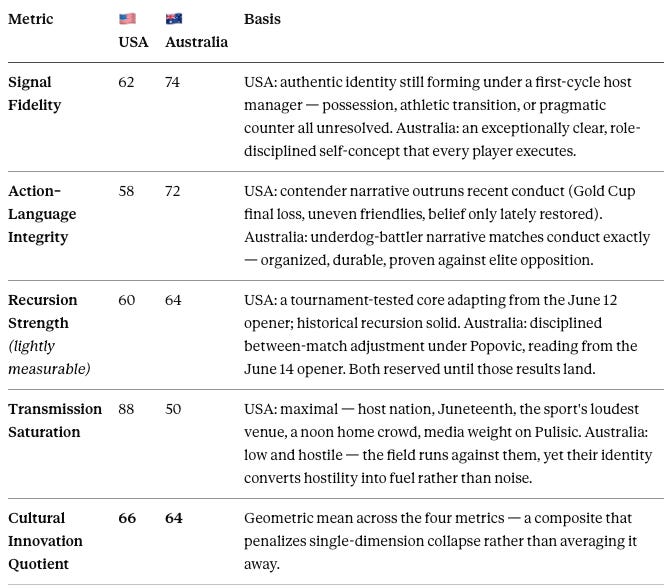
The geometric-mean composite is deliberate. A culture strong on three dimensions and brittle on one does not earn a high synthesis score, because role-ratio logic holds that systems fracture at their weakest coordinating dimension, not at their average.
A single number carries the whole story of this fixture. Strip the Transmission Saturation column away and Australia reads as the more coherent system — higher fidelity, tighter narrative-conduct alignment, clearer identity. Add the home crowd back and the United States edges ahead on the composite, because saturation lifts American signal yield while the hostile field suppresses the Australian reading. The near-parity (66 to 64) is not two evenly matched cultures; it is one disciplined system and one talented system separated almost entirely by who fills the stands. Quantifying that separation is the experimental purpose of the second simulation.
Synthesis Cultural Innovation Quotient for the interaction: 63. The figure estimates signal yield from the encounter, not a scoreline, and reads against the fixed interpretive scale reused across all six Seattle simulations:
Below 50 — weak differentiation between operating grammars; low experimental value.
50–59 — moderate differentiation; a usable reading, though not a headline experiment.
60–69 — strong differentiation; the match generates clear cultural signal regardless of result.
70 and above — extraordinary contrast; a flagship fixture where opposing grammars collide at maximum separation.
USA–Australia opens at 63, and the figure sits below both individual Quotients (USA 66, Australia 64) — an inversion of the opener, where the interaction rose above its two cultures. The inversion is diagnostic, not an error. Belgium and Egypt staged a pure culture-against-culture contrast, so the encounter generated more signal than either grammar alone. Here the home crowd intrudes between the two grammars and the measurement, inflating the American standalone composite while muddying the culture-on-culture signal the interaction is meant to capture. Environment adds to one team’s reading and subtracts from the clarity of the contrast. The 63 therefore lands just below the opener’s 64 by design — the second simulation stages the richer sports forecast but the slightly less pure cultural experiment, and the opener keeps the sharper conceptual geometry.
The second simulation is the first in the Seattle Lab where the crowd variable exceeds the cultural differential. Belgium and Egypt measured competing coordination architectures against each other, culture on culture. USA and Australia measure whether environmental amplification can outweigh superior organizational coherence. The experiment therefore tests not only the two cultures but the relative strength of culture versus environment — and the result points toward an answer. A United States win driven by saturation effects would offer evidence that environment can outweigh coherence; an Australian result would point the other way. Few fixtures isolate that question so directly, which is the second simulation’s deepest contribution even as its cultural geometry stays a step behind the opener’s.
Contact mcai@mindcast-ai.com to partner on Predictive Game Theory in Law and Behavioral Economics.
IV. 🎭 Role-Ratio Profiles
Role ratios break each squad into the four functions that decide whether a system scales, stalls, or fractures: Signalers who generate the decisive creative output, Transmitters who move it through the side, Hybrids who translate between roles and contexts, and Absorbers who hold structure under pressure. The mix matters more than the raw talent, because a federation rich in one function and thin in another breaks at precisely the seam the table below exposes.
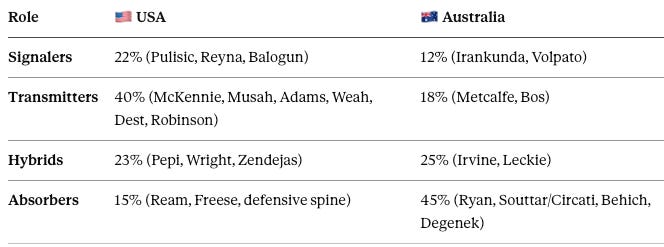
The United States reads Transmitter-saturated — a side full of athletic ball-carriers who move possession and territory, fronted by genuine Signalers but thin on settled Absorbers behind a young spine. Australia reads Absorber-heavy with concentrated Signal — a deep, disciplined holding base beneath a narrow creative apex. The diagnostic prediction follows directly: American Transmitter volume manufactures territory and shots, and if the Signalers do not convert early, the Australian Absorber base soaks the pressure while the home crowd’s expectation curdles into anxiety. Australia’s path to a result runs through that conversion gap.
V. 🌧️ The Seattle Environmental Variable
Seattle functions as an experimental control, not a backdrop. The venue holds physical conditions constant across all six Seattle matches — pitch, acoustics, light-rail access, civic transmission profile — while the crowd that fills it changes by fixture. The opener drew a near-neutral co-produced field. The second simulation draws the opposite extreme: a host-nation crowd on Juneteenth, in a stadium engineered for noise, at a midday kickoff that concentrates attention rather than dispersing it across an evening. Saturation, not neutrality, is the operative condition.
Expected crowd composition:

A dominant partisan bloc drives the predicted effect, and the effect cuts two ways. For the United States, the crowd is an amplifier — energy, tempo, a twelfth man that rewards early aggression. For a recombinant system still settling its coordination grammar, the same crowd is a load: expectation that converts to pressure the longer the scoreline stays level, the exact condition under which an unsettled side presses anxiously rather than playing freely. For Australia, the hostile field is neither amplifier nor load but fuel. Popovic’s “animals” hold a documented comfort in rooms that want them to lose, and an underdog with a clear self-concept reads a hostile crowd as confirmation rather than threat.
The contrast with the opener is the designed measurement. Reading the same Lumen Field instrument under June 15’s balanced field and June 19’s saturated field gives the Seattle Lab a clean cross-match variable: home-field distortion turned up from near-zero to maximal across four days, with culture and venue otherwise held constant. Whether saturation helps or distorts the host is the reading this fixture exists to produce.
VI. 🌫️ Game Regime Classification: TRAP
The four regimes are Arena, Fog, Labyrinth, and Trap. The opener classified as Fog — a first contact with no in-tournament data. The second simulation classifies as Trap, the regime where a side’s apparent strength becomes the lever an opponent turns against it. Information deficit is lower here: both teams have played a group match, recent direct history exists (the United States beat Australia 2–1 in October 2025), and the favorite is clear. What raises the Trap is the structure of expectation. A host nation expected to win, carrying Juneteenth and a home crowd, faces a disciplined underdog whose entire game model is to frustrate favorites and punish impatience. American dominance becomes a liability the moment it fails to produce an early goal, because the crowd’s expectation weighs on the team rather than the opponent, and Australia’s compact block converts the resulting anxiety into counter-attacking lanes.
The classification carries its own falsification. An early United States goal that opens the match into a free-flowing, end-to-end contest would read as Arena, not Trap — the favorite’s strength expressed cleanly rather than turned against it. The opening half-hour decides which regime governs.
VII. 🔮 Match Forecast (Secondary Output)
The simulation’s primary prediction is structural, not numeric. The United States imposes territory and shot volume through Transmitter saturation; Australia holds shape, stays within one goal past the hour, and converts American impatience into counters. The football scoreline rides beneath that mechanism as a secondary output — the same discipline the NFL Vision series applied when it published resolution conditions first and filed a score band second. (See Seahawks v. Patriots, Super Bowl LX.)
Primary prediction (structural): a Trap-regime match resolving toward United States control if the favorite scores early and the crowd amplifies, and toward a Socceroos result if the half stays level and expectation becomes weight.
Secondary output (scoreline probabilities):

Most likely score: USA 2–1 Australia.
Alternative outcomes: USA 1–0 · 1–1 draw · USA 2–0.
Primary driver: the United States manufactures more pathways to goal through recombinant attacking depth — three in-form strikers plus Pulisic and Reyna — than Australia’s organization can fully contain across ninety minutes. Volume favors the host. The draw and upset paths open only if the Socceroos reach the hour level and the home crowd’s expectation turns against its own team.
The forecast and the scorecard pull in instructive directions. Australia holds the higher Signal Fidelity and the tighter narrative-conduct alignment, yet the United States is favored only moderately, not overwhelmingly. Coherence and victory are different properties — Australia is the more coherent system, the United States the more talented one playing at home. The opener showed coherence failing to convert when distribution met concentration; the second simulation shows coherence outweighed when disciplined organization meets recombinant talent backed by seventy percent of the stands. Two matches, two mechanisms, one consistent finding: cultural coherence does not by itself decide a football result.
VIII. ⏱️ Time Gates and Falsification Contract — Committed Before Kickoff
Two accountability instruments govern the simulation, both imported from the validated NFL method: in-match time gates that lock the structural read while the match is still in progress, and a falsification contract specifying what would prove the model wrong. The NFL Vision series established the gate logic — watch the gates, not the score — and recorded every committed gate cleared on schedule. (See Seahawks v. Patriots, Super Bowl LX and Super Bowl LX — AI Simulation vs. Reality.)
In-Match Time Gates — crossed during play
Time Gate A — Opening 25 minutes (which regime governs). An early United States goal that opens the match end-to-end reads Arena, and the host’s strength expresses cleanly. A scoreless, compact opening with Australia’s block intact engages the Trap, and the crowd’s pitch starts to matter.
Time Gate B — The Halftime Eight (four minutes before and after the break). The point where home expectation either pays off or turns. United States-favoring if the host leads at the interval and the crowd reads as a twelfth man. Australia-favoring if the match stays level or the Socceroos lead, and American possession begins to look anxious rather than incisive.
Time Gate C — The 60th-Minute Fork (the favorite’s Trap point). The hour mark resolves the regime. United States-favoring if a multi-goal cushion relaxes the building and recombinant talent flows freely. Australia-favoring if the margin holds within one and Popovic’s side smells an upset, with counter lanes widening as the host commits numbers forward. A United States second goal before roughly the seventieth minute reaches terminal resolution — the point where the outcome locks and the remaining minutes only confirm it.
Falsification Contract — what would prove the simulation wrong
Each condition below is numeric and observable on June 19 or in the June 20 validation. Pre-commitment is the discipline. Falsification is the contract.
Gate 1 — USA coordination coherence. The recombinant system shows a coherent attacking identity if at least 55 percent of United States open-play chances arrive through constructed sequences of three or more passes. Chances arriving overwhelmingly from individual moments and set pieces falsify the coherence reading and confirm talent outrunning grammar.
Gate 2 — Australia resilient pragmatism. The organized-battler identity holds if Australia concedes no more than one goal and keeps the match within a single goal past the seventieth minute. An early multi-goal collapse falsifies the resilience reading — disciplined organization failing under the home crowd.
Gate 3 — Game Regime. The Trap classification holds if the match stays within one goal past the hour with visible United States anxiety and Australian counter-threat. A comfortable host lead built through open play by halftime falsifies Trap and reads Arena.
Gate 4 — Transmission Saturation. Measurement protocol: sample 20 pre-match articles published June 14–19 across FIFA.com, ESPN, BBC Sport, Reuters, The Athletic, and one national outlet per side (a U.S. outlet and an Australian outlet). Code each headline and lead paragraph for primary frame. The gate clears if host-nation framing — USMNT expectation, Juneteenth, the home crowd, must-win pressure — claims at least 60 percent of headline and lead emphasis over tactical or Australia-centered framing, and if in-match United States territorial dominance reaches at least 58 percent possession. A match that covers and plays as an even, neutral contest falsifies the saturation reading.
Gate 5 — Recursion (lightly measurable). Unlike the opener, both teams arrive having played once. The recursion read holds if the United States visibly adjusts its structure from the June 12 Paraguay opener rather than repeating the same failure modes, and if Australia carries forward a coherent adaptation from the June 14 Türkiye match. Identical, unadjusted patterns across consecutive matches falsify positive recursion. The reading waits until those results land at publication.
Series-level gate. The simulation weakens the Seattle Lab framework if public narrative, supporter behavior, media framing, and on-pitch expression remain purely tactical and commercial, surfacing none of the recombination, resilient-pragmatism, or saturation themes specified above.
IX. 🔁 Forward Recursion Prediction
The United States plays a third group match against Türkiye around June 25, and the adaptation arc across three games converts Signal Fidelity from a static reading into a measured trajectory. The simulation commits the bridge in advance, partitioning the outcome space so no result escapes the prediction.
A convincing United States performance that constructs goals through coherent sequences should raise American Signal Fidelity entering the Türkiye match, recombination beginning to set into grammar.
A labored win built on individual moments and set pieces against a deep Australian block should hold Signal Fidelity flat — a result without coherence.
A failure to break Australia down should lower Signal Fidelity, confirming recombinant talent that has not yet cohered under pressure.
One measured quantity does double duty. The share of United States chances built through constructed sequences — the coherence line drawn in Gate 1 — resolves a second-simulation gate and seeds the read on whether American identity is setting across the group stage. A single data capture on June 19 closes this match and feeds the trajectory. One measurement, a running arc. The connective tissue makes the Seattle slate a designed experiment rather than six standalone previews. A United States knockout path back to Lumen Field depends on the bracket and stays unclaimed until the group resolves.
X. 🔄 Model Evolution Protocol
A foresight system that never updates cannot stay accurate, and a system that updates without admitting error carries no integrity. The NFL Vision series treated self-correction as its strongest credibility exhibit: the NFC Championship simulation classified Seattle as compression-dominant, the Rams game falsified that read, and the Super Bowl simulation openly abandoned the prior thesis and rebuilt around multi-regime survivability — documented and timestamped before kickoff. (See Seahawks 2025–2026 Season Validation.)
The second simulation is the first to publish after a prior Seattle Lab result exists. Whatever the Belgium–Egypt validation revised on June 16 — a recalibrated metric, a sharpened gate, a corrected classification — carries forward into the readings here, and the lineage stays visible rather than silent. Should June 19 falsify a reading in turn — the United States cohering immediately under the crowd where the model expected an unsettled system, or Australia collapsing where the model expected resilience — the next simulation will publish the revision openly, prior reading, falsifying evidence, and rebuilt classification shown side by side. An early misclassification is not a blemish to bury; documented correction under falsification is the proof of method.
One honest boundary still travels with the borrowed discipline. The validated track record belongs to the NFL and cross-domain work; the Cultural Signal Integrity Model is two matches into earning its own. The Seattle Lab inherits the method, not a transferred accuracy rate, and earns each ledger entry only by surviving the gates committed before kickoff.
XI. 🌐 Forward Implications
The USA–Australia contrast travels well beyond football, because recombination-versus-organization and the weight of expectation recur wherever capability has to be turned into outcomes. Four domains read the same match through their own lens, and each finds a familiar structural problem underneath the scoreline.
Law and institutional design. A body assembled by recruiting diverse external talent maps onto the United States; a body built on cohesive internal culture maps onto Australia. Home expectation models incumbency advantage — the structural edge that becomes a liability when the incumbent must perform on schedule rather than merely hold position.
Behavioral economics. Host-nation pressure is the favorite’s choke hazard, an expectation tax that rises with every level minute; Australia plays on house money, freed by low expectation. Loss aversion runs asymmetric — the side with more to lose tightens, the side with nothing to lose swings freely.
Predictive game theory. Trap formalizes as a game in which the favorite’s dominant strategy is exploited by the underdog’s counter. Expectation enters as a strategic variable, not a backdrop — the crowd that should help the host can become the lever that unsettles it.
Artificial intelligence and cognitive systems. Recombinant assembly from heterogeneous sources maps onto capability-through-aggregation; a smaller, tightly aligned system maps onto coherence-through-alignment. More components do not help a system whose coordination layer has not yet set, especially under load — the home crowd is a high-signal, high-noise input that can sharpen a mature system and destabilize an immature one, which is why an instrument built on multi-agent Cognitive Digital Twins can read the difference.
XII. 📋 Performance Dashboard
The dashboard records every committed forecast in one place and converts on June 20. The three in-match time gates resolve into these rows; the scorecard, the regime call, and the recursion read supply the rest. Reused across every Seattle simulation, the dashboard accumulates into a visible cumulative record of model performance across the slate.
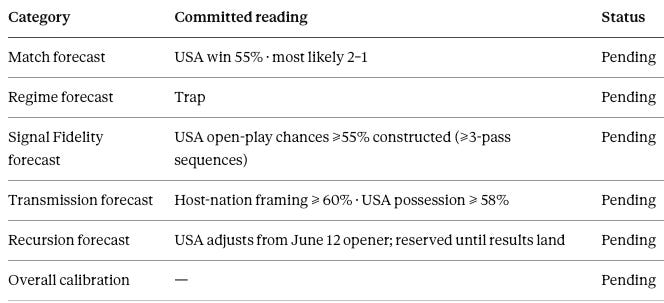
June 20 converts each Pending to Cleared, Triggered, or Revised — cleared when the committed reading holds, triggered when a falsification condition fires, revised when the Model Evolution Protocol rebuilds a classification.
XIII. 📅 Validation Schedule
The simulation commits before the match and grades itself after, on a fixed three-step cadence. The schedule below pins each date to the deliverable attached to it, so accountability runs on a calendar rather than on convenience. The window also absorbs the June 12 and June 14 group openers, whose results fold into the baselines and the recursion read before publication.

The June 20 calibration scores each committed gate as cleared or triggered, grades the match forecast against the result, recalibrates the baseline Cultural Signal Integrity Model readings against observed signal, and records the saturation contrast against the opener's near-neutral baseline. The cross-match comparison is the experiment — the same venue read under opposite crowds, with culture and stadium held constant while home-field distortion moves from near-zero to maximal.