

Energy companies · equipment, flexibility and grid software providers · modular compute operators · hyperscalers · utilities · state and county approvers · lenders · Texas · Pacific Northwest
Companion: the magazine companion “AI Data Centers and Clean Energy: Which Projects Reach Operation and Where Clean Technology Companies Can Win” summarizes this letter on pages 4 and 5. The magazine adds a guide by clean technology segment on page 3 and a risk page on page 31.
Thesis: AI data centers buy power, sites, flexibility and equipment from clean technology companies. Five authorities decide how much of that demand reaches operation. A clean energy company that owns land, storage or generation gains an AI hosting advantage only when the utility and the state, the lender and the contract let it keep that advantage.
Why now: Texas paused data center permits on September 21, grid operators file large-load rules by November 16 and the 2027 legislative sessions write the next terms. Energy companies and operators, utilities and approvers, and counsel and investors each decide before those rules set.
I. Clean Energy Sites Hold Their Strongest Advantage at County Review, and Utilities and States Decide Whether It Pays
Existing energy sites hold their strongest relative advantage in local land-use review. Utility service and state permitting decide whether that advantage produces operating capacity. Lenders and tenant contracts then decide whether the advantage that survives turns into margin or into absorbed delay.
The finding comes from a new MindCast simulation across eleven published works. Energy Vault broke ground on a host-owned AI campus in Snyder, Texas on July 27, 2026. Texas then halted state environmental permits for data center projects on September 21. Snyder now tests whether owning the power site changes the approval outcome.
MindCast AI applies Predictive Behavioral Economics + Dynamic Game Theory through MindCast AI Proprietary Cognitive Digital Twin Foresight Simulations (MP CDT FS). Behavioral Economics supplies the decision rules. Game Theory supplies the payoff structure. Predictive simulations emerge from the combination.
MindCast AI’s founder has testified before the Washington State Legislature, whose 2026 session changed data center incentive law.
Takeaway: owning the power site helps most at the county and least at the utility and the state.
II. What the Finding Means for Each Clean Technology Segment
AI infrastructure reaches clean technology companies through four purchases. Operators buy electricity matched to each class of AI work. Operators also lease powered sites and pay for flexibility that speeds grid service. Equipment buyers order modules, cooling and power equipment.
Each purchase depends on the same five determinations: utility service and state permits, local land use, lender treatment and contract terms. A clean technology company wins business where its product helps a project clear one of those decisions.
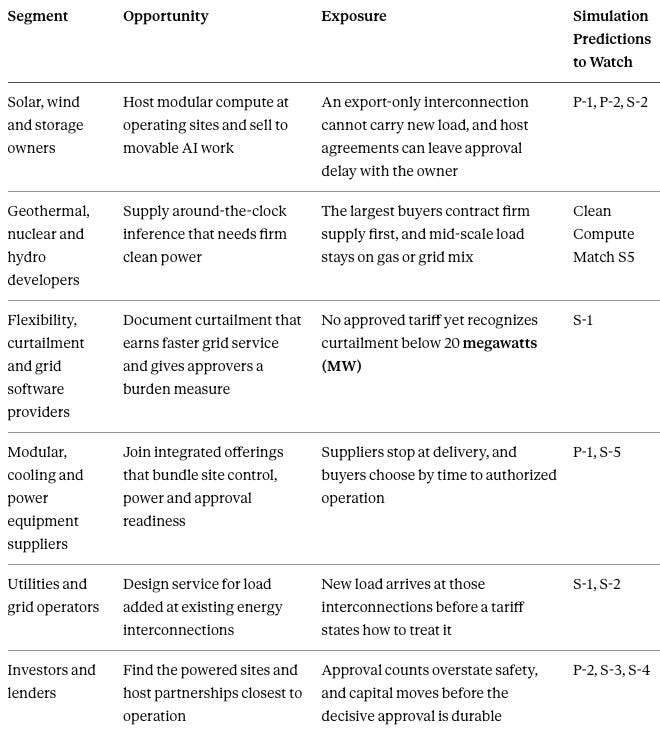
Equipment and software suppliers face the indirect version of every host exposure. A cooling vendor or curtailment provider gets paid when a site operates, so a utility study or a state halt delays the supplier’s revenue as surely as the host’s. Suppliers that document burden evidence for their products give hosts the exhibits counties and lenders ask for.
Pacific Northwest readers. Washington supplies the live local test. Cle Elum’s moratorium meets the Blue Fern project before the end of 2026, and the series expects the moratorium not to reach the project (60–70%). Puget Sound Energy runs in the simulation as the region’s utility twin, and S-3 expects host announcements outside Texas to outnumber those inside Texas through 2027.
Takeaway: each segment should name the approval its product helps a project clear, then sell first to the projects that need that help.
III. Eleven Works Show One Market and the Approval Layer That Acts on It
Since September 2025, MindCast has published eleven works on AI data centers and clean energy. Read together, they describe one market for compute and clean power and the approval layer that decides which matches operate.
The Market
AI Datacenter Edge Computing: Ship the Workload Not the Power (2025) set the founding principle: move compute toward energy and community trust. Host sites put that principle into physical form.
The Grid-Anchored Clean Power Bargain — Powering AI Data Centers Through 2040 (2026) showed that firm service is the weakest of interconnection, deliverable energy and accredited capacity. The weakest-link rule explains why a host’s interconnection matters only when it can import power.
The Clean Compute Match — Which Clean Power Pairs With Which AI Compute, And What Stays On Fossil (2026) paired wind and solar with movable compute and paired firm clean supply with anchored compute. The pairing sets which AI workloads a given clean asset can host.
The Approval Layer
Burden-Based Authorization for AI Data Centers, Modular Clean Compute, and the Backlash Gap Between Grid Tariffs and State Law (2026) found that grid rules reward flexible load while state law sees only the “data center” label. Small host sites fall into that gap.
AI Data Center Veto Points Show Where Projects Get Stopped and How Authorization Risk Moves (2026) mapped ten points at which a project can be stopped and showed opposition moving to the next open one. The paper’s Cle Elum case anchors the Pacific Northwest analysis below.
The Lowest-Exposure AI Data Center Approval Route for Developers, Hyperscalers and Investors (2026) tied capital release to durable approvals. The paper’s durability test is the standard each host determination must meet.
The Data Center Authorization Market: A 50-State Regulatory Atlas (2026) and The Model Data Center Authorization Code (2026) supply state evidence and a common language for comparing rules. Both define the state and local terms the simulation reads.
The Assembly
Modular AI Data Center Specialists and the Integrated Offerings That Turn Small Sites Into Authorized Operating Capacity (2026) identified power-asset hosts as the party that carries small sites to operation. The host role is the subject of the new simulation.
AI Data Center Taxonomy for Decision-Making and Clean Energy, Four Categories That Decide Whether a Site Operates(2026) replaced facility labels with four decision categories. The categories supply the variables each approving authority reads.
AI Data Center Authorization + Clean Energy, the Mid-Scale Squeeze and the Specialized Compute Landscape (2026) read the series together and named the Mid-Scale Squeeze: one tier of AI load failing three gates the largest operators pass by scale. The overview remains the umbrella for this letter.
Takeaway: the series left one question open. Does owning the power site give a clean energy company an approval advantage, or does it only move the burden onto the company?
IV. Five Authorities Decide Whether a Host Site’s Advantage Survives
A host site does not pass one approval. Five authorities each classify the same project, and each can read it differently.
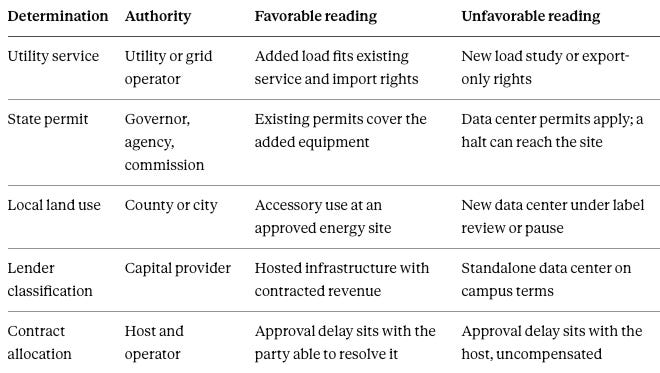
The determinations form a dependency network, not a fixed sequence. One can condition another, and the order shifts with the project and the state. The simulation asked which authority imposes the first constraint that changes a site’s economics.
MindCast built Cognitive Digital Twins (CDTs) of thirteen actors and ran them against one another. Hosts include Energy Vault and PowerBank, and operators include Crusoe and Nodiac. Microsoft, Amazon, Google and Meta run as separate twins beside a residual class for other AI developers.
The Texas grid operator and Puget Sound Energy represent utilities. State and county approvers, firm clean developers, lenders and curtailment providers complete the set.
Mechanism. Game theory supplies the payoff structure. Each authority writes terms inside its own instrument, and the host bears the cost of translating among them.
Behavioral economics supplies the decision rules. Counties react to salient announcements, so an air-cooled module at an existing energy site draws little review. A utility applies its thresholds regardless of salience.
Where the advantage holds. The simulation forecasts that county review does not stop modules at operating generation and storage sites. Energy Vault’s 33 planned modules at Snyder use about 297 gallons of water a day for the whole site, which leaves a county little to object to.
Where it breaks. Utility import rights bind first at distribution-connected sites, because an export-only interconnection cannot carry new load by contract. The Texas permit halt binds first in Texas, because the halt carries no size floor.
Phases that cross 20 to 25 MW inherit large-load study under the same owner. Host ownership can also expose the energy company to approval delays that agreements allocate unevenly. Oracle’s force majeure notice on Project Jupiter (Reuters, September 24, 2026) shows approval delay moving into contracts.
Takeaway: each of the five authorities can erase a host’s advantage, and the county is the least likely to do so.
V. MindCast Simulation Predictions: Seven Forecasts on Host Sites Through 2027
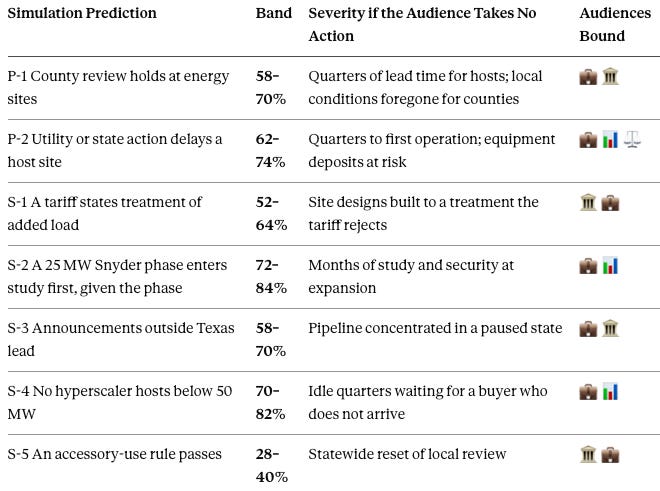
MindCast issues seven forecasts: two Primary Simulation Predictions (P) and five Secondary Simulation Predictions (S). The prediction date and data cutoff are both October 9, 2026. No forecast in the series has reached its resolution date. The validated tally stands at zero hits and zero misses, and the first resolutions arrive December 31, 2026.
Competing explanations. Three accounts compete before any result prints.
Host advantage holds across all five determinations. Owning the power site carries a project through all five reviews. Falsifier: host sites meet new load studies or state holds as often as non-host sites.
Label review reaches energy sites. Counties treat modules at operating energy sites as new data centers. Falsifier: no county stops a module at an operating energy site through 2027.
Host status changes nothing. Host and non-host sites convert alike. Falsifier: host sites show a measurable difference at any one determination.
The simulation favors a fourth, conditional account: the advantage holds at the county and breaks first at the utility or the state. The most likely path carries 55 to 65 percent of the weight. Label review reaching energy sites carries 20-30%, and hyperscaler entry or an accessory-use statute carries 10-15%.
P-1 | No US county or city denies, pauses or forces withdrawal of a modular AI project at an operating generation or storage facility owned by a party other than the module supplier through the end of 2027 (58–70%). Falsifier: one such denial, applied pause or forced withdrawal. Verification source: county minutes, ordinances and company releases. The county evidence rests on one counter-signal, a 2026 Wisconsin review of a 2 MW module, and the band carries that limit.
P-2 | At least one host-sited modular AI project reports a delay or phase reduction from a utility interconnection determination or a state permit action by the end of 2027 (62–74%). A reported relocation or condition also counts. Falsifier: no such report in a company release, securities filing or regulatory docket. Verification source: filings and dockets.
S-1 | A US utility tariff or commission order states how added computational load at an existing generation or storage interconnection is treated by December 31, 2027 (52–64%). Falsifier: no such text. Verification source: commission dockets and filed tariffs.
S-2 | If Energy Vault announces a Snyder phase of 25 MW or more by December 31, 2027, that phase enters a Texas grid-operator large-load study or state data center review before operation (72–84%). Falsifier: the phase operates or advances without study or review. Verification source: grid-operator filings, Energy Vault disclosures and agency filings.
S-3 | Named host-sited modular AI announcements outside Texas outnumber those inside Texas through the end of 2027, with at least two in total (58–70%). Falsifier: the Texas count equals or exceeds the outside count, or fewer than two occur. Verification source: company releases and securities filings.
S-4 | None of Microsoft, Amazon, Google or Meta announces hosted AI compute at a third-party operating energy site with a first phase below 50 MW through the end of 2027 (70–82%). Falsifier: one such announcement. Verification source: company releases and securities filings.
S-5 | A state statute, agency rule or local ordinance treats computing equipment added at an existing generation or storage facility as accessory use or exempts it from data center review by December 31, 2027 (28–40%). Falsifier: no such text. Verification source: statutes, agency rules and ordinances.
Watch conditions. Three further questions await public evidence before they receive bands: lender financing of hosted capacity at a second host site, disclosed approval-delay terms between hosts and operators, and whether most documented host-site delays trace to the utility or the state.
Three events would break the set: federal preemption of state data center rules, a court injunction against the Texas directive, or a grid emergency alert ordering rotating outages in Texas before mid-2027. MindCast publishes misses at the same level as hits.
VI. Risk Mitigation: Exposure, Actions and Residual for Each Simulation Prediction
Each of the seven Simulation Predictions binds at least two audiences. Each entry below states the band, the exposure in a unit the audience controls, actions the audience can take alone and the exposure that survives those actions.
Severity and probability run on separate axes. S-5 carries the lowest band in the set, yet a single accessory-use statute would reset local review across a state. The actions are analytic options for each audience, not legal, investment or fiduciary advice to any party.
P-1: No County Stops Modules at an Operating Energy Site (58–70%, December 31, 2027)
💼 Executives at host companies.
Exposure: quarters of lead time lost to rival hosts if the company holds announcements for local clarity it will likely not need. A miss costs more, because a local pause strands a prepared site for the length of the pause.
Actions: the development lead files water, noise and generator-hour exhibits with the first local filing, before announcement. Counsel obtains a written zoning or accessory-use determination before the host signs the operator agreement.
Residual: a county can still adopt a general moratorium that reaches energy sites.
🏛️ County policymakers.
Exposure: modules arrive under permits written for generation, so the county attaches no conditions on noise, water or generator hours.
Actions: planning staff draft burden thresholds for computing equipment at energy facilities in the next code amendment cycle. The board requests burden data at pre-application by resolution in the first quarter of 2027.
Residual: state preemption or utility rules can override county terms.
P-2: A Utility or State Action Delays a Host-Sited Project (62–74%, December 31, 2027)
💼 Executives at host companies.
Exposure: quarters to first operation and equipment deposits paid before service is confirmed.
Actions: the development lead obtains written confirmation of import capacity at module load before signing an operator agreement. The environmental lead inventories the state permits each module, generator and battery triggers before the Texas audit report on or before December 10, 2026. Finance stages deposits against the utility service milestone.
Residual: a later phase can trigger restudy, and a tariff change can reopen terms.
📊 Investors.
Exposure: months of delayed yield on committed capital.
Actions: the investment committee makes import confirmation and a permit inventory conditions of commitment. The deal team stages funding to the executed utility service agreement.
Residual: rules can change after commitment.
⚖️ Counsel.
Exposure: months of uncompensated delay per site when a host agreement is silent on regulatory events.
Actions: counsel defines approval-delay events by naming the utility and state determinations in each host agreement. Counsel adds a tariff-change reopener before signing.
Residual: courts read force majeure and change-in-law clauses differently.
S-1: A Tariff or Order States How Added Load at an Existing Energy Interconnection Is Treated (52–64%, December 31, 2027)
🏛️ Commissioners and staff.
Exposure: staff months spent deciding host load case by case.
Actions: commission staff open a generic docket on added load at existing interconnections before the next tariff cycle.
Residual: interconnection terms under federal jurisdiction sit outside state authority.
💼 Executives at utilities and host companies.
Exposure: site designs built to a treatment the final tariff rejects, measured in redesign quarters.
Actions: the utility’s regulatory lead files a proposed treatment before a petitioner defines it. Host companies file comments individually within the docket comment period.
Residual: the commission can adopt terms neither party proposed.
S-2: Given a Snyder Phase of 25 MW or More, That Phase Enters Large-Load Study or State Review First (72–84%, December 31, 2027)
S-2 is conditional: the band applies only if Energy Vault announces such a phase.
💼 Executives at host companies.
Exposure: months of study at expansion and the study security that comes with it.
Actions: the development lead models the full planned load against the utility’s aggregation rules before choosing a phase structure. The lead files the study request on the day the expansion is announced.
Residual: a utility can revise aggregation rules after the structure is set, and a growing site crosses the threshold eventually.
📊 Investors.
Exposure: second-phase revenue that arrives quarters later than the base case assumes.
Actions: the deal team models phase-two revenue after study completion in the base case before commitment.
Residual: study length varies by grid operator and queue.
Written import confirmation under P-2 also narrows S-2 exposure. The letter counts that action once, under P-2.
S-3: Host Announcements Outside Texas Outnumber Those Inside Texas (58–70%, December 31, 2027)
💼 Executives at host companies.
Exposure: a pipeline concentrated in a state that has paused data center permits.
Actions: business development qualifies at least one site outside Texas to a written use determination by mid-2027.
Residual: other states can adopt their own pauses.
🏛️ State policymakers outside Texas.
Exposure: host announcements arrive under rules keyed to the data center label, before the legislature defines a low-burden route.
Actions: legislative staff prepare burden-keyed definitions before the 2027 bill cutoff.
Residual: local authorities can still act first.
S-4: No Hyperscaler Hosts Compute at a Third-Party Energy Site Below 50 MW (70–82%, December 31, 2027)
💼 Executives at host companies.
Exposure: idle quarters spent waiting for a hyperscaler buyer.
Actions: business development builds a pipeline of modular operators by mid-2027. Counsel keeps any exclusivity period short.
Residual: a hyperscaler entry would reset terms for every host.
📊 Investors.
Exposure: valuation multiple compression when hyperscaler offtake fails to arrive.
Actions: the investment committee underwrites host sites on modular operator credit alone at the next commitment.
Residual: modular operators carry weaker credit than hyperscalers.
S-5: A Statute, Rule or Ordinance Treats Computing Equipment at an Energy Facility as Accessory Use (28–40%, December 31, 2027)
🏛️ Policymakers.
Exposure: a broad exemption invites larger loads to claim accessory status, removing local review the state did not intend to remove.
Actions: drafting staff tie accessory status to measured burden caps on water, noise and generator hours. Drafters add verification once the site runs.
Residual: burden definitions can still be gamed at the margin.
💼 Executives at host companies.
Exposure: rivals gain a faster route in any state that adopts accessory treatment first.
Actions: the development lead prepares burden exhibits that meet the strictest proposed cap before the 2027 sessions close.
Residual: adopted caps can differ from proposed ones.
Watch Conditions: Bands Pending
Three questions carry no band until public evidence closes their gaps.
Lender financing of hosted capacity at a second host site binds 📊 investors and 💼 hosts. Owners can assemble an approval map and contracted revenue before approaching a lender. Disclosed delay terms between hosts and operators bind ⚖️ counsel, and the P-2 drafting actions apply. The third asks which authority binds first at documented host delays.
Legal limits on the obvious actions. Competitors that coordinate tariff positions create antitrust exposure. Each company files individually or through a trade association with antitrust counsel present. Decisions involving listed hosts such as Energy Vault or PowerBank rest on public filings, never on nonpublic regulatory information.
Takeaway: protection costs least before announcement, while import rights, permits and contract terms are still open.
VII. What the Findings Mean for Each Audience
🏛️ Policymakers. Label-based review sends low-burden host sites through the same process as campuses, and S-1 and S-5 measure whether any authority separates them.
💼 Executives. Site control is necessary but not sufficient. The utility and the state hold the determinations that set a host site’s schedule (P-2).
⚖️ Counsel. Approval delay is a contract term as much as a regulatory outcome, so the host agreement decides who absorbs it.
📊 Investors. Import rights, state permits and contract allocation say more about a host site’s value than land-use approval does (P-1, P-2).
VIII. Working With MindCast: The MindCast Host Advantage Test
Published analysis cannot tell a clean energy company whether its own sites carry a real advantage. The answer depends on each site’s interconnection and permits, its county and lenders, and its candidate operators.
The MindCast Host Advantage Test asks two questions. Can a company’s existing energy assets support AI compute? Does the company keep an economic advantage after utility, permitting, financing and contract requirements?
The test classifies each candidate site across the five determinations and identifies where an apparent advantage disappears. Cognitive Digital Twins of the client’s utility and state agencies then play out each configuration against the county, lenders and operators.
Companies without host sites start from a different question. Each segment maps to one engagement grounded in the series.
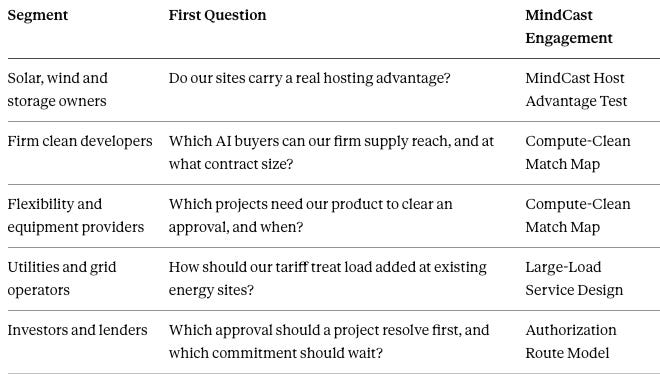
Commissioned work adds complete probability distributions, organization-specific detail and full scenario trees. Any clean technology company can start with one site, one energy portfolio or one commercial opportunity before the 2027 legislative sessions begin. Reach MindCast at mcai@mindcast-ai.com.
What to Watch: The Texas Halt Report, the Grid Filings and the First Resolutions
The dominant fork is whether utilities treat load added at an existing energy interconnection as part of the site or as a new large load (S-1).
October 19, 2026. The Texas environmental agency reports on the permit halt. The report shows whether the halt reaches equipment at existing energy sites (P-2).
November 16, 2026. Six grid operators file large-load rules. Floors at or above 20 MW keep first-phase host sites under ordinary service (S-2).
On or before December 10, 2026. The Texas grid audit report arrives and sets the terms of any exit from the halt (P-2, S-3).
December 31, 2026. The first series forecasts resolve, including federal reliability criteria and the Cle Elum moratorium.
January 2027. Washington and Texas legislatures convene. Definitions keyed to measured burden would move S-5 and the Pacific Northwest share in S-3.
Conclusion: Utilities, States, Lenders and Contracts Decide Whether Owning the Power Site Pays
Energy Vault broke ground at Snyder in July, and Texas paused data center permits in September. The simulation places a host’s strongest relative advantage at county review. The utility, the state, the lender and the contract decide whether owning the power site pays.
Clean energy companies that test their sites against all five determinations before the November filings and the 2027 sessions will know which assets carry an advantage and which carry only the burden. Suppliers of equipment, flexibility and software gain the same view of which projects will pay them.
Appendix A: MindCast Works
AI Data Center Authorization + Clean Energy, the Mid-Scale Squeeze and the Specialized Compute Landscape(2026). The series overview and umbrella for this letter.
AI Datacenter Edge Computing: Ship the Workload Not the Power (2025). The principle that host sites put into practice.
The Grid-Anchored Clean Power Bargain — Powering AI Data Centers Through 2040 (2026). The weakest-link rule behind import rights.
The Clean Compute Match — Which Clean Power Pairs With Which AI Compute, And What Stays On Fossil(2026). Which workloads a clean asset can host.
Burden-Based Authorization for AI Data Centers, Modular Clean Compute, and the Backlash Gap Between Grid Tariffs and State Law (2026). The gap between grid and state rules where small hosts fall.
AI Data Center Veto Points Show Where Projects Get Stopped and How Authorization Risk Moves (2026). The node map behind the five determinations.
The Lowest-Exposure AI Data Center Approval Route for Developers, Hyperscalers and Investors (2026). The durability standard each determination must meet.
The Data Center Authorization Market: A 50-State Regulatory Atlas (2026). State and local terms the simulation reads.
The Model Data Center Authorization Code (2026). The functional language for comparing state rules.
Modular AI Data Center Specialists and the Integrated Offerings That Turn Small Sites Into Authorized Operating Capacity (2026). The host role the simulation tests.
AI Data Center Taxonomy for Decision-Making and Clean Energy, Four Categories That Decide Whether a Site Operates (2026). The decision categories each authority reads.
Appendix B: External Sources
Business Wire. “Energy Vault Breaks Ground on Powered AI Infrastructure Campus in Snyder, Texas to Deploy Crusoe Spark Modular Data Centers.” July 27 2026. Groundbreaking and module lease-back at Snyder.
Energy Vault. “SnyderAI: Powered AI Campus, Texas.” Project page. Module count, water use and phase sizes.
Willkie Farr & Gallagher. “Texas Governor Halts Data Center Permits Pending ERCOT Audit.” October 2026. Scope of the halt and the December 10 audit date.
Office of the Texas Governor. “Governor Abbott Directs TCEQ to Halt Data Center Permits.” September 21 2026. The directive itself; the governor’s site blocks automated retrieval.
Reuters. “Oracle Cites ‘Force Majeure’ to Shield Itself on Controversial Data Center, Bloomberg Reports.” September 24 2026. Approval delay entering a tenant contract.