


Foundational MindCast works: Nash-Stigler Equilibria | Litigation v. Leverage | The Epstein Files and Controlled Disclosure
Executive Summary
Senators can question Todd Blanche, but they may do so without the communications controlled by the department he leads — unless the Senate independently compels production or a court accelerates disclosure. MindCast AI identified Blanche’s office as the Department of Justice’s front-office decision node — the chokepoint separating institutional intent from institutional outcome — months before his nomination to Attorney General. The confirmation process therefore creates a reflexive information problem: DOJ controls the timing and form of initial access to records bearing on whether its acting leader should permanently lead DOJ. Confirmation would convert a previously identified override mechanism into the department’s Senate-ratified command structure, and no later disclosure can restore the decision’s lost pre-vote information value.
A government of laws is strained when any actor holds first control over the timing of the evidence about himself. The Blanche confirmation tests how much of that strain the Senate will ratify, and on whose timeline.
MindCast commits confidence separately to the thesis’s three separately falsifiable components: Decision-Information Decoupling — decision rights and information rights separated at a single office — at 83–89%; Command-Structure Conversion, conditional on confirmation, at 72–82%; and post-confirmation Initiation–Outcome Decoupling at 82–89%. The principal falsification risk is not disclosure but a Republican defection cascade that stalls the nomination before the mechanisms get tested, leaving the conditional claims unresolved rather than validated.
The July 9 multi-actor simulation returns a confirmation-favorable but information-incomplete equilibrium — composite regime output: controlled or conditioned confirmation at 76% (68–83). Headline frozen predictions, with definitions, bands, and falsifiers in Section VII:
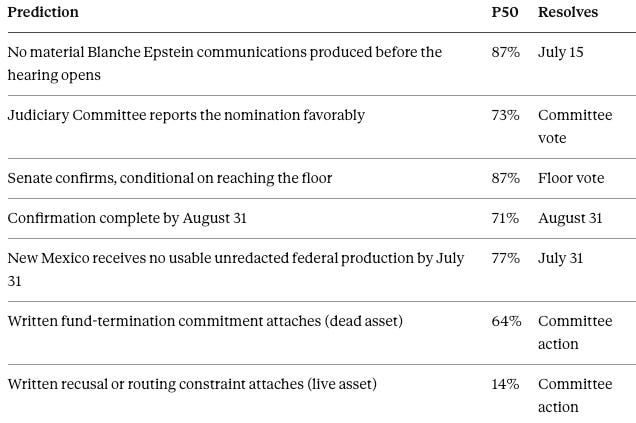
The fifty-point spread between the last two rows is the paper’s sharpest instrument: a confirmation market that formalizes the concession costing the nominee nothing while declining to formalize any constraint on live authority reveals, in one number, what the vote actually purchases.
I. The Pre-Nomination Record
MindCast built the Blanche model before Blanche’s name entered the confirmation calendar. Readers new to the corpus need only this section; the record stands on five findings, each published, timestamped, and frozen before the events now testing them.
The Shadow Antitrust Trifecta mapped Blanche’s office as the front-office decision node of federal antitrust enforcement: the destination where career-staff evidentiary positions terminated and off-docket settlement channels originated. Career attorneys at the Antitrust Division recommended a Second Request on the Compass–Anywhere merger; the deal cleared after lobbying reached the Deputy Attorney General’s office directly. Live Nation settlement discussions ran through the same office, outside the Division conducting the litigation. The Trifecta named the pattern before the nomination gave it a second meaning.
How MindCast Predicted the Slater Ouster documented the personnel dynamic. Gail Slater’s removal from Antitrust Division leadership, after reported loss of confidence from the Attorney General and Deputy Attorney General, confirmed a prediction the capture-geometry work had committed weeks earlier: offices that resist the routing geometry change occupants. Whether removal operates as a deliberate control mechanism or as ordinary administration turnover under strained leadership remains a hypothesis the post-confirmation record will test; the corpus treats the pattern as a structural parallel across cases, not an established identity.
Shadow DOJ Antitrust Credibility identified the model’s key confirmation trigger: sworn testimony about communications with Blanche’s office. MindCast framed the trigger as a deposition scenario in eventual state-enforcement litigation. Events chose a different forum. A Senate confirmation hearing now delivers the trigger under oath, across both of Blanche’s portfolios at once.
Cross-Domain DOJ Geometry established that Blanche is the only individual operating as a chokepoint node in two independent MindCast simulation suites — antitrust routing and Epstein disclosure. The piece documented his signature framing move: presenting “3.5 million pieces of paper” of released material as completion of a disclosure obligation whose completeness remained disputed, volume standing in for compliance.
The Epstein Files and Controlled Disclosure published on November 20, 2025 — one day after the Epstein Files Transparency Act became law — and predicted that the statute would not displace DOJ’s operational control over sequencing, redaction, and timing. Subsequent implementation supports the forecast: Congress changed the governing command, but DOJ retained control over its execution. The department released millions of pages beginning in December 2025 under redactions heavy enough to draw bipartisan criticism and an inspector-general review, and in the Phang disclosure litigation, Judge Sullivan granted preliminary relief after finding the plaintiff likely to succeed and noting that the Attorney General had conceded noncompliance with the Act. Statutory command changed hands; execution control, on the record to date, did not.
Every structural element of the current confirmation fight appears in the record above, committed before the nomination existed. The record is the “before” measurement. Everything that follows analyzes the transition.
II. The Transition: The Override Node Becomes the Command Structure
Institutional analysis begins with a location question: where does decisive authority actually sit? MindCast’s Field-Geometry Reasoning asks it of every institution the corpus models, and for two years the answer inside the Department of Justice has been consistent — for the consequential decisions the corpus has documented, authority resolved in the Deputy Attorney General’s front office, one level above the divisions nominally holding it.
Before April 2026, the node operated as an override. The Antitrust Division investigated; the front office cleared. The disclosure apparatus processed; the front office sequenced. An Attorney General formally sat above the node, and career layers formally sat below it, so the geometry — however distorted — retained structural room for internal contest.
The Bondi removal collapsed the layer above. President Trump dismissed Attorney General Bondi in April 2026, reportedly over her handling of the Epstein files, and elevated Blanche to acting Attorney General. The sequence parallels the Slater ouster one level higher — a hypothesized structural parallel the corpus flags rather than asserts: in both cases, friction between an office and the routing geometry resolved through the officeholder rather than the geometry.
Acting leadership carries a durability limit the corpus has already mapped. The Assefi Test drew the distinction when new acting leadership arrived at the Antitrust Division: acting officials hold substantial statutory authority, but their tenure is contingent and their mandate unratified, so they can adjust tone — a soft variable — far more readily than they can re-center routing authority — a hard variable — against the layer that installed them. Assefi operated underneath the routing layer, constrained by it regardless of intention.
Confirmation inverts the Assefi problem. Blanche does not operate under the routing layer; Blanche’s office is the routing layer, and confirmation converts contingent tenure into more durable, Senate-confirmed authority — an Attorney General still serves at the President’s pleasure, but the ratification removes the acting official’s structural provisionality. Tone and topology merge in one office. No internal layer remains above the node, and after a documented sequence of division-leadership departures — removals and resignations whose circumstances vary, which the Assefi record distinguishes case by case — thinner layers remain below it to contest, document, or slow its decisions.
Confirmation therefore does not merely install a new Attorney General. Confirmation converts a previously identified override mechanism into the Department of Justice’s ratified command structure. Whether the department retains capacity for internal self-correction after that conversion — the question MindCast’s Institutional Cognitive Plasticity framework exists to measure — becomes an empirical matter. Section VIII commits the corpus to scoring it.
III. Decision-Information Decoupling: One Mechanism, Two Projections
Confirmation fights normally turn on what senators know. The Blanche confirmation turns on who controls when the relevant records first become available — and the controller of initial access is the nominee’s own department, subject to two external overrides: judicial acceleration and the Senate’s own compulsory process, neither of which has yet produced the records. MindCast registers the mechanism as Decision-Information Decoupling: a chokepoint separates decision rights, held by the Senate, the states, and the courts, from initial information rights, held by the chokepoint, and the timing gap does the work that outright denial would otherwise have to do. The mechanism extends two existing frameworks rather than founding a new one, and it currently operates along two independent axes.
The temporal projection: confirmation-time information arbitrage
American Oversight has sued for Blanche’s Epstein-related communications and seeks expedited processing before the July 15–16 hearing. The Department opposes expedition on facially neutral grounds — orderly Freedom of Information Act sequencing, burden on the courts, standard queue administration. Each argument is individually respectable, and agencies routinely make them. Their combined effect in a confirmation window is not neutral: absent judicial acceleration or Senate compulsion, the vote precedes the records, and disclosure after an unfavorable-to-reverse decision loses most of its decision value.
Tirole Advocacy Arbitrage supplies the framework: captured systems replace adversarial evidence channels with access channels, and outcomes converge on whatever the access channel prefers. The confirmation variant runs the arbitrage on the clock rather than the docket. Nothing needs suppressing; the queue simply outlasts the decision.
Litigation v. Leverage supplies the diagnostic. MindCast’s Action-Language Integrity metric measures divergence between a legal filing’s stated purpose and its strategic effect, without adjudicating motive. Stated purpose: orderly sequencing. Strategic effect: the Senate decides before initial access exists. The measured divergence is the finding. Two diagnostic patterns from the same instrument complete the tag. Institutional Drift describes rules followed procedurally while their purpose goes unserved; the preliminary-injunction record in Phang — likelihood of success, conceded noncompliance — indicates conduct that a federal court found probably exceeded even drift. Asymmetric Stakes describes a posture in which delay costs the department little while the requester’s decision value decays toward zero on the department’s schedule.
Litigation v. Leverage taxonomized non-merit litigation from the offensive side: tactical, structural, and symbolic uses of the courts as weapons. The Blanche record contributes the mirror case — the government as respondent, where procedural defense produces strategic leverage whether or not leverage is the purpose. Delay-as-attrition is tactical litigation’s logic running in defensive posture. The corpus registers the extension accordingly: same taxonomy, new column, effect-based membership criteria.
The jurisdictional projection: the evidentiary portability threshold
New Mexico Attorney General Raúl Torrez reopened the state’s Zorro Ranch investigation in February 2026 after material in the federal file release prompted renewed review of alleged criminal activity at the property. State investigators searched the ranch in March. A special legislative commission has issued subpoenas to banks and United States Attorneys’ offices. New Mexico possesses jurisdiction, constitutional autonomy, prosecutorial willingness, and an active investigation — every attribute the competitive-federalism model treats as sufficient for a state to function as an independent enforcement supplier.
New Mexico still cannot advance, because the federal chokepoint holds the file. Torrez’s June 30 letter to Acting Attorney General Blanche — released publicly on July 9 — documents six contact attempts over more than 130 days, verbal assurances of cooperation, and, on the state’s account, no production of the unredacted material it requested. The department maintains it responded in June and remains willing to assist; Torrez maintains the critical unredacted records remain unavailable. The live dispute therefore concerns usable completeness rather than the literal absence of any response — and a dispute over usable completeness is exactly where the Evidentiary Portability Threshold does its analytical work, because portability measures what arrives in usable form, not whether replies were sent. The letter’s core argument is not procedural complaint but evidentiary physics: every day of withholding erodes the foundation of a state prosecution as witnesses relocate, memories fade, and physical evidence degrades. Delay does not preserve a status quo. Delay consumes the case on a schedule the records-holder sets, whatever the reason for the delay.
Judicial Process as Competitive Federalism and Competitive Federalism as Market Infrastructure modeled state enforcement as the market that disciplines captured federal enforcement. New Mexico exposes the model’s missing boundary condition, which the corpus now names the Evidentiary Portability Threshold: enforcement autonomy without evidentiary portability does not create an effective competitive enforcement market. States can supply enforcement only when evidence can move to them. A federal records-holder that cannot block state jurisdiction can still leave it unsupplied.
Evidentiary decay admits a precise statement without borrowing machinery built for other purposes. Usable evidentiary signal declines exponentially with withholding time:
E(t) = E₀ · e^(−λt)
E₀ is the evidentiary base at the moment of the state’s first request; t is withholding time; and λ — the decay rate — aggregates witness attrition, memory degradation, and physical-evidence loss. Two features make the formulation more than decoration. The records-holder controls t, so every increment of delay is a choice about how much E survives, whatever the reason for the delay. And redaction raises the effective decay rate: material produced with names and dates obscured arrives with part of its identification value already destroyed, so heavily redacted production can leave E lower than the elapsed calendar alone would predict. The decay is measurable, the control over its rate sits with the office under evaluation, and the model needs no finding about why.
Two projections, one mechanism. The Senate faces it temporally: decide before initial access exists. New Mexico faces it jurisdictionally: investigate without the records the investigation requires. Blanche’s department controls when everyone else first receives what they need to decide about Blanche’s department.
IV. The Criticism Ledger: Aggregation by Mechanism, Not by Critic
Coverage of the nomination aggregates by critic — alumni here, judges there, senators somewhere else — and produces the impression of a heterogeneous political pile-on. MindCast aggregates by mechanism, and the heterogeneity resolves into structure. Seven heterogeneous but partly correlated evidence streams currently oppose or constrain the nomination — correlated because several draw on the same underlying disclosure record, so the streams count as converging perspectives rather than independent observations: a letter signed by 1,205 former Department of Justice employees urging rejection; the preliminary-injunction record in the Phang litigation, including the conceded-noncompliance finding and orders addressing unredaction; the Torrez letter; Republican holdout objections, anchored by Senator Tillis’s demand for formal finality on the abandoned $1.776 billion IRS “anti-weaponization” fund and Senator Cassidy’s demand for assurance that the nominee is not the President’s personal attorney occupying the Attorney General’s chair; Democratic opposition; victim-advocacy criticism of redactions that exposed survivor identities; and the American Oversight FOIA litigation.
Sort the seven streams by asserted mechanism and they compress to five, every one formalized in the corpus before the critics arrived. One stream needs its current form stated once: the administration abandoned the $1.776 billion fund — created in settling the President’s lawsuit against the IRS — after bipartisan Senate resistance forced the retreat, and Tillis’s vote now turns on whether verbal assurance converts to something binding.
Principal-agent alignment. Cassidy’s test, the IRS settlement objection, and prosecution-related allegations in the alumni letter all pose one question — whether the agent serves the appointing principal or the office. The Geometry of Regulatory Capture formalized the question in January; Cassidy compressed it into a sentence in July.
Chokepoint control of disclosure. The Phang record, the redaction criticism, and the FOIA fight all assert that a single node controls disclosure sequencing, scope, and timeline. The November Epstein simulation committed the claim as a frozen prediction eight months ago, which converts the entire stream from fresh criticism into scoring evidence for an existing forecast.
Execution outlasting statute. The Transparency Act sequence — congressional command, heavily redacted compliance, preliminary judicial relief on a conceded-noncompliance record — restates Stigler Harm Clearinghouse as current events: execution discretion, not legislative text, decides regulatory outcomes. Congress won the vote. Execution retained the outcome, pending final judgment.
Error-correction attrition. The alumni letter’s departure claims and the documented sequence of division-leadership changes assert that the department’s internal capacity to contest leadership decisions has thinned. The Slater Ouster and the Assefi Test tracked the pattern division by division before it reached the top of the org chart, distinguishing removals from resignations where the record allows.
Narrative inversion. Blanche’s response to the alumni letter, delivered during an Alaska visit, converted 1,205 signatures into a percentage — roughly 1,200 out of a workforce he estimated at 40,000 — and dismissed the share as insignificant. The move swaps a costly, self-selected signal for a base-rate claim, the same denominator manipulation MindCast’s narrative-governance work has documented in corporate contexts. Volume presented as compliance on the disclosure side; percentage presented as refutation on the dissent side. Same actor, symmetric move, opposite directions.
A weighting protocol keeps the ledger honest in both directions. Signals rank by cost to the sender, descending: a judicial finding after adversarial process outweighs sworn testimony, which outweighs a formal state filing, which outweighs a signed letter carrying professional cost, which outweighs senatorial statements — cheap talk until the vote — which outweigh commentary, weighted near zero. Under the protocol, the criticism corpus is smaller than the headline count suggests and considerably harder: its heaviest elements are court findings and state filings, not opinion volume.
The weighting protocol applies with equal force to the letter’s own numbers, and stating the distinction explicitly prevents any appearance of asymmetry. The ledger weights the 1,205 signatures on the professional cost of attachment — each is a named former official staking reputation on public opposition, a costly signal verifiable name by name. The letter’s aggregate departure figure — sixteen thousand, per the signatories, across a period the letter defines rather than Blanche’s acting tenure alone — carries no such cost structure: no name attaches to it and no payroll data yet confirms it, so the ledger holds it as an unweighted narrative claim until departure records surface. Same protocol, opposite results — which is what a protocol is for. The distinction also completes the answer to Blanche’s Alaska arithmetic: the ledger declines to inflate the signatories’ unverified count for the same reason it declines to deflate their verified signatures into a percentage. A thousand signatures are one costly signal, not a thousand data points, and a small percentage of a workforce can still be a large amount of information.
Heterogeneous sources, homogeneous mechanism. Convergence of that shape is evidence the mechanism is real, and the weighting protocol is what keeps the inference from becoming a pile-on of its own.
Contact mcai@mindcast-ai.com to partner with us on Predictive Game Theory AI in Law and Behavioral Economics. Our verticals include simulating complex litigation, innovation economics and geopolitical risks.
To deep dive on MindCast works upload the URL of this publication into any LLM (preferably Google AI mode) and prompt ‘reconstruct MindCast framework with three degrees of cited sub links.’ See Appendix A and Live-Fire Game Theory Simulators, Runtime Predictive Infrastructure. We stress-tested our AI system for this publication by simulating the Super Bowl and the World Cup.
V. The Blanche Cognitive Digital Twin: Did the Principal Change?
Actor-level modeling invites motive speculation, so the corpus imposes a measurement rule stated here explicitly: every dimension of the Blanche Cognitive Digital Twin scores from observable conduct — filings, routing decisions, disclosure timing, personnel actions — and never from inferred intent. Litigation v. Leverage established the construction protocol in April 2025: twins built from public statements, litigation filings, affiliations, and prior decision history, then run through scenario branches to forecast behavior under stress, scrutiny, and exposure. The protocol predates its present subject by more than a year.
Blanche’s professional formation is the model’s most informative input. Criminal defense counsel learns a durable cognitive grammar: narrow exposure, contest disclosure, exploit burdens of proof, preserve optionality, delay irreversible decisions, protect the client. Every one of those techniques is legitimate — honorable, even — in its native context. The confirmation question is not whether the grammar is legitimate. The confirmation question is whether the grammar updated when the principal changed from Donald Trump personally to the United States.
Eight dimensions structure the twin. Four are scoreable from the current public record; four await the hearing. Each scored dimension states its evidence, its counterevidence, an alternative explanation, and a confidence band on the score.
Evidentiary openness — propensity to disclose absent compulsion. Evidence: the Phang preliminary-injunction record including conceded noncompliance; more than 130 days without substantive production to New Mexico; opposition to expedited FOIA processing before the hearing. Counterevidence: the department released millions of pages beginning December 2025, and agencies routinely contest expedition and assert exemptions. Alternative explanation: ordinary institutional caution and exemption practice common to every administration’s DOJ. Score: low openness, confidence 75–85%. The alternative explanation weakens against the conceded-noncompliance record, which ordinary caution does not produce.
Centralization preference — tendency to resolve decisions in the front office rather than the originating division. Evidence: the documented routing record across Compass–Anywhere, Live Nation, and disclosure sequencing. Counterevidence: the Deputy Attorney General’s office holds supervisory authority by design, and front-office review of major matters is lawful and common. Alternative explanation: energetic but conventional supervision. Score: high centralization, confidence 80–90%. The alternative weakens where routing bypassed rather than reviewed division processes, as the Trifecta record indicates.
Tolerance for internal contestation — willingness to retain and engage dissenting professional judgment. Evidence: the division-leadership departure sequence; the alumni letter’s claims; the percentage-based public dismissal of organized alumni dissent. Counterevidence: departure circumstances vary between removal and resignation; attrition claims remain partially unverified; leadership transitions produce turnover in every administration. Alternative explanation: ordinary transition churn amplified by political conflict. Score: low-to-moderate tolerance, confidence 60–75% — the widest band of the four, because the magnitude evidence is the weakest.
Responsiveness to courts and state enforcers — speed and completeness of compliance with external legal demands. Evidence: production posture that moved only under preliminary judicial relief; verbal assurances to New Mexico unaccompanied by records. Counterevidence: the department litigates within ordinary adversarial norms, and no final judgment yet establishes violation. Alternative explanation: standard governmental litigation posture. Score: low-to-moderate responsiveness, confidence 65–80%.
Unscored pending the hearing: principal identification, loyalty hierarchy, procedural-risk aversion, and separation between presidential and public interests. Sworn testimony is the discriminating instrument for all four; scoring them now would substitute inference for evidence.
The scored dimensions permit a regime statement rather than a verdict. Under a grammar-persistence regime — the defense counsel’s optimization function surviving the change of principal — the model expects continued queue defense, minimal voluntary pre-hearing production, resistance to written constraints, and centralized resolution of the next contested matter. Under a grammar-update regime — client protection converted to sovereign obligation — the model expects voluntary production before the hearing, acceptance of specific written recusal or delegation commitments, and visible re-delegation to divisions. The four scored dimensions currently sit on the persistence side of every axis; the hearing and its aftermath will either extend the pattern or break it, and the model treats both outcomes as scoreable.
Persistence, if it holds, produces the record’s strangest feature: an actor whose conduct is highly consistent under one objective function inside an institution whose stated commitments diverge from that conduct on every Action-Language Integrity axis the corpus tracks. Measured against a client-protection function — centralize authority, control principal exposure, preserve optionality — the conduct record is nearly frictionless. Measured against the department’s stated commitments — impartiality, transparency, decentralized professional judgment — the same record is incoherent. Actor coherence coinciding with institutional incoherence is the model’s registered observation; the causal claim awaits the post-confirmation record. Senators searching the hearing for contradiction may find little in the man. The divergence the model measures lives between the man’s conduct and the office’s commitments.
VI. The Race Between Two Terminations
MindCast’s governing architecture, developed in Nash-Stigler Equilibria, holds that institutional conflicts terminate twice or terminate badly. Nash termination is behavioral settlement: the actors commit, the game closes, the votes are cast. Stigler termination is cognitive sufficiency: the record becomes complete enough that settlement rests on knowledge rather than exhaustion. Healthy institutions sequence them — sufficiency first, settlement second. Pathological ones force settlement while the record stays open.
The Blanche confirmation is the cleanest live instance of the two terminations decoupling that the corpus has recorded, and the July 9 simulation prices the decoupling directly: probability of cognitive sufficiency by the hearing’s opening, 24% (17–31); probability of behavioral closure by August 31, 74% (66–81); dual-termination gap, 0.56.
Three gates govern the outcome, in descending order of narrowness. The committee gate comes first: twelve Republicans and ten Democrats mean a single Republican defection can block a favorable report, and Cornyn and Tillis control it. The floor gate comes second: confirmation survives up to three Republican defections, and the broader Republican swing bloc controls it. The information gate — production of the records every other gate needs — sits outside both, administered by the nominee’s department subject to judicial override, which means the department controls what information reaches either voting gate before it closes.
Committee and floor closure remain contingent; the hearing opens on a scheduled political calendar, but no statute compels either vote. The simulation’s regime distribution: controlled confirmation 44%, conditioned confirmation 32%, committee stall 16%, external-constraint shock 8%. If the nomination advances, senators may reach behavioral closure before the information record reaches cognitive sufficiency, because sufficiency requires the unredacted files, the Zorro Ranch records, the Phang production, and the FOIA communications — every element of which currently sits in a queue whose pace the nominee’s department administers, subject to judicial and senatorial override. If the nomination stalls, the absence of closure opens a separate branch of the game: a stalled nomination preserves Blanche’s acting authority for the remaining lawful period, after which the contest shifts to succession, a new nomination, or another appointment mechanism — a regenerated game under Dynamic Predictive Game Theory rather than a resolution.
The Transparency Act already ran a version of the experiment. Congress attempted to force cognitive sufficiency by statute — release the files, complete the record. Execution answered with redaction discretion; a federal court granted preliminary relief on a record including conceded noncompliance; and the record stayed open while the department declared compliance in units of volume. Statutory command, on the evidence so far, proved insufficient against execution control. A confirmation vote is a weaker instrument than a statute, and the Senate now weighs spending it on the official whose department retained execution control over that statute.
The gate structure also admits a price-theory reading the corpus develops separately in the companion The Market for Confirmation Votes: confirmation as a market in which the department sells an asset — its leader’s future conduct — while controlling the buyers’ due diligence, and the concession most likely to formalize is the one that costs the nominee nothing; Proposition 6’s split in the next section builds the measurement.
VII. The Frozen Prediction Set
Analysis becomes an instrument only when it can be scored, and scoring requires honest sourcing of the probabilities themselves. The probabilities below issued from MindCast’s multi-actor simulation, calibrated July 9, 2026 on public information through that date. The simulation ran coordinated Cognitive Digital Twins for the nominee, the White House, the DOJ front office and career workforce, the Judiciary Committee blocs and pivot senators, the full-Senate conferences, New Mexico enforcement, and the judicial–disclosure constraint, sequenced through the corpus’s Vision Function architecture. Composite regime output: controlled or conditioned confirmation at 76% (68–83). Bands represent model uncertainty ranges, not conventional statistical confidence intervals; P50 identifies the central estimate. The set below is frozen at publication and grades as committed regardless of post-commitment shocks.
Definitions. A substantive question is one requiring a factual answer about specific conduct, records, or decisions, counted from the hearing transcript; procedural and speech-making interventions do not count. Largest share means a plurality of substantive questions by count. Usable records means unredacted material sufficient to identify witnesses or documentary leads — production that names names, not production that adds volume. A written commitment means a specific, documented undertaking — sworn declaration, signed letter, or formal filing — not testimonial assurance.
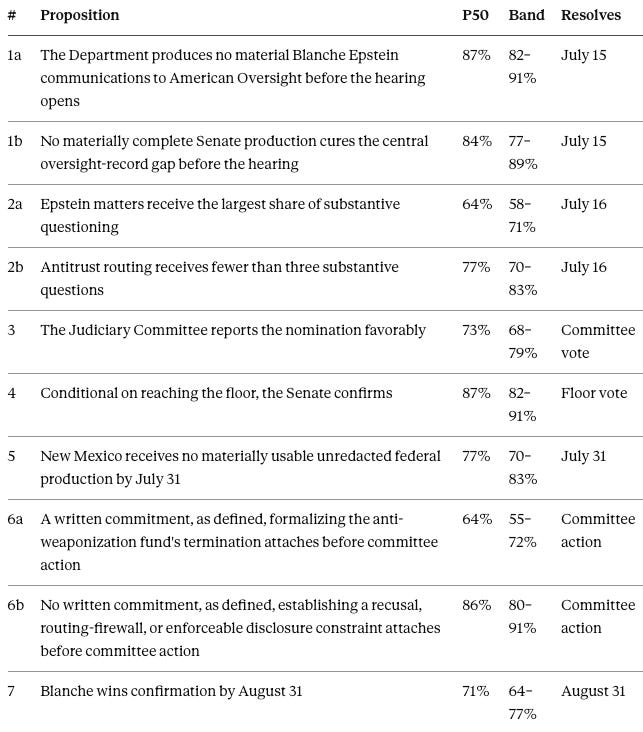
Proposition 6 splits deliberately into a dead-asset leg and a live-asset leg, and the spread between them is the article’s sharpest quantitative instrument. The fund is a dead asset — its termination already declared, the asset already surrendered — and the model prices its written formalization at 64%: Collins’s reported unequivocal assurance and Tillis’s demand for formal finality create pressure toward a written instrument, discounted because the administration may prefer testimony or informal assurance that preserves executive discretion. A recusal or routing constraint is a live asset — formalizing it surrenders the operational discretion confirmation exists to secure — and the model prices a written live-asset constraint at 14%. Fifty points separate the dead asset from the live one, and the spread is the confirmation market’s one-number confession of what the vote actually purchases. Both tails falsify: written constraints on live authority would indicate the Senate successfully repriced the nomination, while refusal to formalize even the dead asset would indicate the White House’s veto on concessions binds harder than any senator’s demand.
Falsifier mapping. Each falsifier breaks one hypothesis, not the whole thesis, and stating the mapping now prevents gaming the score in either direction. Production to American Oversight before the hearing falsifies the temporal-arbitrage projection (1a) while leaving the command-architecture and portability claims untouched. Senate compulsory production (1b) weakens the decoupling mechanism’s practical force — decision rights successfully retrieving information rights — without disproving the chokepoint’s existence. Usable records reaching New Mexico by the fixed date falsifies the Evidentiary Portability Threshold’s application to this case. Restoration of independent career routing, observable in the next contested merger or disclosure matter, falsifies the command-structure conversion claim. A written commitment under 6b weakens the permanence claim in proportion to the commitment’s enforceability. A firm pre-hearing “no” from Tillis or Cornyn moves the stall regime above the conditioned regime and reprices every downstream proposition. A committee that advances the nomination without new production or constraints strengthens the behavioral-closure-before-cognitive-sufficiency finding — the committee’s own conduct becomes scoring evidence. Proposition 2b carries a second-order payload in both directions: sparse antitrust questioning is consistent with the shadow-enforcement thesis — scrutiny clustering on the louder scandal while routing architecture goes unexamined — while dense antitrust questioning would supply the sworn-testimony trigger the credibility model identified, so the thesis gains information from either outcome and the write-up will say which.
A thesis whose components can each die on a named date is a thesis. The dates are named above.
VIII. What Confirmation Installs
A before-and-after institutional test begins if the vote occurs. Sections I through V constitute the “before” measurement — the node’s documented behavior while contingent tenure and residual internal layers still constrained it. Post-confirmation conduct supplies the “after.” MindCast commits to scoring the comparison: merger-clearance channels, disclosure velocity under court order, state-records production, and personnel actions, each tracked against the pre-confirmation baseline. No control group exists and none is claimed; the test measures one institution against its own record.
The “after” branch is already priced. A conditional simulation, calibrated the same day and frozen before any vote, forecasts post-confirmation conduct at ninety-, one-hundred-eighty-, and three-hundred-sixty-five-day horizons and registers the confirmed office’s operating mechanism: Enforcement Initiation–Outcome Decoupling — leadership controls whether legal process begins; grand juries, courts, juries, and evidentiary rules control whether it produces a durable outcome. Confirmation would materially increase Blanche’s capacity to initiate investigations and litigation aligned with presidential priorities; it would not give him equivalent control over subpoenas, grand juries, judicial findings, trial outcomes, or appellate survival. The most likely result is an increase in visible enforcement activity larger than the increase in durable legal victories — the governing conditional prediction, committed at 82–89%. The mechanism is the post-confirmation sibling of Section III’s Decision-Information Decoupling: the node’s control concentrates at initiations and dissipates at adjudications, where the remaining independent institutions sit. The predicted constraint profile, compressed:
Institutional Cognitive Plasticity returns the same verdict in four words — high tactical update, low objective-function update — which is Section V’s persistence regime extended past the vote. The full conditional set, fourteen propositions with horizons, publishes as a companion before any committee action.
Federalism carries the largest downstream consequence. If the Evidentiary Portability Threshold holds, state attorneys general are the surviving enforcement market — the tier the node cannot restaff — and the model predicts that market remains unsupplied with federal evidence for as long as supplying it stays discretionary. New Mexico is the leading indicator either way. Production of usable records by July 31 falsifies the starvation model; absent production, the simulation prices state escalation — litigation, subpoena enforcement, or a formal noncooperation finding — at 69% by August 31, which would convert the portability dispute from correspondence into a docket, month by measurable month, whatever the department’s reasons.
Institutional error correction carries the gravest consequence. Internal falsification capacity — competing professional advocates, adverse evidentiary testing, institutional memory, ethical boundary enforcement — departs with the people who provided it. Weighted signals establish direction: the documented division-leadership departure sequence, 1,205 named signatories, and resignations on the record. Magnitude remains the unweighted claim Section IV holds in escrow — the sixteen-thousand figure enters the model only when departure records confirm it, and the error-correction conclusion stands on direction alone. A department that cannot correct itself from inside can be corrected only from outside, which leaves courts, state enforcers, and disclosure plaintiffs as the remaining error-correction infrastructure — the same three channels whose requests currently sit in queues the department administers.
The hearing will open on schedule; closure is contingent, and the corpus models both branches. The open question is the one MindCast has tracked since November: whether any American institution can still force cognitive sufficiency — a complete record — when initial control over the record’s completion rate sits with the office under evaluation. A government of laws is strained when any actor holds first control over the timing of the evidence about himself. Confirmation week measures the strain.
A companion analysis, The Market for Confirmation Votes, follows in the MindCast Chicago Accelerated Series. Confirmation operates as a market with Chicago price-theory structure throughout: senators supply votes priced in currencies the buyer can and cannot mint, the seller of the asset controls the buyers’ due diligence, the efficient bargain — written constraints for swing votes — fails to clear because a third party holds a veto over the concessions, and each senator’s vote carries a real option on the information gate whose expiry date both sides are trading. Dynamic Predictive Game Theory supplies the moving layer: every court ruling, document release, and defection reprices the option before it expires. The companion commits its own falsifiable payload, led by the Proposition 6a/6b spread — the market’s one-number confession of what confirmation actually purchases.
Appendix — Works Cited
The Shadow Antitrust Trifecta — Maps Blanche’s office as the front-office decision node of federal antitrust enforcement and documents the off-docket routing record the paper treats as the pre-nomination baseline.
How MindCast Predicted the Slater Ouster — Documents the personnel dynamic in which offices resisting the routing geometry change occupants, the pattern Section II parallels one level higher in the Bondi removal.
Shadow DOJ Antitrust Credibility — Identified sworn testimony about communications with Blanche’s office as the model’s key confirmation trigger, which the July 15–16 hearing now delivers.
Cross-Domain DOJ Geometry — Establishes Blanche as the only individual operating as a chokepoint node in both the antitrust and Epstein simulation suites and documents his volume-as-compliance framing.
The Epstein Files and Controlled Disclosure — Commits the November 2025 frozen prediction that DOJ execution control would outlast the Transparency Act, the baseline Section I scores against the current record.
The Assefi Test — Supplies the acting-leadership distinction between soft variables (tone) and hard variables (routing authority) that Section II inverts for a confirmed Attorney General.
Tirole Advocacy Arbitrage — Supplies the framework in which access channels replace adversarial evidence channels, which Section III runs on the clock as confirmation-time information arbitrage.
Litigation v. Leverage — Supplies the Action-Language Integrity diagnostic and the Cognitive Digital Twin construction protocol Section V applies, and receives the paper’s defensive-posture extension to its litigation taxonomy.
Judicial Process as Competitive Federalism — Models state enforcement as the market that disciplines captured federal enforcement, the framework whose missing boundary condition the Evidentiary Portability Threshold names.
Competitive Federalism as Market Infrastructure — Establishes the market-infrastructure foundation of competitive federalism that the New Mexico record tests and the threshold extends.
The Geometry of Regulatory Capture — Formalized the principal-agent question Cassidy’s test compresses into a sentence and committed the personnel prediction the Slater removal later confirmed.
Stigler Harm Clearinghouse — Establishes that execution discretion rather than legislative text decides regulatory outcomes, the mechanism the Transparency Act sequence restates as current events.
Nash-Stigler Equilibria — Defines the dual-termination architecture — behavioral closure versus cognitive sufficiency — that Section VI applies to the confirmation’s three gates.
External record: Phang v. Blanche, preliminary-injunction opinion (D.D.C. 2026), including the likelihood-of-success finding and noted concession of noncompliance with the Epstein Files Transparency Act; letter from New Mexico Attorney General Raúl Torrez to Acting Attorney General Todd Blanche (June 30, 2026; released July 9, 2026); letter from 1,205 former Department of Justice employees to the Senate Judiciary Committee (July 2026); Acting Attorney General Blanche's public remarks, Alaska (July 8, 2026); American Oversight FOIA litigation seeking Blanche Epstein communications; New Mexico Department of Justice statement regarding the Zorro Ranch investigation; Epstein Files Transparency Act, Public Law 119-38 (signed November 19, 2025).