
Compass International Holdings · Open Real Estate · AGNT · HomeServices of America · Keller Williams · Real REMAX Group · California Regional Multiple Listing Service · Southern District of New York · MLS Equilibrium Series
Thesis. Compass’s chief executive praised a national listing system whose announced rules would not let the middle phase of Compass’s marketing model run as designed, the phase Compass is suing MLSs to protect. Praise costs Compass nothing, while membership would require Compass to modify that phase. The gap between the two is evidence that the endorsement is framing rather than alignment.
Companion publications. Compass Invoked Its Washington Lawsuit Against Six MLSs, They Answered Together in New York (October 22, 2026) reported the six-MLS filing and forecast the responses to it. Compass’s National MLS Campaign and the Economics of Local Resistance — Why Partnerships and Lawsuits Grow Together (October 24, 2026) showed that partnerships and lawsuits trade different rights and that Compass’s brokerage-side coalition has one member. The present paper adds the four national brokerages that formed a cooperation coalition.
Why now. Open Real Estate launched on October 26, 2026, five days after six MLSs sued Compass in New York. Open Real Estate’s governance terms remain open until launch. MLS counsel, brokerage executives, investors valuing Compass’s campaign and legislators entering 2027 sessions each face a decision the launch changes.
I. Executive Summary
Compass is asking federal courts to end multiple listing service (MLS) rules that force submission once a listing is publicly marketed. On October 26, 2026, its chief executive congratulated four of its largest competitors on Open Real Estate. The new national listing system goes further than the MLS rules Compass is fighting. Under its announced rules, each member brokerage must enter every listing within one business day of signing, and no one may publicly market listings held among participants.
The cooperation side, meaning the MLSs and brokerages that defend mandatory MLS submission, now has its first market product. Four of its brokerages built Open Real Estate, adding a product to MLS rules, MLS lawsuits and Washington’s statute.
Compass chief executive Robert Reffkin’s post signals alignment with a coalition whose rules exclude the model Compass sells. Read through Behavioral Economics + Dynamic Predictive Game Theory, the post works as a cost-free signal that associates Compass with the cooperation coalition. Open Real Estate’s founders separate the two through a costly commitment Compass has not made: the one-business-day input rule.
Press coverage reported Open Real Estate’s launch and Reffkin’s congratulation as two items. MindCast AI reads them as one strategic interaction. A coalition separates itself through binding rules, and the firm those rules exclude tries to join it through words. The outcome of that contest decides how agents, sellers and judges sort the industry.
MindCast AI applies Predictive Behavioral Economics + Dynamic Game Theory through MindCast AI Proprietary Cognitive Digital Twin Foresight Simulations (MP CDT FS). Behavioral Economics supplies the decision rules. Game Theory supplies the payoff structure. Predictive simulations emerge from the combination.
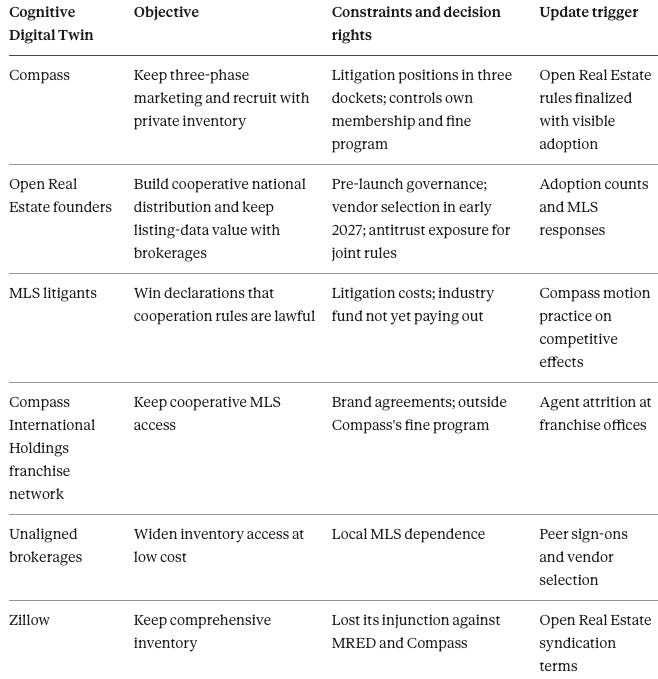
MindCast’s simulation of the Open Real Estate launch built six Cognitive Digital Twins (CDTs). The twins model Compass, the Open Real Estate founders and the MLS litigants. The remaining three model the Compass International Holdings franchise network, unaligned brokerages and Zillow.
MindCast AI testified on the private-listing mechanism before the Washington State legislature in January 2026 and made an amicus submission in Compass v. NWMLS.
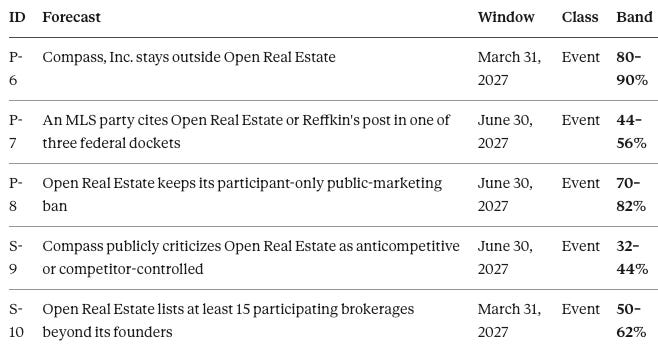
The paper issues five MindCast Foresight Simulation Predictions: three Primary (P) and two Secondary (S). The lead forecast is that Compass stays outside Open Real Estate, and both Secondary entries depend on visible adoption.
The paper first maps Open Real Estate’s two listing tiers against Compass’s three marketing phases and shows the middle phase cannot run unmodified under the announced terms. The analysis then sets four contradictions between Reffkin’s October 26 post and Compass’s filed and public positions. A third part explains the narrative mechanism and marks where the contradiction stops. The paper then sets out the Endorsement–Entry Test, the five Simulation Predictions and a risk mitigation entry for each.
🏛️ Policymakers: The largest non-Compass brokerages now propose stricter submission rules voluntarily, which casts cooperation as an industry choice rather than a restraint imposed on brokers.
💼 Executives: Brokerages outside Compass and Open Real Estate face a free option to join, and joining would close off Compass-style phased marketing.
⚖️ Counsel: MLS litigants hold an exhibit in which Compass’s chief executive calls a stricter submission regime “good news for all agents and their clients,” and its use in court sits near even odds (P-7).
📊 Investors: The endorsement carries no cooperation signal (P-6), and Open Real Estate narrows Compass’s recruiting advantage only if adoption becomes real (S-10).

II. Open Real Estate Turns Opposition to Private Listings Into a Product
The fight over private listings has run through rulebooks, courtrooms and a state legislature. On October 26 it reached the market. Four national franchisors launched a listing system rather than another rule or lawsuit. The timing places the launch inside Compass’s MLS campaign.
AGNT (parent of eXp Realty and NextHome) founded Open Real Estate with HomeServices of America, Keller Williams and Real REMAX Group. HousingWire reported in “4 Real estate giants team up to create new, shared listings platform” (2026) that four more brokerages joined as participants. The four are Brown Harris Stevens, Lamacchia Realty, Samson Properties and Windermere Real Estate. Participation is free for any licensed brokerage or franchise, and the founders expect to select a technology vendor during the first quarter of 2027.
Seven weeks of escalation preceded the launch. Compass sent demand letters to MLSs on September 8, according to Inman’s “How Compass’ fight with MLSs became a coordinated legal battle” (2026). The California Regional Multiple Listing Service (CRMLS) sued Compass in New York in early October, and Compass sued CRMLS on October 16. Six MLSs filed a joint declaratory action in the Southern District of New York on October 21, and Open Real Estate launched five days later.
The founders never named Compass, though their language leaves little doubt about the target. Their open letter warns that “homes are increasingly marketed privately” in ways that “limit competition and reduce transparency,” Inman reported in “KW, AGNT, HomeServices of America, Real REMAX fight private listings with new collaboration” (2026). The frequently asked questions (FAQ) page says inventory is “cloistered and marketed privately to a limited group of buyers.” The FAQ adds that the practice creates “opportunity for discrimination,” and HousingWire called the launch “a potential counterweight to Compass’s private listing strategy.”
Open Real Estate works as a market response because it competes rather than penalizes. MLS rules fine agents, and lawsuits defend those rules. A free national distribution channel gives every non-Compass agent the reach that private inventory is meant to sell.
MLSs and brokerages defending mandatory submission now hold MLS rules, two federal lawsuits and Washington’s statute. An industry legal action fund organized by the Council of Multiple Listing Services reported commitments near $1 million in late October, as the companion paper documented. Open Real Estate adds a market product.
Open Real Estate’s launch also changes which national brokerages stand on each side. The companion paper found that no second national brokerage had joined Compass’s suit or publicly endorsed its demand. Four national brokerages have now formed a coalition on the cooperation side instead.
Open Real Estate could work faster than the courts. Private inventory holds value only relative to what competing agents can see. Every brokerage that contributes listings to Open Real Estate shrinks the share of early inventory that belongs to Compass alone. The erosion depends on listings flowing, which participant counts alone do not show (S-10).
🗂 MLS Leaders. Open Real Estate backs the cooperation rule while competing for the listing input MLSs receive today. 📊 Investors. The cooperation side now competes with a product as well as rules, which adds a commercial cost beside Compass’s legal costs.
III. Open Real Estate’s Announced Rules Would Not Let Compass’s Second Phase Run as Designed
Compass’s marketing model and Open Real Estate’s rules can be compared directly. Compass sells three phases. Open Real Estate allows two tiers, and the missing one is the phase Compass is suing to protect.
Inman described Compass’s three-phase model in “Compass leans into private listings with new marketing push” (2024). The phases run in this order:
Phase one, Compass Private Exclusives: the listing is visible only to Compass agents and their clients.
Phase two, Compass Coming Soons: the listing is “publicly launched on Compass.com” while days on market and price-drop history stay hidden.
Phase three: the listing goes to all platforms and begins accumulating days on market.
Open Real Estate’s FAQ announces the competing structure, which binds no one until the platform launches. Under the announced rules, every listing enters the database within one business day of the listing agreement. A “participant view” listing reaches agents at every participating brokerage but “cannot be publicly marketed by anyone.” The ban covers “the listing agent and the listing brokerage,” and any public listing “must be syndicated to the Open Real Estate database.”
Each Compass phase maps onto the new system differently. Phase one resembles participant view, except that Open Real Estate opens the listing to every participating firm rather than one. Phase three matches the market tier.
Phase two has no equivalent as designed. Once a listing is publicly marketed, the announced terms route it into the market tier, and Open Real Estate rather than Compass decides where it syndicates.
Phase two is the conduct at stake in Compass’s lawsuit against CRMLS. A Compass International Holdings spokesperson said homeowners should be able to “publicly market any listing,” according to Inman’s “Compass files antitrust suit against CRMLS over listing rules” (2026). CRMLS Rule 7.9, which implements NAR’s Clear Cooperation Policy, triggers submission when public marketing begins. Open Real Estate’s announced framework would require submission within one business day of signing, before any marketing begins.
The phase-by-phase comparison also shows what the dispute is not about. Both systems allow a private phase, so the conflict does not set privacy against openness. The conflict turns on two questions: who holds the private phase, and whether a listing can be marketed to the public without full exposure. Open Real Estate gives the private phase to every participating firm, and it bars public marketing without full exposure.
MindCast’s companion paper on Compass’s national MLS campaign separated three benefits Compass draws from phased marketing: distribution, agent recruitment and capture of the buyer side on listings held outside the cooperative. Open Real Estate offers rival agents the first two. The market tier supplies distribution, and its participant tier gives sellers a pre-market option that rival brokerages can now recruit with. Only the third benefit remains unique to Compass, and the companion identified it as the right Compass’s litigation seeks.
Open Real Estate’s announced framework sets a stricter version of the rule Compass asks federal courts to end. Compass could not run its current second phase without modification inside the system its chief executive praised. Joining would mean giving up control over portal withholding, the element Compass is litigating to protect.
⚖️ Counsel. The missing middle phase ties the Open Real Estate comparison directly to the conduct pleaded against CRMLS. 💼 Executives. Any brokerage running a coming-soon program on its own site faces the same conflict with the announced framework.
IV. Reffkin’s Post Contradicts Four Positions Compass Holds Elsewhere
Reffkin’s October 26 congratulation sits beside Compass’s complaints, demand letters and earlier executive statements. Four of those positions conflict with it directly. Each pair sets a Compass position from litigation or public advocacy beside praise for a system built on the opposite rule. The comparisons test the consistency of Compass’s public economic rationale and do not establish that its antitrust claims fail.
On mandatory routing. Reffkin wrote in 2025 that “100% of listings must go through NWMLS … that’s the definition of a monopoly,” Real Estate News reported in “Windermere and Compass spar over Clear Cooperation” (2025). The target was the Northwest Multiple Listing Service (NWMLS). Open Real Estate’s announced rules would require all member listings in its database within one business day, and Reffkin called the system “good news for all agents and their clients.”
On competitor control. Compass’s complaint objects that “every single member of CRMLS’s Board of Directors is a direct competitor of Compass and its agents.” Four of Compass’s largest national competitors founded Open Real Estate. The FAQ gives the system “full discretion” over where listings are syndicated.
On public marketing. Compass argues for a seller’s right to market any listing in public. Open Real Estate’s announced rules ban public marketing of participant listings by anyone, the listing agent included.
On listing control. Reffkin’s post says Open Real Estate will “return the power back to the creator of the listing.” The post names that creator as “the homeowner and their trusted agent.” The FAQ assigns syndication decisions to Open Real Estate instead.
Compass’s habit of attacking MLS rules while professing support for MLSs predates October 26. Reffkin wrote “To be clear, I am pro-MLS” on March 20, 2026, according to Real Estate News in “Robert Reffkin says he’s ‘pro-MLS’ but doubles down on criticism” (2026). One day earlier, Compass International Holdings and Rocket had published an open letter saying some MLSs are “actively working against” agents. MindCast AI’s Compass Invoked Its Washington Lawsuit Against Six MLSs, They Answered Together in New York traced how Compass carried its Washington campaign from forum to forum, and the October 26 post extends the same sequence into the market.
MindCast AI documented the underlying pattern months before Open Real Estate existed. Compass’s Cross-Forum Contradictions (February 28, 2026) catalogued how Compass called restricted listing visibility a consumer harm in federal court and a seller choice before the Washington Legislature. How Compass’s State Legislative Testimony Undermined its Federal Antitrust Claims (January 31, 2026) traced how Compass’s January testimony on Substitute Senate Bill 6091 weakened its federal claims against Zillow and NWMLS. The October 26 post adds a fifth forum to that catalogue: the market launch of a rival coalition.
The four contradictions carry unequal weight. The complaint and the demand letters bind Compass in litigation, while the post is promotional speech. The post is available to opposing counsel, and the Simulation Predictions put its use in court near even odds (P-7).
⚖️ Counsel. The complaint carries legal weight the post lacks, so the post’s value lies in the contrast. 🏛️ Policymakers.Compass’s public statements on cooperation now run in two directions at once.
V. Reffkin’s Congratulation Works as Narrative Control
Reffkin’s post makes three framing moves, and each can be measured against what Open Real Estate published. Behavioral economics supplies the decision rules and salience effects that make the moves work on readers. Game theory supplies the payoff structure that explains why they fail as a commitment. Predictive behavior emerges from the combination of the two.
The Compass Narrative Inversion Playbook (February 4, 2026) defined the pattern the post extends. Compass describes a restraint it imposes as a freedom and the same restraint imposed by others as a harm. The October 26 post runs the pattern in a new direction: Compass praises a rival-imposed restraint because Open Real Estate’s membership is voluntary and its rules do not yet bind Compass. The Cybernetics of Compass Holdings’ Narrative Control Architecture (March 21, 2026) explained why the shifts cohere: each audience receives the message that protects Compass’s control of listing visibility.
V.A Relabeling, Selective Emphasis and Implied Alignment
Reffkin called Open Real Estate “a national real estate listing service.” The founders’ FAQ asks “Is Open Real Estate a national MLS?” and answers “No.” The relabel recasts the launch as evidence that national alternatives to local MLSs are arriving. Compass’s litigation rests on the same claim.
Reffkin’s post emphasizes one element and leaves out two. The FAQ promises to share the value of listing data “with the people who create it.” Reffkin’s line about returning power to the listing’s creator echoes that promise and fits his 2025 testimony that MLSs and portals “profit from the work of others,” as Real Estate News reported in “Compass CEO: Zillow, NAR, MLSs ‘profit from the work of others’” (2025). The post omits the one-business-day input rule and the public-marketing ban.
Reffkin’s closing line signals alignment without establishing membership. “We look forward to helping build the next chapter of listing services” places Compass International Holdings inside a project it has not joined. Most readers meet the post and the headline before the FAQ. The first framing sets the reference point that later facts must displace, a decision rule behavioral economics calls anchoring.
V.B Joining Would Force Changes to Compass’s Middle Phase While Praise Costs Nothing
Agents, sellers, judges and regulators are sorting brokerages into two types. One type distributes listings openly, and the other holds inventory for its own network. Observers can tell the two types apart only through a signal that one type will pay for and the other will not. Game theory calls that outcome a separating equilibrium.
Open Real Estate’s one-business-day input rule is that costly signal. A brokerage that joins would have to commit every listing to the shared database within one business day under the announced framework. The commitment costs a private-network firm its core product, while Reffkin’s post costs Compass nothing. A cost-free message from the type that would refuse the costly action moves observers’ beliefs very little.
Reffkin’s post can still shape coverage. Inman’s launch story quoted the congratulation alongside the founders’ letter, placing Compass inside coverage of a coalition formed against its model. The observable output is a set of headlines in which Compass appears beside the founders rather than opposite them.
V.C The Founders’ Own Statements Separate Them From Compass
The coalition’s members describe Compass’s model in critical terms. The open letter states that Open Real Estate “is not a walled garden or another marketplace that favors one company over another.” The FAQ calls the public market under private-listing strategies “the market of last resort.”
Founders and participating brokers go further in their own words. Participating broker Anthony Lamacchia said five days before the launch that “it will turn into an absolute listing war if Robert (Reffkin) gets his wish,” RISMedia reported in “’An Absolute Listing War:’ Lamacchia Says Compass Driving Industry Toward ‘Disaster’” (2026). HomeServices chief executive Chris Kelly called the private-listing push “a business practice that is couched in the form of marketing and the term ‘seller choice’” in Inman’s “Why Chris Kelly calls real estate’s listing fight a ‘manufactured crisis’” (2026). Windermere’s OB Jacobi said in 2025 that the only reason for office exclusives is to “double end the deal,” as Real Estate News reported in “Windermere exec slams Compass over ‘dirty’ tactics” (2025).
Reffkin’s post calls the founders partners in a shared project. The founders’ rules and statements treat Compass as the problem the project addresses. The two accounts cannot both describe the same relationship.
Relabeling, selective emphasis and implied alignment give Compass coverage it has not earned through membership. The founders’ rules and statements decline the association, and the input rule supplies the costly signal that separates them from Compass. Readers who reach the FAQ will see the separation.
📊 Investors. Coverage placing Compass beside the founders carries no information about membership or cooperation costs. 💼 Executives. Open Real Estate’s founders gain credibility each time a rule they hold separates them from Compass.
VI. Brokerage Participation Could Create Two National Listing Blocs
The competition between Compass and Open Real Estate starts with a single agent’s listing agreement and ends in national market structure. Open Real Estate’s rule acts at the smallest unit, the day a seller signs. Brokerage membership decisions aggregate those choices into blocs, and the blocs feed back into what each agent can offer a seller.
At the agent level, the one-business-day rule decides where a new listing goes first, and each brokerage chooses whether to accept that rule for every agent. At the national level, those choices could sort major brokerages into competing national distribution networks. Compass International Holdings completed its acquisition of Anywhere in January 2026and now holds brands such as Coldwell Banker and Sotheby’s International Realty. Open Real Estate holds most of the remaining national franchisors.
Blocs that form would change incentives back at the agent level. An agent’s recruiting value rises with the inventory the agent’s bloc can see first. MLSs sit between the blocs, defending cooperation rules alongside Open Real Estate while competing with its national database for listing input. The founders tie the contest to the wider economy as well, warning that fragmented sales data weakens how “banking, appraisal and insurance companies” value homes.
Local listing decisions could add up to a national two-bloc structure, and that structure would shape the next local decision. The MLS holds the middle position and faces pressure from both sides. Bloc formation runs through adoption (S-10), and for every actor the bloc each brokerage enters matters more than Compass’s endorsement.
🗂 MLS Leaders. A two-bloc market would press MLSs from both sides, from Compass on rules and from Open Real Estate on input. 💼 Executives. Recruiting value would follow each bloc’s early inventory once blocs form.
VII. The Contradiction Holds on Submission and Public Marketing, Not Data Ownership
The contradiction between Reffkin’s praise and Compass’s litigation has limits on three grounds Compass will raise. Two of them narrow the contradiction without removing it. The third marks where the two sides agree.
Compass’s antitrust theory rests on MLS market power. Open Real Estate is a voluntary consortium, and no brokerage must join it to reach buyers. Compass will argue that a firm can praise voluntary rules while challenging mandatory ones imposed by an MLS with market power. The founders’ combined share of agents strains that distinction over time, but the distinction holds on launch day.
Reffkin’s praise is consistent on one axis. Open Real Estate’s promise to return data value to listing creators matches Compass’s criticism of MLS data licensing. On data ownership, the post expresses a position Compass holds.
Open Real Estate’s participant tier lets listings circulate among brokerages without an MLS or a portal. Compass can cite that feature as proof that listings reach buyers without MLS submission. A voluntary industry standard can inform a court’s analysis of competitive effects, but it cannot by itself establish whether an MLS rule is lawful.
The founders face their own coalition problem. Members gain from shared inventory, yet each founder keeps an interest in its own listing data and in the revenue Open Real Estate promises to share. The rules remain pre-launch, and governance conflict over listing data and distribution revenue could reshape them.
A competing explanation treats the post as preparation for split entry. Open Real Estate accepts franchises, and Reffkin signed as the holding company rather than the Compass brokerage. If Coldwell Banker or another holding-company brand joins while the Compass brokerage stays out, the contradiction narrows for the brands and sharpens for Compass itself. The Simulation Predictions carry split entry as a watch item.
The contradiction holds on the submission trigger and the public-marketing ban, the two rules Compass litigates. The contradiction does not extend to data ownership, where Compass and the founders partly agree. The paper’s claim rests on that narrower ground.
⚖️ Counsel. The distinction between voluntary rules and MLS market power is Compass’s strongest answer to the comparison. 📊 Investors. Compass and the founders partly agree on data ownership, so agreement on data terms would not resolve the submission dispute.
VIII. Open Real Estate Gives Listing-Service Litigants Evidence and Narrows Compass’s Options
Open Real Estate’s launch changes the evidence available in pending cases and the choices open to Compass. MLS litigants gain material, Compass loses a cost-free option and adjacent actors face new incentives. MindCast AI’s companion paper showed that national scale moved local boards through sequence rather than size. Open Real Estate adds a coalition of national brokerages to that bargaining, so Compass is no longer the only national brokerage taking a side.
MLS litigants. CRMLS and the six MLSs in the Southern District of New York can point to the largest non-Compass brokerages adopting a stricter submission rule on their own. The post adds Compass’s chief executive calling that regime good news for agents.
Compass. Compass’s options run in sequence rather than in parallel. Staying outside while praising selectively is the most likely path (P-6), and a turn to criticism follows only if adoption grows while the ban stands (S-9). Joining on the announced terms would force changes to its second phase and sits among the least likely paths. Turning against Open Real Estate means attacking a coalition led by Keller Williams and HomeServices, the two brokerages a Kansas City jury found liable in the Sitzer/Burnett commission case reported in “Missouri jury finds Realtors, brokerages conspired to inflate commissions” (2023).
Former Anywhere brands. Compass’s fine program covers agents at its company-owned brokerages and leaves out the franchise network. Franchise members belong to the cooperatives Compass is suing, and Open Real Estate accepts franchises as members. Reffkin signed as Compass International Holdings rather than as the Compass brokerage.
Zillow and Midwest Real Estate Data. Open Real Estate’s syndication discretion gives brokerages leverage over portal feeds. Zillow shares the founders’ position on private listings but not their claim to control distribution. A federal judge denied Zillow’s injunction against Midwest Real Estate Data (MRED) and Compass on September 15, as reported in “MRED scores important victory in legal battle with Zillow” (2026), and the case is stayed pending arbitration.
Open Real Estate moves the contest from private listings to control of listing distribution. MLS litigants gain evidence, Compass loses a cost-free path and portals face a new distributor. Each actor’s next move will show whether the October 26 post reads as alignment or framing.
IX. A Reusable Instrument: The Endorsement–Entry Test
The Compass case yields a test that applies whenever a firm praises a coalition it has not joined. The Endorsement–Entry Test asks whether a public endorsement reflects alignment or framing. The test uses three conditions, each tied to an observable document.
Cost asymmetry. Membership would impose a cost on the endorser that praise does not. The observable is the coalition’s announced or adopted membership terms. Here compliance with the announced terms would require Compass to modify its second phase.
Selective emphasis. The endorsement names only the coalition terms the endorser already favors. The observable is a line-by-line comparison of the statement with the coalition’s rules. Here the post names data value and omits the input rule and the public-marketing ban.
Forum divergence. The endorser holds a contrary position in a binding forum. The observable is the endorser’s filings or contracts. Here Compass’s complaint against CRMLS attacks the rule the post praises.
When all three conditions hold, the endorsement functions as framing. Observers should then give weight to membership terms and filings over the statement. Entry on the coalition’s stated terms disconfirms the reading, and so does public acceptance of the omitted terms.
The Endorsement–Entry Test transfers to state attorney general coalitions, technical standards bodies and voluntary industry codes. In each setting, firms praise collective commitments they decline to sign. Compass’s post meets all three conditions on the documents available today, and MindCast AI will apply the same test to coalition analyses inside and outside real estate.
🏛️ Policymakers. The test applies to any firm that praises a voluntary code it declines to sign.
X. What the Documents Establish and What Remains Inference
The paper’s claims fall into three groups with different evidentiary weight. Documents support the first group, analysis supports the second and events will resolve the third.
Documented. Open Real Estate’s FAQ sets out its founders and participants. The same page sets out the input rule, the participant-view ban and syndication discretion. The cited reporting carries Reffkin’s congratulation, Compass’s complaint language and the executives’ quoted statements.
Inference. The founders never named Compass, so describing Open Real Estate as a response to Compass rests on timing and language. The narrative-control reading rests on what the post does against Open Real Estate’s published rules and makes no claim about private intent.
Open. Compass’s entry decision, Open Real Estate’s final governance and the courts’ treatment of the post remain unresolved.
The core contradiction rests on documents, while the strategic reading rests on inference from those documents. The open items define what the coming weeks will test. The paper’s conclusion depends only on the documented group.
XI. MindCast Simulation Predictions: Separation Holds and Compass Stays Outside
The paper issues five Simulation Predictions: three Primary (P) and two Secondary (S). Numbering continues the series’ prediction set, which ran through P-5 and S-8 in the companion paper. The bands come from the October 26 MP CDT FS, with data through 10:40 Pacific that day. Each entry names an actor, an outcome, a window and a verification source.
Earlier entries in the MLS Equilibrium Series have already resolved. Two entries from California Private Listing Law After Washington SSB 6091 — Broker Conduct Rules for Listing Visibility Showing Access and Buyer Representation (October 2, 2026) were validated by Compass’s October 16 complaint: P-2 (77–90%) and S-3 (58–74%). One entry missed: S-1 (66–76%) of Compass Runs the Same MLS Playbook Against CRMLS That It Ran Against NWMLS — CRMLS Broke It by Suing First in New York (October 6, 2026), when Compass sued CRMLS in California rather than counterclaiming in New York.
XI.A Six Cognitive Digital Twins Carry the Contest
Each twin carries an objective, the constraints and decision rights that bound it, and the event that would change its behavior.
XI.B Three Hypotheses Compete Before the Results
The simulation tested whether Compass’s endorsement survives as alignment once Open Real Estate’s rules, Compass’s litigation positions and brokerage adoption interact. Three explanations of the post competed. Each carries its own falsifier.
Alignment hypothesis. The endorsement precedes entry, and Compass moves toward Open Real Estate membership. Falsifier: Compass stays outside through the founders’ vendor selection while Open Real Estate’s terms stay unchanged.
Framing hypothesis. The endorsement is a cost-free statement that associates Compass with the cooperation side without changing its conduct. Falsifier: Compass accepts the one-business-day input rule for its listings.
Split-entry hypothesis. The endorsement prepares holding-company brands to join while the Compass brokerage stays out. Falsifier: no holding-company brand seeks participation, or franchise terms bar brand-level participation.
XI.C The Governing Mechanism Is a Separating Rule
The dominant mechanism is Open Real Estate’s input rule, a costly commitment that outweighs a zero-cost endorsement. The founders hold the most coherent position, because their rules, statements and identity point the same way. Compass’s established pattern of attacking rules while professing support for institutions governs its next moves. The framing hypothesis carries the most support, the alignment hypothesis the least.
The simulation weighed four paths:
Most likely path (60%): Compass stays outside and praises selectively, the participant ban holds, adoption clusters and the contradiction becomes available in litigation.
Second path (25%): Open Real Estate adoption becomes visible with the ban intact, and Compass recasts Open Real Estate as competitor-controlled.
Less likely path (9%): adoption stalls, the founders soften the ban and holding-company brands enter.
Least likely path (6%): vendor or governance failure delays the launch past mid-2027.
The decisive variable is whether adoption becomes visible while the ban holds. Visible adoption alone moves Compass from the most likely path to the second.
XI.D Primary Simulation Predictions
P-6 · Compass, Inc. stays outside Open Real Estate through March 31, 2027 (80–90%). Compass does not appear as a founding or participating member on openrealestate.com or in any Open Real Estate or Compass announcement by that date.
Trigger: founder recruitment sessions and vendor selection.
Falsifier: either organization announces Compass brokerage membership or participation by March 31, 2027.
Verification source: openrealestate.com member page; Open Real Estate and Compass releases; Inman, HousingWire and Real Estate News.
P-7 · An MLS party cites Open Real Estate or Reffkin’s post in federal court by June 30, 2027 (44–56%). The filing references Open Real Estate or Reffkin’s October 26 statement. The qualifying dockets are the Southern District of New York (No. 1:26-cv-09253), the Central District of California (No. 5:26-cv-06121) or CRMLS’s New York action.
Trigger: Compass motion practice that opens briefing on competitive effects.
Falsifier: no MLS-party filing in the three dockets references Open Real Estate or the statement by June 30, 2027.
Verification source: the three federal dockets; party releases; Inman and Real Estate News.
Mechanism: the band sits near even odds because the evidence cuts both ways. Open Real Estate’s participant tier shows listings reaching buyers without MLS submission, which gives litigants a reason to hold back.
P-8 · Open Real Estate keeps its participant-only public-marketing ban as of June 30, 2027 (70–82%). As of that date, Open Real Estate’s published rules retain a participant-only category in which the listing agent and listing brokerage may not publicly market the listing.
Trigger: governance finalization and launch documentation.
Falsifier: published rules on or before June 30, 2027 permit public marketing of participant-only listings or eliminate the category.
Verification source: openrealestate.com FAQ, rules and terms pages; Open Real Estate releases.
XI.E Secondary Simulation Predictions
S-9 · Compass publicly criticizes Open Real Estate as anticompetitive or competitor-controlled by June 30, 2027 (32–44%). Statements by Reffkin or a Compass International Holdings spokesperson count, and criticism of the founders or the rules counts. The entry belongs to the second path. The falsifier is no such criticism in Compass releases, Reffkin’s posts or court filings by June 30, 2027.
S-10 · Open Real Estate lists at least 15 participating brokerages beyond its founders by March 31, 2027 (50–62%).Open Real Estate publicly lists at least 15 participating member brokerages beyond its four founders by March 31, 2027. The falsifier is fewer than 15 listed by that date, verified against openrealestate.com and Open Real Estate releases. S-10 measures adoption, not listing volume, and erosion of Compass’s private-inventory advantage requires listings to flow as well.
XI.F Watch Item and Limits
Split entry by a Compass International Holdings franchise brand remains a watch item without a band. Two observables would activate it: agent attrition at franchise offices, and franchise terms that permit or bar brand-level participation without the parent’s consent. A documented case of either would prompt a published revision.
Open Real Estate’s governance and vendor terms remain unpublished. Three events would change the conditions the Simulation Predictions assume: a rule change before launch, a court ruling on MLS submission or an antitrust inquiry into Open Real Estate. Any of them would prompt a dated revision, and each original entry still resolves on its stated terms.
The five Simulation Predictions turn the paper’s argument into dated tests. P-6 and P-8 carry the separation thesis, and P-7 carries its litigation consequence. S-9 and S-10 carry the conditions under which the contest escalates.
Working With MindCast
The published simulation uses public information only. A brokerage weighing Open Real Estate needs its exclusive-listing share and its recruiting dependence on early inventory. An MLS board needs the share of its listings that would arrive through third-party entry. None of these figures is public.
MindCast AI builds an organization-specific Cognitive Digital Twin from those inputs and reruns the contest against the organization’s options. Investors modeling Compass’s campaign can commission the P-6 and S-9 paths against their own assumptions. Counsel can commission the P-7 comparison against a specific docket, and MLS boards can commission S-10 against their own listing input.
Commissioned scope adds complete probability distributions, organization-specific inputs and the full scenario tree. The bounded next step is a diagnostic session placing one organization’s options against the four paths above. Contact mcai@mindcast-ai.com or visit MindCast Corporate.
XII. Risk Mitigation: Each Simulation Prediction Binds One Decision
Each entry states the exposure in a unit the audience controls, the owned actions with deadlines and the exposure that remains. Severity and probability appear as separate axes.
P-6 (80–90%) · 📊 Investors. Exposure: a model that reads the endorsement as movement toward cooperation understates Compass’s dependence on litigation for at least two quarters of filings. Severity · Probability: Medium · High.
Mitigation: set the model’s cooperation input to change only on a documented membership event (analyst · now). Read Compass’s fiscal 2026 10-K risk factors for Open Real Estate or cooperation language (analyst · on filing).
Residual: Compass changes its marketing program without joining, which the membership input cannot see.
P-7 (44–56%) · ⚖️ Counsel for MLS litigants. Exposure: a filing that cites Open Real Estate invites Compass to seek discovery into the litigant’s communications about Open Real Estate, adding a third-party category to discovery scope. Severity · Probability: Medium · Moderate.
Mitigation: preserve and authenticate the October 26 statement and the October 26 FAQ (counsel · before the first responsive brief). Decide in writing whether Open Real Estate evidence enters the competitive-effects argument (counsel · Compass’s responsive deadline). Confine any contact with Open Real Estate to its published terms (counsel · ongoing).
Residual: a court accepts Compass’s market-power distinction, and the comparison carries limited weight.
P-8 (70–82%) · 💼 Executives at unaligned brokerages. Exposure: a brokerage that builds a Compass-style pre-marketing program and then joins Open Real Estate must unwind it, stranding the quarters of recruiting messaging built on it. Severity · Probability: Medium · High.
Mitigation: map current exclusive and coming-soon practices against Open Real Estate’s announced tiers before signing a letter of support (broker of record · before signing). Budget the transition in agent onboarding materials (operations · before Open Real Estate’s vendor selection).
Residual: Open Real Estate’s launch terms differ from the announced framework.
S-9 (32–44%) · 💼 Executives at the Open Real Estate founders. Exposure: a Compass critique framing Open Real Estate as competitor-controlled lands while governance is unfinished and invites scrutiny of joint rule-setting during the 2027 legislative sessions. Severity · Probability: High · Moderate-low.
Mitigation: publish a governance charter with open membership and nondiscrimination terms (founders’ counsel · before the vendor announcement). Document an independent rationale for each listing rule (founders’ counsel · same deadline).
Residual: an inquiry proceeds regardless of the charter.
S-10 (50–62%) · 🗂 MLS Leaders. Exposure: listing input migrates toward Open Real Estate’s single entry point, and the board loses timeliness control over that share of new listings. Severity · Probability: Medium · Moderate.
Mitigation: publish input standards and data-receipt terms for third-party entry systems (MLS staff · before Open Real Estate’s vendor selection). Measure monthly the share of new listings received through third-party input (MLS staff · from launch).
Residual: Open Real Estate’s syndication discretion over portals sits outside any MLS rule.
🏛️ Policymakers hold no entry of their own. P-8 and S-10 together show whether a brokerage consortium can sustain a cooperation rule without statute, which bears on the 2027 sessions.
The strategy matrix consolidates the entries above into one decision view.
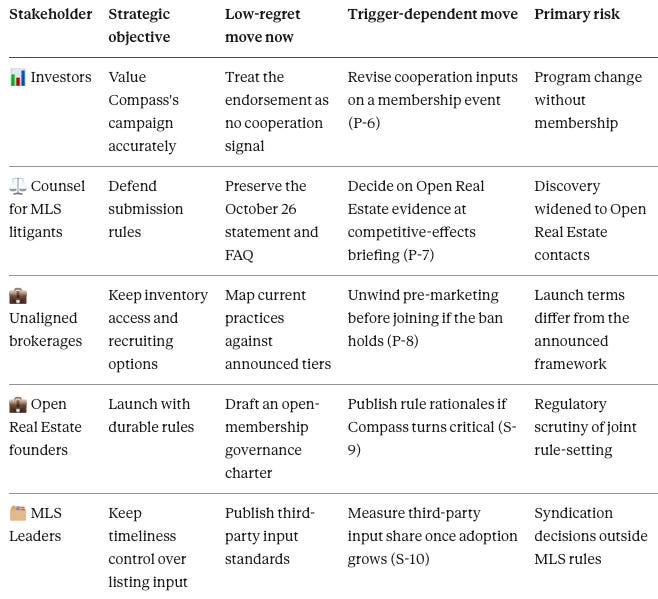
Risk sorts by time gate.
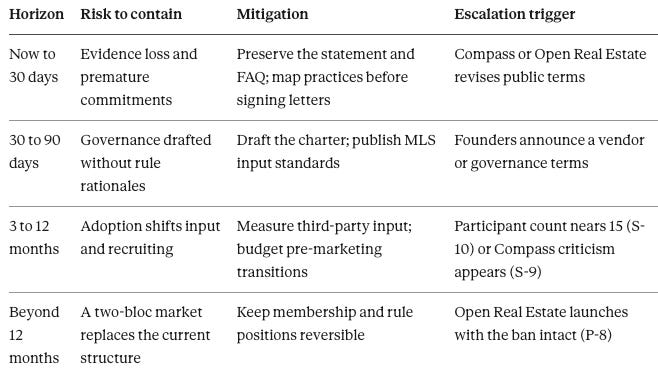
Each audience’s low-regret move is available now from public documents. Each trigger-dependent move waits on one Simulation Prediction.
What to Watch: Membership, Rules, Filings and Adoption
Four observables resolve the five Simulation Predictions, and each has a date. The dominant fork is whether Open Real Estate adoption becomes visible while the participant ban holds. The answer decides whether Compass stays on the most likely path or turns to criticism.
Membership by March 31, 2027. Open Real Estate’s member list resolves P-6 and the split-entry watch item. Cadence: monthly, and on Open Real Estate announcements.
Adoption by March 31, 2027. Open Real Estate’s participant listings resolve S-10 and show whether the dominant fork has turned. Cadence: monthly.
Rules as of June 30, 2027. Open Real Estate’s launch terms resolve P-8. Cadence: on each published revision.
Filings by June 30, 2027. The three federal dockets resolve P-7 and part of S-9. Cadence: weekly.
The membership list and the adoption count arrive first, and both land before any court rules on MLS submission. Readers who track one source should track Open Real Estate’s member page.
Conclusion: Separation Holds Unless Compass Pays the Entry Cost
On October 26, Robert Reffkin congratulated the founders of a system whose announced rules would not let the second phase of Compass’s marketing model run as designed. The founders have made a costly commitment, and Compass has made a statement. The Simulation Predictions hold that the gap persists: Compass remains a non-member through March 2027 (P-6 · 80–90%), while the participant ban survives into June 2027 (P-8 · 70–82%).
If Compass joins on the October 26 terms, the contradiction resolves and Compass’s second phase cannot continue unmodified for listings it sends through Open Real Estate. If Compass stays outside, every MLS defending a submission rule holds an exhibit signed by Compass’s chief executive. MLS counsel bring the post or Open Real Estate into court at near even odds (P-7 · 44–56%).
Beyond Compass, the contest sets proprietary brokerage inventory against reciprocal distribution through shared infrastructure. If adoption becomes real (S-10 · 50–62%), the market could resolve that contest before the courts do, and Compass’s turn to criticism becomes the second path (S-9 · 32–44%).
About MindCast AI
MindCast AI is a Predictive Behavioral Economics + Dynamic Game Theory firm. The firm’s MP CDT FS model how institutions, litigants and markets respond to strategic change. MindCast AI’s real estate work covers MLS cooperation rules, private listing economics and Washington’s Substitute Senate Bill 6091. Contact mcai@mindcast-ai.com or visit mindcast-ai-simulation.com.
Appendix A: Selected MindCast Works
Companion work.
Compass Invoked Its Washington Lawsuit Against Six MLSs, They Answered Together in New York (October 22, 2026). Reports the six-MLS filing and supplies the forum-to-forum sequence this paper extends into the market.
Compass’s National MLS Campaign and the Economics of Local Resistance — Why Partnerships and Lawsuits Grow Together (October 24, 2026). Supplies the three-benefit decomposition and the finding that Compass’s brokerage-side coalition has one member.
Cross-forum contradiction and narrative inversion.
The Compass Narrative Inversion Playbook (February 4, 2026). Defines narrative inversion, the pattern Section V shows the October 26 post extending.
How Compass’s State Legislative Testimony Undermined its Federal Antitrust Claims (January 31, 2026). Traces how Compass’s Washington testimony weakened its federal antitrust claims.
Compass’s Cross-Forum Contradictions (February 28, 2026). Catalogues Compass’s incompatible positions across court, legislature, investor and consumer forums, the catalogue Section IV extends.
The Cybernetics of Compass Holdings’ Narrative Control Architecture (March 21, 2026). Explains how Compass’s audience-specific messages serve one strategy of controlling listing visibility.
Prior Simulation Predictions.
California Private Listing Law After Washington SSB 6091 — Broker Conduct Rules for Listing Visibility Showing Access and Buyer Representation (October 2, 2026). Source of P-2 and S-3, both validated by Compass’s October 16 complaint.
Compass Runs the Same MLS Playbook Against CRMLS That It Ran Against NWMLS — CRMLS Broke It by Suing First in New York (October 6, 2026). Source of S-1, which missed when Compass sued CRMLS in California.
Appendix B: External Sources
Open Real Estate, “Frequently Asked Questions” (2026) · Primary source for founders, participants, input rule, participant-view ban and syndication discretion.
Inman, “KW, AGNT, HomeServices of America, Real REMAX fight private listings with new collaboration” (Oct. 26, 2026) · Launch coverage, open letter and Reffkin’s congratulation.
HousingWire, “4 Real estate giants team up to create new, shared listings platform” (Oct. 26, 2026) · Participating brokers and free participation.
RISMedia, “Brokerage Giants Launch New ‘Shared Infrastructure’ for Listings” (Oct. 26, 2026) · Launch details and the founders’ “not a walled garden” letter.
Inman, “How Compass’ fight with MLSs became a coordinated legal battle” (Oct. 23, 2026) · Timeline of Compass’s demands and the MLS lawsuits.
Inman, “Compass files antitrust suit against CRMLS over listing rules” (Oct. 16, 2026) · Compass’s complaint against CRMLS and its spokesperson’s public-marketing statement.
Inman, “Compass leans into private listings with new marketing push” (Nov. 4, 2024) · Definition of Compass’s three marketing phases.
RISMedia, “’An Absolute Listing War:’ Lamacchia Says Compass Driving Industry Toward ‘Disaster’” (Oct. 21, 2026) · Anthony Lamacchia’s statements on Compass.
Inman, “Why Chris Kelly calls real estate’s listing fight a ‘manufactured crisis’” (Oct. 9, 2026) · Chris Kelly’s characterization of the private-listing push.
Real Estate News, “Robert Reffkin says he’s ‘pro-MLS’ but doubles down on criticism” (Mar. 20, 2026) · Reffkin’s “pro-MLS” statement and the Compass–Rocket letter.
Real Estate News, “Windermere and Compass spar over Clear Cooperation” (Mar. 27, 2025) · Reffkin’s NWMLS monopoly statement.
Real Estate News, “Windermere exec slams Compass over ‘dirty’ tactics” (Apr. 10, 2025) · OB Jacobi’s statement on office exclusives.
Real Estate News, “Compass CEO: Zillow, NAR, MLSs ‘profit from the work of others’” (Nov. 21, 2025) · Reffkin’s testimony in Compass v. Zillow.
Real Estate News, “MRED scores important victory in legal battle with Zillow” (Sept. 15, 2026) · Denial of Zillow’s injunction against MRED and Compass.
Real Estate News, “Compass completes its acquisition of Anywhere Real Estate” (Jan. 9, 2026) · Close of the Compass–Anywhere merger.
HousingWire, “Missouri jury finds Realtors, brokerages conspired to inflate commissions” (Oct. 31, 2023) · Sitzer/Burnett verdict against HomeServices and Keller Williams.