Companions: AI Chip Export Controls After the Remote-Access Rule · Trump-Xi Shenzhen Summit and the AI Chip Remote-Access Rule
Interactive war gaming: US AI Exports | US AI Imports
I. Executive Summary
A Super Micro co-founder allegedly staged dummy servers in Southeast Asian warehouses while the real Nvidia machines shipped to China in unmarked boxes. Prosecutors put the diverted hardware in the billions of dollars (Bloomberg). Six months later Anthropic reported that an Alibaba-linked campaign ran more than 151 million exchanges against Claude to train Qwen models (TechCrunch). The first case moved hardware, and the second moved model capability with no hardware at all.
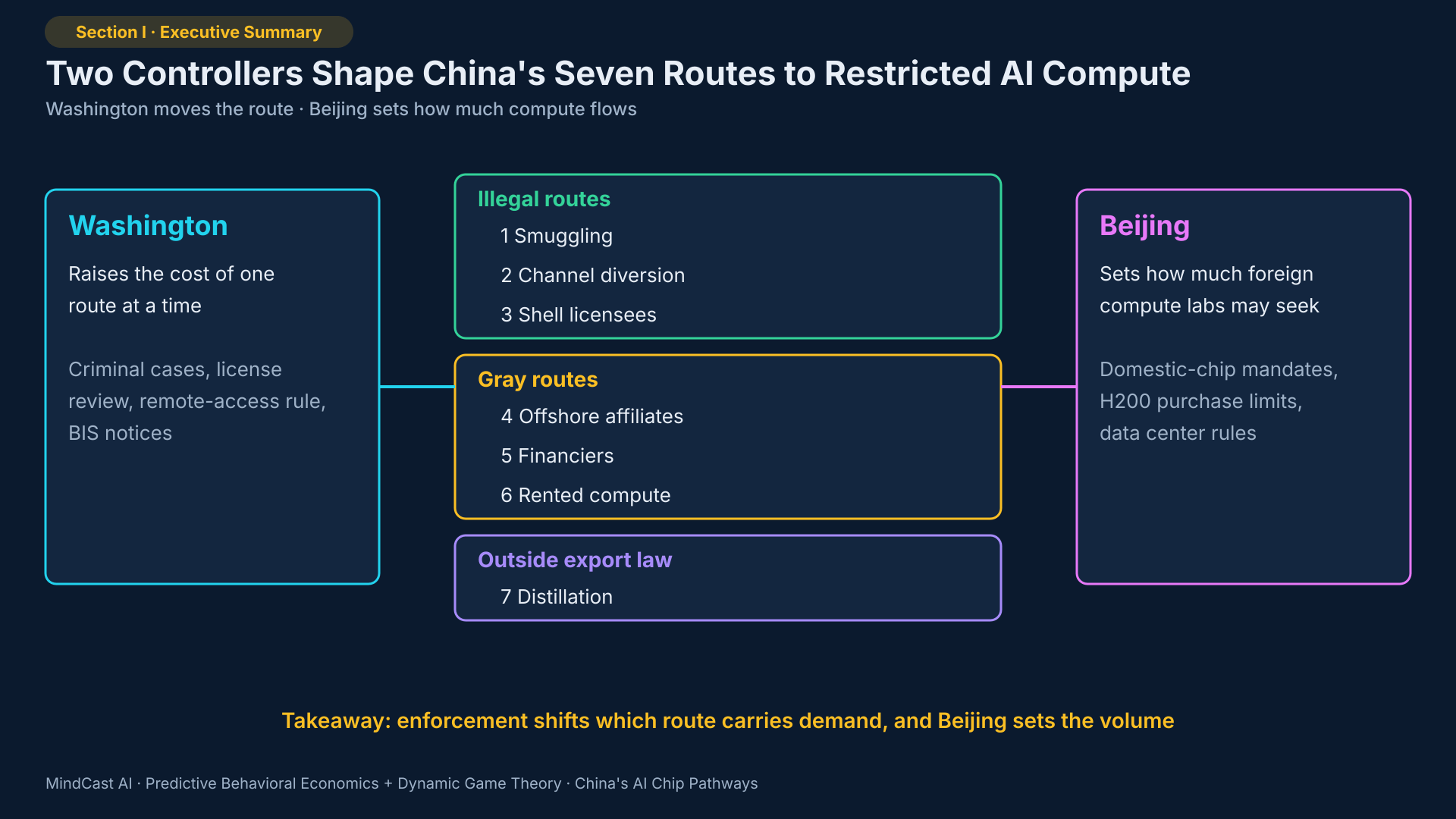
Core insight. China acquires restricted AI capability through seven pathways under two controllers. Washington raises the cost of one pathway at a time, and Beijing decides how much foreign compute its labs may seek. US enforcement moves demand to the next pathway while Beijing sets how much demand there is.
Thesis. Chinese buyers choose routes the way a shipper chooses freight modes: by volume, value density and purpose.
Frontier training scale goes to rented compute. Smuggling carries smaller, high-value lots. Licensed chips move through paper cover and onward rental. Capability itself moves through distillation.
Each US instrument reaches one or two of these pathways and leaves the rest open. Enforcement therefore reshapes the route mix more than it reduces total acquisition, unless Beijing cuts demand itself.
What distinguishes the MindCast approach. MindCast AI applies Predictive Behavioral Economics + Dynamic Game Theory through MindCast AI Proprietary Cognitive Digital Twin Foresight Simulations (MP CDT FS). Behavioral Economics supplies the decision rules. Game Theory supplies the payoff structure. Predictive simulations emerge from the combination.
Here game theory models the buyer's route choice against an enforcer who can see only some routes. Behavioral economics explains why auditors pass dummy servers and why enforcers chase the vivid case.
What the paper does. The paper names the seven pathways in three families and shows the evidence for each. The paper then maps every pathway to the US instrument that reaches it and names the gaps. A closing analysis explains why buyers tailor routes to products, tests the thesis against two rivals and sets out MindCast Foresight Simulation Predictions on how the route mix shifts through 2027.
MindCast Foresight Simulation Prediction highlights. Twelve predictions make up the set: three Primary (P), four Secondary (S) and five carried from published MindCast work. The event that most reshapes the game is a named offshore closure. Commerce lists a named offshore operator serving Chinese labs, such as Megaspeed, or Nvidia or a host cuts one off. The simulation puts a closure at 76% (60-91%) by June 30, 2027.
At least two new US criminal cases on AI chip smuggling or diversion unsealed · By June 30, 2027 · 72% (42-92%)
The Bureau of Industry and Security (BIS) extends the Affiliates Rule suspension past January 10, 2027 · 74% (62-84%)
No US rule treats access to model outputs as an export · By December 31, 2027 · 92% (84-98%)
Stakeholder readout.
🏛️ Policymakers. Each instrument reaches one or two routes. Pair the remote-access rule with financier and distillation measures, or the mix simply shifts (CP-P-3, CP-S-2).
💼 Executives. Exposure depends on which pathway runs through your channel. Map resellers, tenants and lenders against all seven routes (CP-P-1, CP-S-1).
⚖️ Counsel. Paper diligence fails against dummy servers and empty offices. Require site checks for high-value orders (CP-S-1).
📊 Investors. A named offshore closure moves tenants among hosts and jurisdictions. Value data center exposure by tenant headquarters, not by headline case (PX-P-3).
Takeaway: US enforcement keeps catching the visible routes while four quieter routes stay open through 2027: affiliates, financiers, rental inside China and distillation. Beijing decides how much foreign compute the open routes carry.
II. China Reaches Restricted AI Compute Through Smuggling, Gray Structures and Distillation
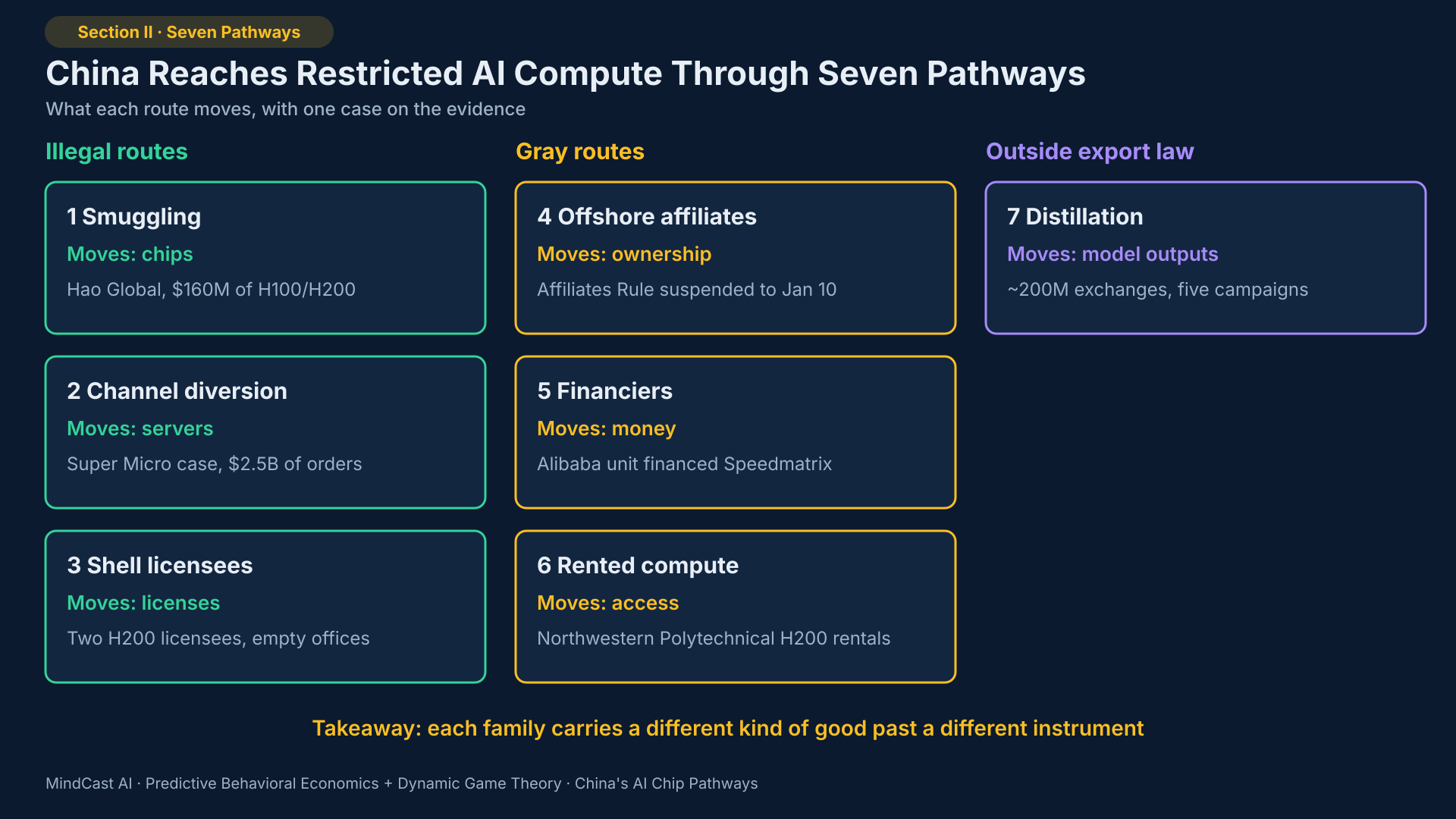
The seven pathways sort into illegal routes, gray routes and one route outside export law. The families differ in who carries the legal risk and in which instrument can reach them.
II.A Illegal Routes: Physical Movement Under False Paperwork
Pathway 1: smuggling through transshipment corridors. Chips leave the United States or Taiwan under a false end user and reroute through a third country. Hao Global, a Texas company, smuggled about $160 million of H100 and H200 chips between October 2024 and May 2025 (Washington Times). Greg Lui of Earthmade allegedly moved more than $300 million of servers through Malaysia and Singapore (Justice Department).
Taiwan became a second prosecutor on this route in August. Keelung prosecutors indicted nine people over 130 Nvidia B300 servers declared for a Taiwan facility. Seventy-four allegedly reached China, routed through Indonesia, Japan and Hong Kong (Taiwan News). B300 servers reportedly sell in China for close to double the US figure (The Next Web).
Pathway 2: diversion through vendor channel partners. An insider at a server maker or distributor routes legitimate orders to a pass-through buyer. The Super Micro case shows the method at scale: a Southeast Asian intermediary placed orders worth billions of dollars. Dummy servers then fooled the manufacturer's auditors (Bloomberg).
Pathway 3: front or shell licensees. A Chinese firm obtains a license under a clean profile while its operations or owners point elsewhere. The New York Times found two H200 licensees with empty offices, one tied to an Entity List fund (AI Weekly). The route turns illegal once the stated end use proves false.
Takeaway: illegal routes depend on false documents, so they work best for lots small enough to hide and valuable enough to justify the risk.
II.B Gray Routes: Lawful Structures With Restricted Effects
Pathway 4: offshore subsidiaries and affiliates. A listed Chinese parent acts through a foreign affiliate that no list names. The Affiliates Rule would extend Entity List restrictions to firms 50% or more owned by listed parties. Washington first suspended it in exchange for Beijing's suspension of rare earth controls (WSGR), and BIS has since extended the suspension to the truce's own end date of January 10, 2027 (Dechert).
Pathway 5: state or quasi-state financiers. A Chinese-linked lender funds the hardware or the data center while another firm holds title. Records reviewed by Reuters show that an Alibaba subsidiary financed Speedmatrix, a Megaspeed-linked operator in Malaysia (The Star). No US instrument names a financier for the act of financing alone.
Pathway 6: rented compute, offshore and inside China. A Chinese lab rents capacity it never owns. The remote-access rule requires a license before a data center anywhere in the world gives more than 12 million aggregate total processing performance (TPP) to a company headquartered in Macau or a Country Group D:5 destination, the US arms-embargo group that includes China (BIS). A separate license duty covers advanced chips sent to five named countries, including Malaysia, Singapore and Brazil.
The rule's text does not exclude data centers inside China, and its preamble names the People's Republic of China among D:5-headquartered entities. The duty attaches where a provider knows of the access, and a data center that declines to supply verifying information presumptively gives that knowledge. BIS can also inform a provider directly that a license is required. Northwestern Polytechnical University, listed since 2001, rented H200 servers through five contracts reported days before the rule appeared (Taipei Times).
Takeaway: gray routes split ownership, money and use across separate firms, so each firm stays below the line any single instrument draws.
II.C Distillation Moves Model Capability Without Moving a Chip
Pathway 7: distillation of model outputs. A lab queries a US frontier model at scale and trains its own model on the answers, so no chip moves and no export occurs. Anthropic attributed roughly 200 million exchanges to five campaigns by China-based labs. The Alibaba-linked campaign alone peaked near three million exchanges a day (TechCrunch).
The US response so far runs through advisories and terms of service. The Cybersecurity and Infrastructure Security Agency (CISA), the FBI and the NSA named six Chinese labs in Advisory AA26-251A on September 8, 2026 (Forkast). The Runtime Export Problem traced why Commerce cannot yet treat model access as an export. The analysis supplies the legal gap this pathway exploits.
Takeaway: distillation acquires capability without hardware, so export controls on chips never touch it.
III. US Law Reaches Physical Routes After the Fact and Leaves Financiers and Distillation Open
Each US instrument attaches to one or two pathways. The map below shows reach and gap in pathway order.
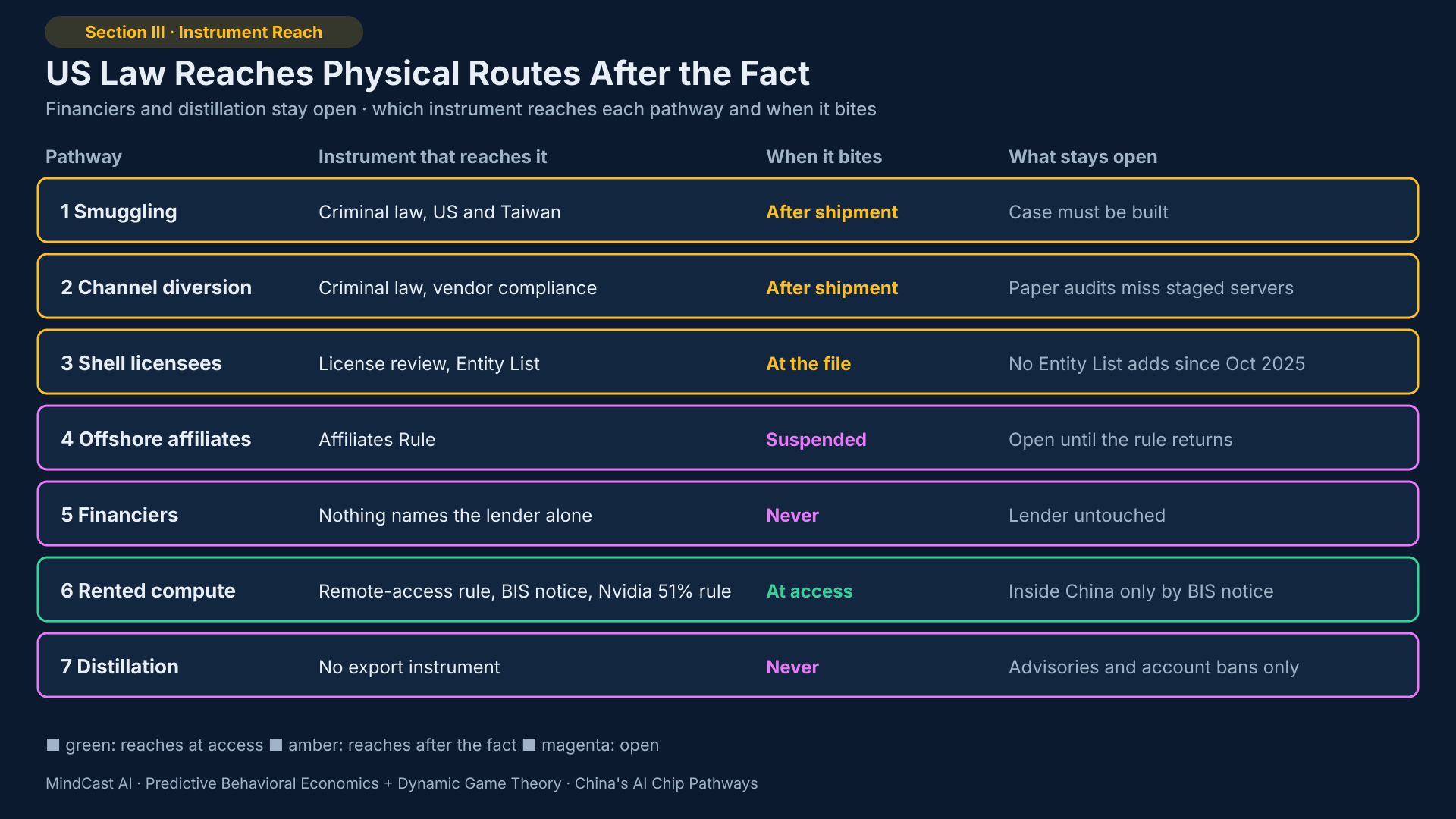
Smuggling. Reached by criminal law under the Export Control Reform Act and the smuggling statute, now with Taiwan's prosecutors as a second enforcer. Reach comes after the shipment, once a case is built.
Channel diversion. Reached by the same criminal law plus vendor compliance, such as Nvidia's no-sell list. Auditors who check paperwork miss staged hardware.
Shell licensees. Reached by license review and the Entity List. Review stops at the file, and the Federal Register shows no company added to the Entity List between October 2025 and mid-November 2026 (FourWeekMBA).
Affiliates. Reached by the Affiliates Rule once it returns. Until then only named entities face restrictions.
Financiers. Reached by nothing that names the lender alone.
Rented compute. Reached by the remote-access rule wherever a provider knowingly serves a D:5-headquartered company above 12 million TPP. A host that withholds verifying information is presumed to know, and BIS can inform a named provider directly, which gives Washington a lever inside China. Vendor policy adds a private lever: Nvidia reportedly requires cloud partners to sell at least 51% of services on new contracts to non-Chinese customers (The Next Web).
Distillation. Reached by no export instrument. Advisories, account bans and civil claims are the only tools.
Beijing filters routes from its own side as well. Regulators discouraged large Chinese firms from buying advanced Nvidia chips in 2025, and in November 2025 Beijing ordered new state-funded data centers to use only domestic AI chips (Reuters via Aaj News). Chinese customs blocked H200 imports in January 2026, and officials warned domestic firms against buying them unless necessary (Techloy).
All three measures target hardware inside China, and none restricts rental abroad. Licensed purchase therefore competes with domestic chips and with the other six routes.
Takeaway: US law reaches the physical routes after the fact and reaches rental through exporter knowledge and BIS notice, while financiers and distillation stay untouched.
IV. Buyers Match Each Product to the Lowest-Cost Open Route
Buyers match each product to the route that delivers it at the lowest expected cost. Expected cost means the fee to intermediaries plus the chance of detection times the penalty.
IV.A Enforcement on One Route Pushes Demand to the Next
The buyer faces a menu of routes, and the enforcer can raise the cost of only the routes it sees. Game theory supplies the payoff structure. Each route has a capacity, a fee and a detection rate, and the buyer fills its demand from the lowest-cost routes first.
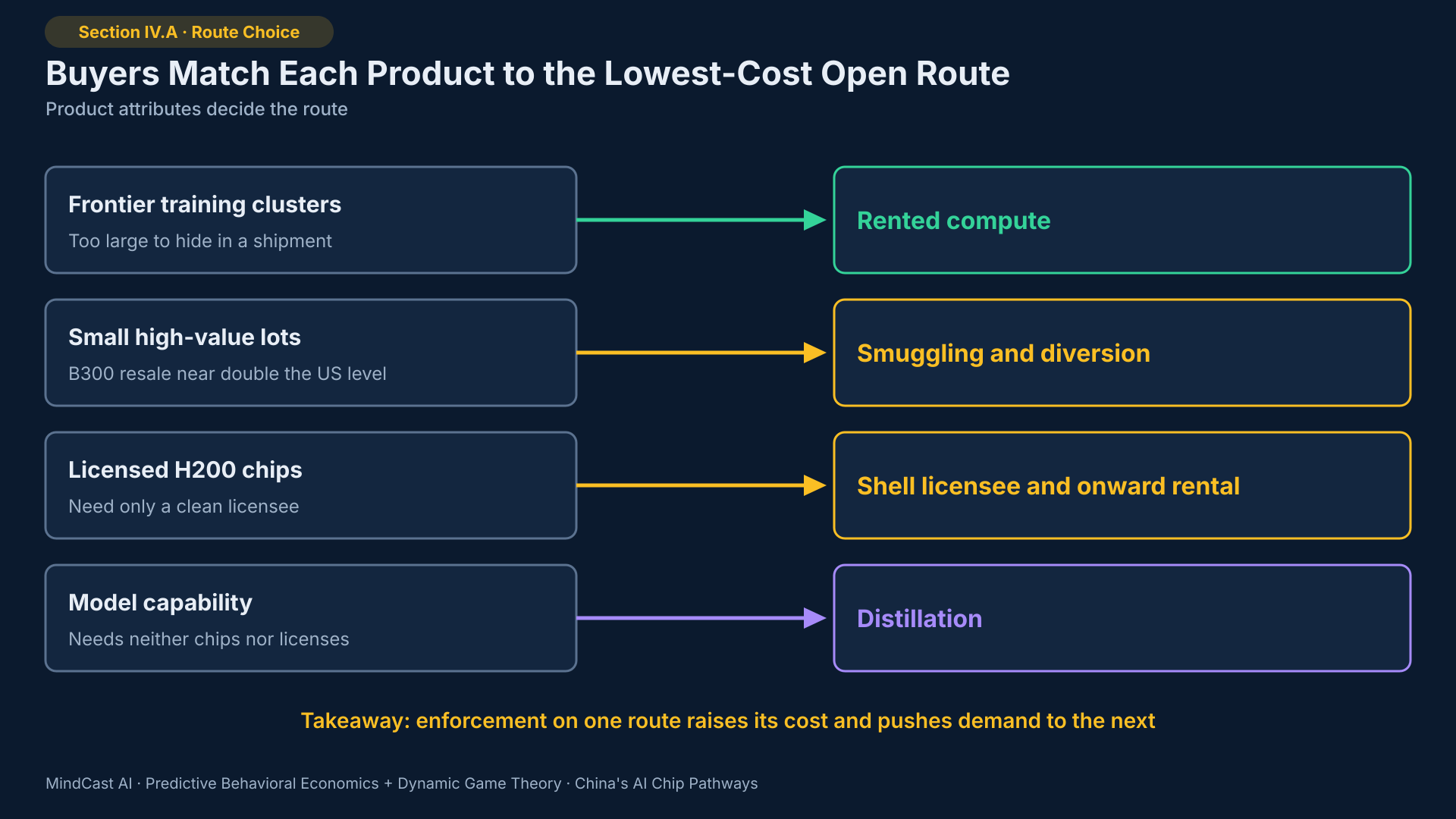
Product attributes set the ranking. Frontier training needs very large clusters in one place. A cluster that size cannot hide in a shipping container, so rental dominates.
A few hundred B300 servers fit inside false paperwork, and the near-doubled resale margin pays for the risk. Licensed H200 chips need only a clean licensee and an onward renter. Capability alone needs neither chips nor licenses, so distillation dominates where the goal is a better model rather than more compute.
Enforcement on one route raises its cost and pushes demand to the next. The equilibrium is a portfolio whose size Beijing controls. Beijing acts as a second controller with its own decision rule, as its January 2026 limits on H200 purchases show (Section IV.D).
IV.B Auditors Check Paperwork While Enforcers Chase Vivid Cases
Behavioral economics supplies the decision rules on both sides. Auditors and licensing officers satisfice: they check documents and stop when the file looks complete. Dummy servers passed an inventory audit, and empty offices passed license review, for the same reason.
Salience drives enforcement. A hair dryer used to swap serial numbers makes a vivid indictment. A financier's loan agreement makes none. Enforcers therefore chase the photographed case while the structural route goes unexamined.
Intermediaries weigh a certain margin today against an uncertain penalty later. Present bias makes the near-doubled B300 margin look larger than the prison term it risks.
IV.C Smuggling Cases Continue While the Quiet Routes Gain Share
Predictive behavior emerges from the combination. Game theory says buyers shift routes when one closes. Behavioral economics says enforcers will keep closing the visible routes first. Together they predict a steady stream of smuggling cases alongside a growing share of acquisition through financiers, onward rental and distillation.
Chinese procurement filings rather than press reports exposed Northwestern Polytechnical's H200 rentals inside China. PX-S-3 tracks those filings.
IV.D Two Rival Explanations Say Total Acquisition Falls
The substitution thesis faces two rivals, and each carries its own falsifier. The simulation favors the thesis and cannot rank the two rivals against each other, so both stay scenarios.
Rival A: enforcement cuts total acquisition. Each route has limited capacity, so demand only partly moves when a route closes. Rival A gains if a named offshore closure occurs and Chinese procurement filings then show no new rental of restricted Nvidia compute inside China (PX-S-3), while Beijing issues no new restriction on offshore rental (CP-S-6).
Rival B: Beijing's domestic-chip policy cuts foreign demand on every route. Beijing limited H200 purchases in January 2026, and a broader mandate would shrink the quiet routes along with the visible ones. Rival B gains if Beijing issues a new measure restricting offshore compute rental after November 20, 2026, the event CP-S-6 rules against.
Beijing therefore acts as a second player in the game. Beijing's decision rule sets how much foreign compute Chinese labs may seek, while the labs' own rule sets which route carries it.
Takeaway: buyers tailor routes to products, enforcers chase the vivid routes, and Beijing sets how much demand the routes carry.
V. A Named Offshore Closure Is the Dominant Fork, and January 10 Sets the Ownership Routes
The game reached its current form in three steps. Washington opened a licensed H200 route in December 2025, and Beijing restricted it within weeks. Prosecutors then broke the largest diversion cases in 2026, which made physical routes costlier. The remote-access rule of November 2026 reached rental for the first time.
Nvidia's position changed in the same month. Nvidia's chief executive resigned on November 12, 2026 over ties to a former Megaspeed executive (BNN Bloomberg), and Nvidia had already told cloud partners to cap Chinese customers. Vendor compliance now works as a second closure channel beside Commerce.
The rules hold through the window for two reasons. The Affiliates Rule suspension and the trade truce both end on January 10, 2027, so ownership-based restrictions move only if one of the two changes on that date. The remote-access rule reaches rental inside China through exporter knowledge or a BIS notice, so onward rental there continues until BIS uses that notice power.
How the Game Branches
Baseline MindCast Foresight Simulation Predictions: CP-P-1 at 72% (42-92%), CP-P-2 at 74% (62-84%) and CP-P-3 at 92% (84-98%).
The game branches on two boards of four. The closure board holds four parallel lanes, and any combination can happen. The January 10 board holds four exclusive outcomes, and exactly one occurs. The dominant fork is a named offshore closure on either of the first two closure lanes, and the January 10 date sets the ownership routes around it.
Each state carries a class: continuation keeps the current game, equilibrium migration changes which outcome holds, and game evolution changes the rules or the players.
Dominant fork: a named offshore closure. By June 30, 2027 a named offshore operator loses access on one of the first two lanes. Class: equilibrium migration. The simulation puts a closure on either lane at 76% (60-91%): 71% if the truce renews and 91% if it lapses.
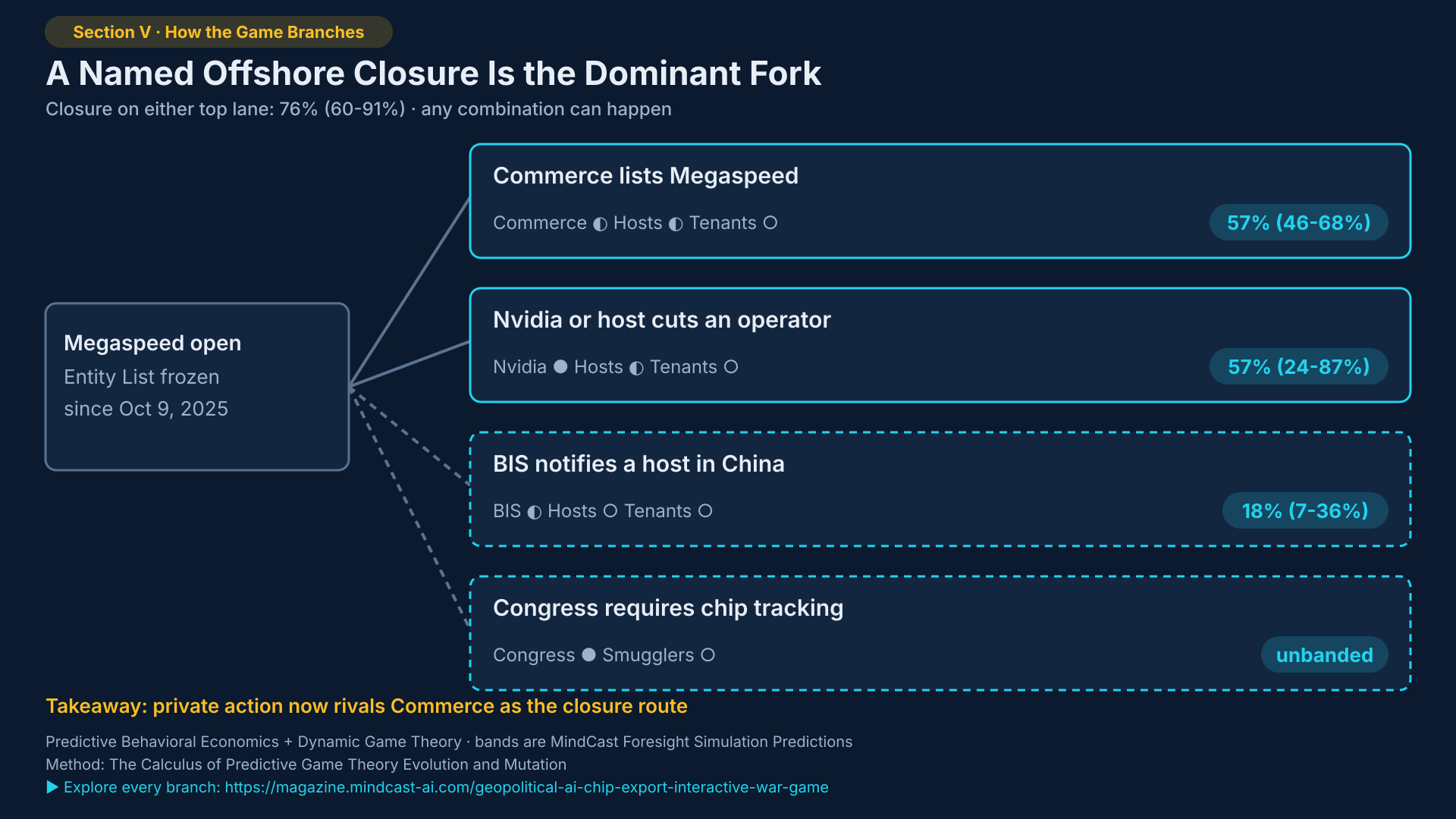
Lane 1, listing. Commerce adds Megaspeed or Speedmatrix to the Entity List. The list has had no additions since October 9, 2025, so the lane waits on the truce. The simulation puts it at 57% (46-68%), and PX-P-3 carries the published call on the same listing.
Lane 2, private cutoff. After November 20, 2026 a named operator not cut off before that date stops serving China-headquartered tenants or loses its Nvidia allocation. The simulation puts the private lane at 57% (24-87%). The two lanes share the Megaspeed scandal as a common cause and often move together.
Lane 3, BIS notice. BIS informs a provider inside China. Class: equilibrium migration. Onward rental inside China moves from a quiet route to a visible one. The simulation puts a notice in the rule's first year at 18% (7-36%), and CP-S-5 carries the call that no notice issues.
Lane 4, congressional tracking. Congress requires chip location verification. Class: game evolution, because a statute replaces case-by-case enforcement with a standing duty. Smuggling and diversion become harder to hide. Unbanded.
The January 10 board has four exclusive outcomes. The White House decides the suspension, and both capitals decide the truce. Snapshot odds round to the nearest 10% because the fork sits too early for an equilibrium to form.
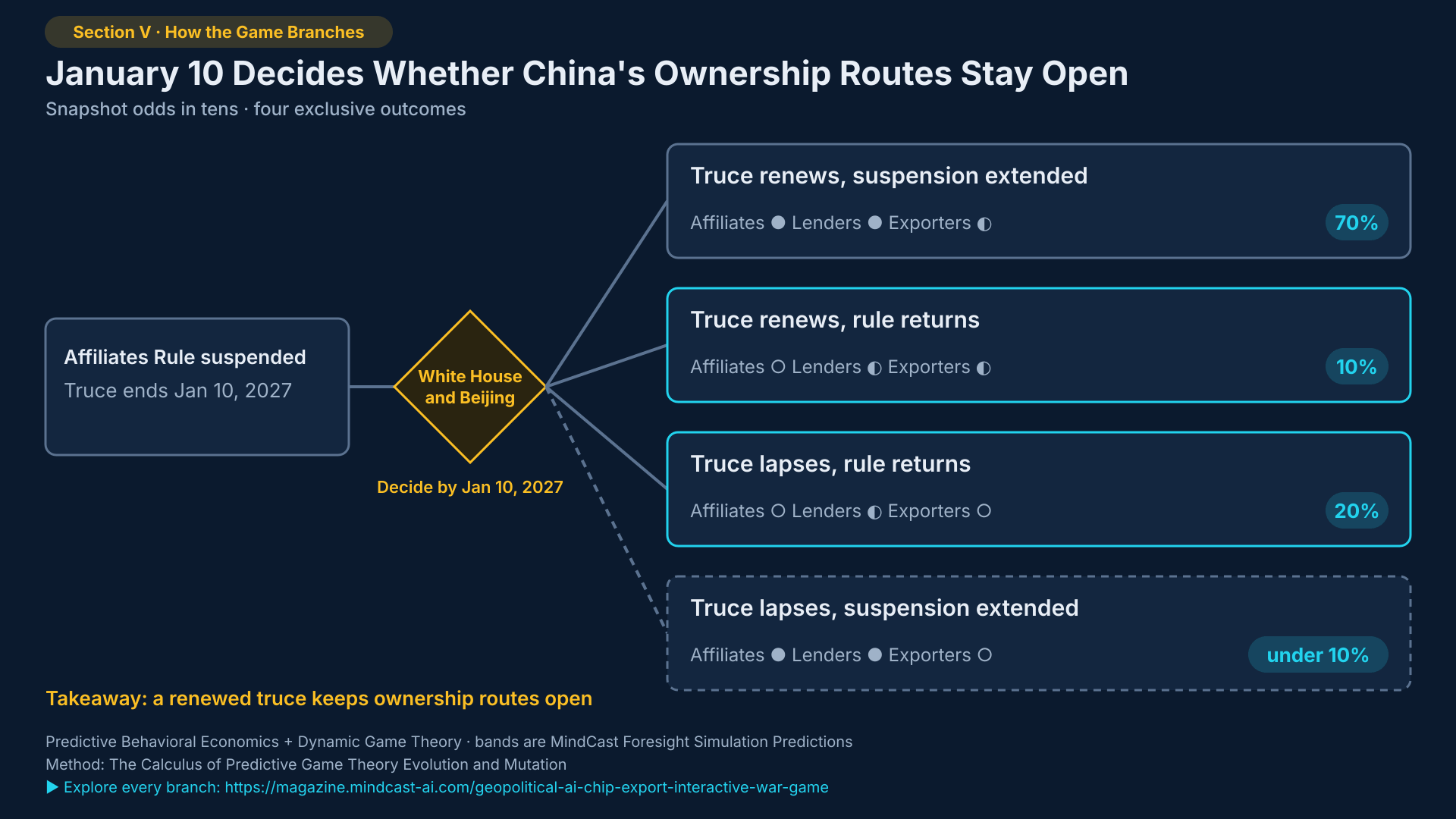
Fork outcome 1: the truce renews and the suspension is extended. Class: continuation. Pathway 4 stays open, listed parents keep acting through affiliates and financiers keep their position. Snapshot odds: 70%.
Fork outcome 2: the truce renews and the Affiliates Rule returns. Class: equilibrium migration. Affiliates 50% or more owned by listed parties lose access, and buyers restructure ownership below the threshold while financiers hold. Snapshot odds: 10%.
Fork outcome 3: the truce lapses and the Affiliates Rule returns. Class: game evolution, because the trade game and the chip game merge. Exporters face Beijing's countermeasures while buyers restructure. Snapshot odds: 20%.
Fork outcome 4: the truce lapses and the suspension is extended. Class: continuation for the ownership routes. Washington keeps the suspension as leverage while exporters absorb trade losses. Snapshot odds: under 10%.
Lane 4 breaks the baseline. Location verification reaches Pathways 1 and 2 before shipment rather than after. Demand then shifts harder toward financiers, onward rental inside China and distillation, which feeds the next cycle of instruments.
Takeaway: the closure lanes test whether demand moves or falls. The January 10 date decides whether ownership routes stay open.
VI. MindCast Foresight Simulation Predictions: Enforcement Keeps Catching Visible Routes While Four Quieter Routes Stay Open
The set holds twelve MindCast Foresight Simulation Predictions: three Primary (P), four Secondary (S) and five carried from published MindCast work. Carried calls print as published.
VI.A Primary Simulation Predictions
CP-P-1 | The Justice Department Unseals Two New AI Chip Smuggling Cases by June 30, 2027 · 72% (42-92%)
Statement. The Justice Department unseals at least two new criminal cases charging smuggling or diversion of Nvidia or other US AI accelerators to China.
Window. By June 30, 2027.
Mechanism. Physical routes stay profitable for high-value lots, and enforcers pursue the visible routes first.
Falsifier. Fewer than two such cases unsealed by June 30, 2027.
Verification source. Justice Department press releases; federal court dockets.
CP-P-2 | BIS Keeps the Affiliates Rule Suspended Past January 10, 2027 · 74% (62-84%)
Statement. BIS extends the Affiliates Rule suspension past January 10, 2027.
Window. Decided on or before January 10, 2027.
Mechanism. Washington first suspended the rule in exchange for Beijing's rare earth suspension and has extended it to the date the truce ends.
Falsifier. The Affiliates Rule takes effect on or after January 11, 2027.
Verification source. Federal Register.
CP-P-3 | No US Rule Treats Model-Output Access as an Export by December 31, 2027 · 92% (84-98%)
Statement. No US rule treats access to model outputs as an export, reexport or transfer subject to license.
Window. By December 31, 2027.
Mechanism. Attribution of distillation remains costly to prove, and export law attaches to items rather than to model answers.
Falsifier. A Federal Register rule that imposes a license duty on model output access by China-headquartered parties. An Entity List or sanctions designation of a named distiller does not count, including one under the Deterring American AI Model Theft Act or the BLADE Act.
Verification source. Federal Register.
VI.B Secondary Simulation Predictions
CP-S-1 · 90% (66-99%) · A new prosecution in any jurisdiction names Blackwell-generation or newer hardware · By December 31, 2027 · Falsifier: no such charge by the date
CP-S-2 · 92% (87-96%) · No US instrument names a financier solely for financing offshore compute · By December 31, 2027 · Falsifier: a listing or rule that names a lender for that act
CP-S-5 · 82% (64-93%) · BIS informs no provider located inside China that the remote-access rule requires a license · By November 16, 2027 · Falsifier: a BIS notice to a provider located in China as reported by BIS or a named outlet · Verification source: BIS releases; Federal Register; Reuters
CP-S-6 · 78% (69-86%) · Beijing issues no new measure after November 20, 2026 that restricts Chinese companies' rental of AI compute outside China · Through 2027 · Hardware measures inside China do not count · Falsifier: an official notice or a report by Reuters, Bloomberg or the Financial Times citing documents or two sources
VI.C Carried Simulation Predictions
PX-P-1 · 64% (55-72%) · Commerce conditions, suspends or revokes at least one H200 license to China · By June 30, 2027 · Source: AI Chip Export Controls After the Remote-Access Rule
PX-P-3 · 58% (48-67%) · Commerce adds Megaspeed or Speedmatrix to the Entity List · By June 30, 2027 · Source: AI Chip Export Controls After the Remote-Access Rule
PX-S-3 · 69% (57-81%) · A Chinese procurement filing dated after November 16, 2026 shows an Entity List institution buying or renting H200-class or newer capacity inside China · Reported by December 31, 2027 · Source: AI Chip Export Controls After the Remote-Access Rule · Serves as the paper's observable test that rental inside China carries restricted demand
S-5 · 85% (72-93%) · The remote-access rule stays in force · Through December 31, 2027 · Source: Trump-Xi Shenzhen Summit and the AI Chip Remote-Access Rule
RX P-1 · 84% · Entity, end-user, intermediary and telemetry measures on runtime access · Through September 2027 · Source: The Runtime Export Problem
Takeaway: the calls test whether enforcement keeps reaching the visible routes while four quieter routes stay open: affiliates under the suspension, financiers, rental inside China and distillation.
VII. Stakeholder Strategy and Risk Mitigation: A Named Offshore Closure and the Open Rental Routes Carry the Largest Exposure
Each audience holds exposure on different pathways. The actions below follow the Simulation Predictions that bear on each.
🏛️ Policymakers (CP-P-3, CP-S-2). Closing one route moves demand to the next. Pair the remote-access rule with a financier disclosure duty and a defined position on model access.
💼 Executives (CP-P-1, CP-S-1). Server makers and distributors carry Pathway 2 risk inside their own sales teams. Audit allocation requests against end-user capacity, not paperwork.
⚖️ Counsel (CP-S-1, PX-P-1). Dummy servers and empty offices defeat document checks. Add site verification and installed-capacity proof to end-use certifications for high-value orders.
📊 Investors (PX-P-3, CP-S-5). Tenants cut off by one host move to the next, and BIS rarely reaches the hosts inside China. Value holdings in Southeast Asian data centers by tenant headquarters and lender identity.
VII.A Risk Mitigation by Simulation Prediction
Each entry routes one Simulation Prediction to the audience it binds most. Severity and probability appear on separate axes, and probability carries the call's band.
PX-P-3 · 📊 Investors
Simulation Prediction and band. Commerce adds Megaspeed or Speedmatrix to the Entity List by June 30, 2027. Severity: high. Probability: 58% (48-67%).
Exposure. Quarters of lease revenue tied to China-headquartered tenants at any holding that serves a closed operator's customers.
Mitigating actions. Portfolio managers map every holding's tenants by headquarters before June 30, 2027. Asset managers seek lease terms that let operators replace a D:5-headquartered tenant within one quarter at the next renewal.
Residual exposure. A host that absorbs the moved tenants inherits the same rule exposure at the next closure.
CP-P-1 · 💼 Executives
Simulation Prediction and band. Two or more new US smuggling or diversion cases by June 30, 2027. Severity: high. Probability: 72% (42-92%).
Exposure. Flagship server units shipped to pass-through buyers that later appear in a charging document, and the quarters of allocation review that follow.
Mitigating actions. Compliance heads require installed-capacity verification for large orders before June 30, 2027. Sales leadership routes every allocation exception through compliance review this quarter.
Residual exposure. An insider who falsifies documents still passes a paper check.
CP-P-2 · ⚖️ Counsel
Simulation Prediction and band. The Affiliates Rule suspension extends past January 10, 2027. Severity: medium. Probability: 74% (62-84%).
Exposure. The count of counterparty files that need re-screening on the next reinstatement date.
Mitigating actions. Trade counsel keep 50% ownership screening running on every China-linked counterparty before January 10, 2027. Counsel document ownership findings so a reinstatement converts in one review cycle.
Residual exposure. The suspension can end on the next truce date with little notice.
CP-P-3 · 🏛️ Policymakers
Simulation Prediction and band. No US rule treats model-output access as an export by December 31, 2027. Severity: high. Probability: 92% (84-98%).
Exposure. One more legislative session without an instrument that reaches distillation.
Mitigating actions. Committee staff draft model-access definitions for the 2027 session before defense bill markup. Agencies issue guidance on fraudulent-account detection for frontier labs by mid-2027.
Residual exposure. Attribution of distillation stays costly to prove even under a statute.
Takeaway: each audience should map its exposure across all seven routes, because enforcement on one route moves the risk to another.
VIII. What to Watch: January 10, a Named Offshore Closure and the Commerce Notice Window
Five dated readouts decide the calls in this paper. The January 10 decision arrives first, and a named offshore closure can land any day before June 30, 2027.
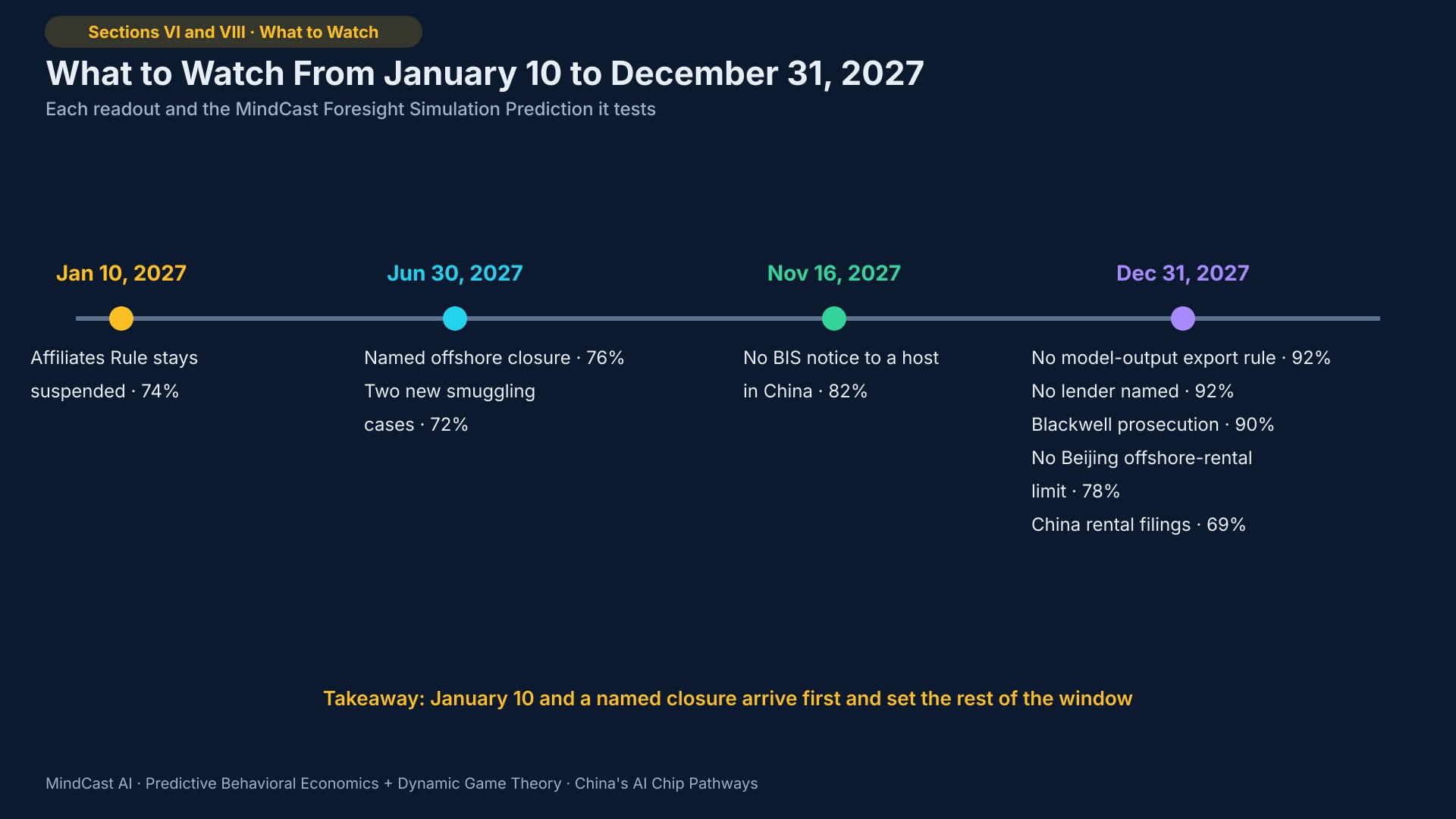
January 10, 2027 · the trade truce and the Affiliates Rule suspension. Both end the same day. An extension confirms CP-P-2, and a return of the Affiliates Rule moves the game to fork outcome 2 or 3.
Through June 30, 2027 · a named offshore closure. Watch for a Commerce listing of Megaspeed or Speedmatrix and for any named operator cut off by Nvidia or a host. Either branch counts as the dominant fork resolving.
Through June 30, 2027 · unsealed smuggling cases. Two new Justice Department cases confirm CP-P-1.
Through November 16, 2027 · BIS notices to providers inside China. A notice falsifies CP-S-5 and exposes onward rental inside China to enforcement.
Through December 31, 2027 · Chinese procurement filings and Beijing notices. Filings showing Entity List institutions renting H200-class compute confirm PX-S-3. A Beijing measure on offshore rental falsifies CP-S-6 and gives Rival B its test.
Takeaway: the January 10 decision and a named offshore closure arrive first and set which routes the rest of the window tests.
IX. Conclusion: Enforcement Reaches the Visible Routes and Leaves Four Open Through 2027
Dummy servers in a Southeast Asian warehouse and 151 million exchanges against a US model serve the same strategy. China fills its demand for AI capability from whichever route costs least, inside the volume Beijing allows.
US enforcement has made physical routes costlier and now reaches rental through exporter knowledge and BIS notice. Four routes remain open: affiliates under the suspension, financiers, rental inside China and distillation. The first named offshore closure, read against procurement filings inside China, will show whether demand moves to another route or falls.
X. Working With MindCast
A firm's exposure to the seven pathways sits in its own contracts: the resellers it ships through, the tenants it hosts and the lenders behind its counterparties. MindCast runs those contracts through the same Foresight Simulation that produced the twelve calls in this paper.
A commissioned simulation delivers three outputs. A pathway map ties each counterparty to the routes it touches. A branch readout shows how each holding fares under the four January 10 outcomes and a named offshore closure. A trigger list names the filings, notices and listings that should move a position before June 30, 2027.
MindCast offers a complimentary proof-of-concept simulation to qualifying firms and agencies. The proof of concept starts from a snapshot of your current position, runs it forward into successor states and branches each state a second layer.
Test your matter in three minutes. The Dynamic Predictive Game Theory pre-selection quiz shows whether your exposure suits a simulation.
Play the board. The Interactive AI Chip Export Enforcement War Game runs every branch in this paper.
Start the engagement. Write to mcai@mindcast-ai.com with the counterparties you want mapped.
First step: review the war gaming catalog at www.mindcast-ai-simulation.com/live-fire-intelligence
Sources
MindCast works
AI Chip Export Controls After the Remote-Access Rule. Supplies the rule facts and the carried license and listing calls.
Trump-Xi Shenzhen Summit and the AI Chip Remote-Access Rule. Supplies the truce timeline and the carried rule-durability call.
The Runtime Export Problem. Explains why model access sits outside export law.
Interactive AI Chip Export Enforcement War Game. Lets readers play the exposure rows that map to five of the seven pathways.
Commerce's Rented GPU Ban Would Exempt Chips Already Delivered, and the Cutoff Date Decides Its Reach. Explains why chips delivered before the cutoff date keep serving Chinese tenants.
Lutnick and the Commerce Department Likely Miss January 10 on the Rented GPU Rule. Explains why Lutnick's tenure shapes what Commerce exempts and when it acts.
The US Bureau of Industry and Security Affiliates Rule Turns Export Controls Into Bargaining Instruments. Explains why Washington holds the suspended Affiliates Rule as a bargaining chip in the trade truce.
Enforcement Incidence and Capability Denial in Artificial Intelligence Export Controls. Shows that enforcement falls mostly on US firms and intermediaries, and that Chinese substitution erodes each later control.
External sources
Bloomberg · Super Micro co-founder charged with smuggling · March 19 2026
Washington Times · Operation Gatekeeper and Hao Global · December 9 2025
AI Weekly · H200 licensees with empty offices · November 2026
Dechert · Affiliates Rule suspension extended · November 2026
The Star · Alibaba financing of Speedmatrix · November 12 2026
Taipei Times · Northwestern Polytechnical rental contracts · November 12 2026
TechCrunch · Anthropic distillation campaigns · September 10 2026
WSGR · Bessent announces suspension of the Affiliates Rule · October 30 2025
Reuters via Aaj News · China bans foreign AI chips from state-funded data centres · November 5 2025
The Next Web · Nvidia tells cloud partners to cap Chinese business at 49% · November 3 2026