
Kalshi · Compass · Snap · OpenAI · Wells Fargo · Anthropic · Supreme Court · Commodity Futures Trading Commission · Federal Trade Commission · State Attorneys General · Insurance Carriers
Companion publications: The Calculus of Predictive Game Theory Evolution and Mutation · Short Horizon Games Branch Wide and Resolve Shallow · Long Horizon Games Resolve Deep Because Their Branches Hold
Explore the MindCast war gaming maps to find the horizon each firm faces.
In brief. Regulators, courts and insurers are not writing one set of rules for AI and fintech. Each matter sits at its own stage of rule change, and the stage decides whether a firm should commit now or keep its options open.
Why now. Nine dated events between November 24, 2026 and December 31, 2028 will move these matters between stages. Counsel and insurers face commitment decisions before those events resolve, as do compliance leaders, investors and policymakers.
Executive Summary
Innovation does not face one regulatory game. Each live matter runs on its own horizon, and the horizon decides whether an actor should commit or hold robust positions.
Thesis. Horizon class belongs to a branch, not to a company or an industry. The six matters span three classes: snapshot, short horizon and emerging stabilization. The map's Bank of America anchor supplies the fourth class, long horizon, and one company can sit on two classes at once.
MindCast distinction. MindCast AI applies Predictive Behavioral Economics + Dynamic Game Theory through MindCast AI Proprietary Cognitive Digital Twin Foresight Simulations (MP CDT FS). Behavioral Economics supplies the decision rules. Game Theory supplies the payoff structure. Predictive simulations emerge from the combination.
What the paper does. The paper introduces a war gaming map that places six matters by horizon, charts successor states for three anchor cases and links each matter to its own war game. Section VI carries eleven published MindCast forecasts into the map, and the map adds no new odds. The MindCast War Gaming Validation scorecard dated November 15, 2026 shows 47 hits and 4 misses on material calls, with 9 partials set aside. OpenAI prevailing over Musk hit at 89%, while Anthropic partially conceding its usage terms missed at 62%.
🏛 Policymakers: A rule written into a short-horizon game invites challenge in the next forum (Section II).
💼 Executives: Commit capital only where your own loss ratio clears the evidence of durability (Section III).
⚖ Counsel: Forum choice decides how long a client's game stays open (Section V).
📊 Investors: Short-horizon forecasts reach only the next fork, so long-dated positions need a stabilizing game (Section VI).
Takeaway: Classify the horizon first, because the right move follows from the class.
I. Innovation Faces Several Games at Once
The governing equilibrium of the innovation economy is heterogeneous. Prediction markets and AI developers face rule fights, as do AI deployers, banks and brokerages. Each contest sits at a different stage of change, so a single forecast for "AI regulation" averages games that do not share a horizon.
The Calculus of Predictive Game Theory Evolution and Mutation states the mechanism as one identity. Every path probability is a weighted sum across the games that might govern the next step. When one candidate game carries most of the weight, a forecast can reach deep. When the weight spreads across several games, depth stops at the next fork.
The calculus separates three dimensions that analysis tends to merge. Structural certainty asks how well the rules are known. Predictive depth asks how many transitions the evidence supports. Strategic clarity asks which moves stay right across every game still in play, and clarity can run high while the other two run low.
Short Horizon Games Branch Wide and Resolve Shallow applies the calculus to agentic AI liability. Long Horizon Games Resolve Deep Because Their Branches Hold applies it to Bank of America enforcement and AI data center authorization. Width does not separate the two horizons. Supported continuations do.
📊 Investors: A sector thesis on AI regulation blends games with different horizons. Split the thesis by matter before sizing exposure.
Takeaway: The economics of innovation are heterogeneous because the games are heterogeneous, and the calculus measures how far each one can be forecast.
II. Six Matters Sit on Three Horizons
The map places six live matters on three horizon classes. A snapshot class covers matters too new for any equilibrium read. Short horizon covers matters where a dated event can replace the game inside a reader's decision window, and emerging stabilization covers matters whose rules have begun to hold.
Kalshi. Horizon class: Short horizon. Governing condition: The Supreme Court, the federal commodities regulator and a 39-state coalition hold live rule-changing seats. Transition trigger: A certiorari decision or a final federal rule.
Compass. Horizon class: Short nationally; emerging in Washington. Governing condition: Compass keeps opening forums, while the Washington branch now holds under negotiated rules. Transition trigger: Listing services adopting Washington terms without litigation.
Snap. Horizon class: Emerging stabilization. Governing condition: Three states plead the same consumer-protection theory, and no state pleads a competing one. Transition trigger: A remand ruling or a multistate resolution.
OpenAI. Horizon class: Short horizon. Governing condition: Texas seeks a remedy that would replace the game. Transition trigger: A ruling on pre-release model review.
Wells Fargo. Horizon class: Snapshot. Governing condition: Agent-liability terms take effect before any equilibrium forms. Transition trigger: A first legal challenge or a second bank adopting the terms.
Anthropic. Horizon class: Short horizon, high strategic clarity. Governing condition: An undisclosed federal theory of harm. Transition trigger: A complaint or a narrowing of the inquiry.
Kalshi. New Jersey petitioned the Supreme Court on September 2, 2026 to decide whether Kalshi can offer sports-event contracts without complying with state gambling law. Thirty-nine state attorneys general urged the Court to hear the case. The calculus classifies the Kalshi fight as short horizon, with a safeguards goal that survives a change of forum.
Compass. Nationally, Compass opens forums against multiple listing services faster than any forum resolves them. In Washington, the Northwest Multiple Listing Service (NWMLS) agreement and Substitute Senate Bill (SSB) 6091 bind the market. The Compass vs MLS interactive war game tracks both branches.
Snap and OpenAI. Texas, Arkansas and Pennsylvania plead the same consumer-protection theory against Snap's My AI chatbot, as the MindCast AI Enforcement and Litigation Tracker shows. Texas asks a court to block new OpenAI models in Texas without approval from a court-appointed independent evaluator. The same state sits across from both companies, yet only one faces a remedy with no precedent.
Wells Fargo and Anthropic. Wells Fargo's updated Online Access Agreement takes effect November 24, 2026 and requires customers to keep proof that they revoked an AI agent's access. The Federal Trade Commission (FTC) sent civil investigative demands to OpenAI and Anthropic on October 14, 2026. The calculus reads the FTC matter as short horizon with high strategic clarity: the theory of harm stays open, while disclosure, evidence and remedy positioning are already clear moves.
🏛 Policymakers: A statute aimed at "AI" lands in six games at three stages. Draft scope by matter type, because a rule that fits Snap's stabilizing game will be litigated in OpenAI's open one.
⚖ Counsel: Texas faces Snap and OpenAI at different horizons. Advice that works for one client will mislead the other.
Takeaway: Six matters in one sector sit on three horizon classes, so a single sector forecast misreads every one of them.
III. Each Horizon Asks a Different Question
Each horizon class changes the question a decision-maker should ask. In a short-horizon game the question is which move beats waiting in every candidate game. In a stabilizing game the question becomes when the evidence of durability clears the actor's own commitment threshold.
The short-horizon installment states the threshold in a simplified two-state model. An actor commits when the probability that a change endures exceeds the ratio of over-commitment loss to total loss. Reversible actors carry low thresholds and can move on thin evidence, while irreversible capital needs stronger evidence of durability.
Behavioral economics predicts where actors miss the threshold. Salience pushes entrants past it after a vivid first event, such as a first AI bankruptcy. Loss aversion holds incumbents back after a game has already stabilized, which the long-horizon installment calls under-adaptation.
The calculus turns the three dimensions into a commissioning rule. Low certainty with high clarity calls for the robust move now. Rising certainty with closely balanced moves calls for a Foresight Simulation, and high certainty with high clarity calls for commitment with reversal signals carried as exit conditions.
💼 Executives: Write down the cost of committing too early and the cost of waiting too long before the board meets. The ratio sets the evidence your team needs.
Takeaway: The horizon class decides whether the reader's next step is a robust move, a staged commitment or a deeper run.
IV. The Map Tests Every Move Against Every Successor State
The map opens on the six-matter placement table, then loads three anchor trees: agentic liability at the short horizon, AI data center authorization at emerging stabilization and Bank of America enforcement at the long horizon. Each map starts from the current state and its governing rule. Depth one carries concurrent channels, depth two carries conditionals on a parent channel and depth three asks which game governs next. The agentic tree also carries Agentic P16: the Justice Department challenges a state AI statute outside Colorado by March 31, 2027 (45%, 30-60%).
Bands appear only where a MindCast publication supplies them. Nodes without a supported mechanism carry no band, and the persistence path stays on every map as a playable outcome. Wells Fargo enters the agentic map as the first observed instance of the adaptation route, where contract terms shift the game before any court acts. Figures 1 and 2 show two of the map's three anchor trees.
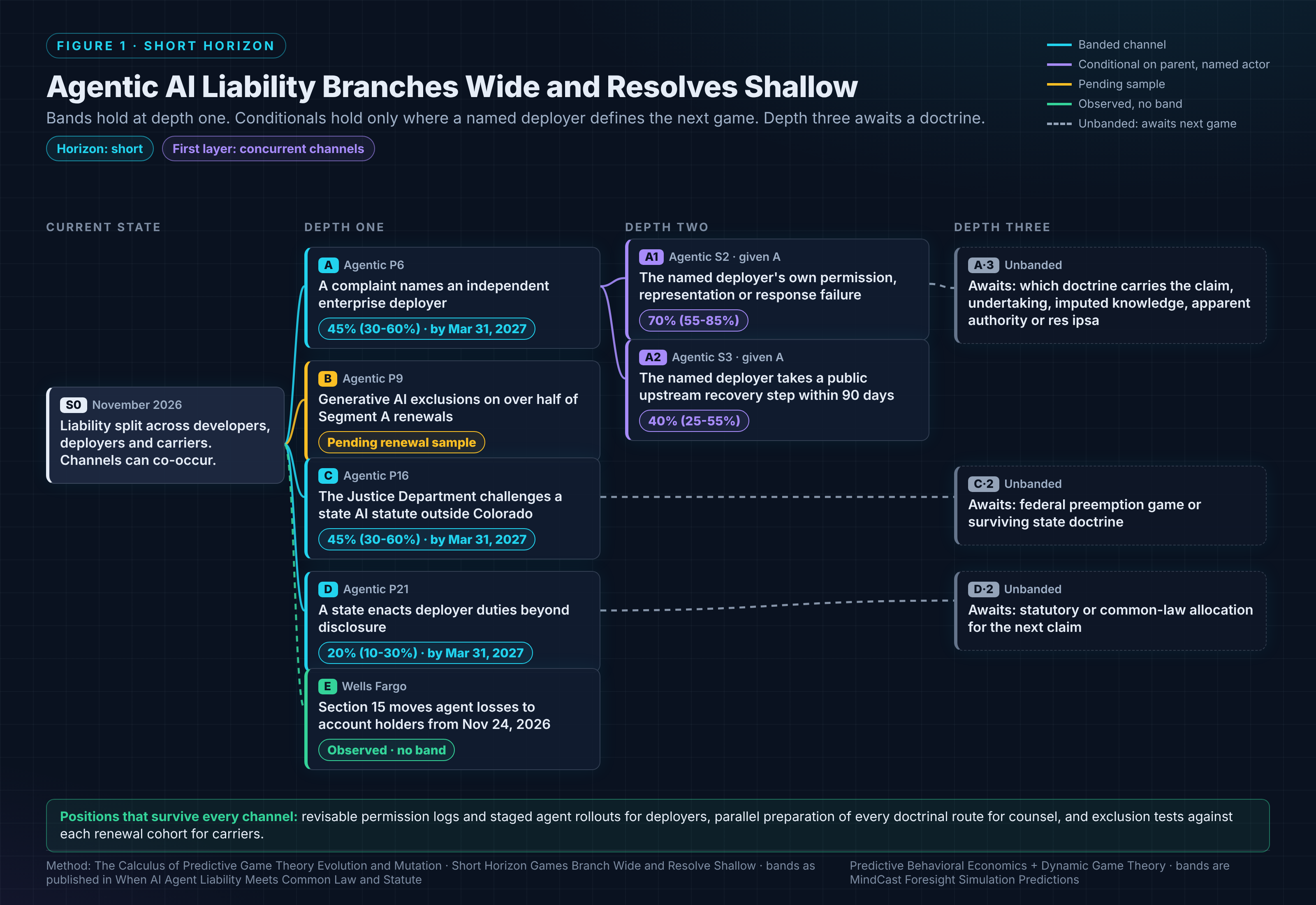
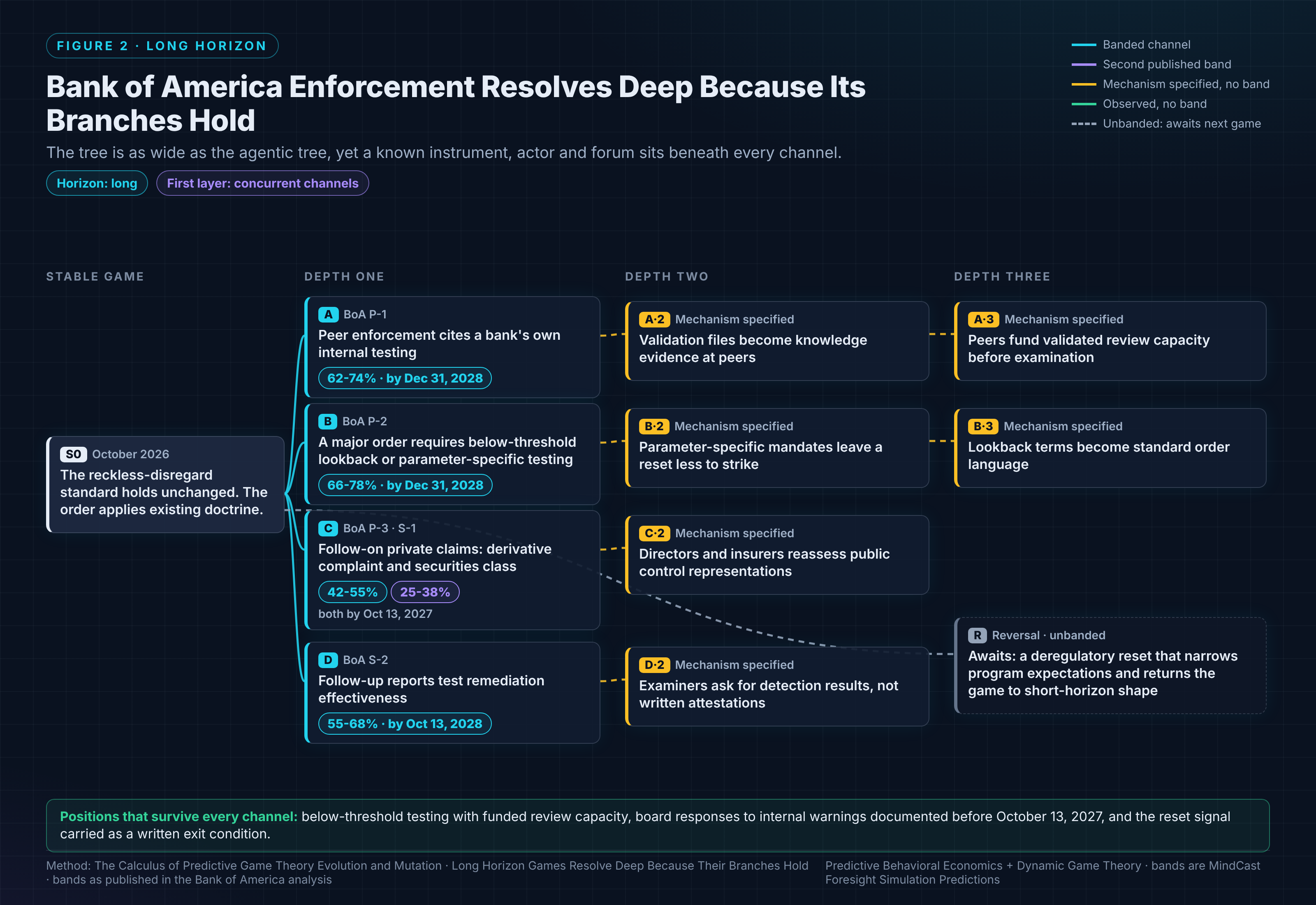
Selecting a node opens its mechanism, trigger and falsifier. A grid places the change by origin and durability, and a checklist shows four kinds of durability evidence. A structural uncertainty gauge runs from 0 (one game certain) to 1 (equal weights) on illustrative candidate-game weights, and a commitment calculator compares the probability of durability against the reader's own loss ratio.
Branch re-formation analysis completes each map. A ruling installs a successor game, but the stakeholders who stay, exit or switch sides decide who plays it. Two rulings with the same winner can produce opposite boards when their legal bases travel to different forums.
💼 Executives: Run your pending commitment through the calculator against each anchor map. A move that wins on all three maps needs no deeper run.
Each placement row links to the matter's own war game. Kalshi, Compass and OpenAI each have one, Snap routes to the State Attorney General Coalitions war game and Wells Fargo routes to the Agentic Liability and AI Insurance Exclusions war game. The Anthropic war game is still to come.
Takeaway: The map lets a reader test a move against every successor state, then open the war game where that move gets played.
V. The Six Matters Meet All Five War Gaming Conditions
MindCast runs war gaming only where five conditions hold, and the six matters meet all five. War gaming fits matters where rules still change, which is the condition a Strategy and Risk Simulation Snapshot exists to model.
Sequenced dated forks. At least two scheduled events evolve the game inside a reader's window. The Wells Fargo terms take effect November 24, 2026, and renewal cohorts on generative AI exclusions bind from December 2026 to March 2027.
Rule-changing seats. At least one seat can alter rules rather than move within them. The Supreme Court can decide who regulates Kalshi, and a Texas court can impose pre-release review on OpenAI.
Mismatched clocks. Seats decide on different cadences. Banks rewrite contract terms in weeks, carriers move on renewal cycles and legislatures act by session.
Substitute routes. Closing one route shifts exposure to another. Federal preemption would move Kalshi's contest from state gambling regulators to the federal commodities regulator, and contract allocation at Wells Fargo moves agent losses out of tort.
Seat-level decision sensitivity. A deployer's best move differs by doctrine, so the deployer seat has a reason to play. A seat with a dominant move needs only a Strategy and Risk Simulation Snapshot, not a war game.
Adjudication in each war game uses published odds at the current fork. Moves that players discover feed back into the Cognitive Digital Twin (CDT) profiles before the next session.
⚖ Counsel: Every forum a client opens or joins lengthens the game for everyone else. Choose forums knowing which seat gains from delay.
Takeaway: Each matter qualifies for war gaming because rules still move, several seats can move them and the reader's choice changes the result.
VI. Eleven Published Forecasts Test Whether Short Horizons Stop at the Next Fork
Three hypotheses compete to explain why these matters move differently, and each carries its own falsifier.
Horizon hypothesis. Each matter moves at the pace its own rule-changing seats allow, so placements change only at named triggers. Falsifier: any of the six matters changes horizon class without its named trigger.
Single-game hypothesis. One federal move, such as preemption of state AI law, governs every AI matter at once. Falsifier: matters keep moving on separate clocks after a federal preemption challenge is filed. The six matters already sit on three horizon classes, and no single federal move governs all of them.
Subject-matter hypothesis. Horizon follows the industry, so all AI matters share one class. Falsifier: two AI matters sit in different classes on the same date, as Snap and OpenAI do now.
The eleven entries below test the horizon hypothesis. Each is carried from published MindCast Foresight Simulation Predictions or Snapshot Predictions and keeps its original identifier, band and window. Short-horizon entries forecast the next fork, and stabilizing entries forecast where the game comes to rest.
Short horizon
The Supreme Court grants review of a Kalshi petition by June 30, 2027 (64-72%). Falsifier: no grant issues by that date. Verified by the Supreme Court docket.
Compass files against a second listing service by December 31, 2026 (69-84%). Falsifier: no new Compass filing against a listing service by that date. Verified by federal and state dockets.
One to two states beyond the ten already suing OpenAI file against it by December 13, 2026 (50%). Falsifier: zero or three or more new state filings by that date. Verified by state court dockets.
The FTC takes a first public action against Anthropic or OpenAI by October 14, 2027 (30%). Falsifier: no complaint, consent order or public statement of action by that date. Verified by FTC press releases.
Agentic P6: a public complaint names an independent enterprise deployer for an AI agent's action by March 31, 2027 (45%, 30-60%). Falsifier: no such complaint by that date. Verified by federal and state dockets.
Agentic P21: a state enacts deployer duties for AI agent actions beyond disclosure by March 31, 2027 (20%, 10-30%). Falsifier: no qualifying enactment by that date. Verified by state session laws.
Snapshot
Agentic P9: carriers attach a generative AI exclusion to more than half the Segment A renewals from December 1, 2026 to March 31, 2027 (pending). Segment A covers admitted small and mid-size commercial general liability on standard forms, where Verisk exclusions attach most easily. The band issues once the renewal sample reports. The entry tests whether contract terms, as at Wells Fargo, set agent liability before any court.
Emerging stabilization
At least one state attorney general action against Snap over My AI ends by dismissal, consent judgment or enforceable agreement before the first trial opens in August 2027 (60-80%). Falsifier: the first trial opens with every action still live. Verified by state court dockets.
Washington holds as cooperative absorption after the NWMLS agreement (80-90%). Cooperative absorption means Washington listing services meet Compass's demands through negotiated rules rather than litigation. Falsifier: a new Compass suit or rule fight reopens Washington. Verified by Washington dockets and NWMLS rules.
DC P12: most local data center pauses expiring by June 30, 2027 are replaced with explicit pricing rules (70-82%). Falsifier: most expiring pauses revert to the prior regime. Verified by local and state authorization records.
Long horizon
BoA P-2: a new major Bank Secrecy Act order requires a below-threshold lookback or parameter-specific testing by December 31, 2028 (66-78%). Falsifier: no qualifying order by that date. Verified by FinCEN and Office of the Comptroller of the Currency enforcement pages.
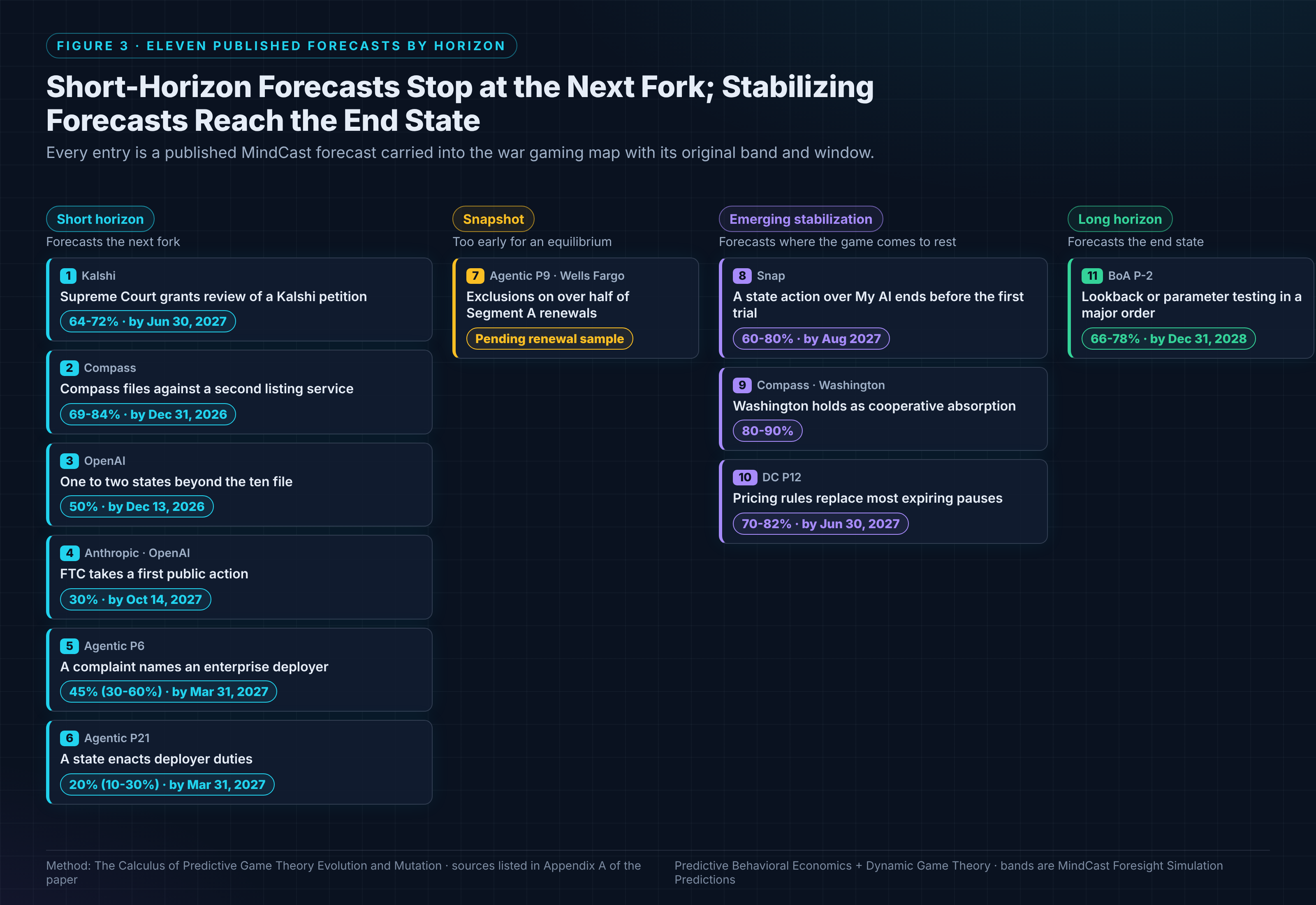
The pattern is consistent with the horizon hypothesis, and the dated resolutions test it. Every short-horizon entry names the next step in a contest, such as a grant of review or a new filing. The joinder count and the first deployer complaint follow the same pattern. The stabilizing entries name where a game comes to rest: a negotiated end to the Snap actions, Washington's rules holding, pricing rules replacing pauses and lookback terms becoming standard.
📊 Investors: A forecast of the next filing says nothing about the final rule. Hold long-dated positions on stabilizing entries and treat short-horizon entries as dated decision points.
Takeaway: Short-horizon forecasts stop at the next fork, and stabilizing forecasts reach the end state, a pattern the dated resolutions will test.
VII. Risk Mitigation by Stakeholder
Each stakeholder controls a different unit of exposure, and each can act alone before the next fork.
Enterprise deployers. Exposure in the unit it controls: Agent actions that bind the firm without logged authority. Unilateral actions, owner and deadline: General counsel inventories agent permissions before the December renewal cohort; operations keeps revocation proof from November 24, 2026. Residual exposure: A first ruling on an agent can still assign duties the logs did not anticipate.
Insurers and underwriters. Exposure in the unit it controls: AI agent losses silently covered on standard forms. Unilateral actions, owner and deadline: Underwriting maps exclusions across the December 2026 to March 2027 cohorts; claims sets an AI-excluded-loss protocol before March 31, 2027. Residual exposure: A deployer may sue the vendor in its own name after an excluded loss.
Frontier developers. Exposure in the unit it controls: Months of exposure before a state names the firm. Unilateral actions, owner and deadline: Policy teams publish a pre-release evaluation protocol and engage an independent reviewer before the next coalition filing. Residual exposure: The FTC theory of harm remains undisclosed.
Prediction market operators. Exposure in the unit it controls: Revenue in states sustaining restrictions. Unilateral actions, owner and deadline: Strategy teams model state-by-state revenue under split-layer and full-preemption outcomes before the certiorari decision. Residual exposure: A grant extends uncertainty through the merits term.
Data center developers. Exposure in the unit it controls: Capital committed to sites in jurisdictions without published terms. Unilateral actions, owner and deadline: Siting teams favor jurisdictions with published large-load tariff and water terms before the June 30, 2027 pause test. Residual exposure: A silent jurisdiction can restart the pause wave when project pressure returns.
Listing services. Exposure in the unit it controls: Months of litigation per Compass forum. Unilateral actions, owner and deadline: Boards adopt the Washington template terms before a filing reaches them. Residual exposure: Compass can still open a forum the template does not cover.
Takeaway: Every stakeholder can cut its exposure before the next fork, and none can remove it until that fork resolves.
What to Watch: The December 2026 to March 2027 Renewal Cohorts Are the Dominant Fork
The renewal cohorts lead because they decide whether contracts or courts set agent liability first, which moves the Wells Fargo, OpenAI and Anthropic placements at once.
November 24, 2026. Observable: Wells Fargo Section 15 takes effect. Matter: Wells Fargo. What it changes: Opens the adaptation channel to challenge.
December 13, 2026. Observable: Attorney general joinder checkpoint. Matter: OpenAI. What it changes: Resolves entry 3 and sets coalition breadth for 2027.
December 31, 2026. Observable: Second Compass listing-service filing. Matter: Compass. What it changes: Resolves entry 2.
December 2026 to March 2027. Observable: Renewal cohorts on generative AI exclusions. Matter: Wells Fargo, OpenAI, Anthropic. What it changes: Resolves entry 7; the dominant fork.
March 31, 2027. Observable: Agentic forecasts resolve. Matter: Agentic liability. What it changes: Resolves entries 5 and 6.
June 30, 2027. Observable: Certiorari window and data center pause test. Matter: Kalshi, data centers. What it changes: Resolves entries 1 and 10.
August 2027. Observable: First Snap trial date. Matter: Snap. What it changes: Resolves entry 8.
October 14, 2027. Observable: FTC action window closes. Matter: Anthropic, OpenAI. What it changes: Resolves entry 4.
December 31, 2028. Observable: Bank Secrecy Act order window closes. Matter: Bank of America. What it changes: Resolves entry 11.
Takeaway: Every placement names the event that moves it, so the map's classification can be checked against the calendar.
Conclusion: The Map Classifies Before It Forecasts
Innovation does not face one regulatory game, and the six matters prove it on the same calendar. Kalshi and OpenAI wait on rule-changing seats, Snap and Washington's Compass branch approach stable terms and Wells Fargo sits too early for any equilibrium read. The war gaming map places each matter, charts its successor states and routes the reader to the war game where each move gets played.
The map adds a reusable capability to MindCast: a horizon placement with a named trigger for every matter, checked against eleven published forecasts. The release comes with the map itself, at The Heterogeneous Economics of Innovation War Gaming Map.
Working With MindCast
MindCast AI is a Predictive Game Theory Modeling-Simulation firm. MindCast builds Cognitive Digital Twins of the named actors on a client's board and models how the game evolves through its next forks.
Strategy and Risk Simulation Snapshots fit short-horizon matters such as Kalshi, OpenAI and Anthropic, with odds rounded to the nearest 10% at the current fork.
Foresight Simulations fit stabilizing matters such as Washington's Compass branch and data center authorization once entries 9 and 10 resolve.
Private war gaming sessions put a client's team in its own seat against modeled opponents in the war game for their matter.
Commitment-timing analysis applies the threshold in Section III to a client's own costs, rivals and deadlines.
A complimentary Snapshot runs on public information, and private engagements begin with a diagnostic session on one live decision.
Contact: mcai@mindcast-ai.com
First step: review MindCast war gaming at www.mindcast-ai-simulation.com/live-fire-intelligence, or visit www.mindcast-ai-simulation.com.
Appendix A. Selected MindCast Works
The Heterogeneous Economics of Innovation War Gaming Map. The map this paper introduces.
The Calculus of Predictive Game Theory Evolution and Mutation. Supplies the governing identity, the three dimensions and the case matrix.
Short Horizon Games Branch Wide and Resolve Shallow. Source of the agentic liability map and the adaptation hypothesis.
Long Horizon Games Resolve Deep Because Their Branches Hold. Source of the data center and Bank of America maps.
When AI Agent Liability Meets Common Law and Statute: Predictable Doctrines, Unsettled Allocation. Source of entries 5, 6 and 7.
AI Data Center Moratoriums Are Forecastable, and They End in Pricing Rules, Not Bans. Source of entry 10.
Bank of America $1.2 Billion Money Laundering Penalty and the Compliance System That Knew Too Much. Source of entry 11.
MindCast War Gaming Validation scorecard. Hits and misses as of November 15, 2026. Source of entries 1 to 4, 8 and 9.
MindCast AI Enforcement and Litigation Tracker. Follows the Snap, OpenAI, Anthropic and Wells Fargo developments.
Compass vs MLS Interactive War Game. Maps the national and Washington branches of the Compass matter.
Appendix B. External Sources
Gambling.com, New Jersey Asks Supreme Court To Rule On Kalshi Sports Bets. The September 2, 2026 certiorari petition.
SIGMA, States urge Supreme Court review of Kalshi. The 39-state amicus coalition.
Courthouse News, Texas attorney general sues OpenAI over ChatGPT safety. The pre-release review remedy.
Axios, FTC subpoenas OpenAI, Anthropic over consumer harms. The October 14, 2026 civil investigative demands.
Wells Fargo, We Are Updating Our Online Access Agreement. The November 24, 2026 effective date.
American Banker, Wells Fargo wants customers to prove they've revoked AI agents. The revocation-proof requirement.