

Meta · Snap · OpenAI · State Attorneys General · Federal Trade Commission · Colorado · Tennessee · California · Kentucky · New Jersey · New Mexico · Rhode Island
Read first. Multi-State Enforcement Against AI and Platform Companies — How Defendants Contain State Attorney General Coalitions and Write the Standard Their Rivals Inherit sets out the Meta agreement’s terms and the containment playbook. The present paper adds the timing history: where the Meta coalition game turned and what the turns teach the next defendant.
Related MindCast works. State Attorney General Coalitions — How Lead States Set the Template and Why Other States Copy the Complaint · How State Attorney General Coalitions Form, Grow, and Hold · Meta and Bank of America Foresight-to-Duty Conversion — Revenue-Funded Versus Cost-Funded Deferral
Interactive war gaming. States vs. OpenAI Interactive War Gaming · MindCast War Gaming Visuals · All MindCast war gaming
I. Executive Summary — Correction Authority Sets the Cost of Every Later Resolution Window
Core insight. Once a cross-party office files, no defendant can stop a multistate coalition from growing, because breadth tracks the cost of joining. Before that filing, a resolution with the investigation leads can still cap breadth. Depth stays within the defendant’s reach at every stage, and the thesis this paper tests is that depth traces to one governance fact: who inside the company approves corrections to measured harms.
The newshook. Court papers put the Meta agreement at up to $16.68 billion for 29 states, reached in the second week of the Oakland trial. Meta’s Form 10-Q describes payments of up to approximately $18.59 billion across 52 attorneys general. A coalition of state offices imposed binding design terms that no federal agency or Congress had enacted.
Why now. Meta’s agreement set the reference terms, Rhode Island has opened a scam-ad channel against Meta and eight states have sued OpenAI. Counsel at platforms and artificial intelligence (AI) developers facing open investigations now choose whether to correct, resolve or hold. The forks in the Meta case show what each choice costs.
MindCast distinction. MindCast AI applies Predictive Behavioral Economics + Dynamic Game Theory through MindCast AI Proprietary Cognitive Digital Twin Foresight Simulations (MP CDT FS). Behavioral Economics supplies the decision rules. Game Theory supplies the payoff structure. Predictive simulations emerge from the combination.
Track record. Meta $16.68 Billion Settlement Validates MindCast Simulation Predictions documents the resolution shape MindCast mapped for the Meta agreement. The MindCast Prediction Scorecard dated October 31, 2026 shows 38 hits and 5 misses on resolved material calls.
What the paper does. Figure 1 maps the mechanism, and Figure 2 places six dated events and four forks on one timeline. Two exhibits set out the events and the forks, and Section IV states each fork as a falsifiable hypothesis. Section IV also carries eight MindCast Foresight Simulation Predictions: five event predictions and three interpretive reads. Sections V and VI turn the forks into moves for counsel, risk teams, investors and issuers.
Prediction highlights. Five of the paper’s eight MindCast Foresight Simulation Predictions resolve by December 31, 2027. P marks a Primary Simulation Prediction and S a Secondary Simulation Prediction.
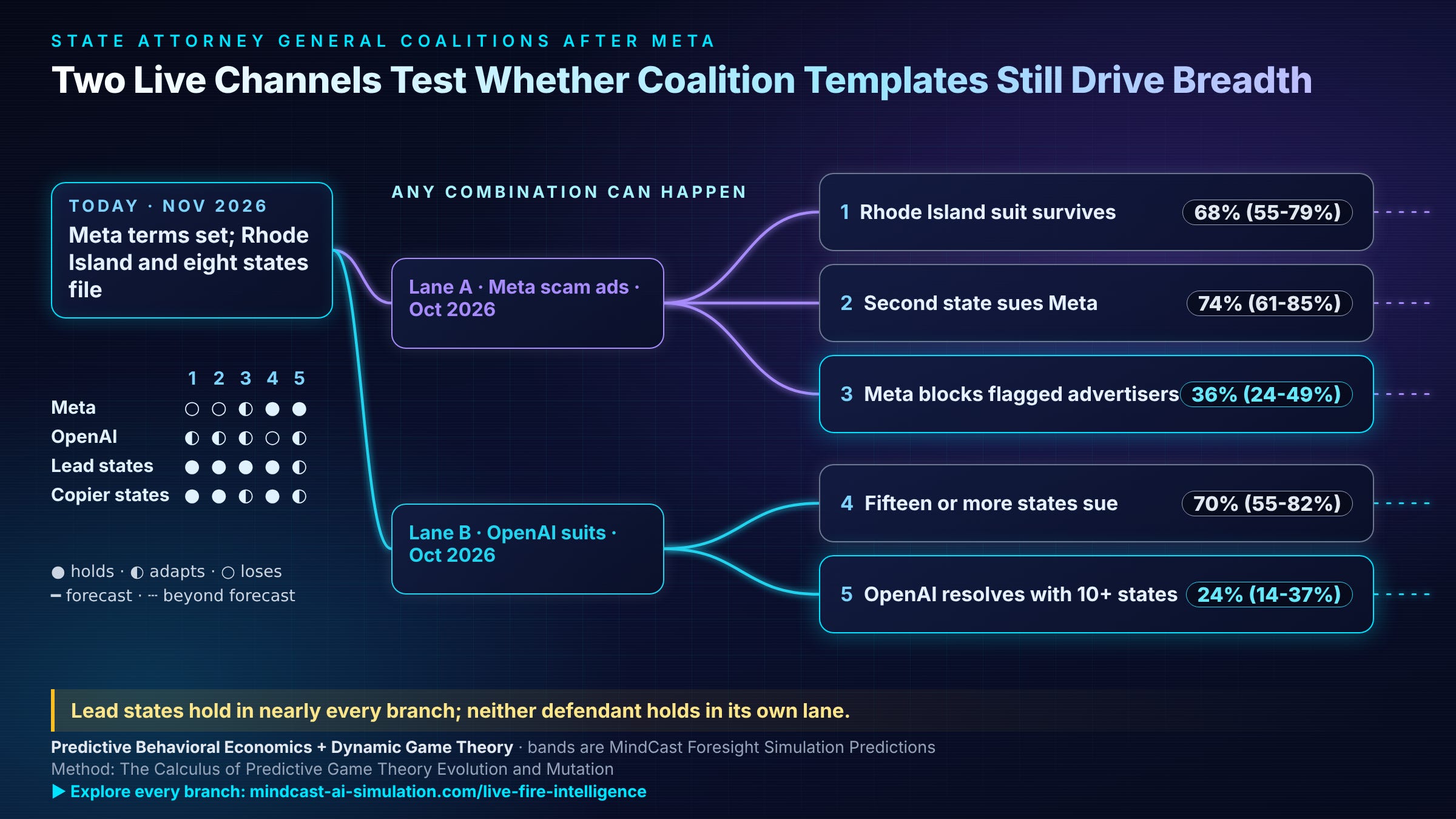
P1. A second state sues Meta over scam advertising. A state other than Rhode Island files a scam or fraudulent-advertising action against Meta: 74% (61-85%).
P2. The OpenAI coalition keeps growing. Fifteen or more states have filed attorney general actions against OpenAI: 70% (55-82%).
P3. Rhode Island’s scam-ad case survives. Providence Superior Court denies Meta’s motion to dismiss in whole or in part: 68% (55-79%).
S1. Meta’s governance signal stays unlikely. Meta announces it will block rather than surcharge advertisers its systems flag as likely scammers: 36% (24-49%).
S2. OpenAI holds rather than resolves. OpenAI resolves with 10 or more state attorneys general: 24% (14-37%).
Quoted from published work, not this paper’s predictions. A coalition of 25 to 40 members follows pre-filing entry by a credible cross-party office at 66-78%, from the coalition propagation paper.
Stakeholder readout.
⚖ General Counsels. A first reasoned ruling becomes the portable basis every copier files on, so the template matters more than the caption. A cross-party co-lead closes the window for a narrow resolution.
💼 AI Strategy at Agentic Firms. H-1 tests whether moving correction approval off the revenue line, before any complaint, lowers the depth of the coalition that follows. The early window closes when a bridge office files.
📈 Issuers Preparing an Offering. OpenAI filed confidentially for its offering days before the 42-state investigation became public. Correction authority placed before the registration statement stops new deferrals from accumulating ahead of the offering.
🛡 Risk Mitigation Specialists. Exposure arrives through breadth first and commitment second. Penalties and injunctions mostly stay with the defendant, while defense costs reach carriers.
📊 Investors. Where a defendant’s correction approver sits is visible before any coalition forms. Late joiners follow public recovery allocation at 76-88% (coalition propagation paper). Exposure therefore runs to every state with users rather than only the states that sued.
🏛 Policymakers. State coalitions now set binding design terms faster than federal rulemaking or legislation. A legislature that wants a voice in AI conduct standards has to act before the next coalition agreement writes them.
Takeaway. The paper’s thesis places a defendant’s lever in its own correction authority, long before the first complaint, because breadth costs a coalition little to buy. The predictions test the thesis in order: Rhode Island’s case and a second state’s filing come first, and Meta’s governance change is the less likely outcome. The rest of the paper shows how the Meta coalition reached its agreement and what the next defendant can still change.
II. Coalitions Grow by Copying After the Bridge Filing, While Defendants Keep Control of Depth
Coalitions grow by copying. The same mechanics recur from Meta and Live Nation to Kalshi, Snap and OpenAI, so the Meta history reads as a template for the next defendant.
Two disciplines explain the copying. Behavioral Economics supplies the decision rules: how a revenue-owning approver weighs a correction and how one vivid document changes every office’s estimate of the cost of joining. Game Theory supplies the payoffs: who absorbs the cost of a theory, who signals that it travels and when a copier office finds joining worth more than waiting.
Figure 1 assembles both into one joining-cost engine, a loop in which each filing lowers the cost for the next office. Breadth comes out of that loop on the right. Depth comes out of the evidence stock on the left: the internal documents a defendant leaves for a coalition to copy.
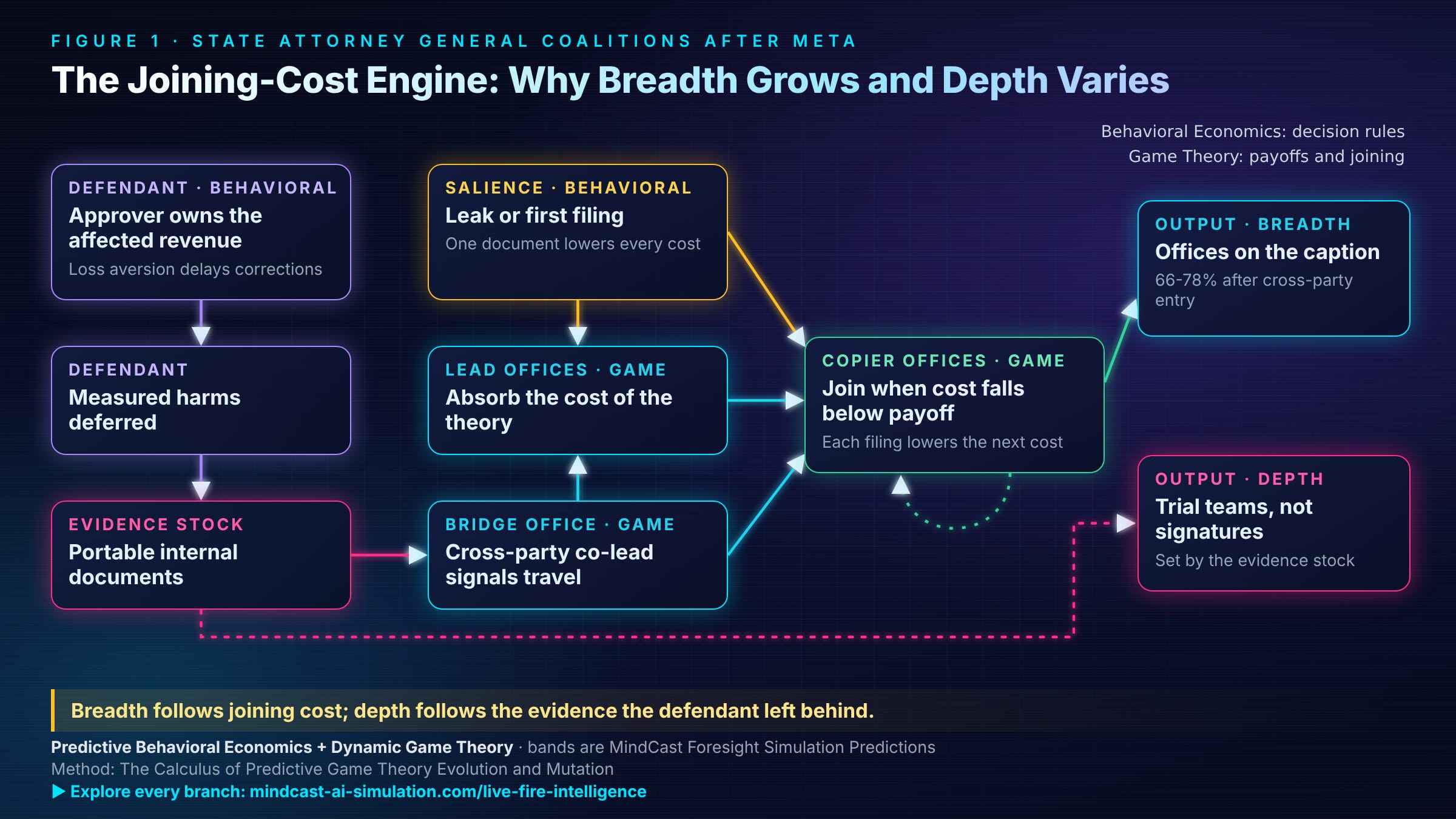
Behavioral Economics: revenue ownership and salience. Meta and Bank of America Foresight-to-Duty Conversion draws on reported internal documents indicating that Meta’s correction approver owned the revenue a correction would forgo. Loss aversion makes forgone revenue loom larger than an avoided future penalty. Salience runs the other way inside attorney general offices, where one vivid internal document lowers the cost of joining for every office that reads it.
Game Theory: joining costs and the copied complaint. How State Attorney General Coalitions Form, Grow, and Hold treats coalition size as a market clearing quantity. Lead offices absorb the cost of building a theory, and a credible cross-party office signals that the theory travels. State Attorney General Coalitions — How Lead States Set the Template and Why Other States Copy the Complaint names the copied object: the complaint.
Why the lessons travel. The Calculus of Predictive Game Theory Evolution and Mutation shows that a forecast can hold when the outcome stays the same in every candidate game. Coalition breadth meets that test. Whichever doctrine a court adopts, joining costs fall as templates circulate.
The roles transfer to the next defendants. The eight states that filed against OpenAI on October 14, 2026 already include a bridge office, and the 42-state investigation supplies the copier pool. Snap's evidence stock arrives partly from outside the company: West Virginia pleads that OpenAI's published GPT-4 limits gave Snap notice. Snap My AI State AG Cases — Resolution Sequence, Meta's Adoption Gates, Insurance Coverage and the Coalition That Keeps Growing traces how that notice theory moves across eight state cases.
Governing question. Which defendant decisions decided how deep the coalition committed against Meta, and when did each stop paying? Each fork below reads only evidence dated on or before its fork.
Takeaway. The engine runs on two inputs the defendant does not control equally. Once a template circulates, joining cost falls with every filing whatever the defendant does, while the evidence stock depends on what the defendant corrected before anyone looked. The Meta contest shows both inputs moving.
III. How the Coalition Reached the Agreement
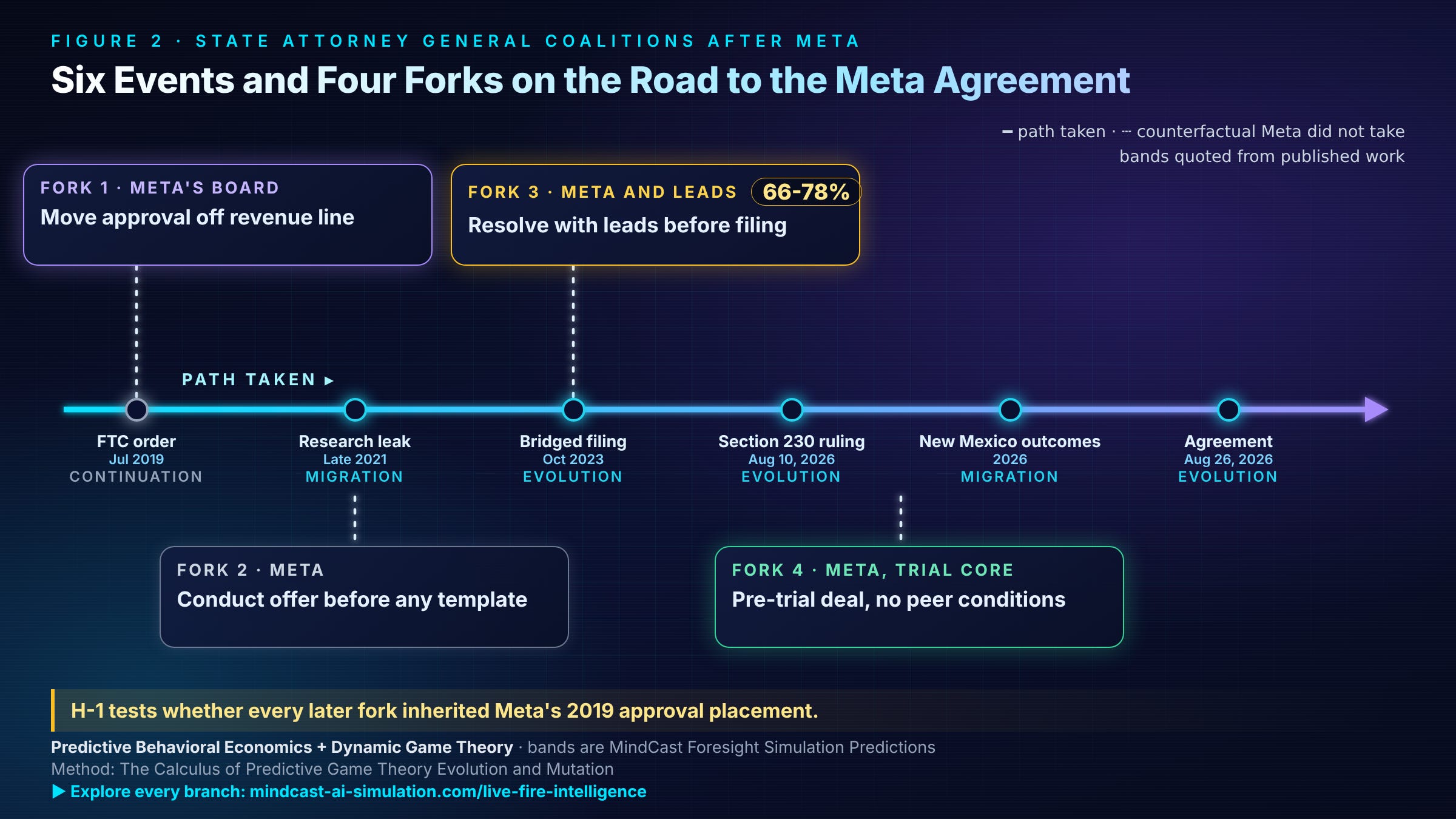
The Meta contest ran from the 2019 federal order to the August 2026 agreement. Six dated events moved the game, and four of them opened forks where Meta could have chosen differently. Figure 2 places both on one timeline before the exhibits set out the detail.
The 2019 FTC order continued the existing game while making the board the documented recipient of privacy findings. Two events, the 2021 leak and the New Mexico verdicts, migrated the equilibrium by lowering the cost of joining without changing the rules. Three events evolved the game: the bridged filing gave copier offices a focal point, the Ninth Circuit let design claims proceed feature by feature and the agreement wrote a standard with peer conditions. None required rebuilding the model, so the Meta history serves as a template for the next defendant.
The forks carry a different test. Each one asks what option Meta held on that date, what it would have cost and what the coalition would have looked like afterward. Exhibit 2 answers those questions fork by fork.
Six Dated Events Moved the Game Without Rebuilding It
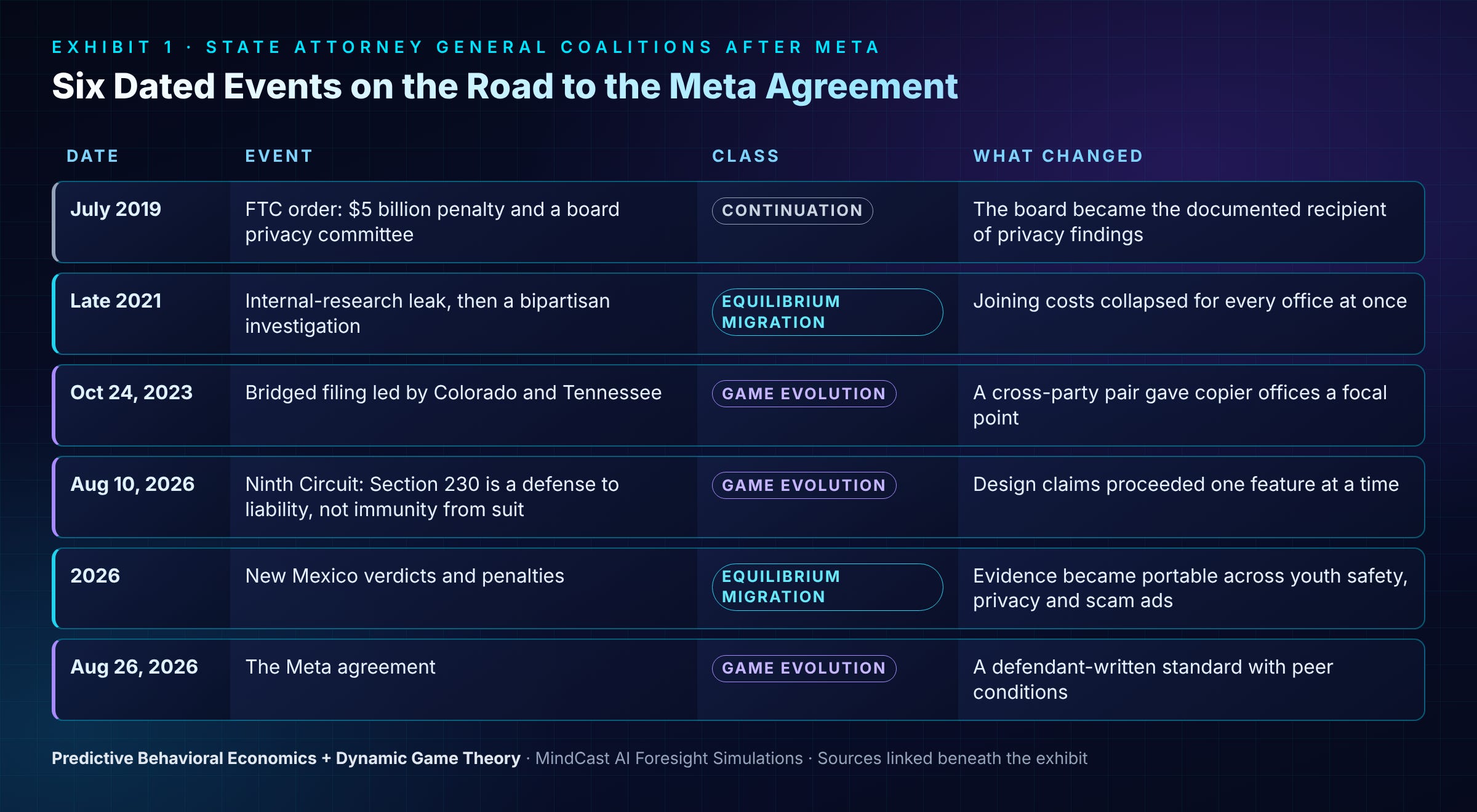
Sources: FTC order · leak and investigation · bridged filing · Ninth Circuit opinion · New Mexico penalties · Meta agreement
Two facts anchor the history. Colorado’s attorney general said he filed because he could not reach a resolution with the company. The Ninth Circuit also rejected Meta’s request to delay the 29-state trial.
Two filings since the agreement test the paper’s mechanism. Rhode Island became the first state to sue Meta over scam advertising on October 22, 2026, after an earlier county suit by Santa Clara. Rhode Island’s complaint relies on internal documents Reuters reported.
Eight states filed separate but coordinated suits against OpenAI on October 14, 2026. Seven of the eight offices have Republican attorneys general, and Arizona’s alone has a Democrat. A 42-state investigation remains open, including the subpoena New York served in June.
Four Forks Where the Game Could Have Turned
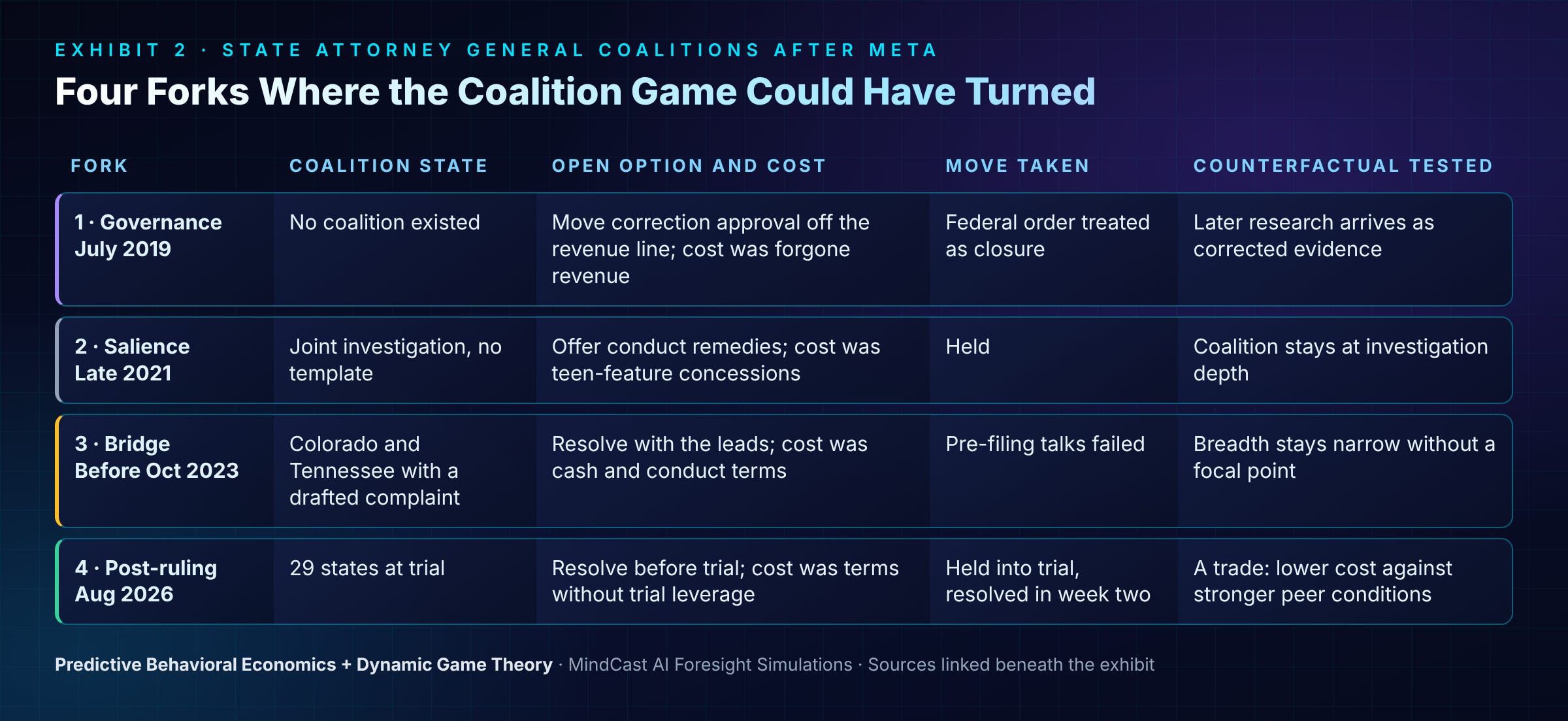
A bipartisan group including Colorado, Massachusetts and New Hampshire opened the 2021 investigation. The trial core differed from the investigation leads: California, Colorado, Kentucky and New Jersey led at trial.
Fork 4 sat late in the calendar. New Mexico’s public-nuisance ruling came on August 6, the Ninth Circuit holding on August 10 and the trial opening on August 18.
How the Game Branches
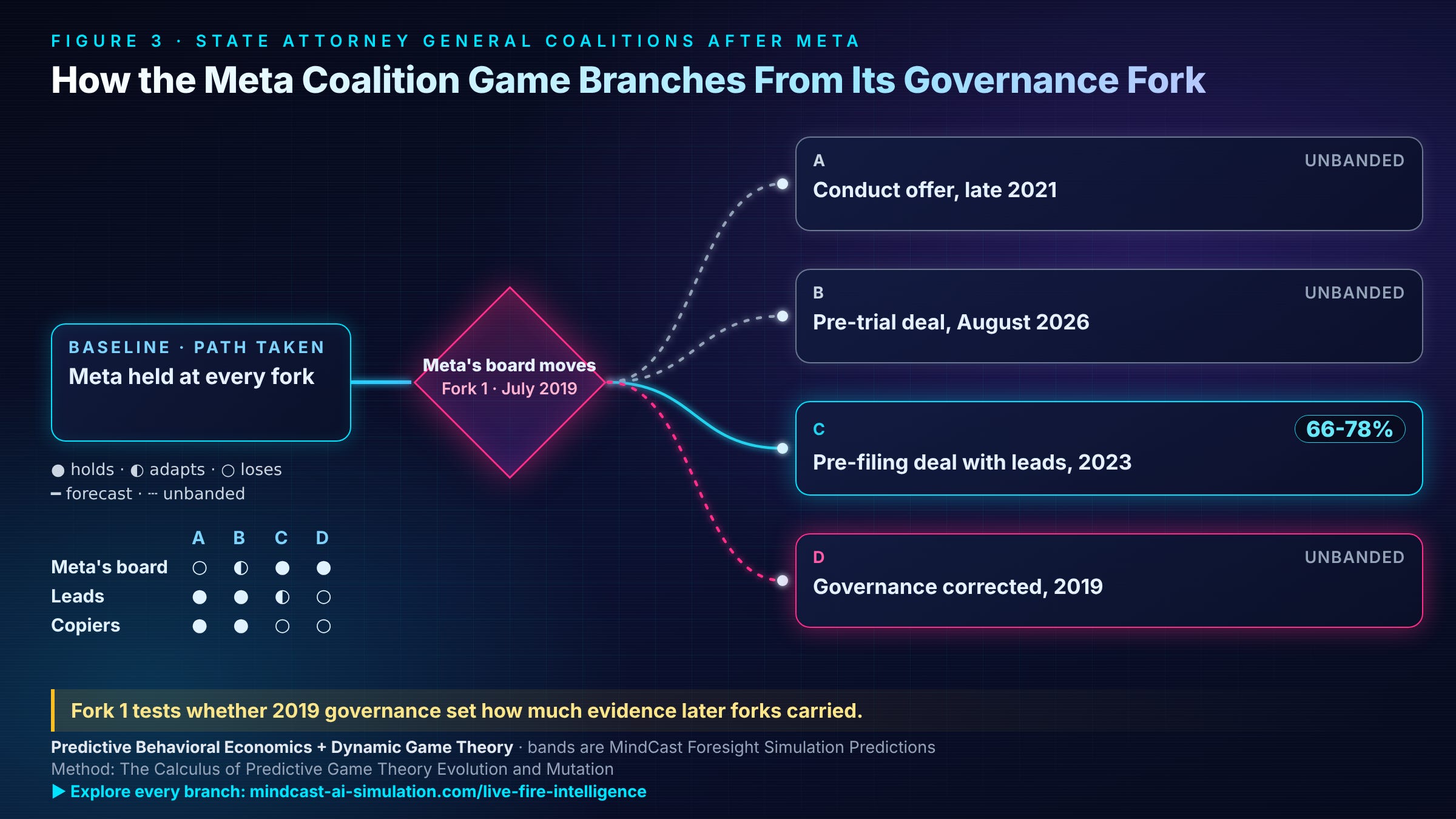
The baseline is the path the game took: Meta held at each fork and resolved in the second week of trial. Fork 1 is the candidate dominant fork, because every later fork inherited where correction approval sat. The quoted breadth forecast frames the cost of the bridged filing at 66-78%.
Takeaway. The game reached the agreement through ordinary evolution rather than a single shock. Each fork narrowed the next, and H-1 tests whether the fork with the widest reach sat in governance in 2019.
IV. Three Rival Explanations Decide Whether Governance Drives Depth
Three rival explanations compete to account for coalition breadth and depth, and four fork hypotheses read only evidence dated before each fork. Figure 4 sets the rivals side by side with the signal that decides each.
The governance thesis (H-1) explains depth, while the bridge thesis (H-3) and the null route (H-0) explain breadth. All three compete on the same cohort of coalitions, so one coded cohort can confirm or overturn each.
Every hypothesis carries a window, a falsifier and a first public signal. The first signals arrive in 2027 from Rhode Island’s motion ruling and the OpenAI filings.
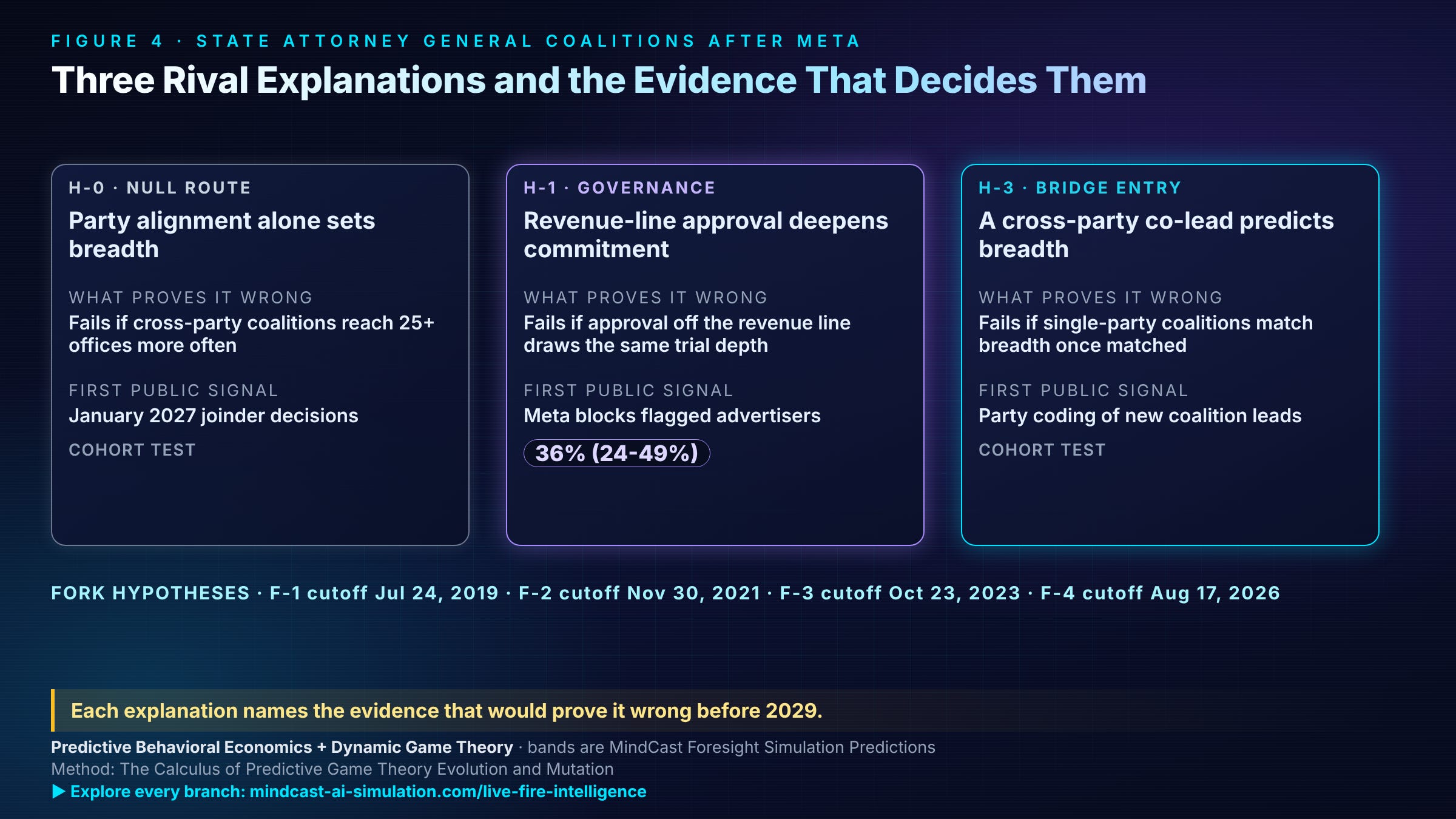
Bands come from the MindCast Foresight Simulation dated November 18, 2026, unless Appendix A names another source.
H-0. Partisan alignment alone predicts breadth (null route). Coalition breadth tracks the party composition of attorney general offices, and neither governance nor bridge entry adds explanatory power.
Falsifier. Cross-party co-led coalitions reach 25 or more members more often than single-party coalitions on matched subjects. Shallower coalitions against defendants with approval off the revenue line also refute the null.
Window and source. Coalitions filed through December 31, 2028. Coding draws on captions, joinder dates and governance filings.
H-1. Correction authority on the revenue line deepens coalition commitment. Defendants whose correction approver owns affected revenue defer longer and face coalitions that commit trial teams rather than signatures.
Falsifier. Defendants with approval off the revenue line face trial-committed coalitions at the same rate.
Definitions. A trial-committed coalition files its own complaints or assigns trial counsel. An approver sits on the revenue line when compensation or targets include the revenue a correction would affect.
Indicators and identifying evidence. A Meta decision to block rather than surcharge flagged advertisers by December 31, 2027 is a behavioral indicator consistent with H-1, at 36% (24-49%). Meta could change enforcement while keeping the same approval structure, so the mechanism requires independent evidence: a disclosed governance change, proxy statement or discovery record showing correction approval moved off the revenue line.
Window and source. Multistate actions against platform and AI companies through December 31, 2028.
H-3. Bridge entry, not party alignment, predicts breadth. Coalitions with a cross-party co-lead at filing reach 25 or more members more often than single-party coalitions on the same subject.
Falsifier. Single-party coalitions reach the same breadth once subject matter and shared counsel are controlled.
First public signal. Lead-office party coding for new coalitions. The eight states that filed against OpenAI on October 14, 2026 already pair one Democratic office with seven Republican offices, the cohort’s first cross-party data point.
Fork hypotheses.
F-1. Governance. Approval moved off the revenue line after July 2019 would have produced a coalition that signs rather than commits trial teams. Cutoff: July 24, 2019. Falsifier: defendants that moved approval after a federal order still faced trial-committed coalitions at the same rate. Resolution source: the H-1 cohort and its public proxies.
F-2. Salience. A conduct offer during the 2021 investigation would have kept the coalition at investigation depth. Cutoff: November 30, 2021. Falsifier: investigations that received conduct offers before any filing still produced multistate complaints at the same rate. Resolution source: investigation announcements and later filings.
F-3. Bridge. A resolution with the Colorado and Tennessee leads before October 24, 2023 would have kept breadth below 25 offices. Cutoff: October 23, 2023. Falsifier: pre-filing resolutions with a cross-party core still drew 25 or more later filers. Resolution source: joinder dates after pre-filing resolutions.
F-4. Post-ruling trade. A pre-trial resolution would have cost less and carried no rival-adoption conditions. Cutoff: August 17, 2026. Cost-side falsifier: pre-trial resolutions in matched multistate matters cost the same or more. Conditions-side falsifier: pre-trial resolutions carry rival-adoption conditions at the same rate.
Watch condition. The Rhode Island scam advertising ruling gates H-1. Meta Foresight-to-Duty Conversion Across Privacy, Child Safety and Scam Ads traces scam ads to the same decision architecture as teen harm. Full or partial denial of Meta’s motion to dismiss carries 68% (55-79%) by December 31, 2027.
Limits. Cohorts remain small. Evidence on who approved Meta’s corrections comes from reported documents, and approver placement for other defendants surfaces mainly in discovery. Fork 3 depends on the leads’ reservation terms, which public filings do not show.
MindCast Foresight Simulation Predictions
Eight MindCast Foresight Simulation Predictions follow: five event predictions and three interpretive reads. Event predictions carry probabilities and resolve by December 31, 2027. Interpretive reads (I) carry structural confidence about past forks and never pool with event probabilities. S1 is the leading behavioral indicator for the governance thesis and ranks Secondary because a yes requires Meta to act against its own revenue, the behavior H-1 predicts Meta resists.
Event predictions.
P1. A state other than Rhode Island sues Meta over scam advertising by December 31, 2027: 74% (61-85%). Falsifier: no second state files a scam-advertising action against Meta in the window. Resolution source: attorney general announcements and court dockets.
P2. Fifteen or more states have filed attorney general actions against OpenAI by December 31, 2027: 70% (55-82%). Falsifier: fewer than 15 states have filed by the deadline. Resolution source: attorney general announcements and dockets.
P3. Providence Superior Court denies Meta’s motion to dismiss Rhode Island’s scam-ad complaint in whole or in part by December 31, 2027: 68% (55-79%). Falsifier: the court dismisses every count. The entry stays unresolved if no ruling issues in the window. Resolution source: the Providence County Superior Court docket.
S1. Meta announces it will block rather than surcharge advertisers flagged as likely scammers by December 31, 2027: 36% (24-49%). Falsifier: no such announcement in the window. Resolution source: Meta newsroom posts, filings and earnings materials.
S2. OpenAI resolves with 10 or more state attorneys general by December 31, 2027: 24% (14-37%). Falsifier: no such resolution in the window. Resolution source: attorney general announcements and consent judgments.
Interpretive reads.
I1. The October 2023 bridged filing marked the largest change in the Meta coalition’s breadth: 70% (55-80%). Falsifier: coded joinder dates show the largest breadth increase at another event.
I2. A conduct offer during the 2021 investigation would not have prevented a filed complaint: 65% (50-78%). Falsifier: investigations that received early conduct offers show materially lower filing rates.
I3. A pre-trial Meta resolution in August 2026 would have carried no rival-adoption conditions: 60% (45-72%). Falsifier: pre-trial resolutions in matched matters carry rival-adoption conditions at the same rate.
Takeaway. The governance thesis and the bridge thesis face their first tests in 2027: Meta’s flagged-advertiser decision as a behavioral indicator for H-1 and coded lead structures in new coalitions for H-3. The moves that follow hold whichever explanation survives.
V. Every Stakeholder Move Pays Most Before a Bridge Office Files
Each stakeholder can act now and can name the event that should trigger a stronger move. Before a bridge office files, a resolution with the leads can still cap breadth. After it files, breadth arrives regardless, so the moves shift to commitment depth and timing. Exhibit 3 lists the moves by stakeholder, and Figure 5 places them on a timeline of escalation triggers.
Counsel holds the litigation posture. One fact narrative across every forum keeps a copier office from lifting an inconsistency into its complaint, and a cross-party office joining an investigation is the trigger to escalate. AI strategy teams hold correction authority. Moving approval off the revenue line pays under every branch, because it shrinks the evidence stock before any coalition reads it.
Risk teams hold the exposure measure. Breadth arrives first, so sizing exposure by users times states before a bridge filing avoids a late revaluation. Investors hold the speed of adjustment. Approver placement is visible before any coalition forms, which lets positions move ahead of the first filing rather than after the agreement.
Each Meta fork returns as a dated decision for the next defendant. Governance comes first: who approves corrections today decides the evidence stock any later coalition reads. A leak or first filing opens the salience fork, where a conduct offer buys little because offices want credit at peak salience. The bridge fork closes when a cross-party office co-leads, and the post-ruling fork opens after the first reasoned ruling, when holding can win peer conditions at the risk of higher cost.
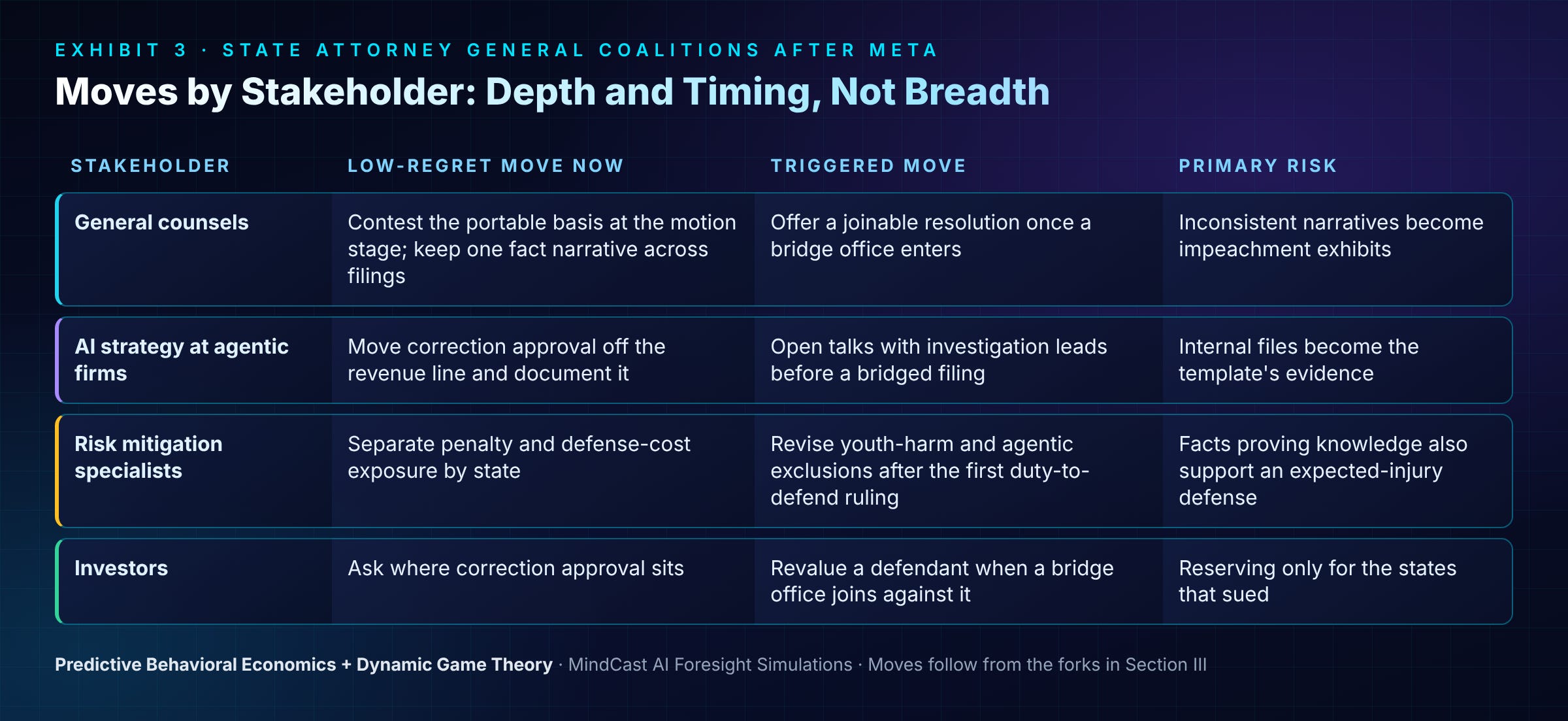
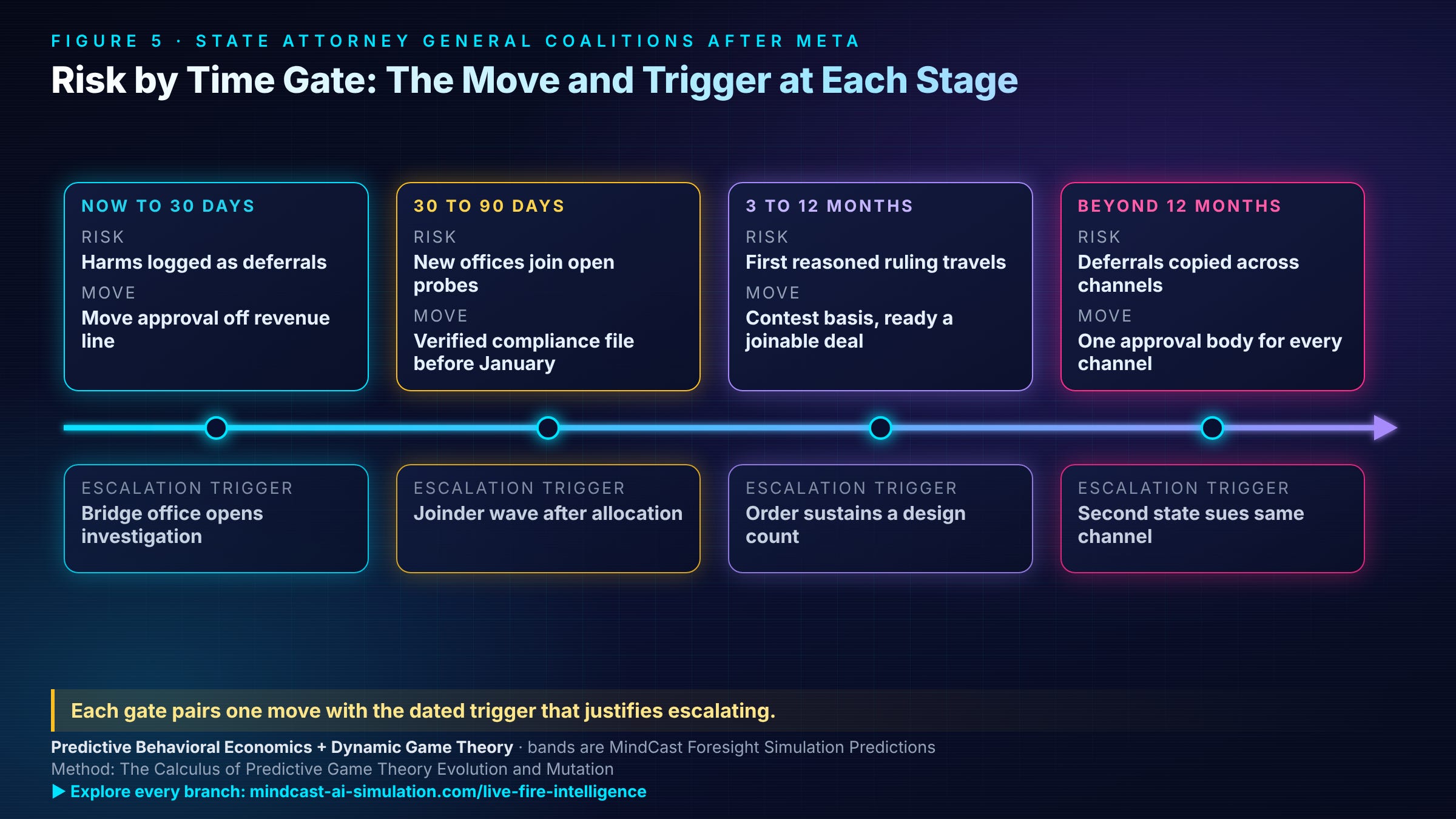
Takeaway. Moves made before a bridge office files carry the lowest cost for every stakeholder. After that point the moves shift from preventing breadth to limiting depth. The forks also reset the cost of the resolution windows counsel already know.
VI. Governance Sets the Cost of Every Resolution Window
The forks matter beyond Meta because they set the cost of every later resolution window. Governance sets how much each window costs, timing decides which windows remain open and two live channels now test the mechanism. The game map after the executive summary shows those channels with their bands, and MindCast War Gaming Visuals collects the maps for every MindCast board.
The containment paper sets out when a defendant should resolve. The Meta forks add what decides how much each window costs and which windows had already closed when Meta held. The answers carry over to Snap, OpenAI and any issuer preparing an offering.
OpenAI and Snap sit at different forks. OpenAI has passed the bridge fork, because the October 14 filings already pair offices of both parties, so its remaining levers are depth and timing. Snap still faces separate state cases rather than a joint filing, and the Snap paper puts its first single-state resolution ahead of any joinable resolution at 76-83% through 2027. Snap can still make the bridge-fork move that Meta's pre-filing talks failed to secure: resolve with individual leads before a cross-party office turns the cases into one template.
The live channels supply the test. Rhode Island’s scam-ad suit and the OpenAI filings will show within the 2027 window whether the template mechanism the forks describe still governs.
Governance sits upstream of the commitment rule. Multi-State Enforcement Against AI and Platform Companies sets the rule: resolve when the expected cost of continuing exceeds the incremental cost of resolving. The early, post-ruling and hold windows each set the cost of a resolution against the evidence a coalition holds. Approver placement decides how much of that evidence exists.
The 2021 window closed almost as it opened. The leak made joining nearly costless for every office. A conduct offer had little to buy, because offices wanted credit at peak salience. The real early window ran until the October 2023 bridged filing.
Fork 4 won conditions. The Ninth Circuit holding came eight days before trial. Holding into trial won peer conditions that tie Meta’s payments to rival adoption, and a pre-trial deal would likely have lacked them (I3). Whether holding also cost more remains the open half of F-4.
Two live channels test the mechanism. Rhode Island’s scam-ad suit and the OpenAI filings run on the same template mechanism the Meta coalition used. A second state’s scam-ad filing (P1, 74% (61-85%)) and fifteen or more OpenAI filing states (P2, 70% (55-82%)) are the likely outcomes. Meta’s move to block flagged advertisers (S1, 36% (24-49%)) and an early OpenAI resolution (S2, 24% (14-37%)) are less likely outcomes.
Issuers preparing an offering. An issuer carries the same exposure into its risk factors. OpenAI filed confidentially for its offering days before the 42-state investigation became public in June 2026. Three steps follow from the forks:
Place correction authority off the revenue line before filing the registration statement.
Resolve open investigations before a bridge state files.
Size coalition exposure by users times states, since every state with users can join.
Falsifier consequences. If H-1 fails, boards should weight evidence management over governance redesign. If H-3 fails, bridge mapping loses its value to counsel. If F-3 fails, pre-filing resolutions do not contain breadth.
Takeaway. Governance sets how much each resolution window costs, and an issuer can fix it before the first filing. The live channels will show by the end of 2027 whether the template mechanism still drives breadth. The signals below arrive in a predictable order.
What to Watch: The Rhode Island Ruling Arrives First
Dated signals will confirm or overturn the paper’s claims. Each signal below names the hypothesis it tests and its expected band. The dominant fork is the Rhode Island ruling, because it gates both the second-state filing and Meta’s governance choice.
The signals arrive in a predictable order. Court rulings and copier filings come first, because they lower joining cost for every office that follows. Governance changes come last, because they require the defendant to act against its own revenue.
A second state’s scam-ad filing against Meta (P1). Tests the template mechanism. Monthly through December 31, 2027. Expected at 74% (61-85%).
The Rhode Island motion ruling (P3). Gates H-1. Monthly. Denial in whole or part is expected at 68% (55-79%).
State filings against OpenAI (P2). Tests the template mechanism on the next defendant, and coding each new coalition’s lead offices feeds the H-3 cohort. Monthly through December 31, 2027. Fifteen or more filing states are expected at 70% (55-82%).
Meta’s flagged-advertiser decision (S1). Indicator for H-1 and F-1. Monthly through December 31, 2027. A move to blocking, at 36% (24-49%), would fit H-1, and only a disclosed change in who approves corrections would establish the mechanism.
January 2027 joinder decisions by new attorneys general. Tests H-0 and H-3. Weekly through February.
Takeaway. The Rhode Island ruling and a second state’s filing arrive first, so the template mechanism faces its test before the governance thesis does. A move by Meta to block flagged advertisers would be the strongest behavioral signal for H-1, and a disclosed change in approval authority would confirm it.
Conclusion — The Next Defendant’s Window Closes When a Bridge State Files
The forks test one thesis: the lowest-cost point to shape a coalition comes before any office can copy a file. The 2021 leak made joining nearly costless, so the real early window ran until the October 2023 bridged filing. The Meta agreement then set terms the next defendant will meet.
Counsel can act now on moves that hold across branches. Boards can move correction approval off the revenue line, counsel can keep one fact narrative and defendants can open talks with investigation leads before a bridged filing. The decisive signal for the next defendant is the first credible bridge office to enter against it.
Working With MindCast
MindCast AI is a Predictive Game Theory Modeling-Simulation firm. MindCast builds Cognitive Digital Twins (CDTs) of the named actors on a client’s board and models how the game evolves through its next forks.
Containment-window analysis that applies the commitment rule to a client’s own costs, evidence base and likely bridge entrants.
Strategy and Risk Simulation Snapshots for short horizon coalition contests within five business days.
Foresight Simulations with complete scenario trees, P10/P50/P90 ranges and organization-specific calibration.
Interactive war gaming that lets a client’s team play its own moves against a modeled coalition.
How engagements begin. A complimentary Snapshot runs on public information. Private engagements proceed after a nondisclosure agreement and retainer, starting with a diagnostic session on one live exposure.
Contact: mcai@mindcast-ai.com · Corporate site: www.mindcast-ai-simulation.com · All MindCast war gaming: www.mindcast-ai-simulation.com/live-fire-intelligence
Appendix A — MindCast Works and Their Reliance
Multi-State Enforcement Against AI and Platform Companies — How Defendants Contain State Attorney General Coalitions and Write the Standard Their Rivals Inherit. Reliance: the agreement’s terms, the commitment rule and the early, post-ruling and hold windows.
How State Attorney General Coalitions Form, Grow, and Hold. Reliance: the joining-cost model, bridge entry and the late-joinder wave. Source of the 66-78% and 76-88% bands.
State Attorney General Coalitions — How Lead States Set the Template and Why Other States Copy the Complaint. Reliance: the complaint as the copied object.
Meta $16.68 Billion Settlement Validates MindCast Simulation Predictions. Reliance: the resolution shape MindCast mapped for the agreement.
Meta Foresight-to-Duty Conversion Across Privacy, Child Safety and Scam Ads. Reliance: one decision architecture across privacy, child safety and scam ads.
Meta and Bank of America Foresight-to-Duty Conversion — Revenue-Funded Versus Cost-Funded Deferral. Reliance: reported approver placement on the revenue line and the basis of H-1.
Snap My AI State AG Cases — Resolution Sequence, Meta’s Adoption Gates, Insurance Coverage and the Coalition That Keeps Growing. Reliance: the expected-injury tension in Exhibit 3, the West Virginia notice theory and the 76-83% band on Snap’s resolution sequence.
The Calculus of Predictive Game Theory Evolution and Mutation. Reliance: outcome robustness across candidate games.
MindCast Prediction Scorecard. Reliance: hits and misses on resolved material calls as of October 31, 2026.
States vs. OpenAI Interactive War Gaming and all MindCast war gaming. Reliance: the public boards whose roles this paper’s actors map onto.
MindCast War Gaming Visuals. Reliance: the game maps for each MindCast board, in the format of this paper’s opening map.
Appendix B — External Sources
PYMNTS · Meta Reaches $16.68 Billion Deal With US States Over Social-Media Risks · August 26, 2026. The agreement amount and the 29 states in court papers.
Meta Platforms · Form 10-Q for the quarter ended September 30, 2026. The 52 attorneys general and payments of up to approximately $18.59 billion.
The Next Web · Meta will pay up to $16.68bn to settle the 29-state youth safety case. The four trial-lead states.
PPC Land · Meta books reserve for $25bn New Mexico penalty, quarterly filing shows. The New Mexico verdicts and penalties.
Federal Trade Commission · Fact Sheet on 2019 FTC Order with Facebook. The $5 billion penalty and the board privacy committee.
San Juan Daily Star · Meta accused by states of using features to lure children. The 2021 leak, the joint investigation and Colorado’s failed pre-filing talks.
Connecticut Attorney General · Attorney General Tong Sues Meta for Harm to Youth Mental Health · October 24, 2023. Colorado and Tennessee as investigation leads.
United States Court of Appeals for the Ninth Circuit · Opinion on Meta’s Section 230 appeal · August 10, 2026. Section 230 as a defense to liability, not immunity from suit.
Monitor · US court rules Meta, other tech firms must face thousands of lawsuits over social media addiction. The denied request to delay the 29-state trial.
The Next Web · Rhode Island sues Meta, alleging it profits from scam ads · October 2026. The first state scam-ad suit against Meta.
Boston Globe · Rhode Island sues Meta over false advertising and scams · October 22, 2026. The earlier Santa Clara County suit.
Troutman Pepper Locke · Eight State AGs Sue OpenAI Over ChatGPT Safety and Consumer Protection · October 16, 2026. The eight coordinated suits against OpenAI.
The Next Web · OpenAI is under investigation by 42 state attorneys general, days after filing for its IPO · June 13, 2026. The 42-state investigation and the timing of OpenAI’s confidential filing.
PYMNTS · Eight States Bring Parallel Lawsuits Against OpenAI Over Safety Issues · October 2026. The party of each filing attorney general: seven Republicans and Arizona’s Democrat.