
State attorneys general · Lead offices · Bridge states · Contingency-fee outside counsel · State courts · OpenAI · Snap Inc. · Character Technologies · Kalshi
Installment III of the Emerging Federalism | State AG Series follows State AG Coalitions in the Landscape of Emerging Federalism and How State Attorney General Coalitions Form, Grow, and Hold. Companion publication: Multistate Enforcement Against AI and Platform Companies — How Defendants Contain State Attorney General Coalitions and Write the Standard Their Rivals Inherit.
Related works · State AG Coalitions in the Landscape of Emerging Federalism · How State Attorney General Coalitions Form, Grow, and Hold · OpenAI State Attorney General Lawsuits · MindCast AI Enforcement and Litigation Tracker · The Calculus of Predictive Game Theory Evolution and Mutation
Executive Summary
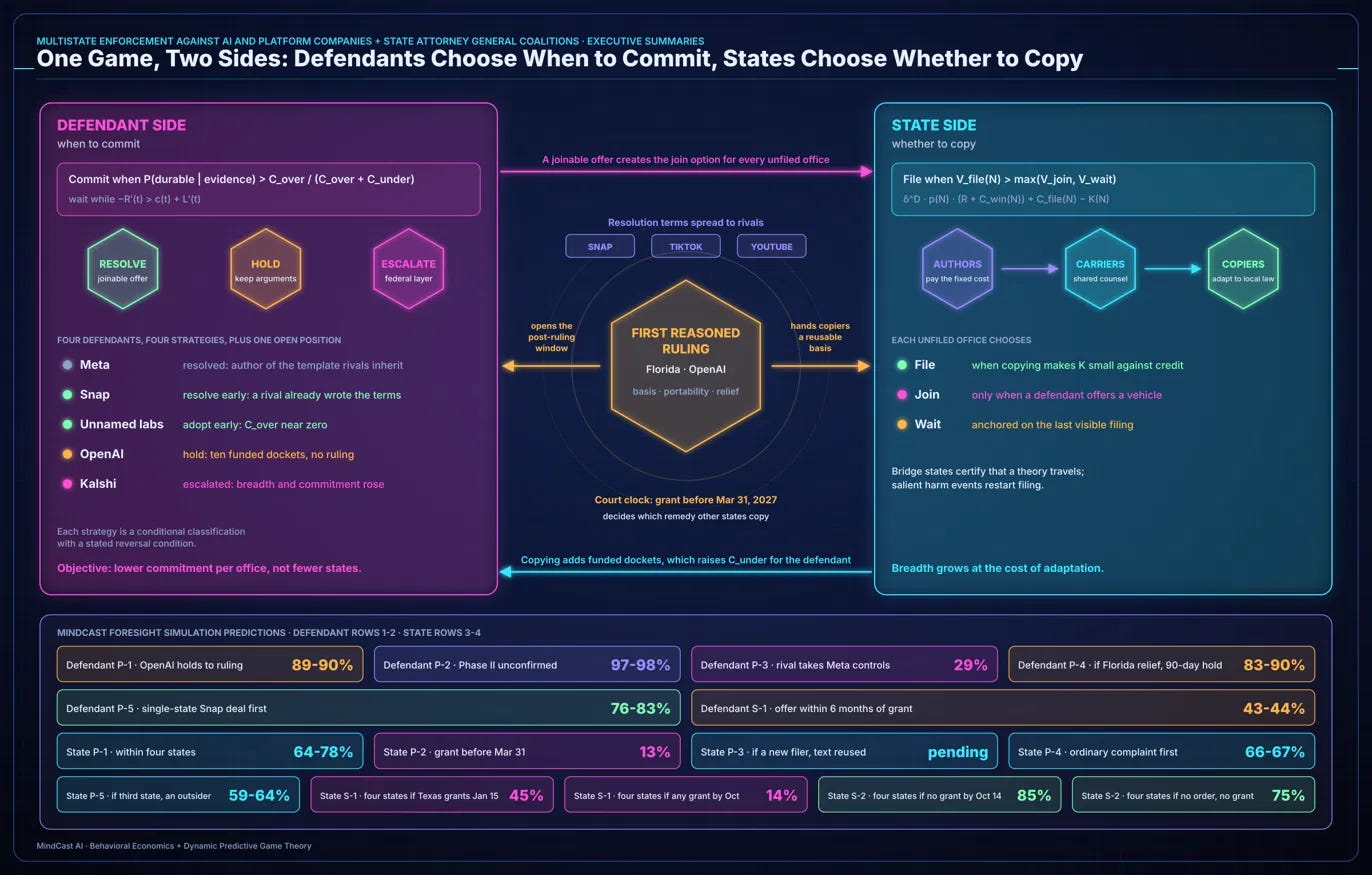
Core insight. A multistate coalition grows by copying, and the object copied is the complaint. MindCast’s model holds that lead offices write the first complaint, outside counsel carries its text and a first reasoned ruling can give later offices a reusable basis.
Eight states sued OpenAI on October 14, 2026. In one inspected passage, Arizona ¶10, Montana ¶11 and West Virginia ¶12 use the same wording. Iowa ¶15 keeps the opening sentences and revises the ending. All four arrived the same day, so the passage shows a shared drafting cluster with local adaptation, and the order of authorship remains open.
At least seven of the eight filers share outside counsel, as Troutman Pepper Locke reported. Three weeks later, West Virginia sued Snap over My AI and cited OpenAI’s published GPT-4 limits as evidence of Snap’s notice. New Mexico had already put My AI safeguards at issue in 2024.
Thesis. The October complaints show shared language with local adaptation. MindCast’s proposed explanation is that copying follows shared counsel and a portable legal basis more than party alignment. The observed passage does not identify the first author, the direction of transfer or whether counsel predicts filers better than party, and Section VIII’s text-reuse measurement supplies that test.
Lead offices pay the fixed cost of theory and evidence, and copying offices pay only the cost of adapting the text. A first reasoned ruling can then give other offices a reusable basis where their law and requested relief fit.
Why now. Eight states filed one template against OpenAI in a single day, and Florida’s injunction motion awaits a hearing. Attorneys general, defense counsel and legislators each decide in 2027 whether the maximal remedy spreads.
What distinguishes the MindCast approach. Coalition commentary counts signatures and sorts states by party. MindCast models the coalition as a market in which the complaint is the product and copying sets how many states file. The paper also proposes a measurable test: paragraph-level text reuse across state complaints.
MindCast AI applies Predictive Behavioral Economics + Dynamic Game Theory through MindCast AI Proprietary Cognitive Digital Twin Foresight Simulations (MP CDT FS). Behavioral Economics supplies the decision rules. Game Theory supplies the payoff structure. Predictive simulations emerge from the combination.
Which part of a remedy another state can reuse. A ruling helps another office only where its own statute supports the same basis and it seeks compatible relief. Pre-release review arrives bundled with a named executive and a court-control prayer, so an office must take on both to copy it.
Hypothesis highlights. Five template hypotheses frame the MP CDT FS.
Published MindCast bands frame two of the open questions:
Bridge acceleration (an open claim in Section X). Joinder accelerates in the 60 days after the first credible cross-party state enters (62-76% in the published formation paper).
Brief breadth (speed-by-commitment hypothesis). The next multistate brief in a state-authority case carries 37 to 41 states (78-88%, published in Kalshi At The Supreme Court). The band was met on October 28, and no published band in this vertical has resolved as a miss.
MindCast Foresight Simulation Predictions. The paper carries seven Simulation Predictions alongside six published MindCast bands carried from prior work. P marks a Primary Simulation Prediction and S a Secondary Simulation Prediction. Florida’s court clock drives whether other states seek the named-executive remedy:
P-1 and P-2 · A grant changes the outlook. A Florida or Texas order granting pre-release relief sharply lowers the chance that the named-executive template stays within four qualifying states (states seeking court control of model releases in a case naming an OpenAI executive). The template stays within four states at 64-78% overall. A grant before March 31, 2027 sits at 13%.
P-3 · Copied text reaches the next filer (band pending). If another state files against OpenAI by October 14, 2027, P-3 tests whether its first complaint reuses at least 30% of its substantive paragraphs from an October 14 complaint. Whether shared outside counsel carries that complaint stays an open claim.
P-4 · Ordinary complaints travel first. By October 14, 2027, an ordinary consumer-protection complaint against OpenAI is filed before a third state seeks the named-executive remedy at 66-67%. The estimate resolves once either filing route occurs.
P-5 · New filers carry the spread. States outside the October 14 coalition, not its members, supply most of the routes to wider adoption. If a third state seeks the named-executive remedy by October 14, 2027, it comes from outside the coalition at 59-64%.
S-1 and S-2 · A grant decides whether the template stays narrow. The template stays within four states at 45%given a Texas grant on January 15, 2027, and at 14% given any Florida or Texas grant through October 2027. Without a grant through October 14, 2027, the figure rises to 85%. It is 75% if Florida issues no order before March 31, 2027 and Texas grants nothing through October 2027.
🏛 Policymakers. A statute that defines the conduct at issue gives every office the same portable basis. Legislators who write that statute decide which complaints other states can copy (Section V).
💼 Executives. The first complaint against your company drafts the ones that follow, and its weak paragraphs travel until a court dismisses them (Section II).
⚖ Counsel. Track the outside firm as well as the caption. Whether shared counsel predicts the next filer better than party remains an open hypothesis (Section II).
📊 Investors. Watch the first reasoned ruling’s basis rather than its winner. The basis gives later filers a reusable ground only where their law and requested relief fit (Section V).
Takeaway. The question shifts from “which states will join” to “which text will travel, and who carries it.”
I. The Governing Equilibrium: Coalitions Grow at the Cost of Copying
The governing equilibrium of multistate enforcement sets the cost of each new complaint at the cost of copying the last one. The formation paper is How State Attorney General Coalitions Form, Grow, and Hold. Installment II showed that lead states absorb the fixed cost of theory and evidence. Installment III identifies what they produce: a complaint whose text later offices adapt.
Copying costs explain why coalitions grow so easily. Writing an original complaint costs months of investigation. Adapting a copied complaint costs a review of local statutes and a change of caption. Coalition breadth therefore clears near the cost of adaptation once the first complaint exists.
Copying does not carry commitment with it. Every office that files a copied complaint still funds its own docket, as the companion publication on defendant containment shows for OpenAI. Copying lowers the cost of entry while leaving the cost of continuing unchanged.
The evidence behind each measure falls into three classes, and every later section draws on them:
Known from public filings. The eight October 14 OpenAI complaints; Florida’s June 1 and Texas’s October 23 complaints; the eight Snap complaints; the Kalshi briefs and criminal filings.
Discoverable. Which outside firm drafted each complaint; how much text each complaint shares with earlier ones; which offices coordinated before filing.
Unknowable until the actors move. The basis of the first reasoned ruling against OpenAI; which offices file after the January 2027 inaugurations; whether a first ruling on My AI arrives before any Snap resolution.
🏛 Policymakers. Coalition breadth tracks the cost of adaptation, not the number of convinced offices.
💼 Executives. One complaint against your company lowers the cost of every later one.
⚖ Counsel. Each copied complaint still carries its own funded docket.
📊 Investors. Breadth rises fastest once the first complaint exists.
Takeaway. A coalition’s breadth tracks the cost of copying its first complaint, while its commitment tracks the cost of funding each copy.
II. Three Roles in Template Diffusion: Authors, Carriers and Copiers
Template diffusion runs on three roles. Authors write the first complaint, carriers move its text and copiers adapt it to their own statutes.
Authors. Lead offices pay the fixed cost. The formation paper found that coalitions above 25 members run on an operating core of eight or fewer offices (80-90%, published coalition paper). The AI child-safety coalitions show a subject-matter core: Iowa, Kansas, Nebraska and West Virginia formed the joint announcement group for the October 14 complaints. Public filings do not establish which office drafted first.
Carriers. Shared outside counsel moves text across offices at near-zero marginal cost. At least seven of the eight October 14 filers share outside counsel, and Idaho’s complaint lists Kibler Fowler & Cave as counsel. A contingency-fee firm earns more from each additional state, so the carrier has a direct incentive to recruit copiers.
Text travel and the identity of its carrier remain separate questions. P-3 measures whether the next complaint reuses October 14 text, and whether the shared firm carries that complaint stays an open claim.
Copiers. Copying offices adapt the text to local statutes and file. Their decision turns on the expected credit of filing against the small cost of adaptation. Behavioral Economics supplies the trigger: offices anchor on the last visible filing and move after salient events.
Bridge states. A credible cross-party office certifies that a theory travels. The formation paper found that bridge entry accelerates joinder over the next 60 days (62-76%). The bridge acts as a focal point that makes coordination safe for offices of either party.
Party alignment matters less than the commentary assumes. Colin Provost’s research across 172 multistate matters finds that an office’s party was not always a significant predictor in consumer cases, while severity and expected recovery were. The formation paper cites that research. Shared counsel and subject-matter expertise sort the copiers more reliably.
🏛 Policymakers. A small operating core writes most coalition complaints.
💼 Executives. Outside counsel paid per state has a reason to recruit more states.
⚖ Counsel. Shared counsel is a testable channel for text, not yet a shown predictor.
📊 Investors. A cross-party bridge filing can speed joinder within 60 days.
Takeaway. Authors pay for the theory, carriers profit from its spread and copiers enter at the cost of adaptation, and the counsel-channel hypothesis (T-1 in Section X) tests whether the carrier predicts the next filer better than the caption.
III. Copying Cuts Filing Costs Faster Than Coalition Size Dilutes Credit
Each attorney general not yet litigating chooses among filing its own case, joining an existing resolution or waiting. Game Theory supplies the payoff structure, and Behavioral Economics supplies the decision rules of salience, credit-claiming and anchoring.
An office files only when its expected payoff from filing beats both joining and waiting:
V_file(N) = δᴰ × p(N) × [ R + C_win(N) ] + C_file(N) − K(N) > max( V_join, V_wait )Here p is the chance of a win, R the recovery and relief and C_win the public credit an office claims from a win. C_file is the credit an office claims simply by filing, and K is its litigation cost. D is the expected delay before any win in months, and δ is the monthly discount factor that converts that delay into present value. N is the number of offices already litigating.
Coalition size enters four terms. K falls with N because authors and carriers absorb the fixed cost, which is the copying effect. C_file and C_win fall with N because credit dilutes as the caption grows. The chance of a win rises with N only when the theory carries a portable basis.
Copying explains why breadth can grow even as credit dilutes. A falling K outweighs a falling C_file for most offices until the caption grows large. Salience then restarts the cycle, because a vivid harm event raises the credit available to the next filer.
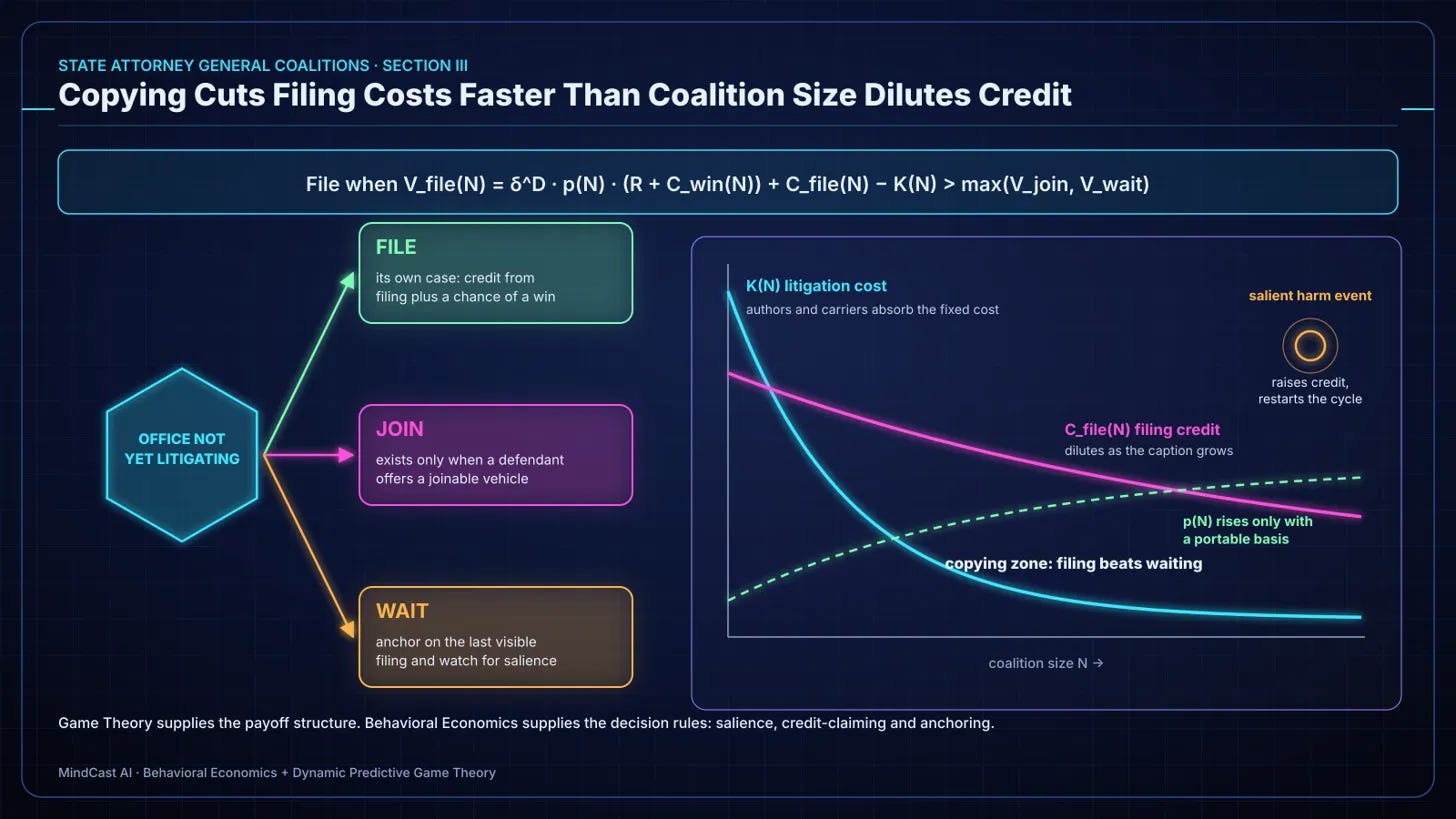
V_join exists only when a defendant offers a vehicle. The companion publication on defendant containment analyzes when a defendant should create one.
🏛 Policymakers. Credit dilutes as the caption grows.
💼 Executives. A joinable offer changes the comparison every unfiled office makes.
⚖ Counsel. Delay discounts the value of a win.
📊 Investors. Salient harm events restart filing.
Takeaway. Copying drives K toward the cost of adaptation, so filing beats waiting for most offices until credit dilution or a defendant’s joinable offer changes the comparison.
IV. Two Templates, Two Speeds
A coalition can run more than one template at once, and templates travel at different speeds. The speed depends on what a copying office must commit to file.
The OpenAI coalition template. Eight states filed on October 14 under state consumer protection statutes, adding product, privacy and nuisance counts office by office. The template names no executive and seeks conduct relief, so a copying office takes on modest political exposure. The template spread to eight states in one filing day.
The Florida and Texas template. Florida’s June 1 complaint named Sam Altman, and its September 28 temporary injunction motion (Highlands County No. 26000295GCAXMX, Filing #257955836) sought independent pre-release approval of new models. Texas’s October 23 petition in Collin County named Altman and asked at ¶208(j) for court-approved evaluation before any new release. The template demands maximal commitment, a named executive and court control of future releases, so two offices have made qualifying filings. The MP CDT FS finds the next qualifying filers more likely to come from offices outside the October 14 coalition than from members amending their complaints.
The Snap templates. Snap faces a social-platform template inherited from the Meta litigation and a chatbot template inherited from the OpenAI and Character.AI cases. West Virginia’s complaint cites OpenAI’s published GPT-4 limits to allege notice. New Mexico’s 2024 complaint had already challenged My AI safeguards, so the supplier disclosure is what crossed into the deployer complaint, not the underlying theory.
The Kalshi templates. States opposing Kalshi run two templates on two vehicles. Briefs travel at signature cost and reached 37 to 39 states. Criminal charges require a state statute and a prosecutor’s commitment, and they reached Arizona and Utah.
Template speed follows one rule. A template that asks less of the copying office spreads faster and wider. A template that asks for a named executive, a conviction or court control of a product spreads slowly and stays with offices that want that result.
The simulation puts numbers on the two speeds. An ordinary complaint is filed before a third state files for the named-executive remedy at 66-67% (P-4). When a third state does seek that remedy, the filer comes from outside the October 14 coalition at 59-64% (P-5).
🏛 Policymakers. Low-commitment templates set breadth, and maximal ones set the ceiling of exposure.
💼 Executives. Named-executive templates spread slowly.
⚖ Counsel. Florida’s motion and Texas’s petition form the baseline of two qualifying filings.
📊 Investors. The next qualifying filer more likely sits outside the October 14 coalition.
Takeaway. Templates sort by the commitment they demand from copiers, and the low-commitment template sets the coalition’s breadth while the maximal template sets its ceiling of exposure.
V. The First Ruling Can Give Other States a Reusable Basis
A reasoned ruling can turn a pleaded theory into a portable basis. Portability here means reusable reasoning or persuasive authority, not binding precedent in another state. Whether it travels depends on the ground the court reaches, whether other states share that legal basis and which remedies they seek. The ruling’s basis matters more than its winner.
The OpenAI Snapshot made the first ruling its central fork. Florida’s pending injunction motion is the lead docket, and nine other courts face dismissal motions on near-identical pleadings. A Florida trial-court ruling binds no court in another state, though other courts may treat its reasoning as persuasive. The October complaints mix consumer protection, privacy and common-law claims, so each category needs separate coding.
Kalshi shows rulings handing the next state a portable basis. The Ninth Circuit ruled for Nevada in August 2026, and the Sixth Circuit ruled for Ohio and Tennessee in September. The circuit rulings bound courts within their circuits and gave states elsewhere reasoning to cite, and courts closed access in Nevada, Michigan and Utah. The Kalshi Supreme Court War Game found that state court orders and filings closed more clocks than federal rules did.
Statutes supply portable bases without waiting for courts. A statute that defines the conduct at issue lets every office plead the same elements. Florida’s 2024 minors’ social media law gives Florida a basis no other office shares, which is why Florida’s Snap complaint does not travel.
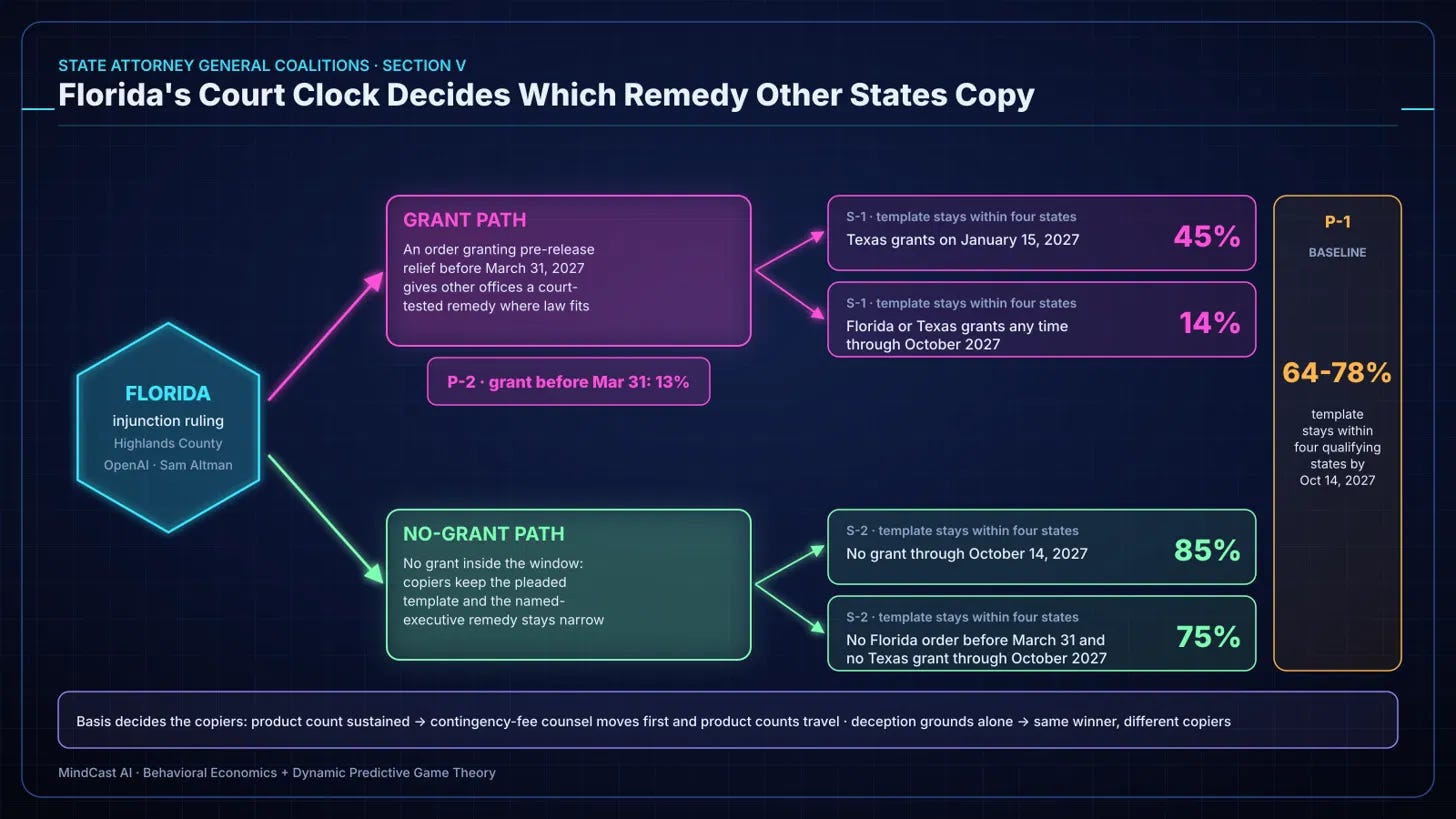
The ruling’s basis also decides which offices move next. Under a Florida ruling that sustains a product count, contingency-fee counsel moves first, because a portable product basis cuts the cost of every new complaint. Candidate offices such as Utah and Tennessee then file as adaptation gets easier.
Copying could then cascade toward the coalition template, with its product counts becoming the standard pleading where other states’ laws support them. A Florida win on deception grounds alone would produce the same winner and different copiers. Offices would copy the deception counts and leave the product counts behind.
Albert Hirschman showed in 1970 that members of a declining organization choose between exit and voice. His 1993 essay on East Germany added the case that matters most for forecasting: mass flight and mass protest fed each other until the regime fell. In the Kalshi contest, sportsbooks exited Utah while states raised their voice through briefs, and the exits and briefs arrived within the same weeks. Stakeholders who stay, leave or switch sides after a ruling decide which game gets played.
The ruling’s timing matters as much as its basis. The MP CDT FS puts an order granting pre-release relief before March 31, 2027 at 13%. If Texas grants pre-release relief on January 15, 2027, the template stays within four qualifying states at 45%. If Florida or Texas grants at any point through October 2027, the figure is 14%.
Florida’s timing barely moves whether OpenAI holds, as the companion publication shows. The court clock therefore matters more for which remedy other states copy than for the defendant’s own strategy.
🏛 Policymakers. A statute gives every office the same basis without waiting for a court.
💼 Executives. An early grant of pre-release relief is the event most likely to widen the named-executive template.
⚖ Counsel. A trial-court ruling can persuade other states but binds none.
📊 Investors. The Florida ruling’s timing matters more for template spread than for OpenAI’s hold.
Takeaway. The first ruling’s basis can change which counts travel, to the extent other states share its legal ground and seek compatible remedies.
VI. Adoption Cascades: When Copying Becomes Self-Sustaining
Copying can stall or cascade. A cascade begins when enough offices file that the next office’s cost of adaptation falls below its expected credit, and each filing lowers the cost for the one after.
MindCast’s adoption analysis, built on Randal Picker’s generative work on norm adoption, models the cascade threshold. The analysis asks whether a seed of filers exceeds the minimum configuration needed to become self-sustaining. The analysis also asks how close the field sits to a transition and where a small intervention would move it.
MindCast’s adoption analysis separates pressure from leverage. A coalition can absorb a large announcement without new filings, while a single bridge filing at the right moment can tip the field. Pressure measures the noise around a coalition, and leverage measures whether a move reaches the threshold.
The network position of each office decides where leverage sits. An operating-core office, a bridge state or a shared carrier each sits at a different point in the network. An intervention at one of those points could move the field more than a larger action elsewhere.
The claim that one well-placed filing can tip the field stands as a hypothesis, not a finding. Testing it requires state-level network data that public filings supply only in part: shared counsel, joint announcements and complaint text. Paragraph-level text reuse across the complaints can supply the missing network data.
🏛 Policymakers. A well-placed bridge filing may tip the field.
💼 Executives. Leverage sits with the offices and carriers nearest the threshold.
⚖ Counsel. The tipping claim remains a hypothesis.
📊 Investors. Large announcements without new filings signal pressure, not leverage.
Takeaway. Copying becomes self-sustaining past a threshold, and the offices and carriers nearest that threshold hold more leverage than the size of any single action suggests.
VII. Seven 2026 Events Set the Authors, Carriers and Bases Copiers Use Today
The copying game evolved through seven dated transitions in 2026. Each changed the authors, the carriers or the bases available to copiers.
January 2026: Kentucky sues Character.AI. A single office authored the first state chatbot complaint for later templates to draw on.
June 1, 2026: Florida sues OpenAI and names Sam Altman. The complaint names Altman without expressly seeking pre-release approval.
September 28, 2026: Florida moves for a temporary injunction. The motion seeks independent pre-release approval of new models, which makes Florida the first qualifying sovereign.
October 12, 2026: Character Technologies files for Chapter 11. States pursued claims inside the bankruptcy, which moved one defendant’s exposure into a single forum.
October 14, 2026: eight states file against OpenAI on a shared template. Complaints from offices sharing counsel show shared language with local adaptation, and the low-commitment template reached eight states in a day.
October 23, 2026: Texas sues OpenAI and names Sam Altman. The petition asks for court-approved evaluation before any new model release, which makes Texas the second qualifying sovereign.
November 5, 2026: West Virginia sues Snap over My AI. West Virginia used a developer’s published limits to plead a deployer’s notice.
In the Kalshi contest, a parallel sequence ran through courts rather than complaints. State court and circuit rulings gave each state a portable basis, and briefs reached 37 to 39 states while criminal charges reached two.
The rules that hold through the forecast window are the state consumer protection statutes and the coalition’s existing complaints. The forks that can replace the game are dated: Florida’s pending injunction ruling, the December 2026 joinder checkpoint and the January 2027 inaugurations.
The forks differ in what they do to the copying game:
Continuation. The December 2026 joinder checkpoint and the January 2027 inaugurations change who files without changing what copiers can copy. The conditional Simulation Predictions remain valid through both.
Equilibrium migration. A Florida ruling on deception grounds alone shifts which counts travel while leaving the named-executive template where it stands.
Changed game. An order granting pre-release relief before March 31, 2027 gives other offices a court-tested remedy where their law fits. The no-grant branch stays pending until its stated window closes without a grant. A coordinated amendment attempt by the October 14 coalition changes the forecast’s premises. A fifth qualifying state by October 14, 2027 makes the template event false.
🏛 Policymakers. Seven 2026 events set the current authors and carriers.
💼 Executives. Florida and Texas are the two qualifying states.
⚖ Counsel. A coordinated amendment attempt would change the forecast’s premises.
📊 Investors. One new state seeking release control would show OpenAI’s exposure spreading past the current pair.
Takeaway. The copying game reached its current form through one maximal author, one low-commitment template carried by shared counsel and one supplier disclosure carried into a deployer complaint.
VIII. Paragraph-Level Text Reuse Turns Copying Into a Checkable Number
Copying leaves a measurable trace in the text. Two complaints drafted from one template share paragraphs, phrasing and structure, and two complaints drafted independently do not. The paper proposes measuring that trace directly.
The text-reuse method compares every pair of state complaints against the same defendant and across defendants in the same harm category. Each complaint splits into paragraphs, and each paragraph receives a similarity value against every paragraph in earlier complaints. The output is a reuse share for each complaint and a similarity map. Arrows of direction appear only where dated drafts or other evidence establish which text came first.
The similarity value is the cosine similarity of term frequency-inverse document frequency (TF-IDF) vectors built from word unigrams and bigrams, with term weights fitted on the complaints in each comparison. Preprocessing lowercases the text and removes punctuation, numbers and citations. It also replaces party and state names with placeholders, so a copied paragraph still matches after a new office inserts its own name. A paragraph counts as reused at a score of 0.8 or higher.
Text reuse tests three of the paper’s hypotheses directly. Shared-counsel pairs should show higher reuse than same-party pairs without shared counsel. Complaints filed after a ruling should reuse the sustained counts and drop the dismissed ones. Complaints against a deployer should reuse paragraphs from complaints against its developer.
The corpus already exists in public dockets. The corpus includes the ten OpenAI complaints, the eight Snap complaints, the Character.AI complaints and the Kalshi briefs. Each comparison strips captions, signature blocks and boilerplate statutory language first, and the similarity threshold is fixed before any result is read. Two controls anchor the reading: complaints by the same office against unrelated defendants, and complaints by same-party offices without shared counsel.
🏛 Policymakers. Text reuse gives regulators a checkable measure of coordination.
💼 Executives. Shared paragraphs mark where one defense can answer many complaints.
⚖ Counsel. The direction of copying needs dated versions.
📊 Investors. Reuse shares can be computed now, before any court rules.
Takeaway. Text reuse turns the claim that states copy each other into a number a reader can check, complaint by complaint.
IX. Where Copying Fails: Templates That Do Not Travel
Some templates stay with their authors. Each failure case shows a term in the join-or-file decision that copying cannot lower.
Statute-specific complaints. Florida’s Snap complaint rests on Florida’s 2024 minors’ social media law. Offices without that statute cannot copy the core count.
Personal-accountability demands. Naming an executive or charging a founder carries political and legal cost that a copier must take on in full. The Florida and Texas template and the Utah charges spread slowly for that reason.
Criminal statutes. A criminal template requires a state criminal law and a prosecutor willing to use it. Arizona and Utah charged Kalshi, while most states opposing Kalshi filed briefs.
Partisan ceilings. Challenges to the federal administration clear within two members of the opposition-party roster (84-93%, published coalition paper). Corporate enforcement escapes that ceiling more often, consistent with the AI coalitions crossing party lines.
🏛 Policymakers. Statute-bound complaints stay narrow.
💼 Executives. Personal-accountability demands raise a copier’s cost.
⚖ Counsel. Criminal templates need a statute and a willing prosecutor.
📊 Investors. Corporate enforcement crosses party lines more often than challenges to the federal administration.
Takeaway. A template travels only as far as its copiers share its legal basis and accept its commitment, so statute-bound and person-bound complaints stay narrow.
X. MindCast Simulation Predictions: The Named-Executive Remedy Stays Within Four States Unless a Court Grants It Early
Five structural hypotheses frame the MP CDT FS. Bands quoted beside a hypothesis come from published MindCast work or from the simulation and carry their source.
T-1 · The counsel channel. Complaints filed by offices that share outside counsel reuse more paragraph text than complaints filed by same-party offices without shared counsel.
Why it matters: the hypothesis tests whether carriers or party alignment drive copying.
Primary observable: paragraph reuse shares across complaint pairs within the same filing wave, sorted by shared counsel and by party. Boilerplate comes out first, and factual allegations, counts and requested relief are measured separately.
Analytical support: Moderate.
What could overturn it: same-party pairs without shared counsel show reuse equal to or above shared-counsel pairs.
T-2 · Basis portability. After the first reasoned ruling, new filings copy the counts the ruling sustained and drop the counts it dismissed.
Why it matters: the hypothesis tests whether courts select the template.
Primary observable: the share of complaints pleading the court-supported count or remedy in the six months after the first ruling, against the share among comparable filers before it. A ruling followed by no new filings resolves nothing.
Analytical support: Moderate to High.
What could overturn it: post-ruling complaints keep dismissed counts at the pre-ruling rate.
T-3 · Speed by commitment. Templates that demand low commitment from copiers reach more offices within twelve months than templates that demand a named executive, a conviction or court control of a product.
Why it matters: the hypothesis explains why coalitions run breadth and exposure on separate templates.
Primary observable: the count of offices adopting each OpenAI and Kalshi template over twelve months.
Analytical support: High on current filings.
What could overturn it: the Florida and Texas template reaches as many offices as the coalition template within twelve months.
Simulation support: P-1 and S-2 below.
T-4 · Cross-defendant migration. A template written against one defendant migrates to a second defendant in the same harm category within one enforcement cycle.
Why it matters: the hypothesis tests whether templates follow the harm rather than the company.
Primary observable: whether text, legal theory or evidence crossed between the West Virginia OpenAI complaint and the West Virginia and New Mexico Snap complaints, with existing deployer cases frozen as baseline.
Analytical support: Moderate, on the West Virginia complaint.
What could overturn it: later deployer complaints show reuse from developer complaints no higher than from unrelated complaints.
T-5 · Subject-matter authors. Subject-matter clusters rather than repeat national leaders author AI child-safety templates.
Why it matters: the formation paper found New York, California, Washington or Colorado leading most new coalitions of 25 or more (62-75%); AI child-safety templates may follow a different author set.
Primary observable: the author offices of each new AI child-safety template through 2027.
Analytical support: Moderate.
What could overturn it: repeat national leaders author most new AI child-safety templates.
MindCast Simulation Predictions
The figures are Simulation Predictions on evidence through November 9, 2026. The paper carries seven: five Primary Simulation Predictions (P), two of which apply only if a stated trigger occurs, and two Secondary Simulation Predictions (S) conditioned on whether a grant issues.
The event: no more than four states have made a qualifying filing against OpenAI by October 14, 2027. Territories and the District of Columbia count as states.
A qualifying filing is a complaint, amended complaint or injunction motion that seeks court control of model releases, filed in a case that names an OpenAI executive officer as a defendant. A motion counts even when the motion itself does not name the executive anew. Florida’s temporary injunction motion of September 28 and Texas’s petition of October 23 form the baseline of two, so a fifth qualifying state makes the event false.
P-1 · The named-executive template stays within four states through October 14, 2027 (64-78%). Falsifier: a fifth qualifying state before October 14, 2027.
P-2 · A Florida or Texas court grants pre-release relief before March 31, 2027 (13%). The Simulation Prediction resolves true if a qualifying order issues before that date and false if the date passes without one.
P-3 · If another state files, its complaint reuses October 14 text (band pending). The eligible complaint is the first original state complaint against OpenAI filed after November 9, 2026 and before October 14, 2027. The Simulation Prediction holds if at least 30% of its substantive paragraphs reach a Section VIII similarity score of 0.8 or higher with a paragraph in an October 14 complaint. Substantive paragraphs exclude captions, signature blocks, verification pages and recitals of statutory text. Term weights for P-3 are fitted on the ten OpenAI complaints on file at November 9, 2026 plus the eligible complaint.
The Simulation Prediction stays pending unless an eligible complaint is filed. Band pending. The Simulation Prediction bears on T-1 and T-3. Falsifier: an eligible complaint below the threshold, verified by text-reuse coding of the public complaints (Section VIII).
P-4 · An ordinary complaint arrives before the maximal remedy spreads (66-67%). An ordinary complaint is an original state consumer-protection complaint against OpenAI without the combined package of a named executive and court control of model releases. The Simulation Prediction holds if an ordinary complaint is filed before a third state makes a qualifying filing under P-1’s definition, by October 14, 2027. The Simulation Prediction resolves when either route occurs and lapses unresolved if neither occurs by the deadline. Falsifier: a qualifying filing first, verified through docket timestamps.
P-5 · If a third state seeks the named-executive remedy, it comes from outside the October 14 coalition (59-64%).The Simulation Prediction applies if a third state makes a qualifying filing by October 14, 2027. The first such state is not one of the eight October 14 filers. Falsifier: an October 14 filer qualifies first through an amendment or motion, verified through file-stamped complaints, amendments and motions.
S-1 · After a grant, the template stays within four states (45% · 14%). P(template stays within four states given a Texas grant on January 15, 2027) = 45%. P(template stays within four states given a Florida or Texas grant at any point through October 2027) = 14%.
S-2 · Without a grant, the template stays within four states (85% · 75%). P(template stays within four states given no grant through October 14, 2027) = 85%. P(template stays within four states given no Florida order before March 31, 2027 and no Texas grant through October 2027) = 75%. Each condition stays pending until its window closes.
Verification for the four template Simulation Predictions: file-stamped complaints, amended complaints and injunction motions, plus the Highlands County and Collin County dockets.
Claims still open. The Simulation Predictions address two claims with bands: ordinary complaints outrun the maximal remedy, and the next maximal filer sits outside the October 14 coalition. P-3 sets the measurement rule for whether copied text reaches the next filer, with its band pending. Three claims stay open: whether a bridge filing in AI child safety accelerates joinder as the published band predicts; which Florida basis the first ruling adopts; and whether shared outside counsel carries the next complaint.
🏛 Policymakers. The named-executive remedy most likely stays within four states.
💼 Executives. An early grant sharply lowers that chance.
⚖ Counsel. The next office seeking court control of model releases most likely sits outside the October 14 coalition.
📊 Investors. A grant before March 31, 2027 is unlikely.
Takeaway. Each hypothesis names its observable and its failure condition, and the text-reuse method supplies the observable for three of the five.
XI. The 1994 Tobacco Filers Supply a Clean Test of Whether Copiers Followed the Authors
Historical coalitions test the copying mechanism when complaint text and filing dates are available. The test codes each coalition by author offices, carriers, filing sequence and the basis each filer relied on.
Tobacco offers a first case. Mississippi filed first in May 1994 and Minnesota followed in August, as the National Association of Attorneys General’s tobacco chapter documents. Massachusetts filed in December 1995 as the fifth state. Mississippi, Florida, Minnesota and West Virginia had filed before it.
The 1998 Master Settlement Agreement (MSA) ultimately covered 46 states. The test asks how much the later state complaints reused from the 1994 authors and which carriers moved the text.
The same protocol extends to opioids, the Kalshi rulings and the coalition that continued against Live Nation after federal exit. Each test compares the copying model with a party-only baseline, and the model earns credit only where it predicts filers that party alone misses.
🏛 Policymakers. Tobacco shows a clean author set from 1994.
💼 Executives. Later complaints in past coalitions show how far early authors’ text traveled.
⚖ Counsel. The protocol separates authorship from carriage.
📊 Investors. The same test extends to opioids, the Kalshi rulings and Live Nation.
Takeaway. Tobacco supplies a clean author set, and the protocol tests whether later complaints copied the authors as the mechanism predicts.
XII. Stakeholder Strategy and Risk Mitigation
Each stakeholder holds a different position in the copying network. The entries list exposure in a unit the stakeholder controls, the unilateral actions that reduce it and the exposure that remains.
Lead state offices. Exposure: staff-months spent on a template other offices copy for free. Actions: lead division chiefs define contribution tiers at seed; lead offices fix the minimum common remedy before carriers recruit copiers. Residual: copiers that file and then drift on remedies.
Copying offices. Exposure: a funded docket built on text another office wrote. Actions: litigation chiefs test whether the copied counts rest on a portable basis before filing; offices weighing the maximal template confirm their own statute supports it. Residual: a first ruling that dismisses the copied counts.
Defense counsel. Exposure: one weak paragraph repeated across many complaints. Actions: defense counsel maps shared text within days of the first filing; motion teams target the shared paragraphs in the forum most likely to rule first. Residual: a ruling elsewhere that sustains the same paragraph.
Outside counsel as carriers. Exposure: fee economics tied to the count of states recruited. Actions: firms disclose shared representation to each client office; engagement leads document local adaptation for each complaint. Residual: conflict challenges where offices’ interests diverge.
Policymakers. Exposure: enforcement standards set by copied complaints rather than statute. Actions: legislators define the conduct at issue in statute, which gives every office the same portable basis. Residual: a statute written to one template carries that template’s weaknesses.
Risk mitigation for the Simulation Predictions. Each entry routes one Simulation Prediction to one audience. Severity and probability appear as separate axes.
🏛 Lead offices in Florida and Texas: no early grant.
Simulation Prediction: S-2. If no grant issues through October 14, 2027, the template stays within four qualifying states at 85%. If no Florida order issues before March 31, 2027 and no Texas grant through October 2027, the figure is 75%.
Exposure: the remedy reaches at most two more offices, measured in staff-months Florida and Texas spend on a remedy few others seek. Severity: moderate. Probability: 85% or 75%, depending on the no-grant condition.
Mitigating actions: the Florida litigation chief seeks a hearing date on the injunction motion once the venue question resolves; both offices publish the remedy terms they seek in a form other offices can adapt by March 31, 2027.
Residual exposure: a ruling on deception grounds alone leaves the pre-release remedy untested in any court.
⚖ Defense counsel for OpenAI: an early grant.
Simulation Prediction: S-1. A Texas grant on January 15, 2027 puts a fifth qualifying state at 55% by the deadline. If Florida or Texas grants at any point through October 2027, the figure is 86%.
Exposure: a court-tested remedy that new filers outside the October 14 coalition can copy, measured in additional forums seeking pre-release review. Severity: high. Probability of a grant before March 31, 2027: P-2 (13%).
Mitigating actions: appellate counsel prepares a stay motion for filing within days of any grant; motion teams map which states’ statutes support pre-release relief by January 31, 2027.
Residual exposure: one sustained grant gives every later filer a template and a precedent at once.
The same coding of counts against each Florida basis serves the companion publication’s entry for OpenAI’s counsel, so the work counts once.
⚖ Defense counsel for OpenAI: copied text.
Simulation Prediction: P-3 (band pending).
Exposure: paragraphs already answered in the October 14 cases reappear in a new forum, measured in shared paragraphs per new complaint. Severity: moderate. Probability: pending.
Mitigating actions: defense counsel builds the Section VIII similarity map of the ten complaints by January 31, 2027; motion teams draft a reusable response to each shared paragraph within 30 days of any new filing.
Residual exposure: a new complaint can adapt shared text to a statute the map does not cover.
🏛 Attorneys general not yet filing: the ordinary complaint.
Simulation Prediction: P-4 (66-67%).
Exposure: if an ordinary complaint comes first, the first new filing carries copied counts without the named-executive package, measured in counts resting on a statute the filing office does not share. Severity: moderate. Probability that an ordinary complaint comes first: 66-67%.
Mitigating actions: litigation chiefs test each copied count against their own statute before filing; intake teams set the remedy prayer, with or without a named executive, before drafting begins.
Residual exposure: an ordinary complaint still inherits the first ruling’s basis once a court rules.
🏛 Lead offices in Florida and Texas: an outside filer next.
Simulation Prediction: P-5 (59-64%).
Exposure: the maximal remedy reaching an office outside any coordination, measured in qualifying states whose remedy language departs from the Florida and Texas terms. Severity: moderate. Probability: P(outside filer first given a third qualifying state) = 59-64%.
Mitigating actions: the Texas litigation chief files the evaluator terms of ¶208(j) as a standalone proposed order by March 31, 2027, so later filers can copy exact terms; the Florida litigation chief does the same for the motion’s pre-release terms after the venue ruling.
Residual exposure: an outside filer can narrow or widen the remedy and split the template.
🏛 Policymakers. Statutes written to one template carry its weaknesses.
💼 Executives. Defense counsel’s best target is the shared paragraph.
⚖ Counsel. Shared representation needs disclosure to each client office.
📊 Investors. A sustained grant would widen exposure across forums.
Takeaway. Every stakeholder’s exposure follows from its position in the copying network, and defense counsel’s best target is the paragraph every complaint shares.
XIII. What to Watch: Dated Signals Through 2027
Eight signals move the copying mechanism’s inputs. Each entry names the Simulation Prediction or hypothesis it bears on, the source to check and how often.
Florida’s ruling on the temporary injunction motion, pending (P-2 and S-1; T-2). The ruling’s basis and timing decide which remedy other offices copy. Source: Highlands County docket, No. 26000295GCAXMX. Review: weekly.
Any new qualifying filing (P-1, S-2, P-5). A fifth state seeking court control of model releases in a case naming an OpenAI executive would make the template event false. Source: state court dockets and attorney general releases. Review: weekly.
December 13, 2026: OpenAI joinder checkpoint. The published OpenAI Snapshot puts one to two states beyond ten suing by this date at 50%. Source: attorney general releases. Review: weekly.
The first new state complaint against OpenAI (P-3, P-4). The complaint tests whether copied text travels and whether an ordinary complaint arrives before the maximal remedy. Source: state court dockets and attorney general releases. Review: weekly.
January 2027 inaugurations. Incoming attorneys general reset priorities, and the formation paper expects near-term joinder to slow and 2027 joinder to rise. Source: attorney general offices. Review: monthly.
The first ruling on a My AI theory (T-4). The ruling tests whether the chatbot template holds against a deployer. Source: state court dockets in the Snap cases. Review: monthly.
Any bridge filing in AI child safety. A cross-party entrant tests the published bridge band in the new subject area. Source: attorney general releases. Review: monthly.
Prediction-market legislation in 2027 sessions. Statutes would give states a portable basis that does not wait for the Supreme Court. Source: state legislative trackers. Review: monthly during sessions.
🏛 Policymakers. The Florida docket is the signal to watch weekly.
💼 Executives. A weekly docket check catches the one filing that ends the four-state forecast.
⚖ Counsel. The first My AI ruling tests the deployer template.
📊 Investors. 2027 legislative sessions may add statutory bases.
Takeaway. The Florida ruling carries the most weight, because its basis and timing shape what other offices can reuse.
Conclusion
Three October 14 OpenAI complaints share one passage word for word and a fourth adapts it. Three weeks later, West Virginia carried OpenAI’s own disclosures into a complaint against Snap. The two events fit one proposed mechanism, which Section VIII’s measurement tests: authors write the complaint, carriers move it and copiers adapt it.
Copying sets a coalition’s breadth near the cost of adaptation and leaves commitment with each funded docket. A first reasoned ruling can then give later filers a reusable basis where their law and requested relief fit. If another state files, P-3 tests whether its complaint reuses the October 14 text. An ordinary complaint most likely arrives before a third state seeks the maximal remedy (66-67%).
The decisive signal is the basis of Florida’s ruling. The text-reuse measurement then shows whether the copying followed counsel, the basis or the party. The Simulation Predictions sharpen the point: Florida’s timing moves whether the named-executive remedy spreads far more than it moves OpenAI’s hold.
Working With MindCast
The next complaint against OpenAI is more likely to be an ordinary consumer-protection filing than a third named-executive case (66-67%, P-4). If a third state does seek that remedy, it most likely sits outside the October 14 coalition (59-64%, P-5). Both findings put one question in front of every party: which paragraphs will the next filer reuse, and who will draft them? Public dockets answer it only after the complaint lands.
A commissioned engagement answers it first, for one matter. MindCast builds Cognitive Digital Twins (CDTs) of the author offices, carriers and copiers on a live matter. The MP CDT FS then runs against the full complaint set. Every engagement opens with a paragraph-level similarity map of the complaints already on file, scored under the Section VIII rule that P-3 uses.
The map shows which text has already traveled and which counsel carried it. The deliverables then split by client:
Defense counsel for a named company receives the shared-paragraph inventory, one response drafted for each shared paragraph and a ranked list of the offices most likely to file next, with the text each would reuse.
An attorney general office weighing a filing receives a test of each copied count against its own statute, so the office files only counts that hold at home. The package includes the remedy language Florida and Texas put before their courts.
A liability carrier or investor receives a forum count: the dockets a first ruling could open, sorted by basis and keyed to the dated signals in Section XIII.
Contact mcai@mindcast-ai.com or visit www.mindcast-ai-simulation.com to scope a similarity map on one live matter.
MindCast Works
Multistate Enforcement Against AI and Platform Companies — How Defendants Contain State Attorney General Coalitions and Write the Standard Their Rivals Inherit. Companion publication; defendant containment and commitment timing.
State AG Coalitions in the Landscape of Emerging Federalism. Installment I; why authority moves to the states.
How State Attorney General Coalitions Form, Grow, and Hold. Installment II; coalition vector, operating core and bridge mechanics.
OpenAI State Attorney General Lawsuits — Two Pleading Templates Across Ten State Courts Decide Which Game Theory Evolution Arrives First. The two OpenAI templates and the first-ruling fork.
State Attorneys General Sue Snap, Not OpenAI, Over My AI — West Virginia Cites OpenAI’s Published GPT-4 Limits. The developer-to-deployer crossing.
Kalshi Supreme Court War Game — Which Investor and Operator Positions Hold Up Under Any Ruling on Prediction Markets. Copying through rulings and the brief and criminal templates.
The Calculus of Predictive Game Theory Evolution and Mutation. Horizon control and game evolution classification.
MindCast AI Enforcement and Litigation Tracker. Live docket tracking for the complaint corpus.
Sources
Troutman Pepper Locke, Eight State AGs Sue OpenAI (October 16, 2026). Reports the eight October 14 filings and their shared counsel.
Kelley Drye, Florida Sues Snap Using New Social Media Law (April 25, 2025). Describes Florida’s statute-based Snap complaint.
National Association of Attorneys General, Powers and Duties, Chapter 22, Tobacco. Dates the 1994 Mississippi and Minnesota filings.
Federal Reserve Bank of Boston, New England Fiscal Facts on the Massachusetts tobacco suit. Dates Massachusetts’s filing and its order among states.
National Association of Attorneys General, The Master Settlement Agreement. Scope of the 1998 agreement.
Colin Provost, “The Politics of Consumer Protection: Explaining State Attorney General Participation in Multi-State Lawsuits,” Political Research Quarterly. Party as a weak predictor across 172 multistate matters.
Paul Nolette, Federalism on Trial: State Attorneys General and National Policymaking in Contemporary America(University Press of Kansas, 2015). History of state attorney general policymaking.
Albert O. Hirschman, Exit, Voice, and Loyalty (Harvard University Press, 1970). The exit-and-voice framework.
Albert O. Hirschman, Exit, Voice, and the Fate of the German Democratic Republic, World Politics 45 (1993). Exit and voice arriving together.
Randal C. Picker, “Simple Games in a Complex World: A Generative Approach to the Adoption of Norms,” 64 University of Chicago Law Review 1225 (1997). Seed and threshold concepts for adoption cascades.