
Meta · Snap Inc. · OpenAI · Kalshi · Unnamed frontier developers · State attorneys general · Commodity Futures Trading Commission · Contingency-fee outside counsel · Liability carriers
Companion to the MindCast case work on Snap, OpenAI, Meta and Kalshi. Companion publication: State Attorney General Coalitions — How Lead States Set the Template and Why Other States Copy the Complaint.
Related works · How State Attorney General Coalitions Form, Grow, and Hold · State AG Coalitions in the Landscape of Emerging Federalism · MindCast AI Enforcement and Litigation Tracker · The Calculus of Predictive Game Theory Evolution and Mutation
Executive Summary
Core insight. A defendant cannot stop a multistate coalition from growing. A defendant can stop the coalition from staying committed, and the defendant that moves first can write the standard the coalition then enforces against firms still outside it.
Meta’s August 26, 2026 agreement with 52 attorneys general shows a coalition growing while its commitment falls. Breadth reached near-universal size, yet Florida, New Mexico and the U.S. Virgin Islands stayed outside it.
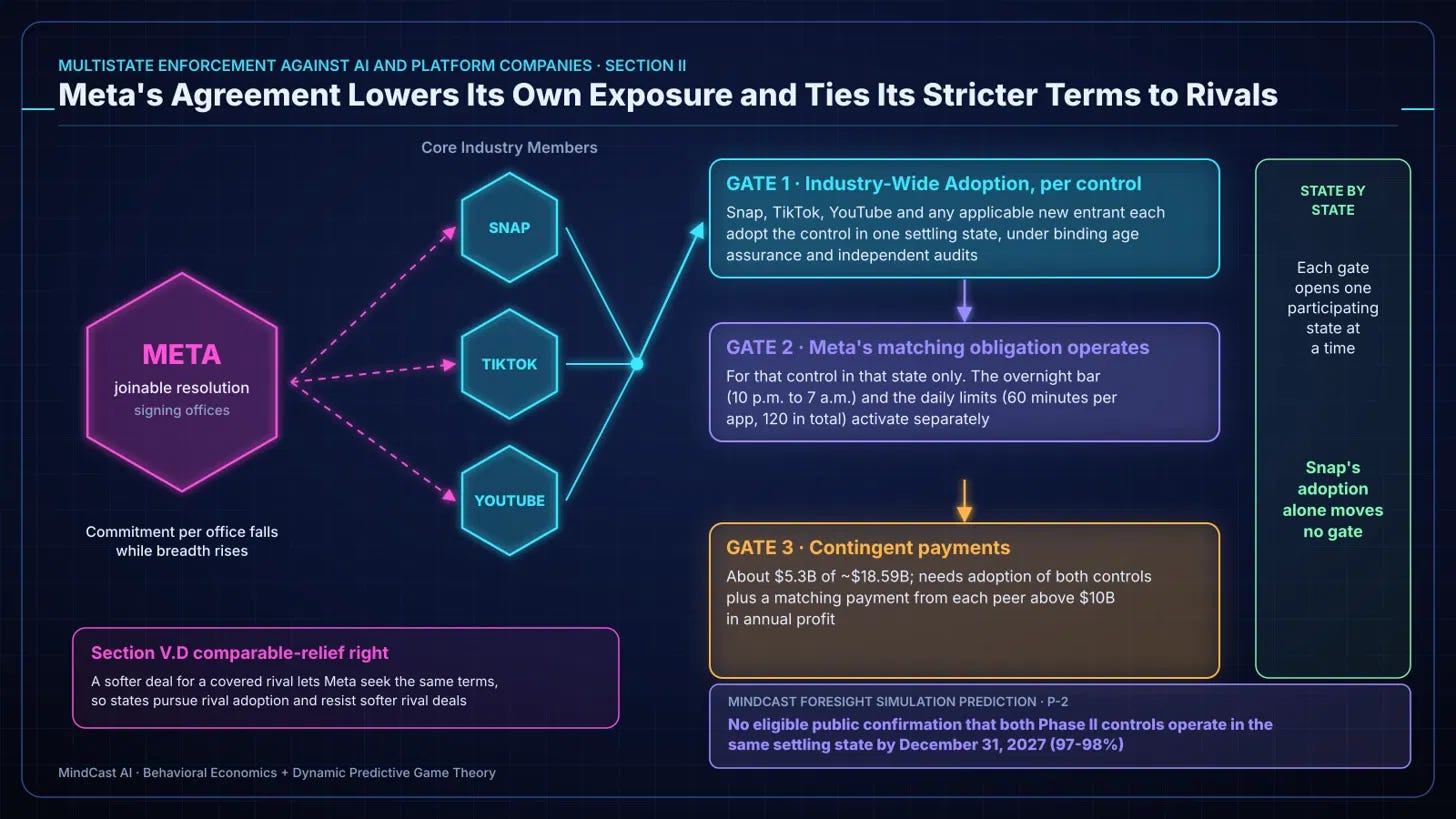
The agreement ties Meta’s stricter terms to its rivals one control and one state at a time. Each Phase II control becomes operative in a state only after Snap, TikTok, YouTube and any applicable new entrant all adopt it there under binding age assurance and audits. About $5.3 billion of contingent payments requires adoption of both controls plus matching peer payments, so Snap’s adoption alone activates nothing. The control terms appear in the agreement and the payment exposure in Meta’s quarterly report.
Thesis. Defendants write the standard their rivals inherit. Meta’s agreement shows the first step directly: it gives states financial and legal reasons to seek comparable terms from rivals. The second step stays a hypothesis: later enforcement concentrates on the last defendant outside the standard. A defendant contains its own exposure by offering a low-commitment way to join at the moment waiting stops paying, and the paper tests that claim on four defendants.
When to move. The moment arrives early for a defendant with few filed forums or a rival that already wrote its terms. For a defendant facing many open dockets, the moment arrives after an adverse ruling whose basis, portability and relief raise the cost of continuing elsewhere. States’ filings against Kalshi show breadth and commitment rising after Kalshi’s federal escalation. Whether escalation caused the rise remains a hypothesis the paper tests.
Why now. Snap faces its first trials in August 2027, OpenAI awaits Florida’s first ruling and Meta’s agreement now names rivals it never bound. General counsel, liability carriers and investors each face a dated decision inside the next twelve months.
What distinguishes the MindCast approach. Defense commentary counts states and reads the caption as consensus. MindCast measures three outcomes separately: how many states join, how much each state commits and how far the resolving defendant’s terms spread across the industry.
MindCast AI applies Predictive Behavioral Economics + Dynamic Game Theory through MindCast AI Proprietary Cognitive Digital Twin Foresight Simulations (MP CDT FS). Behavioral Economics supplies the decision rules. Game Theory supplies the payoff structure. Predictive simulations emerge from the combination.
Hypothesis highlights. Five defendant hypotheses frame the MP CDT FS.
Published MindCast bands already bear on three of them, tagged by the hypothesis each informs:
Rival preemption (laggard hypothesis). The first Snap resolution in a state that signed Meta’s agreement carries Meta-tracking age assurance and a teen time-limit default by the end of 2027 (65-85% in the published Snap analysis).
Forcing events (commitment-timing hypothesis). At least one attorney general action against Snap resolves before the first trial opens in August 2027 (60-80%, published Snap analysis).
Early adoption (laggard hypothesis). A frontier lab not yet sued faces a 40% chance of being named within twelve months, falling to 20% if it adopts the pleaded conduct terms before any order (published OpenAI Snapshot).
MindCast Foresight Simulation Predictions. The paper carries six Simulation Predictions alongside eleven published MindCast bands carried from prior work. P marks a Primary Simulation Prediction and S a Secondary Simulation Prediction:
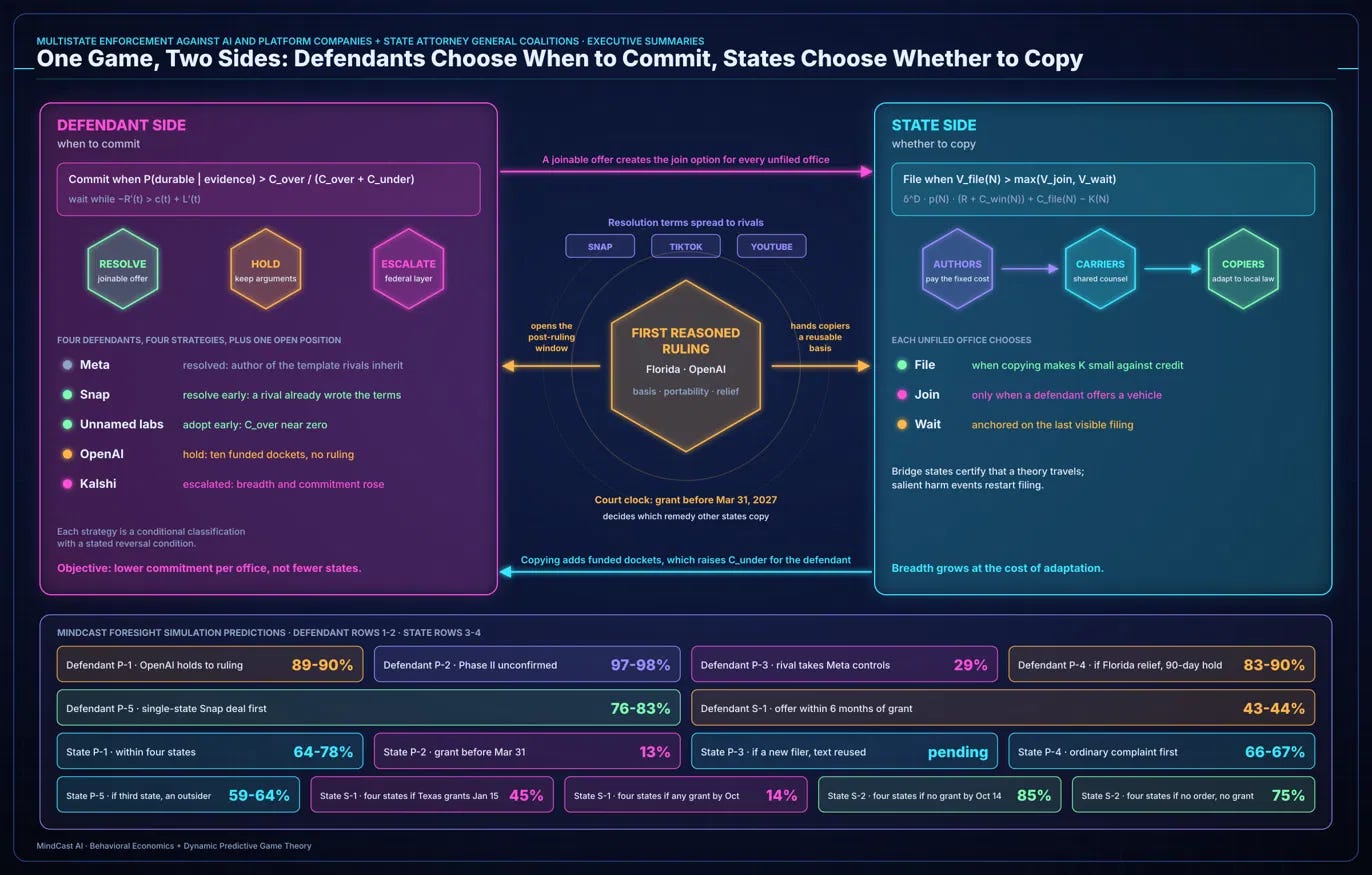
P-1 · OpenAI holds through the Florida ruling (89-90%). No offer or resolution covering three or more states first becomes public before the Florida ruling or March 31, 2027, whichever comes first. A smaller resolution with an express path for a third state to join also counts. A reasoned order changes OpenAI’s calculation through its basis, portability and relief, while its timing barely moves the hold.
P-2 · No eligible public confirmation of Meta’s Phase II through 2027 (97-98%). No court filing, official attorney general statement or Meta SEC filing confirms both controls operative in the same participating state by December 31, 2027. Most of the probability comes from no state opening an adoption route, and most of the rest from peers failing to align once a route opens.
P-3 · A rival accepts Meta-level teen controls by 2027 (29%). TikTok or YouTube enters a binding resolution with a state attorney general by December 31, 2027 that imposes an overnight teen access bar covering 10 p.m. to 7 a.m. or a default daily cap of 60 minutes or less per app. P(rival adoption given a Snap resolution with both controls) = 35-36%.
P-4 · If Florida wins interim relief, OpenAI holds for 90 more days (83-90%). The Simulation Prediction applies if Florida obtains substantive interim relief in a reasoned order by September 30, 2027 and no qualifying public offer or resolution precedes the order. OpenAI then makes no qualifying public offer or resolution in the following 90 days.
P-5 · A single-state Snap deal comes before a joinable deal (76-83%). Snap’s first single-state resolution comes before any joinable resolution through 2027. Snap can close a trial without buying agreement from every office.
S-1 · OpenAI offers within six months of a grant (43-44%). If a court grants Florida or Texas pre-release relief before October 14, 2027, OpenAI makes a qualifying public offer or resolution within 183 days.
🏛 Policymakers. A resolving defendant’s terms become the industry’s terms once rivals adopt them or statutes codify them. Legislators decide which resolution terms persist (Section V).
💼 Executives. Compare the cost of resolving with the cost of continuing before the next forcing event, the trial date or ruling that forces a decision. A rival’s resolution can write your obligations before any state sues you (Section III).
⚖ Counsel. A ruling that state law governs creates exposure for continued conduct before any injunction issues, as Utah’s charges against Kalshi show (Section III).
📊 Investors. Coalition announcements matter through how much each state spends, not how many states sign. MindCast’s laggard hypothesis holds that the last firm outside the standard absorbs the coalition’s commitment (Section VI).
Takeaway. The question shifts from “how many states will sue” to two others: how many states will keep spending, and whose terms will the industry inherit.
I. The Governing Equilibrium: States Join at Low Cost, Commitment Carries the Exposure and Terms Spread to Rivals
The governing equilibrium of multistate enforcement holds breadth and commitment on separate axes. MindCast’s formation paper carries the title How State Attorney General Coalitions Form, Grow, and Hold.
The formation paper measured every coalition three ways. Lead states absorb the fixed cost of theory and evidence, so later offices join at falling cost. Coalition size therefore reflects the cost of joining, not the strength of conviction.
The OpenAI litigation shows falling joining costs on two pleading templates. Every joiner carries a funded docket, so commitment stays maximal however far breadth travels. Ten state forums and no consolidation path leave OpenAI facing breadth multiplied by maximal commitment.
A defendant’s litigation exposure follows from the product of the two axes. Eight funded dockets at trial commitment cost more than fifty signatures on a consent judgment. Breadth matters to a defendant only through the commitment each new office carries.
Standard adoption is the third measure. A resolution’s terms can spread to rivals and into statutes, so a defendant can win on breadth and commitment while helping build a stricter industry standard. The paper therefore tracks three outcomes:
Breadth. How many states litigate or sign.
Commitment. What each office spends, from a signature to a trial team.
Standard adoption. How far the resolving defendant’s terms spread to rivals and statutes.
The evidence behind each measure falls into three classes, and every later section draws on them:
Known from public filings. Meta’s agreement terms; the eight Snap dockets and their trial dates; the ten OpenAI forums; the Kalshi circuit split and Utah’s criminal case.
Discoverable. Each defendant’s reserve assumptions; whether rivals intend to adopt Meta’s obligations; each office’s internal resource commitment.
Unknowable until the actors move. The basis of the first reasoned ruling against OpenAI; whether any rival adopts Meta’s controls without a deadline; the Supreme Court’s first order on the Kalshi petitions.
🏛 Policymakers. Coalition size measures the cost of joining, so a large caption says little about enforcement intensity.
💼 Executives. Exposure scales with funded dockets, not signatures.
⚖ Counsel. Each added state matters through the trial team it funds.
📊 Investors. Breadth headlines misstate risk unless read alongside commitment.
Takeaway. Commitment carries a defendant’s own exposure, while standard adoption carries the industry’s, and a defendant can move the two in opposite directions.
II. Why Reducing the Headcount Is the Wrong Objective
A defense strategy aimed at fewer states fights the mechanism that makes coalitions grow. The companion publication on how states copy complaints shows why: lead states and shared outside counsel make each new complaint a copy of the last one. A joinable resolution lowers joining cost further, so Meta’s agreement drew more states than any complaint against Meta had.
Public recovery allocations pull in late joiners. MindCast’s formation paper puts a measurable late-joinder wave after allocations become public at 76-88%. A defendant that offers a resolution invites breadth by design.
The right objective is lower commitment per office. A resolution converts a litigating office into a signing office, and a signing office spends formatting cost rather than trial-team cost. Breadth rises while exposure falls.
Meta’s agreement creates a containment paradox. The agreement ties its stricter terms to rivals control by control and state by state. Industry-Wide Adoption for one Phase II control occurs in a settling state when Snap, TikTok, YouTube and any applicable new entrant each take on that control there. Each may do so by binding commitment, applicable law or audited voluntary compliance, and each must face binding age assurance for users 13 to 17 and independent third-party audits under Section I.DD of the agreement.
Meta’s matching obligation then becomes operative in that state for that control alone, under Section II.B.1.b. The overnight access bar and the daily limits activate separately, so one can apply without the other. P-2 observes something narrower than either trigger: an official confirmation that both obligations operate in the same state.
Contingent payments require more again. About $5.3 billion of payments up to approximately $18.59 billion becomes payable only after Industry-Wide Adoption has occurred for both controls and each peer above $10 billion in annual profit owes a matching payment. Meta’s quarterly report states the payment exposure, and Section I.U of the agreement sets the trigger. Snap’s controls count toward adoption, but Snap’s adoption alone activates no Phase II obligation and triggers no payment.
Section V.D of the agreement adds a second mechanism. It gives Meta a right to seek comparable injunctive relief in a state that grants a covered rival more favorable terms on comparable claims. States therefore have a reason to pursue rival adoption and a reason to resist softer rival deals.
Counting firm and industry exposure separately resolves the paradox: Meta lowered its own exposure and created conditions that raise the value of commitments from its rivals. Whether rivals actually adopt and whether adoption switches on Meta’s obligations in a named state are separate events, and the durability hypothesis (D-4 in Section X) tests both.
The simulation puts rival adoption below even odds through 2027. TikTok or YouTube accepts a Meta-level teen control by the end of 2027 at 29% (P-3). A Snap resolution carrying both controls raises that estimate to 35-36%.
🏛 Policymakers. Joinable resolutions raise participation while lowering enforcement spending per office.
💼 Executives. A resolution that lowers your exposure can raise your rivals’.
⚖ Counsel. Meta’s comparable-relief right gives states a reason to resist softer rival deals.
📊 Investors. Meta’s contingent payments depend on peers above $10 billion in profit, so Snap’s adoption alone moves no cash.
Takeaway. Mitigation targets commitment per office for the resolving firm, and the same move can raise exposure for every rival still outside the terms.
III. Commitment Timing: Offer a Joinable Resolution Early or One Cycle After the First Adverse Ruling
Each attorney general not yet litigating chooses among filing, joining and waiting. The companion publication on how states copy complaints states that decision formally and shows how coalition size lowers the cost of filing. A defendant’s move enters the decision through one term: joining exists as an option only when a defendant offers a vehicle.
MindCast’s short horizon installment states a commitment threshold for any actor deciding whether to commit before a game stabilizes:
Commit when P(durable | evidence) > C_over ÷ (C_over + C_under)For a defendant, C_over is the incremental cost of a resolution offered too early: the terms it accepts, its compliance cost and the feasibility signal it sends to forums still litigating. Meta’s agreement reserves defenses and disclaims admissions, so a resolution concedes no legal framing; the cost is practical. C_under is the expected cost of continuing across the remaining forums, including dockets not yet filed and rivals that move first.
The full calculation in The Calculus of Predictive Game Theory Evolution and Mutation adds three terms. Commitment error falls as evidence arrives, and it falls in a jump at the first ruling. Delay costs accrue with every new funded docket, and preemption loss arrives when a rival acts first.
J(t) = R(t) + ∫₀ᵗ c(u) du + L(t) wait while −R′(t) > c(t) + L′(t)R is commitment error, c the cost of each month of delay and L the loss from a rival moving first.
Preemption loss carries the main extension of the timing calculation. In coalition litigation, the first defendant to resolve writes terms that states can then seek from later defendants.
Meta’s agreement made Snap, TikTok and YouTube Core Industry Members. Their adoption of a control, under binding age assurance and audits, makes Meta’s matching obligation operative in that state. Snap’s preemption loss has already occurred, so waiting buys Snap no protection from it.
The short horizon installment also states when options lose to commitment. Options normally beat commitments in short horizon games, except in first-come channels where the early mover captures position. Coalition leads form one such channel on the enforcement side, and resolution forms the matching channel on the defense side.
Two questions carry the timing test. The first asks which actor benefits from delay. The second asks which change converts a contested matter into resolution and when, and every matter resolves as delay-dominant or resolution-dominant.
The commitment rule. A defendant should offer a joinable resolution when the expected cost of continuing across remaining and future forums exceeds the incremental cost of the resolution. Three windows follow:
Early window. Few forums are filed, or a rival already wrote the terms. C_over sits low, so the defendant can act on thin evidence.
Post-ruling window. A reasoned adverse ruling raises the expected cost of continuing by an amount its basis, portability and relief determine. A ruling whose reasoning other courts find persuasive raises that cost across the remaining forums.
Hold window. Many dockets are open and no court has ruled. A resolution’s feasibility signal reaches every open forum while no ruling has raised the cost of continuing, so delay dominates.
The simulation tests the post-ruling window directly. P(no qualifying public offer within 90 days given substantive Florida interim relief and no earlier offer) = 83-90% (P-4). P(qualifying public offer within 183 days given a Florida or Texas grant of pre-release relief) = 43-44% (S-1).
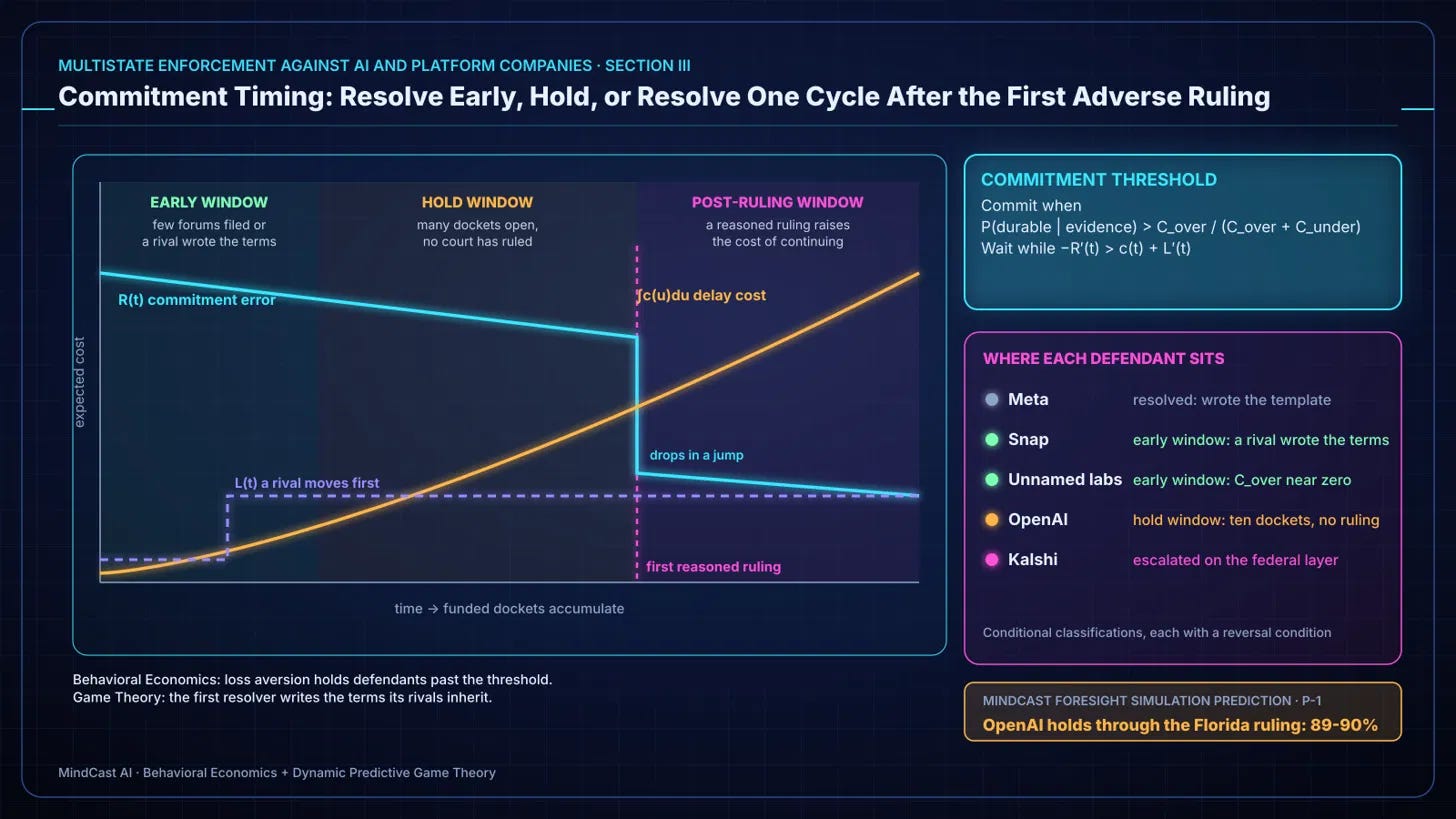
The windows classify positions rather than prescribe calibrated choices. Placing a specific defendant inside a window requires estimates of C_over, C_under and the probability of a durable resolution that this paper does not supply.
Holding a legal position differs from continuing the challenged conduct. A defendant in the hold window keeps its arguments and treats a ruling that state law applies as notice, even before an order enjoins specific conduct. Kalshi kept operating in Utah after an August ruling that state law applied, and Utah’s felony counts rest on that trading.
Behavioral Economics predicts systematic misses around the threshold. Loss aversion holds defendants back past the point the cost ratio recommends, and a defendant whose last bet stranded waits longer still. Snap resolved its last Los Angeles bellwether claims during jury selection, which matches resolution at the Los Angeles forcing event.
🏛 Policymakers. The timing of a defendant’s offer shapes how many offices keep litigating.
💼 Executives. Waiting buys nothing once a rival has written the terms.
⚖ Counsel. A ruling’s basis and relief, not its date, set how far it raises the cost of continuing.
📊 Investors. One reasoned adverse ruling can change exposure across many dockets at once.
Takeaway. The rule tells a defendant when to resolve: early if unfiled or preempted, after an adverse ruling whose basis and relief travel if many dockets are open, and never by missing an order’s compliance deadline.
IV. Seven Defense Levers: Four Change the Game a New Office Enters and Three Improve Position Inside It
The Calculus paper splits the value of any move into two parts. One part changes which game arrives. The other improves position inside the game the actor already plays.
dV_i/da = Σ_g ( dp_g/da × V_ig )  +  Σ_g ( p_g × dV_ig/da )
          which game arrives         position within games
MindCast’s Kalshi Supreme Court War Game classifies every turn into one of three moves. A continuation updates information inside the same game. An equilibrium migration changes which outcome persists, and a game evolution changes the players, payoffs or strategies. The levers below carry the same labels.
Levers that change which game arrives.
Lever 1, joinable template. One agreement plus parallel state judgments lets a new office claim a win in weeks. The lever migrates the equilibrium from filing to signing. The observable is a joinder clause and states signing after the first filing.
Lever 5, condition the defendant’s own obligations on rival adoption. Obligations that become operative for the defendant only when rivals adopt comparable terms give states a reason to pursue those rivals. The lever evolves the game by changing its targets. The observable is rivals named in the agreement and states pressing those rivals.
Lever 6, shift duty downstream. Developer terms that make deployers responsible for minors move the coalition’s aim. The lever applies only to companies supplying models or platforms others build on.
Lever 7, escalate to the federal layer. A preemption claim, a federal ally or a federal forum tries to replace the state game with a federal one. Breadth and commitment rose after Kalshi’s escalation, so the Kalshi contest shows no containment benefit. The escalation hypothesis (D-5 in Section X) tests whether escalation caused the rise.
Levers that improve position within the game.
Lever 2, shrink the portable evidence base. Verified fixes and dated decision logs answer the paragraphs a new complaint would copy. The lever lowers the chance of a win for the next office.
Lever 3, counsel economics. Terms weighted toward verified controls over cash shrink contingency fees, so fewer firms recruit new states. The lever also blunts the allocation wave.
Lever 4, political calendar. Incoming attorneys general set priorities in their first months. A defendant that presents a verified compliance file before priorities form lowers the credit a new office expects from filing.
Published coalition results support the levers. Large coalitions sustain trial commitment only with portable evidence and compatible remedies (74-84%, published coalition paper). Lever 2 attacks portability, and lever 5 breaks remedy compatibility, because Meta’s obligations take effect state by state.
Lever 2 carries a self-defeat risk. MindCast’s Foresight-to-Duty Conversion in AI Governance series holds that compliance files become evidence of knowledge when the underlying gap persists. A published safety baseline narrows what a new complaint can copy only if the fixes are verified.
🏛 Policymakers. Conditioning a defendant’s obligations on rival adoption shifts enforcement toward firms that never signed.
💼 Executives. Four levers change the game a new office enters, and three improve position inside it.
⚖ Counsel. Unverified fixes can become evidence of knowledge.
📊 Investors. Federal escalation has shown no containment benefit on the Kalshi facts.
Takeaway. Levers 1, 5 and 6 change the game a new office enters, and levers 2 through 4 improve position in the current one. Lever 7 also changes the game, and both breadth and commitment rose after Kalshi’s escalation.
V. Stabilization: How Resolution Turns a Short Horizon Game Into a Long Horizon One
MindCast’s long horizon installment defines when a game supports deeper forecasts. Four kinds of evidence carry the stabilization condition: a binding act, reuse by independent actors, subsiding response waves and boundable payoffs. Mitigation means producing those four kinds of evidence on the defendant’s terms.
A coalition’s theory can stay contested while the defendant’s terms stop being contested. Consent judgments make the terms binding, and rivals adopting the same controls supply independent reuse. Joinder that stops shows the response waves subsiding, and a fixed set of obligations bounds the payoffs. Mitigation therefore means steering the game toward stability.
A defendant can partly choose durability. An actor who benefits from a change can recruit a second adopter. Meta used lever 5, conditioning its own obligations on rival adoption and giving states reasons to seek comparable terms. Kalshi recruited by contract, signing commercial terms with three major professional sports leagues and pursuing tribal ventures.
Reliance on rivals to sustain the terms carries Meta’s main exposure. The long horizon installment holds that games sustained by one actor or by a role with no successor revert more often than games sustained by continuing reuse. Meta’s agreement sets no adoption deadline for the Core Industry Members and names no auditor, though it sets a selection and dispute process.
Randal Picker’s generative work on norm adoption names the risk of a template that rests on rivals who may never adopt. MindCast’s adoption analysis, built on that work, flags systems that look resilient while sitting near a narrow transition point. A template that depends on three rivals adopting can look settled until one refuses.
🏛 Policymakers. Codified resolution terms last longer than terms that wait on rivals.
💼 Executives. A template that depends on rivals with no deadline can revert.
⚖ Counsel. The agreement names no auditor, so the selection process shapes what counts as compliance.
📊 Investors. Reversion risk sits where activation rests on rivals.
Takeaway. A resolution stabilizes the game only when other actors reuse its terms, and a template held up by rivals with no deadline is the place to watch for reversion.
VI. Enforcement Followed Rivals’ Moves in Two Industries, and the Laggard Hypothesis Tests Whether Waiting Draws It
Coalition commitment does not spread evenly across an industry. One case and one published forecast point to commitment concentrating on whichever defendant has not adopted the emerging standard, and a third case shows rival exits following enforcement.
Prediction markets. Utah charged Kalshi and its two founders on October 28. DraftKings announced its Utah exit later that day, and FanDuel followed on October 30. Fanatics stopped Utah trading on November 4. Rival exits followed the charges, so the case shows the order in which laggards formed, not why they formed or where pressure lands next.
Social platforms. Meta resolved in August. Framework states then gained a reason to seek Snap’s own commitment, and West Virginia filed against Snap in November.
Frontier AI. The published OpenAI Snapshot gives a lab that adopts the pleaded terms early half the naming odds of a lab that waits: 20% against 40%. The figures are a prior forecast and a testable proposition, not an observed case.
Game Theory explains why commitment would concentrate on the holdout. An office claims credit for a visible win, and a defendant that has already adopted the standard offers no win to claim. Behavioral Economics adds salience: the remaining holdout becomes the most visible case available, and a felony count against a named founder is the most salient case of all.
Prediction markets and social platforms show the same sequence, with frontier AI a forecast rather than an observed case. The laggard hypothesis (D-3 in Section X) tests whether the pattern holds as a rule.
The laggard principle joins the paper’s two halves. Early movers write the standard, and coalitions enforce it against the laggards. A defendant deciding whether to wait must count the chance of becoming the last firm outside the terms.
🏛 Policymakers. Enforcement followed rival exits in prediction markets, a sequence rather than a shown cause.
💼 Executives. If the laggard hypothesis holds, waiting raises the odds of becoming the visible holdout.
⚖ Counsel. Charges against named founders carry the most salience for prosecutors.
📊 Investors. Holdout concentration stays a hypothesis until D-3 resolves.
Takeaway. The observed cases show sequence, and D-3 tests the cause. If D-3 holds, each rival that adopts the standard would concentrate the coalition on whoever remains outside it.
VII. Seven Moves in Eleven Weeks Made Meta the Template Author and Kalshi the Escalation Case
The defendant game evolved through seven dated transitions in about eleven weeks. Each changed the players, the payoffs or the moves available. Each also left some positions surviving and others converting or stranded.
August 26, 2026: Meta’s agreement. Snap, TikTok and YouTube became targets of a resolution they never signed. Texas joined through a parallel consent judgment. Florida declined, and New Mexico stayed out after winning its own judgment. Meta converted from litigant to template author.
October 7, 2026: Ohio and 38 other states support the New Jersey certiorari petition against Kalshi. Kalshi’s preemption claim had produced a near-universal brief.
October 14, 2026: eight states file against OpenAI on a shared template. The cost of joining fell, as the companion publication details.
October 23, 2026: Texas files against OpenAI and names Sam Altman. Personal claims against Altman added a bargaining constraint for any company-level resolution.
October 27 and 28, 2026: the Commodity Futures Trading Commission (CFTC) sues Utah and Utah charges Kalshi. Utah filed thirteen felony counts against Kalshi and its founders the next day. The sequence shows order, not cause.
November 2, 2026: Snap resolves its last Los Angeles bellwether claims during jury selection (Jurist). The private docket showed Snap resolution-dominant at the Los Angeles forcing event.
November 5, 2026: West Virginia sues Snap over My AI. Snap’s state count reached eight.
The rules that hold through the forecast window are the state consumer protection and gambling statutes, the Meta agreement’s adoption mechanics and the trial calendars. The forks that can replace the game are dated: the December 2026 OpenAI joinder checkpoint, Florida’s pending injunction ruling, the Supreme Court’s first order on the Kalshi petitions and the August 2027 Snap trials.
Each fork either continues the current game or changes it, and the difference decides which Simulation Predictions survive:
Continuation. The December 2026 joinder checkpoint, the Kalshi first order and the August 2027 Snap trials update positions inside the current game. Each Simulation Prediction in Section X remains valid through them.
Equilibrium migration. A reasoned Florida order closes the window for OpenAI’s hold and moves OpenAI from the hold window to the post-ruling window. The players and rules stay the same, so the commitment rule carries over and only OpenAI’s position changes.
Changed game. A qualifying public offer or resolution from OpenAI before the order resolves P-1 against it. A state statute imposing both Phase II controls on all three covered peers changes the forecast’s premises. Phase II would become operative only with qualifying age assurance, audits and coverage of applicable new entrants.
Each fork also changes which offices move next. Under a Snap resolution in a framework state before August 2027, other framework states move first because Meta’s adoption mechanics reward each state’s own Snap commitment. The states then realign toward Snap’s terms, so Snap’s remaining exposure narrows to New Mexico and Florida. A trial in Nevada or New Mexico would produce no resolution, and each framework state would weigh its own filing.
🏛 Policymakers. Seven moves in eleven weeks changed the players and the targets.
💼 Executives. The Florida ruling and the August 2027 Snap trials are the dated forks.
⚖ Counsel. Personal claims against Altman add a constraint to any company-level resolution.
📊 Investors. A fork that changes the game changes the forecast’s premises.
Takeaway. The game reached its current form through a resolution that named rivals, an escalation followed by criminal charges and a forcing event that showed one defendant resolving at the last moment.
VIII. Four Defendants and Four Strategies: Meta, Snap, OpenAI and Kalshi
Meta supplies the observed resolution, and Kalshi supplies the observed escalation. Snap and OpenAI supply the forward tests, and unnamed frontier developers supply a fifth position the rule covers.
Meta resolved. Meta resolved after years of litigation and after New Mexico won a judgment. The agreement used four levers at once: a joinable structure, controls under an independent auditor, timing ahead of a new political cycle and Meta’s own obligations conditioned on rival adoption.
On the three measures, Meta’s agreement raised breadth, lowered commitment for the signing offices and created conditional adoption terms for rivals. Whether those terms spread remains the open test in D-4. The holdouts match the rule: Meta’s quarterly report names Florida, New Mexico and the U.S. Virgin Islands as nonparticipants, with New Mexico holding a trial win and Florida a statute to enforce.
The chance that no participating state publicly confirms Meta’s Phase II controls through 2027 stands at 97-98% (P-2).
Snap faces terms Meta’s agreement made into a benchmark. Snap faces the social-platform template from the Meta litigation and the chatbot template from the OpenAI and Character.AI cases. Meta’s agreement gives framework states a reason to seek comparable terms from Snap, so C_over for Snap sits low and the early window applies.
Published MindCast bands frame Snap’s test: at least one attorney general action resolves before the first trial (60-80%), the first framework-state resolution tracks Meta’s controls (65-85%) and OpenAI stays outside all eight Snap actions through 2027 (70-90%). The holdouts are predictable: New Mexico as a trial-seeking office and Florida as a statute defender under its 2024 minors’ social media law.
Snap’s early resolution need not be joinable. A single-state Snap deal comes before a joinable deal at 76-83% (P-5), because Snap can close a near-term trial without buying agreement from every office. The early window therefore applies office by office, with the August 2027 trial dates in Nevada and New Mexico as the forcing events.
OpenAI is holding. Ten funded dockets and no ruling make C_over high, and the OpenAI Snapshot called holding its strongest move before a ruling. Florida and Texas name Sam Altman, so personal claims add a bargaining constraint that a company-level resolution must address before either office resolves. Lever 3 works poorly because the stakes stay large.
The MP CDT FS tests the hold directly. The simulation puts a reasoned Florida order before March 31, 2027 at 53-58%and a qualifying public offer or resolution by that date at 12%. The hold therefore reaches 89-90% whether the Florida deadline arrives early or late.
Lever 5 offers OpenAI its best move. The OpenAI Snapshot puts another frontier developer named within twelve months at 70%, and OpenAI can turn that outcome into a shared standard rather than a second target. Kalshi supplies a warning for the hold window: a model release while Florida’s injunction motion pends could become the next predicate.
Kalshi escalated. Kalshi fought on the federal layer. The Third Circuit ruled for Kalshi in April 2026, and the Ninth and Sixth Circuits ruled for the states in August and September. The CFTC has sued ten states, and Kalshi raised $1 billion at a $40 billion valuation in the week Utah charged it.
Breadth rose after the escalation. MindCast’s Kalshi At The Supreme Court analysis forecast that the next multistate brief in a state-authority case would carry 37 to 41 states (78-88%). The October 28 Tenth Circuit brief backing Utah carried 37 states plus the District of Columbia, which resolves the forecast as a hit whether or not the District counts. No published MindCast band in this vertical has resolved as a miss to date.
Commitment also rose: courts closed access in Nevada, Michigan and Utah, and Arizona and Utah filed criminal charges. Kalshi’s war game puts a split decision as the modal merits outcome (55-60%), which would leave the states the conduct layer even if Kalshi wins the exchange layer.
Unnamed frontier developers. A lab not yet sued faces C_over near zero. The same terms OpenAI should not offer before a ruling are terms an unnamed lab should adopt now. The point is a recommendation, not a forecast that labs will adopt.
The four strategies are conditional classifications under the commitment rule, not calibrated optimal decisions. The paper has not estimated any defendant’s C_over, C_under or probability of a durable resolution. Each classification names the condition that would reverse it:
Snap, resolve early. The classification reverses if a ruling on a My AI theory favors Snap or framework states demand terms beyond Meta’s benchmark.
OpenAI, hold. The classification reverses if a reasoned ruling with reusable reasoning raises the cost of continuing across the other forums, or if a joinable term set satisfies the offices pressing personal claims.
Unnamed developers, adopt early. The classification reverses if adoption costs exceed the expected cost of being named, as when no state signals interest in frontier labs beyond OpenAI.
Kalshi, no escalation for containment. The classification reverses if the Supreme Court’s first order points toward federal preemption, which would let escalation contain the state contest rather than widen it.
🏛 Policymakers. Meta’s agreement is the benchmark states now carry to Snap.
💼 Executives. Snap gains nothing by waiting, and OpenAI’s hold ends once a ruling with reusable reasoning raises the cost of every open docket.
⚖ Counsel. Snap’s holdouts are predictable: New Mexico and Florida.
📊 Investors. The Kalshi brief count resolved as a hit inside its band.
Takeaway. Resolution contained Meta and the rule places Snap in the early window. OpenAI holds until the first ruling, and Kalshi’s breadth and commitment rose after its escalation, a sequence the escalation hypothesis (D-5) tests for cause.
IX. Where the Rule Fails: Offices No Template Can Buy
The containment levers fail where an office values a ruling, a trial or a conviction above any resolution. No template raises the value of joining above a verdict the office wants.
Trial-seeking offices. New Mexico tried Meta to judgment and stayed outside the framework, and the same office holds the same posture against Snap.
Statute defenders. Florida sued Snap under its 2024 minors’ social media law and wants a court to enforce it. A template that tracks the statute is the only joinable offer.
Personal-accountability offices. Florida and Texas named Sam Altman, and Utah charged Kalshi’s founders. Personal claims add a bargaining constraint that a company-level resolution must address.
Large-stakes defendants. Lever 3 weakens as the recoverable sum grows, so it works for Snap far better than for OpenAI.
Third sovereigns. Tribal governments bargain on a separate compact track in the Kalshi contest. No state-level template reaches them.
Lever 5 also carries an antitrust constraint. Conditioning obligations on rival adoption follows the raising-rivals’-costs pattern. State negotiation and rival adoption through each rival’s own resolution, statute or audited compliance reduce the concern. State involvement does not by itself resolve every antitrust or coordination question, so the structure needs separate antitrust analysis before another defendant copies it.
🏛 Policymakers. Trial-seeking offices and statute defenders stay outside any template.
💼 Executives. Holdouts can be sized before any offer.
⚖ Counsel. Conditioning obligations on rival adoption needs separate antitrust analysis.
📊 Investors. Residual litigation persists after resolution in identifiable offices.
Takeaway. The holdouts are identifiable before any offer, so a defendant can size the residual litigation it will carry after a resolution.
X. MindCast Simulation Predictions: OpenAI Holds Through the Florida Ruling and Meta’s Teen Time Limits Stay Unconfirmed Through 2027
Five structural hypotheses frame the MP CDT FS, with Meta and Kalshi as observed cases and Snap and OpenAI as forward tests. Bands quoted beside a hypothesis come from published MindCast work or from the simulation and carry their source.
D-1 · Commitment timing. Defendants offer joinable multistate resolutions in the early window or within one enforcement cycle after the first adverse ruling. Joinable offers stay rare while many dockets are open and no court has ruled.
Why it matters: the hypothesis converts the rule into dated observables across defendants.
Primary observable: the date of each joinable offer or consent judgment against the defendant’s docket count and ruling history.
Analytical support: Moderate.
What could overturn it: a defendant with five or more open state dockets and no ruling offers a joinable resolution and draws most filed offices into it.
D-2 · Three-measure split. A joinable resolution raises breadth, lowers median commitment and spreads the resolving defendant’s terms to at least one rival or statute. The offices still litigating twelve months later hold a trial win, a statute to enforce or a named executive.
Why it matters: the hypothesis tests the claim that containment and standard expansion arrive together.
Primary observable: signatories, active dockets and residual compliance costs reported separately twelve months before and after a resolution, plus rival or statutory adoption of its terms. Many new signatories can lower median commitment while the most expensive litigation stays intact.
Analytical support: High on the Meta case for the first two measures; Moderate for the third.
What could overturn it: a third or more of filed offices keep litigating while none holds a trial win, a statute or a named executive, or no rival or statute adopts the terms within the window.
D-3 · Pressure flows to the laggard. Once one or more defendants adopt an emerging standard, new filings and escalated charges concentrate on the defendants that have not.
Why it matters: the hypothesis measures the cost of waiting that the headcount hides.
Primary observable: the defendants named in new filings after each adoption event among comparable operators from November 9, 2026, with earlier filings as baseline. The first Snap framework-state resolution against Meta’s controls (published band 65-85%) also counts.
Analytical support: Moderate to High across three industries.
What could overturn it: new filings after an adoption event name adopters and holdouts at similar rates.
D-4 · Durability through reuse. Templates that other defendants adopt or that statutes codify persist. Templates whose activation rests on rivals with no adoption deadline revert, as states reopen or seek direct terms from the rivals.
Why it matters: the hypothesis separates real stability from false stability in resolved coalitions.
Primary observable: rival adoption of comparable terms and activation of Meta’s obligations in a named state, counted as separate events. Any state action seeking direct commitments from Snap, TikTok or YouTube also counts.
Analytical support: Moderate.
What could overturn it: no rival adopts and no state reopens or seeks direct terms while Meta’s contingent obligations stay dormant.
D-5 · Escalation grows the coalition. A defendant’s move to the federal layer raises coalition breadth within the following brief cycle and raises commitment at the operating core.
Why it matters: the hypothesis tests whether lever 7 works against containment generally or only in the Kalshi contest.
Primary observable: brief breadth and new criminal or injunctive filings in the 90 days after a preemption claim, a federal suit against a state or a federal intervention.
Analytical support: Moderate, on one industry so far.
What could overturn it: a federal escalation against state AI enforcement draws flat breadth and no new core filings within 90 days.
MindCast Simulation Predictions
The figures are Simulation Predictions on evidence through November 9, 2026. The paper carries six: five Primary Simulation Predictions (P), two of which apply only if a stated trigger occurs, and one Secondary Simulation Prediction (S) conditioned on a court grant.
P-1 · OpenAI holds through the Florida ruling (89-90%). OpenAI makes no qualifying public offer or resolution before the Florida ruling or March 31, 2027, whichever comes first. A qualifying offer is public resolution terms covering three or more states, and it counts even if every state rejects it. A qualifying resolution is a consent judgment, assurance of voluntary compliance or agreement that covers three or more states or gives a third state an express path to join.
The Simulation Prediction resolves when a qualifying offer or resolution first becomes public through an official attorney general statement, an OpenAI statement or a court filing. If an offer or resolution and the order fall on the same Pacific date, the offer or resolution counts first unless the docket shows the order came first. The Simulation Prediction supports D-1’s hold window. Falsifier: a qualifying public offer or resolution before the Florida deadline, verified through state court dockets, attorney general releases and OpenAI statements.
P-2 · No eligible public confirmation of Meta’s Phase II through 2027 (97-98%). No court filing, official attorney general statement or Meta SEC filing confirms by December 31, 2027 that both Phase II controls became operative in the same participating state. The controls are the overnight teen access bar (10 p.m. to 7 a.m.) and the daily teen limits (60 minutes per app and 120 minutes in total).
The Simulation Prediction measures confirmation, not actual dormancy. The Simulation Prediction bears on D-4. Falsifier: an eligible official filing names a participating state and confirms both controls operative there, verified through attorney general releases, consent-judgment dockets and Meta’s SEC filings.
P-3 · A rival accepts Meta-level teen controls by 2027 (29%). By December 31, 2027, TikTok or YouTube enters a binding resolution with at least one state attorney general that imposes a comparable teen control. A comparable control is either an overnight access bar covering at least 10 p.m. to 7 a.m. or a daily cap of 60 minutes or less per app, applied to minors by default. Optional parental tools, reminders and caps above 60 minutes do not count. A binding resolution is a consent judgment, assurance of voluntary compliance or signed settlement filed with or announced by an attorney general.
The Simulation Prediction bears on D-2 and D-4. P(rival adoption given a Snap resolution with both controls) = 35-36%. The Simulation Prediction resolves true on a qualifying TikTok or YouTube resolution by the deadline and false if the deadline passes without one, verified through attorney general releases and state court dockets.
P-4 · If Florida wins interim relief, OpenAI holds for 90 more days (83-90%). The Simulation Prediction applies if Florida obtains substantive interim relief against OpenAI in a reasoned order by September 30, 2027, with no qualifying public offer or resolution before the order. OpenAI then makes no qualifying public offer or resolution in the 90 days after the order, using P-1’s definitions. The Simulation Prediction stays pending unless the order issues.
The hold can coexist with product changes made to comply with the order. The Simulation Prediction bears on D-1. Falsifier: a qualifying public offer or resolution within 90 days of the order, verified through the Florida docket and official statements.
P-5 · A single-state Snap deal comes before a joinable deal (76-83%). Through December 31, 2027, Snap’s first single-state binding resolution comes before its first joinable resolution. A single-state resolution covers one state and has no express path for a third state to join. A joinable resolution covers three or more states or contains an express joinder path.
A two-state resolution without a joinder path falls outside both routes, and the Simulation Prediction resolves only if one of the two routes appears by the deadline.
The Simulation Prediction bears on D-1 and D-2. Falsifier: a joinable resolution first, verified through signed terms and state dockets.
S-1 · OpenAI offers within six months of a grant (43-44%). The Simulation Prediction applies if a court grants Florida or Texas pre-release relief against OpenAI before October 14, 2027. OpenAI then makes a qualifying public offer or resolution within 183 days of the grant. S-1 and P-4 differ in trigger, jurisdiction and window, so both can resolve true.
Claims still open. The Simulation Predictions address how likely Meta’s Phase II is to stay unconfirmed, whether rivals take on Meta-level controls, how long OpenAI holds after an adverse order and whether Snap resolves state by state. Three claims stay open: whether New Mexico holds its Snap case for trial; whether shared outside counsel carries the next OpenAI complaint; and each defendant’s cost ratio expressed as a threshold.
🏛 Policymakers. A statute imposing both controls on all three peers opens one route to Meta’s stricter terms without a new resolution.
💼 Executives. OpenAI’s hold does not turn on when Florida rules.
⚖ Counsel. Any public offer covering three or more states before the Florida ruling resolves P-1 against OpenAI.
📊 Investors. Public confirmation of Meta’s Phase II is unlikely through 2027.
Takeaway. Each hypothesis names its observable and its failure condition, so the docket can test the rule directly.
XI. Stakeholder Strategy and Risk Mitigation
Each stakeholder holds a different lever on the defendant board. The entries list exposure in a unit the stakeholder controls, the unilateral actions that reduce it and the exposure that remains.
Defendants and general counsel. Exposure: funded dockets at trial commitment, measured in forum count multiplied by months to trial. Actions: the general counsel runs the commitment threshold for each open matter within 30 days; the litigation lead maps the operating core and the holdouts before any offer; operations stops challenged conduct by the deadline in each operative order and reviews conduct whenever a ruling holds state law applies. Residual: holdout offices litigate regardless of terms.
Rivals named in another defendant’s resolution. Exposure: obligations written by a competitor, measured in states where adoption would switch on stricter terms. Actions: the general counsel decides within 60 days whether to adopt by resolution, statute or audited compliance; the board sets an adoption decision date for each participating state by March 31, 2027. Residual: becoming the last firm outside the terms.
Liability carriers. Exposure: defense costs and conduct-relief obligations on policies written before any coverage ruling. Actions: underwriters condition renewals on verified controls rather than cash reserves; underwriting adds a conduct-relief exclusion review to each renewal of a named defendant by the first-quarter 2027 renewal cycle. Residual: no court has yet addressed coverage for the eight Snap attorney general cases.
Investors. Exposure: valuations committed before a dated fork. Actions: investment committees set a valuation review at each dated fork in Section XII and seek terms keyed to that fork in any follow-on round. Residual: a single adverse ruling can move many dockets at once.
Policymakers. Exposure: a resolution that governs conduct without a statute. Actions: legislators decide which resolution terms to codify. Residual: codified terms bind every later defendant, including ones the original resolution never named.
Risk mitigation for the Simulation Predictions. Each entry routes one Simulation Prediction to one audience. Severity and probability appear as separate axes.
⚖ Counsel for OpenAI: the hold.
Simulation Prediction: P-1 (89-90%).
Exposure: ten funded state dockets enter the post-ruling window with no public joinable offer. Severity: high, because one ruling with reusable reasoning can raise the cost of continuing in many forums at once. Probability that no qualifying offer becomes public before the gate: 89-90%.
Mitigating actions: the general counsel prepares a joinable term sheet now and releases it only if a reasoned Florida order makes litigating elsewhere costlier; operations meets any order’s compliance deadline independently; the litigation lead codes every count in the ten complaints against each possible Florida basis by January 31, 2027; product counsel reviews each model release against the pending motion’s requested terms before launch.
Residual exposure: Florida and Texas name Sam Altman, so the personal claims remain a bargaining constraint a company-level vehicle may not resolve.
💼 Executives at Snap, TikTok and YouTube: Phase II confirmation.
Simulation Prediction: P-2 (97-98%).
Exposure: dormant obligations look inert while states seek the same controls directly from each peer. For Snap the unit is eight state dockets, each able to demand Phase II-equivalent terms before the August 2027 trials. Severity is moderate to high, and probability is 97-98%.
Mitigating actions: the general counsel chooses an adoption route for each state by June 30, 2027; the product lead builds auditor-certifiable versions of both controls by the same date. Each company decides unilaterally and shares no adoption plans with rivals, which reduces coordination concerns.
Residual exposure: a state statute imposing a control on all three peers, with binding age assurance and audits, would activate Meta’s matching obligation in that state for that control.
💼 Executives at TikTok and YouTube: rival inheritance.
Simulation Prediction: P-3 (29%).
Exposure: state actions able to demand Meta-level teen controls before 2028, measured in states where a binding resolution would impose an overnight bar or a 60-minute daily cap. Severity: moderate. Probability: 29%, rising to 35-36% if Snap resolves with both controls.
Mitigating actions: the general counsel sets a unilateral position on each control by March 31, 2027. The product lead builds both controls in auditable form by June 30, 2027, so any resolution can adopt them without a rebuild. Each company decides alone and shares no plans with rivals.
Residual exposure: the first rival resolution becomes the reference terms for every later state demand.
⚖ Counsel for OpenAI: the post-order window.
Simulation Predictions: P-4 (83-90%) and S-1 (43-44%).
Exposure: nine other dockets proceed while OpenAI complies with a Florida order, measured in forums able to cite that order during the 90 days. Severity: high. Probability: 83-90% that OpenAI still holds 90 days after the order; P(offer within 183 days given a grant) = 43-44%.
Mitigating actions: the general counsel fixes the release conditions for the P-1 term sheet by January 31, 2027; operations runs order compliance on its own track, separate from any bargaining; appellate counsel prepares stay papers for filing within ten days of an order. The term sheet also serves the P-1 entry, and its credit counts once.
Residual exposure: the 90-day hold gives other offices time to cite the order in their own motions.
💼 Executives at Snap: a single-state deal first.
Simulation Prediction: P-5 (76-83%).
Exposure: offices left outside the first resolution, measured in active state dockets remaining after it (eight today). Severity: moderate. Probability: 76-83%.
Mitigating actions: the litigation lead ranks the eight offices by trial date and holdout posture by January 31, 2027; the general counsel decides by June 30, 2027 whether the first resolution carries an express joinder path for framework states.
Residual exposure: New Mexico and Florida stay outside any vehicle, whatever its structure.
🏛 Policymakers. Codified terms bind every later defendant.
💼 Executives. A prepared vehicle shortens the response after a ruling.
⚖ Counsel. Compliance deadlines run independently of strategic choices.
📊 Investors. Exposure concentrates at the dated forks.
Takeaway. Every stakeholder’s best move follows from where it sits on the commitment axis and how close it stands to the standard the first mover wrote.
XII. What to Watch: Dated Signals Through October 2027
Eight dated signals move the commitment rule’s inputs. Each entry names the Simulation Prediction or hypothesis it bears on, the source to check and how often.
December 7, 2026: Kalshi’s brief in opposition (D-5). The brief tests whether Kalshi prefers delay before the Supreme Court acts. Source: Supreme Court docket. Review: on filing.
December 10, 2026: Snap’s coverage hearing. A ruling on bodily-injury coverage frames how carriers treat the attorney general cases. Source: the coverage court’s docket. Review: on ruling.
December 13, 2026: OpenAI joinder checkpoint. The published OpenAI Snapshot puts one to two states beyond ten suing by this date at 50%. Source: attorney general releases. Review: weekly.
Florida’s ruling on the temporary injunction motion, pending (P-1 · P-4 · S-1). A reasoned ruling opens OpenAI’s post-ruling window only if it makes litigating elsewhere costlier. Source: Highlands County docket, No. 26000295GCAXMX. Review: weekly.
The Supreme Court’s first order on the Kalshi petitions (D-5). The order installs one of four successor games for the escalation case. Source: Supreme Court order lists. Review: after each conference.
Any rival adoption of Meta’s obligations (P-2 · P-3 · D-3 · D-4). Adoption by Snap, TikTok or YouTube in a participating state tests P-2 and both hypotheses. Source: attorney general releases and Meta’s SEC filings. Review: monthly.
August 2027: Nevada and New Mexico trials against Snap (P-5). The first trial date is the forcing event for Snap’s resolution decision. Source: state court dockets. Review: monthly until trial.
October 14, 2027: OpenAI breadth window. The published OpenAI Snapshot puts eleven to twenty-four states litigating by this date at 70%. Source: attorney general releases and state court dockets. Review: monthly.
🏛 Policymakers. The Florida ruling is the dated signal with the widest reach.
💼 Executives. The first Snap trial date forces Snap’s decision.
⚖ Counsel. The Kalshi first order sets the federal-layer outcome.
📊 Investors. Most signals need monthly review, and the Florida docket needs weekly review.
Takeaway. The Florida ruling, the Kalshi first order and the first Snap trial date carry the most weight, because each can move a defendant from one window of the rule to another.
Conclusion
Meta resolved and left three jurisdictions outside its agreement. Utah charged Kalshi, and DraftKings, FanDuel and Fanatics announced Utah exits within days. Meta’s case shows an early mover writing the standard, and Kalshi’s shows rivals leaving a market after enforcement began.
The commitment rule classifies when each defendant should move, subject to the reversal conditions in Section VIII. Snap sits in the early window because Meta’s agreement already set the benchmark terms. OpenAI holds until the first ruling but stops any conduct a court enjoins. Unnamed labs move now, and no defendant seeking containment escalates.
The Simulation Predictions add three estimates. A single-state Snap deal comes before a joinable deal at 76-83%, if either appears. A rival accepts a Meta-level teen control by 2027 at 29%. OpenAI holds for 90 days after Florida interim relief at 83-90%, if no offer precedes the order.
The Simulation Predictions support the hold: OpenAI stays outside any qualifying resolution before the Florida deadline, whether Florida rules early or late.
The decisive signals are the basis of Florida’s ruling, the Supreme Court’s first Kalshi order and the first Snap trial date. Rival adoption of Meta’s obligations decides whether the standard that started the sequence holds.
Working With MindCast
Every defendant in this analysis faces one question on its own clock: resolve now, hold for a ruling or move the fight to another forum. The public analysis classifies each position. A commissioned engagement turns the classification into a decision for one company.
MindCast builds Cognitive Digital Twins (CDTs) of the client, its rivals, the coalition’s operating core and each holdout office. The MP CDT FS then runs against the client’s own dockets, reserves and deadlines. The engagement delivers four products:
A calibrated commitment threshold for each open matter, with the cost of resolving and the cost of continuing estimated from the client’s dockets and reserves.
A holdout map that names the offices no resolution will reach and sizes the litigation that remains after any deal.
A rival-adoption forecast wherever another defendant’s agreement can write the client’s obligations.
A ruling playbook that fixes the response to each possible basis of the next reasoned ruling before the court issues it.
Engagements open with a diagnostic on one live coalition decision. Contact mcai@mindcast-ai.com or visit www.mindcast-ai-simulation.com to schedule it.
MindCast Works
State Attorney General Coalitions — How Lead States Set the Template and Why Other States Copy the Complaint. Companion publication; template diffusion and the state-side forecasts.
OpenAI State Attorney General Lawsuits — Two Pleading Templates Across Ten State Courts Decide Which Game Theory Evolution Arrives First. Governing equilibrium, the hold recommendation and the early-adoption odds shift.
State Attorneys General Sue Snap, Not OpenAI, Over My AI — West Virginia Cites OpenAI’s Published GPT-4 Limits. The eight-state Snap map and published Snap bands.
West Virginia v. Snap — What OpenAI’s Published GPT-4 Limits Prove About Snap’s Knowledge Before the My AI Rollout. Launch-window chronology.
Kalshi Supreme Court War Game — Which Investor and Operator Positions Hold Up Under Any Ruling on Prediction Markets. The escalation history, branch weights and event-class taxonomy.
Meta Foresight-to-Duty Conversion Across Privacy, Child Safety and Scam Ads. Meta’s correction authority across regulators.
Consent Order Remedies at Meta, Boeing, Starling and Wells Fargo — Verified Correction Versus Recurrence. Durability test for remedies.
How State Attorney General Coalitions Form, Grow, and Hold. Coalition vector and published coalition bands.
The Calculus of Predictive Game Theory Evolution and Mutation. Horizon control and commitment timing.
Predictive Game Theory Evolution and Mutation — Short Horizon Games Branch Wide and Resolve Shallow. Commitment threshold and first-come channels.
Predictive Game Theory Evolution and Mutation — Long Horizon Games Resolve Deep Because Their Branches Hold. Stabilization condition and false stability.
Foresight-to-Duty Conversion in AI Governance, Series Introduction. Compliance files as evidence of knowledge.
OpenAI Liability War Game — When AI Safety Controls Reduce Exposure and When They Become Evidence. Breadth as the exposure still open.
MindCast AI Enforcement and Litigation Tracker. State, federal and private AI actions.
Sources
Meta agreement with state attorneys general, filed text (Massachusetts copy). Source for the adoption, Phase II and payment terms.
Troutman Pepper Locke, Eight State AGs Sue OpenAI (October 16, 2026). Reports the eight October 14 filings and their shared counsel.
Kelley Drye, Florida Sues Snap Using New Social Media Law (April 25, 2025). Describes Florida’s statute-based Snap complaint.
Randal C. Picker, “Simple Games in a Complex World: A Generative Approach to the Adoption of Norms,” 64 University of Chicago Law Review 1225 (1997). The generative adoption model behind the stabilization analysis.
Drew Fudenberg and Jean Tirole, “Preemption and Rent Equalization in the Adoption of New Technology,” Review of Economic Studies 52 (1985). First-mover timing in adoption races.
Steven C. Salop and David T. Scheffman, “Raising Rivals’ Costs,” American Economic Review 73 (1983). The antitrust frame for conditioning obligations on rival adoption.