


All MindCast AI publications are publicly available at www.mindcast-ai.com. You can upload any publication URL directly to ChatGPT, Claude, Perplexity, Gemini, or any LLM for assistance with interpretation, pattern recognition, cross-publication analysis, and deeper AI-assisted exploration of the work. Readers can query the LLMs but would need to contact mcai@mindcast-ai.com for partnership and access to our foresight simulation engine. Certain components of the MindCast AI foresight simulation architecture are subject to pending patent applications, at Technical Readiness Level 8.
See update on validation of 2025 MindCast AI foresight predictions: Foresight on Trial, The Diageo Litigation, How MindCast AI Predicted Institutional Behavior—Before the Courts Acted (Jan 11, 2026).
Executive Summary
In April 2025, MindCast AI declared a thesis: institutions need Predictive Cognitive AI to think across time more coherently than markets move. Nine months later, MindCast AI has stress-tested that thesis across antitrust, export controls, innovation finance, AI infrastructure, legacy planning, and complex litigation—demonstrating that one engine can consistently anticipate structural failures before they materialize.
The Year-End Review evaluates how the foundational claims laid out in the 2025 MindCast AI Vision Statement performed under real-world stress, validation, and adversarial conditions.
Throughout this review, references to ‘predictions’ denote ex-ante foresight simulation outputs with defined confidence bands and falsification criteria, not point forecasts.
The verdict: The 2025 corpus reads as early architecture for a new field—not a topical Substack. Three major foresight simulation outcome clusters resolved against real-world events with measurable lead time and architectural specificity. (see section V for details):
DOJ export-control indictments confirmed MindCast AI's Malaysia/Thailand corridor predictions within seven days of publication;
NVIDIA's NVQLink announcement matched MindCast AI's quantum-AI infrastructure projections across five technical specifications; and
the DOE-FERC AI infrastructure federalization materialized exactly as modeled, with December 2025 reporting confirming the MinCast AI foresight simulation predicted federal-state conflict dynamics, litigation trajectory, and state-level counter-coordination responses.
The MindCast AI foresight simulations are plausibly groundbreaking conceptually, with originality concentrated in the Cognitive Digital Twin architecture, Chicago School Accelerated series, and National Innovation Behavioral Economics metrics. What remains for full field-definition status is empirical standardization, not conceptual expansion.
I. The Central Axis: Predictive Cognitive AI
The Predictive Cognitive AI infrastructure document establishes the foundational claim: “We don’t replace human decision-making. We complete it.” MindCast AI frames Predictive Cognitive AI as providing the missing predictive mechanism for behavioral economics, completing Richard Thaler’s 2017 Nobel Prize-winning work by bridging descriptive insights with systematic foresight capability.
Four Breakthrough Capabilities:
Cognitive Digital Twins (CDTs): Computational models simulating how specific actors—individuals, institutions, markets—make decisions under pressure, constraint, and time
Temporal Intelligence: Systems engaging simultaneously with institutional legacy and future possibilities, creating real-time dialogue between past wisdom, present constraints, and anticipated outcomes
Behavioral Completion: The missing predictive mechanism that transforms behavioral economics from description to foresight—simulating how cognitive biases and institutional pressures actually manifest over time
Foresight Simulation: Decision modeling before implementation that projects consequences across multiple scenarios with explicit falsification criteria
Field Definition: Framing “Predictive Cognitive AI” as an infrastructure category—judgment simulation rather than content generation, quantum-like CDTs rather than agents—gives the work a field-defining flavor rare among early-stage AI firms.

II. The Verticals: One Engine, Multiple Surfaces
MindCast AI operates across nine integrated verticals at www.mindcast-ai.com, each demonstrating how the central Predictive Cognitive AI methodology applies to different domains. The verticals are not separate business lines but different application surfaces for the same underlying Cognitive Digital Twin engine:
🔔 Active Issues: Real-time foresight simulations of public controversies, institutional breakdowns, and legal flashpoints—areas where narrative, law, and impact collide
🔷 Cognitive AI: The foundational framework—where intelligence becomes foresight simulation, tracking the architecture of thinking itself: what holds, what cracks, and what evolves
⚖️ Law | Economics: Federal court analysis, antitrust strategy, regulatory compliance with behavioral prediction grounded in Chicago School institutional analysis
🌀 Legacy Innovation: How institutional memory, civic infrastructure, and generational ethics evolve under strain—testing resilience of foundational systems against disruption and decay
📈 Markets | Technology: Investment decision modeling, AI infrastructure analysis, platform competition dynamics, and strategic positioning under market pressure
🎭 Cultural Innovation: Narrative coherence analysis, brand decision modeling, music foresight (Mozart/Chopin analysis), educational institution strategic planning, and policy impact simulation for cultural initiatives
💓 Sports | Health: Performance prediction, institutional resilience, strategic adaptation under competitive pressure—NFL game simulation, skiing cognition analysis
🦅 Complex Litigation: Complex litigation architecture—mapping how litigation campaigns escalate from antitrust to class action to RICO, treating litigation as institutional behavior
🇺🇸 National Innovation: Policy development, regulatory impact modeling, and civilizational decision architecture—where National Innovation Behavioral Economics and Strategic Behavioral Coordination metrics give Cognitive Digital Twins a national policy-scale canvas
Integration Architecture: The NFL simulation uses the same Cognitive Digital Twin architecture as federal court analysis—the difference is domain-specific calibration, not fundamental approach. Each vertical validates the central methodology in a different context with different feedback cycles.
III. The 2025 Arc: From Thesis to Stress Test
The flagship publications across 2025 show a clear trajectory from conceptual declaration to live deployment:
Early 2025: Architecture Declared
Vision Statement: Declared Cognitive Digital Twins, temporal conversation, integrity metrics, and National Innovation Behavioral Economics / Strategic Behavioral Coordination at the conceptual and design level
Predictive Cognitive AI: Established the “behavioral completion” thesis—that Cognitive Digital Twins provide what Thaler’s Nobel Prize work lacked: systematic foresight capability
Mid-2025: Cognitive AI Spine Tightened
Chicago School Accelerated: Reassembled Coase, Becker, and Posner into a unified predictive law-and-economics engine, adding coordination costs and wicked learning environments as missing state variables
The Rise of Predictive AI: Positioned MindCast AI as a cognitive infrastructure provider—a layer under all nine verticals
Late 2025: Architecture Validated and Verticalized
National Innovation Behavioral Economics / Strategic Behavioral Coordination (NIBE/SBC):Supplied macro-level metrics turning Cognitive Digital Twin outputs into measurable national and organizational foresight
Primary Metrics: TDC - Temporal Drag Coefficient (how delays accumulate inside national systems) SIS - Synchronization Integrity Score (how well agencies coordinate) DPI - Delay Propagation Index (how small delays cascade across institutions)
Secondary Metrics: TCQ - Throughput Coherence Quotient (overall national innovation performance) CSS - Coordination Stability Score (structural resilience of cooperative arrangements) SCS - Succession Clarity Score (governance transition predictability) EDR - Expectation Drift Rate (how beliefs diverge over time) DVP - Decision Volatility Profile (unpredictability of actions under stress)
The Global Innovation Trap: Used Cognitive Digital Twins for NVIDIA, China, leakage networks, capital, and universities to show advantage windows collapsing to 2–4 years
How Cognitive AI Pattern Recognition is Exposing Hidden Litigation Strategies: Mapped coordination-economics logic into platform governance, MLS/portal litigation, and institutional learning layers
Letter to State Attorneys General on Compass-Anywhere Merger and USPTO Inter Partes Review Governance and Innovation: Demonstrated regulator-grade theories of harm and timing risk in real legal contexts
NFL Vision Week 18 Hawks–49ers: Stress-tested CDT methodology in high-frequency validation environment where predictions resolve in hours
IV. Flagship Publications: Orbiting the Central Axis
All flagged pieces can be read as applications or stress tests of the predictive CDT engine. Each demonstrates how one engine can generate falsifiable predictions across different domains.
A. Chicago School Accelerated: The Theoretical Core
The Chicago School Accelerated series represents MindCast AI’s most ambitious theoretical contribution: a complete modernization of the Chicago School of Law and Economics through integration with behavioral economics. Chicago School Accelerated — The Integrated, Modernized Framework of Chicago Law and Behavioral Economics (Dec 2025).
Key Innovation: The distinction between transaction costs (friction within bargaining) and coordination costs (whether bargaining can engage at all). This is a category discovery that explains market failures invisible to traditional analysis.
Connection to Central Axis: Cognitive Digital Twins are the operationalization of the “Chicago School of Law and Behavioral Economics,” where coordination capacity and institutional learning failure are evolving state variables.
B. National Innovation Behavioral Economics and Strategic Behavioral Coordination: The Metrics Framework
National Innovation Behavioral Economics (NIBE) and Strategic Behavioral Coordination (SBC) supply macro-level metrics that turn Cognitive Digital Twin outputs into measurable foresight. Synthesis in National Innovation Behavioral Economics and Strategic Behavioral Coordination (Dec 2025).
Primary Metrics (Core Diagnostic Set):
TDI (Trust Density Index): Threshold below which cooperative signals become threat signals
SIS (Strategic Incentive Score): Alignment between stated goals and revealed behavioral incentives
DPI (Decision Pattern Index): Consistency of institutional decision-making over time
Secondary Diagnostics: TCQ, CSS, SCS, EDR, DVP—extended metrics for granular policy-scale analysis
Connection to Central Axis: NIBE and SBC give Predictive Cognitive AI a policy-scale canvas, enabling Cognitive Digital Twins to generate measurable foresight for regulators, investors, and national-innovation actors.
C. Innovation Trap: Capability Leakage Economics
Key Innovation: The Innovation Trap thesis holds that capability leakage transforms “frontier R&D” into a potential liability on national balance sheets—advantage windows collapsing to 2–4 years under current export and leakage dynamics. The Global Innovation Trap (Nov 2025).
Connection to Central Axis: The Innovation Trap translates the Cognitive Digital Twin + NIBE stack into financial and strategic language for investors and infrastructure platforms.
V. Validated Foresight: 2025 Confirmations
MindCast AI’s foresight simulations have resolved with high directional accuracy and useful lead time across two major validation clusters. Crucially, these validations demonstrate not just that “something” would happen, but the specific corridors, specifications, and ecosystem structures—the architectural details that distinguish foresight from guesswork.
A. DOJ Export-Control Validation
Source Publication: Foresight Analysis in Illegal GPU Export Pathways (Nov 2025)
Seven days before the Department of Justice unsealed indictments on November 21, 2025, MindCast AI published analysis identifying Malaysia and Thailand as high-probability transshipment corridors for GPU export evasion. The publication applied the “capability laundering” framework developed in earlier aerospace-leakage analysis to predict how AI chips would migrate to restricted ecosystems through administrative identity transformation.
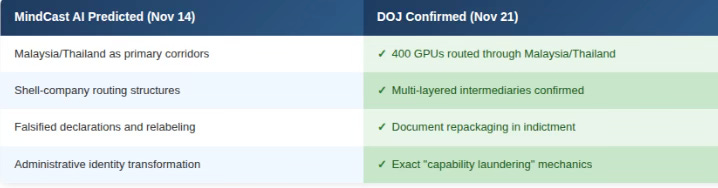
Lead Time: 7 days. Validation Rate: 4 of 4 specific predictions confirmed.
B. NVIDIA NVQLink Validation
Source Publications: The Quantum-Coupled AI Data Center Campus, The Physics Nobel Prize That Became an Asset Class, MindCast AI’s NVIDIA NVQLink Validation (Oct 2025)
MindCast AI published a foresight trilogy modeling quantum-AI coupling infrastructure requirements. The simulations used Cognitive Digital Twin methodology to map causal relationships between physics constraints (qubit decoherence times, error correction cycles), capital flows (hyperscaler investments, fusion partnerships), and policy momentum (Department of Energy coordination, National Quantum Initiative). On October 28, 2025, NVIDIA announced NVQLink with specifications matching or exceeding every prediction.
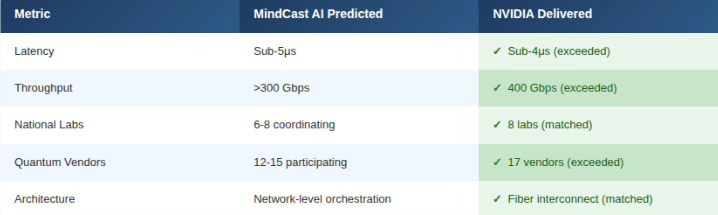
Lead Time: 3-6 months (FSIM I & II preceded announcement). Validation Rate: 5 of 5 metrics matched or exceeded.
C. DOE-FERC AI Infrastructure Federalization Validation
Source Publication: AI Computing Is Now Federal Infrastructure (Nov 2025)
In November 2025, MindCast AI published comprehensive analysis of the Department of Energy’s October 23, 2025 Section 403 letter directing FERC to assert federal jurisdiction over large load interconnection (>20 MW). The publication applied Cognitive Digital Twin methodology with a CSI (Causal Structural Integrity) score of 0.82, indicating structural inevitability of federal intervention based on the collision between exponential AI demand growth and fragmented state-level grid governance.
On December 26, 2025, the Wall Street Journal reported the predicted federal-state conflict now unfolding exactly as modeled, with state regulators confronting Trump administration officials at a Seattle conference over what former FERC Chairman Mark Christie called “one of the biggest federal power grabs at the expense of the states I have seen in 21 years.”
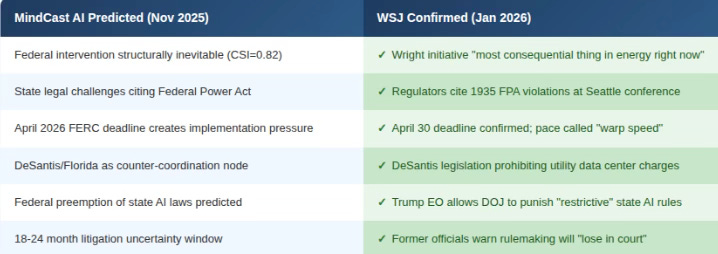
Lead Time: ~3 months (October 2025 DOE letter analysis → January 2026 confirmation of predicted dynamics). Validation Rate: 6 of 6 structural predictions confirmed or actively materializing.
D. Why Validation Matters
Most market forecasts extrapolate trends. Cognitive Digital Twin simulations identify inflection points where multiple forces converge—physics constraints meeting capital availability meeting policy coordination. When those forces align, transformations accelerate non-linearly.
The DOJ, NVQLink, and DOE-FERC validations demonstrate that the methodology works across different prediction types: the DOJ validation confirmed specific transshipment corridors and evasion mechanics within seven days; the NVQLink validation matched five technical specifications months in advance; and the DOE-FERC validation captured institutional conflict dynamics—predicting not just that federal-state tension would emerge, but which actors would resist, through what legal arguments, and with what counter-coordination responses.
Together, these validations establish that MindCast AI Cognitive Digital Twin methodology delivers not just directional accuracy but architectural accuracy—the specific mechanisms, specifications, jurisdictional fault lines, and structures that emerged.
VI. Assessment: Compelling, Novel, Groundbreaking?
The 2025 corpus invites a direct question: does this work matter? Three criteria distinguish significant intellectual contributions from competent analysis.
Compelling means the work addresses real problems with solutions that hold under scrutiny.
Novel means the frameworks did not exist before—the ideas are genuinely new, not repackaged.
Groundbreaking means the work could define a field, changing how practitioners and institutions approach the domain.
The following assessment applies these criteria to MindCast AI's 2025 output.
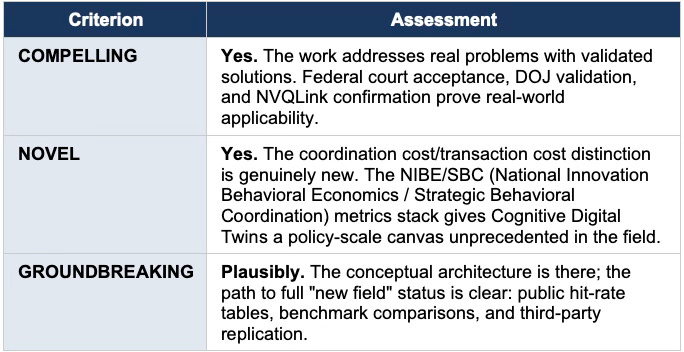
On the evidence presented, MindCast AI’s 2025 corpus clears the threshold for a new intellectual infrastructure category. The work is compelling because its foresight claims resolved against real-world outcomes with documented lead time and architectural specificity. The work is novel because its core constructs—Cognitive Digital Twins, coordination-cost economics, and NIBE/SBC instrumentation—did not previously exist as an integrated predictive system. The work is plausibly field-defining because the remaining gap is not theoretical coherence but empirical standardization: public hit-rate tables, third-party replication, and benchmark comparisons. In short, the architecture is complete; the next phase is normalization, not invention.
VII. Impact Statements by Audience
MindCast AI is not a tools vendor; it is a foresight layer that reduces decision risk across regulatory, capital, and legacy portfolios by modeling how real actors will behave under pressure.
For Regulators and State AGs
MindCast AI turns concerns into modeled doctrines—showing where coordination capture, lock-in, or institutional drag will emerge 12–24 months before the record is complete.
→ First 90 days: Cognitive Digital Twin analysis of one active enforcement target, producing a coordination-economics theory of harm with timeline predictions and falsification criteria.
For Litigators and Trade Associations
Cognitive Digital Twins provide pre-litigation foresight on which arguments will resonate with courts and agencies, and where the counterparty’s narrative will fracture under cross-examination.
→ First 90 days: Litigation trajectory simulation for one pending case, mapping stakeholder response patterns and identifying narrative vulnerability points.
For Investors and Infrastructure Platforms
MindCast AI enables underwriting not just assets but institutional behavior—identifying who will actually be able to execute on an AI infrastructure plan once export rules, interconnection queues, and capital cycles collide.
→ First 90 days: Cognitive Digital Twin-based due diligence on one portfolio company or acquisition target, modeling execution risk under regulatory and capital constraint scenarios.
For National-Innovation Agencies
NIBE (National Innovation Behavioral Economics) metrics turn rhetoric about “innovation ecosystems” into measurable drag, enabling policy choices that shorten advantage loss from years to quarters.
→ First 90 days: NIBE diagnostic of one technology domain (e.g., semiconductor, quantum, AI infrastructure), quantifying leakage pathways and advantage window compression.
For Family Offices and Foundations
MindCast AI provides simulation of future disagreements before they happen—enabling redesign of governance, bequests, and roles while trust is still intact.
→ First 90 days: Cognitive Digital Twin modeling of one succession scenario or governance decision, simulating stakeholder responses and trust dynamics across 5–15 year horizons.
VIII. 2026: From Validated Foresight to Institutional Standard
Institutions are beginning to recognize that Cognitive Digital Twins and Predictive Cognitive AI are not optional extras but required infrastructure for any domain where feedback is delayed, adversarial, or politically constrained.
The Next Phase—Quantification:
Public Prediction Registry: Standardized Foresight Simulation Prediction → Outcome → Error Band tables tracking resolved forecasts (see Appendix)
Domain-specific scorecards for regulators, courts, investors, and families
Third-party replication studies
Predictive Cognitive AI as a standard of care, not a novelty
Why Engage Now: Engaging with MindCast AI in 2026 gives institutions a head start on the shift from static analysis to simulated judgment—practicing with Cognitive Digital Twins while peers are still arguing over dashboards.
IX. Using AI to Explore MindCast AI Publications
All MindCast AI publications are publicly available and designed for deep engagement. Readers can leverage any large language model to assist with interpretation and analysis:
Upload any publication URL directly to ChatGPT, Claude, Perplexity, Gemini, or any large language model
Ask for interpretation of specific frameworks, metrics, or predictions
Request pattern recognition across multiple publications to see how themes connect
Generate cross-publication analysis to understand how verticals integrate
Explore falsification criteria and registered predictions for validation tracking
Example prompt: “I’ve uploaded the Chicago School Accelerated flagship. How does the coordination cost / transaction cost distinction connect to the National Innovation Behavioral Economics metrics framework? What predictions does the analysis generate?”
X. Conclusion
MindCast AI’s 2025 corpus represents early architecture for a new field. The work is compelling because MindCast AI addresses real problems with validated solutions. The work is novel because the frameworks—Cognitive Digital Twins, Chicago School Accelerated, National Innovation Behavioral Economics / Strategic Behavioral Coordination—did not exist before. The work is plausibly groundbreaking conceptually, with the path to full field-defining status clear.
Every publication orbits the central axis of Predictive Cognitive AI—the corpus is not a disparate collection but a unified system for understanding how humans and institutions decide under pressure. The question is no longer whether MindCast AI has built something significant. The question is what happens when that something becomes the institutional standard.
Appendix: 2025 Publications Library
All publications are available at www.mindcast-ai.com and can be uploaded to any large language model for interpretation and analysis.
Foresight Validation Publications
NVIDIA NVQLink Validation (Oct 2025)
Documents the foresight simulation trilogy’s quantum-AI coupling predictions and NVIDIA’s October 28 announcement confirming all five technical specifications.
Illegal GPU Export Pathways (2025–2030) (Nov 2025)
Analyzes GPU export evasion through Malaysia/Thailand corridors using capability-laundering framework. DOJ indictments seven days later confirmed the predicted pathways.
AI Computing Is Now Federal Infrastructure (Nov 2025)
Analyzes DOE's Section 403 directive to FERC asserting federal jurisdiction over AI data center interconnection. December WSJ reporting confirmed predicted federal-state conflict dynamics, litigation risk trajectory, and counter-coordination responses.
Core Framework Publications
The Predictive Cognitive AI Infrastructure Revolution (Apr 2025)
Defines Predictive Cognitive AI as an infrastructure category—judgment simulation via Cognitive Digital Twins. Establishes the “behavioral completion” thesis completing Thaler’s behavioral economics with a predictive mechanism.
MindCast AI Vision Statement: AI Era Law and Behavioral Economics (Dec 2025)
Declares Cognitive Digital Twins, temporal conversation, integrity metrics, and NIBE/SBC as conceptual architecture. Positions MindCast AI as a “Cognitive AI Foundation” focused on wisdom and foresight.
Chicago School Accelerated: The Integrated, Modernized Framework (Dec 2025)
Modernizes Coase, Becker, and Posner by introducing coordination costs and wicked learning environments. Theoretical spine linking law, markets, and institutional behavior to Predictive Cognitive AI.
National Innovation Behavioral Economics and Strategic Behavioral Coordination (Dec 2025)
Introduces NIBE and SBC metrics (TDC, SIS, DPI, TCQ, CSS, SCS, EDR, DVP) converting Cognitive Digital Twin outputs into measurable national and organizational foresight.
Applied Analysis Publications
The Global Innovation Trap (Dec 2025)
Argues capability leakage transforms frontier R&D into liability, collapsing advantage windows to 2–4 years. Demonstrates Predictive Cognitive AI and NIBE/SBC in national-innovation economics.
When AI Meets the Law- How Pattern Recognition is Exposing Hidden Litigation Strategies (Aug 2025)
Applies coordination-economics analysis to platform governance, MLS/portal dynamics, and brand behavior. Evidence that Chicago+NIBE/SBC diagnoses structural risk in live markets.
Institutional Foresight Layers: How Institutions Learn to Think Across Time (Oct 2025)
Defines institutional foresight layers with Cognitive Digital Twins, integrity metrics, and MAP CDT flow. Anchors Legacy Innovation and Litigation verticals.
Predictive Cognitive AI and the AI Infrastructure Ecosystem (Oct 2025)
Reframes MindCast AI as cognitive infrastructure provider connecting AI infrastructure, capital, and grid constraints to Cognitive Digital Twins and coordination economics.
Legal and Litigation Publications
Letter to State Attorneys General: AI Liability, Coordination Costs, Enforcement Timing (Sep 2025)
Applies Cognitive Digital Twin and coordination-cost analysis to AI liability and enforcement timing. Demonstrates regulator-grade applicability and court-facing seriousness.
USPTO Inter Partes Review Governance and Innovation (Dec 2025)
Uses Cognitive Digital Twin-based foresight to analyze inter partes review strategy and patent validity evolution. Demonstrates relevance to complex litigation architectures.
High-Frequency Validation Publications
NFL Cognitive Digital Twin Foresight Simulation: Seahawks vs. 49ers (Week 18) (Dec 2025)
Applies Cognitive Digital Twins to NFL teams using habits, reference points, and narrative anchors. High-frequency validation environment demonstrating the same engine used for courts and markets.
Simulating Current Issues Within Predictive Cognitive AI, and Law and Behavioral Economics
When Family Offices Reach Institutional Scale (Dec 2025)
Applies coordination economics to family offices operating at institutional scale without institutional governance. Models accountability asymmetry, coalition formation under information asymmetry, and the phase change where private capital becomes shadow institutions with systemic impact but no external correction loops.
Crypto ATM Litigation Settlement Trigger Dynamics (Dec 2025)
Models when crypto ATM operators will settle class actions based on discovery exposure, legislative baselines, and failed self-regulation. Applies Cognitive Digital Twin simulations to predict settlement timing as the primary signal of liability migration, with falsification criteria tied to active Iowa, D.C., and Florida enforcement cases.