


Game theory moved the goalposts from human psychology — what do I want? — to systems engineering — how do I stay stable? Institutions are not rational actors optimizing toward truth. They are cybernetic loops optimizing for control. Modern systems feel gaslit because they are not broken. They are succeeding.
Executive Summary
Cybernetic Game Theory (CGT) replaces static equilibrium models with a control-based framework explaining how institutions actually behave under pressure. Markets, courts, and Artificial Intelligence systems do not converge toward truth through rational optimization. Systems stabilize through feedback control, delay strategies, narrative shaping, and constraint geometry. Feedback loops continuously reshape incentives while latency and distortion degrade signal integrity. The result: systems reach equilibrium without reaching truth — and the actors inside them are doing exactly what their architecture demands.
Traditional game theory elevated the rational actor — Homo Economicus — choosing optimally in a vacuum. CGT eliminates the vacuum. In a high-frequency, AI-accelerated environment, every choice re-enters the system as a signal, every signal reshapes the payoff matrix, and the decisive variable shifts from quality of reasoning to speed of loop closure. A system does not win by being right. A system wins by having the shortest latency between signal and adaptation. Surviving the next feedback cycle matters more than long-run accuracy — and the architecture enforces it regardless of participant intent.
Four mechanisms govern outcomes: delay dominance, narrative control, feedback capture, and constraint geometry. Each operates as a substitut for rational calculation. Each produces stable equilibria that diverge from truth. Taken together, they explain why modern institutions feel gaslit — not because bad actors control them, but because the system architecture rewards control over accuracy and no individual actor can override it.
Modern institutions do not fail because they are wrong. Cybernetic game theory explains why they stabilize around wrong answers — feedback loops enforce control over accuracy, and the architecture makes that trade-off invisible to every actor inside it.
MindCast work demonstrates this pattern consistently across domains. Cybernetics Umbrella: A Predictive Institutional Control Framework establishes feedback loops as the governing architecture. Prediction Markets Reveal Truth — Feedback Loops Determine It operationalizes the Feedback Latency Index, Feedback Stabilization Index, and Causal Signal Integrity instruments that ground CGT’s empirical claims. Kalshi’s Prediction Market Federal Strategy: Engineering a Circuit Split delivers a live demonstration of delay-dominant behavior executing in real time. The corpus reveals a unified system where equilibrium emerges from control dynamics rather than truth discovery.
For investors and capital allocators: CGT maps where feedback debt has accumulated and estimates when compression arrives. Every domain running on weak feedback loops — venture portfolios sustained by narrative, regulatory postures that have never faced adversarial testing, platforms whose pricing power depends on captured consumer feedback — carries mispricing that compounds until external entropy forces alignment. The investor who identifies which systems are running on narrative rather than signal, and positions before the loop closes, holds the structural advantage.
For litigators and regulators: CGT converts institutional behavior into falsifiable predictions. The delay payoff function identifies when an opponent’s procedural posture is rational delay strategy rather than genuine engagement. The Multi-Forum Stackelberg Sequencing (MFSS) framework surfaces cross-forum contradictions that individual-forum analysis cannot see. Capture-Correcting Mechanism Design (CCMD) predicts which actors will preempt state jurisdiction before federal enforcement activates — and why. For state attorneys general, enforcement counsel, and antitrust practitioners, CGT’s five emergent frameworks operationalize the analytical moves that experienced litigators make intuitively — and make them reproducible, documentable, and defensible on the record.
I. From Static Games to Cybernetic Systems
Speed of control — not quality of reasoning — determines who dominates the system. Once feedback loops close faster than opponents can reason, rationality becomes a second-order variable. The foundational move of Cybernetic Game Theory is a substitution: replace the rational actor with the feedback loop as the unit of analysis. Classical game theory asked what a player wants and what a player will choose given what others want. CGT asks how fast a system can incorporate the consequences of a move and reconfigure its behavior before opponents can respond. The answer to that question — not the quality of any individual decision — determines who controls the outcome.
Strategic interaction shifts from choice optimization to system control when feedback loops reshape incentives in real time. Classical models assume fixed payoffs and eventual convergence. Real systems operate as adaptive loops where outputs re-enter as inputs — and every round of play rewrites the rules for the next round.
The rational actor assumption served a useful analytical purpose in low-frequency, high-deliberation environments. Remove the deliberation window — replace it with algorithmic execution, continuous market pricing, and AI-accelerated signal propagation — and the assumption collapses. Actors do not choose from a fixed menu of strategies. Systems select actors who close loops fast enough to survive. Cybernetics Umbrella: A Predictive Institutional Control Frameworkformalizes the transition: institutions modeled as closed-loop systems governed by signal processing and feedback control, where feedback capture rate and adaptation velocity displace payoff maximization as the operative variables.
Four mechanisms operationalize the shift. Delay dominance converts time into a strategic asset. Narrative control converts belief formation into payoff engineering. Feedback capture converts prediction into behavioral lock-in. Constraint geometry converts structural density into strategic predetermination. Each mechanism functions independently. Together, they eliminate the analytical space where rational optimization operates.
Most systems do not fail because they are wrong. They fail because they stabilize around wrong answers — and the feedback architecture makes that outcome self-reinforcing.
II. Decision Engineering and the Missing Control Problem
Decision Engineering correctly identifies that prediction is not decision. CGT identifies the deeper problem: in real institutional systems, the decision layer receives pre-degraded inputs because the feedback architecture surrounding it has already been captured. Designing a better decision layer does not fix a captured control loop. The gap between prediction and decision is real. The gap between a well-designed decision layer and a functioning one is larger — and it lives upstream. Formalizing objectives, constraints, and action spaces produces a structurally coherent decision architecture. What determines whether that architecture produces truth-aligned outputs is the condition of the feedback loops delivering inputs to it. CGT’s contribution to the decision engineering literature is identifying that problem as prior — and demonstrating, across live institutional cases, how consistently it is ignored.
Aleksandra Pinar’s Decision Engineering: The Architecture of Decision Systems (Regen AI Institute, March 2026) makes a correct and underappreciated diagnostic claim: the artificial intelligence field has conflated prediction with decision-making, leaving a formal structural gap where a decision layer — defining objectives, constraints, action spaces, and accountability — should sit. Pinar’s five-layer stack (Representation → Prediction → Decision Logic → Execution → Feedback) is architecturally coherent as a normative design prescription. The Decision Quality Index (DQI) = (Q × A × T) / R correctly identifies information quality, alignment, transparency, and risk as the operative dimensions of decision performance. The fuller formalization in Pinar’s Cognitive Infrastructure Stack™ extends the decision system to D = (Ω, A, F, T, U, C, Φ, Γ) — state space, action space, feasible actions, transition dynamics, objectives, constraints, feedback operators, and governance layers — and introduces the Decision Consistency Principle: decisions must adapt predictably under transformation rather than remain static.
CGT accepts the Pinar diagnosis and identifies what the framework cannot reach. Decision Engineering asks how systems should be structured to produce accountable, high-quality decisions. CGT asks why real institutional systems consistently fail to produce them — not because the decision layer is missing, but because the feedback architecture governing the decision layer has already been captured by control dynamics before any formal decision process engages. A well-designed decision layer receiving captured inputs produces captured outputs. The architecture is irrelevant if the control environment is not first understood.
Pinar’s framework treats feedback as restorative: outcomes flow back into the system, representations update, decision quality improves over time. The feedback loop in her stack is a thermostat returning temperature to setpoint. CGT’s central finding is that real institutional feedback loops are frequently not restorative. Captured feedback loops amplify the control signal rather than correcting toward truth. A media system optimizing for engagement installs a feedback loop that systematically rewards narrative distortion and penalizes accuracy. A regulatory body with five-year enforcement latency installs a feedback loop that structurally cannot correct within the cycle time of the conduct it governs. The Feedback Latency Index (FLI), formalized in Prediction Markets Reveal Truth — Feedback Loops Determine It, measures exactly this decay rate: the degradation of corrective capacity as latency between action and consequence increases. High FLI does not produce bad decisions — it produces structurally disconnected decisions that optimize for the wrong signal because the right signal never arrives.
The DQI formula exposes the gap with precision. DQI = (Q × A × T) / R treats Q, A, and T as inputs the decision layer can optimize. CGT demonstrates that in captured systems these are not free variables — they are outputs of the feedback control architecture delivered pre-degraded. Narrative-dominant systems degrade Q by amplifying distortion over signal. Delay-dominant systems degrade A by allowing objectives to drift from outcomes across the enforcement latency window. Constraint-dense systems degrade T by eliminating the observable action space within which transparency could operate. The DQI scores low not because the decision layer was poorly designed but because the control architecture upstream determined the inputs before the decision layer engaged. Decision Modeling and Foresight Simulation identifies this failure mode in Apple’s institutional behavior: Apple’s decisions align internally with its installed cognitive grammar while failing externally against the feedback requirements of the competitive environment — high DQI by internal metrics, structural misalignment at the system boundary. CGT names the mechanism that produces that divergence: the Installed Cognitive Grammar is itself the captured feedback loop, routing signals through an internal control architecture that never receives the external correction.
The governance argument is where the departure sharpens further. Pinar argues that formalizing the decision layer enables auditability and regulatory compliance — that explicit objectives and constraints make decisions assessable. Capture-Correcting Mechanism Design (CCMD), formalized in MindCast AI Emergent Game Theory Frameworks, demonstrates why formal decision architecture does not prevent capture. When the enforcement mechanism itself is captured — when the regulator’s utility function aligns with the regulated industry — explicit decision objectives and documented constraints become governance theater: auditability-compliant outputs that satisfy the DQI transparency dimension while producing no behavioral correction. Documented compliance with a captured enforcement mechanism is compliance with capture, not with the nominal objective. Washington Senate Bill (SSB) 6091’s 141-1 legislative passage documented this pattern directly: formal decision architectures in Washington residential real estate produced governance-compliant outputs for years while systematically diverging from consumer-protective intent — until a parallel state enforcement mechanism activated and the control loop was forcibly reoriented from outside. Decision Engineering designs the decision layer. CGT maps the control architecture that determines what that layer receives. Understanding the control environment is the prior condition — without it, a well-designed decision layer is a precision instrument installed downstream of a corrupted signal.
Contact mcai@mindcast-ai.com to partner with us on Predictive Cognitive AI in Law and Behavioral Economics. To deep dive on MindCast Foresight Simulations upload the URL of this publication into any LLM and prompt ‘reconstruct MindCast framework with three degrees of cited sub links.’ See Live-Fire Game Theory Simulators, Runtime Predictive Infrastructure.
Recent projects: MindCast AI Emergent Game Theory Frameworks | Super Bowl LX — AI Simulation vs. Reality | Google’s Deep-Thinking Ratio Measures Effort, Not Structure | The Cognitive AI Response to Apple’s “The Illusion of Thinking | MindCast AI Constraint Geometry and Institutional Field Dynamics | The Runtime Causation Arbitration Directive | Runtime Geometry, A Framework for Predictive Institutional Economics | Foresight on Trial, The Diageo Litigation Validation | The Compass Antitrust Self-Destruction Sequence | MindCast Dynamic Game Theory— Competing Inside a System That Rewrites Itself
III. The Influence-Integrity Inversion
Influence and feedback integrity move in opposite directions. The systems with the weakest feedback loops exert the greatest control over upstream belief formation — and face the most abrupt corrections when the loop finally closes. The most counterintuitive structural finding in the CGT framework is also its most consequential: the systems that most reliably produce accurate signals are the least influential, and the systems that shape the most consequential decisions operate under the weakest feedback conditions. Prediction markets price reality with precision and remain peripheral to major institutional choices. Regulatory bodies and media systems govern expectations at scale while insulated from the consequences of being wrong. Tracing that inversion — mapping where influence accumulates relative to where feedback integrity exists — is the diagnostic core of CGT applied to any institutional domain.
The most structurally important finding across the MindCast corpus is an inversion: influence frequently increases as feedback integrity declines. Prediction markets produce the cleanest signals in any expectation system and remain peripheral to major institutional decisions. Media systems and regulatory bodies shape expectations at scale while operating under the weakest feedback conditions — no financial penalty for inaccuracy, multi-year enforcement latency, diffuse accountability.
MindCast’s Prediction Markets Reveal Truth — Feedback Loops Determine It formalizes the feedback gradient across five domains. Prediction markets: rapid settlement, direct financial consequence, unambiguous outcomes — high integrity throughout. Venture capital: multi-year fund cycles create structural delay arbitrage — valuations persist on narrative long after the underlying feedback would have forced repricing if it arrived faster. Regulatory systems: five-year enforcement latency and diffuse accountability allow mispricing to compound without correction until external shock compresses the loop.
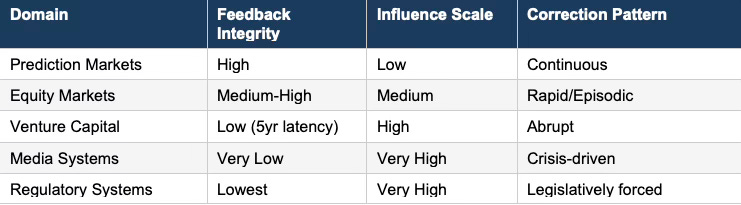
The inversion is not coincidence. Weak feedback loops allow narrative to persist and accumulate influence precisely because consequences never arrive fast enough to discipline belief. High influence with weak feedback is the exact structural condition that produces the largest correction events. Actors who treat the absence of correction as evidence of accuracy are exhibiting the behavioral lock-in that makes the eventual correction severe — a pattern documented across MindCast’s prediction markets regulatory arc and Compass real estate litigation series alike.
IV. Delay-Dominant Game Theory
Delay is not stalling. Delay is the strategy. When rule mutation outpaces enforcement, extending the timeline becomes more valuable than winning the immediate exchange. Delay dominance is the most misread mechanism in institutional strategy because it looks, from the outside, like a failure to engage. Litigation that drags, regulation that never arrives, appellate timelines that stretch across political cycles — observers read these as institutional dysfunction. CGT reads them as optimal play. A rational actor who cannot win the current rule contests the timeline instead, holding the loop open until the environment changes. The D = (Δt × Rm) / (Ce + L) function makes the calculation explicit: delay is profitable whenever rule mutation outpaces enforcement cost. In complex multi-forum environments, it almost always does.
Time becomes a strategic asset when delay reshapes the structure of the game itself. Players accept short-term losses to extend the timeline, allowing rule mutation and cost transfer to opponents. Delay does not merely postpone resolution — delay actively alters the enforcement dynamics and effective payoff matrix that resolution will eventually apply.
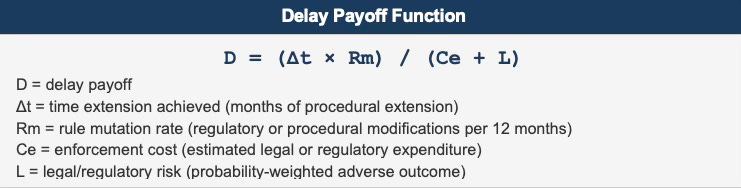
Delay becomes rational when rule mutation outpaces enforcement — especially in multi-forum litigation environments where appellate divergence compounds strategic time extension. Kalshi’s Prediction Market Federal Strategy: Engineering a Circuit Split demonstrates the function in practice: multi-jurisdictional filings create rule fragmentation, appellate divergence increases probability of circuit conflict, and federal preemption becomes the strategic endpoint rather than case-by-case victory. The platform did not litigate to win the existing rule — Kalshi litigated to extend the timeline until the rule changed.
Delay arbitrage — the exploitation of slow feedback cycles — represents the corporate equivalent of managing to the next quarterly report. Surviving the feedback cycle matters more than the long-run reality of the market. Venture portfolios running on narrative-sustained valuations, regulatory postures sustained past enforcement capacity, and litigation strategies targeting forum multiplication all execute the same underlying function: keep the loop open long enough for the environment to change.
V. Narrative-Control Game Theory
Narrative does not describe the payoff matrix. Narrative constructs it. Control over belief formation is control over participation — and participation determines whose equilibrium survives. Every strategic framework assumes players know what game they are playing. Narrative control challenges that assumption at its root. An actor who controls the framing of a situation controls which payoffs participants perceive as available, which risks they weight as salient, and which outcomes they consider legitimate. Reffkin’s ‘seller choice’ framing did not describe the 3-Phased Marketing Strategy — it constructed the perceived payoff matrix within which agents, sellers, and legislators evaluated it. CGT’s narrative control mechanism formalizes the move that practitioners execute intuitively: change the game by changing what participants believe the game is.
Control over belief formation determines outcomes when perception reshapes participation. Narrative does not merely describe reality — narrative actively constructs the perceived payoff matrix that drives behavior. Distortion amplifies through feedback, reducing signal fidelity over time. Actors who control narrative control the game board, not just their position on it.
Truth Function (Operationalized)
T ~ f(S, N, F) — where truth integrity is a function of signal quality, narrative distortion, and feedback amplification.
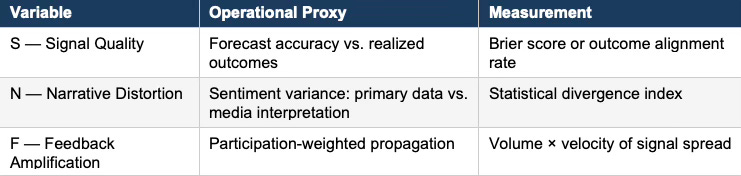
Truth integrity declines when sentiment variance increases and amplification accelerates faster than verification. Causal Signal Integrity — formalized as CSI = (ALI + CMF + RIS) / DoC² in Prediction Markets Reveal Truth — Feedback Loops Determine It — separates genuine structural shifts from advocacy noise and narrative momentum. ALI is Analytical Logic Integrity, CMF is Causal Mechanism Fidelity, and RIS is Recursive Inference Stability.
Truth Breakdown Threshold: truth degradation becomes irreversible when N × F / S > 1 — when narrative distortion multiplied by feedback amplification exceeds signal quality. Below that threshold, signal can still correct narrative. Above it, the feedback loop amplifies distortion faster than any external signal injection can counteract. Prediction markets breach the threshold rarely because financial consequence continuously forces S upward. Regulatory and media systems breach it routinely because neither N nor F faces any structural discipline.
Sustained divergence between price signals and realized outcomes above defined thresholds signals narrative-dominated systems. Four failure modes generate that divergence: narrative dominance (outcomes fail to discipline beliefs), delay arbitrage (actors exploit slow feedback cycles), moral hazard (error carries no penalty), and signal fragmentation (no unified mechanism aggregates outcomes). Each failure mode names a live condition in a current domain — not an abstract pathology.
VI. Constraint Geometry Game Theory
When constraint density exceeds strategic flexibility, intent becomes irrelevant. The geometry predetermines the outcome — and no amount of rational optimization escapes the corridor. Constraint geometry is the mechanism that makes institutional outcomes predictable even when individual actors are unpredictable. Post-SSB 6091, no Compass executive needed to make a strategic error for the outcome trajectory to converge toward transparency enforcement — the field geometry did the work. Post-Zillow LAS, no Compass agent needed to defect consciously — the demand-side aggregator removal made defection structurally overdetermined. CGT’s constraint geometry framework formalizes the intuition that good analysts have always had: understand the shape of the field before analyzing the players, because in high-constraint environments the field selects the outcome.
Structural constraints determine outcomes when available strategic paths collapse under pressure. Constraint density reduces optionality while dominant attractors channel behavior into narrow trajectories. Strategic intent loses explanatory power when geometry governs movement — and high-constraint fields produce convergent outcomes regardless of who is playing.

Corridor Width Metric

High-density constraint fields eliminate meaningful strategic variation and force convergence toward structurally predetermined outcomes. Seahawks Super Bowl LX Foresight Simulation functions as a controlled test environment: high data density, rapid feedback, and bounded resolution conditions provide observable closed-loop constraint behavior without the noise of multi-year institutional timelines. The mechanism, not the sport, generates the signal. In high-frequency, closed-loop environments — whether sports simulations, algorithmic markets, or regulatory proceedings with narrow procedural corridors — constraint geometry determines trajectories that no single actor’s strategy can override.
VII. Feedback Market Game Theory
Prediction markets do not measure reality. They enforce accountability against it. When feedback loops tighten under AI amplification, the market stops forecasting and starts controlling. Prediction markets are the only institutional mechanism where the feedback loop is engineered rather than inherited. Every other system examined in CGT carries feedback architecture installed by history, regulation, or competitive convention — frequently degraded, often captured. Prediction markets specify resolution conditions before play begins, attach financial consequence to error, and aggregate distributed private signals into continuous price discovery. The result is the closest observable approximation to a functioning truth-production mechanism. Understanding why prediction markets work is therefore the diagnostic that reveals why every other system does not — and what specific feedback properties are missing from the environments where accuracy matters most.
Prediction markets function as closed-loop control systems where outputs reshape inputs. Forecasts influence behavior, behavior alters outcomes, and outcomes reinforce forecasts. Feedback loops transform markets from measurement tools into behavioral control mechanisms — a transition that accelerates as AI compresses latency and increases capture rate.

Threshold Conditions

Empirical anchor for FS > 1.5: behavioral lock-in corresponds to environments where more than 60% of participants adjust behavior within a single feedback cycle. Below that threshold, enough participants remain anchored to prior beliefs that the system retains open-loop characteristics. Above it, the majority-driven behavioral shift becomes self-reinforcing — each cycle of adjustment recruits the next wave of participants, and the market stops measuring probability and starts manufacturing it.
Systems with high capture and low latency achieve behavioral lock-in, converting prediction into control across markets, platforms, and regulatory environments. The Full Spectrum of Prediction Markets: From Casinos to Cognitive AI traces the evolution from aggregation mechanism to control architecture. Prediction Markets Reveal Truth — Feedback Loops Determine It delivers the Feedback Latency Index and Feedback Stabilization Index — the instruments that determine where on the FS scale any given system currently sits.
VIII. Dual-Equilibrium Termination
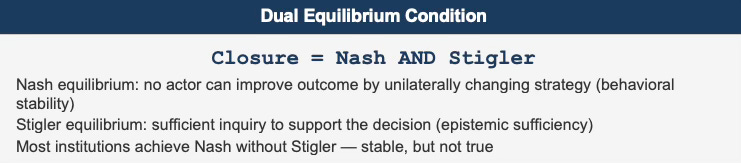
Behavioral equilibrium and truth equilibrium are not the same condition. Most institutions stabilize without resolving the underlying truth — producing a persistent, structurally enforced gap between stability and accuracy. The Nash equilibrium tells you when a system has stopped moving. The Stigler condition tells you whether it stopped in the right place. Most institutional analysis stops at Nash — identifies stable strategies, maps the equilibrium, declares the system understood. CGT insists on the second test. A system that achieves behavioral stability while operating on false or distorted inputs has not reached equilibrium in any meaningful sense — that system has reached a stable attractor for inaccuracy, and the longer it remains there, the larger the correction event when external entropy finally forces the loop to close. Apple’s strategy — internally coherent, externally misaligned against competitive feedback requirements — achieves Nash without Stigler: no individual executive can profitably deviate, but the system is not converging on truth.
System closure requires both behavioral alignment and cognitive sufficiency. Behavioral equilibrium can emerge without resolving underlying truth conditions, creating stable yet inaccurate outcomes. Cognitive equilibrium governs whether sufficient inquiry supports decisions. Most institutions achieve the first and never pursue the second — because the architecture rewards stability, not accuracy.
Entropy Override Condition

The five-layer causation stack — Event → Incentive → Feedback Loop → Structural Geometry → Identity Grammar — formalized in Cybernetic Foundations of Predictive Institutional Intelligence — underlies the dual-equilibrium condition. Systems diverge from truth because loops are weak, structure prevents correction, and actors resist updating. Any one of those conditions, unremedied, sustains the divergence. All three together produce the full architecture of institutional gaslighting — stability enforced by control, not resolved by truth.
IX. The Constraint-Latency Matrix
System type determines the game being played — and modern systems migrate from open arenas toward traps and labyrinths as feedback tightens and constraints increase. Before deploying any of the four CGT mechanisms, identify which quadrant the system occupies — because quadrant position determines which mechanisms are operative and which strategies remain available. A system in the Arena (low constraint, low latency) still permits rational optimization — classical game theory applies. A system in the Fog (low constraint, high latency) rewards narrative control above all else. A system in the Labyrinth (high constraint, high latency) rewards procedural fluency and delay dominance. A system in the Trap (high constraint, low latency) is governed entirely by feedback architecture — speed of loop closure determines everything. Most modern institutional environments have migrated away from the Arena and toward the Labyrinth and the Trap. Understanding where you are determines what works.
Quadrant position in the constraint-latency matrix determines not just strategy but the kind of game available to players.
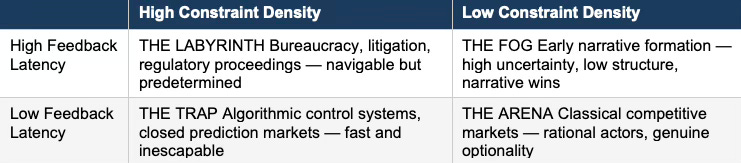
Modern institutions migrate away from open arenas toward traps and labyrinths as feedback loops tighten and constraints increase. Regulatory proceedings are labyrinths: slow feedback, high constraint density, navigable only through procedural fluency. Algorithmic trading systems are traps: fast feedback, high constraint density, no escape for actors who cannot match the loop speed. Understanding which quadrant a system occupies determines which CGT mechanism is operative — and which strategies remain available.
X. Case Study — Kalshi and Circuit-Split Strategy
Kalshi does not litigate to win the existing rule — Kalshi litigates to extend the timeline until the rule changed, a textbook delay-dominant play executed across federal and appellate forums simultaneously. Kalshi’s Prediction Market Litigation Architecture, the CFTC Amicus, and the Strategic Framework for State Enforcement. Kalshi’s regulatory strategy is the cleanest available demonstration of delay dominance because the game structure is visible, the timeline is documented, and the voluntary concession that closed the loop arrived on a specific date. Prediction market regulation sits at the intersection of commodity futures law, state gambling statutes, and constitutional preemption questions — a multi-forum environment where rule mutation is structurally guaranteed and enforcement coordination is structurally impaired. Kalshi read that environment correctly and built its strategy around it. CGT’s delay payoff function predicts the precise conditions under which that strategy becomes rational — and the March 2026 voluntary contract screening announcement marks the exact moment the function flipped negative.
Kalshi’s litigation strategy demonstrates delay-dominant game dynamics executing in real time across all four CGT mechanisms. Multi-jurisdictional filings create rule fragmentation (constraint geometry). Appellate divergence increases probability of circuit conflict (delay dominance). Federal preemption framing converts a regulatory dispute into a constitutional question (narrative control). Platform expansion during litigation establishes institutional facts on the ground before resolution occurs (feedback capture). Kalshi’s Prediction Market Federal Strategy: Engineering a Circuit Split documents how delay, narrative framing, and forum selection interact to reshape the game rather than resolve it.
Kalshi’s March 2026 voluntary contract screening announcement — accepting behavioral constraints without a court order — signals the internal probability of the upside preemption case had contracted below the strategic threshold. Prediction Markets Reveal Truth — Feedback Loops Determine It analyzes it as a Prospective Repeated Game Architecture (PRGA)-predicted signal: platforms with genuine private information about their legal position do not concede voluntarily until error cost forces the update. The voluntary screening concession was the feedback loop closing.
Forward implication: at least one appellate divergence emerges within 18 to 24 months, increasing probability of Supreme Court review — unless the Prediction Markets Are Gambling Act’s Statutory Category Exclusion Mechanism moves the resolution channel to legislation before appellate review completes.
XI. Case Study — Goloja v. Vail Resorts and Signal Suppression Equilibrium
Vail and Alterra did not need to communicate to suppress competitive pricing signals. The Pass Trap— How Vail and Alterra Replaced Price Discovery With Architectural Control. The architecture of the Mountain Collective and Ikon Pass programs installed a shared feedback loop that made price competition structurally irrational for both — a Signal Suppression Equilibrium enforced by the pass infrastructure itself, not by any detectable agreement. The Vail/Alterra case poses the hardest version of the antitrust coordination problem: how do you prove coordination when no coordination occurred? Signal Suppression Equilibrium (SSE) answers that question by shifting the evidentiary target from communication to architecture. Plaintiffs need not find the smoking-gun email because the pass pre-commitment structure is itself the coordination mechanism — a shared feedback loop that made price competition structurally irrational for both operators regardless of intent. CGT’s analytical contribution to the Goloja complaint is identifying that the relevant question for antitrust liability is not whether Vail and Alterra agreed, but whether the pass architecture installed a feedback loop that produced the same behavioral outcome as an agreement — and whether that outcome was foreseeable.
The antitrust complaint in Goloja et al. v. Vail Resorts / Alterra Mountain Company presents the cleanest live application of Signal Suppression Equilibrium (SSE) in the MindCast corpus. SSE governs institutional behavior under the inequality A × R × F × N > S — where Amplification, Reach, Frequency, and Network effects jointly exceed the Signal capacity of any competitive correction. MindCast’s SSE analysis, formalized in Prestige Markets as Signal Economies, establishes the conditions under which coordination becomes self-enforcing without explicit agreement: the architecture installs the equilibrium, and rational actors simply optimize within it.
The Mountain Collective and Ikon Pass programs function as feedback capture mechanisms in the CGT sense. Consumers commit annual pass fees before the ski season begins — before any pricing signal from competitive alternatives can reach them. Once committed, sunk cost locks behavior for the remainder of the season. Vail’s Epic Pass operates identically. The pre-commitment architecture compresses the feedback latency for competitive pricing signals to near zero at the point of purchase decision, then eliminates competitive feedback entirely for the rest of the season. A consumer who paid $1,200 for an Ikon Pass in September has a feedback loop that closed at purchase — no subsequent Vail price reduction reaches them as actionable information. The FS function (Feedback Stability = FCR × AV / FLI) in the relevant market approaches infinity: feedback capture rate is near-total, adaptation velocity is suppressed by sunk cost, and feedback latency for competitive signals is effectively infinite post-purchase.
Apply the MFSS framework from MindCast AI Emergent Game Theory Frameworks to the Vail/Alterra dual-pass architecture. Both operators simultaneously maintain contradictory positions across forums: (f1) antitrust litigation posture — independent operators competing vigorously on mountain experience, amenities, and access; (f2) consumer marketing — interchangeable prestige products targeting the same affluent recreational demographic with functionally overlapping resort networks; (f3) institutional investor communications — stable, predictable fee revenue insulated from competitive pricing pressure by the pre-commitment mechanism. The Segmentation Condition holds: no ski pass consumer compares the federal litigation position to the earnings call. No earnings call analyst maps the resort overlap to antitrust exposure. The contradiction is sustainable because audiences are structurally segmented — the MFSS equilibrium is stable until an analytical actor aggregates positions across forums.
The constraint geometry of the mountain resort market produces the Labyrinth quadrant in the CGT constraint-latency matrix: high constraint density, high feedback latency. Entry barriers — terrain, permitting, infrastructure investment, brand equity — create a CD/GAR ratio well above 1. No new competitor enters the premium destination ski market on any timeline relevant to consumer pricing decisions. Strategic intent is therefore irrelevant: even if Vail and Alterra wanted to compete aggressively on price, the constraint geometry eliminates the corridor through which competitive pricing pressure could flow. The Corridor Width Metric (CW = available viable actions / total possible actions) approaches structural determinism. Complaint plaintiffs need not prove agreement — they need to demonstrate that the architecture made competition structurally irrational, which is a CGT showing, not a conspiracy showing.
Delay dominance governs the litigation trajectory. The D = (Δt × Rm) / (Ce + L) function runs strongly in Vail and Alterra’s favor. Discovery in complex class antitrust litigation extends timelines by years. Rule mutation is active: the antitrust treatment of multi-sided platform pass programs has no settled precedent. Enforcement cost is asymmetric — plaintiff class counsel bears discovery burden against two well-resourced corporate defendants with overlapping but technically separate document repositories. Rm is high; Ce is high; L is moderated by the absence of per se price-fixing allegations. MindCast’s PRGA equilibrium prediction for Vail and Alterra’s litigation posture: maximum procedural delay, aggressive Twombly/Iqbal motion practice targeting the pleading standard for parallel conduct without explicit agreement, and forum-specific narrative maintenance separating the antitrust defense posture from investor communications.
The Pinar Decision Engineering framework surfaces a specific gap in how plaintiffs and regulators approach this case. Pinar’s DQI = (Q × A × T) / R asks whether the decision system produces coherent, aligned, auditable outputs. Regulators evaluating the Vail/Alterra pass architecture through a conventional decision quality lens may find formally compliant pricing decisions — no explicit price-fixing communication, independent revenue management systems, technically distinct pass products. DQI scores high on transparency (T) and formal alignment (A) with competitive market rules. CGT’s control architecture analysis reveals what DQI misses: the feedback loop was captured at the structural level before any individual pricing decision was made. A captured decision layer produces captured outputs regardless of how well it is designed — formal architecture cannot recover truth from corrupted inputs. The complaint’s strength lies not in identifying bad decisions but in demonstrating that the architecture made competitive decisions structurally unavailable — a CGT argument that the Pinar framework’s design-layer focus cannot reach.
The CCMD parallel enforcement mechanism analysis applies directly. No active DOJ or FTC investigation into multi-resort pass programs has been confirmed at this stage — federal antitrust enforcement remains latent. State attorneys general (AGs) in Colorado, Utah, Vermont, and California — states with significant resort infrastructure — represent the M′ parallel enforcement mechanism. CCMD-P5 predicts that introduction of state AG investigation strictly increases expected enforcement regardless of federal posture. Corollary 5.1 predicts the Vail/Alterra strategic response: federal preemption arguments (already present in nascent form in resort operator lobbying), voluntary consumer pricing disclosures calibrated to reduce M′ enforcement motivation, and investor communications framing pass program economics as pro-consumer access expansion rather than market foreclosure. Each move is a CCMD-predicted response to the parallel mechanism — not genuine behavioral change.
Forward falsifiable predictions, P-assigned: (1) Vail and Alterra both move to dismiss on Twombly/Iqbal parallel conduct grounds within 6 months of complaint service — P85; (2) at least one state AG opens an investigation within 12 months — P60; (3) Ikon and Epic Pass pricing increases by less than 5% in the next annual cycle as litigation pending — P70 (delay arbitrage preserves the status quo); (4) discovery reveals no direct pricing communication between Vail and Alterra executives — P80 (SSE requires no communication; the architecture coordinates). SSE + MFSS + Constraint Geometry + CCMD applied simultaneously: the Vail/Alterra pass architecture is the fullest live demonstration of CGT’s integrated control framework operating without conspiracy. The architecture installed the equilibrium, the constraint geometry maintained it, forum segmentation protected it, and the feedback capture mechanism insulated it from correction.
XII. Case Study — Compass v. NWMLS and the Self-Inflicted Feedback Loop
Compass opened a feedback loop to press its antitrust claims — and that loop became the control mechanism that disciplined Compass’s own conduct. Delay dominance usually protects the delay player. Here, the litigation generated the sworn admissions, legislative record, and judicial findings that accelerated enforcement convergence against the actor deploying the delay. Compass serves as the highest-resolution dataset in the corpus, not the central object of analysis. Compass v. NWMLS is the most empirically dense CGT case study available precisely because the dominant actor’s strategy was sophisticated, legally well-resourced, and still produced the opposite of its intended outcome. Compass deployed every CGT mechanism correctly in isolation: forum fragmentation, narrative control across segmented audiences, delay-dominant procedural sequencing, and aggressive preemption of parallel enforcement. The failure was architectural, not tactical. Compass could not control the feedback loop its own litigation opened. Federal complaints are public records. Sworn chief executive officer (CEO) testimony is subpoenable. Legislative drafters read court filings. The signal Compass released to press its antitrust claims became the signal that restructured the enforcement environment against it. CGT’s lesson from Compass is not that delay dominance fails — it is that delay dominance fails when the delay player is also the signal source.
The Compass v. NWMLS litigation, analyzed in depth in The Law and Behavioral Economics of Compass vs. NWMLS: Procedural Survival Is Not Substantive Victory, is the fullest live demonstration of every CGT mechanism operating simultaneously against a documented evidentiary record. Four days of live witness testimony including sworn CEO admissions, a 50-page judicial opinion, 141-1 legislative passage with MindCast publications in the official record, and a documented 44 percent behavioral reversal in adoption data — the Compass case provides the empirical density that transforms CGT from analytical framework into falsifiable prediction engine.
The Self-Inflicted Feedback Loop
Before April 2025, Compass operated Private Exclusives in a regulatory gray zone. Multiple Listing Service (MLS) rules held jurisdiction only over listings already submitted — pre-submission marketing fell entirely outside enforcement reach. An agent could market a property privately for 84 days, narrow the competitive buyer pool to network-affiliated agents, and submit a compliant MLS listing on day 85. Nothing violated. The harm was complete before enforcement authority began. In April 2025, Compass filed a federal antitrust complaint against the Northwest Multiple Listing Service (NWMLS). In June 2025, Compass escalated against Zillow. By broadcasting the mechanics of its shadow market through public federal complaints, Compass handed Washington State legislators and regulators a fully developed analytical and evidentiary framework for statutory intervention. As documented in the MindCast Compass series: Compass’s elite antitrust counsel drafted, with billable precision, the operative definition of ‘public marketing’ that SSB 6091 codified. Washington’s drafters did not need to invent a regulatory framework. Compass filed one in federal court, and the Legislature applied it 141-1.
The CGT mechanism at work is a feedback loop inversion. Delay dominance normally operates in the delay player’s favor: extend the timeline, allow rule mutation, transfer cost to opponents. Compass executed the playbook correctly — fragmented forums, avoided early merits testing in NWMLS after the Zillow preliminary injunction (PI) loss, preserved optionality. The error was structural, not strategic. The litigation itself was the signal. Opening a public federal complaint activates a feedback loop that routes institutional responses — legislative, judicial, regulatory — back into the environment. Compass’s delay strategy preserved its procedural position while the feedback loop it opened restructured the enforcement architecture around it. Surviving the pleading stage is not winning when the complaint itself is building the case against you.
MFSS — The Compass Corollary Executed
The MindCast AI Emergent Game Theory Frameworks piece names the Compass Corollary explicitly within the MFSS framework. Compass ran three simultaneous contradictory positions across segmented forums: antitrust litigation (NWMLS’s Rule 2 is an anticompetitive restriction on seller choice), state legislative testimony (the 3-Phased Marketing Strategy is procompetitive innovation), and investor communications (Private Exclusive revenue is a stable solvency mechanism independent of MLS outcomes). Each forum audience received the signal optimized for their credibility threshold. No federal court audience reads the earnings call. No earnings call analyst tracks the legislative testimony. No legislator maps the discovery position. The Segmentation Condition held — until MindCast’s Compass Trilogy applied the Segmentation Violation Function (SVF), reducing information transmission cost T below enforcement benefit E and collapsing the equilibrium set to consistent strategies only. The cross-forum market definition contradiction is the sharpest MFSS output: Compass argued a national geographic market against Zillow (where national scope made Zillow’s share appear concentrated) and a Seattle/King County market against NWMLS (where local scope made NWMLS’s near-100% MLS share appear dominant). Both cases involve the same conduct. The contradiction is available by subpoena in the federal record.
ISCT — The Corrupted Pooling Equilibrium
Reffkin’s LinkedIn announcement framing voluntary dismissal of the Zillow case as a consumer-choice victory is textbook Corrupted Pooling Equilibrium. Form-level credibility: CEO communication, issued through verified professional channels, authored by a named public figure. Content accuracy: the federal record shows 268 days of litigation, zero judicial relief obtained at any stage, Section 1 conspiracy theory collapsed for lack of agreement evidence after four days of witness testimony, Section 2 monopoly theory collapsed because Compass’s own expert metrics were insufficient. Judge Vargas’s 50-page opinion is the content record. Reffkin’s LinkedIn post is the form-credibility signal sent to a different audience. The Segmentation Condition ensures that LinkedIn readers and federal court observers occupy different information environments — and the Corrupted Pooling Equilibrium is stable as long as those environments stay segmented.
The 17:1 undisclosed-to-disclosed affiliation ratio in SSB 6091 legislative testimony operationalizes the Astroturf Coefficient from the Astroturf Equilibrium Detection Model (AEDM) framework. Compass deployed coordinated lobbying infrastructure — pre-drafted agent messaging campaigns, designated legislative witnesses including Brandi Huff as named broker-witness at both hearings — while presenting the testimony as independent citizen participation. The Astroturf Equilibrium sustained itself until MindCast’s Segmentation Violation Function aggregated the affiliation data. Corollary 1.1 of AEDM-P1 states the collapse condition: the equilibrium fails when an analytical actor aggregates cross-forum positions and presents them to the enforcement authority at cost below d(C). The legislative record now contains that aggregation.
Constraint Geometry — Post-SSB 6091 Structural Determinism
Post-SSB 6091, the Corridor Width Metric for Compass’s selective exposure model approaches structural determinism. The statute moves the compliance clock to the moment marketing starts — the 84-day pre-MLS window is no longer lawful in Washington. Zillow’s Listing Access Standards removed the primary demand-side aggregator for Phase 1 inventory. NWMLS’s Rule 2 constrains the supply-side infrastructure. The Compass-Redfin-Rocket partnership inserted a substitute aggregator — but one whose prior public commitments contra Compass’s model are already in the legislative and judicial record, and whose announcement the same week the legislature voted 92-1 eliminated the market self-correction argument Compass had been deploying in legislative forums. No viable strategic path remains for scaling the selective exposure model. The geometry predetermines the outcome. The litigation is running inside a field where all structural forces converge on transparency, coordination, and broad market access.
CCMD — Parallel Enforcement Activation
NWMLS is M-primary: a private cooperative governance mechanism whose enforcement authority cannot reach pre-submission marketing by design. SSB 6091 is M-prime: state statutory enforcement with jurisdiction beginning the moment marketing starts. The CCMD-P5 proposition holds: introduction of M-prime strictly increases expected enforcement regardless of M-primary’s capture status. Corollary 5.1 predicted Compass’s strategic response before it executed: federal preemption arguments to reduce Pr(M-prime exercises jurisdiction), and voluntary consumer pricing disclosures calibrated to reduce M-prime’s enforcement motivation. The Redfin partnership announcement — timed to the House Rules Committee scheduling gate, designed to signal market self-correction before the vote — is Corollary 5.1 executing. The legislature voted 92-1 the same week. The parallel mechanism did not defer. The Compass circumvention analysis documented in MindCast AI Emergent Game Theory Frameworks identifies the seven post-SSB 6091 adaptation vectors — each of which enters the judicial record as intent evidence during discovery, compounding the enforcement feedback loop Compass cannot close.
Five PRGA-grounded falsifiable predictions, matching the MindCast AI Proprietary Cognitive Digital Twin (MAP CDT) output published in the MindCast corpus: (1) Compass fails to establish monopoly power or per se group boycott on the developed NWMLS factual record at summary judgment — P75; (2) the cross-forum market definition inconsistency surfaces as a contested issue in NWMLS summary judgment briefing within 12 months — P80; (3) Reffkin’s Zillow PI testimony enters NWMLS discovery or summary judgment proceedings as evidence of Phase 1 mechanics and intent — P85; (4) Compass 3PM adoption in Washington falls below 15% within six months of SSB 6091’s June 2026 effective date — P70; (5) NWMLS prevails at summary judgment or the case settles on terms that preserve mandatory-sharing architecture — P65. Compass built the trap. The litigation generated the admissions, the legislation codified the definitions, the constraint geometry closed the exits, and the parallel enforcement mechanism activated when private governance could not reach far enough. Every CGT mechanism converges on the same output: the structure is not open.
XIII. CGT Diagnostic Protocol — How to Read a System in Ten Minutes
CGT is not just theory — it is a diagnostic instrument. The five steps below convert the framework into an operational protocol. Apply them to any institutional system — a litigation posture, a regulatory environment, a market structure, a platform competitive dynamic — and the CGT mechanism governing outcomes becomes identifiable before the outcome arrives. Regulators use the protocol to detect captured enforcement architectures. Investors use it to identify where feedback debt has accumulated. Litigators use it to map opponent strategy before the first deposition.
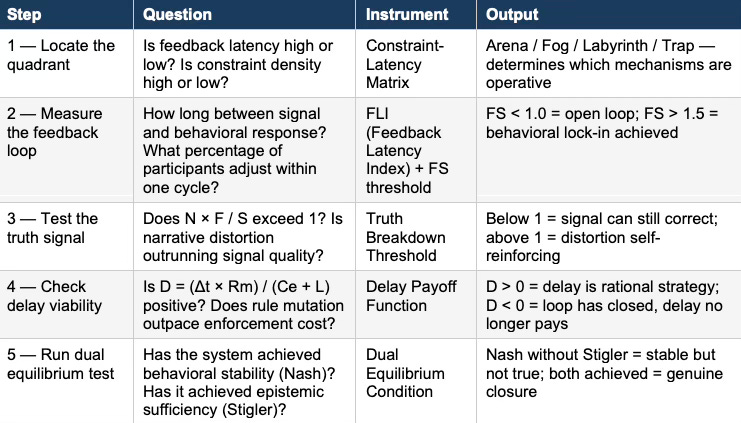
Read the outputs together, not in isolation. A system in the Labyrinth (Step 1) with D > 0 (Step 4) and Nash without Stigler (Step 5) is a delay-dominant institution operating against a captured enforcement architecture — the Compass litigation before SSB 6091. A system in the Trap (Step 1) with FS > 1.5 (Step 2) and N × F / S > 1 (Step 3) is a prediction market transitioning from forecasting tool to behavioral control mechanism — the Kalshi platform as AI amplification increases participation velocity. A system with D < 0 (Step 4) and external entropy approaching control capacity (Step 5 entropy override) is at the inflection point where the loop is about to close — the moment to position, not to analyze.
The protocol does not replace judgment. It structures it. Five questions, five instruments, one integrated read of where the system is, which mechanism governs it, and when the feedback loop will be forced to close.
XIV. Foresight Predictions
Convergence speed will increase while accuracy declines. Feedback loops will tighten faster than verification capacity can scale — and the gap between stability and truth will widen until external entropy forces abrupt correction. Foresight predictions are not extrapolations — they are structural outputs. Each prediction below derives from a specific CGT mechanism operating under identifiable conditions. The falsification milestones are the analytical commitments that separate CGT from commentary: if faster convergence consistently improves accuracy, if circuit splits resolve without rule mutation, if high-feedback systems reduce rather than amplify distortion — the model fails on its own terms. Publish the predictions before the outcomes arrive. Measure them when they do.
Four falsifiable predictions define the forward CGT trajectory:
1. Prediction markets become regulatory targets once feedback effects become visible — P50: 12–24 months
2. Litigation strategies converge on delay-dominant equilibrium — P90: already observable in multi-jurisdictional cases
3. AI accelerates truth degradation through correlation compression — P50: 6–18 months
4. Regulatory systems stabilize decisions without resolving underlying truth conditions — P90: persistent condition
Falsifiable Milestones
• If prediction market accuracy (Brier scores) improves alongside increased volume and AI participation, Feedback Market Game Theory is invalidated
• If a circuit split resolves in under 12 months without observable rule mutation, Delay-Dominant Game Theory is invalidated
• If high-feedback systems consistently reduce sentiment variance rather than amplify it, Narrative-Control Game Theory is invalidated
XV. Conclusion — The Forward Lock
Control over feedback, not optimization of strategy, determines outcomes. Engineers of the loop dominate optimizers of the play. Position before the loop closes — or accept that the loop’s closure positions you. Every framework in this paper converges on a single operational instruction: identify the feedback loop before analyzing the actors inside it. Who controls the loop controls the outcome. Who understands the loop before others do controls the timing of the correction. Who can inject external signal into a captured loop — through litigation, legislation, parallel enforcement, or analytical aggregation — controls the direction of the correction when it arrives. CGT is not a descriptive framework for explaining what happened — CGT is a predictive architecture for identifying where loops are open, where they are captured, and when they will be forced to close.
Control over feedback, not optimization of strategy, determines outcomes in modern systems. Delay extends timelines. Narrative reshapes belief. Feedback locks behavior. Constraint geometry narrows available paths. Prediction markets, courts, and AI systems will converge faster while producing less reliable truth — unless external signal injection increases faster than feedback loop tightening.
Cybernetic Game Theory moves the analytical frame from what do actors want to how do systems stay stable. Institutions are not collections of rational preferences. They are control architectures whose equilibrium properties follow directly from their feedback structure. The actors inside them are not irrational — they are responding correctly to the incentives the architecture creates. Understanding why modern systems feel gaslit requires understanding that the architecture is working. The gaslighting is the product.
MindCast’s MAP CDT (MindCast AI Proprietary Cognitive Digital Twin) Foresight Simulation operates as a multi-loop simulator — modeling the media loop, the market loop, the regulatory loop, and the institutional loop simultaneously — and predicting which loop dominates, which collapses, and how they synchronize when compression arrives. Most forecasting systems ask what will happen. Prediction markets ask what is the probability. Predictive Cognitive AI asks when competing expectation systems will be forced to update — and what reality looks like after they do.
Confidence signals belief. Feedback determines truth. MindCast predicts when systems run out of the distance between the two.
Forward Lock: If faster convergence consistently improves accuracy across systems, the model fails.