


Related publications: MindCast Predictive Game Theory AI vs. Market Predictive AI— Structural Foresight in Institutional Systems | How MindCast Game Theory Differs from Textbook Game Theory (Visual Companion) | MindCast AI Emergent Game Theory Frameworks | MindCast Cybernetic Game Theory | Super Bowl LX — AI Simulation vs. Reality
Visual Synthesis: MindCast Predictive Game Theory AI vs. Market Predictive AI
Executive Summary
Rule mutability replaces equilibrium with control. When institutions rewrite constraints during play, strategy shifts from optimizing within rules to determining which rules will exist. Standard models assume fixed constraints, stable payoffs, and known strategy sets. Real institutional environments violate all three assumptions simultaneously — agencies reinterpret statutes mid-enforcement, legislatures encode reactions to ongoing litigation, and courts reshape enforcement boundaries in real time. Strategy built on static assumptions misprices risk and misallocates resources in exactly the environments where the stakes are highest.
MindCast extends the prior framework — How MindCast Game Theory Differs from Textbook Game Theory — by shifting the unit of analysis from equilibrium formation to rule evolution. The prior piece established how actors converge, stabilize, or fragment under fixed constraints. Rule mutability inverts that condition: constraints themselves become contested terrain, and the actors who shape them gain structural advantage before traditional competition begins.
Rule mutability converts strategy from optimization under known payoffs into navigation under shifting control conditions. Strategy migrates from static positioning to temporal sequencing, forum selection, and rule anticipation. Actors no longer compete solely on price, quality, or legal merit — they compete to influence the structure of the rule environment itself.
Four applied domains illustrate the mechanism: federal prediction markets regulation, Washington State real estate transparency, consumer AI device platforms, and AI data center energy infrastructure. Across all four, the same pattern holds. Innovation or litigation exposes constraint gaps. Institutions respond by redefining rules. Timing windows emerge between signal and enforcement. Strategic advantage accrues to actors who anticipate rule evolution rather than react to it.
MindCast treats rule evolution as a first-class variable and models institutions as competing rule engines inside a shared system. Rather than assuming the game, the system simulates the evolution of the game itself — tracking rule formation, institutional feedback loops, and cross-forum interaction to produce falsifiable forward predictions.
I. Rule Mutability Defines the Strategic Environment
Every competitive environment rests on a set of rules — classification standards, disclosure requirements, enforcement thresholds, jurisdictional boundaries. Standard strategy assumes those rules hold still. Rule mutability names the condition where they do not, and where the contest to shape them becomes as consequential as any competition within them. Understanding rule mutability as a first-order strategic variable is the precondition for operating effectively in environments where institutions are active participants, not passive referees.
Rule mutability transforms institutions from referees into participants with rule-setting power. Agencies issue guidance that shifts compliance thresholds. Legislatures respond to perceived loopholes exposed through litigation. Courts reinterpret statutory language in ways that redefine enforcement scope. Each action modifies the available strategy set for every other actor — not as a side effect, but as a strategic output in itself. Shaping the rule set is a form of competition, and in many environments it is the most consequential form.
Actors who recognize the shift stop optimizing solely within the existing rule set and begin competing to influence its structure. A firm that shapes disclosure standards, timing requirements, or enforcement triggers gains structural advantage before traditional competition begins. A regulator that defines classification boundaries determines which products exist in a regulated category and which do not. A litigant that generates favorable precedent rewrites the operating environment for every subsequent actor in the same space. Rule influence is not ancillary to strategy — in mutating environments, rule influence is strategy.
The practical implication is that the unit of competitive advantage shifts. Price, quality, and market share remain relevant, but they become secondary to positional control over the rule surface. Firms that invest heavily in product differentiation while ignoring regulatory engagement misallocate resources in exactly the environments where regulatory engagement determines survival. The prior work established how Cognitive Digital Twins — CDTs — navigate competitive fields under fixed constraints. Rule mutability adds the layer that CDTs must also navigate: the contest to define what the constraints will be.
Recognizing rule mutability as a first-order competitive variable requires a fundamental reorientation. Regulatory affairs, litigation posture, and legislative engagement are not support functions — they are primary strategic functions in environments where rule evolution governs outcomes. Actors who treat them as secondary expose themselves to the oldest form of competitive displacement: being outmaneuvered by a player operating on a different, better-understood level of the game. The sections that follow build the analytical framework for operating on that level.
II. Static Game Theory Breaks Under Moving Constraints
The failure of static game theory in rule-mutating environments is not a matter of degree — it is structural. Classical models were built for a specific condition: rules that hold still long enough to permit equilibrium analysis. Remove that condition and the model does not produce a useful approximation — it produces a systematically wrong answer. Before constructing a better framework, it is necessary to understand precisely why the standard one breaks.
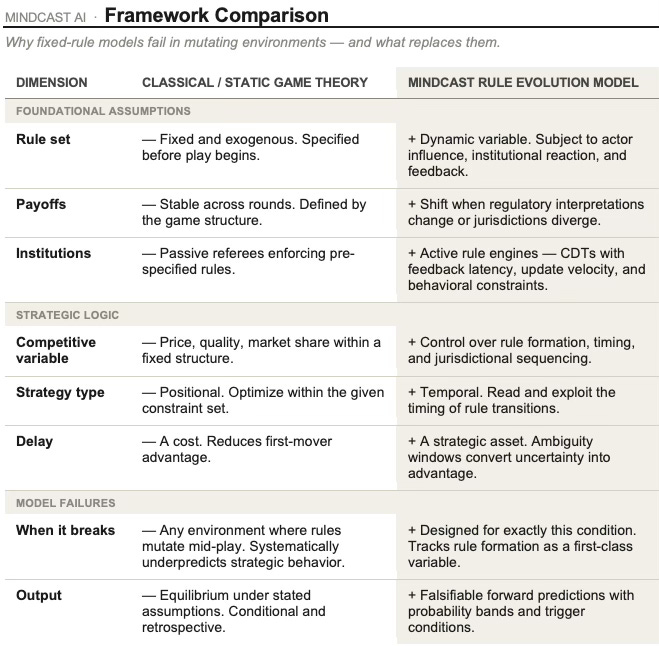
Classical game theory models achieve analytical power by holding the rule set fixed. Define the players, specify the payoffs, identify the available strategies, and solve for equilibrium. The model explains what rational actors should do given a stable set of conditions. Rule mutability breaks every one of those foundations simultaneously — and breaks them in ways that compound rather than offset.
Payoffs shift when regulatory interpretations change. A product that operated in an unregulated category yesterday faces enforcement exposure today not because the firm changed its behavior, but because the agency changed its reading of the statute. Strategy sets expand or contract as jurisdictions diverge. An actor that routes activity through one forum to exploit a favorable interpretation finds the same activity reclassified in an adjacent forum, generating inconsistent compliance obligations and enforcement risk that the original strategy never anticipated. Information asymmetry increases as actors exploit timing gaps between rule creation and enforcement — a gap the model treats as noise but that functions in practice as a primary competitive lever.
Two constructs define how these dynamics operate at the system level. Rule Surface Area measures the total extent of contested regulatory terrain across a given environment — the number of active forums, overlapping statutory authorities, and open classification questions that bear on the same activity. As Rule Surface Area expands, the number of viable strategic pathways increases and the probability of stable equilibrium decreases. Jurisdictional Drift describes the movement of actors across forums in response to inconsistent interpretations. Actors drift toward favorable jurisdictions, forcing regulatory response, which generates further inconsistency, which extends the drift window. Both dynamics compound: expanding Rule Surface Area increases the range of drift opportunities, and active drift generates new contested terrain that further expands the surface.
Classical equilibrium analysis fails in these conditions not because the underlying logic is wrong, but because the preconditions for equilibrium cannot be satisfied. Equilibrium requires sufficient stability for actors to form consistent expectations about payoffs and available moves. Rule mutability ensures those expectations will be invalidated before they can stabilize. Modeling a moving rule set as if it were fixed does not produce a simplified but useful approximation — it produces a systematically wrong answer. The error compounds with every round of play, as each new institutional move generates a new constraint configuration that the fixed-rule model never anticipated and cannot incorporate.
Traditional legal analysis treats rule change as exogenous — something that happens to the competitive field rather than something produced by it. Traditional strategy treats regulation as a constraint to optimize around rather than a variable to influence. Both approaches fail because they model institutions as referees rather than competitors. In mutating environments, that assumption guarantees systematic underprediction of strategic behavior.
The correct response is not to abandon game-theoretic structure but to extend it. MindCast treats the rule set itself as a dynamic variable — subject to actor influence, institutional reaction, and feedback from prior moves. The model tracks how the game evolves, which actors accelerate that evolution for competitive advantage, and which actors are structurally exposed by their inability to perceive or respond to the shift. Section III develops the strategic logic that follows from that extension.
III. Strategy Becomes Temporal Rather Than Positional
Once the rule set becomes a dynamic variable, the dominant logic of competitive strategy changes. Positional advantage — holding a strong market position within a stable structure — degrades as the structure shifts. Temporal advantage — reading rule transitions accurately and moving at the right moment — becomes the primary source of durable competitive superiority. Strategy in mutating environments is fundamentally a sequencing problem, not a positioning problem.
Static competitive strategy asks where to stand. Temporal strategy asks when to move. Rule mutability converts positioning from a durable asset into a contingent condition — advantages that hold under one rule configuration dissolve under the next, and the dominant competitive variable becomes not what position an actor holds but how quickly and accurately the actor can read the timing of rule transitions.
Timing governs outcomes across every stage of the competitive sequence. Early entry captures advantage before restrictions tighten — a platform that establishes market share before regulatory classification forces compliance costs into its product structure acquires a durable cost advantage that later entrants cannot replicate under the new regime. Delayed entry benefits from enforcement clarity — an actor that waits for interpretive ambiguity to resolve before committing resources avoids the sunk costs that early movers absorbed during the uncertainty window. Forum sequencing allows actors to test interpretations in jurisdictions with lower enforcement density before scaling activity to higher-stakes forums, using the initial forum’s outcome as a signal calibration and a precedent-building opportunity simultaneously.
Delay deserves particular attention because standard competitive logic treats it as a cost. In rule-mutating environments, delay functions as a strategic asset. Litigation timelines, regulatory comment periods, enforcement backlogs, and legislative calendars all create windows during which actors operate under ambiguous or favorable interpretations without bearing full enforcement exposure. An actor that correctly identifies the boundaries of a delay window — knowing when ambiguity will resolve and in which direction — can operate aggressively within that window and reposition before enforcement consolidates. An actor that treats uncertainty as uniformly negative misses the window entirely and cedes the advantage to competitors with better temporal modeling.
Forum sequencing extends temporal strategy across multiple jurisdictions simultaneously. A product tested in a state regulatory environment before federal classification is finalized generates interpretive data that federal advocates can use in rulemaking proceedings. A litigation strategy advanced in a district court with favorable precedent creates doctrinal footholds that shape appellate review. Each forum operates on a distinct timeline, with distinct feedback latency and distinct rule update velocity. Actors who model those timelines as a system — rather than treating each forum as an isolated proceeding — gain a sequencing advantage that compounds across the full arc of rule evolution.
The CDT framework from the prior work applies directly here. Actors with faster feedback loops perceive timing windows earlier and can reposition before slower competitors recognize the window is open. Actors with narrative commitments that constrain adaptation — who cannot credibly shift strategy without imposing unacceptable costs on their institutional legitimacy — lose temporal flexibility and become predictable targets for competitors operating without those constraints. Temporal strategy requires not only modeling the rule evolution timeline but modeling which actors have the behavioral architecture to exploit it. Section IV develops the institutional side of that equation.
Contact mcai@mindcast-ai.com to partner with us on Predictive Law and Behavioral Economics + Game Theory Foresight Simulations. To deep dive on MindCast work in Cybernetic Foresight Simulations upload the URL of this publication into any LLM and prompt ‘reconstruct MindCast framework with three degrees of cited sub links.’ See Live-Fire Game Theory Simulators, Runtime Predictive Infrastructure | MindCast Predictive Cybernetics Suite
IV. Institutions Operate as Rule Engines
Temporal strategy depends on reading institutional behavior accurately. To do that, institutions cannot be treated as black boxes that emit rules at unpredictable intervals. Each institution operates as a system — processing inputs, generating outputs, and doing so at a characteristic speed and pattern that actors can model. Understanding the mechanics of institutional rule generation is what converts temporal awareness into actionable strategic positioning.
Institutions are not passive enforcers of externally determined rules. Institutions are active rule-generating systems — processing environmental signals and emitting rule changes as outputs in a continuous feedback cycle. Treating institutions as fixed referees produces the same analytical error as treating rules as fixed: both assumptions mistake a dynamic variable for a stable one, and both produce predictions that degrade as the environment evolves.
Every institution operates with a characteristic feedback latency — the lag between receiving a signal from the environment and updating its rule output in response. A regulatory agency with high feedback latency receives market signals about new product structures, processes them through internal review cycles, coordinates across divisions, and issues guidance months or years after the conduct it is addressing has already adapted. A court with low feedback latency issues interim rulings that reshape the effective rule set within weeks of a filing, collapsing ambiguity before either party can exploit the delay window. A legislature with political feedback constraints may receive clear signals from litigation and enforcement activity but delay rule codification for years while internal coalition dynamics resolve. Each latency profile creates a distinct opportunity structure for actors who model it correctly.
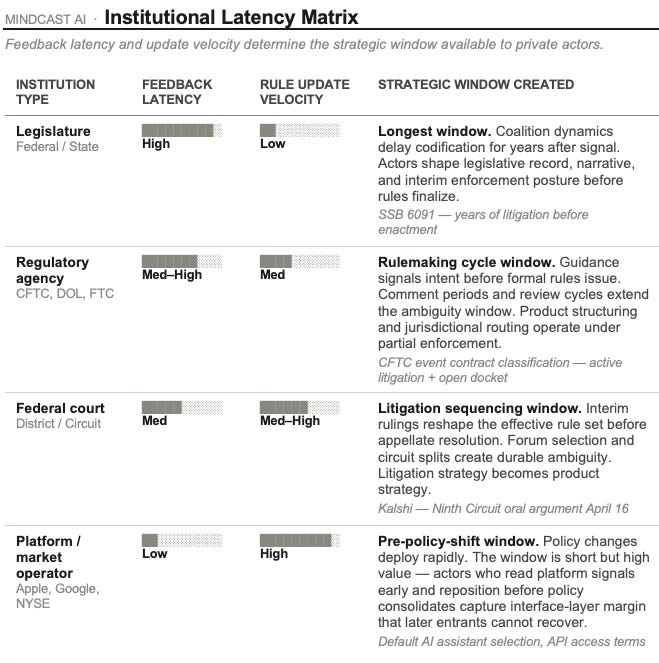
Rule update velocity compounds the latency dynamic. High-velocity institutions — those that can change rule outputs rapidly in response to new signals — compress the timing windows that slow-moving actors depend on. Low-velocity institutions extend those windows but also extend the period during which the environment operates under outdated or contested rules. An actor operating under a high-latency, low-velocity enforcement regime faces a fundamentally different strategic landscape than an actor operating under rapid-response regulatory oversight. Both conditions create exploitable structure, but the nature of the advantage differs: high-latency environments reward aggressive positioning within ambiguity windows, while low-latency environments reward actors who can influence the rule output itself rather than simply exploiting the lag.
Cross-institutional interaction generates the most complex dynamics. When multiple institutions with different latency profiles and update velocities operate on overlapping jurisdictional terrain, rule signals become inconsistent and actors can exploit the gaps between institutional outputs. A federal agency issues guidance that an industry interprets as permissive. A state legislature reads the same guidance as insufficient and codifies stricter standards. Courts in different circuits interpret the agency guidance differently as litigation tests its boundaries. The effective rule set becomes a composite of contested outputs rather than a single authoritative constraint — and competitive advantage flows to actors who map the composite correctly rather than anchoring to any single institutional pronouncement.
MindCast models institutions as CDTs operating within the same system as private actors. Each institution carries an installed behavioral architecture — incentive structures, internal feedback mechanisms, political constraints, and institutional memory — that shapes how it processes signals and generates rule outputs. Modeling the institution as a CDT rather than a fixed referee produces predictions about rule evolution grounded in observable institutional behavior rather than assumed policy intent. The operative question is not what the agency should do under the statute. The operative question is what the agency, given its feedback architecture and constraint geometry, is most likely to do next. Section V shows how these institutional dynamics combine into a repeating, predictable structural sequence.
V. The Repeating Mechanism
Sections I through IV established the components: rule mutability as a competitive variable, the failure of static models, temporal strategy as the dominant logic, and institutions as active rule engines with distinct latency profiles. Taken together, those components generate a predictive template — a structural sequence that repeats across domains with sufficient consistency to function as a forward-looking tool. Recognizing where a given environment sits within the sequence determines which moves are available and which timing windows remain open.
Innovation or litigation exposes a gap in the existing constraint set — a product that does not fit existing classification, a practice that existing disclosure rules do not reach, a technology that existing permitting frameworks were not designed to address. Institutional actors perceive the gap at different speeds depending on their feedback latency. Early perceivers begin repositioning before the gap becomes visible to the full market. The gap generates public visibility — through court filings, legislative hearings, press coverage, or enforcement actions — that signals the closure window is opening.
Institutional response follows, but rarely as a single coordinated action. Agencies signal intent through guidance and public statements before formal rules issue. Legislatures begin hearings that indicate the direction of likely codification. Courts issue rulings that test the boundaries of existing frameworks. Each institutional signal narrows the remaining optionality for actors still inside the ambiguity window, accelerating repositioning by those who read the signals accurately. The timing window between initial institutional signal and final rule enforcement is where the most consequential strategic moves occur — not during the ambiguity itself, but during the closing phase when direction is visible but enforcement has not yet consolidated.
Actors who reposition during the closing window capture the most durable advantage. Early movers who repositioned during the ambiguity window bear the cost of navigating uncertainty; they gain first-mover position but accept the risk that the institutional response moves in an unfavorable direction. Late movers who wait for final rule clarity face reduced optionality — the most favorable structural positions have already been claimed — but bear lower uncertainty costs. Closing-window actors read institutional signals accurately and move with sufficient speed to capture remaining optionality before enforcement consolidates.
Feedback loops from repositioning alter subsequent rule formation, closing the sequence and opening a new one. Repositioning by early movers generates new market practices that institutions must evaluate. New practices expose new gaps. New gaps trigger new institutional signals. Each cycle runs faster than the one before, as institutions update their monitoring capacity in response to prior cycles and actors refine their signal-reading and repositioning capabilities. Rule mutability is not a transitional condition that resolves into permanent stability — in high-innovation, high-litigation environments, rule mutability is the permanent condition. Section VI applies the sequence across all four domains and validates the template against observable evidence.
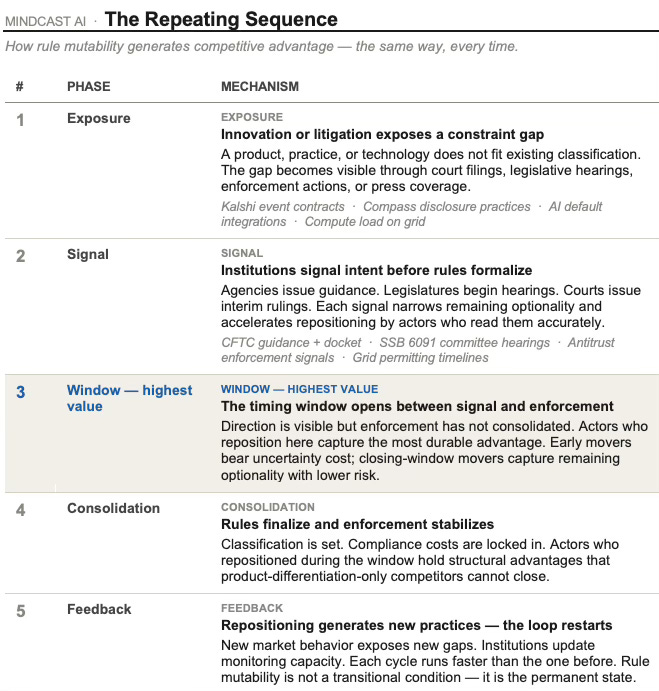
| Rule mutability creates a feedback loop where each institutional move alters the next. Strategy requires modeling the loop — not reacting to isolated events.
VI. Applied Case Studies: Rule Mutability Across Four Domains
The structural sequence established in Section V is not an abstraction. Each of the four domains examined below has produced observable evidence of the mechanism operating in real time — trigger events, institutional signals, timing windows, and competitive repositioning. Mapping those domains against the template confirms the sequence’s predictive value and demonstrates how MindCast applies the framework to generate falsifiable forward positions.
Case 1: Prediction Markets (CFTC and Federal Jurisdiction)
Prediction markets in the United States illustrate rule mutability through overlapping statutory authority, evolving agency posture, and active litigation. The Commodity Futures Trading Commission asserts jurisdiction over event contracts while simultaneously exploring new rulemaking through advance notices and guidance. Private platforms test the boundaries of classification, structuring products to fit or avoid definitions that trigger enforcement. Courts become interim arbiters, shaping the effective rule set while formal rulemaking remains incomplete.
Jurisdictional Drift becomes a primary lever. Actors route activity through structures that exploit classification ambiguity while regulators decide whether to tighten definitions or tolerate experimentation. Feedback latency between agency signal and formal rule adoption creates a window where strategy operates under partial enforcement. Actors who model that window gain advantage; actors who assume fixed jurisdiction misprice risk.
Litigation strategy becomes part of product strategy — legal challenges influence the trajectory of rule formation, not just the outcome of any single case. Dominant actors are not those who optimize within a fixed regulatory framework, but those who anticipate how the framework will evolve and position accordingly. The prediction markets domain currently sits inside the closing window: direction is visible, enforcement remains unsettled, and actors who have already structured for rule consolidation hold positions that later entrants cannot replicate.
Case 2: Real Estate Transparency (Washington State)
Washington State real estate demonstrates the full sequence at speed. Litigation exposed gaps in disclosure and marketing practices. Legislative response codified new standards that eliminated those gaps. Industry actors then adjusted strategy to anticipate or resist further changes — some repositioning early, others treating each development as an isolated event rather than a connected sequence.
Sequence matters more than any single action. Litigation triggered visibility. Visibility triggered legislation. Legislation redefined the competitive landscape. Actors who anticipated the legislative response repositioned early. Actors who treated litigation as isolated legal risk mispriced the structural shift — they optimized for the courtroom while the real competition moved to the statehouse. Washington State now represents a post-consolidation environment: the timing window has largely closed, and actors who failed to reposition during the legislative cycle bear structural disadvantages that product or service competition alone cannot close.
Case 3: Consumer AI Devices (Apple, Google, Samsung)
Consumer AI devices illustrate rule mutability operating through platform policy rather than formal regulation. Platform owners, operating systems, and intelligence providers compete to define the boundary between interface and intelligence. Apple stabilizes control through ecosystem integration while externalizing portions of intelligence. Google pushes intelligence upward into the interface layer. Samsung leverages distribution scale while navigating dependence on external operating systems. Each actor attempts to shape what counts as the “device” versus the “intelligence layer” — because whoever defines that boundary captures the margin that sits on it.
Platform policies, API access, privacy constraints, and distribution agreements continuously redefine competitive boundaries. Firms that anticipate shifts in where value is captured — device, operating system, or intelligence layer — position ahead of rule consolidation. Firms that assume static boundaries misallocate capital.
Platform policy shifts and default AI integrations determine whether intelligence is embedded or externalized, directly affecting which firms capture margin at the interface layer. Each policy update — governing API access, data sharing, or default assistant selection — functions as a rule mutation that reshapes the competitive geometry before any firm responds through product alone. The consumer AI device domain remains inside an active ambiguity window; the interface–intelligence boundary has not consolidated, and actors shaping policy terms now are writing the rules that will govern everyone else later.
Case 4: AI Data Center Energy and Infrastructure
AI energy infrastructure demonstrates rule mutability operating at the intersection of physical constraint and regulatory sequencing. Artificial intelligence infrastructure converts computation into an energy-constrained system. Power availability, grid interconnection, permitting timelines, and environmental regulation become binding constraints. Hyperscalers, utilities, and regulators co-evolve the rule set governing energy allocation and infrastructure buildout.
Regulatory approvals, transmission capacity, and energy sourcing rules mutate in response to load growth. Actors compete to secure favorable positioning within these evolving constraints — through long-term power agreements, geographic placement, and regulatory engagement. Firms that model these changes secure capacity ahead of bottlenecks. Firms that treat energy as a static input face constraint shocks.
Grid interconnection queues and permitting timelines now determine which AI clusters can scale, converting regulatory sequencing into a primary competitive bottleneck. A firm that secures grid position before interconnection queues harden captures a capacity advantage that no subsequent product investment can replicate under the constrained regime. Energy infrastructure is approaching the closing window: regulatory frameworks are tightening, interconnection queues are lengthening, and actors who have not yet secured favorable positioning are running out of room to do so before the constraint surface hardens.
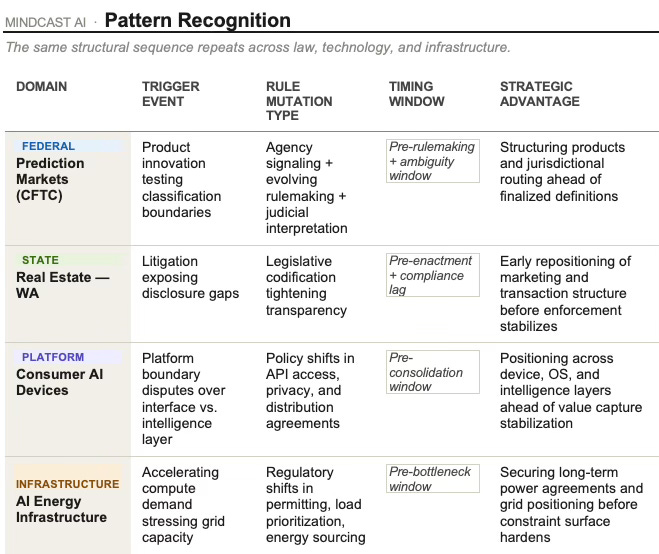
The same structure appears across law, technology, and infrastructure because the mechanism is not sector-specific. Rule mutability is a property of any system where rule formation and competition occur simultaneously.
mindcast-ai.com·Dynamic Game Theory: Competing Inside a System That
Trigger events expose constraint gaps. Institutions respond by mutating rules. Timing windows open between signal and enforcement. Actors who model the window capture advantage.
The same structure appears across law, technology, and infrastructure because the mechanism is not sector-specific. Rule mutability is a property of any system where rule formation and competition occur simultaneously — and that condition is becoming the default, not the exception.
VII. MindCast as a Rule Evolution Engine
The four case studies validate the structural template. Applying that template in practice requires an analytical system capable of determining, for any given environment, whether rules are stable or mutating, which institutional signals are material, and where in the sequence a domain currently sits. MindCast was built for exactly that function — not as a single model but as a routed architecture that selects and constructs analytical layers based on the observed characteristics of the environment.
MindCast evaluates environments to determine whether rules are stable or mutating. Stable environments route to equilibrium-based analysis. Mutating environments trigger models that track rule formation, institutional feedback, and cross-forum interaction. The routing decision itself is analytical — assessing feedback latency profiles, Rule Surface Area, Jurisdictional Drift activity, and the stage of the repeating sequence before selecting the appropriate analytical layer.
Once routed to a mutating environment, MindCast constructs the analysis by selecting and weighting four operational functions: identifying which rules are likely to change; estimating when changes will occur; mapping which actors benefit from each change; and simulating forward states of the rule environment under alternative institutional response scenarios. Each function draws on CDT modeling of the relevant institutions and private actors, incorporating behavioral architecture, narrative constraints, and feedback loop characteristics.
MindCast builds Cognitive Digital Twins that incorporate institutions as active rule-generators rather than passive enforcers. The system prioritizes and weights analytical modules based on observed instability. When existing models fail to capture emerging dynamics, MindCast introduces new constructs to quantify rule volatility and strategic timing. The output is not a description of how the environment works — it is a falsifiable forward prediction of where the environment is moving, which actors are positioned to benefit, and which observable signals would confirm or invalidate each prediction.
VIII. Forward Prediction and Falsification
A framework without falsification conditions is not a predictive system — it is a retrospective narrative. MindCast’s value depends on generating expectations that can be tested against outcomes. The forward prediction below applies directly to the four domains examined in Section VI and to any high-fragmentation regulatory environment exhibiting the structural conditions identified in Sections I through V.
In high-fragmentation environments, firms that invest more in rule formation than product differentiation will outcompete firms that do the opposite within one regulatory cycle. Competition migrates upstream — from market share to control over enforcement timing, classification standards, and jurisdictional sequencing. Firms that recognize the migration and allocate accordingly will hold structural advantages that product-differentiation-only competitors cannot close through feature competition alone.
The model fails if firms that deprioritize regulatory strategy outperform rule-shaping competitors over a full rule cycle — from initial institutional signal through final enforcement consolidation. Observable falsification evidence would include stable pricing competition despite persistent regulatory fragmentation, minimal litigation-driven rule changes across the four domains examined, and convergent rather than divergent jurisdictional interpretations over the same period. If those conditions hold, the model requires revision. If rule-shaping competitors continue to outperform through enforcement consolidation, the prediction stands.
IX. Conclusion
Strategy in mutating environments is not a refinement of classical competitive logic — it is a different discipline. Classical strategy optimizes within a given structure. Dynamic game theory, as developed here, competes to shape the structure itself. Actors who internalize that distinction gain access to a level of competition that most competitors do not recognize is occurring. Actors who ignore it remain optimizing within a game that the more sophisticated players have already begun to rewrite.
Rule mutability redefines strategy as control over the evolution of the game rather than performance within a fixed system. Actors who recognize the shift move upstream, shaping rules before competing on outcomes. Actors who ignore it remain trapped in a game that no longer exists.
Strategy no longer optimizes within rules. Strategy determines which rules survive long enough to matter.