Microsoft · Nvidia · Google · Meta · CoreWeave · Nebius · IREN · Nscale · Crusoe · Fluidstack · AI labs · Bank lenders and private credit · Insurers · State Utility Commissions · United States · United Kingdom
Companion to Nvidia Guarantees After Huang — Underwritten Terms, Not Founder Conviction, Decide Which AI Data Center Credit Holds | Microsoft Neocloud Consolidation: Energized Megawatts, Not Contract Backlog, Decide Which Neoclouds Survive | Neocloud Operators and the Acceptance Gate: Accepted Megawatts, Not Signed Backlog, Decide What a Delay Costs
Interactive war game Neocloud Competition Simulation (updated 11/14/2026). War gaming visualization maps available.
Related MindCast works: AI Data Center Credit Risk, Permitting, Curtailment, and the Cost of Capital · AI Data Center Authorization Bargaining Power · The Lowest-Exposure AI Data Center Approval Route for Developers, Hyperscalers and Investors
I. Executive Summary: One Rule Explains Microsoft’s Cuts, IREN’s Slips and Nvidia’s Guarantees
Microsoft walked away from Nscale’s Loughton site over a grid connection date Nscale could not move. IREN’s three Microsoft deployments slipped after Microsoft changed its design, yet IREN faces no financial penalty for delays stemming from Microsoft’s design changes. Nvidia’s board accepted Jensen Huang’s resignation on November 11, 2026. The finance chief who questioned how its guarantees were valued now decides whether they continue.
Neoclouds are specialist operators that rent graphics processing unit (GPU) clusters to hyperscalers and artificial intelligence (AI) labs. Most of them build or lease the data centers they rent out, so a late site costs them twice: once in construction and once in lost rent.
Core insight. Contract size does not decide who pays for an AI data center delay. Walk-away value does. The party with the weakest option to leave the deal carries the cost, unless documented cause moves it or the party buys protection from someone stronger.
Thesis. Microsoft cut neocloud suppliers whose sites slipped, IREN waited on Microsoft’s sign-off for three deployments, and Nvidia’s guarantees changed hands when Huang resigned. The three events follow one rule: the Neocloud Delay Incidence Equilibrium. Delay cost lands on the party with the weakest walk-away option, unless a party documents that another party caused the delay. Operators sit in the weak position more often than buyers or guarantors. When contracts cannot move the cost, operators buy protection from guarantors, buyers or new owners. Nvidia sold much of that protection on terms tied to its chip sales, and its interim chief executive now asks what each guarantee earns on its own.
The deeper finding. The buyers that impose delay cost by default are becoming the natural sellers of protection against it. When Nvidia narrows its guarantees, Microsoft, Google and Meta can step in as protectors and take capacity rights in exchange. Each cycle of cuts and substitute support moves capacity toward the seats that already carry the least delay cost. A cost-allocation question becomes a question of concentration and vertical control.
MindCast AI applies Predictive Behavioral Economics + Dynamic Game Theory through MindCast AI Proprietary Cognitive Digital Twin Foresight Simulations (MP CDT FS). Behavioral Economics supplies the decision rules. Game Theory supplies the payoff structure. Predictive simulations emerge from the combination.
What distinguishes the MindCast approach. Market coverage treats Microsoft’s supplier cuts, IREN’s acceptance slips and Nvidia’s leadership change as three stories. MindCast treats them as moves in one game with three seats: buyer, operator and guarantor. Each case paper tests one condition of the same equilibrium, so a result in one paper changes the odds in the others.
Why now. Nvidia reports on November 17 under its interim chief executive, and Microsoft reports its fiscal second quarter in late January. Lenders, neocloud executives, counsel and utility commissions each face financing and credit support decisions before either report shows where delay cost lands next.
What the paper does. Section II defines the equilibrium and its three conditions. Section III sets three competing explanations against six propositions. Sections IV through VI map who controls each delay, how the three case papers test the rule and how the seats move one another. Section VII sets out four series-level MindCast Foresight Simulation Predictions, and Sections VIII and IX convert them into strategy and authorization implications.
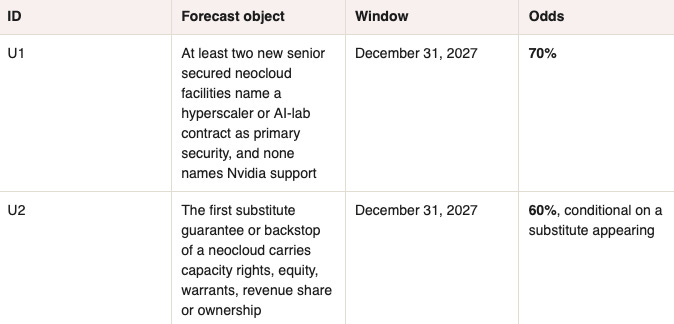
The series carries 28 MindCast Foresight Simulation Predictions: four in this paper and 24 across the three case papers. U marks a series-level Simulation Prediction. Odds use 10% steps and come from two Foresight Simulations completed before Nvidia’s November 17 report. Every window closes by December 31, 2027, while buyers, operators and guarantors are still adjusting and before any game theory equilibrium forms. At that stage a 10% step captures every change the evidence supports, and a finer figure would claim precision the Foresight Simulations do not have.
Stakeholder readout.
🏛️ Policymakers. Large-load credit support rests on whoever stands behind the operator. Commissions should read buyer and guarantor credit, not only the operator’s balance sheet (Section IX).
💼 Executives. Operators carry delay cost by default. Document the cause of every buyer-side delay, and secure protection before a buyer exercises its walk-away (U1).
⚖️ Counsel. Cause attribution, grace periods and prepayment crediting decide who pays for a slip. Draft landlord remedies that mirror buyer remedies (Proposition 3).
📊 Investors. Underwrite operators on their walk-away position and on who protects them. The protector’s terms now decide which operators survive (U2).
Takeaway. One rule explains the three events. Delay cost follows weakness, documentation moves it and protection costs money, and the cost of protection now decides which neoclouds survive. The buyers that impose delay cost are becoming the sellers of that protection.
II. Delay Cost Lands on the Weakest Walk-Away Option Unless Cause Is Documented
The Neocloud Delay Incidence Equilibrium names where delay cost lands among the parties to an AI data center deal. Incidence is the economist’s term for where a cost finally lands, as distinct from where a contract places it. The equilibrium is the division of delay cost among buyer, operator and guarantor that no party can improve by walking away.
Three conditions govern the division.
Default. Delay cost falls on the party with the weakest walk-away option, whatever the contract assigns and whichever party caused the delay.
Exception. Where a party documents that another party caused the delay, the cost moves to the party that caused it.
Protection. A party that neither condition protects buys protection through contract repair, a change of ownership or insurance. The cost of that protection decides which operators survive.
Game Theory supplies the payoff structure. Each seat’s walk-away value sets its bargaining share, and the equilibrium selects the allocation no seat can improve by leaving. Game theorists call the walk-away value a disagreement payoff. Behavioral Economics supplies the decision rules. Documented cause is the salient evidence that moves a buyer off its default, and loss-averse operators accept delay cost rather than risk losing the buyer.
The default condition in practice. The Nebius agreement lets Microsoft receive service credits or terminate individual tranches when delivery slips, whatever the cause. Microsoft left Loughton over a grid date outside Nscale’s control. Microsoft’s walk-away rests on its own campuses and a roster of other suppliers, so the cost of the grid delay fell on Nscale.
The exception condition in practice. IREN’s three deployments for Microsoft slipped after Microsoft changed its network design. IREN documented the cause, and the penalty never arrived. The same buyer imposed the full cost at Loughton and none at Childress, and the difference was proof of who caused the delay.
The protection condition in practice. Nebius secured prepayments covering 50-60% of related capital spending, which moves construction risk to the buyer. Google backstopped $3.2 billion of Fluidstack’s lease obligations. Nvidia wrote capacity floors, leases and site guarantees for operators without a hyperscaler anchor.
What moves the equilibrium. Any change in a seat’s walk-away value moves the division. A buyer’s own build and supplier roster strengthen its exit. An operator gains leverage when other buyers want its accepted capacity on current chips. A guarantor’s decision rule and the cost of documenting cause move the other two conditions.
The condition that breaks it. Walk-away values can converge. If compute scarcity leaves buyers unable to walk, buyers absorb undocumented delay and the default condition fails.
The default holds most strongly for buyers with their own build, such as Microsoft, Google and Meta. It holds most weakly for AI labs that rent, so the first sign of a break would be an AI lab paying for a delay nobody documented. The scarcity that argues against a demand downturn is the same force that weakens a renting buyer’s exit.
The efficient allocation sits inside the equilibrium. When documenting cause costs nothing, the equilibrium reduces to the efficient allocation. Cost then falls on the party that can prevent the delay at least cost, the result Ronald Coase described for costless bargaining. The test of the equilibrium therefore runs on undocumented buyer-side delays, where the two readings part ways.
🏛️ Policymakers. Public gates that slip push cost onto the weakest private party. Dated state terms reduce the delay nobody can document.
💼 Executives. Walk-away value is an asset. Every additional qualified buyer for accepted capacity moves delay cost away from the operator.
⚖️ Counsel. Documented cause converts a default loss into a buyer obligation. Contracts that define how cause is proven decide the exception.
📊 Investors. Contract backlog overstates an operator’s position. Model the walk-away value of each counterparty instead.
Takeaway. Contract size does not decide who carries delay cost. Walk-away value decides it, unless cause is documented or protection is bought.
III. Six Propositions Explain Where Delay Starts, Who Carries It and What Moving It Costs
Six propositions carry the argument from the origin of a delay to the cost of moving it. Three competing explanations come first, each with the result that would confirm it, so a reader can hold the alternatives before weighing the evidence.
III.A Three Explanations Compete
Explanation A: one equilibrium. Delay cost follows walk-away value, moves with documented cause and gets bought away through protection. Falsifier: operators bear remedies only for delays inside their own control across the next disclosed contract amendments.
Explanation B: a demand downturn. Risk spreads across every seat because AI demand is weakening. Current evidence runs against it. CoreWeave reported that older-generation rental rates rose 30-50% in a quarter, and CoreWeave continues to contract new capacity at higher prices. Falsifier: Microsoft’s cut basis resolves to demand by March 31, 2027, or rental rates fall for two consecutive quarters.
Explanation C: three unrelated events. Microsoft’s supplier strategy, IREN’s engineering and Nvidia’s governance crisis coincided with no common structure. Falsifier: U1 and U2 both fail.
III.B Most Data Center Delay Starts Where the Operator Has No Control
Of the four delays examined in Microsoft Neocloud Consolidation, three started outside the operator. Loughton waited on a grid date, Vineland on air permits and local opposition, and Childress on Microsoft’s own network changes. Only IREN’s cabling problems and generator fire sat inside the operator’s control.
Operators still choose sites, landlords and contractors, so a delay outside the operator can sit inside its chain. At Vineland, the site developer ran generators without permits and New Jersey fined the site $1 million. The failure sat outside Nebius but inside its landlord. The case supports a landlord-chain reading of control rather than a claim that nobody on the operator side caused the delay.
Breaks if: disclosed delays in the next two quarters trace mainly to construction and contractor failure.
III.C Contracts Assign Delay by Walk-Away Value, Not by Control
The Nebius tranche terms apply whatever the cause of a slip. Microsoft exercised its walk-away at Loughton over a delay Nscale could not prevent, and it declined its option to expand the Texas deal. Both moves rest on an exit Microsoft built for itself: owned campuses and a roster of suppliers.
The competing reading is the efficient allocation from Section II. Where documenting cause costs nothing, cost falls on the least-cost avoider, and the contract terms would follow control. The two readings part only on undocumented buyer-side delays.
Breaks if: operators bear remedies only for delays inside their own control across the next disclosed amendments. Microsoft P5 tests the claim: the next documented supplier action falls on capacity not yet energized.
III.D Documented Cause Overrides Walk-Away Value
IREN’s statement on Microsoft’s design changes is the cleanest case. Neocloud Operators and the Acceptance Gate names cause attribution, grace periods and prepayment crediting as the three terms that decide what a slip costs. Every counsel callout across the two published papers turns on cause documentation.
The competing reading holds that buyers waive penalties to keep a supplier they still need. Under that reading, the waiver reflects scarcity rather than documented cause.
Breaks if: Microsoft terminates or credits an IREN deployment after IREN documents buyer-caused delay.
III.E Unprotected Parties Buy Protection in One of Three Forms
Where neither walk-away value nor documentation protects a party, protection gets bought. Contract repair moves risk through prepayments and through landlord remedies that mirror buyer remedies. Ownership moves it by consolidation: Google acquired Crusoe’s southeast Wyoming site after Crusoe completed approvals, and CoreWeave tried to buy the landlord whose delay later cut its guidance.
Insurance moves risk to a third party. Nvidia’s capacity floors, tenant-of-record leases and the Ohio site guarantee all sell protection. Meta’s credit carried CoreWeave’s $8.5 billion facility to an investment-grade rating, and Google’s Fluidstack backstop does the same work for a lease.
Breaks if: distressed operators in 2027 fail without any of the three forms appearing first.
III.F Nvidia Sold Part of That Insurance Below a Standalone Cost
After the August dispute over its revenue-sharing terms, Huang asked staff for a test that counted the chip sales a guarantee could generate. The Ohio guarantee carries no disclosed fee. Capacity floors earn a revenue share, and early backstops earned warrants. Nvidia’s book therefore holds two kinds of protection: fee-bearing and cross-subsidized by chip sales.
The competing reading holds that every guarantee earns a return through chip demand. Under that reading, “below cost” mislabels a bundled sale.
Breaks if: Nvidia under Kress keeps signing protection with no explicit consideration at the prior pace, which Nvidia S3 tests.
III.G When the Insurer Changes Its Rule, Protection Migrates to Buyers and Owners
Buyers and owners who step in take control in exchange. Google’s Fluidstack backing and Wyoming purchase show the terms. Meta weighs leasing raw GPU capacity to third parties, which would turn a customer into a competitor.
One constraint shapes how control arrives. Nvidia’s August pause turned on a clause letting it approve which customers a neocloud could rent to, not on its revenue share. A hyperscaler that takes the same approval right meets the same antitrust objection, so control may arrive as ownership or offtake priority instead.
The competing reading holds that private credit and insurers fill the gap on financial terms alone.
Breaks if: substitute guarantees in 2027 carry no capacity rights, equity or revenue share, which U2 tests.
Chain conclusion. Propositions III.B through III.D explain where delay cost lands. Propositions III.E through III.G explain what it costs to move. Microsoft Neocloud Consolidation tests the walk-away proposition, the Acceptance Gate paper tests documented cause and the Nvidia paper tests the insurance propositions.
🏛️ Policymakers. Most delay starts at public gates and grid dates. Shortening those windows reduces the cost no private party can avoid.
💼 Executives. Landlord delay is operator delay. Mirror buyer remedies in every lease, or buy the landlord.
⚖️ Counsel. The exception condition is a drafting outcome. Define cause, evidence and notice before the first slip.
📊 Investors. Protection carries a cost and often a control right. Read who holds the control before reading the coverage.
Takeaway. Delay starts where operators lack control, contracts assign it by exit strength and documented cause reverses it. Protection costs money, and its provider now sets the terms.
IV. The Delay Control Map: The Acceptance Rung Carries Risk No Third Party Insures
The capacity ladder tracks megawatts (MW) from contracted through authorized, energized, accepted and utilized. For each rung, the map below names who controls the delay, who carries it by default and which repair moves it. A rung where controller and carrier differ carries risk nobody has paid to move.
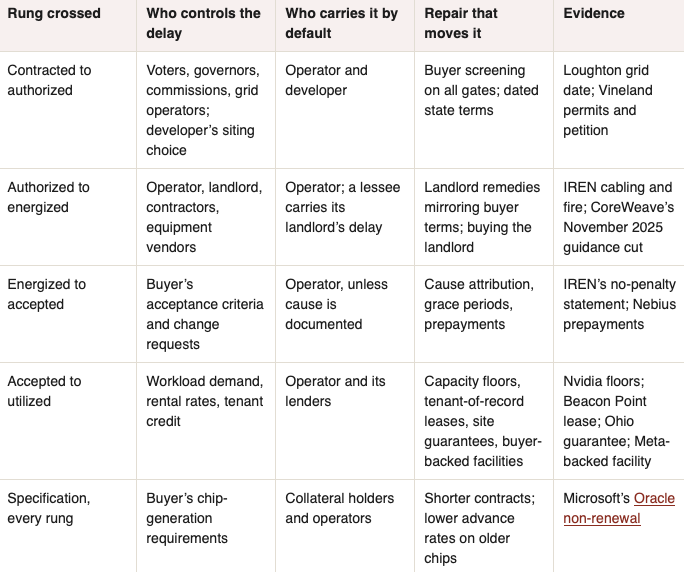
The widest gap between controller and carrier sits at the energized-to-accepted rung. The buyer controls acceptance, the operator carries the delay and no third party insures the gap. Every Nvidia tool sits at the utilization rung or at site resale. Only the buyer covers the acceptance gap, through prepayments, so contract repair is the only market at that rung.
The first insurance product written against acceptance delay would change the game. Parametrix’s neocloud service-level insurance covers uptime after go-live, one rung higher. MindCast carries an acceptance-delay product as a watch item without odds.
🏛️ Policymakers. The first rung belongs to public gates. Dated decisions move the first rung from undocumented delay to documented cause.
💼 Executives. Acceptance is the uninsured rung. Prepayments and documented cause are the only protection available today.
⚖️ Counsel. Acceptance criteria written by the buyer decide the largest uninsured exposure. Negotiate objective tests and deemed acceptance.
📊 Investors. Lending against energized capacity carries acceptance risk nobody insures. Key draws to accepted megawatts.
Takeaway. Acceptance carries the widest gap between who controls delay and who pays for it, and only the buyer can close it today.
V. Three Cases Test One Equilibrium
Each case paper isolates one condition of the equilibrium and holds the other two roughly steady. Read together, the three work like a natural experiment. The same buyer appears in two of them with opposite outcomes, and the third shows what protection costs once neither contract terms nor documentation shields the operator.
V.A The Buyer Case Tests the Default Condition
Microsoft Neocloud Consolidation follows the strongest exit in the market. Microsoft built its walk-away before it used it: owned campuses, a roster of suppliers and tranche terms that let it credit or terminate whatever the cause of a slip. Energized megawatts, not contract backlog, decide which neoclouds survive.
The default condition predicts where Microsoft’s cuts land. The cuts should fall on capacity not yet energized and on suppliers with no documented claim against Microsoft, whoever caused the delay. Loughton fits the pattern: the grid date sat outside Nscale’s control, and Nscale carried the full cost.
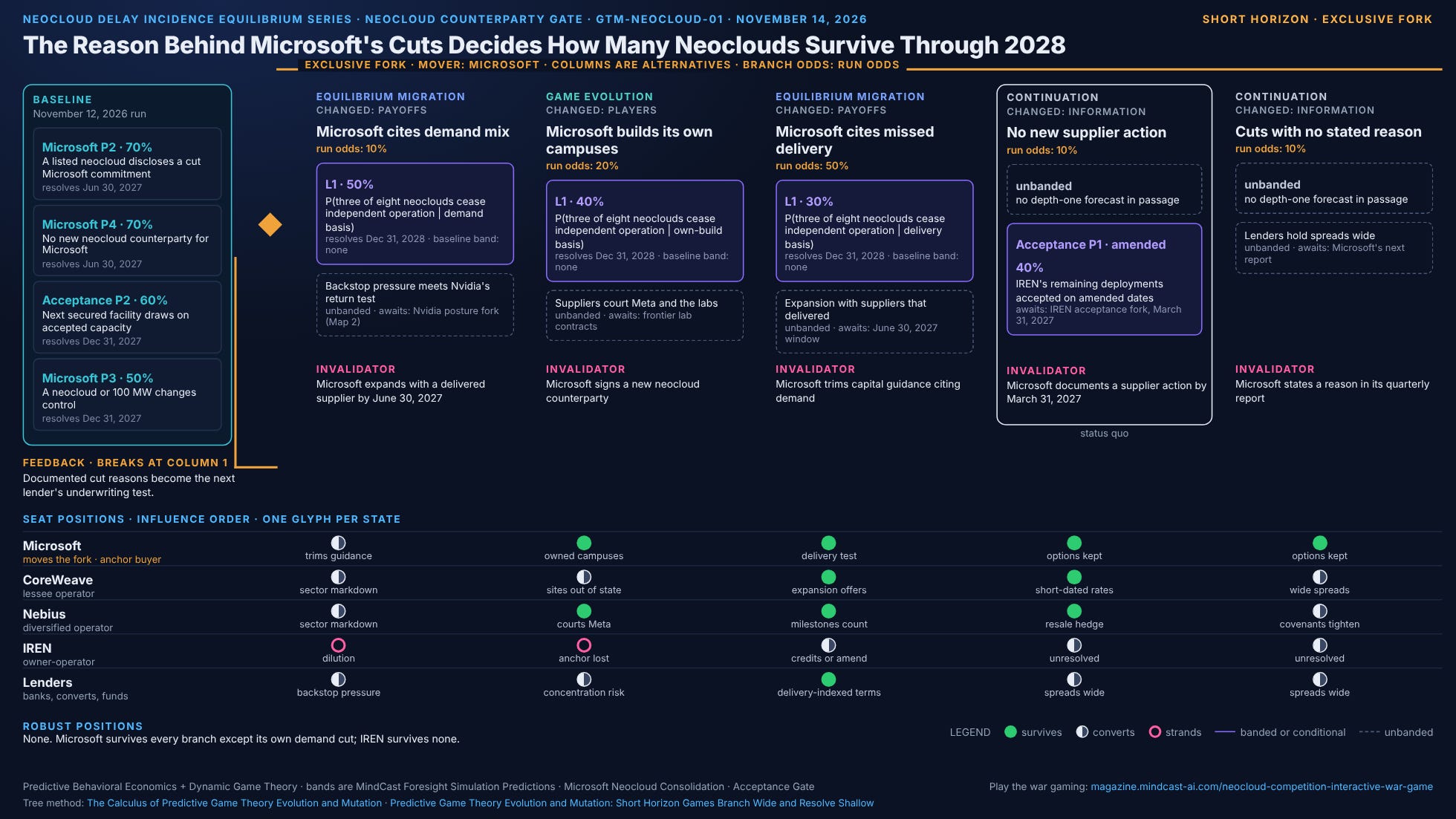
The paper’s dominant fork asks why Microsoft cuts, and the answer sorts the explanations in Section III. A delivery basis (50%) confirms the default operating through the counterparty gate. An own-build basis (20%) shows the buyer raising its own walk-away value, which strengthens the default further. A demand basis (10%) would favor Explanation B, a downturn that spreads cost across every seat. Microsoft P5 (60%) tests the prediction directly: the next documented supplier action falls on capacity not yet energized.
V.B The Operator Case Tests the Exception Condition
Neocloud Operators and the Acceptance Gate follows IREN, Nebius and CoreWeave between energization and the buyer’s sign-off. Accepted megawatts, not signed backlog, decide what a delay costs. The paper holds the buyer constant: Microsoft sits across the table at Childress just as it did at Loughton.
The comparison narrows the variable. At Loughton, Microsoft imposed the full cost of a delay Nscale did not cause and could not document against Microsoft. At Childress, IREN documented that Microsoft’s design changes caused the slip, and the penalty never arrived. Same buyer, same walk-away strength, opposite outcome: documented buyer cause made the difference. Cause and documentation moved together in both cases, so the Acceptance Gate paper tests whether documentation moves delay cost on its own.
The IREN fork carries the test. Acceptance on current dates (30%) and amended dates without credits (40%) both keep the exception intact, so the exception survives on 70% of the fork. Credits or termination (20%) would break Proposition III.D, because the buyer would have overridden documented cause. A lessee adds a second layer. Acceptance P3 (40%) asks whether a lessee ties a loss of $100 million or more to a landlord’s delay, the case where the operator carries a cause it can document only against its own landlord.
V.C The Guarantor Case Tests the Protection Condition
Nvidia Guarantees After Huang follows the seller of protection rather than its buyer. Operators that neither walk-away value nor documentation protects buy cover, and Nvidia sold much of it on terms justified by chip sales. When Huang resigned, the terms of that cover passed to an executive who asks what each guarantee earns on its own.
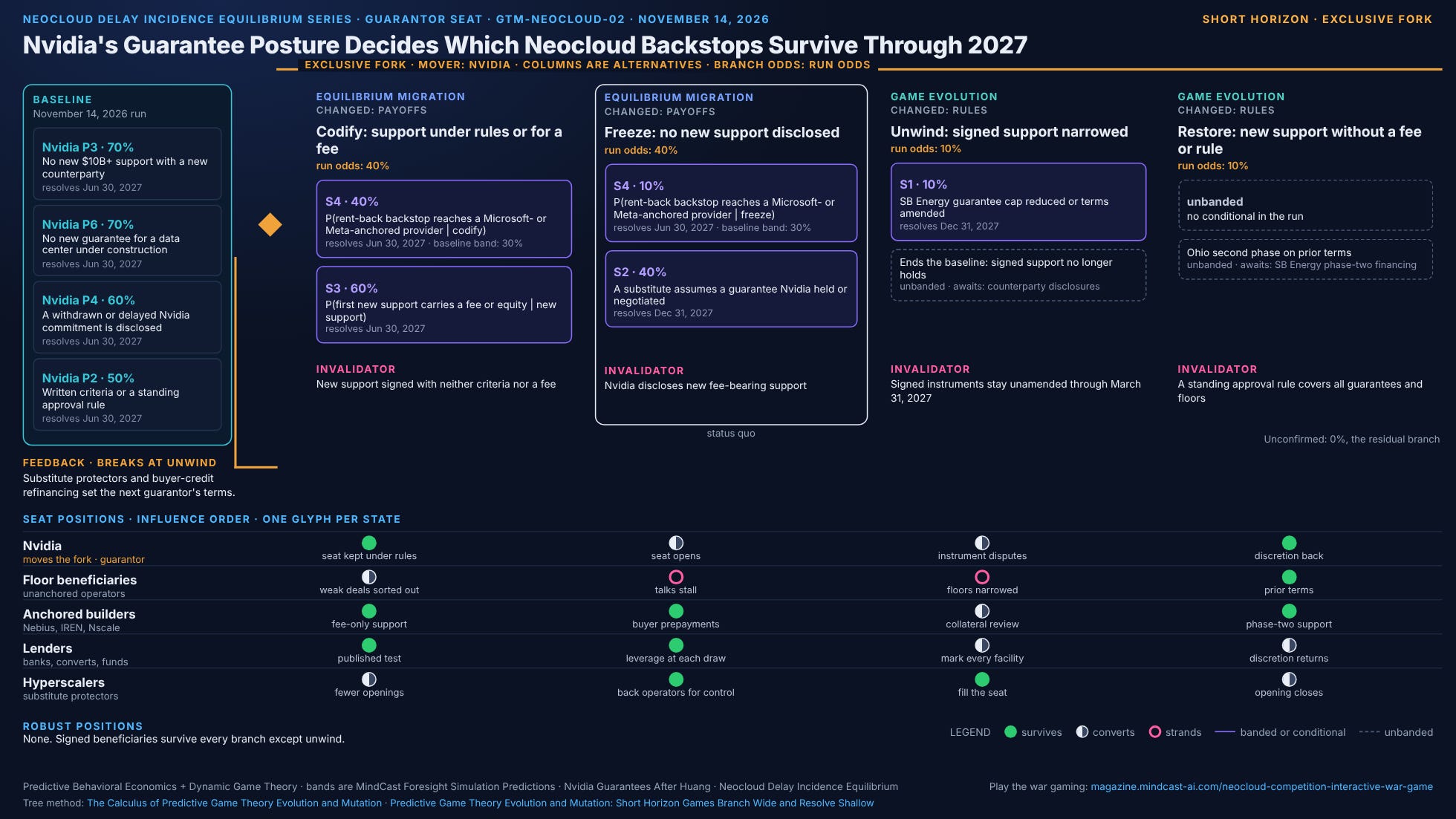
The protection condition predicts that the cost of cover rises when its main seller changes its rule. The posture fork splits evenly. Codify (40%) gives protection a published cost: written criteria, a fee or equity. Freeze (40%) withdraws new cover and opens the seat to buyers, insurers and private credit. Nvidia S3 (60%) adds that the first new support, if any, carries explicit consideration.
Either leading branch raises what an unprotected operator pays. Under codify the cost appears as a fee, and under freeze it appears as control handed to a substitute protector. U2 (60%) tests the second path.
V.D Reading the Three Cases Together
The three conditions operate in sequence. The default creates the loss, the exception limits it and protection buys away what remains.
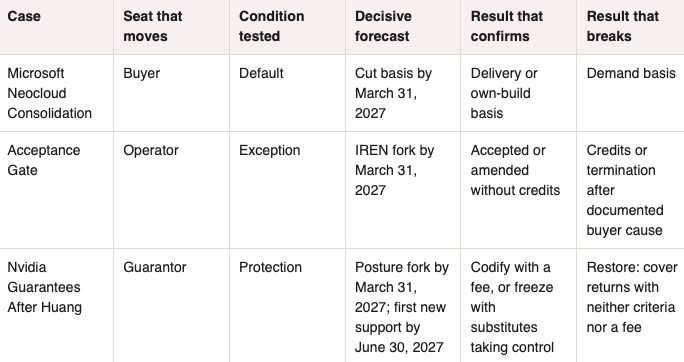
Three links carry results from one case into the next.
The buyer’s cut basis feeds the guarantor. A delivery basis keeps demand for guarantees concentrated among the operators that slipped. A demand basis sends every unanchored operator to the protection market at once, just as Kress applies a return test. Demand for cover would peak while supply tightens, so the weakest operators would buy protection on the worst terms of the cycle.
The acceptance outcome feeds the lenders. Amended dates keep IREN’s facilities drawing on accepted capacity, which Acceptance P2 (60%) expects lenders to require. Credits or termination would push the operator into the protection market with a documented loss, the weakest position from which to negotiate cover.
The guarantor’s posture feeds the buyer. A freeze hands the guarantor seat to parties that can back a lease, and the strongest candidates are the buyers that already hold the strongest exits. Nvidia S2 (40%) asks whether a substitute assumes a guarantee Nvidia held or negotiated.
The last link exposes the deepest pattern in the series. Microsoft, Google and Meta hold the strongest walk-away options as buyers. Under a freeze, the same firms become the natural protectors, and protection arrives with capacity rights attached. The party that imposes delay cost by default then sells the cover against it and takes control in exchange. The equilibrium reinforces itself: each cycle of cuts and substitute support moves capacity toward the seats that already carry the least delay cost.
A joint failure would carry its own message. If Microsoft’s cuts rest on demand, IREN takes credits despite its documentation and Nvidia restores discretion, the three cases would share no structure. Such a result would favor Explanation C, three unrelated events, and U1 and U2 would likely fail with it.
🏛️ Policymakers. Buyers that cut by default may become the protectors of the operators they cut. Credit support rules that read a hyperscaler’s backing should also read the capacity rights it takes.
💼 Executives. The order of the conditions sets the order of defense. Document cause before the slip, close protection before the buyer cuts and avoid entering the protection market with a documented loss.
⚖️ Counsel. Childress and Loughton turn on the same buyer and different documentation of cause. Cause clauses, notice terms and evidence standards decide which case a client resembles.
📊 Investors. Read the three papers as one position. A demand basis at Microsoft, credits at IREN or restored discretion at Nvidia each move the odds in the other two papers.
Takeaway. The default creates the loss, documented cause limits it and protection buys away the rest. When the buyers with the strongest exits also become the protectors, the equilibrium moves capacity toward them with every cycle.
VI. The Seats Move Each Other: Guarantor Retreat Raises Hyperscaler Leverage
The three seats do not move alone. Four interactions connect them, and each one shifts walk-away values in a second seat.
The guarantor narrows, and hyperscaler leverage rises. Operators without an anchor turn to buyers who can back a lease. Google’s Fluidstack backstop shows the terms: support arrives with a capacity relationship attached.
The buyer cuts, and guarantee demand peaks as the guarantor tightens. A Microsoft cut sends lenders to revalue the operator. Demand for support then arrives just as Kress applies a return test to new guarantees.
Adverse selection turns a written test into a freeze for weak operators. Bigger neoclouds already declined Nvidia’s first terms. The operators still seeking support are weaker credits, so a written return test rejects most of the remaining pipeline. A codified program and a freeze diverge only for strong operators, who need support least.
Floors fail together. A capacity floor pays when utilization falls. Utilization falls across operators at once, so Nvidia’s floor exposure rises with the same events that cut buyer demand.
If Nvidia narrows, four candidates can fill the guarantor seat. Hyperscalers and AI labs can back leases. Insurers have studied the risk, and Nvidia shared chip depreciation data with at least one insurer in September. Private credit funds, including the six firms Nvidia enlisted, and sovereign funders complete the field. The candidate that fills the seat decides whether protection carries control or only cost.
Four dated events can change the game: Nvidia’s November 17 report, Microsoft’s fiscal second quarter in late January, Nvidia’s fourth quarter in late February and the appointment of a permanent Nvidia chief executive.
💼 Executives. Hyperscaler support costs control. Negotiate the capacity rights before the coverage.
📊 Investors. Floor exposure is correlated exposure. Treat vendor floors as one position across the sector.
Takeaway. A narrower guarantor hands leverage to buyers who can back leases, and the substitute guarantor decides whether protection costs money or control.
VII. MindCast Foresight Simulation Predictions: Buyer Credit Replaces Vendor Support
The paper carries four MindCast Foresight Simulation Predictions. Each tests a link in the chain that no case paper tests. Each names its actor, outcome, window and falsifier.
U1. Buyer credit replaces vendor support as the security in neocloud secured debt by December 31, 2027 (70%). The window opens November 14, 2026. The issuers are CoreWeave, Nebius, IREN and Applied Digital. At least two of their new senior secured facilities name a hyperscaler or AI-lab contract as primary security, and none names Nvidia support as security.
Facility announcements and securities filings verify the result. Falsifier: fewer than two qualifying facilities, or any facility naming Nvidia support as security. The call tests Proposition III.G and correlates with the Acceptance Gate paper’s P2 on drawdown conditions.
U2. Substitute protection carries control by December 31, 2027 (60%, conditional on a substitute instrument). The condition requires a disclosed guarantee or backstop of a neocloud lease, offtake or loan after November 14, 2026. A hyperscaler, AI lab, insurer or fund must provide it. The first such instrument then carries disclosed consideration. Capacity rights, equity and site ownership qualify, as do warrants and revenue share.
Offtake priority counts only when it reaches capacity beyond what the backed instrument covers. Falsifier: the first substitute instrument carries financial terms alone.
No resolution occurs if no substitute appears. Nvidia S2 asks whether a substitute appears, and U2 asks on what terms.
U3. A neocloud’s own buyer becomes its protector by December 31, 2027 (60%). The window opens November 14, 2026. A hyperscaler or AI lab that buys capacity from a neocloud also gives that neocloud credit support or capital, or buys one of its sites. Guarantees, backstops, loans and equity count. Prepayments and loans secured on the buyer’s own contract do not.
Company announcements and securities filings verify the result. Falsifier: no buyer of a neocloud’s capacity provides qualifying support or buys a site from it by the deadline. The call tests the finding in Section V.D that the party imposing delay cost becomes the party selling protection against it.
About half the odds rest on an AI lab or its backer stepping in where Nvidia withdraws from a project, with Nscale’s West Virginia project the likeliest case. A hyperscaler backing a lease and a buyer acquiring a site supply the rest. U3 moves with U2 and Nvidia S2, because one project would likely trigger all three.
U4. Cause-based delay terms spread beyond IREN by December 31, 2027 (50%). The window opens November 14, 2026. A second listed neocloud discloses buyer terms that excuse buyer-caused delay, assign delay cost by cause or deem capacity accepted after a set period.
Securities filings and earnings calls verify the result. Falsifier: no listed neocloud other than IREN discloses such terms by the deadline. The call tests whether the exception condition in Proposition III.D becomes a contract standard or stays a one-off.
The odds sit at even because two forces pull against each other. Lenders reward cause-based terms, and buyers want them kept confidential.
The map below places the series’ MindCast Foresight Simulation Predictions on the seats and rungs they test. Identifiers, windows and odds copy each paper’s published text.
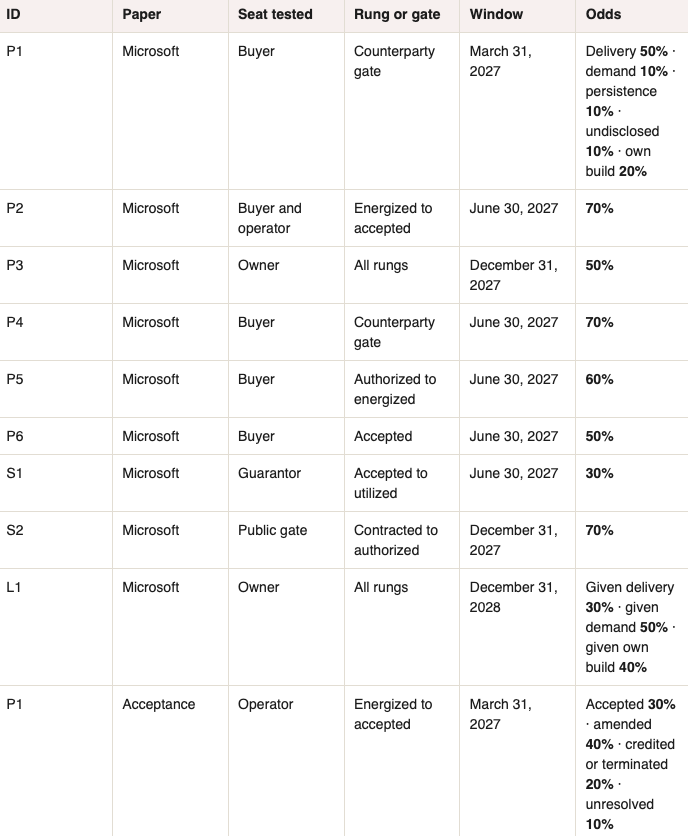
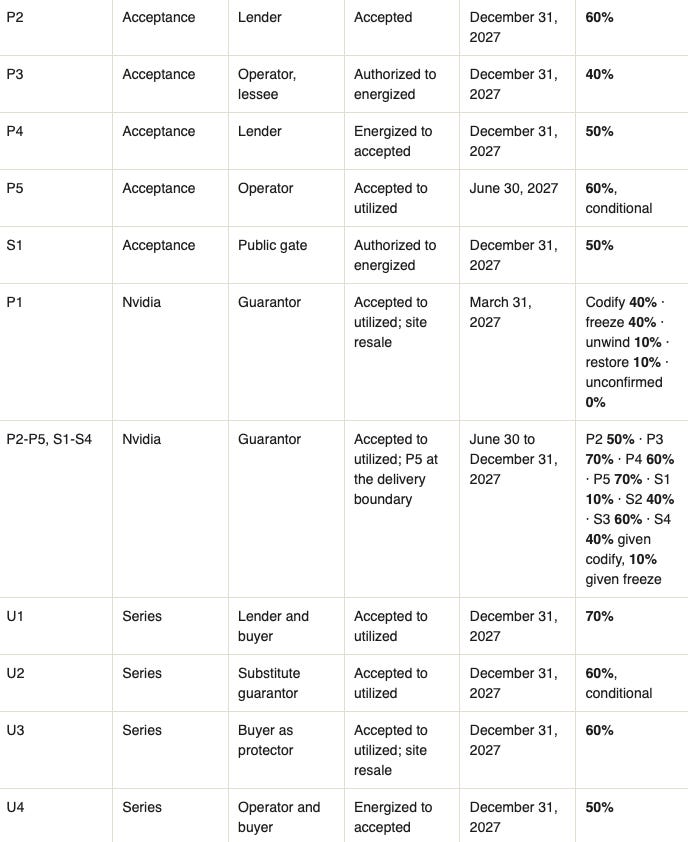
The map tests the energized-to-accepted rung only from the operator and buyer seats. No forecast tests a third party entering that rung, which matches the finding in Section IV.
Sharon AI, Firmus and Lambda carry the Nvidia floors and leases most exposed to a narrower program. Adverse selection concentrates distress among weaker credits under either posture Nvidia adopts. Their filings and court dockets stay a watch item without odds.
💼 Executives. U1 points to the buyer contract as the collateral that will finance the next facility. Lead every financing with it.
📊 Investors. U2 points to control as the cost of substitute protection. Discount operators whose next guarantor will take capacity rights.
Takeaway. Buyer credit is replacing vendor support as the security behind neocloud debt, and the substitute protector will take control in exchange.
VIII. Strategy and Risk Mitigation by Seat
Each seat holds a different walk-away position and carries uncovered risk on a different rung. The strategy table names the move that strengthens each position, and the risk table converts the four MindCast Foresight Simulation Predictions into owned tasks.
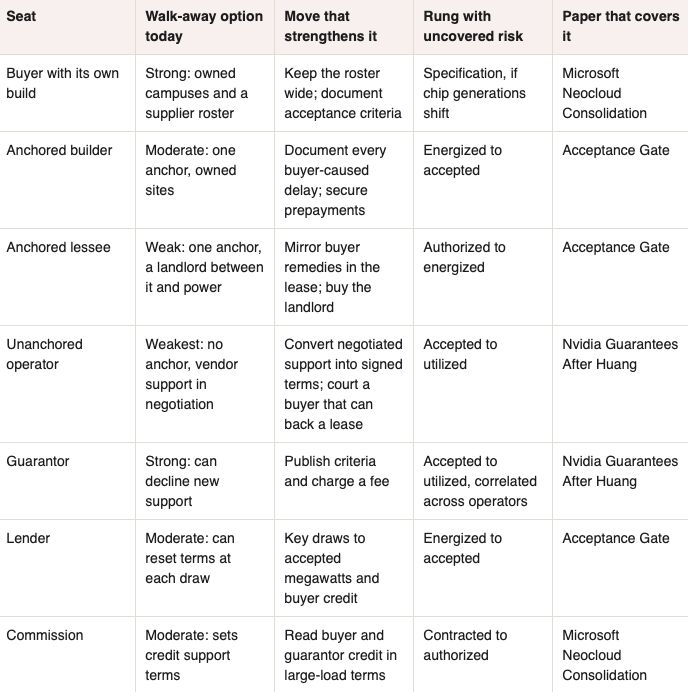
Actions below are options for consideration, not legal, investment or fiduciary advice. Severity and probability appear as separate axes.
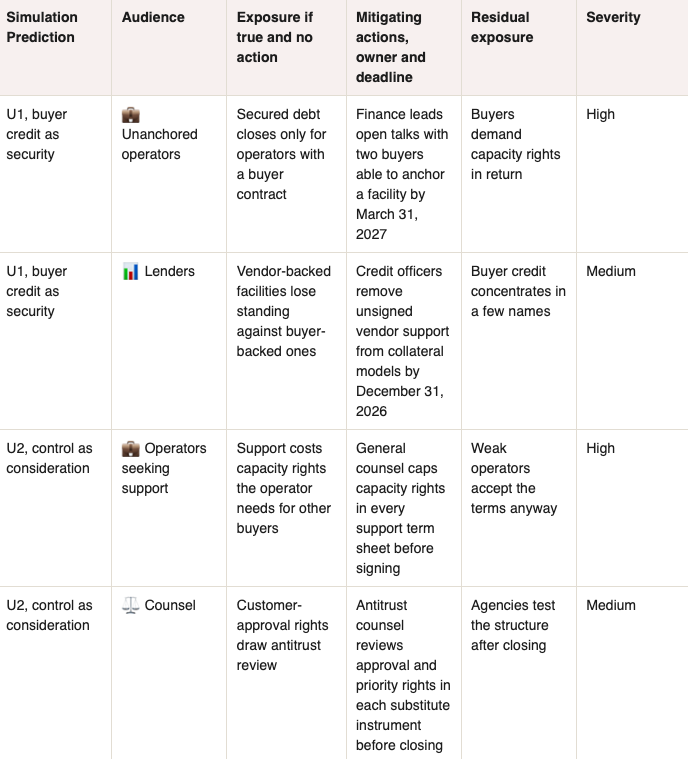
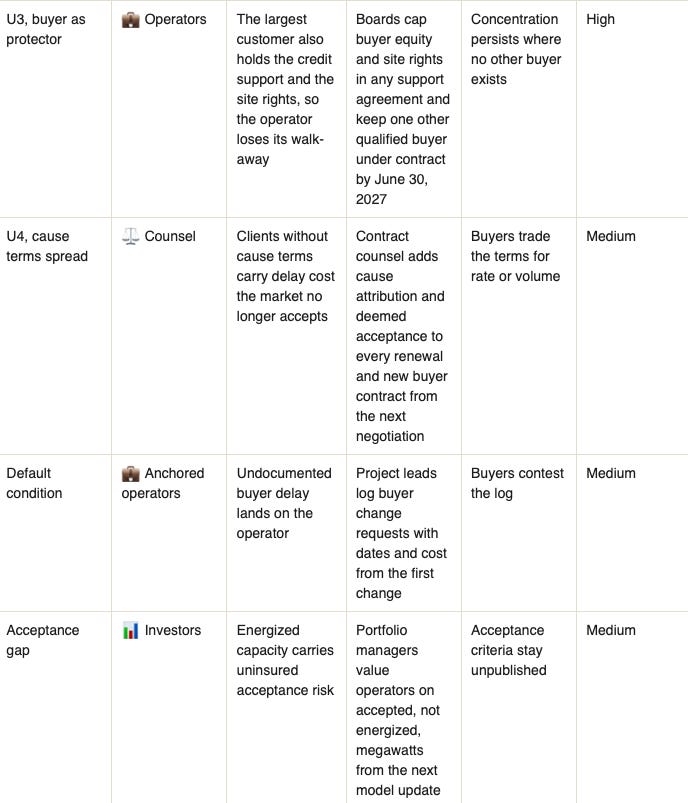
Takeaway. Operators strengthen their position by documenting cause and closing on buyer credit. Lenders and investors protect themselves by valuing accepted megawatts and signed support only.
IX. Implications for Authorization: Commissions Read Buyer and Guarantor Credit
Large-load credit support terms ask who stands behind a customer’s payments to the utility. The equilibrium answers that the operator rarely stands alone. A buyer’s contract, a guarantor’s floor or a new owner’s balance sheet carries the real credit.
Commissions writing those terms should read buyer and guarantor credit, and name what happens when a guarantor narrows its program. Microsoft Neocloud Consolidation gives a commission tying credit support to the customer’s credit or an offtaker guarantee by December 31, 2027 at 70%. The 50-State Authorization Price Atlas and the Model Data Center Authorization Code set out the public terms that now read third-party credit as an input.
Public gates also produce most of the undocumented delay in the series. Dated decisions on permits, interconnection and large-load tariffs convert delay that lands on the weakest party into delay with a documented cause.
🏛️ Policymakers. Dated authorization terms reduce the delay cost that lands on operators by default. Guarantor disclosure rules protect credit support from a single executive’s discretion.
Takeaway. Authorization terms that read third-party credit and fix dates move the equilibrium toward the efficient allocation.
What to Watch
Eight signals separate the paths in this paper. Each names a source and a cadence.
Nvidia’s first commentary on guarantees (Nvidia P1). Nvidia’s report and call on November 17, 2026.
Microsoft’s stated reason for supplier cuts (Microsoft P1, Explanation B). Microsoft’s fiscal second-quarter report in late January 2027.
New senior secured neocloud facilities (U1). Facility announcements and securities filings from the four listed issuers, as issued.
The first substitute guarantee or backstop (U2, U3, Nvidia S2). Monthly releases from hyperscalers, AI labs, insurers and funds.
Buyer-caused delay disputes and cause-based terms (Proposition III.D, U4). IREN filings and Microsoft supplier actions, quarterly.
An AI lab paying for undocumented delay (the breaking condition). Lab and operator disclosures, as issued.
An insurance product written against acceptance delay (Section IV). Insurer and broker releases, as issued.
Distress among Nvidia-backed operators (watch item). Filings and court dockets for Sharon AI, Firmus and Lambda, monthly.
Takeaway. The November 17 and late-January reports give the first reads. The first secured facility, the first substitute guarantee and the first disclosed cause-based terms decide the four series calls.
Conclusion
Microsoft walked away from a site over a grid date its supplier could not move. IREN avoided penalties on its own delays because it documented Microsoft’s role in them. Nvidia’s guarantees lost the executive who justified them by chip sales.
One rule connects the three. Delay cost lands on the party with the weakest walk-away option, documented cause moves it and protection buys it away at a cost. Operators sit in the weak seat more often than buyers or guarantors, so the cost of protection decides which of them survive.
The protector is changing. The buyers that impose delay cost are becoming the sellers of protection against it, and capacity concentrates toward them with each cycle. Buyer credit is replacing vendor support behind neocloud debt, and substitute guarantors will take control in exchange. Operators act now by documenting cause and closing on buyer credit, and lenders act by valuing accepted megawatts and signed support only.
Working With MindCast
Published analysis cannot tell a specific operator, lender or commission where delay cost lands in its own deals. An anchored builder, an unanchored operator and a lender each hold a different walk-away position on a different rung.
A commissioned engagement builds Cognitive Digital Twins of the organization, its buyers, its guarantors and its lenders. MindCast then reruns the division of delay cost against the organization’s actual contracts, cause documentation and financing calendar.
Commissioned scope adds complete probability distributions, P10/P50/P90 ranges and settings fitted to the organization. It also adds scenario trees, decision thresholds and a monitoring dashboard keyed to the dated events in Section VI. Interactive war gaming lets a client’s team play the buyer, operator, lender or guarantor seat against modeled opponents.
The MindCast Prediction Scorecard dated November 15, 2026 shows 47 hits, 9 partials and 4 misses on resolved material MindCast Foresight Simulation Predictions. MindCast forecast that Microsoft would sign the first hyperscaler firm-power deal, and Project Kilby confirmed it in June. MindCast also forecast that the Federal Energy Regulatory Commission (FERC) would finalize one large-load interconnection rule near April 30; FERC instead asserted authority through six regional orders on June 18.
The bounded next step is a diagnostic session on one contract, financing or credit support decision due before March 31, 2027. Contact: mcai@mindcast-ai.com.
Visit MindCast AI for the full Foresight Simulation library, prior MindCast Foresight Simulation Predictions and engagement options.
Appendix A. Selected MindCast Works
Microsoft Neocloud Consolidation: Energized Megawatts, Not Contract Backlog, Decide Which Neoclouds Survive. Series paper; tests the default condition from the buyer seat.
Neocloud Operators and the Acceptance Gate: Accepted Megawatts, Not Signed Backlog, Decide What a Delay Costs. Series paper; tests the exception condition and supplies the capacity ladder.
Nvidia Guarantees After Huang: Underwritten Terms, Not Founder Conviction, Decide Which AI Data Center Credit Holds. Series paper; tests the protection condition from the guarantor seat.
Neocloud competition interactive war gaming. Lets a reader play the buyer, operator, lender or guarantor seat across the dated turns.
AI Data Center Authorization Bargaining Power. Rates neoclouds as the most dependent tier, with bargaining power borrowed from backstops.
AI Data Center Credit Risk, Permitting, Curtailment, and the Cost of Capital. Supplies the credit framing for authorization risk.
50-State Authorization Price Atlas. Reference terms for the public gates by state.
Model Data Center Authorization Code. Reference statute for dated authorization terms.
MindCast Prediction Scorecard. Resolved material calls as of November 15, 2026.
Appendix B. External Sources
Ronald H. Coase, “The Problem of Social Cost,” Journal of Law and Economics 3 (1960). Supplies the efficient-allocation result the equilibrium contains.
Securities and Exchange Commission, NVIDIA Form 8-K, NVIDIA Announces CEO Transition. Dates Huang’s resignation and Kress’s appointment.
Data Center Knowledge, Nscale loses Microsoft deal as power delays threaten AI. Default condition at Loughton.
Reuters via LINE Today, Microsoft tightens oversight of neocloud projects; IREN statement on penalties. Exception condition at Childress.
The Energy Mag, Microsoft committed $7 billion upfront in Nebius AI deal. Tranche credit and termination terms.
MarketBeat, Nebius second-quarter 2026 earnings call highlights. Prepayment coverage of capital spending.
New Jersey Monitor, NJ slaps Vineland data center with $1M fine for unpermitted generators. Landlord-chain delay at Vineland.
Paul, Weiss, TeraWulf to expand AI hosting agreements with Fluidstack. Google’s lease backstop.
Crusoe, Crusoe Announces Wyoming Data Center Campus Update. Google’s site acquisition.
Bloomberg, Dina Bass and Brody Ford, CoreWeave Shares Soar After AI Computing Firm Eases Debt Fears. Meta-backed facility rating.
The Motley Fool, CoreWeave third-quarter 2026 earnings call transcript. Older-generation rental rates.
Finviz, CoreWeave continues to contract new compute capacity at higher prices. Demand evidence against Explanation B.
The Wall Street Journal via To Vima, Before His Ouster, Jensen Huang Belittled the Executive Replacing Him. Huang’s chip-sales test for guarantees.
Reuters via Yahoo Finance, Nvidia pauses revenue-sharing deals with AI cloud companies, WSJ reports. Customer-approval clause behind the August pause.
Capacity, Meta’s $48 billion cloud question. Meta weighing third-party GPU leasing.
Dealroom, Neocloud shakeout looms, and Nvidia has a lot to lose. Larger neoclouds declining Nvidia’s first terms.
Let’s Data Science, Nvidia asking insurers to cover what happens if GPUs don’t resell. Insurer talks on chip depreciation.
Implicator, Nvidia enlists six Wall Street firms to target $500 billion for AI compute. Private credit candidates for the guarantor seat.
Parametrix, Who Backstops the Backstop? The Operational Gap in Neocloud Financing. Service-level insurance one rung above acceptance.
Tech Insider summarizing Bloomberg, Microsoft winds down 2023 Oracle AI cloud deal. Specification risk on older chips.