Nvidia · Colette Kress · Nvidia Board of Directors · OpenAI · SB Energy · CoreWeave · Nebius · IREN · Nscale · Crusoe · Microsoft · Google · Apollo · BlackRock · Blackstone · Brookfield · Goldman Sachs · KKR · Bank Lenders and Private Credit · State Utility Commissions · United States
Who Pays for AI Data Center Delays — Series Introduction · Companion to Microsoft Neocloud Consolidation: Energized Megawatts, Not Contract Backlog, Decide Which Neoclouds Survive and Neocloud Operators and the Acceptance Gate: Accepted Megawatts, Not Signed Backlog, Decide What a Delay Costs
Interactive war game Neocloud Competition Simulation (updated 11/14/2026). War gaming visualization maps available.
Related MindCast works: AI Data Center Credit Risk, Permitting, Curtailment, and the Cost of Capital · AI Data Center Authorization Bargaining Power
I. Executive Summary: The Guarantor Seat Changed Hands, and Lenders Now Read Its Rules
Nvidia’s balance sheet stood behind much of the credit extended to operators without a hyperscaler anchor, and one executive decided how far it would stretch. The board accepted Huang’s resignation on November 11, 2026, and the finance chief who questioned how the guarantees were valued now holds the decision. Nvidia can still pay. The person who decides whether it will has changed, and lenders revalue that decision faster than they revalue a balance sheet.
Neoclouds are specialist operators that rent graphics processing unit (GPU) clusters to hyperscalers and artificial intelligence (AI) labs. Many borrowed on the expectation that Nvidia would stand behind them.
Nvidia’s board appointed Colette Kress interim chief executive while she keeps the chief financial officer role. The Wall Street Journal reported that Kress had pressed Jensen Huang on how to choose guarantee deals, how to value the guarantees and how to measure the return. The Information reported that Kress had already resisted a $250 billion backstop proposal for OpenAI. The August plan fell below $120 billion, and Nvidia signed at a $105 billion cap.
The board also named Harvey C. Jones its first chair and said it expects customer commitments to continue without interruption. Nvidia’s quarterly filing for the period ended July 26 lists about $530 billion of commitments and guarantees across three tables.
MindCast AI applies Predictive Behavioral Economics + Dynamic Game Theory through MindCast AI Proprietary Cognitive Digital Twin Foresight Simulations (MP CDT FS). Behavioral Economics supplies the decision rules, including the blame-averse rule an interim chief executive follows. Game Theory supplies the payoff structure among Nvidia, its customers, their lenders and the buyers behind them. Predictive simulations emerge from the combination.
Core insight. A guarantee is worth what its guarantor will do under stress. Nvidia wrote two kinds: capacity floors that earn a share of cloud revenue, and lease and site guarantees justified by the chip sales they unlock. Colette Kress launched the first kind and questioned how the second was valued. Freeze and codify carry equal odds, and freeze is what happens if nothing happens. Lenders should plan for no new support through March, and when support returns, expect a fee and no customer-approval clause.
Thesis. Earlier MindCast work mapped five gates that capacity must pass: voters, governors and utility commissions, then the counterparty gate set by buyers and lenders and the acceptance gate set by the buyer’s sign-off. Behind those gates sit the parties that carry the risk: buyers, operators and guarantors. The MCAI Economics Vision: Who Pays for AI Data Center Delays — Series Introduction places delay cost on the seat with the weakest walk-away option unless cause is documented, and Nvidia sold protection to the operators it left exposed. Incidence is the economist’s term for where a cost finally lands, as distinct from where a contract places it. Nvidia held the guarantor seat for operators without a hyperscaler anchor, and its governance now sets the terms on which that seat stays filled.
What distinguishes the MindCast approach. The paper separates the guarantor’s capacity from its decision rule. Two causes can produce the same pause in guarantees: a governance cause tied to the interim chief executive, or a capacity cause tied to Nvidia’s commitment load. Lenders treat the two differently, because a governance pause can reverse under a new chief executive and a capacity pause cannot.
Why now. Nvidia reports on November 17 under its interim chief executive. Lenders, neocloud executives, counsel and utility commissions each face decisions on guarantee-backed credit before a permanent successor arrives.
What the paper does. Section II maps the four guarantee tools, the rungs of capacity each one covers and the actors who move. Section III sets out nine MindCast Foresight Simulation Predictions on Nvidia’s guarantee posture and its consequences through 2027. Sections IV and V convert them into strategy, risk mitigation and implications.
P marks a primary MindCast Foresight Simulation Prediction, S a secondary one and H a structural hypothesis. The odds come from one Foresight Simulation run before Nvidia’s November 17 report. They are rounded to the nearest 10%, the snapshot convention for a game too early to settle into an equilibrium.
P1. Nvidia’s guarantee posture: codify, freeze, unwind, restore or unconfirmed · March 31, 2027 · Codify 40% · freeze 40% · unwind 10% · restore 10% · unconfirmed 0%
P2. Nvidia discloses written criteria or a board-level approval step for guarantees and backstops · June 30, 2027 · 50%
P3. Nvidia discloses no new guarantee or backstop of $10 billion or more with a counterparty it had not guaranteed before · June 30, 2027 · 70%
P4. A neocloud or developer discloses that an Nvidia commitment under negotiation was withdrawn, reduced or delayed · June 30, 2027 · 60%
P5. Nvidia discloses no new guarantee covering a data center still under construction · June 30, 2027 · 70%
S1. Nvidia’s SB Energy guarantee cap is reduced or its terms amended · December 31, 2027 · 10%
S2. A hyperscaler, insurer or financial institution publicly assumes a lease or offtake guarantee for a neocloud that Nvidia held or negotiated · December 31, 2027 · 40%
S3. The first new Nvidia support disclosed after the November 12 announcement carries explicit consideration, if new support appears · June 30, 2027 · 60%
S4. Microsoft Neocloud Consolidation’s S1 event (Nvidia’s rent-back backstop extends to a provider holding a Microsoft or Meta contract), reassessed by posture branch · June 30, 2027 · Given codify 40% · given freeze 10%
H1. Guarantee terms track the guarantor’s decision rule more than its balance sheet · Through 2028 · Structural hypothesis, no odds
H2. Vendor guarantees across the chip industry move from executive discretion to written criteria · Through 2028 · Structural hypothesis, no odds
H3. Advance rates on chip collateral fall first for the GPU generations buyers stop specifying · Through 2028 · Structural hypothesis, no odds
Stakeholder readout.
🏛️ Policymakers. Commissions that accept a vendor guarantee as large-load credit support now carry the vendor’s governance risk (watch item W1 tracks commission orders on guarantor credit). Credit support schedules should name what happens when a guarantor narrows its program.
💼 Executives. Neoclouds negotiating an Nvidia floor or lease guarantee should close on signed terms or line up a second guarantor (P3, P4). Handshake-stage support no longer carries a sponsor.
⚖️ Counsel. Guarantee documents now matter more than relationships (P1, S1). Map each client’s support to its signed instrument, its cap and its trigger.
📊 Investors. Separate signed guarantees from negotiated ones, and separate a governance pause from a capacity pause (P1, H1). The two carry different recovery paths.
Takeaway. Signed guarantees hold, and unsigned ones lost their sponsor. The paper forecasts which rule replaces founder discretion and how credit follows it.
II. A Guarantor Seat Changes Owner: One Executive’s Rule Set the Terms of AI Infrastructure Credit
Nvidia’s chief executive transition looks like a governance story. The evidence shows a credit story, because a single decision-maker set the terms on which a large part of AI infrastructure borrowed. Four dated facts, four guarantee tools and one changed decision rule explain how.
II.A Four Dated Facts Define Nvidia’s Starting Position
Four facts define the starting position. Each comes from a filing or from reporting that cites people inside the company.
The transition. The board accepted the resignation on November 11 and announced it on November 12. Kress continues as executive vice president and chief financial officer while she serves as interim chief executive. The board will consider internal and external candidates, and one analyst expects the interim term to last about a year. The same release names Harvey C. Jones the board’s first chair, who said Nvidia expects its customer commitments to proceed uninterrupted.
The dispute. Huang summoned his finance team in August to address talks on billions of dollars of guarantees to companies that could not afford Nvidia’s chips. Some of those deals originated below the chief executive and lost their sponsor when he left. After the meeting, Huang asked staff to build a test for whether a guarantee was worthwhile that counted the chip sales it could generate.
The exposure. Supply commitments rose from $119 billion to $279 billion in one quarter, within roughly $530 billion of commitments and guarantees that include $108.5 billion of maximum guarantee exposure. Three scopes circulate. The filing’s tables total about $530 billion; The Information counts more than $170 billion at risk for neoclouds and large customers, including up to $164.5 billion of data center guarantees and commitments; and Morgan Stanley’s Joseph Moore put direct credit exposure mostly in backstops for a couple of smaller neoclouds. The paper uses the filing scope unless a sentence says otherwise.
The Ohio precedent. The Information reported that Kress pushed back on a proposed $250 billion credit backstop for OpenAI’s data centers. The Journal reported in August that Nvidia cut the planned guarantee to under $120 billion, limited to the first five of ten gigawatts. The signed terms cap the guarantee at $105 billion and cover about 4.25 gigawatts of a campus planned for up to 8 gigawatts, so a second phase remains a live deal.
Kress now approves guarantees and signs the filings that disclose them. Investors filed a securities class action against Nvidia and Huang on November 9, two days before he resigned, so every new guarantee becomes a statement she must defend in a public table during live litigation.
The Information reported about $140 billion of Nvidia dealmaking, including credit guarantees, in two months this year. Investments under binding contracts are expected to proceed, and finance executives said most expectations of an “Nvidia put” have disappeared. A neocloud executive told the Financial Times that Nvidia dealmaking would mostly halt until the uproar resolves. Nvidia shares fell as much as 14% at the open on November 12, taking its value below $4 trillion for the first time since 2025.
Takeaway. The filing fixes the exposure, the Ohio cut shows how the new decision-maker acts and the market has stopped assuming a rescue. The open question is which rule she installs.
II.B The Governing Question: Which Data Center Credit Keeps a Guarantor
Which neocloud and data center financings keep third-party support as Nvidia replaces founder discretion with a rule, lenders revalue the support and buyers decide who absorbs the gap?
The target system is guarantee, backstop and vendor financing support for U.S. AI infrastructure. The horizon runs from November 2026 through 2027, with structural hypotheses through 2028.
The first fork resolves by March 31, 2027. Chip demand, export controls and the reasons for Huang’s departure sit outside scope.
Takeaway. The question concerns who keeps a guarantor, not whether AI demand holds.
II.C The Guarantor Seat Stands Behind the Counterparty Gate
The Ballot Decides Where Data Center Sites Proceed; Governors and Regulators Set the Terms of Power and Service mapped three public gates: voters on site eligibility, governors on permit timing and commissions on service terms. Microsoft Neocloud Consolidation added a fourth. The counterparty gate decides whether an anchor buyer renews and a lender refinances.
Neocloud Operators and the Acceptance Gate added a fifth gate, the buyer’s acceptance. Behind the gates sits a seat rather than a sixth gate. Some lenders lent because a third party stood behind the buyer’s payments or the operator’s lease, and most financings never pass through such support at all. The guarantor seat decides whether that support exists and on what terms.
The value of that support shows in credit spreads. CoreWeave’s facility backed by Meta contracts carried a margin of 2.25 points over the Secured Overnight Financing Rate, while its unsecured bonds yielded above 15% in October. A creditworthy party standing behind a contract cuts the operator’s borrowing cost roughly in half. Nvidia had become that party for operators without a hyperscaler anchor.
Credit was tightening before the transition. CoreWeave’s 2031 bonds yielded above 16% in October, and Huang said the company needed no Nvidia backstop. At GTC Berlin he said Nvidia had invested enough in neoclouds. The guarantor’s own signals had started to narrow before the guarantor changed.
Takeaway. The guarantor seat converts one firm’s governance into many firms’ credit terms.
II.D Four Guarantee Tools Carry Four Kinds of Exposure
Nvidia supports its customers through four distinct tools. Each tool rests on different collateral and fails in a different way.
Capacity floors. Nvidia rents back unsold GPU capacity at a guaranteed rate in exchange for a share of cloud revenue. Kress and Raj Mirpuri announced the program in July as a revenue-sharing and credit-support model. Nvidia paused some of those deals in August after staff warned of antitrust scrutiny. The objection centered on control rather than the fee, because Nvidia had told some customers they could rent the chips only to approved customers. Nvidia said the model remains in place and continues to evolve, and it later offered shorter-term support for a smaller revenue share. Sharon AI’s 40,000-GPU deployment in Australia came first, followed by Firmus with up to 170,000 GPUs in Indonesia. The filing reports these cloud service commitments at $36 billion as of July 26. The model began with a $6.3 billion pledge to buy CoreWeave’s unsold capacity through 2032. The tool fails when utilization drops across the sector at once.
Tenant-of-record leases. Nvidia signs the data center lease with its own credit and places a neocloud in the space. At Hut 8’s Beacon Point campus in Texas, Nvidia holds the lease, and Lambda installs Nvidia GPUs to serve a $35 billion Anthropic contract covering about 350 MW. Hut 8’s two 15-year leases total 704 MW, and Hut 8 financed the first phase with $4.25 billion of non-recourse senior secured notes. Nvidia also holds $20 billion of its own leases to pass on to customers. The tool fails if the placed operator cannot pay and no replacement tenant appears.
Site value guarantees. Nvidia agreed to guarantee up to $105 billion in conditional lease and power obligations for the OpenAI campus that SB Energy is building in Ohio. If OpenAI walks away, SB Energy must first re-lease the site and then try to sell it, and only then does Nvidia pay the difference up to the cap. Nvidia had discussed guaranteeing about $250 billion before the final terms, and OpenAI agreed to reimburse and indemnify Nvidia for any amounts paid.
Chip-collateral financing platforms. Nvidia signed memorandums with six financial firms aimed at more than $500 billion of outside capital. The six are Apollo, BlackRock and Blackstone plus Brookfield, Goldman Sachs and KKR. Special vehicles would issue debt secured by compute and lease the hardware to Nvidia customers. The filing describes the arrangements as memorandums that may not lead to definitive agreements. Nvidia offered residual value support of up to 25% of a transaction, reviewed project by project, and the support pays only after recovery steps such as re-leasing capacity or selling chips. As of early October, no platform transaction had closed.
The Ohio tool deserves a closer read. Nvidia pays only after a re-lease and a sale fail, so the guarantee sets a floor on what a stranded campus is worth to its next owner. A lost contract can end with value destroyed, capacity moved to another buyer or working sites passing to stronger owners. The site value guarantee insures the third outcome.
The four tools differ sharply in size. The filing’s guarantee table shows $3.5 billion of land, power and shell guarantees for AI cloud partners against $105 billion for SB Energy. The neocloud side of the posture fork therefore runs mostly through the $36 billion of capacity floors, and the guarantee side runs mostly through one instrument.
The tenant-of-record lease shows the guarantor seat most plainly. Nvidia never makes a loan; it lends its credit rating to the developer’s debt. Hut 8’s investment-grade financing measures what that rating is worth, and a narrower program withdraws it before construction lenders ever see a guarantee.
Takeaway. Floors insure utilization, tenant leases lend credit, site guarantees insure resale value and the platforms insure chip collateral. A narrower program removes a different insurance from each.
II.E Two Capacity Rungs Decide What Each Tool Covers
Neocloud Operators and the Acceptance Gate separated megawatts (MW) into five rungs, from contracted through authorized and energized to accepted and utilized. Two of those rungs decide what Nvidia’s tools cover.
Energized capacity draws power and runs GPUs. The Ohio guarantee covers completed data centers, not facilities under construction, so Nvidia’s exposure starts at the energized rung. Authorization and construction risk stay with the developer and its lenders.
Accepted capacity has passed the buyer’s sign-off, so billing starts. Lenders treat accepted megawatts as collateral for servicing-phase debt. Capacity floors pay when utilization falls after that point, and tenant-of-record leases cover the placed tenant’s credit.
Specification adds a third test. Microsoft declined to renew a 2023 Oracle capacity agreement partly because the capacity ran older Nvidia chips. Chip collateral loses value in the same way, because buyers stop specifying a generation before its hardware wears out.
Takeaway. Nvidia insures demand and tenant credit, not delivery. Every tool sits at or above acceptance. The Nscale talks covered electricity and construction, so a signed deal would have extended Nvidia into delivery risk for the first time (P5).
II.F Behavioral Economics: An Interim Chief Executive Follows a Blame-Averse Rule
Behavioral Economics supplies the decision rule. An interim chief executive with a horizon of about a year and a likely outside successor faces asymmetric blame. A guarantee that fails on her watch carries her name, and a guarantee she declines carries none.
Loss aversion therefore predicts tiering rather than cancellation. Kress honors signed and filed instruments, holds handshake-stage deals and requires written criteria before approving new ones. Her August questions already name the criteria: deal selection, guarantee valuation and return.
A second driver points the same way. An interim chief executive who is also the chief financial officer can defend a guarantee that books revenue and cannot defend one that books only exposure. Kress caps rather than refuses: she pushed back on a $250 billion proposal, and Nvidia signed at $105 billion rather than refusing. The rule rests on her conduct and incentives, not on any statement of intent.
Lenders anchored on a different reference point. Years of uninterrupted support taught them to read Nvidia’s backstop as policy, and the founder’s public statements reinforced the anchor. Huang said in October that neocloud demand was off the charts and the missing piece was working capital. The reference point left with him.
Predictive Game Theory Evolution and Mutation, Long Horizon Games Resolve Deep Because Their Branches Hold names the signal. Persistence sustained by one actor’s continued commitment marks false stability. The guarantee regime carried that signal for its whole life.
Takeaway. Lenders lent on conviction, and the new decision-maker runs on criteria. The gap between the two decides which deals survive.
II.G Game Theory: The Guarantor’s Exit Option Moves Every Other Party’s Terms
Game Theory supplies the payoff structure. A guarantor holds an outside option: declining the next deal. Under Huang, Nvidia rarely used it, because each guarantee also bought chip demand. Kress values the outside option more, because her payoff weighs the guarantee’s downside before the chip sales.
Neoclouds lose an outside option at the same moment. An operator facing a hard lender could previously point to a likely Nvidia floor. Without that option, operators without a hyperscaler anchor accept tighter terms or seek a buyer to stand behind them.
A valuation contest sits inside the payoff contest. Huang rejected the “circular financing” label in August, saying OpenAI will pay the lease. The framing’s chief advocate has left. A new chief executive can adopt the label’s logic without conceding it, by requiring each guarantee to earn a return apart from the chip sales it enables.
Kress’s second role pulls the other way. As chief financial officer she owns the revenue outlook, and guarantees protect market share. Semiconductor executives told The Information that AMD and Broadcom cannot offer guarantees at Nvidia’s scale, and William Blair warned that losing Huang’s dealmaking could hand rivals a bigger share. Broadcom did backstop most of the debt on its own $35 billion financing, so Nvidia’s edge lies in scale rather than kind.
Adverse selection narrows the remaining pipeline. Before the transition, Nvidia already cut its terms to shorter support at a smaller share after some larger neoclouds declined. The operators still seeking support are the weaker credits, so a written return test rejects most of them, and codification acts as a freeze for unanchored operators. The same report places Nvidia’s exposure mainly with builders such as Nebius, IREN and Nscale rather than lessees such as CoreWeave, so a return test favors protecting builders Nvidia already backs.
Takeaway. The guarantor’s exit option rose in value as the operators’ exit option fell. The market-share stake keeps that option from becoming a reflex.
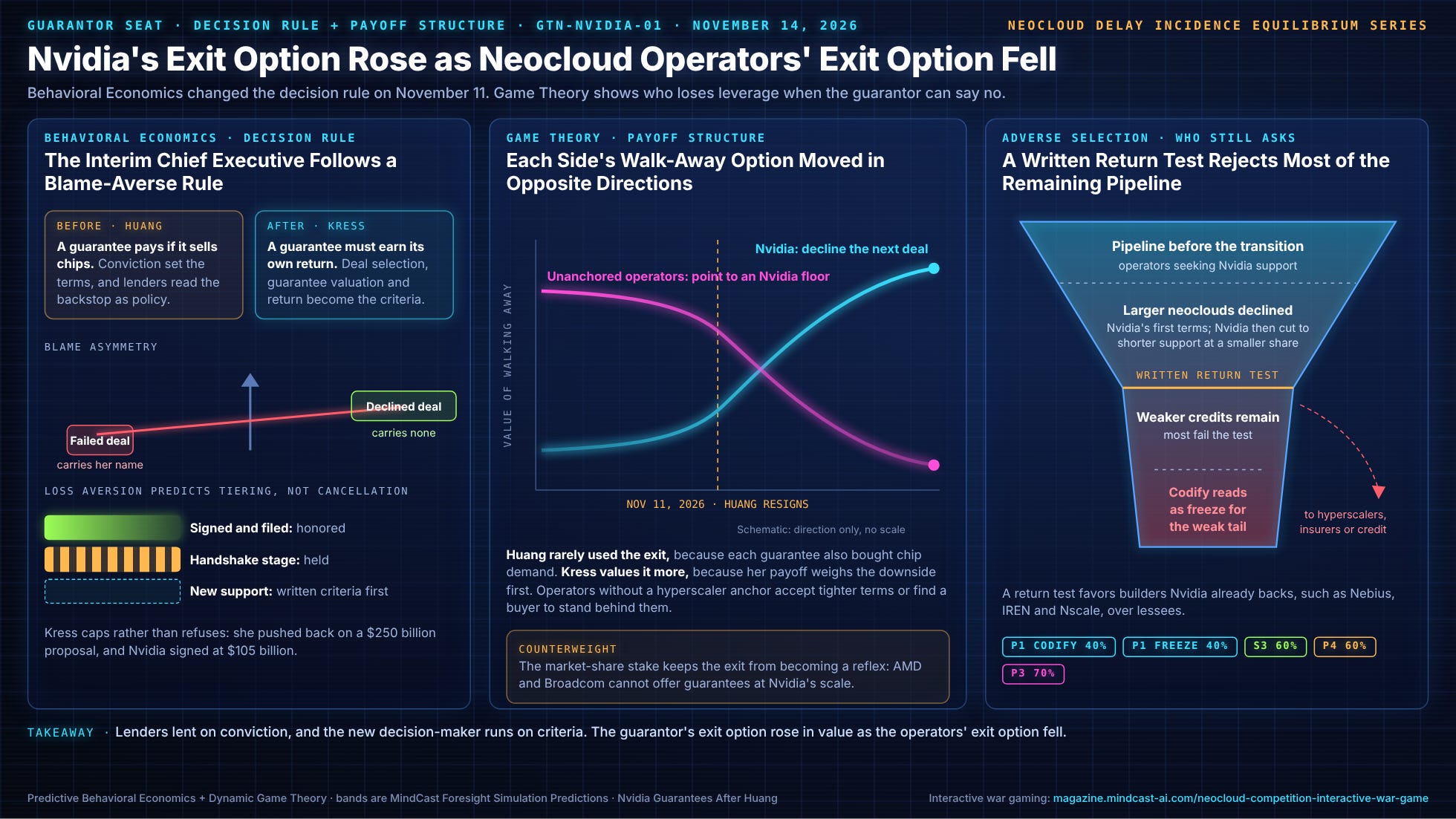
Figure 1. Nvidia’s exit option rose as neocloud operators’ exit option fell. Behavioral Economics changed the decision rule on November 11, and adverse selection leaves a written return test rejecting most of the remaining pipeline.
II.H Five Actors Move the Fork, and Six Explanations Compete
Five actors move the fork. Kress approves new guarantees and signs the filings that disclose them. Nvidia’s board, now led by independent chair Harvey C. Jones, runs the successor search and can install a standing approval step for guarantees.
Operators without a hyperscaler anchor need working capital before acceptance. Anchored builders such as Nebius, IREN and Nscale need support for the sites they develop. Lenders reset their terms at each draw, so they move first whenever the guarantor’s rule changes.
Three more actors wait to fill any gap Nvidia leaves. Hyperscalers can back leases, and Google already backstopped $3.2 billion of Fluidstack’s lease obligations. Insurers have studied the risk, and Nvidia shared chip depreciation data with at least one insurer in September. AMD and Broadcom gain share wherever Nvidia withdraws support.
Nvidia also sits in the buyer seat at some operators. IREN’s first-quarter release names Nvidia as a contracted customer beside Microsoft and 13 others. Nvidia’s posture therefore moves demand as well as credit at the operators it buys from.
Six explanations compete, and each names the result that would break it.
Underwriting hypothesis. Kress converts discretion into written criteria, and guarantees continue for deals that pass. The hypothesis fails if Nvidia signs a large new guarantee without disclosed criteria.
Retrenchment hypothesis. The interim chief executive pauses new guarantees until a permanent successor arrives. The hypothesis fails if new guarantees appear before the successor is named.
Capacity hypothesis. Guarantees shrink because Nvidia’s commitment load has grown, and any chief executive would shrink them. The hypothesis fails if a permanent chief executive restores the prior pace while commitments stay near the July level.
Fee-bearing hypothesis. Support that earns explicit consideration continues, and support justified by chip sales alone stops at signed instruments. The hypothesis fails if Nvidia signs new support with no disclosed consideration, or halts revenue-share floors.
Disclosure-driven hypothesis. Written criteria reach filings because litigation and the new chair require them, not because policy changed. The hypothesis fails if criteria appear with operational detail and new approvals under them, outside any filing context.
Antitrust-constraint hypothesis. Scrutiny of revenue-share terms, customer restrictions and equity stakes in customers narrows fee-bearing support too, so new support of both kinds slows. The hypothesis fails if Nvidia signs or extends a revenue-share capacity floor by June 30, 2027.
Null route. Guarantee policy continues unchanged, and the transition moves nothing beyond sentiment.
Two constraints bind every branch. The securities class action turns each new guarantee into a disclosure Kress must defend. Antitrust scrutiny already paused part of the fee-bearing program once, under Huang.
Five dated events can move the fork.
November 17, 2026. Nvidia reports its fiscal third quarter, with written commentary from Kress before the call.
Late November or December 2026. Nvidia files its third-quarter report with updated commitment and guarantee tables.
Late January 2027. Microsoft reports its fiscal second quarter, the decisive signal in the companion paper’s roster fork.
Late February 2027. Nvidia reports its fiscal fourth quarter and files its annual report.
Unscheduled. The board names a permanent chief executive.
Takeaway. Five actors move the fork and six explanations compete to explain it. The November 17 report carries the most weight in the near term.
Consequences for each audience.
🏛️ Policymakers. A vendor guarantee now carries that vendor’s governance, so credit support resting on it inherits a decision rule the commission does not see.
💼 Executives. Nvidia’s support now turns on what it earns, so an operator’s case rests on the revenue share or equity it offers rather than on chip volume.
⚖️ Counsel. The signed instrument, its cap and its trigger now define the support, and negotiating history carries little weight with a new approver.
📊 Investors. Nvidia’s exposure concentrates in one $105 billion instrument and $36 billion of floors, so a narrower program reaches floor beneficiaries first.
Section conclusion. A single decision rule stood behind much of the support, and that rule changed hands. The open question is which rule replaces it and on what basis.
III. MindCast Foresight Simulation Predictions: Signed Support Holds, New Support Waits for Terms
Nine MindCast Foresight Simulation Predictions follow: the P1 posture fork, four more primary calls (P) and four secondary calls (S). Three structural hypotheses (H) run beside them. Odds are rounded to the nearest 10%, the snapshot convention for a game that has not yet settled into an equilibrium. The companion papers’ MindCast Foresight Simulation Predictions stay in those papers and appear here by name.
III.A The Posture Fork: Codify, Freeze, Unwind, Restore or Unconfirmed
The first fork closes on March 31, 2027, after Nvidia’s fourth-quarter report and annual filing. Five outcomes are possible, and each sends credit in a different direction.
Mechanism. Kress holds approval of new guarantees and the disclosure that describes them. A written framework lets her approve deals while limiting blame. A pause defers every decision to her successor. An unwind invites litigation with counterparties and offers her little.
Three deals will most likely resolve the fork: Ohio’s second phase, the Nscale West Virginia guarantee and the revamped capacity floors.
P1 | Nvidia’s Guarantee Posture by March 31, 2027
P1a | Codify (40%). Nvidia discloses at least one new or extended guarantee, backstop or capacity floor signed after November 12 that passes either of two tests. The first test is disclosed criteria, a program-wide cap or a board-level approval step. The second test is explicit consideration: revenue share, warrants, equity or a fee. Explicit consideration means a payment or equity to Nvidia, and indemnity, reimbursement or hosting exclusivity does not count. A cap counts only as a program-wide limit on total exposure, per-counterparty exposure or a class of support, never as the maximum written into a single instrument. A board-level approval step counts only as a standing requirement that applies to all guarantees and floors, never as one board vote on one deal.
P1b | Freeze (40%). Nvidia states a pause or review of new guarantees, or its filings show no new guarantee or floor signed after November 12. Existing instruments continue without amendment.
P1c | Unwind (10%). Nvidia or a counterparty discloses an amendment that lowers a cap, narrows terms or ends an existing guarantee, backstop or AI cloud agreement.
P1d | Restore (10%). Nvidia discloses any new or extended guarantee, backstop or capacity floor signed after November 12 with neither disclosed criteria nor explicit consideration.
P1e | Unconfirmed (0%). Press reports describe new support or a pause, and neither Nvidia nor the counterparty confirms it by March 31, 2027.
When outcomes overlap, P1c takes precedence over P1a, P1a over P1d and P1d over P1b. P1e applies only when no other branch holds, so a press report beside filings that show no new support resolves to P1b.
The five branches sum to 100. Windows open at the November 12 announcement. Nvidia filings, Nvidia statements and counterparty disclosures verify the result, and a counterparty release resolves P1a or P1c without Nvidia’s confirmation. Nvidia’s fiscal year ends in late January, so filings cover the window only through then, and outcomes in February and March rest on statements.
Freeze and codify carry equal odds, and freeze is the default because it needs nothing to happen. The window runs four and a half months through an interim chief executive’s first quarter, and filings that show no new support resolve the fork to freeze. Codify arrives mainly through an operator’s release of a revamped fee-bearing floor rather than through an Nvidia framework. Unwind and restore each need a specific counterparty move: a narrowed floor, or an Ohio second phase or Nscale guarantee signed without a fee or standing rule.
Takeaway. The fork asks which rule replaces discretion, not whether Nvidia stays solvent. The rule decides how every other actor moves next.
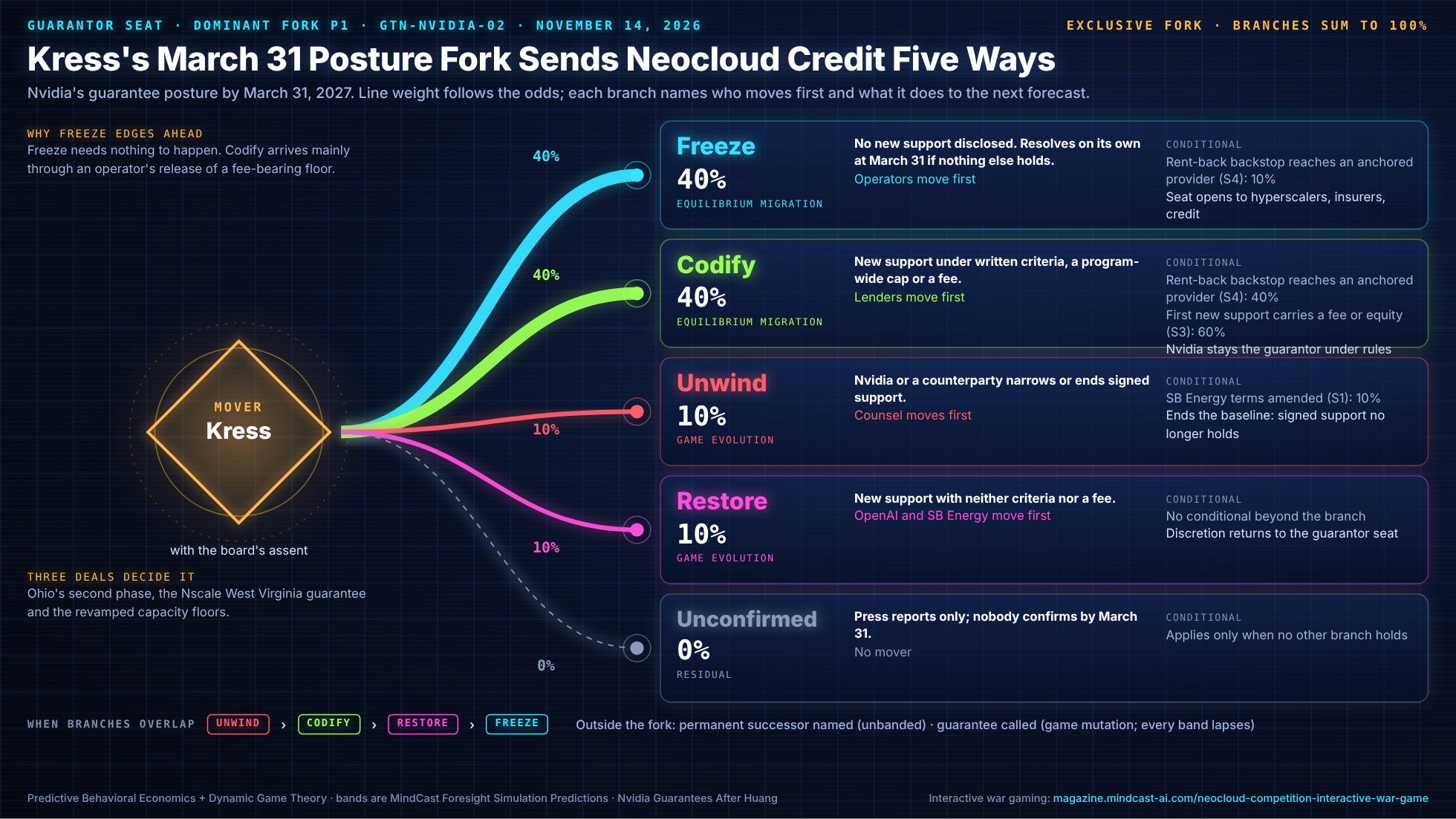
Figure 2. Nvidia’s guarantee posture by March 31, 2027: freeze 40%, codify 40%, unwind 10%, restore 10%, unconfirmed 0%. Each branch names who moves first and what it does to the next forecast.
III.B Lenders Move First Under Codify, and Operators Move First Under a Freeze
Under a codify branch, lenders move first, because their terms reset at each funding draw. Operators whose deals pass the criteria requalify on modestly tighter terms. Operators whose deals fail turn to hyperscalers or insurers for support.
A freeze hands the first move to operators. Neoclouds negotiating floors or lease guarantees either close on signed terms already in hand or restart talks with other guarantors. Hyperscalers gain bargaining power over operators without an anchor.
An unwind would move counsel first. Counterparties would test the instruments, and lenders would mark every vendor guarantee in the sector. Restore would return the guarantor seat to its July terms with a new name on the approvals.
A freeze on a capacity basis would produce the same pause and a different outcome. The guarantor role would empty. Four candidates would compete to fill it: hyperscalers, insurers, private credit funds and sovereign funders. The winner sets the terms, because buyers attach control while insurers and funds charge only a fee.
Microsoft Neocloud Consolidation expects Nvidia to face pressure to widen its backstops if Microsoft’s cuts rest on demand. Under Kress that pressure meets a return test, so demand for guarantees peaks as supply tightens, and the joint state of a demand basis and a freeze is the worst corner for unanchored operators.
Albert Hirschman showed in Exit, Voice, and Loyalty (1970) that members of a declining organization choose between exit and voice. Operators face the same choice when their guarantor narrows: exit to another guarantor, or voice by renegotiating with Nvidia. The basis of the pause decides which choice pays.
Takeaway. The same pause produces opposite outcomes. A governance basis keeps Nvidia in the seat under rules, and a capacity basis opens the seat to new holders.
III.C Short Horizon MindCast Foresight Simulation Predictions Through 2027
Eight MindCast Foresight Simulation Predictions run through 2027 beside the posture fork. The set covers disclosure, new counterparties, withdrawn commitments and the construction boundary. The Ohio cap, substitute guarantors, fee-bearing support and the companion’s backstop call complete the set.
P2 | Nvidia discloses written criteria or a board-level approval step for guarantees and backstops by June 30, 2027 (50%). Criteria include program-wide caps and return thresholds. Collateral requirements or a named committee also count. A board-level approval step counts only as a standing requirement, as P1a defines it. A press release, earnings commentary or securities filing verifies the result. P2 can resolve under a codify or a freeze branch, because a framework can accompany a pause. Criteria can also reach a filing because counsel and the new chair require them during live litigation, so P2 alone cannot separate underwriting from retrenchment.
P3 | Nvidia discloses no new guarantee or backstop of $10 billion or more with a counterparty it had not guaranteed before the November 12 announcement, by June 30, 2027 (70%). Extensions with an existing counterparty do not count against P3. A new counterparty is a party with no Nvidia guarantee, floor or lease support before November 12, and the same definition governs S4. In 2026 Nvidia signed such support at least twice, the Ohio guarantee and the Firmus capacity floor that SemiAnalysis values at a $21.1 billion total obligation. The MindCast Foresight Simulation Prediction fails on the first such disclosure.
P4 | A neocloud or developer discloses by June 30, 2027 that Nvidia withdrew, reduced or delayed a commitment under negotiation (60%). Commitments include guarantees, floors, leases and investments. Open negotiations include Nvidia’s talks to guarantee debt for Nscale’s West Virginia campus for Anthropic, about $2 billion in Nscale’s pre-listing round and an investment in Firmus after its withdrawn listing. The window opens November 15, 2026. Only disclosure or reporting that a commitment was withdrawn, reduced or delayed counts; reporting that talks are in doubt does not. Company filings and statements verify the result, as does reporting by Bloomberg, Reuters or The Wall Street Journal.
P5 | Nvidia discloses no new guarantee covering a data center still under construction, by June 30, 2027 (70%). The Ohio guarantee covers completed facilities only. The Nscale talks covered electricity and construction costs, so a signed Nscale guarantee fails P5. P5 is the boundary test between Nvidia insuring demand and Nvidia insuring delivery. Nvidia filings and counterparty disclosures verify the result.
S1 | Nvidia’s SB Energy guarantee cap is reduced or its terms amended by December 31, 2027 (10%). Nvidia filings and SB Energy or OpenAI statements verify the result. The instrument is signed and filed, and OpenAI must reimburse Nvidia for any amount paid, which makes amendment costly for both sides.
S2 | A hyperscaler, insurer or financial institution publicly assumes a lease or offtake guarantee for a neocloud that Nvidia held or negotiated by December 31, 2027 (40%). Company releases verify the result.
S3 | The first new Nvidia support disclosed between the November 12 announcement and June 30, 2027 carries explicit consideration as P1a defines it (60%, conditional on new support). Nvidia and counterparty disclosures verify the result, and the MindCast Foresight Simulation Prediction carries no resolution if no new support appears. S3 tests the fee-bearing hypothesis directly, and the antitrust-constraint hypothesis pulls against it.
S4 | Microsoft Neocloud Consolidation’s S1 event reassessed by posture branch, by June 30, 2027 (40% given codify · 10% given freeze). The event is Nvidia’s rent-back backstop extending to a provider holding a Microsoft or Meta contract. The published call stays as written at 30%; S4 restates the same event for each posture branch.
Microsoft Neocloud Consolidation published S1 at 30% before the transition and weighed the investigation of Nvidia’s chief executive against a quick extension. S4 reassesses the event on each posture branch while the original stands as published. A commission order tying credit support to a guarantor’s credit now sits as watch item W1, because any such order would also resolve the companion’s S2.
A signed Nscale West Virginia guarantee fails P5 and fails P3 if it reaches $10 billion; it resolves the Microsoft S1 event only if it includes rent-back support.
Two questions stay as analysis rather than MindCast Foresight Simulation Predictions. No platform has closed, so the six firms’ loss-support terms have nothing yet to test. Most freezes would carry no stated reason, and stated reasons would lean toward legal review, so a freeze’s basis can be read only when Nvidia gives a non-legal reason.
Takeaway. New large counterparties wait, and new support carries a charge. Withdrawn negotiations surface first, and substitute guarantors follow.
III.D Guarantee Terms Track the Decision Rule: Structural Hypotheses Through 2028
Three structural hypotheses run through 2028. Each names its breaking condition.
H1 | Guarantee terms track the guarantor’s decision rule more than its balance sheet through 2028. The hypothesis fails if lenders treat Nvidia support the same before and after the transition while Nvidia’s commitments stay near the July level.
H2 | Vendor guarantees across the chip industry move from executive discretion to written criteria through 2028. The hypothesis fails if no other chip vendor that guarantees customer financing discloses criteria by the end of 2028.
H3 | Advance rates on chip collateral fall first for the GPU generations buyers stop specifying through 2028. The hypothesis fails if advance rates hold across generations while buyers drop older chips from new contracts. CoreWeave’s report that older-generation rental rates rose 30-50% in a quarter weighs against H3 for now.
Takeaway. H1 tests whether lenders read rules over reserves, H2 tests whether the rule spreads and H3 tests the collateral.
III.E How the Game Evolves: The Guarantor Seat Changed Hands While the Rules Held
A forecast holds only while the situation that produced it holds. Some events add information, some shift which outcome sticks and some change the players, payoffs or rules. Only the last kind forces new odds.
The game reached its current form in three steps. Under Huang, Nvidia wrote support by discretion and justified much of it by the chip sales it unlocked. In August, an antitrust pause and the Ohio cap showed that both kinds of support already faced limits. The November 11 transition changed the rules at one seat: the decision rule changed hands while the instruments, the players and the rules held.
The remaining rules hold through the forecast windows for three reasons. Signed instruments are filed, and Ohio’s reimbursement term makes amendment costly for both sides. The board has stated that customer commitments continue, and the interim term is expected to run about a year. The class action and the August antitrust pause bind every branch, so neither discretion nor control clauses return quickly.
Three conditions would end the baseline. A permanent chief executive named before June 30, 2027 reopens the posture fork. An amendment that narrows signed support breaks the claim that signed support holds. A call on a guarantee is the one event in view that would rewrite the game outright, because it makes Nvidia a direct holder of site or capacity losses.
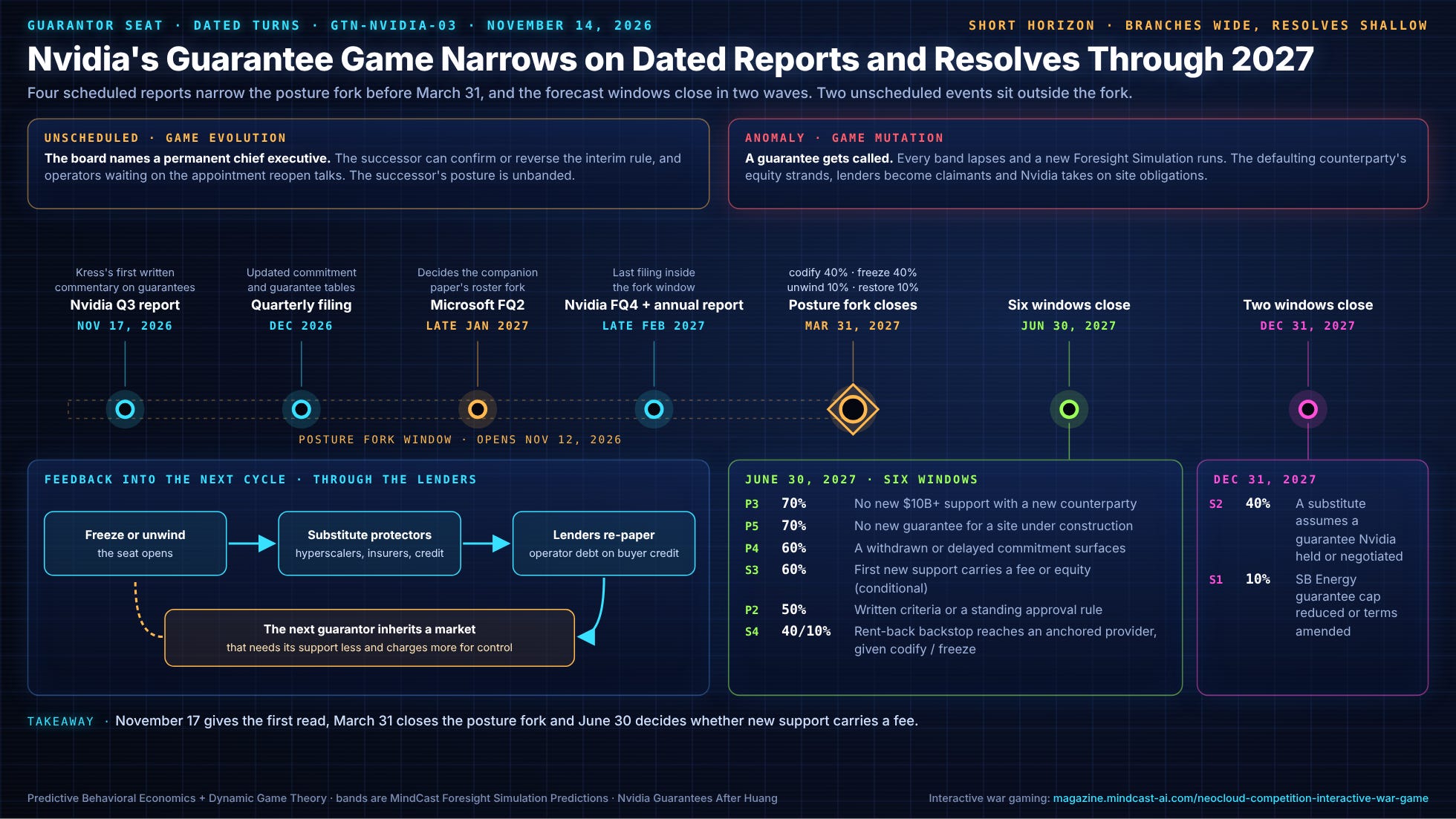
Figure 3. Four scheduled reports narrow the posture fork before March 31, six forecast windows close on June 30, 2027 and two close on December 31, 2027.
How the Game Branches
The baseline MindCast Foresight Simulation Predictions start from signed support holding. A withdrawn or delayed commitment surfaces (P4 at 60%). Any first new support carries explicit consideration (S3 at 60%). No new support of $10 billion or more with a new counterparty appears by June 30, 2027 (P3 at 70%), and no new construction-stage guarantee appears (P5 at 70%). A standing approval rule reaches a filing (P2 at 50%), and an amendment to the SB Energy terms stays unlikely (S1 at 10%).
The dominant fork is P1, Nvidia’s posture by March 31, 2027. Kress moves it with the board’s assent. The MindCast Foresight Simulation Predictions set codify and freeze at 40% each, unwind and restore at 10% each and unconfirmed at 0%.
State 1: freeze. Freeze is the default if nothing happens. Under a freeze, the Microsoft S1 event falls to 10%. Hyperscalers, insurers and private credit gain the move to back operators, while operators in negotiation strand or switch protector. Lenders gain leverage at each draw, and signed counterparties keep their positions.
State 2: codify. Nvidia stays the guarantor under written terms or fees. Under codify, the Microsoft S1 event rises to 40%. Any first new support carries explicit consideration at 60%. Lenders gain a published test, and floor beneficiaries keep fee-only floors. Unanchored operators whose deals fail the test strand, so codify reads as freeze for the weak tail.
State 3: restore. Discretion returns to the guarantor seat. No conditional applies beyond the branch’s 10%. OpenAI and SB Energy gain the move to request Ohio’s second phase on prior terms, and AMD and Broadcom lose the opening a narrower program would give them. The cross-subsidized half of the core insight fails at its largest instance.
State 4: unwind. Unwind ends the baseline, because signed support no longer holds. The branch sits at 10%, and an SB Energy amendment at 10% (S1). Beneficiaries of amended instruments strand, lenders with collateral beyond the guarantee survive and counsel gains a contest over instrument terms.
State 5: permanent successor. A permanent successor ends the interim baseline, and the successor’s posture carries no odds until a new Foresight Simulation sets them. The successor gains the move to confirm or reverse the interim rule. Operators waiting on the appointment convert their positions into negotiations, and the restore path reopens if the successor favors deal-led growth.
State 6: guarantee called. A called guarantee breaks the baseline outright. Every current odds figure lapses, and a new Foresight Simulation runs. The defaulting counterparty’s equity strands, lenders convert to claimants and Nvidia gains possession or resale obligations at the site.
Feedback into the next cycle. Each state reaches the next cycle through the lenders. Freeze and unwind push substitute protectors into the seat, and lenders re-paper operator debt on buyer credit. The next guarantor, Nvidia under a permanent chief executive or a substitute, then inherits a market that needs its support less and charges more for control. The Microsoft paper’s long-horizon call reruns after Microsoft’s fiscal second quarter.
Takeaway. The seat changed hands and the rules held. Freeze and codify carry equal odds, and a called guarantee is the one event that would require new odds.
III.F Four Routes Would Break the Forecast Set
Nvidia’s disclosure can separate the governance basis from the capacity basis only through stated reasons. Few freezes would state a reason, and legal review would lead among those that do. Only a non-legal stated reason reveals the basis, and filings that show fewer guarantees without explanation cannot tell a pause from a lull in deal flow.
Four routes would break the forecast set. Kress announces a large new guarantee with neither stated criteria nor explicit consideration, which resolves P1 to P1d. A permanent successor is named before March 31, 2027 and reverses the interim posture at once. Lenders show no change in terms on Nvidia-supported deals through mid-2027, which weakens H1.
The fourth route runs through market share. Kress continues support near the prior pace to defend share against AMD and Broadcom, under a thin framework that reads as codification on paper and restoration in substance.
Takeaway. The forecast set names the evidence that separates its hypotheses and the events that would break it.
Consequences for each audience.
🏛️ Policymakers. Signed support stays in place on every branch except unwind (10%), so commission terms built on signed instruments hold.
💼 Executives. No new support through March is the default path, so an operator counting on new Nvidia support before then carries the gap.
⚖️ Counsel. Counterparty releases resolve the posture fork alongside Nvidia filings, so a client’s own announcement can decide how the posture reads.
📊 Investors. The fee-bearing half resolves by June 30 (S3 at 60%, conditional on new support), and a signed Nscale guarantee would fail P5.
Section conclusion. Freeze and codify are tied, and freeze is the default if nothing happens. Each MindCast Foresight Simulation Prediction names its window, its source and the event that ends it.
IV. Stakeholder Strategy and Risk Mitigation: Close on Signed Terms and Line Up a Second Guarantor
Each stakeholder holds a different lever against the same exposure. The right move depends on whether the stakeholder’s support is signed, negotiated or assumed. The moves below come first, and the risk table converts each MindCast Foresight Simulation Prediction into an owned task.
🏛️ Policymakers. Low-regret move now: state how large-load credit support treats a third-party guarantee. If watch item W1 appears: require guarantor disclosure of caps and triggers. Primary risk: a credit support rule that rests on a guarantor’s goodwill.
💼 Executives at unanchored neoclouds. Low-regret move now: convert any negotiated Nvidia support into signed terms or a dated decline. If P1b resolves: approach a hyperscaler or insurer for substitute support. Primary risk: carrying capital plans that assume a floor no one signed.
💼 Executives at anchored neoclouds. Low-regret move now: lead financing materials with the buyer’s credit, not the vendor’s support. If P1a resolves: qualify deals against the published criteria. Primary risk: support terms tightening at the next draw.
⚖️ Counsel. Low-regret move now: inventory each client’s vendor support by instrument, cap and trigger. If P1c resolves: test amendment rights against the signed text. Primary risk: side letters and term sheets treated as binding.
📊 Investors. Low-regret move now: separate signed from negotiated Nvidia support in holdings models. If P2 resolves: rate each exposure against the disclosed criteria. Primary risk: reading a governance pause as a capacity failure, or the reverse.
Actions below are options for consideration, not legal, investment or fiduciary advice. Severity and probability appear as separate axes.
P1b, freeze · 💼 Unanchored neoclouds. Exposure: Working capital plans fail at the next draw. Actions: Finance leads secure signed terms or a dated decline by January 31, 2027; business development leads open talks with two substitute guarantors by February 28, 2027. Residual: Substitutes demand anchor-level credit. Severity: High.
P1a, codify · 💼 Anchored neoclouds. Exposure: Deals fail criteria the operator never saw. Actions: Finance leads map pipeline deals to likely criteria after the November 17 report; deal teams restructure failing deals by March 31, 2027. Residual: Criteria may stay unpublished. Severity: Medium.
P1c, unwind · ⚖️ Counsel. Exposure: Clients lose support they treated as firm. Actions: Contract counsel confirms amendment and termination rights in each instrument by December 31, 2026. Residual: Courts read ambiguous terms against the drafter. Severity: High.
P3, no new large counterparty · 📊 Investors. Exposure: Growth plans for unsupported operators overstated. Actions: Portfolio managers remove unsigned Nvidia support from operator models by December 31, 2026. Residual: Signed support may also tighten at renewal. Severity: Medium.
P4, withdrawn negotiation · 💼 Unanchored neoclouds. Exposure: Disclosure of a withdrawn deal moves equity and debt at once. Actions: Investor relations leads prepare disclosure language on support status by January 31, 2027. Residual: Market reaction outruns the disclosure. Severity: Medium.
Platform terms (analysis) · 📊 Investors. Exposure: Platform debt valued as if vendor-backed. Actions: Credit analysts value platform debt on chip collateral and offtake alone from the first closing. Residual: Chip resale values move faster than models. Severity: Medium.
S2, substitute guarantor · 💼 Hyperscaler executives. Exposure: A rival gains control of operator capacity through support. Actions: Corporate development leads set terms for backing operator leases by June 30, 2027. Residual: Support draws the hyperscaler into operator risk. Severity: Medium.
P5, construction-stage support · 💼 Developers and operators. Exposure: Construction financing assumed vendor support that never signs. Actions: Project finance leads secure lender commitments that stand without vendor support before each financing deadline. Residual: Buyers may exercise walk rights at the deadline. Severity: High.
Takeaway. Signed terms and a second guarantor address the largest exposures. Each row names an owner and a date, so the exposure converts into a task.
V. Implications: Guarantor Governance Becomes an Authorization Input
Nvidia’s transition changes who stands behind AI infrastructure credit and on what terms. Four implications follow for institutions, strategy, distribution and the MindCast Foresight Simulation Predictions themselves.
Institutional impact. State commissions write large-load credit support terms that ask who stands behind a customer’s payments (watch item W1). Microsoft Neocloud Consolidation gives a commission tying credit support to the customer’s credit or an offtaker guarantee by December 31, 2027 at 70%. A guarantor that narrows its program weakens the security those terms rest on. The 50-State Authorization Price Atlas and the Model Data Center Authorization Code describe the public terms that now read guarantor credit as an input.
Strategic interaction. Hyperscalers gain the most from a narrower Nvidia program. Each operator that loses a vendor floor becomes a candidate for hyperscaler-backed capacity, as Google’s Fluidstack backing shows. Support converts into control, because the party that stands behind a lease shapes who uses the capacity. Nvidia’s retreat bites hardest under the Microsoft paper’s demand basis rather than its delivery basis, because Nvidia insures demand and tenant credit.
Distribution. Signed beneficiaries keep their support, with OpenAI’s Ohio guarantee the largest example. Unanchored operators carry the first loss, because their working capital depended on support still in negotiation. Lenders to anchored operators gain relative standing, because their collateral rests on the buyer’s credit.
Falsifier consequences. If P1d resolves, the governance thesis fails and founder-style discretion survives the transition. Guarantor rules would still matter, yet the interim period would count as a pause in personnel rather than in policy. The original MindCast Foresight Simulation Prediction stands as a miss under the codify branch.
🏛️ Policymakers. Credit support schedules that name guarantor treatment now avoid a scramble when the next vendor narrows its program.
Takeaway. Guarantor governance has become an authorization input. States and lenders that read the guarantor’s rules early avoid carrying its discretion.
What to Watch
Eleven signals separate the paths in this paper. Each carries a named source and a cadence.
Kress’s first commentary on guarantees (P1, P2). Nvidia’s written commentary and call on November 17, 2026, the first read.
First new Nvidia support and its terms (S3). Counterparty releases and Nvidia filings through June 30, 2027. The decisive test of the fee-bearing half: a fee and no customer-approval clause.
Updated commitment and guarantee tables (P1 and S1). Nvidia’s third-quarter filing, late November or December 2026, then quarterly.
Successor appointment (P1, P3). Nvidia board announcements, as issued.
Withdrawn or delayed support (P4). Neocloud and developer filings and wire reporting, monthly.
First platform closing and its advance rates (H3). Offering documents and releases from the six firms, as issued.
Substitute guarantors (S2). Hyperscaler, insurer and lender releases, monthly.
Watch item W1: commission treatment of guarantor credit. State commission dockets, monthly. A commission order that cites a guarantor’s credit in large-load credit support would also resolve the companion’s S2.
Microsoft’s supplier actions (companion paper). Microsoft’s fiscal second-quarter report in late January 2027.
Older-generation rental rates and advance rates (H3). Operator earnings and financing documents, quarterly.
Nscale’s West Virginia financing (P4, P5). Nscale filings and Anthropic contract notices, as issued.
Takeaway. The November 17 report is the first read. The first new support decides the fee-bearing half by June 30, and the successor appointment decides how long the posture lasts.
Conclusion
Nvidia’s guarantees rested on one decision-maker’s conviction, and that decision-maker left on November 11. The finance chief who questioned the guarantees’ valuation now approves new support. Signed support holds, and support still in negotiation lost its sponsor.
The posture fork decides how credit moves next. A codified program keeps Nvidia in the guarantor seat under rules, and a pause opens the seat to hyperscalers, insurers and private credit. The basis of the pause decides whether it reverses under a permanent successor.
Operators act now by converting negotiated support into signed terms and lining up a second guarantor. Lenders and investors act by separating signed from negotiated support and governance from capacity. The first read arrives with Nvidia’s report on November 17. The decisive test of fee-bearing support closes on June 30, 2027.
Working With MindCast
Published analysis cannot tell a specific operator, lender or developer how its own support fares under the new guarantor rule. An unanchored neocloud, a platform lender and a site developer each face the guarantor seat on different terms.
A commissioned engagement builds Cognitive Digital Twins of the organization, its guarantors, its buyers and its lenders. MindCast then reruns the guarantor contest against the organization’s actual support instruments and financing calendar.
Commissioned scope adds complete probability distributions, P10/P50/P90 ranges and settings fitted to the organization. Commissioned scope also adds complete scenario trees, decision thresholds and a monitoring dashboard keyed to the five dated turns. Interactive war gaming lets a client’s team play the operator, lender or buyer seat against modeled opponents.
The MindCast Prediction Scorecard dated November 15, 2026 shows 47 hits, 9 partials and 4 misses on resolved material MindCast Foresight Simulation Predictions. MindCast forecast that Microsoft would sign the first hyperscaler firm-power deal, and Project Kilby confirmed it in June. MindCast also forecast that the Federal Energy Regulatory Commission (FERC) would finalize one large-load interconnection rule near April 30; FERC instead asserted authority through six regional orders on June 18.
The bounded next step is a diagnostic session on one financing or support decision due before March 31, 2027. Contact: mcai@mindcast-ai.com.
Visit MindCast AI for the full Foresight Simulation library, prior MindCast Foresight Simulation Predictions and engagement options.
Appendix A. Selected MindCast Works
MCAI Economics Vision: Who Pays for AI Data Center Delays — Series Introduction. Series introduction; defines the equilibrium this case tests through its protection condition.
Microsoft Neocloud Consolidation: Energized Megawatts, Not Contract Backlog, Decide Which Neoclouds Survive. Companion paper; supplies the counterparty gate, the published backstop call and the commission credit support call.
Neocloud Operators and the Acceptance Gate: Accepted Megawatts, Not Signed Backlog, Decide What a Delay Costs. Companion paper; supplies the capacity ladder and the accepted rung.
Neocloud competition interactive war gaming. Lets a reader play Microsoft, a neocloud or a lender across the dated forks.
The Ballot Decides Where Data Center Sites Proceed; Governors and Regulators Set the Terms of Power and Service. Supplies the three public authorization gates.
AI Data Center Credit Risk, Permitting, Curtailment, and the Cost of Capital. Supplies the credit framing for authorization risk.
AI Data Center Authorization Bargaining Power. Rates neoclouds as the most dependent tier, with bargaining power borrowed from backstops.
Predictive Game Theory Evolution and Mutation, Long Horizon Games Resolve Deep Because Their Branches Hold. Supplies the false-stability signal applied to the guarantee regime.
50-State Authorization Price Atlas. Reference terms for the public gates by state.
Model Data Center Authorization Code. Reference statute for dated authorization terms.
MindCast Prediction Scorecard. Resolved material calls as of November 15, 2026.
Appendix B. External Sources
Albert O. Hirschman, Exit, Voice, and Loyalty: Responses to Decline in Firms, Organizations, and States (Harvard University Press, 1970).
Securities and Exchange Commission, NVIDIA Form 8-K, NVIDIA Announces CEO Transition.
The Wall Street Journal via To Vima, Before His Ouster, Jensen Huang Belittled the Executive Replacing Him.
Michael Parekh summarizing The Information, Nature Abhors a Vacuum in AI.
FourWeekMBA, Nvidia’s 10-Q Lists $530B in Commitments and Guarantees.
InterCapital, We’re All Nvidia Analysts Now.
Digg summarizing SemiAnalysis, Nvidia reportedly disclosed $530 billion in gross off-balance-sheet guarantees.
NVIDIA, NVIDIA Sets Conference Call for Third-Quarter Financial Results.
Axios, OpenAI announces massive data center in Ohio with Nvidia guarantee.
Implicator, Nvidia Guarantees Up to $105 Billion on OpenAI’s Ohio Data Center Lease.
Fortune summarizing Bloomberg, Nvidia taps Wall Street for $500 billion funding commitment.
Implicator, Nvidia enlists six Wall Street firms to target $500 billion for AI compute.
The Decoder, Nvidia guarantees its own chips’ value to unlock $500 billion in AI infrastructure financing.
The Edge Malaysia, citing Bloomberg, Nvidia residual value mechanism.
Crypto Briefing, Nvidia faces Wall Street skepticism over $500 billion chip-backed financing plan.
Global Data Center Hub, Nvidia’s $500B AI Infrastructure Financing Platform.
Michael Parekh summarizing Bloomberg, The Information and the FT, AI: Nvidia Beyond Jensen.
Digital Today summarizing The Information, Jensen Huang resignation throws Nvidia investment talks into doubt.
VARIndia, Nvidia’s $140 Billion Spending Spree Faces a Freeze.
Kistenmacher v. NVIDIA Corporation, No. 5:26-cv-13448 (N.D. Cal., filed November 9, 2026), class action complaint.
The Next Web, Nvidia has paused parts of the revenue-sharing programme it launched in July, August 2026, reporting The Wall Street Journal.
Reuters via Yahoo Finance, Nvidia pauses revenue-sharing deals with AI cloud companies, WSJ reports, August 27, 2026.
Capacity, Nvidia now agrees to rent back unused GPU capacity from neocloud operators.
Capacity, Huang at GTC Berlin.
FourWeekMBA, Nvidia Has Backstopped 6.5 GW of Cluster Deals, Patel Says.
Michael Parekh summarizing The Information, Nvidia expands revenue share deals.
KuCoin summarizing the WSJ, Hut 8 Beacon Point lease chain.
ROIC, Huang defends CoreWeave as cost of capital sparks debate.
The Next Web citing Bloomberg, Nvidia in talks to guarantee debt for Nscale’s Anthropic data centre.
The Next Web, Nscale $3.5 billion pre-IPO financing.
Investinglive, Nvidia in talks to invest hundreds of millions in Firmus.
Data Center Dynamics, Nvidia acts as backstop for customer GPUs in return for cut of cloud revenue.
Stocktwits, Nvidia’s Jensen Huang wants AI chips to be a financeable asset.
Bloomberg, Dina Bass and Brody Ford, CoreWeave Shares Soar After AI Computing Firm Eases Debt Fears.
The Motley Fool, CoreWeave third-quarter 2026 earnings call transcript.
Tech Insider summarizing Bloomberg, Microsoft winds down 2023 Oracle AI cloud deal.
Paul, Weiss, TeraWulf to expand AI hosting agreements with Fluidstack.