
Microsoft · Nebius · CoreWeave · IREN · Nscale · Oracle · Nvidia · Meta · OpenAI · Anthropic · Bank Lenders and Infrastructure Funds · Electric Reliability Council of Texas · State Utility Commissions · Local Governments and Voters · US · UK
Companion to Neocloud Operators and the Acceptance Gate: Accepted Megawatts, Not Signed Backlog, Decide What a Delay Costs
Play the interactive war game Neocloud Competition Simulation
Related MindCast works: The Ballot Decides Where Data Center Sites Proceed; Governors and Regulators Set the Terms of Power and Service · AI Data Center Credit Risk, Permitting, Curtailment, and the Cost of Capital · AI Data Center Authorization Bargaining Power
I. Executive Summary: Energized Megawatts Now Decide Which Neoclouds Keep Their Anchor Buyer
Microsoft is cutting neocloud suppliers whose sites missed delivery, not suppliers it no longer needs. Lenders now judge neoclouds by the power and permits they actually hold. The cause of a cut decides what follows: a delivery cut rewards neoclouds with energized capacity, and a demand cut tightens financing for the whole sector.
Neoclouds are specialist operators that rent graphics processing unit (GPU) clusters to hyperscalers and artificial intelligence (AI) labs. Their capacity is measured in megawatts (MW) of power drawn.
Microsoft is cutting its roster of neocloud suppliers, and the evidence so far points to delivery rather than demand. Delivery failures in Microsoft’s review come from two sources. Authorization gates stopped some sites through grid power, local approval and environmental permits. Execution stopped others through construction defects and design changes Microsoft itself requested.
Authorization and execution risk now converge in the offtake contract, where buyers and lenders set their cost. Authorization is the part of that risk MindCast models, because it runs through dated dockets, ballots and tariffs.
On November 6, 2026, CNBC reported that Microsoft is shrinking its roster of neocloud partners to focus on a few key suppliers and its own data centers. Microsoft had already walked away from an Nscale site in England over access to electricity. Three providers carry Microsoft contracts worth up to about $70.9 billion across Nscale, Nebius and IREN.
MindCast AI applies Predictive Behavioral Economics + Dynamic Game Theory through MindCast AI Proprietary Cognitive Digital Twin Foresight Simulations (MP CDT FS). Behavioral Economics supplies the decision rules, including the reference point Microsoft sets on capacity it has already sold. Game Theory supplies the payoff structure among Microsoft, its suppliers, lenders and approvers. Predictive simulations emerge from the combination.
The MindCast Prediction Scorecard dated November 10, 2026 shows 47 hits, 9 partials and 4 misses on resolved material calls.
Core insight. The cause of a cancellation decides the successor game, not the cancellation itself. Demand for compute held while deliveries slipped: CoreWeave reported on November 10 that rental rates for older GPU generations rose 30% to 50% in a quarter. The evidence therefore favors a delivery cause, which rewards authorized and energized megawatts.
Credit markets already show the split: CoreWeave expects its next contract-backed loan to yield 7% to 7.5%, about half the yield on its unsecured bonds. Lenders, rival buyers and operators then decide whether a lost contract ends in consolidation, reallocation or a change of ownership.
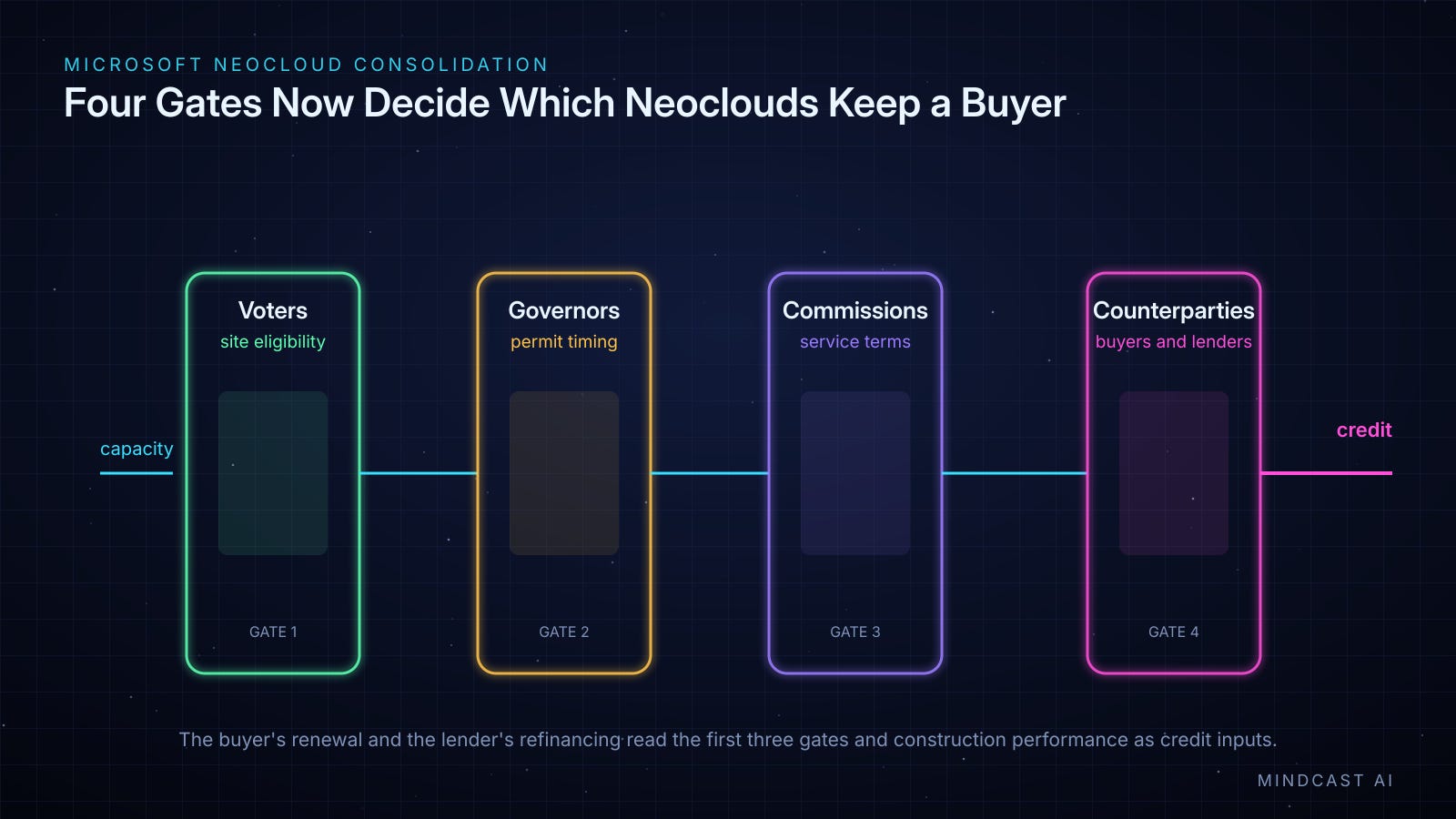
Thesis. Buyers and lenders now act as a fourth approval gate. The Ballot Decides Where Data Center Sites Proceed; Governors and Regulators Set the Terms of Power and Service mapped the first three: local voters decide where sites proceed, governors set permit timing and utility commissions set service terms. The buyer’s renewal and the lender’s refinancing now read those three approvals and construction performance as credit inputs.
What distinguishes the MindCast approach. The paper separates authorization risk from execution risk inside the same contract. Authorization risk runs on public and dated decisions. MindCast can therefore model which sites clear before a buyer decides.
What the paper does. Section II maps the four gates, the capacity ladder and the actors in the contest. Section III sets out nine MindCast Foresight Simulation Predictions on the roster fork and its consequences through 2028. Sections IV and V convert them into strategy, risk mitigation and implications.
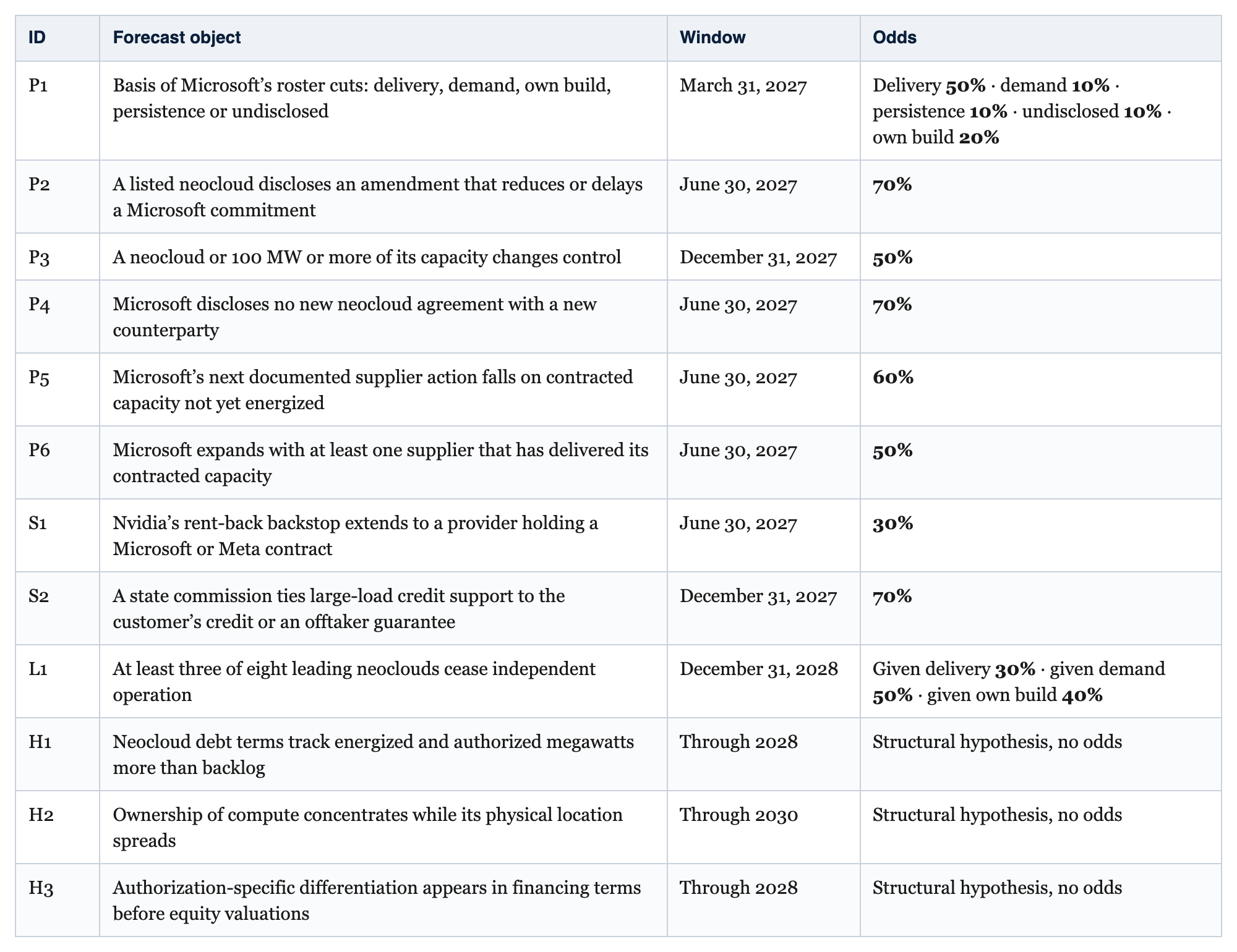
P marks a Primary Simulation Prediction, S a Secondary Simulation Prediction, L a Simulation Prediction dated to 2028 and H a structural hypothesis. Odds print in tens. Odds come from one certified simulation run covering both papers and frozen before Nebius reported its third quarter on November 12, 2026.
Stakeholder readout.
🏛️ Policymakers. Lenders now read local approval and tariff status as credit inputs (S2). A state that publishes dated large-load terms lowers the cost of capital for every project inside its borders.
💼 Executives. Microsoft’s review rewards delivered megawatts, and one late site can put a whole contract at risk (P1, P2). Neocloud operators should publish energized capacity and on-time delivery by contract tranche.
⚖️ Counsel. Delivery remedies in hyperscaler contracts now carry the consolidation (P2). Map which delays the buyer caused, because buyer-caused delay weakens the remedy.
📊 Investors. Backlog no longer separates survivors from targets (L1, H1). Value neoclouds on energized megawatts with authorization in hand.
Takeaway. The cause of Microsoft’s cuts decides which suppliers gain and which lose financing. The paper forecasts that cause and how capital follows it.
II. Authorization and Execution Risk Converge in the Offtake Contract: Why the Contest Fits a Simulation
Neocloud consolidation looks like a capital markets story. The evidence shows authorization and execution risk converging in contracts. Bounded actors, dated forks and competing explanations make the contest fit a simulation.
II.A Three Deliveries Slipped for Three Different Reasons
Microsoft relies on neoclouds for capacity beyond its own build. Chief financial officer Amy Hood told analysts that capital expenditures were $45.2 billion as some third-party capacity deliveries were delayed. Azure revenue still reached $33.2 billion, up 48%. Microsoft lost revenue it could have booked, not demand it could not find.
Each delay maps to an authorization gate or to execution.
Grid power. Microsoft walked away from Nscale’s roughly $3 billion Loughton site after the grid operator said it may not power the site until the early-to-mid 2030s.
Environmental permits. The developer of Nebius’s New Jersey site was fined $1.07 million for running 62 natural gas generators without permits. Satellite analysis cited by Business Insider sees roughly 140 megawatts at Vineland slipping into 2027.
Local approval. A Vineland resident brought 2,900 signatures opposing the center to a planning board hearing on project amendments.
Execution: construction and specification. IREN’s Texas campus faced cabling problems and a generator fire. Microsoft itself asked for network changes to support newer AI models, and IREN moved more than $4 billion of annual recurring revenue to at least January at a customer’s request.
Microsoft also declined to renew a 2023 Oracle capacity agreement that served Bing. People familiar with the matter told Bloomberg the capacity no longer fit Microsoft’s specifications and ran older Nvidia chips. Specification joins delivery as a supplier test, and Oracle anchors much of OpenAI’s compute.
Microsoft now inspects the gates directly. Bloomberg reported that Microsoft sends staff to neocloud sites to confirm facilities meet its specifications and comply with regulations, including the Nebius site fined over generators. IREN said it faces no financial penalty for delays stemming from Microsoft’s design changes. Nscale corrected a disclosure to remove wording that Microsoft held an option on 700 MW of added capacity.
Takeaway. Demand held, and deliveries failed at authorization gates and in execution. Microsoft now reads both as supplier risk.
II.B The Governing Question: Which Suppliers Keep Their Anchor Buyer
Which neocloud positions remain viable as Microsoft narrows its roster, lenders revalue delivery risk and states write large-load terms?
The target system is U.S. and U.K. neocloud supply to hyperscalers and AI labs. The horizon runs from November 2026 through 2028. The roster fork resolves by March 31, 2027. Chip supply and model demand sit outside scope.
Takeaway. The question concerns which suppliers keep a buyer, not whether AI demand holds. CoreWeave’s November results answer the demand question for now.
II.C The Counterparty Gate Reads the First Three Gates as Credit Inputs
The Ballot Decides Where Data Center Sites Proceed; Governors and Regulators Set the Terms of Power and Service set out three gates for the 2027 sessions. Local voters decide site eligibility, governors set permit timing and utility commissions set service terms. On November 3, voters left 22 binding restrictions standing, and five measures ban sites above 25 MW.
A fourth gate sits behind those three. The counterparty gate decides whether an anchor buyer renews and a lender refinances. Bank of America’s Karen Fang told Reuters that permitting status and local community support now sit alongside credit quality in data center loan reviews. Construction performance enters the same review, because a permitted site that misses its build date still fails delivery.
The counterparty gate acts faster than the other three. A commission takes months to write a tariff, and a buyer can cancel a tranche in a quarter. The Nebius agreement lets Microsoft receive service credits or terminate individual tranches when delivery slips. The buyer therefore enforces authorization discipline before any regulator rules.
Opposition carries a measured cost. Data Center Watch counted at least 75 projects worth about $130 billion that ran into local opposition in the first quarter of 2026. Lenders now steer capital toward states seen as welcoming.
Credit terms already split on the buyer behind the contract. CoreWeave’s $8.5 billion facility backed by Meta contracts earned an investment-grade rating and carried a margin of 2.25 points over the Secured Overnight Financing Rate. CoreWeave’s unsecured bonds yielded above 15% in October. A loan backed by a creditworthy buyer’s contract on deployed capacity costs about half what the operator’s own credit costs.
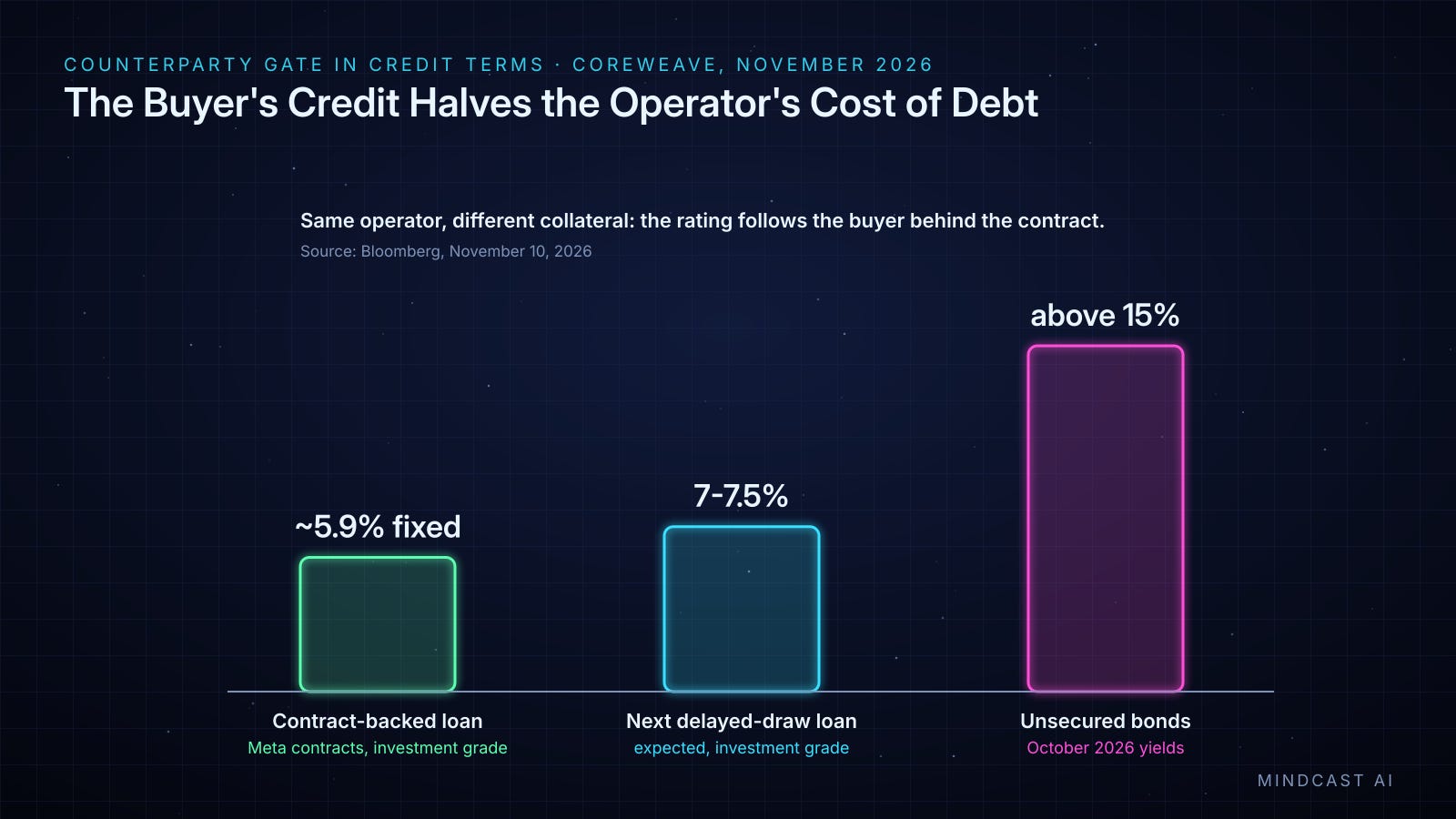
Takeaway. The counterparty gate converts the first three gates into contract and credit terms. A site that clears all four gates keeps its buyer.
II.D Five Kinds of Capacity Carry Five Kinds of Risk
Neocloud reporting often treats capacity as one number. Five different quantities sit behind it, and each carries a different risk.
Contracted capacity is the megawatts a buyer has agreed to take. Termination rights and delivery remedies govern its value.
Authorized capacity has cleared local approval, permits and a service agreement. Voters, governors and commissions govern its value.
Energized capacity is drawing power and running GPUs to the buyer’s specification. Construction and interconnection govern its value. Oracle’s capacity was running when Microsoft dropped it for older chips, so energized capacity that misses specification still loses.
Accepted capacity has passed the buyer’s sign-off against contract terms, so service and billing start. The buyer’s acceptance criteria govern its value.
Utilized capacity is earning revenue at contract rates. Workload demand and rental rates govern its value.
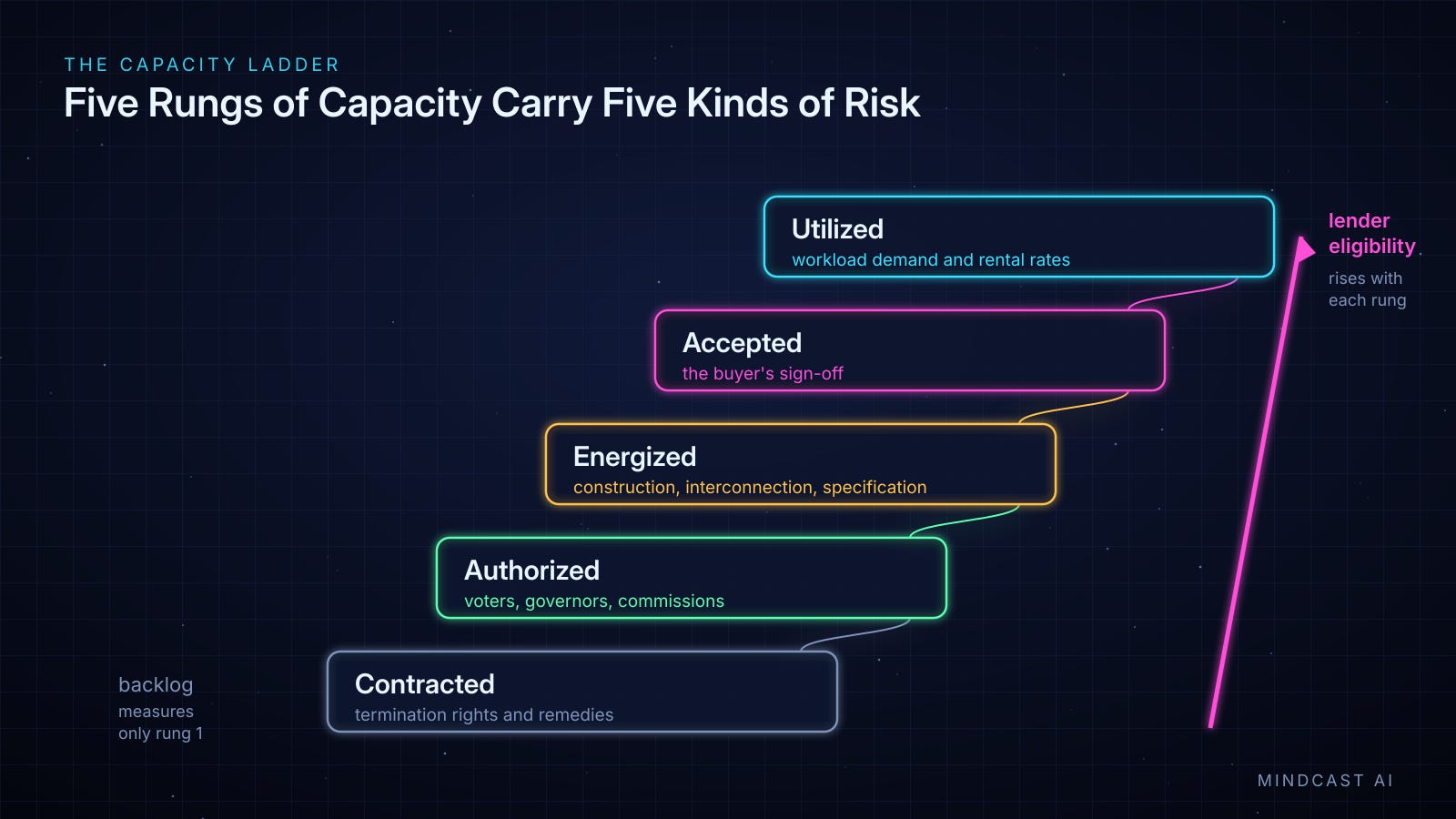
Backlog measures the first rung, and Microsoft’s review tests the second and third. A supplier’s value depends on how fast megawatts climb the ladder. Each rung also binds a different remedy: more customers cannot fix missing power, and more GPU financing cannot fix a missing permit.
Lender eligibility is a property of the ladder rather than a rung. Lenders extend credit more readily as megawatts climb, and the companion paper develops the accepted rung in detail.
📊 Investors. Value each neocloud on the rung its megawatts have reached, not on backlog.
Takeaway. Each of the five rungs is a different asset. Buyers and lenders now value the middle three.
II.E Every Large Buyer Faces the Same Test on Different Terms
Microsoft is the loudest signal, not the only one. Each large buyer faces the authorization test under its own funding constraint.
Meta. Capital spending of $34.91 billion exceeded operating cash flow, leaving free cash flow at negative $2.12 billion in the third quarter. Meta also holds direct contracts with CoreWeave and Nebius. Reporting in October described Meta weighing leasing raw GPU capacity directly to third parties, which would make a neocloud customer a neocloud competitor.
Oracle. Oracle plans to raise $40 billion in fiscal 2027 through debt and equity on top of $43 billion raised a year earlier. Much of its contracted demand traces to OpenAI.
Google. Third-quarter capital spending came in at $51.36 billion, below the $55.09 billion analysts expected. Google’s own chips give it an internal alternative to rented GPUs.
OpenAI. The Wall Street Journal placed OpenAI’s future compute commitments at about $600 billion.
Anthropic. Anthropic’s amended registration statement of November 2 discloses about $895.4 billion of purchase commitments and leases, substantially all for compute and infrastructure. Anthropic also disclosed that some compute partners depend on outside financing.
Buyers differ in what they can substitute. Hyperscalers can build, AI labs mostly rent and Meta does both. One buyer concentrating its suppliers can therefore coexist with another diversifying.
🏛️ Policymakers. Funding strain at every large buyer raises the value of a state’s dated large-load terms.
Takeaway. The authorization test applies to every buyer, and funding pressure decides how hard each one enforces it. Microsoft enforces it first because its revenue waits on delivery.
II.F Supplier Decisions Move Faster Than Authorization Rules
Supplier decisions can change inside a quarter, while state authorization rules are firming into written conditions that hold through 2027. Predictive Game Theory Evolution and Mutation, Long Horizon Games Resolve Deep Because Their Branches Hold traces that shift. The paper’s Simulation Predictions therefore run through 2027, and entries dated to 2028 depend on the outcome of Microsoft’s review.
Takeaway. Microsoft’s review governs every Simulation Prediction in the paper. Authorization rules enter through bands MindCast has already published.
II.G Behavioral Economics: Buyers Count Delivered Megawatts While Sellers Lead With Backlog
Behavioral Economics explains why the cut lands on delivery. Microsoft’s reference point is capacity it already sold, so a late tranche counts as a loss of booked revenue. Loss aversion makes a late supplier weigh more than an equal supplier that never signed.
Neocloud operators anchor on backlog. A contract worth $17 billion feels like security, yet the buyer values the next delivered tranche. Equity investors anchor on the most recent headline, which is why CoreWeave rose as much as 24% on November 11 after a strong quarter that followed a month of steep declines.
Takeaway. Reference points explain the gap between what neoclouds sell and what buyers value. Buyers value delivered megawatts, and sellers still lead with backlog.
II.H Game Theory: A Third Seat Changes Who Can Survive a Lost Buyer
Game Theory supplies the payoff structure. Microsoft holds an outside option in its own build, and each delivered tranche reduces the value of that option for the neocloud. A supplier that delivers on time raises its bargaining power, and a supplier that slips hands the buyer a contractual exit.
The game also changes mid-play. Nvidia now rents back unused GPUs at a fixed rate for some neoclouds in exchange for a share of cloud revenue. A new guarantor changes who can borrow, and a static analysis of buyer and seller misses the third seat.
Takeaway. The board has three kinds of seats: buyers, suppliers and backstops. Each new backstop changes which suppliers can survive a lost buyer.
II.I Ten Actors, Three Hypotheses and Five Dated Turns Define the Simulation
Ten actors become Cognitive Digital Twins (CDTs). Each entry names what the actor wants, what it controls and what moves it.
Microsoft. Wants delivered capacity for Azure and its own models. Controls renewals, tranche terminations and its own build. Updates on delivery dates and earnings.
Builder neoclouds (Nebius, IREN, Nscale). Want to deliver contracted capacity on owned sites. Control site selection and construction. Update on permits, interconnection and buyer notices.
Leasing neoclouds (CoreWeave and peers). Want to scale on leased shells. Control customer mix and financing. Update on developer delays and interest costs.
Nvidia. Wants GPU demand to survive a buyer pullback. Controls backstops, equity investments and allocation. Updates on neocloud utilization.
Lenders and infrastructure funds. Want repayment and site value. Control loan terms and acquisitions. Update on permits, community support and buyer concentration.
AI labs (OpenAI, Anthropic). Want compute on multi-year terms. Control take-or-pay commitments. Update on revenue and model demand.
Meta. Wants capacity for its own models and holds spare capacity it may rent out. Controls direct contracts and its own build. Updates on cash flow.
Oracle. Wants to deliver OpenAI capacity on borrowed money. Controls debt issuance and site contracts. Updates on credit spreads.
State regulators and grid operators. Want reliability and fair cost allocation. Control interconnection queues and large-load tariffs. Update on audits and filings.
Local governments and voters. Want local costs bounded. Control zoning, ballots and permits. Update on project proposals.
Three causal hypotheses compete, and each carries its own breaking condition.
Delivery hypothesis. Microsoft cuts suppliers whose sites missed delivery. The hypothesis fails if Microsoft drops an on-schedule supplier and cites demand or its own build.
Demand hypothesis. Microsoft cuts because its capacity needs fell. The hypothesis fails if Azure capacity remains constrained while cuts land only on delayed sites.
Own-build hypothesis. Microsoft cuts to move capacity onto its own sites. The hypothesis fails if Microsoft signs new neocloud agreements while capital spending stays on its guided path.
The null route holds that the review ends with the Nscale and Oracle actions already taken.
Five dated turns structure the simulation.
November 12, 2026. Nebius reports third-quarter results.
December 10, 2026. The Electric Reliability Council of Texas (ERCOT) files its Texas audit report, presented to the Public Utility Commission of Texas on December 17.
Late January 2027. Microsoft reports its fiscal second quarter.
March 31, 2027. The roster fork window closes.
June 30, 2027. Expiring local pauses resolve against replacement terms.
Takeaway. Ten actors, three hypotheses and five dated turns define the simulation. The roster fork carries the most weight in the near term.
Section conclusion. Delivery failed at authorization gates and in execution, and the buyer now enforces both through the contract. The open question is which basis governs the cuts.
III. MindCast Simulation Predictions: Microsoft’s Cuts Follow Delivery, and Capital Follows the Cuts
The Simulation Predictions are original to this publication. Each carries odds in tens. Odds come from one certified simulation run covering both papers and frozen before Nebius reported its third quarter on November 12, 2026. Entries dated to 2028 print as conditionals on the roster fork.
III.A The Roster Fork: Delivery, Demand, Own Build, Persistence or an Undisclosed Basis
The first fork closes on March 31, 2027. Five outcomes are possible, and each sends capital in a different direction.
Mechanism. Microsoft holds a contractual exit on late tranches and an outside option in its own build. A cut on delivery or specification grounds uses the exit. A cut on demand grounds signals lower need across the sector. A cut for Microsoft’s own build shifts work away from suppliers that depend on Microsoft.
P1 | Basis of Microsoft’s Roster Cuts by March 31, 2027
P1a | Delivery and specification basis: 50%. Microsoft takes at least one new action. Every new action involves a reported delay in power, permits, construction or delivery. Capacity that fails Microsoft’s specifications also counts. P1a therefore joins two causes: a delayed site that would meet Microsoft’s requirements, and an on-time site running older GPUs.
P1b | Demand basis: 10%. At least one new action rests on lower demand or lower capital spending as its documented reason.
P1c | Persistence: 10%. Microsoft takes no new action beyond the Nscale and Oracle steps already reported.
P1d | Undisclosed basis: 10%. Microsoft takes at least one new action, and no new action carries a documented reason.
P1e | Own-build basis: 20%. At least one new action rests on Microsoft’s own data centers as its documented reason.
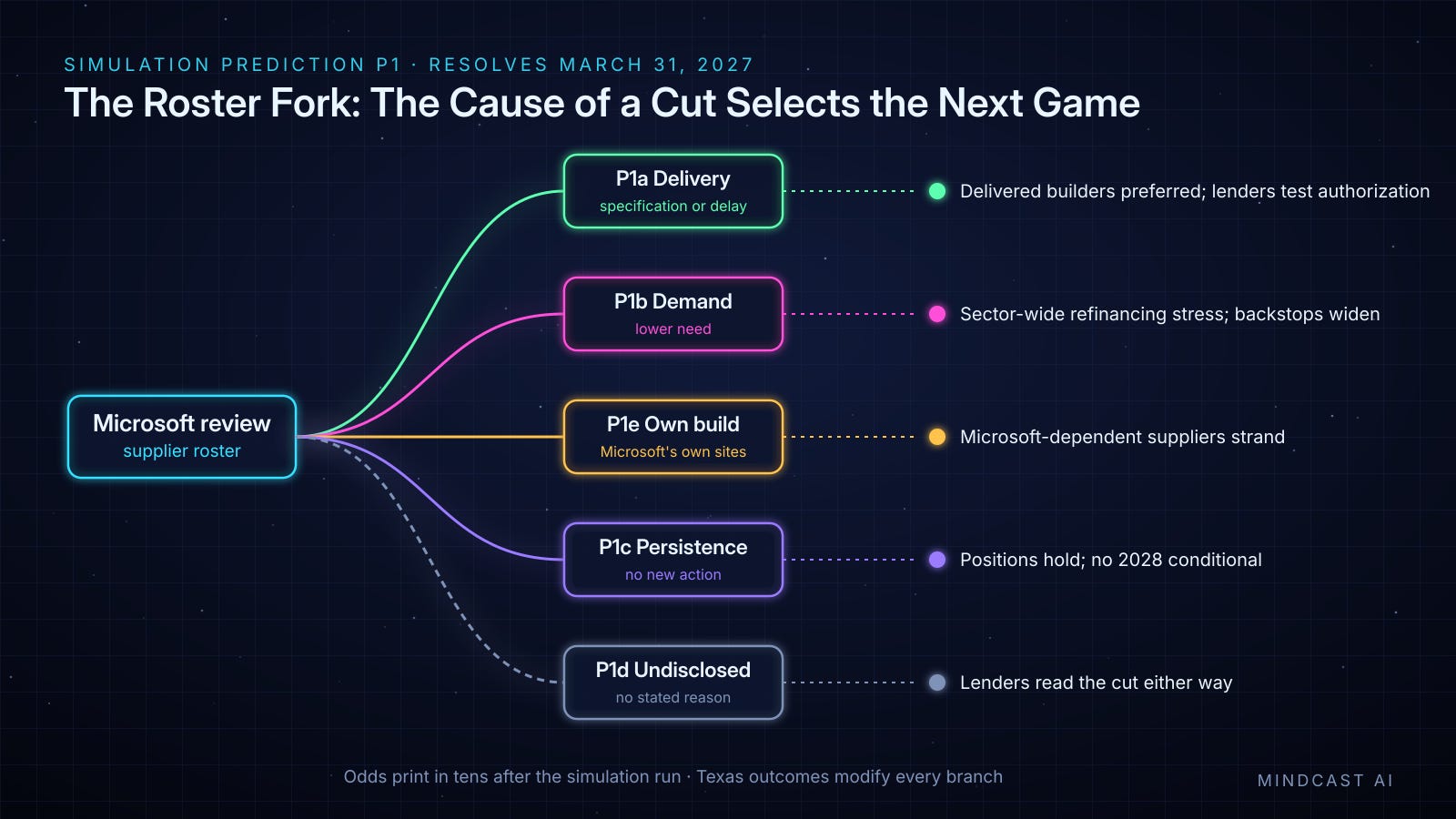
A new action means a termination, non-renewal, cut or declined expansion of a neocloud agreement reported after November 6. Each action is classified by its documented reason, so an on-time site dropped for outdated GPUs falls under P1a. Actions without a documented reason count toward no branch except P1d, and documented actions decide the branch whenever any occur.
Oracle is a cloud provider rather than a neocloud, and its non-renewal came before the window. Oracle’s case illustrates the specification cause and does not count as a new action.
When actions with different documented reasons occur in the same window, P1b takes precedence over P1e and P1e over P1a. The five branches sum to 100. Microsoft statements, provider filings and reporting by Bloomberg, CNBC or Reuters verify the result.
Takeaway. The fork asks why Microsoft cuts, not whom. The basis decides how every other actor moves next.
III.B Who Moves on Each Basis
The question on each branch is who moves first. Under a delivery basis, lenders move first because their loan terms reset at each funding draw. Infrastructure funds then bid for powered sites as builders with delayed sites lose their anchor buyer. The re-formed board reads as a realignment toward authorized megawatts, so a developer’s permit file becomes part of its credit file.
A demand basis would produce the same suppliers losing work and a different board. Equity investors would move first and mark down every neocloud, on time or late. Builders with delivered sites would then lose financing along with the rest, and Nvidia would face pressure to widen its backstop.
An own-build basis splits the board by dependence. Suppliers concentrated on Microsoft lose work and financing, while diversified suppliers resell capacity to other buyers.
A lost contract can end in three different economic outcomes. Enterprise value can disappear, capacity can move to another buyer or working sites can pass to stronger owners. Lenders decide between the first and third by choosing to refinance, restructure or withdraw.
Reallocation reaches only capacity another buyer can use. Chip generation and network design limit the eligible pool. Location, assignment rights and timing limit it further. Meta, OpenAI and Anthropic can absorb released megawatts only where those limits clear, so a Microsoft cut does not always mean lost demand.
Albert Hirschman showed in Exit, Voice, and Loyalty (1970) that members of a declining organization choose between exit and voice. Lenders face the same choice when a supplier misses delivery: exit by refusing to refinance, or voice by renegotiating terms. Their choice decides whether a lost contract ends in a transfer or a restructuring.
Takeaway. The same cut produces opposite boards. A delivery basis rewards authorized sites, and a demand basis punishes the whole sector. Lenders and rival buyers then decide whether capacity is lost, reallocated or transferred.
III.C Short Horizon Predictions Through 2027
Seven forecasts run through 2027. The set covers where cuts land on the capacity ladder and whether delivered suppliers gain. Amendments and control changes complete it, along with new counterparties, backstops and tariff terms.
P2 | A listed neocloud discloses a reduced or delayed Microsoft commitment by June 30, 2027. One of four listed neoclouds discloses an amended Microsoft agreement. The amendment reduces committed capacity, ends a tranche or extends a delivery date. The four are CoreWeave, Nebius, IREN and Applied Digital. Securities filings verify the result. Amendments are the likely form, because a delay the buyer caused weakens its termination remedy. Odds: 70%.
P3 | A neocloud or 100 MW or more of its capacity changes control by December 31, 2027. The buyer can be an infrastructure fund or a utility affiliate, or a hyperscaler or another neocloud. Company releases and securities filings verify the result. Odds: 50%.
P4 | Microsoft discloses no new neocloud agreement with a new counterparty by June 30, 2027. No agreement with a neocloud that held no Microsoft contract on November 11, 2026 appears in Microsoft or provider disclosures. Expansion with an existing supplier does not count against P4. The Simulation Prediction fails on the first such disclosure. Odds: 70%.
P5 | Microsoft’s next documented supplier action falls on contracted capacity not yet energized by June 30, 2027. The action is the first qualifying action reported after November 11, 2026. Qualifying actions are those P1 counts, plus amendments that reduce or delay capacity. The capacity it affects was not drawing power and running GPUs when the action was reported. P5 tests the title claim directly, apart from the reason Microsoft gives: an energized site dropped for outdated GPUs counts against P5 even though it falls under P1a. Microsoft statements, provider filings and reporting by Bloomberg, CNBC or Reuters verify the result. Odds: 60%.
P6 | Microsoft expands with at least one supplier that has delivered its contracted capacity by June 30, 2027. Expansion means a new agreement, a new site or an exercised option to add capacity. The supplier must have energized and delivered its earlier Microsoft capacity before the expansion. P6 is the positive signature of the delivery basis: Microsoft cuts late suppliers and rewards on-time ones. Microsoft’s decision not to exercise an option to expand its Texas deal with Nscale shows the opposite signal at a supplier still building. Odds: 50%.
S1 | Nvidia’s backstop extends to a provider holding a Microsoft or Meta contract by June 30, 2027. Nvidia or the provider announces the arrangement. The Simulation Prediction fails if the program stays limited to providers without hyperscaler anchors. Two inputs weigh against a quick extension: Nvidia’s chief executive said in October that CoreWeave needed no backstop, and Nvidia’s board now faces an investigation of its chief executive. Odds: 30%.
S2 | A state commission ties large-load credit support to the customer’s credit by December 31, 2027. An order or tariff sets collateral by credit rating or requires a parent or offtaker guarantee for a data center load. Commission dockets verify the result. Odds: 70%.
P3 has precedent. Brookfield’s Radiant merged with Ori, and neoclouds have been buying software layers: Nscale agreed to acquire Anyscale for about $1.65 billion and IREN closed its $625 million purchase of Mirantis. P3 counts only transfers of operators or capacity.
Takeaway. Cuts land on capacity not yet energized, and delivered suppliers gain expansions while new counterparties wait. Contract amendments come first, and control changes follow.
III.D Simulation Predictions Dated to 2028 Depend on the Roster Fork
One Simulation Prediction, one watch item and three structural hypotheses reach 2028 or later. L1 prints as a conditional on the branch of P1 that drives it. Published Simulation Predictions on the authorization layer appear as source annotations.
L1 | P(at least three of eight leading neoclouds cease independent operation by December 31, 2028 given P1a), P(the same given P1b) and P(the same given P1e). Printing the three conditionals shows how much the basis of Microsoft’s cuts moves consolidation. The eight are CoreWeave, Crusoe, Lambda, Nebius, Nscale, Core Scientific, IREN and Applied Digital. Acquisition, merger into another operator or a bankruptcy filing counts. L1 measures corporate independence, not asset survival, because a restructured operator’s sites can keep running under new owners. Company releases and court dockets verify the result. Odds: 30% given P1a, 50% given P1b and 40% given P1e.
L2 | Watch item: a neocloud announces a firm clean power site of 25 MW or less marketed for inference by December 31, 2028. The simulation released no odds for L2, because the evidence for small firm clean sites remains too thin to clear the release test. A delivery basis raises the value of small authorized sites. A demand basis pushes neoclouds to diversify into inference and regional computing. An own-build basis pushes Microsoft-dependent suppliers toward other buyers. Hydro, geothermal or nuclear generation must supply the site. Regional Clean Compute Anchors shows that a 20 MW anchor runs roughly 9,000 to 10,000 GPUs below both the ballot ceiling and the large-load tariff line. The 25 MW line comes from five local measures and a few utility tariff classes, so a smaller site still faces each jurisdiction’s own zoning, permit and service terms.
H1 | Neocloud debt terms track energized and authorized megawatts more than backlog through 2028. The hypothesis fails if a neocloud with large backlog and delayed sites borrows on better terms than a peer with smaller backlog and delivered sites.
H2 | Ownership of compute concentrates while its physical location spreads through 2030. Fewer independent platforms control workloads and customers across more sites owned by utilities, funds and regional operators. The hypothesis fails if the surviving platforms hold a smaller share of sites they do not own in 2030 than in 2026.
H3 | Authorization-specific differentiation appears in financing terms before equity valuations through 2028. The differentiation is a gap between operators with authorized and energized sites and operators with delayed sites, net of the sector-wide move and measured from November 11, 2026. The hypothesis fails if equity valuations separate delivered from delayed operators before any financing term does.
Three successor end-states compete through 2030, and H2 and L2 test two of them.
Concentrated hyperscale. Hyperscalers expand owned campuses and buy from a few large neoclouds. Scale and tightly linked training clusters decide the market, and regional sites stay marginal. A failure of both H2 and L2 points here.
Platform concentration over distributed sites. A few surviving platforms run workloads on sites owned by utilities, funds and regional operators. Ownership of customers concentrates while the physical footprint spreads. H2 tests this end-state.
Specialized regional infrastructure. Firm clean anchors, inference sites and scientific computing services build markets beside the large training campuses. L2 tests this end-state.
The second and third end-states can coexist, because specialized sites can sell through a few dominant platforms. The first end-state excludes both.
Gartner forecasts that more than 80% of neocloud providers will cease independent operations by 2030. L1 tests the leading tier on a shorter clock.
Three published Simulation Predictions anchor the authorization layer. The Ballot paper gives states adopting conditions over pauses by at least 2:1 by July 31, 2027 at 88-95%, and Texas resuming approvals by rule or protocol by the same date at 50%. AI Data Center Moratoriums Are Forecastable — and They End in Pricing Rules, Not Bans gives a majority of expiring local pauses replaced by explicit cost terms by June 30, 2027 at 70-82%.
Takeaway. Entries dated to 2028 depend on the roster fork, so each prints under the branch that drives it. Consolidation and small firm clean sites both follow from the basis of Microsoft’s cuts.
III.E How the Game Evolves: Each Event Opens Some Paths and Closes Others
A Simulation Prediction holds only inside the game that produced it. When an event changes that game, the prediction is revalidated or replaced by one conditioned on the new state. Each event below therefore names the state it creates and the Simulation Predictions that apply there.
Events fall into three classes. A continuation updates information inside the current game. An equilibrium migration changes which outcome persists without replacing the game.
A game evolution changes the strategies or payoffs available, or the rules, players and timing. Game mutation is reserved for an anomaly outside the scheduled map.
The baseline state is the game on November 11, 2026. Each event carries five entries. The first two name what the event changes and which paths it opens or closes. The last three name surviving and stranded positions, moves gained or lost and the Simulation Predictions that apply afterward.
E1 | Nebius third-quarter results, November 12, 2026. Continuation; the game stays at baseline. - Changes. Information on Vineland timing and financing. - Paths. None open or close; weight shifts among the branches of P1. - Positions. Builder positions survive. - Moves. Investors gain a delivery read on one supplier. - Simulation Predictions. All remain valid. P2 and P5 update on Vineland disclosures.
E2 | ERCOT audit report, December 10, 2026. Game evolution if verified projects re-enter studies; new state: Texas re-entry. - Changes. Texas queue rules: verification replaces queue order. - Paths. Opens a path toward power for verified Texas projects. Closes queue-position claims for unverified ones. - Positions. Verified projects convert to study candidates. Unverified projects strand. - Moves. Texas builders gain a filing route. ERCOT gains a verification gate. - Simulation Predictions. All remain valid, with lower delivery risk for verified Texas sites under P1 and P3. An extended pause keeps the game at baseline.
E3 | Texas moratorium under the new governor, after the January 2027 inauguration. Game evolution if enacted; new state: Texas moratorium. - Changes. Texas rules for new data center development. Governor-elect Gina Hinojosa has called for an immediate moratorium, and CoreWeave wrote to her seeking cooperation. - Paths. Closes new Texas builds pending written terms. Opens out-of-state siting and bargaining over terms in Texas. - Positions. Built and powered Texas sites survive. Texas projects without approvals strand. - Moves. Operators gain a negotiation route, as CoreWeave’s letter shows. States with dated terms gain sited capital. - Simulation Predictions. Delivery risk rises for Texas builders under P1, and P3 and L1 gain weight. The Ballot paper’s published call on Texas resuming approvals by July 31, 2027 at 50% faces its first test.
E4 | Microsoft fiscal second-quarter results, late January 2027. Continuation unless a stated reason resolves P1 early. - Changes. Information on third-party capacity and capital spending. - Paths. A stated delivery, demand or own-build reason opens the matching state below. - Positions. All positions survive the release itself. - Moves. Investors gain a roster read. - Simulation Predictions. P1, P4 and P6 update. No prediction lapses on the release alone.
E5 | Roster cuts on a delivery basis (P1a). Equilibrium migration; new state: delivery basis. - Changes. Payoffs for builders. - Paths. Opens preferred-supplier status for delivered builders and authorization-indexed lending. Closes the demand-retrenchment path. - Positions. Delayed builders strand. Delivered builders convert to preferred suppliers. - Moves. Lenders gain an authorization test. Delivered builders gain expansion offers. - Simulation Predictions. L1 applies under its P1a conditional, and L2 stays a watch item, and P6 gains weight. P2 and P3 remain active, as do P5, S2 and H1.
E6 | Roster cuts on a demand basis (P1b). Equilibrium migration; new state: demand basis. - Changes. Payoffs for the whole sector. - Paths. Opens sector-wide refinancing stress and backstop expansion. Closes authorized capacity as a competitive edge; it becomes a survival floor. - Positions. All neocloud equity positions weaken. Delivered builders survive without a premium. - Moves. Nvidia gains pressure to widen backstops. Principals gain bargaining power over distressed sites. - Simulation Predictions. L1 applies under its P1b conditional, and L2 stays a watch item, and S1 gains weight. P5 stays valid because it counts energized status regardless of reason.
E7 | Roster cuts for Microsoft’s own build (P1e). Equilibrium migration; new state: own-build basis. - Changes. Payoffs for suppliers that depend on Microsoft. - Paths. Opens resale of released capacity to other buyers. Closes Microsoft as a growth buyer for the neocloud tier. - Positions. Microsoft-concentrated builders strand, and lessees whose revenue leans on Microsoft weaken. Diversified operators survive. - Moves. Other buyers gain released capacity. Microsoft takes on its suppliers’ authorization risk at its own sites. - Simulation Predictions. L1 applies under its P1e conditional, and L2 stays a watch item, and P4 gains weight. P5 stays valid.
E8 | Review ends with no new action (P1c). Continuation; new state: persistence. - Changes. Nothing beyond information. - Paths. Closes all three roster-cut paths for the window. - Positions. All positions survive. - Moves. No seat gains a move. - Simulation Predictions. P4 runs on to June 30, and persistence supports it. L1 carries no conditional in this state, so a new run assigns one before its 2028 odds apply.
E9 | Roster cuts with no documented reason (P1d). Continuation with an information gap; new state: undisclosed basis. - Changes. Information for lenders and buyers. - Paths. Keeps the delivery, demand and own-build states open until a reason surfaces. - Positions. Positions survive pending a stated reason. - Moves. Lenders gain discretion to read the cut either way. - Simulation Predictions. P2 and P3 remain active, as does P5. L1 carries no conditional until a documented reason moves the game.
E10 | A leading neocloud defaults or sells under distress, unscheduled. Game mutation; new state: distressed default. - Changes. Players and credit terms. - Paths. Opens lender ownership of operating sites. Closes the current roster game. - Positions. Lenders convert to owners. The defaulting operator’s equity strands. - Moves. Infrastructure funds gain powered sites. - Simulation Predictions. All base odds lapse, and a new simulation runs in the new state.
Reachable states. Five roster outcomes and four Texas outcomes give twenty combinations on paper. The Texas outcomes come from the ERCOT audit and a possible moratorium, and both matter mainly for Texas builders under any roster basis. The map therefore carries them as modifiers on the five roster states. Odds assume no leading neocloud default before March 31, 2027.
Takeaway. Three events move the equilibrium, two evolve the rules and the rest update information inside the game. A distressed default is the anomaly that requires a new game.
III.F What Would Break the Forecast Set
Chronology alone cannot separate the delivery basis from the own-build basis. Resolution needs Microsoft or provider statements that cite delivery, demand or Microsoft’s own build. Actions without such statements resolve to P1d. A package that moves several contracts at once tests the basis only through its stated reasons.
Three routes would break the forecast set. Microsoft cuts its capital spending guidance in January and cites demand, which resolves P1 to P1b. Other buyers absorb every eligible released megawatt within two quarters, which weakens P3 and L1. Azure stays constrained and Microsoft signs with a new neocloud counterparty, which ends P4.
Takeaway. The forecast set names the evidence that separates its hypotheses and the events that would break it.
Section conclusion. Microsoft’s cuts follow delivery, contract amendments come before control changes and authorized megawatts set credit terms. Each Simulation Prediction names its window, its source and the event that ends it.
IV. Stakeholder Strategy and Risk Mitigation: Delivery Evidence Is the Low-Regret Move
Each stakeholder holds a different lever against the same exposure. The right move depends on which rung of the capacity ladder binds: a supplier short of customers needs buyers, one short of power needs service rights and one short of margin needs utilization. The moves below come first, and the risk table converts each Simulation Prediction into an owned task.
🏛️ Policymakers. Low-regret move now: publish dated large-load terms before the 2027 sessions close. If S2 resolves: align credit support with tariff classes. Primary risk: open-ended pauses that read as unvoted moratoriums to lenders.
💼 Executives at neoclouds. Low-regret move now: report energized megawatts and on-time delivery by tranche. If P1a resolves: market authorized capacity to rival buyers. Primary risk: one delayed site revaluing a whole contract.
💼 Executives at hyperscalers. Low-regret move now: screen suppliers on all four gates before signing. If P1e resolves: expect own-build sites to face the same gates. Primary risk: moving authorization risk onto the buyer’s own balance sheet.
⚖️ Counsel. Low-regret move now: document which delays the buyer caused. If P2 resolves: negotiate amendments on cause, not on outcome. Primary risk: remedies invoked against delays the buyer requested.
📊 Investors. Low-regret move now: value neoclouds on authorized and energized megawatts. If L1 resolves: favor buyers of powered sites. Primary risk: backlog treated as delivered capacity.
Actions below are options for consideration, not legal, investment or fiduciary advice. Severity and probability appear as separate axes.
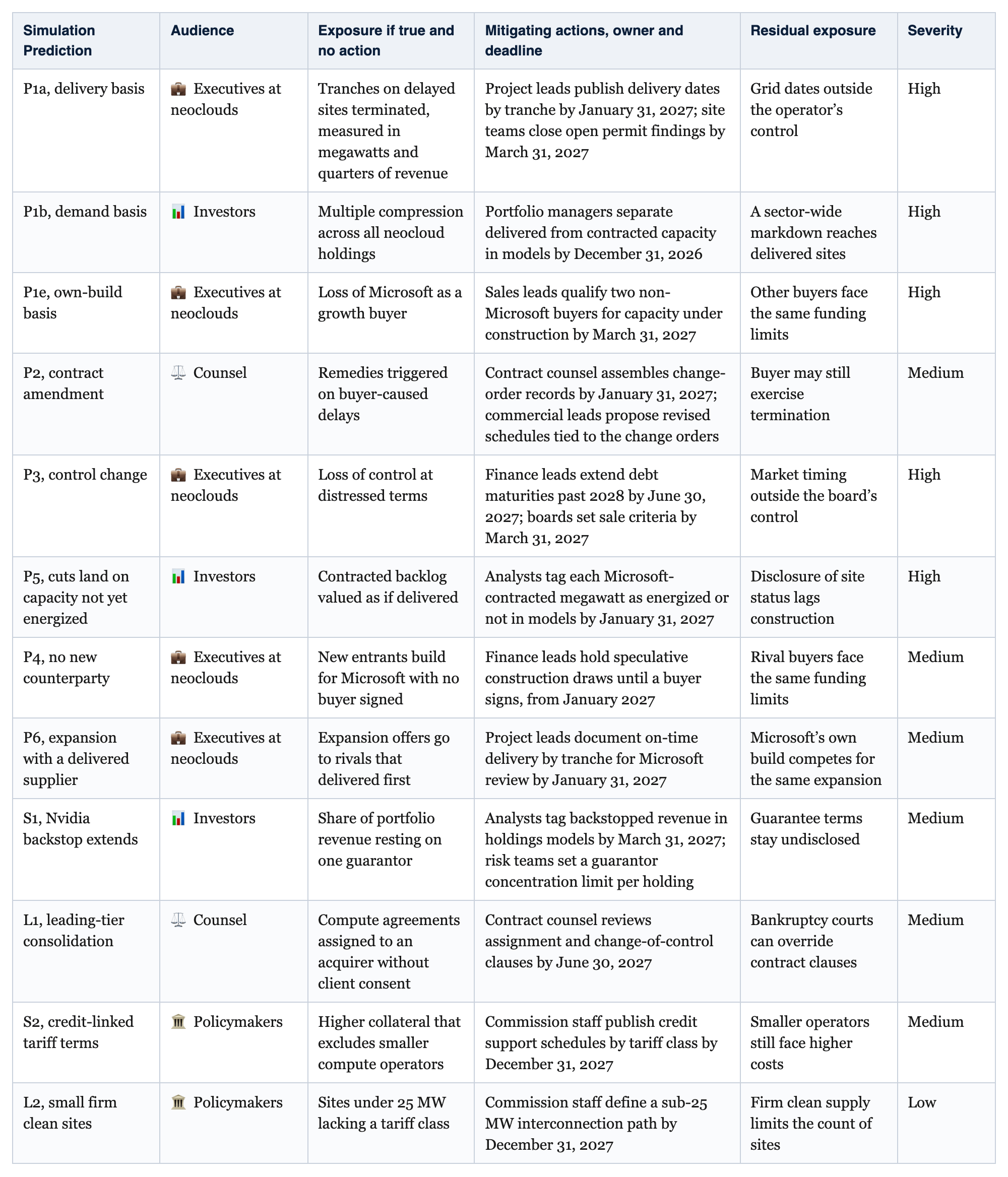
Takeaway. Delivery evidence and maturity extension address the largest exposures. Each row names an owner and a date, so the exposure converts into a task.
V. Implications: The Authorization Atlas Becomes a Credit Input
Microsoft’s review changes who enforces authorization discipline. Four implications follow for institutions, strategy, distribution and the Simulation Predictions themselves.
Institutional impact. Buyers and lenders now enforce authorization before regulators finish writing it (P1, S2). The 50-State Authorization Price Atlas and the Model Data Center Authorization Code describe the terms a site must clear. The same terms now feed contract renewals and loan reviews as well as permits.
Minimum efficient scale. Authorization rules can push the market in either direction. Large-load terms that charge every project the same fixed cost raise the scale a site needs to pay off, which favors large operators. Terms that open a path below the 25 MW line favor small firm clean sites and regional entrants (L2, H2). The path holds only where a state writes it, because the 25 MW line exempts a site from nothing by itself.
Strategic interaction. Microsoft’s own build faces the same gates its suppliers failed. A shift to owned sites moves authorization risk onto Microsoft’s balance sheet rather than removing it. Washington State’s large-load policy in Docket UE-260162 and the Grant County Public Utility District rate classes become Microsoft’s own terms.
Distribution. Powered and authorized sites gain value on every branch. Builders with delayed sites carry the first loss, and AI labs with take-or-pay commitments carry the second. Equity holders and sites can part ways: a restructuring can wipe out shareholders while energized sites keep serving customers under new owners. Anthropic disclosed that some compute partners depend on third-party financing, so a neocloud financing failure reaches the labs.
Falsifier consequences. If P1b resolves, the delivery thesis fails and the sector revalues on demand. Authorized megawatts would still matter, yet as a survival floor rather than a competitive edge. The original Simulation Prediction stands as a miss under the delivery basis.
🏛️ Policymakers. A dated tariff schedule now lowers the cost of capital for every project in the state. An undated pause raises it.
Takeaway. Authorization terms have become credit terms. States that write them early attract the capital that buyers and lenders now ration.
What to Watch
Ten signals separate the paths in this paper. Each carries a named source and a cadence.
Microsoft supplier actions (P1, P4 and P6). Microsoft statements and wire reporting from Bloomberg, CNBC and Reuters each week through March 2027.
Neocloud contract amendments (P2). Securities filings by the four listed neoclouds, quarterly.
Vineland delivery dates (P1 and P2). Nebius results on November 12, then quarterly.
ERCOT audit outcome (P1 and P3). ERCOT filing on December 10 and the Public Utility Commission of Texas meeting on December 17, 2026.
Control transactions (P3 and L1). Company releases and court dockets, monthly.
Nvidia backstop expansion (S1). Nvidia and provider announcements, quarterly.
Large-load credit support terms (S2). State commission dockets, monthly.
Texas moratorium terms (P1, P3 and L1). Governor’s orders and legislative filings after the January 2027 inauguration.
Neocloud refinancing terms (H1). Offering documents and loan announcements, quarterly.
Energized status of affected capacity (P5). Provider disclosures of site status at the time of each Microsoft action, as actions occur.
Takeaway. Microsoft’s January results are the decisive signal. The ERCOT report arrives first and tests the delivery path in Texas.
Conclusion
Microsoft’s neocloud cuts follow delivery, and delivery fails at authorization gates and in execution. Grid power, local approval and environmental permits stopped some contracted sites. Construction defects and design changes stopped others. The buyer now enforces both through the contract, and lenders enforce them through credit terms.
The roster fork decides how capital moves next. A delivery basis rewards authorized megawatts, and a demand basis punishes the whole sector. An own-build basis falls hardest on suppliers that depend on Microsoft. The paper forecasts the basis and the moves that follow it.
Operators act now by publishing delivery evidence by tranche and extending debt past 2028. Investors and lenders act by separating delivered capacity from backlog. The decisive signal arrives with Microsoft’s fiscal second-quarter results in late January 2027.
Working With MindCast
Published analysis cannot tell a specific operator how its sites fare across all four gates. A builder, a leasing operator and a hyperscaler each face different gates on different clocks.
A commissioned engagement builds Cognitive Digital Twins of the organization, its buyers, its lenders and the authorities over its sites. MindCast then reruns the four-gate board against the organization’s actual site pipeline.
Commissioned scope adds complete probability distributions, P10/P50/P90 ranges and settings fitted to the organization. Commissioned scope also adds complete scenario trees, decision thresholds and a monitoring dashboard keyed to the five dated turns.
The bounded next step is a diagnostic session on one site or contract decision due before March 31, 2027. Contact: mcai@mindcast-ai.com.
Visit MindCast AI for the full simulation library, prior Simulation Predictions and engagement options.
Appendix A. Selected MindCast Works
The Ballot Decides Where Data Center Sites Proceed; Governors and Regulators Set the Terms of Power and Service. Supplies the three authorization gates and the 25 MW line this paper extends to the counterparty gate.
Regional Clean Compute Anchors, Quantum Tenancy and Quantum-Labeled Training Data. Supplies the firm clean anchor design behind L2.
AI Data Center Moratoriums Are Forecastable — and They End in Pricing Rules, Not Bans. Source of the published Simulation Prediction on expiring local pauses.
The Calculus of Predictive Game Theory Evolution and Mutation. Supplies the rule that a forecast reaches only as far as evidence supports the next game.
Predictive Game Theory Evolution and Mutation, Long Horizon Games Resolve Deep Because Their Branches Hold. Classifies data center authorization as an emerging long horizon game.
50-State Authorization Price Atlas, PDF edition. Reference terms for the four gates by state.
Model Data Center Authorization Code, PDF edition. Reference statute for dated authorization terms.
MindCast Prediction Scorecard. Resolved material calls as of November 10, 2026.
Appendix B. External Sources
Albert O. Hirschman, Exit, Voice, and Loyalty: Responses to Decline in Firms, Organizations, and States (Harvard University Press, 1970).
CNBC, Microsoft plans to use fewer neoclouds as AI buildout shows signs of strain.
AI Weekly summarizing Bloomberg, Microsoft Pulls Back From Neocloud Bets With Nscale, Nebius, IREN.
Tech Insider, Microsoft neocloud oversight of Nebius, IREN and Nscale.
Stocktwits, Neocloud stocks drop after Microsoft capex falls short on delayed third-party capacity.
Gotrade, Microsoft cloud beat; lower capex hits neocloud stocks.
The Energy Mag, Microsoft committed $7 billion upfront in Nebius AI deal.
FourWeekMBA, Satellite images flag delay risk in $27.1B Microsoft deals.
Blockspace, Nebius target cut on Vineland delays.
Crypto Briefing, IREN Texas data center delays.
Crypto Briefing, IREN delays $4 billion in annualized revenue to January.
The Motley Fool, CoreWeave third-quarter 2026 earnings call transcript.
Securities and Exchange Commission, CoreWeave third-quarter 2026 earnings release.
Bloomberg, Dina Bass and Brody Ford, CoreWeave Shares Soar After AI Computing Firm Eases Debt Fears.
Nebius, Date of third-quarter 2026 results.
Data Center Dynamics, Nvidia acts as backstop for customer GPUs in return for cut of cloud revenue.
AI Weekly summarizing Reuters, US banks add community opposition to data center loan checks.
AI Weekly, Data Center Watch counts of blocked and delayed projects.
Capacity, Neocloud consolidation explained.
Techstrong AI, Nscale buys Anyscale.
FourWeekMBA, IREN closes $625 million Mirantis acquisition.
Global Data Center Hub, ERCOT data center interconnection pause, Docket 59220.
Tech Insider, Anthropic S-1 third-quarter analysis.
Capacity, Meta’s $48 billion cloud question.
Tech Insider summarizing Bloomberg, Microsoft winds down 2023 Oracle AI cloud deal.
World Journal summarizing Bloomberg, Microsoft site inspections and capacity meetings.
Reuters via LINE Today, Microsoft tightens oversight of neocloud projects; IREN statement on penalties.
FourWeekMBA, Meta’s third quarter: capex outran its cash by $2.1 billion.
AI Weekly summarizing Gizmodo, Oracle plans $40 billion more in debt and equity.
Implicator, OpenAI compute obligations face IPO scrutiny.
FourWeekMBA, AI compute contracts tracker.