
CoreWeave · Nebius · IREN · Nscale · Crusoe · Microsoft · Google · Meta · Oracle · OpenAI · Nvidia · Bank Lenders, Convertible Holders and Private Investors · New Jersey Department of Environmental Protection · City of Vineland · Electric Reliability Council of Texas · UK Grid Operator · US · UK
Companion to Microsoft Neocloud Consolidation: Energized Megawatts, Not Contract Backlog, Decide Which Neoclouds Survive
Interactive war game Neocloud Competition Simulation
Related MindCast works: AI Data Center Credit Risk, Permitting, Curtailment, and the Cost of Capital · AI Data Center Authorization Bargaining Power · The Lowest-Exposure AI Data Center Approval Route for Developers, Hyperscalers and Investors
I. Executive Summary: Acceptance Converts Delivered Infrastructure Into Service, and Financing Decides What a Delay Costs
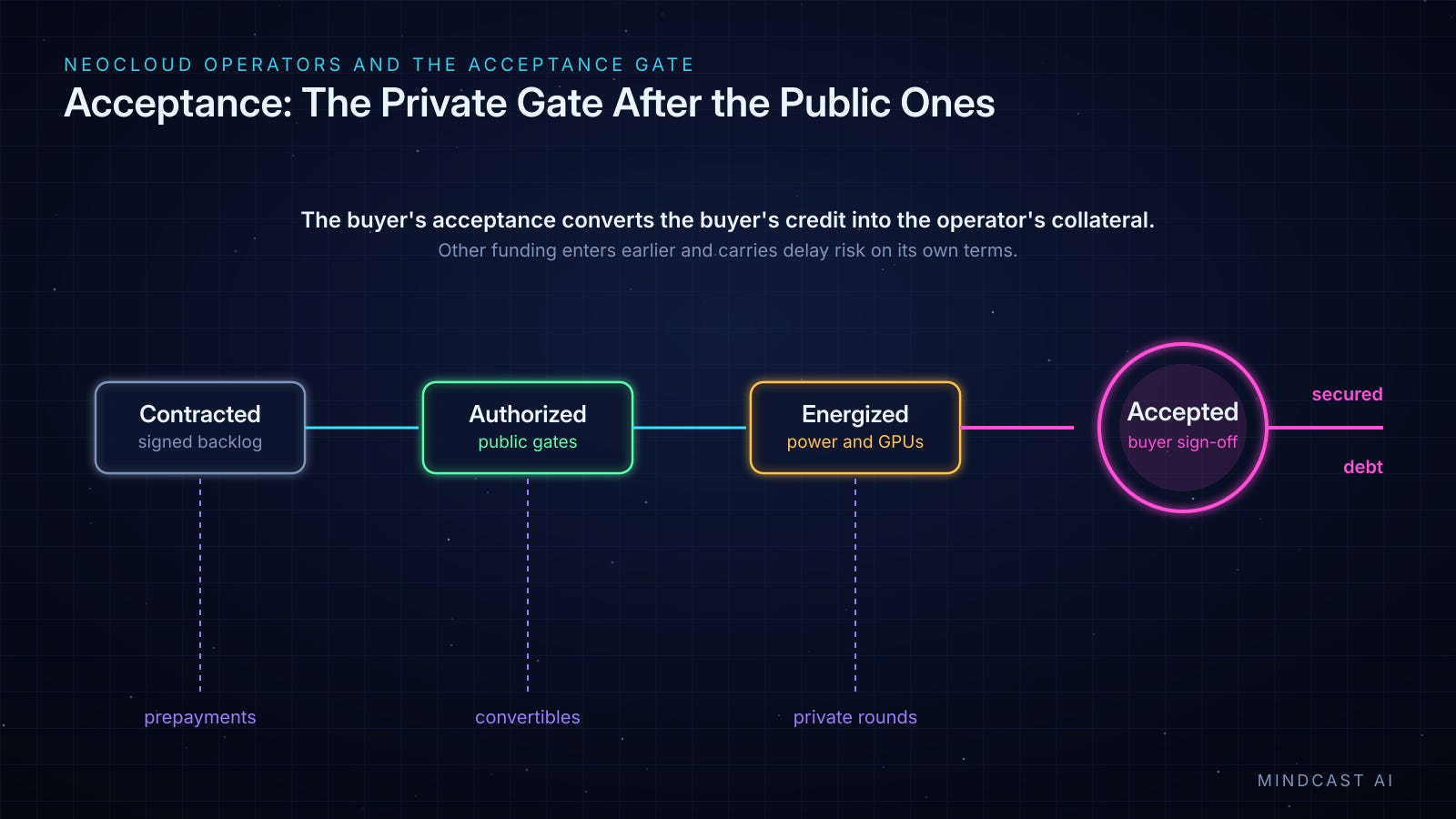
Customer acceptance converts delivered infrastructure into contractually recognized service. The operator’s financing structure then decides how much acceptance matters. A delay can end in amendment, dilution, restructuring or sale. The financing mix chooses among them.
The power path decides which authority controls the time to acceptance.
Neoclouds are specialist operators that rent graphics processing unit (GPU) clusters to hyperscalers and artificial intelligence (AI) labs. The companion paper reads Microsoft’s consolidation from the buyer’s side, where the cause of a cut selects the successor game. The present paper reads the same game from the operator’s side, through five cases.
On November 5, 2026, IREN moved its target of more than $4 billion in operating annual recurring revenue from December to January. Slippage into February remains possible.
Microsoft had accepted IREN’s first Texas deployment in August, and IREN’s operating annual recurring revenue doubled to $1 billion. The three remaining deployments, about three-quarters of the contract, now wait on acceptance. IREN attributes the slip partly to networking upgrades the customer requested.
MindCast AI applies Predictive Behavioral Economics + Dynamic Game Theory through MindCast AI Proprietary Cognitive Digital Twin Foresight Simulations (MP CDT FS). Behavioral Economics supplies the decision rules, including the optimism that leads operators to set schedules their landlords and contractors cannot hold. Game Theory supplies the payoff structure among buyers, operators, landlords and lenders. Predictive simulations emerge from the combination.
Core insight. Acceptance is a private gate, held by the buyer, that sits after every public gate a regulator controls. Acceptance weighs most on servicing-phase and deployment-linked secured financing. Other funding finances capacity before acceptance and carries the delay risk on different terms. Equipment collateral, customer commitments and guarantees play that role, alongside convertibles and private capital.
Acceptance matters because it converts the buyer’s credit into the operator’s collateral, and CoreWeave’s contract-backed debt costs about half what its unsecured bonds yield.
Thesis. Five operators face one gate with five strategies. Nebius diversifies its buyers and funding, and IREN owns its power and bargains over the cause of each slip. Nscale depended on a grid connection and lost its anchor tenant.
Crusoe integrates power and sites and sells developed sites to principals. CoreWeave leases from developers, so a landlord’s delay becomes its own acceptance slip.
What distinguishes the MindCast approach. MindCast has analyzed the neocloud tier across eight publications, and the paper consolidates those findings into one operator-side frame. The paper adds one new gate to the capacity ladder: the buyer’s acceptance, after authorization and energization. A new measure, the Accepted Capacity Share, tracks it.
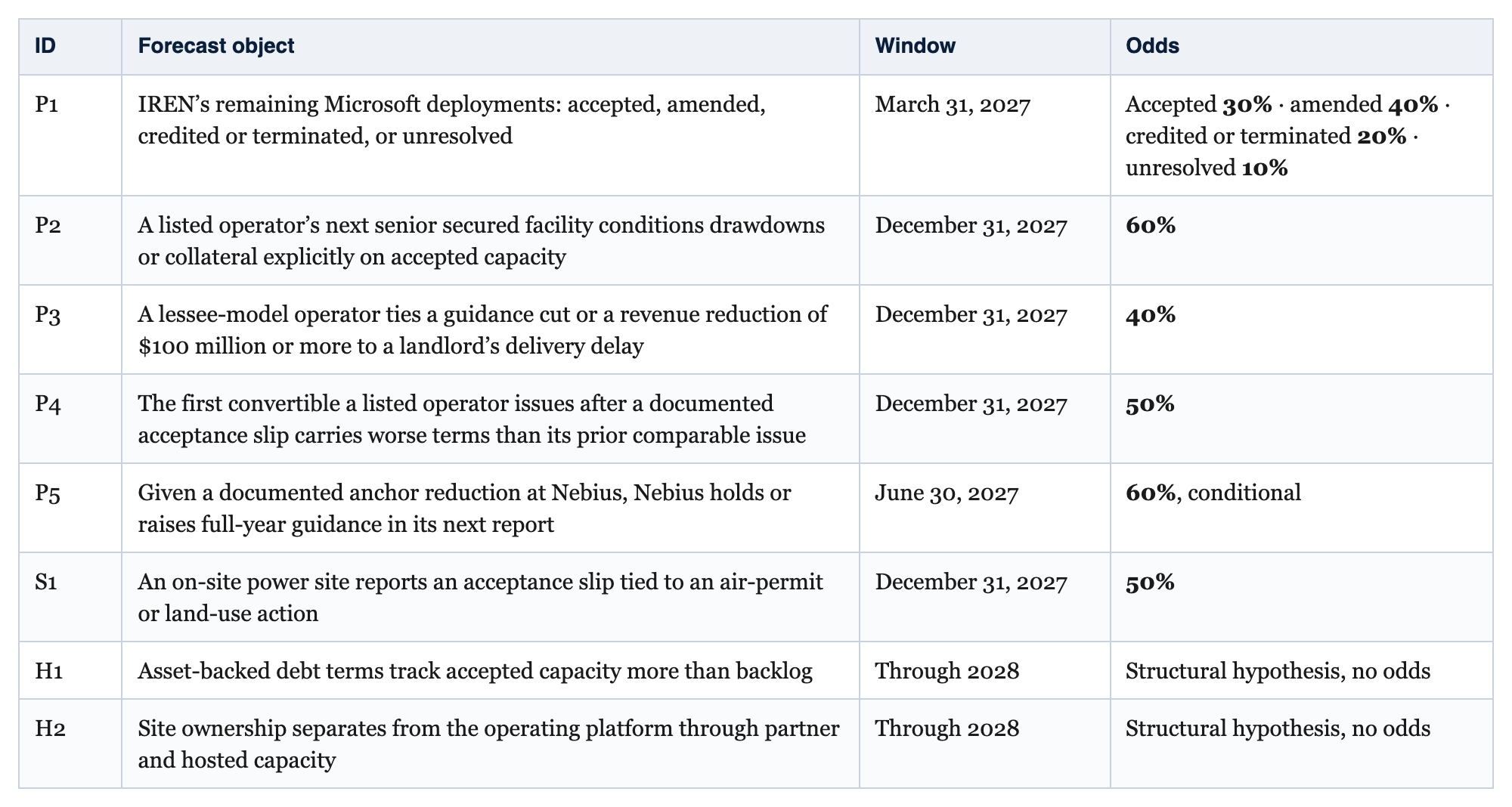
What the paper does. Section II sets out the acceptance gate, the prior findings it builds on, the four power paths and the five operator strategies. Section III sets out six MindCast Foresight Simulation Predictions with odds in tens. Sections IV and V convert them into strategy, risk mitigation and implications.
P marks a Primary Simulation Prediction, S a Secondary Simulation Prediction and H a structural hypothesis. Odds print in tens. Odds come from one certified simulation run covering both papers and frozen before Nebius reported its third quarter on November 12, 2026.
Stakeholder readout.
🏛️ Policymakers. Public gates now set the date of a private one. A dated permit or tariff schedule shortens every operator’s path to acceptance (S1).
💼 Executives. Report accepted capacity by tranche beside backlog, and diversify buyers before the anchor tests a slip (P1, P2 and P5).
⚖️ Counsel. The cause of each delay decides the remedy. Lessees need landlord remedies that mirror their buyers’ acceptance terms (P1, P3).
📊 Investors. Separate accepted, energized and contracted megawatts. Disclosed operating shares cap the accepted share and do not measure it (H1).
Takeaway. Acceptance turns delivered capacity into service, and the operator’s funding mix decides what a delay costs. The paper maps both for five operators.
II. One Gate After the Public Gates: Why the Operator Contest Fits a Simulation
The operator contest looks like a capital markets story. The evidence shows a contractual gate, held by the buyer, that converts public authorization into private credit. Bounded actors, dated deadlines and competing funding routes make the contest fit a simulation.
II.A Five Operators Reached the Same Gate by Different Routes
Each operator reached the acceptance gate through a different mix of ownership, power and funding.
Nebius. Nebius delivers Microsoft capacity from Vineland, New Jersey, under a contract worth up to $17.4 billion. The agreement lets Microsoft receive service credits or terminate individual tranches when delivery slips. Nebius also holds a Meta agreement worth up to $27 billion and four core contracts that averaged over $1 billion each in the second quarter.
IREN. IREN owns its land, power and buildings at Childress, Texas. Microsoft accounts for roughly half of its contracted run-rate. IREN moved its operating revenue target to January and cited customer-requested networking upgrades and equipment delays.
Nscale. Microsoft ended its anchor agreement at Nscale’s Loughton site after grid officials put power in the early-to-mid 2030s. Nscale had filed for a US listing and raised $3.4 billion in pre-listing financing.
Crusoe. Crusoe combines power, site development, modular infrastructure and cloud compute. Crusoe reports 6 gigawatts (GW) of contracted capacity with more than 1 GW operational. On November 6, Google acquired Crusoe’s southeast Wyoming site after Crusoe completed site selection, approvals and a hybrid power plan.
CoreWeave. CoreWeave leases most of its shells from developers and converted bitcoin miners. CoreWeave reported more than 1.7 GW active against more than 4.6 GW contracted at September 30, with $132.5 billion of revenue backlog. Microsoft once accounted for the majority of CoreWeave’s revenue.
Takeaway. Five operators carry the same anchor buyer and different exposures. The acceptance gate tests each through a different route.
II.B The Governing Question: What a Delay Costs Each Operator
What turns a slipped anchor tranche into a pricing, dilution, control or sale event? The operator’s financing form, buyer mix and power path decide the answer.
The target system is US and UK neocloud operators serving hyperscalers and AI labs. The horizon runs from November 2026 through 2028. IREN’s acceptance decision resolves by March 31, 2027. Chip supply and model demand sit outside scope, because CoreWeave’s November results show demand holding.
Takeaway. The question concerns what a delay costs, not whether demand holds. The answer differs by operator because the funding mix differs.
II.C Acceptance Sits Between Energized and Utilized Capacity
The companion paper sets out a five-rung capacity ladder that runs from contracted to utilized megawatts, with accepted capacity as the fourth rung. The present paper develops the accepted rung. Authorized capacity clears land use, permits and a service agreement, and energized capacity draws power and runs GPUs. Accepted capacity has passed the buyer’s sign-off against contract terms, so service and billing start.
Lender eligibility is a property of the ladder rather than a rung. A lender treats capacity as collateral for servicing-phase secured debt once it reaches the accepted rung, while other funding can enter lower on the ladder.
AI Data Center Credit Risk, Permitting, Curtailment, and the Cost of Capital defined Financeable Authorization Coverage (FAC). FAC is the share of committed megawatts that have cleared every critical authorization gate. The paper keeps FAC as defined. The paper adds the Accepted Capacity Share (ACS): megawatts the anchor has accepted divided by megawatts contracted.
IREN’s ACS sits near 25%. Microsoft has accepted Horizon 1, a 50-megawatt (MW) deployment out of the contract’s 200 MW. Disclosed operating shares measure energization, not acceptance. Crusoe’s operational share sits near 17% and CoreWeave’s active share near 37%, and each sets an upper bound on the operator’s ACS.
Takeaway. FAC measures the public gates, and ACS measures the private gate that follows them. IREN’s ACS of about 25% shows the measure at work.
II.D Acceptance Governs Specific Instruments, Not All Lending
Nebius’s first senior secured facility shows the gate at work. The $775 million facility, priced at the Secured Overnight Financing Rate plus 2.50%, rests on deployed GPUs and an investment-grade contract already in its servicing phase. Nebius funds growth before acceptance through convertible notes, with $4.3 billion closed in March and $5.75 billion closed in August.
CoreWeave runs the lessee’s version. CoreWeave’s delayed-draw term loans release debt as capacity deploys, and a new $2.6 billion facility supports shorter-duration contracts. The same release reports about $4.2 billion in convertible notes and about $9 billion of customer prepayments expected within three months.
CoreWeave’s $8.5 billion facility backed by Meta contracts earned an investment-grade rating and carried a margin of 2.25 points over the Secured Overnight Financing Rate. CoreWeave expects its next delayed-draw loan to yield 7% to 7.5%, about half the yield on its unsecured bonds. The rating comes from the buyer’s credit, not the operator’s.
Acceptance therefore weighs most on servicing-phase secured facilities and deployment-linked draws. Other asset-backed structures can rest on equipment collateral, customer commitments or guarantees before acceptance. Convertibles, private rounds, joint ventures and customer prepayments also fund capacity before acceptance. Crusoe’s $3.9 billion private round at a $30.9 billion valuation shows the private route.
Takeaway. Acceptance governs the timing of servicing-phase and deployment-linked secured debt, not every asset-backed structure. Other funding carries capacity until then, and each source carries the delay risk differently.
II.E Prior MindCast Work Mapped the Tier, the Credit Metric and the Power-Route Gates
MindCast has analyzed the neocloud tier across eight publications. The paper consolidates those findings and cites each at the proposition it supports.
Tier position. AI Data Center Authorization Bargaining Power rated neoclouds the fastest builders and the most dependent tier, with bargaining power borrowed from hyperscaler backstops. Converted bitcoin-mining sites offered the lowest-cost route, because permits and power already existed.
Credit. Credit Risk defined FAC and the Capital Irreversibility Ratio (CIR), the share of capital that can no longer move. Credit Risk’s first Simulation Prediction gives three or more financings disclosing permit-to-draw conditions by June 30, 2027 at 65-75%.
Delay in tenant contracts. The Lowest-Exposure AI Data Center Approval Route for Developers, Hyperscalers and Investors showed authorization delay moving into tenant agreements. Lowest-Exposure Route’s P2 gives two or more force majeure or tenant deferral notices tied to approval delay by December 31, 2027 at 65-75%.
On-site power. Lowest-Exposure Route and Modular AI Data Center Specialists and the Integrated Offerings That Turn Small Sites Into Authorized Operating Capacity showed that on-site generation moves the decisive approvals to air permits and fuel supply. AI Data Center Veto Points traced the same move.
Firmness. The Grid-Anchored Clean Power Bargain: Powering AI Data Centers Through 2040 showed that connected service is not firm service. The Clean Compute Match: Which Clean Power Pairs With Which AI Compute, And What Stays On Fossil showed hyperscalers contracting scarce firm clean supply first.
Flexibility and hosts. Burden-Based Authorization for AI Data Centers, Modular Clean Compute, and the Backlash Gap Between Grid Tariffs and State Law found flexibility programs starting at 20 to 50 MW. Modular Specialists found modular sites sitting mainly on partner land and power.
The paper adds six findings no prior MindCast work states.
Acceptance is a commercial gate after authorization and energization.
Acceptance works as a bargaining node, decided by grace periods, cause attribution and prepayment crediting.
Diversified buyer books turn an anchor cut into a resale event.
ACS can be measured per operator where disclosures allow, starting with IREN at about 25%.
A pre-acceptance site sale gives developers an exit from the gate.
A lessee inherits its landlord’s delay as its own acceptance slip.
Takeaway. Prior MindCast work mapped the tier, the credit metric and the power-route gates in separate papers. The paper joins them at the acceptance gate and adds what none of them covered.
II.F Four Power Paths Select Four Authorities
The power path decides which authority sets the date of acceptance. Four paths appear across the five operators.
Grid interconnection. Utility and system-operator timing governs. Loughton’s grid date in the 2030s ended Nscale’s anchor agreement.
On-site generation. Air permits, fuel supply and local land use govern. At Vineland, New Jersey fined the site developer $1.07 million for 62 unpermitted natural gas generators. The city issued stop-work orders before the planning board approved a second phase built on fuel cells. Crusoe’s Microsoft buildings at Abilene also carry an on-site power plant.
Owned or pre-secured power. An existing connection governs. IREN’s Childress campus holds 750 MW of secured power, and its Sweetwater hub holds conditional inclusion in the first study batch of the Electric Reliability Council of Texas (ERCOT).
Firm clean anchored supply. Geothermal, hydro or nuclear supply governs. Crusoe plans a modular site powered by a 10-megawatt-electric (MWe) reactor in 2027, the only scheduled operator project on the path.
CoreWeave inherits whichever path its landlord chose. CoreWeave’s power exposure is therefore a portfolio of other operators’ gates.
Firm clean supply stays a minority path for three reasons. Hyperscalers contract scarce firm supply first. Operator deadlines run in quarters while new firm supply arrives from 2027 at module scale and from 2028 at campus scale. Anchor contracts buy firm reserved capacity, while variable clean power earns grid value through flexibility.
Takeaway. On-site power does not escape authorization; it moves the gate to air regulators and planning boards. Lessees inherit their landlords’ gates.
II.G Acceptance Works as a Bargaining Node
A slipped tranche opens a negotiation over cause. IREN said it faces no financial penalty for delays stemming from Microsoft’s design changes. Grace periods on IREN’s remaining deployments end in early 2027, after which delay credits could fall due.
Three terms decide the outcome. Cause attribution decides who bears the remedy. Grace periods set the deadline for bargaining. Prepayments, which cover 50% to 60% of related capital spending at Nebius, shift construction risk onto the buyer and soften its termination incentive.
CoreWeave shows the two-contract version. In November 2025, a third-party developer’s delay forced CoreWeave to cut its guidance. Core Scientific’s shareholders had rejected CoreWeave’s bid to acquire the developer the month before. The lessee held the buyer’s acceptance clock without holding the site’s.
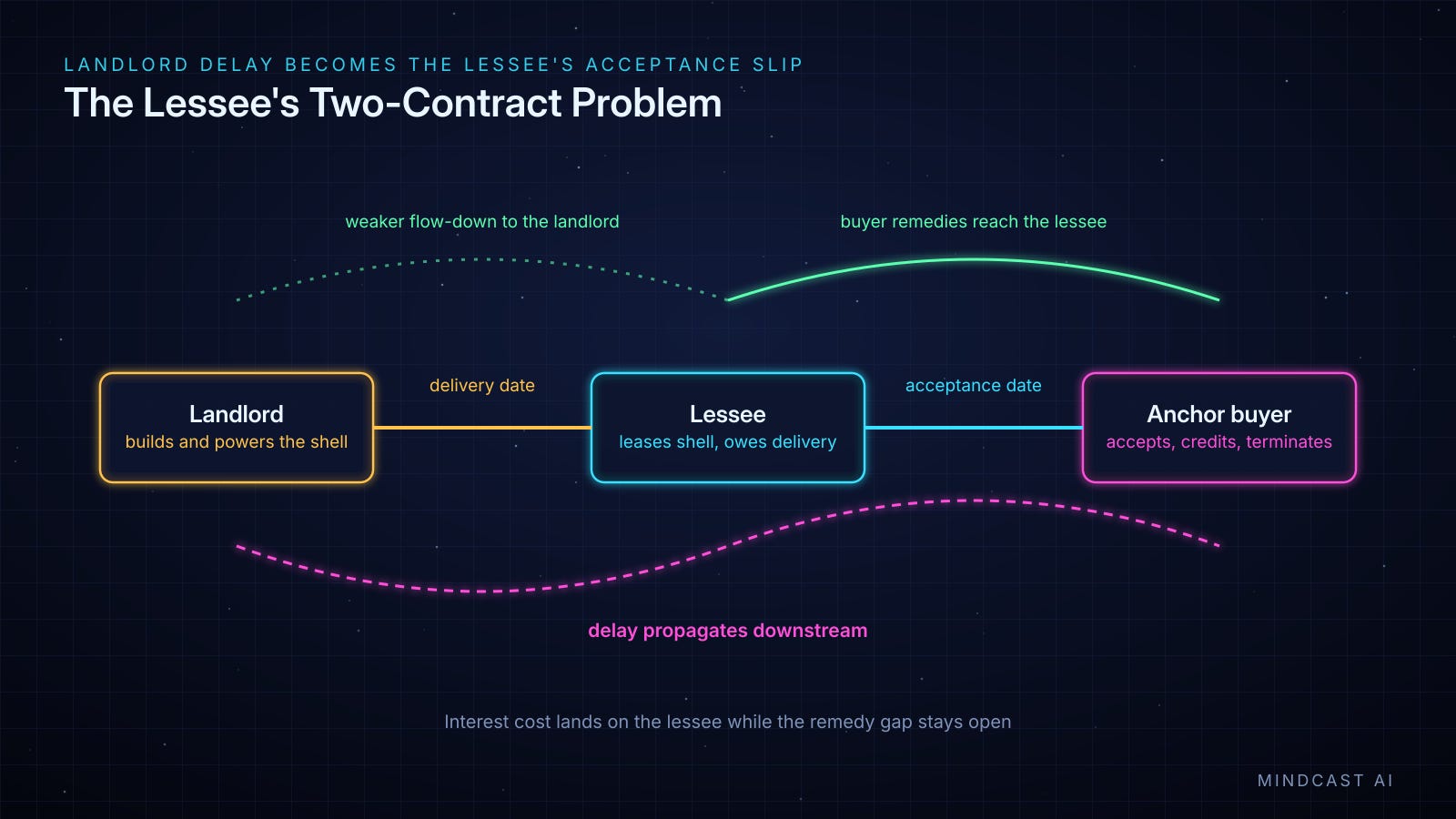
Takeaway. Cause, deadline and prepayment decide whether a slip ends in amendment or termination. A lessee bargains on two contracts at once.
II.H Five Strategies Under One Gate
Each operator’s mix of funding, buyers and power sets what a slip costs.
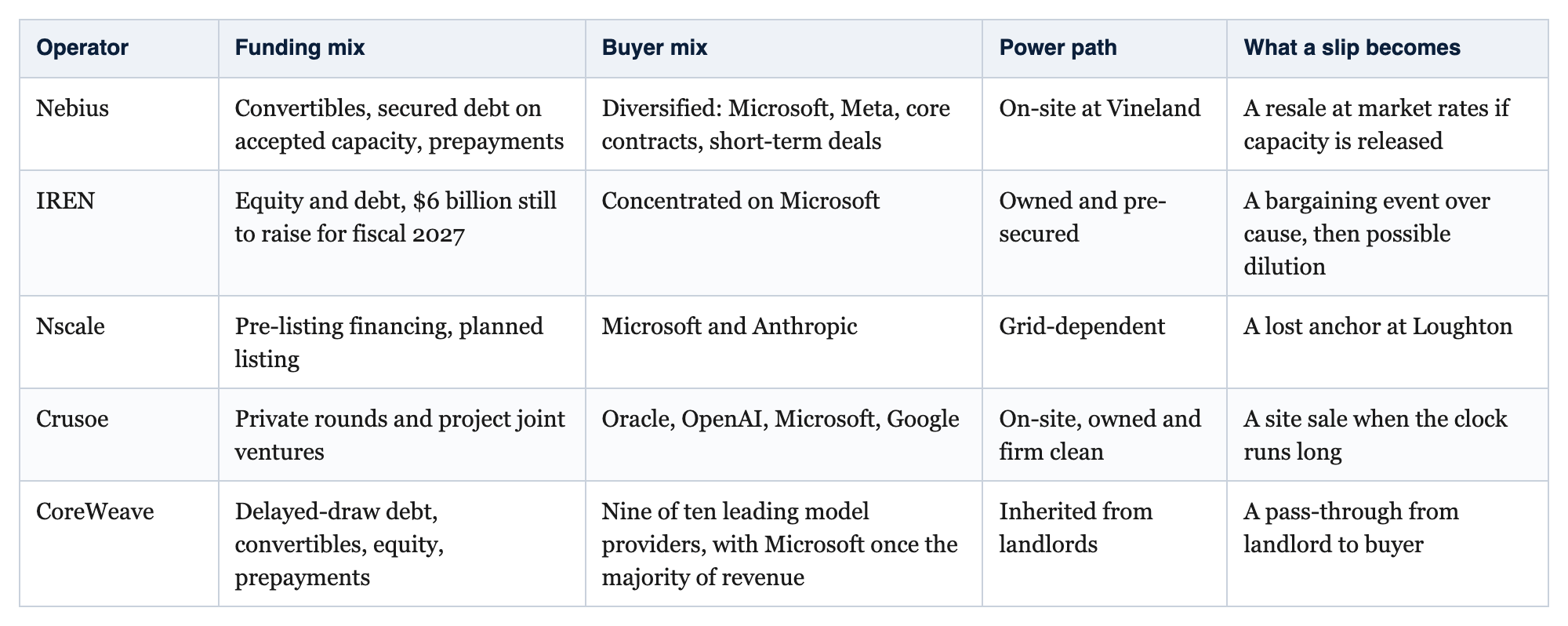
Short-dated capacity has started to trade like a commodity. Nebius signed short-term deals at about $40 million to $50 million per MW, and its first capacity auction cleared 15% above its highest prior Blackwell rate. CoreWeave signed three-to-six-month contracts near $40 million per MW. An anchor cut then releases capacity into a market with visible rates.
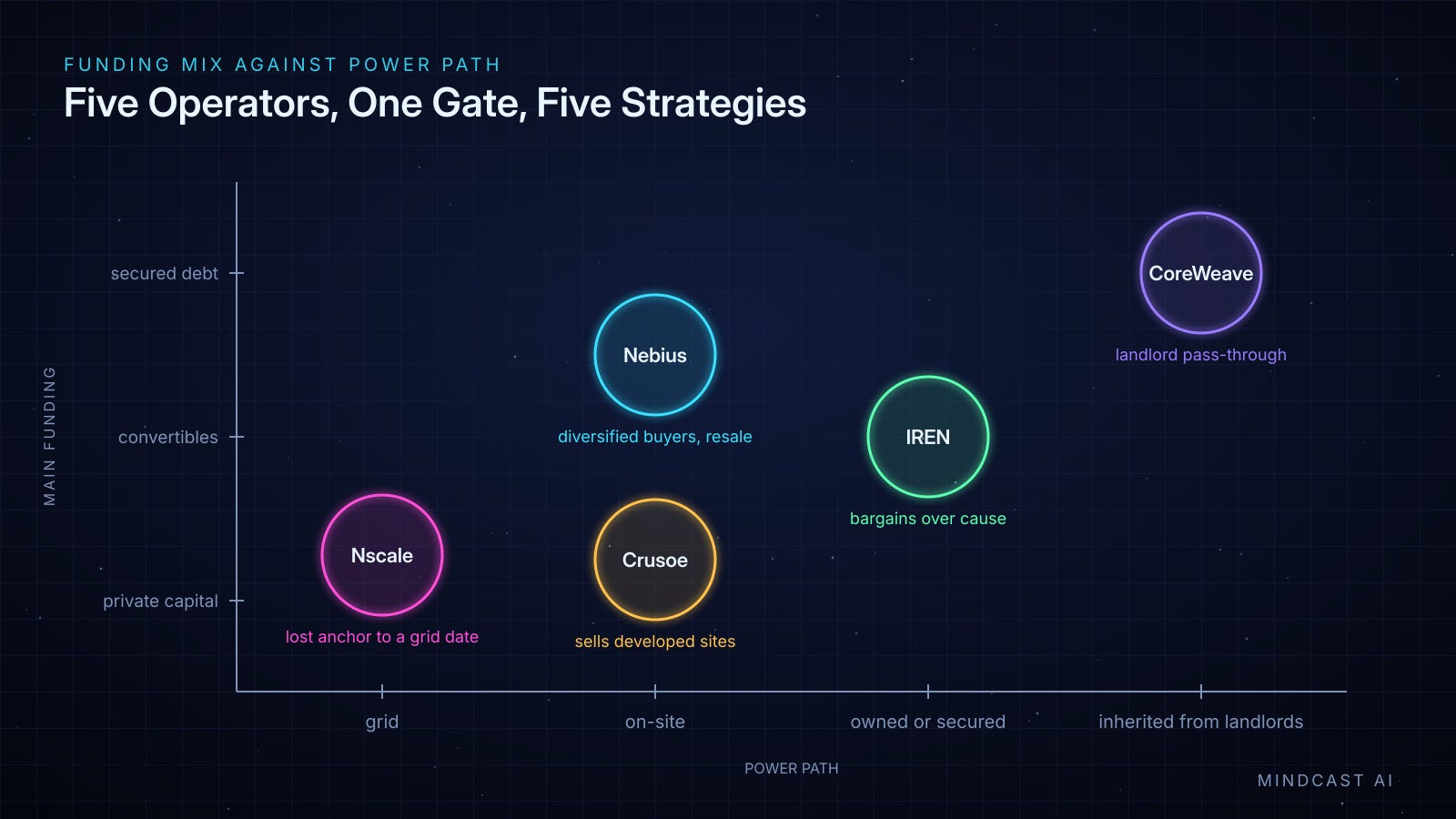
Takeaway. Diversified operators can resell released capacity, and concentrated operators bargain over cause. Lessees pass the slip through, and integrated developers can sell the site.
II.I Behavioral Economics: Optimistic Schedules Meet Deferred Deadlines
Operators plan deliveries the way most builders do, with optimistic schedules that discount landlord, equipment and permit delays. The planning fallacy then turns a contract date into a negotiation. Grace periods add present bias on both sides: each party defers the hard decision until the period ends.
Equity investors anchor on the latest headline. IREN fell about 20% on one report tying its delays to Microsoft’s lower spending. Convertible-funded operators feel that salience directly in their cost of capital.
Takeaway. Optimistic schedules explain why acceptance slips recur, and deferred deadlines explain why they end in amendments. Salience explains why delivery news moves convertible-funded operators fastest.
II.J Game Theory: The Buyer’s Outside Options Set the Operator’s Payoff From Waiting
Game Theory supplies the payoff structure. The buyer holds an outside option in its own build and a contractual exit on late tranches. An operator that documents buyer-caused delay narrows the exit and raises its bargaining power.
The game also changes mid-play. Principals now buy developed sites, as Google did in Wyoming. Principals also back neocloud leases, as Google did when it backstopped $3.2 billion of Fluidstack’s lease obligations. A principal with a site-buying option changes the operator’s payoff from waiting.
Takeaway. The board seats buyers, operators and landlords beside lenders and principals. Each new seat changes what an operator gains from waiting for acceptance.
II.K Ten Actors, Three Hypotheses and Four Dated Turns Define the Simulation
Ten actors become Cognitive Digital Twins (CDTs). Each entry names what the actor wants, what it controls and what moves it.
Nebius. Wants delivered Microsoft capacity and a diversified book. Controls allocation, auctions and funding. Updates on Vineland permits and acceptance.
IREN. Wants Microsoft acceptance on owned sites. Controls construction and cause documentation. Updates on grace-period dates and financing.
Nscale. Wants anchor credibility for its listing. Controls remaining Microsoft and Anthropic delivery. Updates on grid dates.
Crusoe. Wants to develop and operate across power paths. Controls site development and sales to principals. Updates on private funding and acceptance.
CoreWeave. Wants to scale on leased shells. Controls customer mix and debt draws. Updates on landlord delivery.
Microsoft, as acceptor. Wants delivered capacity for Azure. Controls acceptance, credits and termination. Updates on delivery evidence.
Principals as site buyers and backstops. Want capacity on their own terms. Control site purchases, offtake and lease backing. Update on operator distress and site quality.
Lenders, convertible holders and private investors. Want repayment and growth. Control secured terms, convertible demand and private valuations. Update on acceptance and delivery news.
Power-path authorities. Want reliability and compliance. Control permits, stop-work orders and interconnection. Update on filings and violations.
Nvidia. Wants GPU demand to survive a buyer pullback. Controls backstops and investments in Nebius, Nscale, Crusoe and CoreWeave. Updates on operator financing.
Three causal hypotheses compete, and each carries its own breaking condition.
Acceptance hypothesis. Asset-backed lenders finance accepted capacity, so time to acceptance sets the operator’s cost of capital. The hypothesis fails if a secured facility funds capacity not yet accepted without prepayment backing.
Funding-mix hypothesis. Convertibles and private rounds carry operators through delays, so acceptance binds only operators that rely on asset-backed debt. The hypothesis fails if a convertible-funded operator loses market access after an acceptance slip alone.
Diversification hypothesis. Operators with diversified buyers resell released capacity at market rates. The hypothesis fails if a diversified operator cuts guidance after an anchor reduction.
Four dated turns structure the simulation.
November 12, 2026. Nebius reports third-quarter results.
December 10, 2026. ERCOT files its Texas audit report, presented to the Public Utility Commission of Texas on December 17.
January 2027. IREN’s revised target for Microsoft acceptance of its remaining deployments, with possible slippage into February.
Late January 2027. Microsoft reports its fiscal second quarter.
Takeaway. Ten actors, three hypotheses and four dated turns define the simulation. IREN’s acceptance decision carries the most weight in the near term.
Section conclusion. Acceptance sits after every public gate and before secured credit. Funding mix, buyer mix and power path decide what a delay costs each operator.
III. MindCast Simulation Predictions: Acceptance Shapes Secured Financing, and Funding Mix Sets the Cost of Delay
The Simulation Predictions are original to this publication. Each carries odds in tens. Odds come from one certified simulation run covering both papers and frozen before Nebius reported its third quarter on November 12, 2026. The companion paper’s Simulation Predictions on amendments, control changes and backstops stay in that paper and are cited by ID here.
III.A IREN’s Acceptance Fork Decides Its Funding Path
The first fork closes on March 31, 2027. Four outcomes are possible, and each sends IREN’s funding in a different direction.
Mechanism. Microsoft holds service credits and termination rights on late tranches. IREN holds a documented claim that Microsoft’s design changes caused part of the delay. The bargaining runs until Microsoft accepts, amends, credits or terminates.
P1 | IREN’s Remaining Microsoft Deployments by March 31, 2027
P1a | Accepted: 30%. Microsoft accepts all three remaining deployments by March 31, 2027, with no amendment to dates or capacity and no delay credits.
P1b | Amended: 40%. Microsoft accepts at least one deployment on an amended date or capacity, with no credits or termination.
P1c | Credited or terminated: 20%. Microsoft takes delay credits on or terminates at least one deployment.
P1d | Unresolved: 10%. At least one deployment remains unaccepted on March 31, 2027. No qualifying amendment, credit or termination has been disclosed.
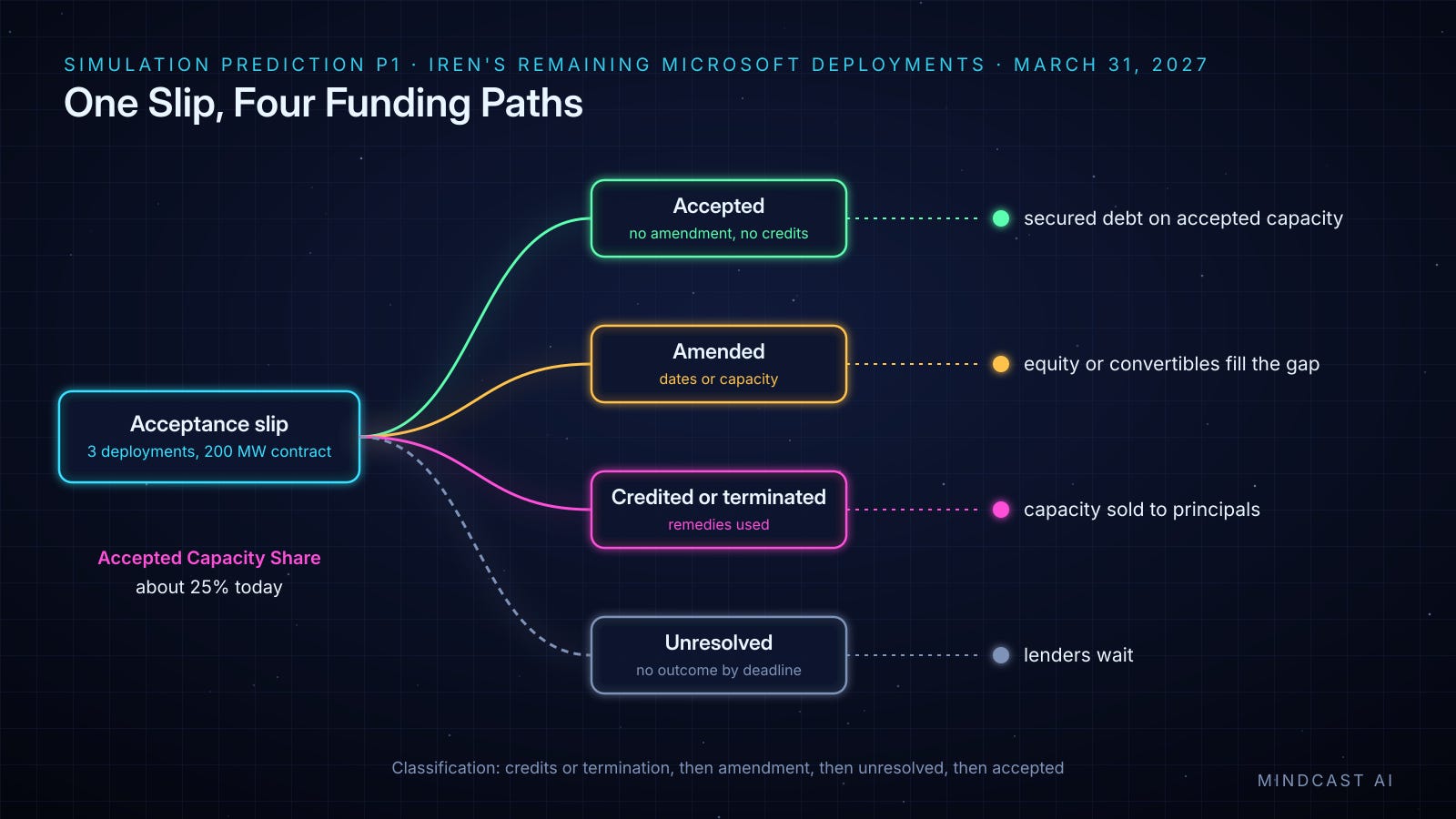
The four branches sum to 100. Classification runs in order: P1c applies if any credit or termination occurs, then P1b if any amendment occurs, then P1d if any deployment remains unaccepted. P1a applies only when none of the three holds. IREN filings and Microsoft disclosures verify the result.
Interaction with the companion paper’s roster fork. IREN’s acceptance fork and the Microsoft paper’s roster fork are distinct decisions with correlated outcomes. A termination of an IREN deployment that cites delay is also a new action under that paper’s P1, and it pushes that fork toward the delivery basis. An amended IREN contract also resolves that paper’s P2. The joint simulation models the two forks together, so their odds cannot contradict each other.
The Microsoft paper’s P2 carries 70%, above the 60% this fork gives to an amendment, credit or termination at IREN.
Takeaway. The fork asks how the slip resolves, not whether demand holds. The branch decides whether IREN refinances on accepted capacity or raises on backlog.
III.B Each Branch Hands the First Move to a Different Seat
Under P1a, secured lenders move first, because accepted capacity qualifies for servicing-phase secured debt at the next facility. IREN then closes part of its $6 billion gap on asset-backed terms.
Under P1b, the amendment moves revenue later and keeps the contract whole. IREN funds the gap through equity or convertibles, and dilution replaces delay credits as the cost of the slip.
Under P1c, credits or a termination remove contracted capacity. Principals and other operators then bid for powered capacity at Childress, and a control or capacity transfer becomes possible.
Under P1d, the bargaining runs past the window without a formal outcome. IREN carries unaccepted capacity on equity-linked funding, and lenders wait for a disclosed resolution.
Takeaway. The same slip produces a refinancing, a dilution, a transfer or a stalled negotiation. The acceptance branch chooses among them.
III.C Short Horizon Predictions Through 2027
Four forecasts run through 2027, and one conditional forecast tests diversification. The set covers secured collateral, lessee pass-through and the cost of delay in convertible terms, plus on-site power. Site sales and interruptible capacity stay as analysis in Section II and as watch items, because the evidence does not yet support a dated forecast.
P2 | A listed operator’s next senior secured facility conditions drawdowns or collateral explicitly on accepted or servicing-phase capacity by December 31, 2027. The facility must be announced after November 11, 2026, so Nebius’s July facility does not count. The operators are Nebius, IREN and CoreWeave. Nscale joins once listed. Facility announcements and securities filings verify the result. The Simulation Prediction fails if the first such facility carries no explicit acceptance or servicing condition. CoreWeave expects to launch a contract-backed delayed-draw loan in the coming weeks, which would make it the first test. Odds: 60%.
P3 | A lessee-model operator ties a guidance cut or a revenue reduction of $100 million or more to a landlord’s delivery delay by December 31, 2027. The report must come in a quarterly release issued after November 11, 2026. CoreWeave’s quarterly reports and landlord disclosures verify the result. CoreWeave’s November 2025 guidance cut shows the mechanism and does not count. Odds: 40%.
P4 | The first convertible a listed operator issues after a documented acceptance slip carries worse terms than its prior comparable issue by December 31, 2027. The operators are Nebius, IREN and CoreWeave. A documented acceptance slip is an amendment, a delay credit or a disclosed acceptance date moved past schedule. Worse terms means a higher coupon net of the change in the five-year Treasury yield, or a lower conversion premium. Offering announcements verify the result. P4 tests the funding-mix clause of the thesis: a convertible-funded operator pays for a delay in its next financing, consistent with the companion paper’s H3. Odds: 50%.
P5 | Given a documented reduction in an anchor buyer’s commitment at Nebius by June 30, 2027, Nebius holds or raises its full-year guidance in its next quarterly report. A documented reduction is a termination, cut or amendment that lowers committed capacity. Nebius’s next quarterly release verifies the result, and the Simulation Prediction carries no resolution if no reduction occurs. P5 tests the diversification hypothesis: a diversified operator turns an anchor cut into a resale event rather than a guidance cut. Odds: 60%, conditional on a reduction.
S1 | An on-site power site reports an acceptance slip tied to an air-permit or land-use action by December 31, 2027. Vineland and Abilene permit records and acceptance dates verify the result. Lowest-Exposure Route’s S1 gives two or more contested air or fuel conditions at redesigned sites by the same date at 65-75%. Odds: 50%.
Takeaway. Collateral terms come first, and lessee pass-through follows any landlord slip. Convertible-funded operators pay for a slip in their next issue, while a diversified operator holds guidance through an anchor cut.
III.D Structural Hypotheses Through 2028
Two structural hypotheses run through 2028. Each names its breaking condition.
H1 | Asset-backed debt terms track accepted capacity more than backlog through 2028. The hypothesis fails if an operator with large backlog and a low accepted share borrows on better secured terms than a peer with a higher accepted share. H1 narrows the companion paper’s H1 from energized to accepted capacity.
H2 | Site ownership separates from the operating platform through 2028. Partner-built sites, hosted modules and sales to principals spread ownership while platforms keep customers. The hypothesis fails if the leading operators hold a larger share of owned sites in 2028 than in 2026.
Takeaway. H1 tests the acceptance gate in credit terms, and H2 tests the ownership split. Both depend on how the acceptance fork resolves.
III.E How the Game Evolves: Acceptance, Collateral and Site Sales Move the Operator Board
The operator game changes in two ways. A buyer’s or lender’s decision can shift which outcome holds, or a new strategy can change the game itself. Every event below names the state it leaves behind and the Simulation Predictions that stay valid there.
A continuation adds information without changing the game. An equilibrium migration shifts which outcome persists. A game evolution adds or removes strategies or payoffs, or rules and players. Game mutation names only an anomaly outside the scheduled map.
The baseline is the operator game on November 11, 2026. Each event carries five entries. The change and the paths opened or closed come first. Surviving and stranded positions, moves gained or lost and the Simulation Predictions that apply afterward follow.
E1 | Nebius third-quarter results, November 12, 2026. Continuation; the game stays at baseline. - Changes. Information on Vineland acceptance and Nebius financing. - Paths. None open or close. - Positions. Operator positions survive. - Moves. Investors gain a reading on Nebius’s accepted share. - Simulation Predictions. All remain valid. P2 and S1 receive their first evidence.
E2 | ERCOT audit report, December 10, 2026. Game evolution if verified projects re-enter studies; new state: Texas re-entry. - Changes. Texas queue rules for new interconnection. - Paths. Opens a study path for IREN’s Sweetwater hub. Leaves Childress unchanged, because its power is already secured. - Positions. Owned-power positions survive. Unverified Texas projects strand. - Moves. Texas operators gain a filing route for added power. - Simulation Predictions. All remain valid. P1 does not move, which shows the acceptance fork running apart from the public gate at a site with secured power.
E3 | Texas moratorium under the new governor, after the January 2027 inauguration. Game evolution if enacted; new state: Texas moratorium. - Changes. Texas rules for new data center development. Governor-elect Gina Hinojosa has called for an immediate moratorium, and CoreWeave wrote to her seeking cooperation. - Paths. Closes new Texas builds pending written terms, including IREN’s Sweetwater hub and new Crusoe campuses. Opens bargaining over terms and siting in states with dated rules. - Positions. Powered sites already serving buyers survive. CoreWeave’s Texas landlords and unapproved Texas projects face delay. - Moves. Operators gain a negotiation route, as CoreWeave’s letter shows. - Simulation Predictions. P3 gains weight through Texas landlords. P1 moves only if a moratorium reaches projects already under construction.
E4 | IREN acceptance outcome (P1), by March 31, 2027. Equilibrium migration; four new states, one per branch of P1. - Changes. IREN’s accepted share and funding path. - Paths. Acceptance opens secured debt on accepted capacity. Amendment opens equity or convertible funding for the gap. Credits or termination open capacity sales to principals. An unresolved fork keeps all three open. - Positions. IREN’s owned-power position survives in every branch. IREN’s Microsoft concentration strands under credits or termination. - Moves. Secured lenders gain collateral under acceptance. Principals gain a bid for Childress capacity under credits or termination. - Simulation Predictions. P4 activates at IREN under amendment, credits or termination. P2 gains IREN as a candidate under acceptance. H1 remains valid in every branch, and the outcome also feeds the companion paper’s P1 and P2.
E5 | A principal buys a second developed site before compute runs. Game evolution; new state: site-sale exit. - Changes. Developer strategies: sale becomes a standard exit. - Paths. Opens a dated forecast on site sales. Closes the reading of Wyoming as a one-off. - Positions. Integrated developers convert to slot sellers. Principals convert from offtakers to owners. - Moves. Developers gain a sale exit when acceptance clocks run long. - Simulation Predictions. H2 gains support, and a new run assigns odds to a site-sale forecast.
E6 | A secured facility funds capacity not yet accepted, without prepayment backing. Game evolution; new state: pre-acceptance lending. - Changes. Collateral rules. - Paths. Opens pre-acceptance secured debt. Closes the acceptance-indexed reading of secured lending. - Positions. Operators with low accepted shares survive on better terms than the thesis expects. - Moves. Operators gain pre-acceptance debt. - Simulation Predictions. P2 resolves against the forecast, and H1 weakens. P4 stays valid, because convertible terms can still move on a slip.
E7 | A leading operator defaults or sells under distress, unscheduled. Game mutation; new state: distressed default. - Changes. Players and credit terms. - Paths. Opens lender ownership of operating sites. Closes the current acceptance game for the defaulting operator. - Positions. Lenders convert to owners. The operator’s equity strands. - Moves. Infrastructure funds and principals gain powered sites. - Simulation Predictions. All base odds lapse, and a new simulation runs in the new state.
Reachable states. Within this paper the acceptance fork, the two Texas events and the collateral rule vary independently. The map keeps them as separate events, because each moves a different Simulation Prediction. IREN’s acceptance fork correlates with the companion paper’s roster fork, as Section III.A sets out, so the joint simulation carries both.
Takeaway. IREN’s acceptance outcome moves the equilibrium. A Texas moratorium, site sales and pre-acceptance debt would evolve the rules. A distressed default is the anomaly that requires a new game.
III.F What Would Break the Forecast Set
Disclosures rarely separate accepted from energized capacity. Resolution depends on operator statements that name acceptance, servicing phase or customer sign-off. Private operators disclose less, so Crusoe’s cases resolve through announcements rather than filings.
Three routes would break the forecast set. Equity and private markets stay open, and operators fund regardless of acceptance. Microsoft accepts every IREN deployment by January 31, 2027. Microsoft terminates where an operator documents buyer-caused delay.
Takeaway. The forecast set names the disclosures that resolve it and the routes that would break it.
Section conclusion. Acceptance shapes servicing-phase and deployment-linked secured debt, and funding mix sets what a delay costs. Each Simulation Prediction names its window, its source and the event that ends it.
IV. Stakeholder Strategy and Risk Mitigation: Report Accepted Capacity Before the Buyer Tests a Slip
Each stakeholder holds a different lever against the same exposure. The moves below come first, and the risk table converts each Simulation Prediction into an owned task.
🏛️ Policymakers. Low-regret move now: publish dated permit and tariff schedules for on-site generation. If S1 resolves: set air-permit timelines for fuel cells and engines before construction starts. Primary risk: stop-work orders that delay acceptance after capital is spent.
💼 Executives at owner-operators. Low-regret move now: report accepted capacity by tranche beside backlog. If P1b resolves: fund the gap before dilution terms worsen. Primary risk: one concentrated buyer controlling the acceptance clock.
💼 Executives at lessees. Low-regret move now: align landlord delivery dates with buyer acceptance dates. If P3 resolves: add landlord remedies that mirror buyer remedies. Primary risk: carrying the buyer’s remedy without a matching claim on the landlord.
⚖️ Counsel. Low-regret move now: document every buyer-requested change order. If P1c resolves: negotiate credits on cause rather than on calendar. Primary risk: grace periods expiring before cause is established.
📊 Investors. Low-regret move now: separate accepted, energized and contracted megawatts in models. If P2 resolves: treat ACS as the collateral base. Primary risk: reading disclosed operating shares as accepted capacity.
Actions below are options for consideration, not legal, investment or fiduciary advice. Severity and probability appear as separate axes.
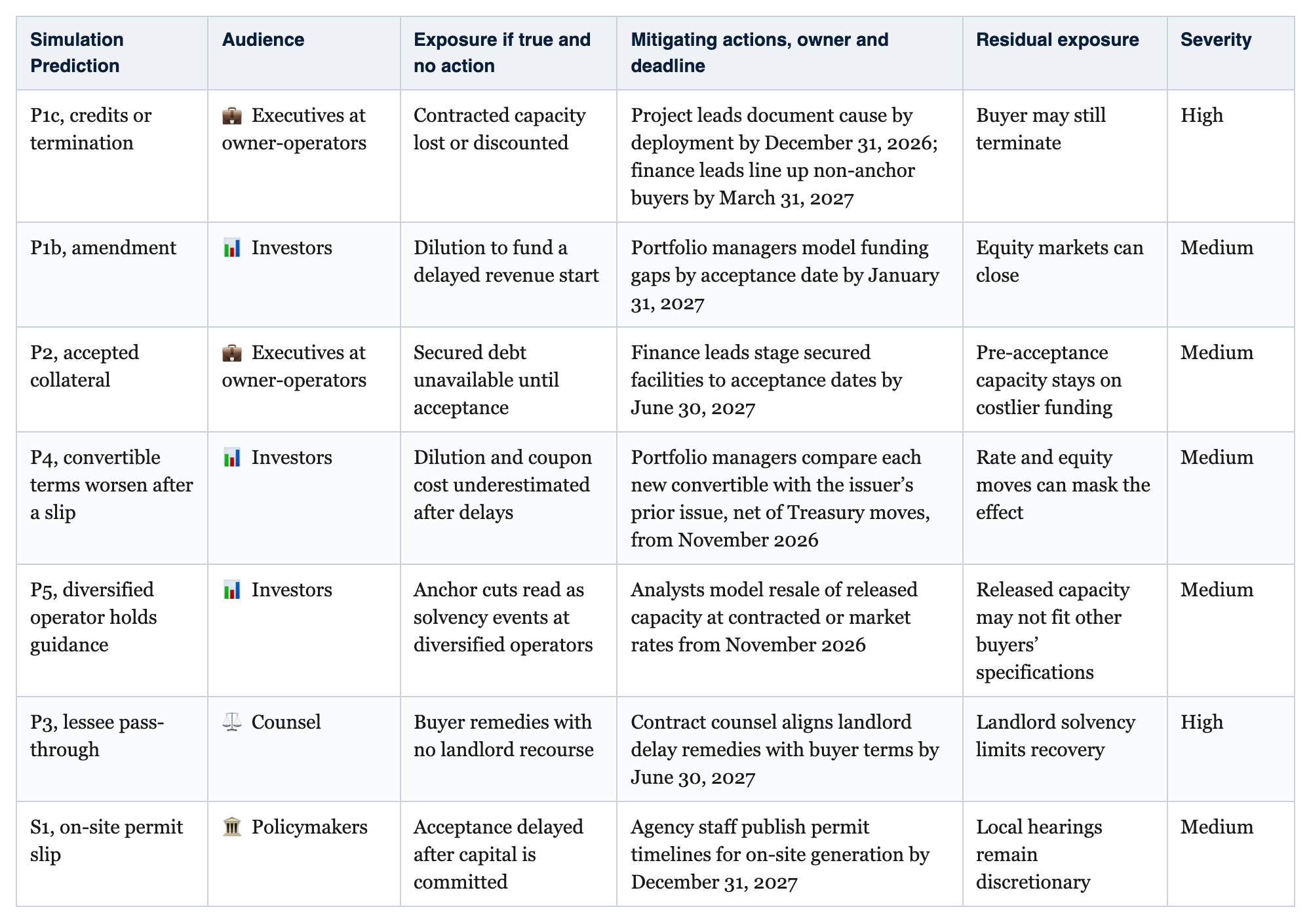
Takeaway. Cause documentation and accepted-capacity reporting address the largest exposures. Each row names an owner and a date, so the exposure converts into a task.
V. Implications: The Buyer’s Sign-Off Becomes a Credit Input
Acceptance moves part of the authorization contest into a private contract. Four implications follow for institutions, strategy, distribution and the Simulation Predictions themselves.
Institutional impact. Public authorities set the date of a private gate. A stop-work order in Vineland or a grid date in Essex now reaches a lender through the buyer’s acceptance clause. The 50-State Authorization Price Atlas and the Model Data Center Authorization Code describe the public terms that feed the private gate.
Strategic interaction. Principals hold three options against each operator: buy capacity, buy the site or back the operator. Each option moves the operator’s ACS and funding differently. Google’s Wyoming purchase and its Fluidstack backing show two of the three in use.
Distribution. Operators that own power gain bargaining time. Lessees carry delay risk they cannot cure, and integrated developers can exit through a sale. Equity holders absorb dilution when acceptance slips at operators funded through convertibles.
Falsifier consequences. If P2 fails because lenders fund capacity not yet accepted, acceptance stays one financing route among several. The operator thesis then narrows to funding mix alone.
🏛️ Policymakers. Dated on-site generation permits shorten the path from capital to acceptance.
Takeaway. The buyer’s sign-off has become a credit input. Public gates now set its date.
What to Watch
Ten signals separate the paths in this paper. Each carries a named source and a cadence.
Vineland acceptance and Nebius financing (P2, S1). Nebius results on November 12, then quarterly.
IREN acceptance (P1). IREN releases and filings through January 2027, read beside Microsoft’s late-January report.
Secured facility terms (P2, H1). Facility announcements and offering documents, quarterly.
Site sales to principals (H2). Company releases, monthly. A second sale would support a dated forecast in a later run.
Landlord-attributed delays (P3). CoreWeave quarterly reports and landlord disclosures.
Convertible terms after a slip (P4). Offering announcements by Nebius, IREN and CoreWeave, as issued.
Texas moratorium terms (P1 and P3). Governor’s orders and legislative filings after the January 2027 inauguration.
Nebius guidance after any anchor reduction (P5). Nebius quarterly releases, through June 30, 2027 and the following report.
On-site power permits (S1). New Jersey and Texas permit records, monthly.
Interruptible capacity offers (watch item). Operator product terms and utility enrollments, quarterly.
Takeaway. IREN’s January acceptance is the decisive signal. Nebius’s results arrive first and test the financing route.
Conclusion
IREN moved its revenue target in November because three Microsoft deployments still wait on acceptance. The buyer’s sign-off, not the signed contract, decides when IREN’s megawatts qualify for servicing-phase secured debt.
Five operators face the same gate with five strategies. Diversified operators can resell released capacity, owner-operators bargain over cause and lessees inherit their landlords’ delays. Integrated developers can sell the site before compute runs.
Operators act now by reporting accepted capacity by tranche and documenting the cause of every slip. Lenders and investors act by separating accepted, energized and contracted megawatts. The decisive signal arrives with IREN’s acceptance outcome in January, read beside Microsoft’s late-January report.
Working With MindCast
Published analysis cannot tell a specific operator how its tranches fare against its buyer’s acceptance terms. An owner-operator, a lessee and an integrated developer each face the gate on different clocks.
A commissioned engagement builds Cognitive Digital Twins of the organization and its counterparties. The set covers buyers, landlords and lenders, plus the authorities over its sites. MindCast then reruns the acceptance board against the organization’s actual tranche schedule.
Commissioned scope adds complete probability distributions, P10/P50/P90 ranges and settings fitted to the organization. Commissioned scope also adds complete scenario trees, decision thresholds and a monitoring dashboard keyed to the four dated turns.
The bounded next step is a diagnostic session on one tranche or financing decision due before March 31, 2027. Contact: mcai@mindcast-ai.com.
Visit MindCast AI for the full simulation library, prior Simulation Predictions and engagement options.
Appendix A. Selected MindCast Works
Microsoft Neocloud Consolidation: Energized Megawatts, Not Contract Backlog, Decide Which Neoclouds Survive. The companion paper; supplies the counterparty gate, the capacity ladder and the buyer-side forecasts.
AI Data Center Authorization Bargaining Power. Supplies the neocloud tier ratings and the developer gains from rationing.
AI Data Center Credit Risk, Permitting, Curtailment, and the Cost of Capital. Supplies FAC, CIR and the permit-to-draw forecast.
The Lowest-Exposure AI Data Center Approval Route for Developers, Hyperscalers and Investors. Supplies delay in tenant contracts and the on-site generation forecast.
AI Data Center Veto Points. Traces how a grid bypass moves exposure to air and fuel approvals.
Modular AI Data Center Specialists and the Integrated Offerings That Turn Small Sites Into Authorized Operating Capacity. Supplies the power-route finding and the hosted-site pattern.
Burden-Based Authorization for AI Data Centers, Modular Clean Compute, and the Backlash Gap Between Grid Tariffs and State Law. Supplies flexibility program thresholds.
The Grid-Anchored Clean Power Bargain: Powering AI Data Centers Through 2040. Supplies the distinction between connected and firm service.
The Clean Compute Match: Which Clean Power Pairs With Which AI Compute, And What Stays On Fossil. Supplies firm clean scarcity and hyperscaler priority.
AI Data Center Authorization + Clean Energy, the Mid-Scale Squeeze and the Specialized Compute Landscape. Places the paper in the series.
50-State Authorization Price Atlas. Reference terms for the public gates by state.
Model Data Center Authorization Code. Reference statute for dated authorization terms.
Appendix B. External Sources
Bloomberg, Dina Bass and Brody Ford, CoreWeave Shares Soar After AI Computing Firm Eases Debt Fears.
The Energy Mag, Microsoft committed $7 billion upfront in Nebius AI deal.
The Star summarizing Reuters, Nebius says “well-funded” after closing $4.3 billion debt raise.
Pulse 2.0, Nebius raises $775 million in first secured debt financing.
Pulse 2.0, Nebius raises $5.75 billion through convertible notes.
MarketBeat, Nebius second-quarter 2026 earnings call highlights.
New Jersey Monitor, NJ slaps Vineland data center with $1M fine for unpermitted generators.
WHYY, Vineland planning board approves second phase of 300-megawatt data center plan.
IREN, IREN Reports Q1 FY27 Results.
TIKR, IREN sinks 20% on report it is behind Microsoft’s AI spending delay.
Reuters via LINE Today, Microsoft tightens oversight of neocloud projects; IREN statement on penalties.
Data Center Knowledge, Nscale loses Microsoft deal as power delays threaten AI.
Mobile World Live, Microsoft pulls out of Nscale UK data centre deal.
AI Magazine, Crusoe: Building AI factories at a $30.9bn valuation.
CoreWeave, CoreWeave Reports Strong Third Quarter 2026 Results.
Finviz, CoreWeave continues to contract new compute capacity at higher prices.
Fierce Network, CoreWeave preps for monster capex growth in 2026.
The Energy Mag, Weather disruptions delay CoreWeave and Core Scientific AI data center in Texas.