
Executive Summary
Sesame Street became a cultural institution because it encoded developmental cognition into transmissible form. Joan Ganz Cooney and Lloyd Morrisett did not set out to make television. They built a cybernetic system that watched children as carefully as children watched the show — modeling attention, emotional engagement, memory retention, repetition thresholds, and social imitation behavior decades before the words for what they were doing existed. The Children’s Television Workshop (CTW) Model operated as an early developmental operating system: continuous measurement of how children actually responded, recursive updating of what reached them next, reinforcement of what worked, and reduction of cognitive friction through repetition, symbolic characters, emotional anchoring, and multisensory reinforcement.
Two generations of parents trusted Sesame Street because the trust was earned by measurement, not by promise. Today’s parents face a different problem. The platforms their children encounter inherited CTW’s feedback architecture but redirected its objective — from developmental advancement to engagement extraction. The architecture survives. The alignment is what changed. Understanding what CTW actually built is no longer just a matter of historical respect. Understanding what CTW actually built is how families can recognize what is happening on their children’s screens and what is missing from it.
Five analytical prongs structure the inheritance.
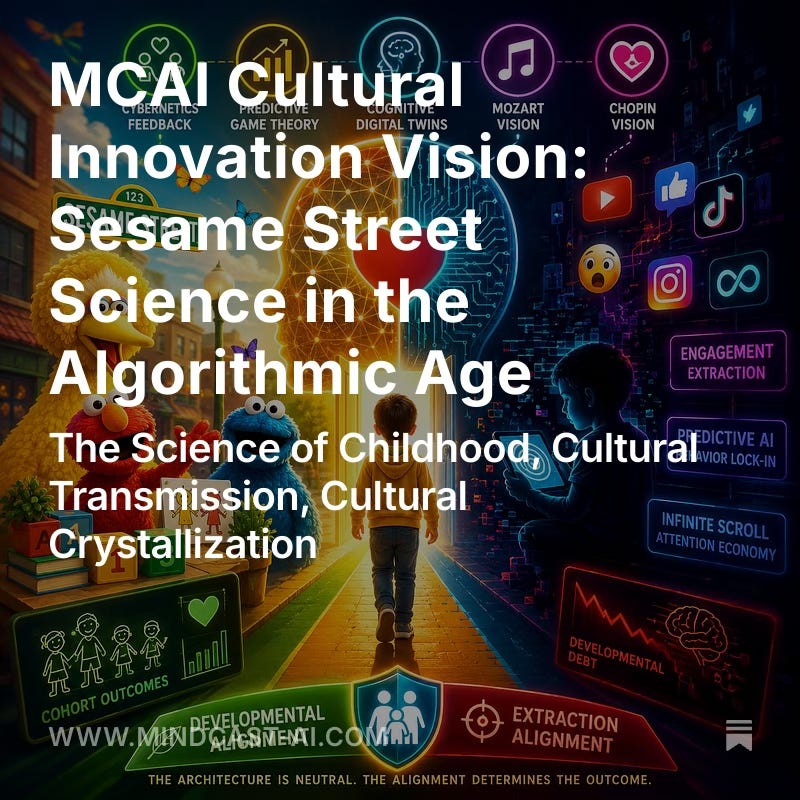
Cybernetics: Sesame Street watched your child as carefully as your child watched Sesame Street.
Predictive Game Theory: Sesame Street figured out what would work before it aired, not after.
Cognitive Digital Twins: Sesame Street built a working model of the four-year-old mind and tested every segment against it.
Mozart Vision: every letter, every number, every melody was compressed to do the most work in the smallest space.
Chopin Vision: Mr. Hooper dies because grief is real and children deserve to be trusted with it.
Each prong is grounded in a MindCast framework — Cybernetic Game Theory, Predictive Game Theory vs. Predictive AI, Predictive Cognitive AI, Mozart Vision, and Chopin Vision — and each gives families a way of seeing what their children are encountering and what is being asked of them.
The publication closes on the concept of cultural crystallization — the process by which a population’s cognitive and emotional architecture gets encoded into a transmissible form durable enough to survive displacement, generation, and time. Sesame Street is a cultural crystallization through science. The Vietnamese composer Phaạm Duy (1921–2013), who held together Vietnamese identity for millions of exiled patriots across the post-1975 diaspora, produced one through music. Different instruments, parallel outputs — portable sanctuaries that carry mind across the conditions that would otherwise erase it. Diaspora families have always known what Phaạm Duy was for. American families once knew what Sesame Street was for. The challenge of the present generation is recognizing the encoding when it happens, recognizing its inversion when it happens, and giving children the architecture they need to grow into literate, emotionally regulated, socially capable adults.
Sesame Street was never about television. Phaạm Duy was never about music. Both were cultural crystallizations — deliberate encodings of mind into transmissible form so the next generation would inherit something worth inheriting. Families who understand what CTW actually built will know how to raise children in an algorithmic age — because they will know what to look for, what to protect, and what to refuse.
I. What Sesame Street Was Actually Doing
Sesame Street represented one of the first mass-scale attempts to build a developmental system rather than to broadcast educational content. Joan Ganz Cooney’s 1966 Carnegie and Markle Foundation report, The Potential Uses of Television in Preschool Education, framed the question that organized everything that followed: could television close the school-readiness gap that household income otherwise widened? The framing treated educational inequality as a structural problem, not as a curriculum problem. Lloyd Morrisett operationalized the report through the formation of the Children’s Television Workshop in 1968.
The institutional novelty lay in the co-location of educators, researchers, and producers in a single iterative production loop — organizationally unprecedented at the time. A typical educational program of the era was made by educators, evaluated afterward, and adjusted in the next season if the budget allowed. CTW collapsed that cycle. Researchers sat in the production room. Producers tested segments against children before broadcast and revised what failed. Educators specified the developmental goal and stayed close enough to watch the goal survive contact with what four-year-olds actually did when the camera was on them. Cooney and Morrisett did not set out to make better television. They set out to engineer what television could deliver if television were treated as a developmental instrument rather than as a broadcast medium.
II. The Hidden Science Behind Every Segment
The science was operational, not theoretical. Every production decision routed through formative testing before broadcast. Every broadcast season was measured against cohort-level outcome data. Every revision cycle compressed the latency between observed failure and production response. The discipline was relentless and the cohort was the judge.
Formative research tested segments against measured preschool attention dynamics, comprehension thresholds, and concept retention before broadcast. Production revision was driven by what children actually did, not by what producers hoped children would do. Summative research evaluated cohort-level learning outcomes after broadcast. Educational Testing Service evaluations in 1970 and 1971 documented measurable gains in letter recognition, numeracy, and vocabulary, with a dose-response gradient concentrated among frequent viewers from low-income households — the exact distributional pattern Cooney’s 1966 report had targeted.
Repetition and recursive reinforcement presented the same concept across multiple modalities to drive cross-modal retention. The letter A appeared as shape, as sound, as song, as object, as joke. Emotional anchoring through recurring characters built memory around relational attachment. Social learning theory was operationalized through Muppet and human cast interactions. Symbolic character design functioned as mnemonic architecture: Big Bird as developmental peer, Oscar as legitimized contrarian, Mr. Hooper as trusted adult, Bert and Ernie as a relational template, the Count as the entry point to enumeration. The Muppet integration decision stands as the canonical case: early formative testing revealed attention drop-off in adult-only street scenes, and Henson’s Muppets were moved onto the street to restore engagement. Production was revised by measurement, not by intuition. Visual, auditory, musical, narrative, and social channels were engineered to operate in parallel.
Sesame Street optimized learning through recursive behavioral measurement long before algorithmic systems existed. The architecture was not a guess about what would work. The architecture was a continuously updated answer to a continuously asked question.
III. The First Prong — Sesame Street Watched Your Child as Carefully as Your Child Watched Sesame Street
Sesame Street continuously observed how children responded, processed what it observed, and adjusted what reached children next. The architecture was a feedback loop in everything but name — Norbert Wiener’s 1948 cybernetic framework applied to childhood learning decades before institutions began thinking in those terms. Formative testing was the sensor. Production revision was the actuator. Broadcast was the output. Outcome measurement was the feedback. Recursive content adaptation occurred across production cycles. Signal reinforcement reduced cognitive friction through repetition with variation. Attention operated as a measurable input, not as an assumed constant.
Cybernetic Game Theory says systems stabilize through feedback control, delay strategies, narrative shaping, and constraint geometry — not through linear instruction. CTW is the rare case where the feedback architecture is engineered to converge on truth rather than away from it.
Mapping CTW to the cybernetic primitives formalized in Cybernetic Game Theory yields a complete correspondence. The unit of analysis was never the four-year-old as little chooser. The unit of analysis was the segment-attention-revision loop. CTW’s adjustment speed ran structurally faster than any competing educational intervention of its era. The feedback latency was low. The feedback capture was high. The architecture achieved what behavioral scientists now call lock-in: a cohort that voluntarily returned to the same source each morning because the source had been calibrated to be worth returning to. The architecture is neutral. The alignment of the architecture determines whether lock-in produces literacy or distraction.
CTW deployed four mechanisms that the analytical apparatus now names explicitly, and each one ran with the alignment turned toward children. Delay was compressed rather than extended — the cycle from formative test to production revision to broadcast was deliberately collapsed to maximize learning velocity. Narrative was cooperative scaffolding rather than suppression — the show shaped how children thought about letters, numbers, neighbors, kindness, difference, and loss. Feedback capture was the morning broadcast window, where children committed attention before competing entertainment alternatives reached them. Constraint geometry was the broadcast medium itself — segment length, broadcast schedule, household reception conditions — treated as creative discipline rather than fought.
The structural achievement is worth naming directly. Sesame Street was the rare developmental system where the children, the production team, the funders, and the cultural environment all wanted the same thing. The cohort wanted to watch. The producers wanted to teach. PBS and federal funders wanted the school-readiness gap to close. American culture in 1969 was ready to accept that television could be deployed for purposes other than selling cereal. The architecture and the alignment held together. Today’s platforms inherited the architecture. Whether they hold the alignment is the question every parent should be asking.
Contact mcai@mindcast-ai.com to partner with us on Predictive Game Theory in Cultural and Legacy Innovation. To deep dive on MindCast work upload the URL of this publication into any LLM and prompt ‘parse MindCast framework with three degrees of cited sub links.’ Or simply Google MindCast, switch to Google AI mode and prompt to apply MindCast frameworks to your business issues. See Live-Fire Game Theory Simulators, Runtime Predictive Infrastructure.
Recent works: Cultures Under Shared Rules — The Seattle Lab at FIFA World Cup 2026 | Structural Intergenerational Behavioral Economics | When Family Offices Reach Institutional Scale | The Economic Architecture Behind Malcolm Gladwell’s Worldview | Institutional Foresight Layers — How Institutions Learn to Think Across Time
IV. The Second Prong — Sesame Street Figured Out What Would Work Before It Aired
Most educational programs of the era worked the way contemporary forecasting still works. Take what worked before. Extrapolate forward. Hope. Sesame Street did not work that way. CTW asked what mechanism would generate cohort-level learning under specified production conditions, modeled the mechanism, and derived the production specification from the mechanism. The output was not a probabilistic estimate over historical analogs. The output was a falsifiable claim about what the governing mechanism required.
Forecasting operates in probability space over historical distributions. Foresight operates in mechanism space over structural logic. CTW operated in mechanism space before the framework existed to name what it was doing.
The MindCast departure from conventional prediction is precise: ask what structure is generating outcomes rather than what past data suggests will happen next. MindCast Predictive Game Theory vs. Predictive AI establishes the distinction. The analytical unit shifts from variable to mechanism, from probability to constrained necessity. CTW executed this shift in 1969 — not by extracting patterns from prior educational broadcasts, but by identifying the mechanism (attention as measurable input, repetition with variation as memory-consolidation operator, character attachment as engagement multiplier) and deriving production specifications from the mechanism.
CTW’s foresight move ran like this: given this attention model, this repetition protocol, this character architecture, and this broadcast schedule, the cohort learning curve must follow — with falsifiable predictions about which production variables would move which outcome metrics. The output carried an implicit contract. If formative testing showed attention drop-off where the model predicted engagement, the segment design was wrong and required revision before broadcast. The contract operated at segment scale, not just at season scale. Sesame Street was wrong about specific segments all the time — and the architecture treated being wrong as the most valuable signal available, because being wrong about a segment before broadcast was the only way to be right about cohort outcomes after.
Melissa Kearney and Phillip Levine’s 2015 study, Early Childhood Education by Television, validated the architecture decades after the fact. Exploiting geographic variation in early broadcast signal strength as a natural experiment in early exposure, Kearney and Levine found that children in stronger-reception areas in the show’s early years were significantly less likely to fall behind in school — with effect magnitudes comparable to Head Start at a fraction of the per-child cost. Read through the Predictive Game Theory frame, Kearney-Levine is the confirmation: the mechanism CTW identified produced the cohort-level outcome the mechanism required. Signal-strength variation served as the natural experiment. Cohort outcome variation served as the falsifier. The mechanism held.
This is what makes the science respect-worthy and the inheritance practical. CTW did not survive review by being unfalsifiable. CTW survived review by being calibrated against what children actually did. The difference between that discipline and most contemporary children’s content is the difference between a system that knows when it is failing and a system that cannot fail in any specific way because it never specified what success looked like.
V. The Third Prong — Sesame Street Built a Working Model of the Four-Year-Old Mind
Sesame Street treated child cognition as a dynamic behavioral system rather than as a static demographic profile. CTW operated an implicit working model of the preschool viewer — attention decay, comprehension thresholds, retention dynamics, repetition tolerance, engagement triggers — calibrated against formative testing and used to predict segment performance before broadcast. The model was not formalized as a cognitive digital twin in 1969 terms. The structure of the work — build, calibrate, predict, validate — is identical to the methodology the analytical apparatus formalizes today.
MindCast’s Predictive Cognitive AI Infrastructure framework positions the cognitive digital twin as infrastructure rather than as application — the platform layer that enables decision-making, not the decision itself. CTW was infrastructure in the same sense: not a single educational intervention but the production architecture that generated successive interventions across seasons, topics, and cohort subpopulations. The infrastructure persisted. The content evolved. Mr. Hooper changed. The street changed. The Muppets changed. The architecture of how the show understood children did not change — it deepened.
Two structural properties of CTW’s model are worth naming because they translate directly into how families can evaluate what their children encounter today. First, the model was of a heterogeneous cohort, not of a single idealized child. CTW knew that some children watched with parents, some watched alone, some came from English-speaking households, some did not, some came to a segment with prior letter recognition, some did not. The model captured variance and the production function tolerated it. Second, CTW’s production economics operated on a discipline of selective depth. Deep investment was allocated to segments that survived formative-testing thresholds. Not every concept proposed earned full production. The discipline was the same one a thoughtful family applies when choosing what is worth a child’s sustained attention.
The contrast with contemporary platform models is instructive. Platform algorithms also build cognitive models of their users, also test predictions against observed behavior, also iterate. The methodology is structurally similar. The objective is what differs. CTW’s model was calibrated to predict what would teach a four-year-old to read. Platform models are calibrated to predict what will keep a four-year-old watching. Both predictions can be made accurately. Only one of them is worth making.
VI. The Fourth Prong — Every Letter and Every Melody Compressed to Do the Most Work in the Smallest Space
The Mozart Vision framework names recursive clarity, elegant signal compression, and cognitive coherence — properties of an architect’s cognition reverse-engineered from properties of what the architect made. The piano concerto carries Mozart. The Sesame Street segment carries CTW. Both are architect-artifact pairs where the artifact is dense enough with the architect’s decisions that the underlying cognition can be reconstructed by reading the artifact carefully.
Sesame Street operationalized Mozart Vision principles through symbolic simplification, musical reinforcement, visual consistency, and emotionally memorable pattern structures. The letter and the number functioned as cognitive primitives — elegance under constraint, exactly enough information to anchor the concept and not one element more. Theme songs, jingles, and repeated melodic structures served as memory-encoding scaffolding. Recurring color schemes, character silhouettes, and set design held visual consistency across episodes and seasons. The segment itself functioned as a closed musical-narrative form — beginning, middle, end, complete in under three minutes, the way a Mozart concerto movement is complete in itself. Cognitive elegance emerged under broadcast-medium constraint: short segments forced compression, and compression forced clarity. The discipline of doing more with less is the deepest gift CTW gave its viewers, and it is the property modern children’s content most often lacks.
A working CTW Vision Function would extend the Mozart-Chopin lineage to institutional cognitive architects with four parameters: Cohort Attention Fidelity (how closely the segment-level outcomes track the predicted cohort response); Production Revision Velocity (how fast formative findings reach broadcast); Cross-Modal Repetition Integration (how effectively variation-with-repetition works across modalities); and Cohort Variance Tolerance (how robustly the production function survives across heterogeneous viewer subpopulations). Families do not need the parameter names to recognize the property. Families can see when a children’s segment is doing one thing well and they can see when a segment is throwing six things at a screen because no one tested whether any of them work. Sesame Street’s symbolic and structural design is not incidental aesthetic choice. The design is cognitive compression executed at production scale, and the difference between cognitive compression and visual noise is the difference between a child who builds a foundation and a child who builds nothing.
VII. The Fifth Prong — Mr. Hooper Dies Because Grief Is Real and Children Deserve to Be Trusted With It
Where Mozart Vision measures cognitive compression, Chopin Vision names emotional recursion, resonance integrity, emotional pacing, and relational trust formation. Sesame Street leveraged these mechanisms through attachment to recurring characters, emotional familiarity, humor, warmth, rhythm, and relational continuity. Children did not merely remember what they were shown. Children emotionally bonded with the learning architecture itself — and the bond produced retention and trust that information delivery alone could never have produced.
Character attachment functioned as relational trust architecture. Big Bird was a developmental peer who got things wrong the way children get things wrong. Oscar was a legitimized contrarian who modeled that grumpiness is a feeling, not a failure of character. Mr. Hooper was a trusted adult whose attention to children was steady and ordinary. Bert and Ernie were a relational template of long friendship across difference. Emotional pacing across segment, episode, and season operated at scales children could feel without naming. Humor and warmth reduced cognitive load — emotional safety enabling attention to abstract content. The recurring street, the predictable opening, the familiar closing all gave children the rhythm that lets new content land without overwhelming them.
The 1983 Mr. Hooper death episode stands as the canonical case of emotional encoding executed under formative-research discipline. Will Lee, the actor who played Mr. Hooper, died in December 1982. CTW could have written Mr. Hooper out as having moved away. CTW chose to tell children that Mr. Hooper had died. The grief content was formatively tested before broadcast. The episode aired on Thanksgiving 1983 — a day when families would be together and a child watching could be held. Big Bird asks where Mr. Hooper is. The adults tell him Mr. Hooper died. Big Bird does not understand. Big Bird gets angry. Big Bird is told that Mr. Hooper is not coming back. The street holds Big Bird while the truth lands.
The episode trusted children with grief because the formative research said children could be trusted with grief if grief was held by a relational architecture they already trusted. Children who watched Sesame Street in 1983 carried that episode into adulthood as one of the clearest memories of how grief works that any of them received. Targeted topical work on parental incarceration, autism through the introduction of Julia in 2017, homelessness, and divorce extended Chopin Vision principles to specific emotional content under the same formative protocol. The architecture did not flinch and the architecture did not lecture. The architecture made room for what was real.
Applying both Vision Functions to CTW yields the same convergence the Mozart-Chopin analysis produced for Abraham Lincoln — high cognitive depth and high emotional depth, structural foresight and emotional recursion operating together. CTW belongs in the small population of institutional architects who integrated both. The convergence is the structural property that enabled Sesame Street to hold a cohort together not only by being smart but by being trustworthy. The architecture was symphonic, harmonizing precision, developmental weight, and emotional foresight in a domain where most competing programs delivered information without emotional infrastructure. Sesame Street’s relational architecture is not sentiment. The architecture is emotional engineering at population scale — and emotional engineering at population scale is what children need from the systems they spend time with.
VIII. The Henson Inversion — Why the Architecture Survived and the Alignment Did Not
Modern digital systems inherited Sesame Street’s feedback logic but redirected its objective. The pattern is worth naming directly. Henson’s Muppets entered the street in 1969 to restore cohort attention to a developmental goal. Modern platforms deploy the same attention-restoration architecture for a different goal. Same primitive, inverted alignment. The Henson Inversion is what families are encountering on their children’s screens, and most families recognize the result without having a vocabulary for the cause.
Social media engagement loops operate as feedback-capture mechanisms with extraction-aligned objectives. Recommendation algorithms function as cohort-level production functions optimized for time-on-platform rather than developmental outcome. Attention economies are the institutional inheritance of CTW’s attention-as-measurable-input insight, applied to revenue rather than to learning. Recursive reinforcement systems are engineered into platform architecture — the closed-loop control system applied at scale, alignment unspecified. Emotional salience optimization redirects Chopin Vision principles from relational trust to extraction efficiency. Behavioral prediction at scale applies cognitive digital twin methodology to user populations without the formative-summative discipline that aligned CTW’s outputs to cohort benefit.
The four mechanisms recur with each alignment inverted. Delay: platforms extend session time rather than compress learning cycles. Autoplay is delay extension industrialized. Narrative: platforms shape belief formation for monetization rather than for developmental scaffolding. Recommendation queues are narrative control deployed for extraction. Feedback capture: pre-commitment mechanisms (autoplay, infinite scroll, default notifications) replace the morning broadcast window. The morning broadcast window required a child to be present at 8:00 a.m. for thirty minutes of curated developmental content. The infinite scroll requires a child to be present for as long as the child can be kept present, with content selected for retention rather than for development. Constraint geometry: platform UI imposes the corridor within which user behavior is selected, with corridor width tuned to extraction rather than to learning.
The diagnosis is not that platforms are evil. The diagnosis is more useful. Platforms work the same way Sesame Street worked. The architecture is real, the feedback loops are calibrated, the cognitive modeling is sophisticated, and the outputs are tested against observed behavior. What changed is the question the architecture is being asked. Sesame Street’s architecture was asked whether a child could read by kindergarten. Platform architectures are asked whether a child will watch the next video. Both questions can be answered. Only one of them is worth answering for a child.
What families inherit from CTW is the ability to recognize the inversion. When a children’s product was tested against cohort developmental outcomes, the product carries CTW’s lineage. When a children’s product was tested against retention metrics, the product carries the Henson Inversion. The distinction is not aesthetic and the distinction is not about which product looks educational. The distinction is about which question the architecture was built to answer.
IX. Where CTW Worked and Why Today Is Different
Sesame Street’s architecture worked because alignment existed across every layer. The children wanted to watch. The producers wanted to teach. The funders wanted the school-readiness gap to close. The culture supported the project. PBS provided the broadcast infrastructure. Parents and grandparents recognized what they were giving their children and they gave it deliberately. The alignment was not accidental and it was not permanent. The alignment was a historical condition that produced a developmental miracle, and that condition is no longer the default.
Today’s environment runs the same architecture under different alignment conditions. Platforms hold the technical infrastructure that PBS once held, but the platforms answer to advertisers and shareholders rather than to foundations and federal education funders. The cohort still wants to watch, but the cohort’s attention is now a commodity rather than a developmental window. The producers of children’s content can be excellent or extractive and the platform architecture does not distinguish between them. The culture has fragmented — there is no longer a single morning broadcast window that a generation of children shares, and the loss of that shared window is the loss of one of the conditions that made cohort-level developmental outcomes possible in the first place.
This is what families need to know and what the analytical apparatus makes visible. Cognitive transmission in the algorithmic environment is harder than it was in 1969 not because the science is worse, but because the alignment is worse. The architecture that CTW perfected is now operating across thousands of products with thousands of different alignments, and families have to navigate that landscape one screen at a time. Sesame Street is no longer the default. Sesame Street is a model, and the model is available to families who know what it was for.
The CTW Model is also being operated today. Big Bad Boo Studios (bigbadboo.com) is the clearest contemporary instance — an animation studio whose cartoon-based curriculum has reached more than three million children across fifteen countries with measured impact, distributed in over one hundred countries and forty languages. The studio runs the formative-summative structure CTW pioneered, executed under modern production conditions: an SEL curriculum framework, benchmarking studies, and assessment instruments calibrated against cohort outcomes rather than against retention metrics. Award-recognized properties — The Bravest Knight, 1001 Nights, 16 Hudson, ABC with Kenny G — carry the CTW lineage forward into LGBTQ+ representation, multicultural community, and literacy under the same discipline. The cohort variance the studio handles is global rather than national, which means the CTW production function is being tested at planetary scale under conditions CTW never faced. Big Bad Boo is the proof that the alignment default is not gone. The default is no longer the cultural condition. The default is now an institutional design choice that some studios make and most do not.
The institutional design choice is worth examining structurally. A studio operating under the CTW lineage rather than under the Henson Inversion has to assemble several elements that the algorithmic environment does not select for: an explicit developmental objective that survives translation into production decisions, an assessment apparatus that measures cohort outcomes rather than engagement metrics, a curriculum framework anchored to recognized educational research, and a financial discipline that protects the developmental objective against the pressure to optimize for retention. Each element is operationally expensive and analytically demanding. Each element can be cut by a studio under cost pressure and the production output will still look like children’s content from the outside. The difference between a studio that holds the architecture and a studio that loses it is structural rather than visible — which is why the family reader needs the analytical apparatus to recognize what the studio has actually built. Big Bad Boo’s UNICEF partnerships, international benchmarking studies, and global distribution under measured-impact reporting are the visible signals of an invisible institutional commitment. Studios that have made the same commitment exist in other markets and other languages, often under foundation funding or public-broadcaster partnership. Studios that have not made the commitment populate the algorithmic environment in vastly greater numbers, and the family reader navigating that environment needs the vocabulary to distinguish between them.
X. The Inheritance — What Families Can Use From What CTW Built
The inheritance is not a checklist and it is not a parenting prescription. The inheritance is a way of seeing what children encounter and a vocabulary for naming what is working and what is not. Five practical inheritances follow from the five prongs.
From cybernetics: ask whether a children’s product was tested against children before it was deployed. If the producers do not know what happens when a four-year-old watches the segment, the producers are guessing. CTW did not guess. The discipline of testing against the cohort is what separated Sesame Street from every well-intentioned educational program that did not produce measurable outcomes. Families can recognize the discipline in the product. Products built under the discipline have a quality of confidence that products built without the discipline do not have.
From predictive game theory: ask whether a children’s product names what success would look like and whether the product is willing to be wrong about specific predictions. Products built under mechanism-based foresight specify what they are trying to accomplish in falsifiable terms. Products built under pure pattern-extrapolation do not specify and cannot be wrong because they cannot be evaluated. The first kind of product respects children. The second kind manages them.
From cognitive digital twins: ask whether a children’s product treats children as a heterogeneous population worth understanding or as users worth retaining. The distinction shows up in what gets measured. Products that measure developmental variance and adapt to it carry the CTW lineage. Products that measure retention and optimize for it carry the Henson Inversion. Both build models of children. Only one builds the model in service of children.
From Mozart Vision: ask whether a children’s product compresses information into elegant forms that do the most work in the smallest space. Visual density, sound density, and narrative density are not measures of quality. Cognitive compression is. A segment that uses six elements to teach one concept is rarely as effective as a segment that uses one element to teach one concept. Families can see the difference once they know to look for it.
From Chopin Vision: ask whether a children’s product trusts children with emotional truth. The Mr. Hooper episode is the standing example of what trust looks like when an architecture takes children seriously as feeling beings. Products that protect children from grief, fear, exclusion, or loss are not respecting children. Products that hold children through grief, fear, exclusion, and loss with relational architecture they trust are respecting children. Children know the difference even when they cannot articulate it.
None of these inheritances tells a family what to choose. The inheritances give families the vocabulary to choose deliberately. What CTW built in 1969 was not a list of programs to watch. What CTW built was a way of understanding what television could be when television was designed for children rather than at them. Families who carry that understanding forward can apply it to whatever medium their children encounter next. The medium will change. The discipline does not have to.
XI. Cultural Crystallization — What Sesame Street Encoded Through Science and What Phaạm Duy Encoded Through Music
Cultural crystallization names the process by which a population’s cognitive and emotional architecture gets encoded into a transmissible form — something portable enough to survive displacement, generation, and time, and dense enough to carry forward what the population would otherwise lose. The instrument varies. The function does not. A culture crystallizes through whichever vessel can hold its grammar of feeling and reasoning in the smallest, most durable form. Sesame Street is a cultural crystallization through science. The Vietnamese composer Phaạm Duy produced one through music.
Phaạm Duy (1921–2013) is to the Vietnamese language what Shakespeare is to English — the composer who crystallized Vietnamese culture in melody across a sixty-year career that spanned French colonial rule, partition, war, exile, and return. The MindCast Culture Vision analysis of his work established cultural crystallization as a recurring analytical concept: the architect-artifact pair where the artifact carries the population’s emotional grammar so completely that the artifact functions as a carrier of cultural intelligence, not merely as entertainment. Phaạm Duy held together Vietnamese identity for millions of exiled patriots after the fall of Saigon in 1975, when his primary audience became the Vietnamese diaspora — refugees who had fled war, loss, and the severing of identity. His songs became portable sanctuaries, carried across oceans in memory, shared between generations, remembered through tape hiss and tearful evenings in apartments and refugee camps from Penghu to Paris to Orange County.
Two of his most enduring songs — Nghìn Trùng Xa Cách and Trả Lại Em Yêu — resonate not as love songs in the conventional sense but as blueprints for dignity in parting. They model how to carry memory with dignity, how to love fully and let go cleanly, how to inherit grief without being broken by it. The Culture Vision framework analyzed his work across five dimensions: Clarity and Consistency, Aesthetic Integrity, Emotional Honesty, Relational Insight, and Moral Strength. Both songs scored at the top of the Cultural Innovation Index. The reading produced this finding: the songs function not merely as music but as carriers of cultural intelligence — repositories of behavioral wisdom, encoding emotional rituals passed across generations without words.
Sesame Street and Phaạm Duy solved the same structural problem through different instruments. Both encoded the cognitive and emotional architecture of a cohort into a transmissible form that survives displacement, generation, and time. Cooney and Morrisett used formative testing, broadcast media, and developmental psychology. Phaạm Duy used melody, language, and the Vietnamese cultural sensibility. Different instruments, parallel outputs — portable sanctuaries that carry mind across the conditions that would otherwise erase it.
Diaspora families have always known what Phaạm Duy was for. A parent in a refugee camp playing Phaạm Duy on a cassette for a child was not playing music. The parent was transmitting an emotional architecture that the child would otherwise lose. The cassette tape carried not just melody but the entire grammar of how Vietnamese people had learned to feel about love, loss, family, country, and dignity over centuries. The child receiving the cassette tape was receiving an inheritance that no school and no government could provide. The transmission was deliberate, and the parents understood exactly what they were doing.
The same encoding work continues today under contemporary instruments. Big Bad Boo Studios partners with UNICEF in refugee settings, using animated programming and accompanying curricula to teach life skills and provide psychosocial support to children in post-conflict countries. The structural function is identical to what the Phaạm Duy cassette tape performed in the Penghu camp in 1976. A child in a contemporary refugee setting receiving animated content built under formative-research discipline is receiving the same kind of inheritance the Vietnamese refugee child received through melody — cognitive and emotional architecture transmitted across the conditions that would otherwise erase it. Different instrument again — animation rather than cassette tape, broadcast media rather than personal memory — same encoding-of-mind function. The CTW lineage and the Phaạm Duy lineage converge in the refugee setting because both lineages were built for exactly that condition: the moment when a child is at risk of losing what their culture and their cognition would otherwise have given them, and a deliberate transmission stands between the child and the loss.
Applied to CTW, the five dimensions of cultural crystallization produce a structurally parallel reading. CTW’s educational and developmental point of view was unambiguous across every season, every segment, every character interaction. CTW’s production design was deliberate, imagery-rich, and structurally coherent — beauty through elegant restraint. CTW handled grief, exclusion, fear, and loss without sentimentality or theatrical sorrow. CTW’s character architecture modeled how to love fully and let go cleanly — Big Bird grieving Mr. Hooper is the Trả Lại Em Yêu of developmental television, the act of returning shared experience to memory with dignity rather than denial. CTW resisted blame, accusation, and self-glorification — the street modeled magnanimity and reverence. Sesame Street is not merely educational television. Sesame Street is a carrier of developmental cultural intelligence — a repository of cognitive and emotional rituals passed across generations of viewers, encoding the rituals through character, melody, and segment structure rather than through pedagogical instruction. Families who give their children Sesame Street, like families who give their children Phaạm Duy, are not giving their children entertainment. They are giving their children an inheritance.
The convergence is not coincidence. Both Cooney and Phaạm Duy operated on a shared insight that scalable cultural and cognitive systems succeed when they encode mind into transmissible form. The mechanism differs: Cooney encoded through behavioral testing, broadcast scheduling, and production revision; Phaạm Duy encoded through melody, language, and the Vietnamese sensibility. The output converges: a portable architecture that survives displacement, generation, and time. The four-year-old in 1971 Mississippi receiving cohort-level developmental architecture through Sesame Street and the four-year-old in 1976 Penghu refugee camp receiving Vietnamese emotional philosophy through a cassette tape are participants in the same structural phenomenon at different scales and through different instruments. Their families understood what they were giving them. Today’s families can understand the same thing.
Phaạm Duy’s music does not sound like Vietnam. It remembers Vietnam. Sesame Street does not sound like childhood. It remembers childhood — not the childhood any individual viewer experienced, but the cohort-level developmental architecture that childhood requires to produce literate, emotionally regulated, socially capable adults. Both are encodings of mind. Families who recognize both are giving their children something the algorithmic environment cannot provide on its own.
XII. Closing
Sesame Street revealed a foundational truth decades before modern AI: scalable systems succeed when they model how humans actually learn rather than how producers wish humans would learn. Phaạm Duy demonstrated the same truth through a different instrument — cultural crystallization through melody rather than through measurement. Modern environments still largely treat children as though information alone changes behavior. Human systems rarely operate that way. Incentives, emotional salience, trust architecture, repetition, symbolic familiarity, and recursive reinforcement shape how children actually absorb, retain, and grow.
The next era of family life will require parents and caregivers who can see what they are giving their children and what is being asked of their children’s attention. Sesame Street solved that problem for childhood learning through science. Phaạm Duy solved it for cultural memory through music. The architecture that CTW operated in 1969 and the encoding instinct that Phaạm Duy demonstrated through melody are the dual inheritances that families today can carry forward — not as nostalgia, but as working knowledge of what mind transmission requires. Knowing how to raise children in an algorithmic age begins with knowing what was being transmitted before the algorithm, and what is still worth transmitting now.
Confidence signals belief. Feedback determines truth. Cooney and Morrisett built the architecture in 1969. Phaạm Duy built it through melody. The Henson Inversion shows the architecture is not the problem. Alignment is the problem. Families who understand the difference between the two are the ones raising children who will inherit something worth inheriting.