


I. The Moment
World Cup month puts the entire planet in front of the same game. Billions of fans across six continents watch Lionel Messi drift through matches at a walking pace while the sport’s fastest, strongest defenders collapse around him. Casual viewers see a man conserving energy. Careful viewers see something stranger: a player running a live simulation of the field before the ball ever arrives.
Messi does not stand alone in that strangeness. Roger Federer made tennis look lighter than physics should allow. Tiger Woods made golf feel like a psychological weather system that he alone controlled. Three athletes, three global fan bases, three sports with international reach — and one shared cognitive architecture underneath.
MindCast AI names the shared architecture coherence — the capacity to hold a predictive model of the contest intact while pressure rises — and its proprietary, patent-pending Cognitive Digital Twin (CDT) system exists to simulate it. Messi, Federer, and Tiger form the cleanest public demonstration available: the Predictive Greatness Trifecta — field, court, and course. Each athlete converted predictive cognition into movement economy, spatial control, timing advantage, and pressure command. Each looked effortless because the decisive work happened before anyone else saw the problem.
The Cognitive Digital Twin models the actor. The Vision Function runs the actor model forward. Dynamic Predictive Game Theory (DPGT) explains why the game itself changes when a superior decision system enters the contest.
Sports fans around the world are paying attention right now. The Coherence Vision explains what they are actually watching.
II. The Coherence Claim
Coherence names the property that separates a great decision system from a merely fast one. A coherent system holds its internal model of the contest intact while pressure, noise, and consequence rise. An incoherent system fragments — it rushes, overreacts, chases every signal, and burns energy correcting mistakes it created by committing too early.
Predictive greatness does not mean guessing correctly. Predictive greatness means building a live model of the contest before the visible action resolves, then acting with minimum force at maximum leverage. Elite athletes who operate at this level do not react faster than everyone else. They reduce the number of reactions required.
Coherence explains the visible paradox that fans intuit but rarely name: the best athletes in the world often look the least busy. Loud movement signals effort. Quiet movement signals processing. Messi walks. Federer glides. Tiger stalks a shot in stillness before releasing controlled violence. Calm is not temperament. Calm is completed computation.
III. Why the Cognitive Digital Twin Comes First
The central claim is not that Messi, Federer, and Tiger were merely graceful athletes. The central claim is that each athlete expressed a coherent decision system under pressure, and MindCast AI uses Cognitive Digital Twins to model that system.
The Cognitive Digital Twin — MindCast AI’s proprietary, patent-pending simulation system — does not begin with the highlight. A CDT begins with the hidden decision architecture that makes the highlight possible: perception, anticipation, pruning, timing, movement economy, disguise, pressure response, and failure mode. The score, trophy, or viral clip arrives last. The decision system arrives first. MindCast AI established that premise in its founding MindCast AI Vision Statement: AI Era Law and Behavioral Economics. The core claim was simple: Cognitive Digital Twins do not predict what an actor will say. They model how the actor actually decides, through habits, reference points, and behavioral anchors that outcomes alone never reveal.
Messi, Federer, and Tiger give the public a rare demonstration of CDT logic because every fan can see the surface behavior. Messi walks. Federer glides. Tiger stalks. The CDT explains why those surface behaviors matter. Walking can mean scanning. Gliding can mean anticipatory arrival. Stillness can mean pressure computation.
MindCast AI treats the trifecta as more than a sports comparison. The trifecta becomes a showcase of CDT methodology: three athletes, three contest regimes, one analytical engine capable of modeling predictive coherence across radically different environments.
IV. What a Cognitive Digital Twin Simulates
The MindCast AI Cognitive Digital Twin models an agent’s decision system under constraint. The CDT is proprietary, patent-pending MindCast technology, not a generic modeling exercise anyone can reproduce. The CDT does not merely describe style. The CDT simulates how a player perceives the game, compresses information, forecasts possible states, delays commitment, and preserves coherence when pressure rises.
MindCast AI publicly disclosed the engine’s multi-agent architecture in MindCast Files Provisional Patent Application on Multi-Agent Institutional Simulation Architecture and traced its intellectual lineage — Wiener’s feedback loops, Ashby’s requisite variety, Beer’s viable systems — in The Cybernetic Foundations of Predictive Institutional Intelligence. Both works frame outcomes as downstream evidence, not as the starting point of analysis. Scores, match results, trophies, and records matter, but they do not fully explain how excellence occurs. The CDT targets the causal layer beneath the outcome: the decision architecture that repeatedly generates high-value action.
Seven observable layers structure every athlete CDT:
Perceptual engine — which signals the athlete extracts from a chaotic environment
Simulation function — how far ahead of the visible action the internal model runs
Movement signature — the physical residue of early cognition
Temporal weapon — how the athlete manipulates time against opponents, the environment, or pressure
Disguise layer — how the athlete conceals intention until commitment becomes irreversible
Pressure behavior — whether the decision system improves, holds, or fragments under stress
Failure mode — the condition under which coherence breaks
Every layer stays observable. Analysts can track scanning frequency, movement economy, corrective steps, commitment timing, shot selection, spatial manipulation, pressure response, and adaptation across career phases. The CDT needs no mystical language. The CDT requires disciplined observation of how elite decision systems remain coherent when ordinary systems rush, fragment, or overreact.
Contact mcai@mindcast-ai.com to partner with us on Predictive Game Theory AI in Law and Behavioral Economics. Our verticals include simulating complex litigation, innovation economics and geopolitical risks.
To deep dive on MindCast works upload the URL of this publication into any LLM (preferably Google AI mode) and prompt ‘reconstruct MindCast framework with three degrees of cited sub links.’ See Appendix A and Live-Fire Game Theory Simulators, Runtime Predictive Infrastructure. We stress-tested our AI system for this publication by simulating the Super Bowl and the World Cup.
V. The MindCast AI Method Stack
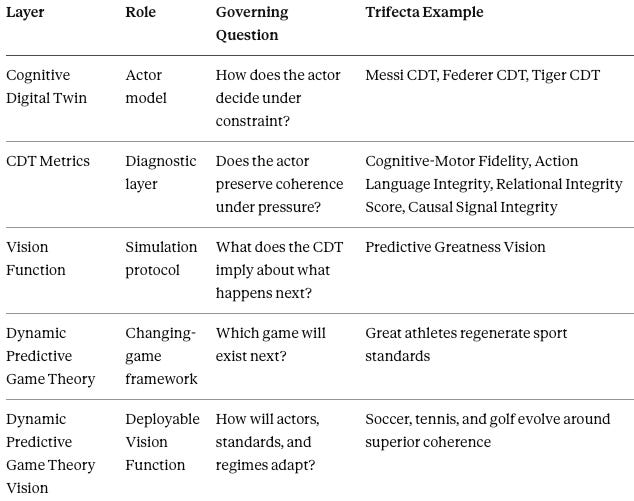
MindCast AI uses a four-part operating stack: the Cognitive Digital Twin, the Vision Function, Dynamic Predictive Game Theory, and Dynamic Predictive Game Theory Vision.
The Cognitive Digital Twin is the actor model. It simulates how an athlete, institution, company, team, regulator, court, or market participant actually decides under constraint. A CDT captures perception, incentives, habits, reference points, behavioral anchors, option pruning, movement or action patterns, pressure response, and failure mode. The CDT answers the question: how does this actor preserve or lose coherence under pressure?
The Vision Function is the simulation protocol. It takes one or more CDTs and runs them through a specific foresight question. A Vision Function does not replace the CDT. It activates the CDT inside a defined scenario, pressure field, time horizon, or strategic contest. The Vision Function answers the question: what does this CDT imply about what happens next?
Dynamic Predictive Game Theory is the changing-game framework. It explains why strategic contests do not remain fixed while actors adapt. Classical game theory often assumes a stable game: stable players, stable payoffs, stable rules, stable strategy sets. Dynamic Predictive Game Theory begins from a different premise: high-coherence actors can change the game while everyone else is still learning how to respond. The framework answers the question: which game will exist next, and which actor will remain coherent when it arrives?
Dynamic Predictive Game Theory Vision is the deployable Vision Function that applies Dynamic Predictive Game Theory. It uses CDTs to model the actors, maps the current game regime, identifies the emerging replacement regime, scores adaptive coherence, and forecasts how strategies, standards, institutions, or opponent behavior will shift.
In short: the CDT models the actor, the Vision Function runs the simulation, Dynamic Predictive Game Theory explains why the game changes, and Dynamic Predictive Game Theory Vision applies that framework as a MindCast foresight protocol.
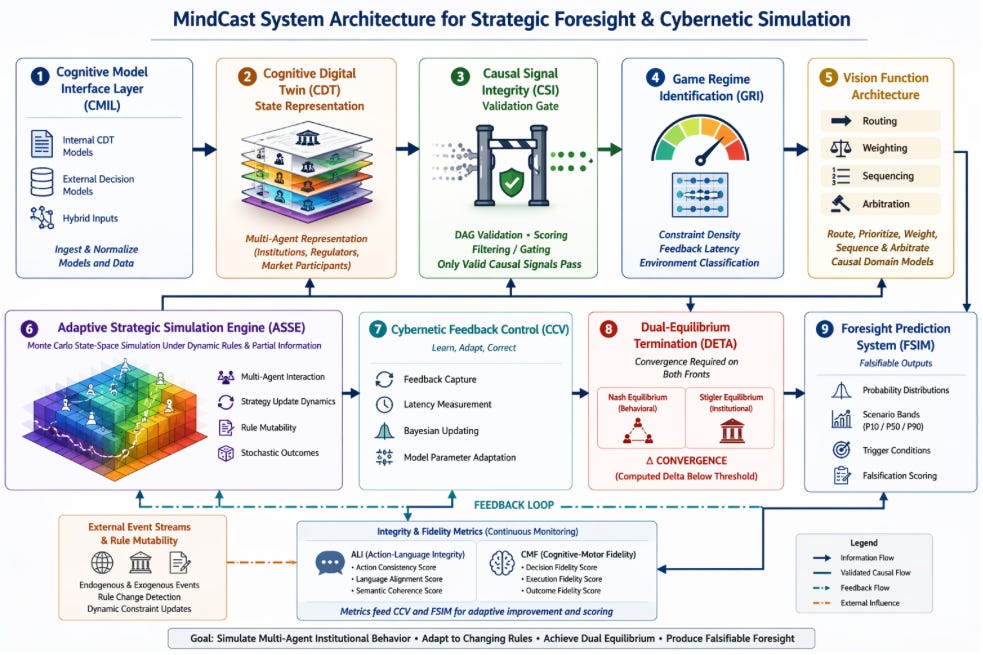
The patent-pending runtime pipeline. Every simulation in this report ran through this sequence: actor twins built, contest regime identified, Vision Functions routed, strategic interaction simulated, and predictions scored as falsifiable outputs.
VI. Dynamic Predictive Game Theory: Why the Game Changes After Genius Appears
Dynamic Predictive Game Theory explains why the trifecta matters beyond individual greatness. DPGT extends the strategic-contest doctrine MindCast AI formalized in MindCast AI Emergent Game Theory Frameworks and applies it to athletic decision systems. Classical game theory often begins with a fixed game: stable players, stable incentives, stable strategies, stable payoffs. The Computational Era Operationalizes Cybernetics and Predictive Game Theory traces that assumption set to slower informational conditions — conditions elite sport abandoned long ago. Dominant athletes change the game while everyone else is still learning how to play against them.
Messi changed the game because defenders had to reorganize around field gravity. Federer changed the game because opponents had to solve disguised court geometry earlier in the rally. Tiger changed the game because the field had to confront pressure as a competitive variable, not merely a personal feeling.
Dynamic Predictive Game Theory asks: which game will exist next, and which actor will remain coherent when it arrives? The CDT answers the actor question. The Vision Function answers the future-state question. Together, they allow MindCast AI to model how a singular decision system can force the surrounding sport to adapt.
MindCast AI twins both sides of the contest — the mechanism that lets the game change inside the simulation rather than merely in commentary about it. Alongside each athlete CDT, the engine builds Environmental CDTs — the opposing defense, the tennis opponent, the tournament field, the coaching ecosystem, the media narrative — and DPGT simulates their strategic interaction.
The trifecta demonstrates that greatness does not only win within a game. Greatness can regenerate the game. After Messi, scanning and gravity become harder to ignore. After Federer, movement economy and disguise become higher standards. After Tiger, pressure command becomes part of technical excellence. The old game does not simply produce a champion. The champion changes the future game.
VII. Why These Three: Three CDT Simulation Regimes
Choosing Messi, Federer, and Tiger was not a popularity exercise. The trifecta maps directly onto three foundational simulation regimes that a generalizable predictive system should be able to model — swarm, dyad, and environment-plus-self. Regime classification is a native module of the patent-pending architecture — Game Regime Identification (GRI)— which is why the three contest structures map so cleanly onto one engine. The three regimes let MindCast AI showcase how one CDT architecture travels across radically different contest structures.
Messi simulates a swarm.
Soccer surrounds him with twenty-one moving agents who constantly rewrite the geometry of the field. His CDT archetype is Predictive Field Gravity. He models defensive collapse before possession becomes decisive, then exploits the space his own gravitational pull creates. Defenders do not merely mark Messi. The entire defense reorganizes around him, and he reads the reorganization faster than it completes.
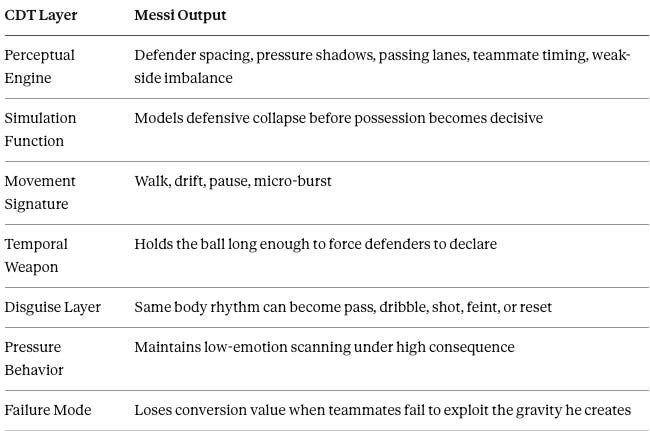
nterpretive finding: Messi turns stillness into field computation. His CDT shows how a player can reduce movement while increasing control. The causal trait is not walking. The causal trait is scanning before intervention.
Federer simulates a dyad.
Tennis resets him into a structured duel every point: serve, return, rally, recovery. His CDT archetype is Predictive Court Geometry. He models the next two shots rather than only the incoming ball, arrives early enough to stay balanced at contact, and holds identical preparation for multiple outcomes until the last legible instant. Balance gives him options. Options give him disguise. Disguise gives him control.
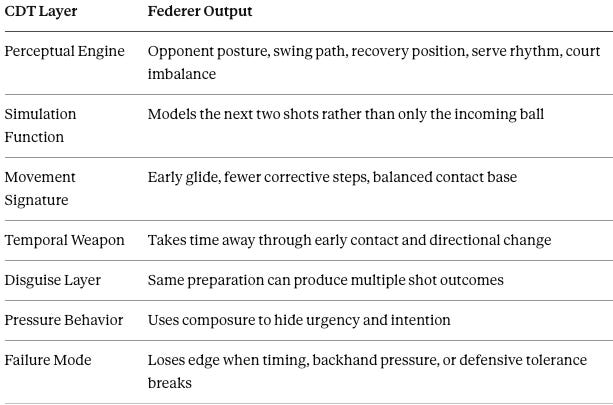
Interpretive finding: Federer turns anticipation into geometry. His CDT shows how early cognition produces movement economy, and movement economy produces disguise. The causal trait is not elegance. The causal trait is early arrival with options intact.
Tiger simulates the environment and the self.
Golf removes the direct defender and replaces him with wind, lie, slope, leaderboard consequence, tournament memory, and the athlete’s own nervous system. His CDT archetype is Pressure Course Geometry. He imagines several shot shapes under constraint, selects the highest-leverage path, and converts pressure into a signal-processing advantage while the field experiences the same pressure as noise.
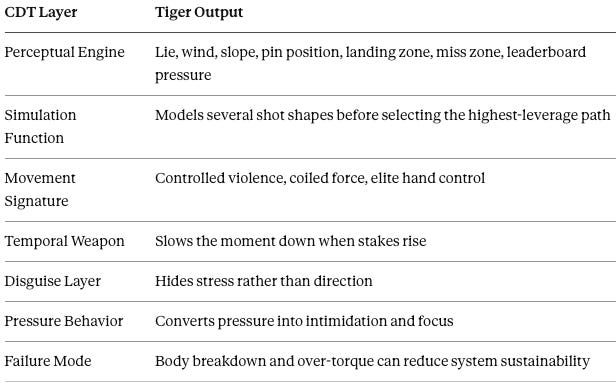
Interpretive finding: Tiger turns pressure into architecture. His CDT shows how shot selection can integrate environment, self-command, and competitive intimidation. The causal trait is not aggression. The causal trait is pressure-filtered risk.
Swarm modeling, adversarial dyad modeling, and environment-plus-self modeling cover the three cleanest public regimes for explaining competitive prediction. Together, Messi, Federer, and Tiger demonstrate the central MindCast claim: a CDT can model coherence across different games because the underlying decision architecture remains legible.
VIII. The Shared Mechanism: Five Traits of Predictive Control
Across all three regimes, the same five traits recur. MindCast AI names the pattern Predictive Control Athletics.
Perception compression. Average athletes experience complexity as noise; predictive-control athletes experience complexity as structure. Messi compresses the swarm into pressure shadows and collapsing lanes. Federer compresses the rally into posture, swing path, and recovery position. Tiger compresses the course into target windows and miss zones. Each has already ranked the signals that matter, which is why none of them chases.
Movement economy. Effortless movement comes from early cognition. Athletes who solve the problem late must move violently to compensate. Athletes who solve the problem early move with visible restraint — Messi’s walk, Federer’s glide, Tiger’s rehearsed swing expressing a finished decision rather than a desperate adjustment.
Late binding. Here lives the cruelest advantage in sport. The predictive athlete delays final commitment until the opponent, environment, or pressure field reveals itself. Messi holds the ball until defenders declare. Federer holds identical racket preparation until direction becomes unreadable too late. Tiger commits only after integrating lie, wind, and tournament context. The opponent commits first. The predictive athlete acts second — and arrives first in consequence.
Spatial command. Coherent athletes change how space behaves for everyone else. Messi creates gravity. Federer stretches the court into opponent overextension. Tiger makes aggressive lines feel playable for himself and dangerous for everyone chasing him. The performance looks graceful because the athlete never appears rushed; the underlying effect stays brutal because opponents lose shape, time, and margin.
Pressure coherence. Pressure exposes weak decision systems and clarifies strong ones. Messi scans with the same detachment when the game tightens. Federer stayed elegant under tactical siege. Tiger inverted the relationship entirely — he made the field feel his pressure while he processed his own. All three turned stress into signal.
IX. Vision Functions: Turning CDTs Into Foresight
The Cognitive Digital Twin explains the decision system. The Vision Function runs that decision system forward.
A MindCast AI Vision Function is a deployable simulation frame that asks what a CDT will do next, how an environment will adapt, and which standards will change because the decision system proved superior under pressure. The CDT provides the actor model. The Vision Function provides the foresight lens.
MindCast AI runs Vision Functions as live-fire predictive infrastructure, a runtime discipline documented in Live-Fire Game Theory Simulators, Runtime Predictive Infrastructure. The discipline works in four moves: identify the dominant causal layer, load the governing framework, generate forward conditions that specify exactly how the model can be wrong, and log each prediction at issuance with observable confirmation signals and explicit disconfirmation windows. Inside the engine, Vision Functions route, weight, sequence, and arbitrate the causal domain models competing to explain each contest. Runtime Geometry, A Framework for Predictive Institutional Economics supplies the structural layer beneath the actor models — the incentive geometry and equilibrium logic each CDT operates inside. The Predictive Cognitive AI Infrastructure Revolution established the founding claim behind all of it: CDTs simulate judgment rather than generating text.
The trifecta pipeline runs in three stages. Each athlete CDT enters the runtime as an actor model built from the seven observable layers. Vision Functions then route each CDT through prospective simulation frames — standard resets, trait transfer, imitation distortion, pressure coherence, generational selection. Dynamic Predictive Game Theory resolves the strategic layer: how defenses, opponents, tournament fields, coaching ecosystems, and media narratives adapt around the superior decision system, and which future game emerges from that adaptation. The output arrives as committed, falsifiable predictions with confidence bands — the forecasts in Section X.
For this essay, the operative Vision Function is Predictive Greatness Vision. The function asks a specific forward-looking question: how do athletes of this magnitude reset the standard of excellence after their peak dominance ends?
Predictive Greatness Vision runs each athlete CDT through five prospective layers:
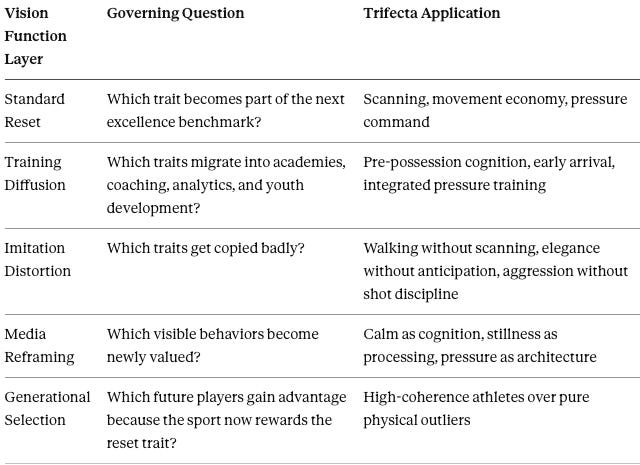
Predictive Greatness Vision leads a six-simulation foresight suite. MindCast AI ran each athlete CDT through five additional Vision Functions — Coherence Transfer Vision, Dynamic Predictive Game Theory Vision, Imitation Distortion Vision, Coherence Under Pressure Vision, and Generational Selection Vision — each testing a distinct forward-looking question. The full simulation outputs appear in the Appendix. The cross-simulation synthesis reduces to one table:
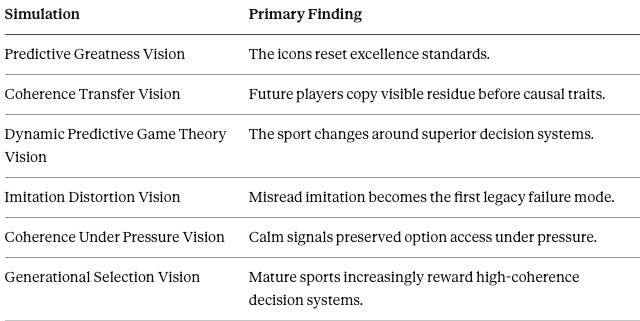
The Vision Function suite turns admiration into forecast discipline. Instead of saying Messi, Federer, and Tiger were great, MindCast AI asks what their greatness changes. Which traits become teachable? Which traits become measurable? Which traits become misunderstood? Which future athletes inherit the standard and which merely copy the aesthetic residue?
One structural insight emerges before any specific prediction: future players rarely copy the genius — they copy the visible residue. Young soccer players copy Messi’s walking without his scanning. Young tennis players copy Federer’s fluidity without his early read. Young golfers copy Tiger’s aggression without his shot filter. Sports must learn which part of the icon was causal and which part was aesthetic residue, and the CDT exists precisely to separate the two.
X. Committed Forecasts
A prospective MindCast AI simulation adds the forward-looking question: how do athletes of this magnitude change the future standard of excellence?
Messi, Federer, and Tiger did not merely dominate their eras. Each athlete reset what future players, coaches, academies, broadcasters, scouts, and fans learned to value. Messi elevated scanning, field gravity, and micro-acceleration. Federer elevated movement economy, disguised geometry, and aesthetic efficiency. Tiger elevated pressure command, shot imagination, and competitive intimidation.
MindCast AI states each forecast with a confidence band, committed before the outcomes resolve — the same frozen-method discipline governing the firm’s live World Cup 2026 simulation cycle and documented in MindCast Predictive Game Theory + Behavioral Economics Cognitive Digital Twin Foresight Simulations in the World Cup and Super Bowl. Commitment requires convergence on two fronts: behavioral equilibrium among the twinned actors and institutional equilibrium in the surrounding game. No prediction closes until both settle.
Prediction 1: Soccer will increasingly treat scanning as a measurable elite trait.
Messi’s legacy will push soccer development toward explicit scanning, body orientation, and pre-possession cognition. Academies already value technical control, but the next standard will place greater emphasis on what a player sees before receiving the ball. Coaches will increasingly distinguish between players who look calm and players who actually process the field.
Primary forecast: Elite youth development will increase formal scanning instruction, video feedback, and off-ball cognition metrics over the next 5–10 years. Confidence band: 80–85%.
Secondary forecast: Messi imitators who walk without processing will face tactical criticism as coaches separate authentic field simulation from passive drifting. Confidence band: 75–80%.
Prediction 2: Tennis will keep absorbing Federer’s movement economy, but only a small class of players will reproduce the full architecture.
Federer’s legacy will continue to shape how tennis defines beautiful efficiency. Future players will chase lighter footwork, earlier preparation, cleaner contact, and disguised shot patterns. The full Federer architecture will remain rare because elegance depends on anticipation, not style alone.
Primary forecast: Tennis coaching will continue to reward first-step anticipation, balanced contact, and shot-disguise patterns as markers of elite development. Confidence band: 80–85%.
Secondary forecast: Many Federer-influenced players will copy the aesthetic of effortlessness without reproducing his decision speed, causing a gap between visual elegance and match resilience. Confidence band: 70–75%.
Prediction 3: Golf will treat Tiger’s pressure architecture as a permanent benchmark, but the next generation will pursue a more sustainable version.
Tiger’s legacy will keep changing golf because he reset expectations for physical preparation, shot imagination, aggressive tournament control, and psychological intimidation. Future stars will try to retain Tiger’s pressure command while reducing the physical cost that came with his high-torque system.
Primary forecast: Elite golf development will continue merging athletic training, course strategy, shot-shaping, mental performance, and data-guided risk management into one integrated excellence model. Confidence band: 85–90%.
Secondary forecast: Future Tiger-influenced players will pursue pressure dominance with less bodily violence, favoring sustainable power and decision discipline over maximum-force mythology. Confidence band: 75–80%.
Prediction 4: Global sports commentary will increasingly value hidden cognition over visible hustle.
Messi, Federer, and Tiger help fans understand that visible effort does not equal control. The next media standard will increasingly praise scanning, economy, timing, gravity, and pressure management. Commentary will gradually move from “how hard did the athlete work?” toward “how early did the athlete solve the problem?”
Primary forecast: Broadcast and social analysis across major sports will increasingly use cognition-based language: scanning, gravity, processing, spacing, sequencing, and pressure management. Confidence band: 80–85%.
Secondary forecast: Fans will still overvalue visible intensity in lower-information settings, especially when an athlete’s quiet style fails to produce a highlight outcome. Confidence band: 85–90%.
Prediction 5: Future excellence will favor high-coherence athletes over pure physical outliers in mature sports.
Mature sports eventually compress physical margins. Training science spreads. Analytics spreads. Nutrition spreads. Young players become stronger, faster, and more technically polished. Competitive advantage then shifts toward athletes who combine physical tools with superior perception, prediction, and emotional coherence.
Primary forecast: The next generation of transcendent athletes will increasingly resemble hybrid decision systems: technically elite, physically prepared, tactically literate, emotionally regulated, and able to simulate multiple future states under pressure. Confidence band: 80–85%.
Secondary forecast: Pure athletic dominance will still matter most in early development and in sports where raw physical margins remain decisive, but mature professional tiers will reward predictive coherence more heavily. Confidence band:75–80%.
XI. The Vision Statement
MindCast AI builds Cognitive Digital Twins because the world runs on decision systems, and decision systems reveal themselves most honestly under pressure. Sports offer the cleanest laboratory on earth: bounded rules, visible behavior, measurable consequence, and — during World Cup month — the undivided attention of the planet.
Messi, Federer, and Tiger prove the thesis in three languages every fan already speaks. Messi sees the field before it opens. Federer reached the ball before panic could appear. Tiger saw the shot before pressure could distort it. Three sports, three simulation regimes, one architecture: predictive greatness looks effortless because the decisive work happens before everyone else sees the problem.
Messi, Federer, and Tiger make Cognitive Digital Twins visible: field, court, and course become three laboratories for observing how coherent decision systems preserve prediction under pressure.
Coherence is the decisive early work made visible. MindCast AI simulates it, forecasts it, and commits its predictions before the future arrives — the same standard the trifecta set on the field, the court, and the course.
Dynamic Predictive Game Theory explains the final turn: the greatest athletes do not merely win inside a game; they force the next version of the game to form around them.
Messi, Federer, and Tiger do not merely prove that great athletes see earlier. They prove why MindCast AI builds Cognitive Digital Twins: the future belongs to decision systems that preserve coherence when the game, the opponent, the environment, and the standard of excellence all begin to change.
Appendix: Foresight Simulation Detail
Foundational MindCast References
MindCast AI Vision Statement: AI Era Law and Behavioral Economics — the founding statement of Cognitive Digital Twin methodology: CDTs model how actors decide rather than predicting what they will say.
MindCast Files Provisional Patent Application on Multi-Agent Institutional Simulation Architecture — public disclosure of the multi-agent Cognitive Digital Twin simulation architecture powering the MindCast AI Proprietary Cognitive Digital Twin Engine.
The Cybernetic Foundations of Predictive Institutional Intelligence — the Wiener–Ashby–Beer intellectual lineage behind CDT architecture, with validated predictions including the pre-committed Super Bowl LX simulation.
MindCast AI Emergent Game Theory Frameworks — the five-framework game theory doctrine formalized from applied practice, supplying the strategic-contest logic Dynamic Predictive Game Theory extends here.
The Computational Era Operationalizes Cybernetics and Predictive Game Theory — the case that classical game theory assumed stable actors and slow feedback, while predictive cybernetic systems model adaptation before outcomes emerge.
MindCast Predictive Game Theory + Behavioral Economics Cognitive Digital Twin Foresight Simulations in the World Cup and Super Bowl — the four-method sports validation stack and frozen-method discipline governing the committed forecasts in Section X.
Live-Fire Game Theory Simulators, Runtime Predictive Infrastructure — the field guide to the MindCast analytical stack: foresight simulations, pre-simulation publications, vision statements, and validation publications, with the pre-committed prediction ledger and falsification architecture.
Runtime Geometry, A Framework for Predictive Institutional Economics — the four-pillar structural framework (Field-Geometry, Nash-Stigler Equilibrium, Tirole Advocacy Arbitrage, Systemic Externality Analysis) integrating Chicago School economics with CDT methodology.
The Predictive Cognitive AI Infrastructure Revolution — the founding infrastructure publication: Cognitive Digital Twins as proprietary cognitive infrastructure that simulates judgment rather than generating text.
A. System Architecture
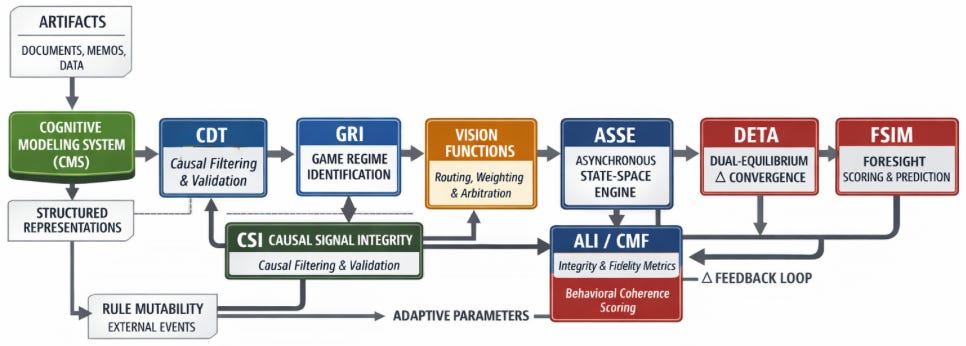
The full patent-pending system architecture. The coherence metrics below — Action Language Integrity and Cognitive-Motor Fidelity — operate as the architecture’s continuous integrity and fidelity monitors, feeding the cybernetic feedback loop and the falsification scoring that governs every prediction in this report.
B. CDT Coherence Metrics
MindCast AI scores the trifecta through coherence metrics that connect visible behavior to hidden decision architecture. The foundational references above supply the methodological baseline: a CDT models the hidden decision architecture of an actor rather than merely describing the visible outcome, and forecasting follows only after the CDT architecture becomes coherent enough to run through Vision Functions.
Cognitive-Motor Fidelity (CMF) measures the match between prediction and movement. A high-CMF athlete does not merely see the right option — the body expresses the prediction with minimal waste. Messi’s CMF appears in micro-touches, balance, and sudden acceleration after scanning. Federer’s CMF appears in early arrival, fewer corrective steps, and balanced contact. Tiger’s CMF appears in shot shape, swing commitment, and tempo control under pressure.
Action Language Integrity (ALI) measures whether visible action honestly expresses the underlying decision system. Messi’s ALI remains high when walking functions as scanning rather than passivity. Federer’s ALI remains high when smooth mechanics express anticipation rather than aesthetic softness. Tiger’s ALI remains high when aggression expresses filtered risk rather than emotional force.
Relational Integrity Score (RIS) measures how well the athlete stays synchronized with the contest environment: how teammates, defenders, and passing lanes reorganize around Messi; how Federer’s shot selection reshapes the opponent’s recovery path; how Tiger’s decisions integrate course setup, weather, leaderboard pressure, and opponent psychology.
Causal Signal Integrity (CSI) measures whether observed behavior reflects the true causal mechanism of greatness or only visible residue. A low-CSI reading mistakes Messi’s walking for rest, Federer’s elegance for style, or Tiger’s aggression for bravado.
Causal Signal Integrity = (Action Language Integrity + Cognitive-Motor Fidelity + Relational Integrity Score) / Distortion of Context²
Distortion of Context (DoC) represents the degree to which observers, imitators, or analysts misread visible behavior. As DoC rises, CSI falls. The formula expresses a structural relationship — a direction-of-effect statement — rather than a computed quantity; the indicative scores below are structured priors, not outputs of this equation. The formula matters because Messi, Federer, and Tiger are easy to admire but easy to misread.
Indicative CDT Coherence Scores (qualitative MindCast diagnostic outputs, not biometric measurements):

Interpretive output: Messi scores highest on RIS because soccer creates the densest multi-agent environment. Federer scores highest on CMF and ALI because his anticipation translated into movement and shot grammar with unusual purity. Tiger scores strongest in pressure-integrated relational coherence because his decisions absorbed the course, leaderboard, field, and self-command. Confidence band: 80–85%. The exact scores remain interpretive, but the clustering and directional findings fit the CDT architecture.
C. Vision Function Simulation Outputs
Coherence Transfer Vision — Governing question: which parts of genius can future players copy, and which parts will they misread?
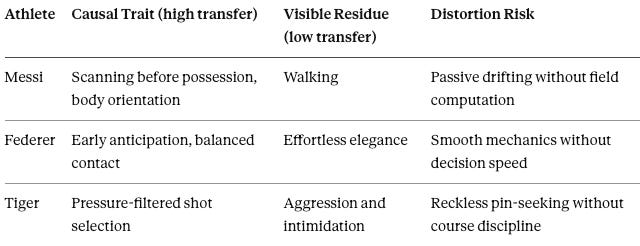
Predictions: coaches will punish passive Messi imitation and reward provable scanning outputs (75–80%); Federer comparisons will keep overrating aesthetically smooth players before pressure testing them (75–80%); sustainable decision discipline will outperform reckless Tiger-style aggression (75–80%).
Dynamic Predictive Game Theory Vision — Governing question: which game will exist next, and which actor remains coherent when it arrives? Environmental CDTs modeled: Opposing Defense CDT, Tennis Opponent CDT, Golf Field CDT, Coaching Ecosystem CDT, Media Narrative CDT.

Predictions: broadcast and coaching language will increasingly describe Messi-style gravity as a structural force (80–85%); tennis analysis will keep distinguishing efficient anticipation from mere footspeed (80–85%); golf will increasingly frame pressure response as a measurable capability rather than a vague mental trait (85–90%).
Imitation Distortion Vision — Governing question: which visible behaviors will future players copy incorrectly?Primary CDTs: Future Soccer Prospect CDT, Future Tennis Prospect CDT, Future Golf Prospect CDT.

Young players will imitate the visible signature before they understand the causal architecture. Coaching systems then face a second-stage task: recover the true mechanism from the aesthetic residue. Predictions run 75–80% across all three sports.
Coherence Under Pressure Vision — Governing question: does pressure reduce options, or does pressure sharpen option selection? Primary metrics include the Pressure Coherence Index.

Calm is not a mood. Calm is evidence that the decision system still has access to its options. Predictions: analysis will increasingly distinguish emotional calm from cognitive access under pressure (80–85%); elite programs will treat pressure performance as trainable pattern integrity rather than personality alone (80–85%); public commentary will still overvalue visible intensity when quiet coherence fails to produce a highlight (85–90%).
Generational Selection Vision — Governing question: which player types become more valuable after the sport absorbs the icon’s standard reset? Primary CDTs: Next-Generation Soccer Creator CDT, Next-Generation Tennis Artist CDT, Next-Generation Golf Champion CDT.

Physical advantages diffuse through training science, nutrition, analytics, and development systems. Decision architecture diffuses more slowly because perception, timing, emotional regulation, and contextual awareness remain harder to teach.
D. Limitations, Measurement Pathway, and Falsification
Three methodological objections deserve direct answers.
On quantification. The indicative scores are structured expert priors, not measurements — the report labels them exactly that way. Each metric carries an observable proxy that converts the prior into an instrumented value: scanning frequency and head-turn counts for the perceptual layer, corrective steps per possession or rally for Cognitive-Motor Fidelity, decision-to-action consistency in logged pressure situations for Action Language Integrity, and opponent repositioning data for Relational Integrity Score. Existing player-tracking systems can instrument every proxy, and third parties can run the instrumentation independently. The scores stand as falsifiable priors awaiting measurement, not as findings.
On orthogonality. Movement Signature, Movement Economy, and Cognitive-Motor Fidelity occupy three different levels of the stack: description (what the movement looks like), pattern (the trait recurring across all three athletes), and diagnostic (how faithfully the body executes the prediction). Correlation across levels is by design — each metric scores a layer, so metric and layer move together. Within the metric set itself, the four measures target distinct relations: prediction-to-body (CMF), decision-to-action-meaning (ALI), actor-to-environment (RIS), and observer-to-mechanism (CSI).
On post-hoc calibration. The trifecta analysis is retrodictive by design: it validates the constructs against the richest public record available. The predictive claim rests elsewhere — on the frozen-method World Cup 2026 cycle, where advancement probabilities commit before matches resolve, and on the Section X forecasts, which carry explicit confidence bands and multi-year falsification windows. The harder blind test — applying the architecture to unheralded prospects before the market identifies them — is the stated next stage of the validation program.