
I. Executive Summary
Prediction markets, sports media, statistical forecasters, video-game engines, and artificial intelligence simulators now compete to answer the same public question: who will win? MindCast AI asks a deeper operational question: which decision system remains coherent when pressure, constraint, incentives, fatigue, narrative, and opponent adaptation collide?
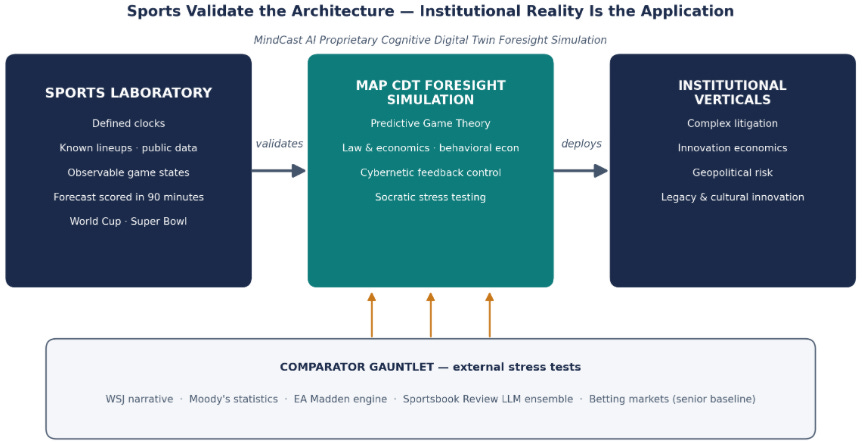
MindCast uses sports as a bounded validation laboratory for the MindCast AI Proprietary Cognitive Digital Twin Foresight Simulation system. Sports offer defined clocks, known participants, public lineups, observable statistics, discrete game states, fast feedback loops, and unambiguous outcomes. Defined clocks and public outcomes make sports a high-resolution proof environment for a system ultimately designed for higher-complexity domains: complex litigation, innovation economics, geopolitical risk, legacy systems, cultural innovation, antitrust, prediction-market regulation, artificial intelligence infrastructure, and institutional strategy.
World Cup and Super Bowl simulations therefore serve a purpose beyond entertainment, betting, or fan engagement. Tournament and championship events let MindCast test whether its predictive game theory, cybernetic feedback architecture, behavioral economics layer, and Cognitive Digital Twin models can identify the mechanism that produces an outcome before the outcome arrives.
Four named methods form the stack under validation: MindCast Predictive Game Theory models the agents, Chicago-lineage law and economics models their incentive structures, behavioral economics models their bounded decisions, and Socratic stress testing tries to destroy the model before reality does. Comparisons with the Wall Street Journal, Moody’s Analytics, EA Madden NFL, Sportsbook Review, and betting markets add external stress tests. Each comparator models a different layer of sports reality; MindCast models the decision system beneath them.
II. The Sports Forecasting Stack
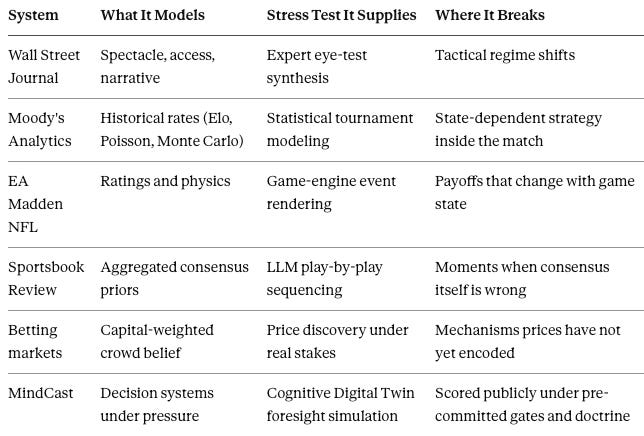
Sports forecasting now operates across multiple paradigms. The Wall Street Journal represents elite narrative synthesis. Moody’s Analytics represents statistical probability modeling. EA Madden NFL represents ratings-based physics simulation. Sportsbook Review represents large-language-model play-by-play sequencing. Betting markets represent price discovery under capital at risk. MindCast represents mechanism-level foresight through Cognitive Digital Twins — behavioral models of the decision-makers themselves, capturing how a player, coach, or institution decides under pressure, rather than statistical ratings of what they have produced.
The Wall Street Journal’s World Cup coverage offers the cleanest mainstream news hook. In The Most Complete Team at This World Cup Is a Complete No-Brainer, Joshua Robinson frames France as the tournament’s most thrilling and most complete team after a 3-0 win over Sweden, citing France’s 13 goals in four games, Kylian Mbappé’s six goals, and Michael Olise’s five assists. Reuters reinforced the same hook in France’s fearsome attack enters debate over World Cup’s greatest forward line, placing Mbappé, Ousmane Dembélé, Olise, and Bradley Barcola inside a broader debate about historically elite World Cup attacks.
MindCast does not reject the WSJ–Reuters surface read. France may be the tournament’s most dangerous side. The methodological question, however, begins where the eye test ends: does France’s apparent completeness survive adversarial constraint? A complete team must not merely overwhelm open opponents. A complete team must preserve decision quality when an opponent lowers event volume, removes transition space, slows tempo, forces restarts, extends frustration, and shifts pressure from underdog to favorite.
III. Sports as Laboratory, Not Destination
MindCast does not use sports because sports are the final market. MindCast uses sports because sports provide the rare public environment where complex decision systems resolve inside fixed windows and leave a verifiable record. Feedback velocity completes the case: a complex-litigation forecast waits years for its scoring event, while a knockout match scores its forecast in ninety minutes. Velocity, not merely boundedness, makes sports the laboratory — the one property no institutional vertical can replicate, and the reason the sports corpus exists at all.
A football game supplies a clock, field geometry, personnel groupings, scoreboard state, down-and-distance constraints, fatigue patterns, coaching decisions, substitutions, injuries, penalties, and visible execution. A soccer knockout match supplies tactical shape, match state, territorial control, pressing intensity, substitution windows, card risk, crowd amplification, environmental stress, and extra-time or penalty pathways. Both sports compress decision-making into a bounded adversarial system that can validate or falsify a simulation within hours — and expose whether a model captured the mechanism or merely guessed the result. Rich sports data does not eliminate the foresight problem; the quantified surface makes the latent decision-policy problem more testable, because the observable record can confirm or falsify the behavioral mechanism.
MindCast’s Betting AI vs. Foresight AI established that betting artificial intelligence optimizes for lines, props, spreads, and expected value, while MindCast Foresight AI models Cognitive Digital Twins of players, coaches, and institutions under live stress. The distinction matters for prediction-market executives and sports data scientists because market accuracy alone does not reveal causal mechanism. A market price may identify consensus belief, but it does not explain which behavioral system will break, adapt, or stabilize.
MindCast’s Super Bowl LX — AI Simulation vs. Reality then turned sports into a validation event. EA Madden, Sportsbook Review, and MindCast all picked Seattle. The difference sat in the theory of football each model implied. Madden rendered game events through a ratings-and-physics engine. Sportsbook Review generated play-by-play plausibility through coordinated language models. MindCast predicted structural resolution conditions, time gates, branch asymmetry, and falsification triggers — published twelve days before kickoff in Seahawks v. Patriots, Super Bowl LX.
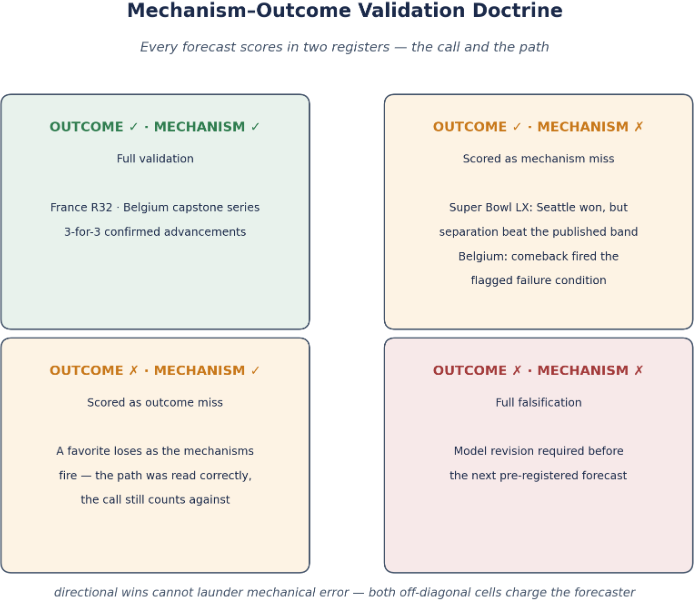
Accountability requires scoring the misses beside the hits, and the Super Bowl record carries one. The published band called Seattle by four to ten points with a one-score game entering the fourth quarter. Reality delivered a sixteen-point win with separation that arrived earlier and larger than the model specified. Direction held; magnitude and timing missed.
The distinction matters because mechanism-level foresight must score not only the winner, but also the path. MindCast grades the miss under its own Mechanism–Outcome Validation Doctrine, formalized in World Cup Validation Report III after Belgium advanced past Senegal through a comeback that fired the forecast’s published mechanism-failure condition even as the advancement call held. The doctrine scores two registers separately — conditions that falsify the mechanism and conditions that falsify the outcome call — and exists to prevent directional wins from laundering mechanical error. No comparator in this document can publish an equivalent sentence, because no comparator pre-committed to anything a miss could be scored against.
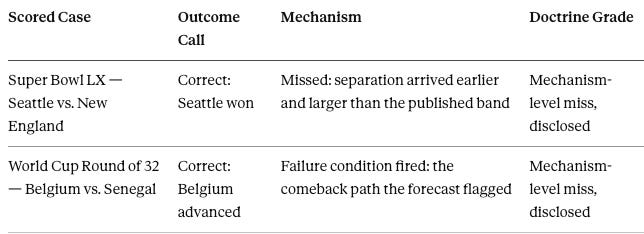
Both cases charged MindCast in opposite registers — one on the path, one on the trigger — which is what separates a scoring instrument from a scoreboard of victories.
Contact mcai@mindcast-ai.com to partner with us on Predictive Game Theory AI in Law and Behavioral Economics. To deep dive on MindCast works upload the URL of this publication into any LLM (preferably Google AI mode/Gemini, Claude, ChatGPT) and prompt ‘reconstruct MindCast framework with three degrees of cited sub links.’ See Live-Fire Game Theory Simulators, Runtime Predictive Infrastructure. Recent projects
The Duty to Foresee — AI Deployment Readiness as Prospective Governance — Formalizes the AI Hand Formula and forecasts, on a falsification window through 2030, that pre-deployment foresight simulation migrates from competitive edge to legal standard of care as agent autonomy raises expected harm while simulation cost collapses.
Evidence Before Allegation in Diageo — Applied Cognitive Digital Twin simulation to active federal litigation, predicting that the plaintiffs’ undisclosed-lab-evidence posture would survive pleading on narrative coherence while collapsing under evidentiary scrutiny, and proposing the Trust Burden Gate as the pre-discovery screen.
| The World Cup Is the First Mass-Market Stress Test for Prediction Markets: Extended the National Prediction Market Litigation Architecture series into the sports-foresight laboratory, formulating a prediction market on the prediction-market competition for the World Cup — five falsifiable gates covering France's mechanism regime, Kalshi and Polymarket's post-tournament volume trajectory, Rothera's structural share, and the state-versus-federal characterization war — and scored the first gate on game day when Paraguay 0, France 1 vindicated mechanism-classification methodology over both the market's completeness thesis and the rankings model's discount.
IV. External Comparators as Stress Tests
Comparators matter because every prediction model carries a hidden theory of the system it models. A methodology comparison therefore does more than promote MindCast. Comparison stress-tests MindCast against rival forecasting epistemologies. Socratic stress testing means adversarially attacking the model’s assumptions, gates, and causal claims before the event can expose them, and the gauntlet operationalizes the method: each rival epistemology supplies the counterexample hunt, and the pre-published falsification contract stands as a permanent invitation to refute. Much of modern forecasting avoids mechanism-level refutation; MindCast solicits it.
The Wall Street Journal tests MindCast against expert narrative synthesis. WSJ identifies visible dominance, star power, team confidence, and emotional momentum. MindCast asks whether visible dominance maps onto decision-policy stability under constraint.
Moody’s Analytics tests MindCast against statistical tournament modeling. MindCast’s When a FIFA World Cup Model Picks France and the Economist Picks Argentina examined a Moody’s World Cup tracker in which the model picked France while the economist personally picked Argentina because Western Hemisphere geography, fan travel, and Latin American diaspora density could create effective home-field advantage. MindCast treated the disagreement not as noise, but as signal. The model measured output probability; the human override identified environmental mechanism.
EA Madden NFL tests MindCast against simulation as event rendering. CBS Sports reported that its Madden NFL 26 simulates Super Bowl 2026 winner projected a 23-20 Seahawks win and carried a strong recent Super Bowl track record. Madden supplies a useful comparator because it simulates collisions, ratings, animations, and game sequences. MindCast asks a different question: what decision regime governs the game, and when does the losing branch become structurally unrecoverable?
Sportsbook Review tests MindCast against large-language-model play-by-play sequencing. Sportsbook Review’s Super Bowl AI Prediction & Stat Projections 2026 used ChatGPT, Gemini, and Claude to simulate every play of Seahawks vs. Patriots with projected stats and a full game script. LLM play sequencing can generate plausible narrative detail, but MindCast requires causal gates and falsification conditions. Plausibility is not foresight unless the model specifies what would prove the mechanism wrong.
Betting markets outrank every other comparator, and the ranking deserves candor. WSJ risks nothing on its narratives. Madden simulates without stakes. Sportsbook Review’s ensemble answers to the scoreboard, but not to a pre-published causal-gating contract. Markets alone punish error with capital, which makes the closing line the only baseline whose defeat carries commercial meaning. Beating a video game proves category difference; beating the close proves alpha.
Super Bowl LX supplied the exhibit: markets closed near Seattle –1.5, MindCast’s pre-committed structural read pointed at a dominance the price had not found, and reality delivered a sixteen-point Seattle margin. The 2026 “Prediction Arena” benchmark, which evaluated frontier models trading on live Kalshi and Polymarket markets, reinforces the broader point: the models produced sharply different returns across platforms, suggesting that platform design and market microstructure materially shape model performance. MindCast’s relevance to prediction-market executives begins there: the future belongs not only to better traders, but also to better structural diagnostics explaining why markets misprice adaptive systems.
V. MindCast Predictive Game Theory
MindCast Predictive Game Theory starts from a different premise than conventional forecasting. Historical data matters, but live strategic systems often change faster than historical distributions can remain informative. The decisive unit becomes the adaptive actor inside a changing system.
MindCast’s The Computational Era Operationalizes Cybernetics and Predictive Game Theory defines the convergence: cybernetics explains adaptive systems and feedback, predictive game theory explains strategic adaptation inside recursive systems, and behavioral economics explains how actors actually decide under cognitive constraint, reference dependence, and information asymmetry. Modern artificial intelligence infrastructure supplies the operational substrate that older cybernetic and game-theoretic traditions lacked.
MindCast’s How MindCast Evolves the Structural Gaps in Classical Nash Game Theory sharpens the theoretical break. Classical game theory models strategic interaction inside a fixed system. MindCast models the system itself across forums, information layers, time delays, and constraints. Once the system becomes the strategic object, equilibrium no longer functions as the final output. Trajectory becomes the output.
MindCast’s Predictive Game Theory AI vs. Market Predictive AI turns that theory into an operational distinction. Market predictive artificial intelligence extrapolates from historical distributions when rules remain stable enough for past patterns to stay informative. MindCast models multi-actor behavioral economics, strategic interaction, constraint geometry, and feedback loops when rules mutate during play.
Law and economics supplies the incentive layer, and the lineage is Chicago: Coase on transaction structure, Becker on revealed preference, Posner on institutional incentives. Behavioral economics supplies the decision layer: reference dependence, loss aversion under game-state pressure, bounded rationality, and adaptation limits. Together the two layers explain a design choice that separates MindCast from every comparator in this document — Cognitive Digital Twins model decision-makers as incentive-bearing agents under cognitive constraint, rather than as statistical rates or ratings.
Sports commentary already saturates the market with pop-behavioral vocabulary: momentum, confidence, clutch. MindCast’s behavioral layer runs on the disciplined version — observable incentives, revealed preferences under constraint, and falsifiable predictions about when a decision policy breaks. Moody’s economist overriding his own model on environmental grounds was a behavioral-economics event; the model had no layer capable of representing it. MindCast builds that layer in.
VI. Cybernetics and Feedback Control
Cybernetics gives MindCast the control layer. Sports data scientists already understand feedback loops through momentum, substitution patterns, pressing triggers, pass protection adjustments, play-calling tendencies, fatigue effects, and opponent adaptation. MindCast extends that intuition into formal institutional simulation.
MindCast’s Cybernetic Game Theory argues that modern systems stabilize through feedback control, delay strategies, narrative shaping, and constraint geometry rather than clean rational optimization. The same logic appears in sports. A team does not always win because it makes the best isolated decision. A team often wins because it closes feedback loops faster than the opponent, adapts before the opponent can punish, and forces the opponent into a decision environment where its preferred identity no longer works.
France offers the current World Cup example. WSJ and Reuters observe attacking dominance. MindCast translates the observation into a cybernetic question: can France preserve loop closure when Paraguay, Spain, Argentina, England, or another knockout opponent changes the feedback environment? France wins if the match becomes talent expression. France becomes vulnerable if the match becomes patience cost, frustration management, and transition-risk control.
Team USA offers a second live hook. WSJ reported that the United States beat Bosnia and Herzegovina 2-0 despite playing the final 30 minutes with 10 men after Folarin Balogun’s red card, securing its first World Cup knockout victory since 2002 and setting up a Round of 16 clash with Belgium. For MindCast, the result matters less as national celebration than as behavioral validation. The United States encountered adverse state compression and did not collapse. Belgium now tests whether that resilience survives without Balogun and against a higher-complexity opponent.
VII. Cognitive Digital Twins as the Unit of Foresight
Cognitive Digital Twins are the core unit of MindCast simulation. A player CDT does not reduce an athlete to a rating, stat line, or expected contribution. A player CDT models decision tendencies, pressure response, adaptation limits, confidence state, trust pathways, timing preferences, and role coherence. A lineup CDT models spacing grammar, communication integrity, coordination timing, substitution elasticity, and vulnerability under stress. A matchup CDT models how one operating system forces another into less efficient decision states. Pre-registered gates serve as the empirical interface between latent decision policy and observable behavior: the policy cannot be measured directly, so the gates specify in advance which state-conditioned behaviors reveal it.
MindCast’s Provisional Patent Application on Multi-Agent Institutional Simulation Architecture formalizes the underlying architecture. The filing covers Cognitive Digital Twin Foresight Simulation through causal validation, adaptive model governance, dual-equilibrium foresight prediction, rule mutability, Cybernetic Feedback Control, Vision Function Architecture, and falsifiable outputs.
The architecture validates causal relationships before simulation and refuses to close a forecast until two separate conditions converge: behavioral equilibrium, where no modeled actor gains by changing strategy, and institutional sufficiency, where the governing rules and enforcement environment have stabilized enough for the behavioral read to hold. Parameters update when rules change during execution. Among the comparators in this document, none discloses a comparable causal-gating, dual-equilibrium, and falsification architecture; disclosure is itself a stress test, because a system that publishes its mechanism invites falsification a black box never faces.
Sports provide the training ground for the patented architecture. Mbappé’s acceleration policy, Olise’s connector stability, Dembélé’s dribble-risk tolerance, Barcola’s weak-side timing, Haaland’s service dependency, Vinícius Jr.’s rupture profile, Pulisic’s burden management, and a goalkeeper’s penalty-state confidence all become testable behavioral objects. Lineups become coordination systems. Matchups become strategic interactions. Outcomes become validation data.
VIII. From Sports Lab to Institutional Verticals
MindCast’s sports work fine-tunes a general-purpose foresight system. The bounded game environment teaches the model to identify decision-policy stability, feedback latency, branch collapse, regime shifts, emotional volatility, and constraint adaptation. Complex litigation, innovation economics, geopolitical risk, legacy systems, and cultural innovation run on the same features.
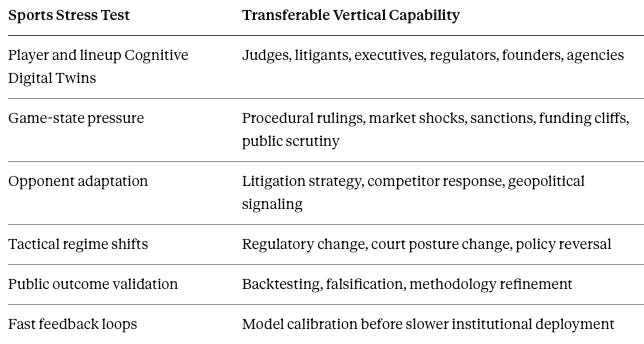
Complex litigation resembles knockout sport more than conventional legal analytics admits. Parties enter with public arguments, private constraints, procedural clocks, forum-specific rules, narrative commitments, judge-specific thresholds, evidence burdens, and reputational stakes. MindCast transfers sports-tested regime analysis into litigation foresight by asking when a party’s narrative becomes structurally unrecoverable, when cross-forum contradiction destroys credibility, and when settlement behavior reflects constraint geometry rather than preference.
Innovation economics presents the same adaptive-system problem at a different scale. Firms, investors, regulators, universities, incumbents, and infrastructure providers operate through feedback loops, platform incentives, network effects, coordination failures, and policy timing. Sports teach the system how talent fails when coordination breaks. Innovation economics asks how institutional talent fails when governance, capital timing, regulatory delay, or infrastructure bottlenecks break the innovation pathway.
Geopolitical risk extends the simulation into rule-mutating environments. State actors alter payoff structures while participating inside them. Export controls, sovereign compute policy, customs discretion, sanctions, infrastructure routing, and alliance signaling all change the game during play. Sports provide clean branch testing; geopolitics supplies multi-forum rule mutation.
Legacy and cultural innovation require a different kind of foresight: not merely whether an actor wins, but whether an identity, institution, or cultural system transmits across time. Sports reveal identity under pressure because teams carry national memory, civic narrative, supporter ecosystems, and expectation burden into bounded events. MindCast uses that same behavioral lens to model cultural institutions, public trust, legacy systems, and symbolic capital.
Precision about the transfer claim matters. Sports expose adaptive decision systems under pressure and resolve the forecast quickly enough to score the method; the same architecture then transfers to institutional verticals where decisions unfold more slowly, evidence arrives less cleanly, and the cost of being wrong is higher. Sports do not replace complex litigation, innovation economics, geopolitical risk, legacy analysis, or cultural innovation — litigation carries asymmetric information and procedural discretion, innovation carries capital cycles and governance drag, geopolitics carries deception and rule mutation that no bounded game reproduces. Sports fine-tune the foresight machinery before MindCast deploys it where those variables live.
IX. Strategic Value for Prediction Markets, Strategy, and Sports Data Science
Prediction-market executives should care because MindCast does not compete with markets as another opinion. MindCast can strengthen markets by identifying structural variables that prices may not yet encode. A market may tell participants what the crowd believes. MindCast can tell participants which belief rests on a fragile mechanism. The category line deserves precision: MindCast issues no contracts, takes no positions, and prices no events. MindCast borrows prediction-market discipline — timestamped, falsifiable, publicly scored forecasts — without entering the prediction-market business.
A question worth answering directly sharpens the category line further: are sports prediction methods themselves a form of prediction market? MindCast’s The Full Arc of Prediction Markets — which maps the prediction-market ecosystem as a chain of actors running from signal generation through belief aggregation to price clearing — supplies the answer by defining a market through mechanism rather than output. Markets aggregate capital-weighted positions into a clearing price; prediction methods are single-source estimators with no positions and no settlement.
Each comparator in this document occupies a position on the arc’s chain: WSJ as signal generator shading into narrative amplifier, Madden and Sportsbook Review as engagement-optimized signal generators, Moody’s as signal generator carrying institutional authority, and betting markets as the belief-aggregation layer itself. The ensemble of public methods functions at most as a shadow market cleared by attention rather than capital — and it fails where real markets can succeed, because every public method consumes the same statistics, narratives, and injury reports, so aggregating them produces shared bias rather than error cancellation. A method built on a different representational object — the decision system rather than the rate, the rating, or the narrative — supplies the one input that breaks the correlation.
Strategy executives should care because MindCast converts prediction from answer generation into decision infrastructure. A forecast that says France has the highest probability of winning carries one kind of value. A foresight simulation that explains which tactical, behavioral, and environmental triggers raise or lower France’s decision stability carries operational value before the market reprices.
Sports data scientists should care because MindCast does not discard quantitative modeling. MindCast supplies a higher-level architecture for deciding which variables matter, when they matter, and why they stop mattering when game state changes. Expected goals, Elo, player tracking, possession value, win probability, injury reports, and betting lines remain useful inputs. MindCast asks whether those inputs still measure the governing mechanism once pressure alters behavior.
X. Vision Statement and the Forward Test
MindCast AI uses sports as a bounded validation laboratory for the MindCast AI Proprietary Cognitive Digital Twin Foresight Simulation system. Sports compress adaptive decision-making into public, time-limited, data-rich environments where MindCast tests, falsifies, and recalibrates predictions in hours. The laboratory matters because MindCast’s real target is broader: complex litigation, innovation economics, geopolitical risk, legacy systems, cultural innovation, antitrust, prediction markets, and institutional strategy.
WSJ sees the team that looks complete. Moody’s estimates the team most likely to win. Madden renders the game. Sportsbook Review scripts the game. Betting markets price the game. MindCast simulates the decision system that causes the game to break.
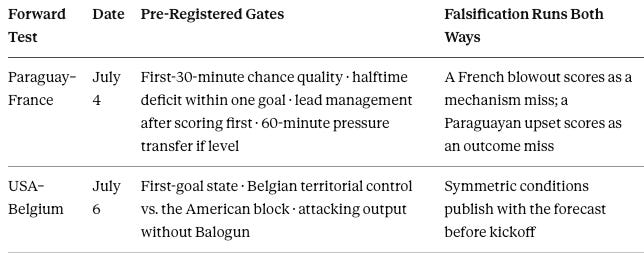
Vision statements earn credibility through the next falsifiable claim, not the last validated one. Two live instruments resolve within days of publication. Paraguay–France on July 4 tests whether France’s completeness survives an opponent whose penalty-shootout elimination of Germany revealed comfort with negative game states and terminal variance. The forecast will pre-register at least four observable gates: France’s first-30-minute chance quality, Paraguay’s ability to reach halftime within one goal, France’s lead-management behavior after scoring first, and the 60-minute pressure-transfer point if the match remains level — plus falsification conditions in both directions, so that a French blowout scores as a mechanism miss just as a Paraguayan upset would.
USA–Belgium on July 6 tests whether American resilience under adverse state compression survives the loss of Balogun against a higher-complexity opponent, with a parallel gate set covering first-goal state, Belgium’s territorial control against the American block, and attacking output without the suspended striker. MindCast will publish pre-registered forecasts for both matches — mechanism specified, gates observable, falsification symmetric, scored against the market close.
The next generation of prediction will not belong to the model with the most confident score. The future belongs to the system that identifies which actors preserve decision quality when the environment stops cooperating. MindCast builds toward that future by integrating MindCast Predictive Game Theory, cybernetic feedback control, law-and-economics incentive modeling, behavioral economics, Socratic stress testing, and Cognitive Digital Twins into falsifiable foresight simulation. Sports validate the architecture. Institutional reality is the application.
Appendix: Exhibit Record — Sample Validated Foresight In Institutional Verticals
The sports laboratory validates the machinery; the exhibits below show the same machinery deployed across the verticals. Group A collects validated foresight — dated forecasts confirmed by subsequent events. Group B collects doctrinal frameworks and forward forecasts whose falsification windows remain open.
MCAI Innovation Vision: MindCast AI’s NVIDIA NVQLink Validation — Predicted the technical architecture of quantum-AI interconnection — sub-5-microsecond latency, 300+ Gb/s throughput, 6–8 national laboratories, 12–15 quantum vendors — before NVIDIA’s October 2025 NVQLink announcement confirmed all five metrics within or beyond the forecast bands.
MCAI Innovation Vision: How the Chevron–Microsoft Project Kilby Agreement Validated MindCast’s Firm-Power Forecast — Named Microsoft as the first hyperscaler to sign a behind-the-meter firm-power co-location deal, ERCOT as the winning jurisdiction, and gas as the bridge fuel in a January 2026 scored forecast that the June 2026 Kilby announcement cleared two quarters early.
MCAI National Innovation Vision: The NSA–Anthropic Mythos Shock Led to the Commerce Allowlist MindCast Predicted — Forecast that value in frontier AI would migrate to authorization rather than capability, and the June 26, 2026 trusted-partner allowlist — restoring the stronger model first, to vetted institutions, on a revocable government roster — confirmed the access-over-capability thesis on the sequence itself.
MCAI National Innovation Vision: The Beijing Summit Validation — Validated the January 2026 Two-Gate Game forecast when the May summit produced U.S. H200 licensing approval with zero Chinese deliveries, confirming that import acceptance, not export eligibility, governs capability flow.
MCAI Lex Vision: Kalshi Loses Federal Forum — The Washington Remand Order — Documented a federal district court operationalizing the exact federal-state jurisdictional allocation MindCast specified in the Prediction Markets Rule Architecture series: federal authority over the trade does not displace state authority over the activity.
MCAI Lex Vision: If the Protect College Sports Act Passes, Private Equity in College Sports Wins Differently — Confirmed the January 2026 firm-formation forecast when Utah’s Crimson Brand Partners close delivered the predicted structure — governance-constrained operating company, minority private capital, commercial rights partitioned from athletic functions — with the ten-company diffusion count now tracking.