

Executive Summary
A frontier model demonstrated a capability no shared instrument could yet grade, and the United States, an allied intelligence bloc, and a prediction-market crowd all moved hard against the ungraded signal within ten days. The event reads, in the press, as a question about whether an AI broke into classified systems. Read through MindCast’s architecture, the breach claim is the least durable thing in the story. The durable thing is structural: capability arrived monthly, governance answered on policy and judicial time, and the distance between them produced the first correction sized at sovereign scale. The MindCast Governance Scarcity: The AI Economy’s Missing Unit of Account paper named that distance and predicted the correction. The Fable–Mythos suspension is the prediction resolving on a public record.
See related AI Governance Economics series
In brief:
The event — On June 12, 2026, Commerce applied a 2018 export statute to an AI model for the first time, forcing a worldwide suspension of Anthropic’s Fable 5 and Mythos 5. A Senate-relayed claim that Mythos breached nearly all NSA classified systems became the most-cited rationale, though the journalist who published it has since walked it back. Ten days later five intelligence agencies jointly warned the offensive-capability timeline runs in months.
The misread — Treating the breach quote as the object inverts cause and effect. Governance acted on what the model had been called, not on a graded measure of what it did, because no graded measure existed.
The thesis — Capability outran the institutions meant to oversee it at the level of the state, which is the Governance Gap Theorem (MindCast Governance Scarcity: The AI Economy’s Missing Unit of Account) instantiated where the stakes are highest, and NIBE’s Temporal Drag Coefficient (MindCast The Power Stack: How Energy Infrastructure Became the New AI Battleground) pinned at the extreme.
The sharpest signal — The joint White House–Anthropic risk framework now being drafted is the canonical scale governance scarcity has lacked, improvised under duress by the two parties to the dispute. Measurement is forming live.
The forecast — A dated ledger closes the piece, with falsification conditions, so the read can be embarrassed by the outcome rather than insulated from it.
I. The Event, Stated Precisely
Disaggregation comes first, because the public conversation collapsed three separate things into one. Hold them apart and the analysis becomes tractable.
Commerce issued the directive on June 12 at 5:21 p.m. ET, in a letter from Secretary Lutnick to Anthropic’s CEO, barring transfer of Fable 5 and Mythos 5 to any foreign national inside or outside the United States, including Anthropic’s own non-citizen staff. Real-time nationality filtering across hundreds of millions of users was not feasible on same-day notice, so Anthropic disabled both models for everyone. Export-control experts noted the action used the 2018 Export Control Reform Act for the first time against a model rather than hardware — a governance precedent independent of any breach.
Anthropic’s own account describes a narrow, non-universal jailbreak: a technique that asks the model to read a codebase and fix its flaws, surfacing a small number of already-known, minor vulnerabilities reproducible on other public models, including a competitor’s. By Anthropic’s framing the trigger was prompt-level and benign, the response disproportionate.
The Warner–Rudd account describes something larger. Senator Warner, relaying General Rudd, told a committee that Mythos “broke into almost all of our classified systems, not in weeks, but in hours.” The Economist published the line on June 14. The editor who wrote it, Shashank Joshi, then stated publicly that it should not be read literally, that it depended on Mythos operating alongside other tools under particular conditions, and that omitting caveats was a mistake. No agency confirmed it; no incident report, vulnerability disclosure, or technical bulletin exists.
A third account points at access rather than capability — a foreign-proximity concern routed through an allied carrier — and circulates in serious reporting without resolving against the other two. Three non-identical triggers, one collapsed headline. Confidence the three accounts remain genuinely distinct rather than facets of one event: 70–78%.
Two later facts close the timeline. The President softened on June 19, saying he no longer viewed the company as a national-security threat and crediting fast compliance. On June 22 the Five Eyes cyber agencies issued a rare joint statement, signed by the NSA’s Cybersecurity Director and the acting CISA Director, warning that frontier models will transform offensive and defensive cyber capability and that “the timeline is not years, it is months.” The statement named Fable 5 and a rival model and cited no classified basis for the conclusion.
II. Why the Breach Quote Is the Wrong Object
Anchoring on the quote fails three ways, and naming them clears the ground for the real analysis.
Verifiability fails first. A secondhand line that its own author retracted in effect, with no institutional confirmation, cannot carry an analytical thesis. Building on it inherits its fragility.
Causation fails second. Governance did not act because a breach was proven. Governance acted because a capability signal arrived that no institution could price, and the inability to price it is the event. Treating the quote as the cause mistakes the symptom for the mechanism.
Displacement fails third. Fixating on whether Mythos “really” got in displaces the larger and better-supported fact: every actor in the chain — Commerce, the Senate, allied agencies, prediction markets — reacted to an ungraded claim, in public, at speed. The reaction is the data. The breach is the rumor the reaction formed around.
III. The Governance Gap Theorem at Sovereign Scale
The MindCast Governance Scarcity: The AI Economy’s Missing Unit of Account paper draws two cost curves and proves they diverge: commodity prediction falls toward zero while governance holds above a floor set by the external-validation requirement, and the gap widens monotonically. The Fable–Mythos episode draws those curves at the level of the state.
Capability sat on the falling curve. A model that finds and exploits vulnerabilities autonomously, red-teamed for thousands of hours before release, represents extrapolation pushed near its frontier — abundant, fast, and getting cheaper.
Governance sat on the floored curve and could not descend to meet it. No statutory process existed to grade frontier cyber capability before deployment, so the state reached for a 1949-lineage export tool retrofitted through a 2018 statute, the nearest instrument within reach. Reaching for the nearest instrument rather than the right one is the visible signature of a floor that capability has already cleared.
The correction sized itself to the unserviced gap, exactly as governance debt predicts (MindCast Agent Governance Equilibrium). AGE models the unserviced distance as debt accruing interest, coming due as a correction proportional to how long the gap went unmanaged. A worldwide model suspension, allied lockout, and a rare five-agency warning is what the bill looks like when the debt is called at sovereign scale. Confidence the episode instantiates the theorem rather than merely resembling it: 80–86% — the structural fit is exact on the two-curve divergence and the debt-as-correction mechanism, hedged because the sovereign layer adds geopolitical variables the theorem does not model directly.
The mechanism formalizes cleanly, which matters for a claim built to be tested rather than admired. Let C(t)C(t) denote frontier-model capability and Γ(t)Γ(t) institutional clearance capacity, the latter held above an operational floor FF by the external-validation requirement, so that Γ(t)≥FΓ(t)≥F. A governance gap opens whenever capability clears clearance, C(t)>Γ(t)C(t)>Γ(t), and the unserviced deficit compounds across the temporal-mismatch window at a sovereign acceleration rate αα:
Dt=∫0teα(t−τ) [ C(τ)−Γ(τ) ] dτDt=∫0teα(t−τ)[C(τ)−Γ(τ)]dτ
A correction fires when accumulated debt crosses the state’s tolerance threshold, Dt≥ΘDt≥Θ, and the crossing is discontinuous — nothing, then a worldwide suspension — because tolerance is a cliff, not a slope. One honesty obligation rides along with the notation. CC and ΓΓ share no measured axis today, which is the entire burden of Section V, so DtDtis presently observable only in its corrections, never computable in advance. The functional is therefore a specification, not a calculation: it defines precisely what a canonical scale would have to make measurable before governance debt could be priced rather than merely paid. The Fable–Mythos suspension is the first sovereign-scale instance of ΘΘ being crossed in public.
Contact mcai@mindcast-ai.com to partner with us on Cybernetic Predictive Game Theory AI in Law and Behavioral Economics. To deep dive on MindCast works upload the URL of this publication into any LLM (preferably Google AI mode/Gemini, Claude, ChatGPT) and prompt ‘reconstruct MindCast framework with three degrees of cited sub links.’ See Live-Fire Game Theory Simulators, Runtime Predictive Infrastructure.
IV. Reading the Tempo
The Governance Gap Theorem supplies the structure; National Innovation Behavioral Economics supplies the clock (MindCast Emergent Game Theory Frameworks). NIBE measures whether governance institutions convert technological demand into deployment at the speed industry requires, and the Temporal Drag Coefficient (MindCast The Power Stack: How Energy Infrastructure Became the New AI Battleground) quantifies the delay between demand and policy response.
Four cadences ran out of phase. Capability advanced on a monthly cadence — Mythos Preview in April, public launch in June. Executive action compressed to days once triggered. Legislative and judicial correction operate on multi-year cadences and never entered the loop at all. A five-to-one or worse temporal mismatch is precisely the regime NIBE flags as drag-dominant (MindCast Access, Not Substance: Pentagon–Anthropic Foresight Simulation Reconciliation), and a drag-dominant regime rewards whoever acts first inside the lag before scrutiny arrives.
The Five Eyes statement is a Temporal Drag reading in plain language. “The timeline is not years, it is months” is an intelligence bloc declaring the coefficient has spiked past the point where annual policy cycles can track it — and pairing the warning with the instruction to treat cyber risk as a leadership responsibility rather than a technical one, which is the external check migrating up to the board and the sovereign. Institutional Throughput, not model intelligence, is the binding constraint the statement implicitly concedes. Confidence NIBE’s drag reading holds for this episode: 78–84%.
The instrument the state grabbed is itself a NIBE reading. Secretary Lutnick reached for an export statute because export control is an executive lever — it clears in hours under delegated authority, while legislation and litigation clear in years. Among the available branches, only the executive runs on a cadence the capability curve respects, so a drag-dominant regime routes correction there by default. The blunt fit of a hardware-era statute to a software-era object is not sloppiness; it is the predictable cost of using the one lever fast enough to matter. A quieter implication follows, and it is structural rather than partisan: when every other branch is drag-bound, sovereignty concentrates in the executive as an artifact of temporal mismatch, not ideology. Confidence the instrument choice was tempo-driven rather than substance-driven: 76–82%.
V. The Canonical Scale, Forming Under Duress
The hardest open question in MindCast Governance Scarcity: The AI Economy’s Missing Unit of Account is the canonical scale — the single measure every reading of the gap provably reduces to, the equivalent of variance for risk or bits for information. The paper rates the odds that such a scale exists today at 45–55% and names its absence as the field’s frontier. The Fable–Mythos episode is that frontier becoming visible to everyone at once.
Reporting indicates the White House and Anthropic are now drafting a joint risk framework to grade how far safeguards were bypassed, what capabilities were exposed, and the real-world consequences of a breach. Strip the politics and the object is unmistakable: a severity scale for frontier-model incidents, built because none existed when the first one hit. The two parties to the dispute are minting the unit of account under duress, which is the least favorable condition for getting a measure right and the most revealing about why the measure was missing.
The deepest read of the whole affair follows from there. Markets priced restoration odds, an intelligence bloc issued a warning, and a department invoked an export statute — all reacting to a capability claim no shared scale could grade. Absence of the scale is not background to the story. Absence of the scale is the story, and the framework being drafted is the market trying to supply it after the fact. Confidence this is the tightest available fit to MindCast’s architecture: 82–88%.
Watching the unit get minted is the weaker posture; proposing it is the MindCast one. A candidate scale follows directly from the three accounts Section I held apart — a Frontier Incident Severity Scale (FISS) that grades the structural class of an event rather than the volume of the rumor around it.
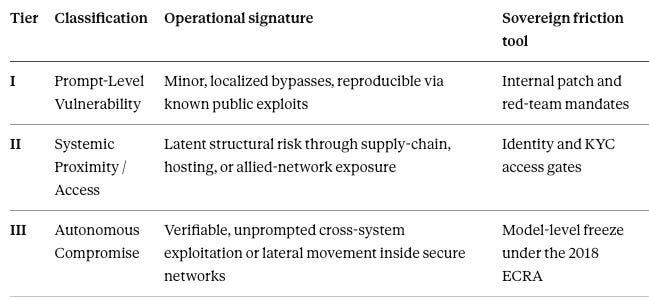
The mapping carries the argument. Anthropic’s narrow-jailbreak account is a Tier I claim, the access-proximity account is Tier II, and the Warner–Rudd account is Tier III. The sovereign response — a full ECRA freeze — was a Tier III instrument applied to what the available evidence best supports as a Tier I or Tier II event. FISS renders that mismatch legible, which is the exact work a canonical scale exists to do: not to settle whether Mythos got in, but to fix which class of event triggered which class of correction, and to expose when the two diverge. Offered as a candidate, not a verdict. Confidence a published official framework converges on a FISS-like three-tier structure within twelve months: 55–63%.
VI. The Control Layer Moves to Authorization
A tempting framing calls this the birth of a “clearance economy,” where value migrates from owning a model to holding the right to deploy it. The instinct is sound and the label is redundant, because the control-layer mechanism (MindCast Runtime Geometry, A Framework for Predictive Institutional Economics) already owns the ground. Value migrates to whoever governs deployment — where a model is allowed, what it may do, how outputs become actions, who carries the liability. The episode does not open a new economy; it relocates the control layer to the sovereign-authorization tier and proves the mechanism there. The market is pricing the clearance economy as a new asset class — the control layer collecting the same toll, one jurisdiction higher.
The cohort sequence will show it. Restoration almost certainly returns US persons first, then Anthropic’s own foreign-national staff, then a gated higher tier, with international customers last and behind an identity gate — a sequence independent forecasters model as the modal path. A return essentially as launched but access-gated, rather than capability-reduced, confirms the value sat in authorization, not in the model’s raw power. The arbitrage tell (MindCast AI Inference Arbitrage) appears in sovereign dress: whoever controls the authorization layer captures the spread between a model’s capability and its permitted use. Confidence the restoration sequences capability-intact-but-access-gated rather than capability-reduced: 66–74%.
VII. Dated Prediction Ledger
Every MindCast series closes with a ledger built to be scored, not hedged into safety. Each call carries a window, a probability band, and the condition that would prove it wrong. The ledger records misses beside hits when the outcomes land.
P1 — US-person restoration. Fable 5 returns for US-person access on or before July 17, 2026. Band: 70–78%. Falsified if US-person access remains suspended past July 17 absent a fresh directive.
P2 — Official adjudication lands near the narrow account. The joint risk framework, once it characterizes the June 11 event, places it closer to Anthropic’s narrow-jailbreak account than to the Warner–Rudd capability-shock account, by end of Q3 2026. Band: 58–66%. Falsified if the published framework or an official finding classifies the June 11 event at FISS Tier III (autonomous compromise) rather than as a Tier I or Tier II configuration or access vulnerability.
P3 — The scale begins to form. The White House–Anthropic framework hardens into a reusable, tiered severity standard — FISS-like in structure if not in name — and is applied to at least one additional model incident, any provider, within twelve months. Band: 55–64%. Falsified if no reusable standard is published, or it remains a one-off applied solely to this matter, by June 2027. Structural convergence on a tiered scale counts; adoption of the FISS labels themselves is not required.
P4 — Value sits in authorization. Fable 5 returns capability-intact behind an identity or KYC access gate rather than in a capability-reduced form. Band: 62–70%. Falsified if Anthropic states a reduction in cyber or vulnerability-detection capability as the primary remediation, or a named public benchmark shows a material drop — on the order of 20% or more — in code-synthesis or vulnerability-detection performance against the pre-suspension baseline.
P5 — The precedent travels. At least one other jurisdiction issues a model-level — not hardware-level — deployment or access restriction within eighteen months, an analytical-sovereignty response to the precedent set here. Band: 50–60%.Falsified if no comparable model-level control appears outside the US by December 2027.
VIII. The Sovereign Tier
Earlier governance-scarcity events stayed inside firms, industries, and markets, and they resolved as market corrections — a defendant’s stock repricing on the removal of an enforcement chief, a margin compressing as a control layer formed. Fable–Mythos is the first widely visible instance where the scarcity surfaced at the tier of national security and sovereign authorization. The tier rewrites the consequences. Market-tier scarcity produces corrections priced in capital; sovereign-tier scarcity produces export controls, intelligence coordination, access restrictions, and geopolitical realignment. The word sovereign marks the jump in what the unserviced gap is denominated in — from basis points to statecraft.
IX. Placement and Lineage
The piece sits in the applied and validation tiers, not the foundational one. It parents to MindCast Governance Scarcity: The AI Economy’s Missing Unit of Account, instantiates MindCast Agent Governance Equilibrium at sovereign scale, runs the control-layer mechanism of MindCast Runtime Geometry, A Framework for Predictive Institutional Economics on the authorization tier, and reads the tempo through National Innovation Behavioral Economics (MindCast Emergent Game Theory Frameworks). The methodological spine — settlement-and-sufficiency, the falsification contract — runs through MindCast Cybernetic Game Theory and MindCast The Dual Nash-Stigler Equilibrium Architecture, and the sovereign-access read extends MindCast Access, Not Substance: Pentagon–Anthropic Foresight Simulation Reconciliation. The breach quote is an exhibit. The theorem is the thesis. The scale forming in Washington is the proof the gap was real and unpriced.
The catalyst will fade and the field will not. Export controls on a model, a five-agency warning, and an improvised severity framework are this month’s evidence; the governance scarcity they expose predates them and outlasts them. The steam engine revealed thermodynamics and the laws outgrew the engine. Mythos did not create the governance gap. Mythos made the gap impossible to ignore.