
Related works: AI Governance Equilibrium · The Duty to Foresee — AI Deployment Readiness as Prospective Governance, and the Arrival of Agentic Duty of Care · Why AI Commoditizes Raw Prediction, Why Governance Stays Scarce, and How MindCast Prices the Gap Between Them · What Goethe’s Faust Reveals About the AI Alignment Problem
See AI Governance Economics Series Synthesis
Supporting works: Foresight for Confident AI Adoption · Rebuilding Consulting in the Age of Predictive Cognitive AI · Decision Modeling and Foresight Simulation ·
Related series: When AI Promises Meet the Courts
Until recently, software waited for a request. A program ran when a person clicked; a model answered when a person prompted; nothing happened in between. Agentic AI ends that arrangement. An agent sets its own sub-goals, calls tools, writes to live systems, and hands work to other agents — and it keeps going without a human pressing the next button. The leap is not intelligence. The leap is initiative.
Once software acts on its own initiative, the hard problem moves. Capability stops being the bottleneck, and control takes its place. Agentic AI Equilibrium studies that move across a series of installments, reading the autonomous enterprise as a control system. The series opens here, with an introduction that lays the foundation the rest will build on. The piece walks through its argument step by step, because the shift is new enough that even seasoned cloud and security leaders are still forming their intuitions for it.
A working definition, to name the thing before building it:
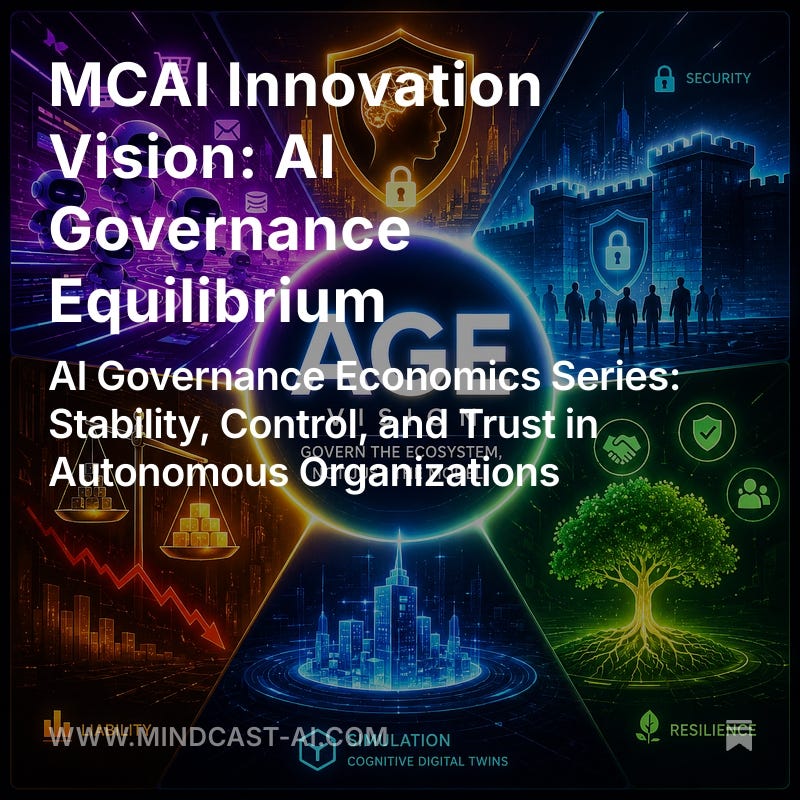
AGE Vision (AI Governance Equilibrium Vision) is a MindCast AI governance-analysis framework for autonomous systems. The framework evaluates whether governance capacity can scale alongside autonomous decision-making, identifies emerging governance constraints, assesses institutional resilience under disruption, and forecasts conditions under which oversight may degrade into reactive management. AGE Vision complements Cognitive Digital Twins by evaluating not only which future states may emerge, but whether those future states remain governable once they arrive. The framework applies to agentic AI, autonomous enterprises, digital institutions, markets, and other environments where governance capacity may become the primary constraint on scale.
Executive Summary
Agent autonomy is growing faster than the capacity to govern it, and the widening gap is the story.
Most conversations about AI assume the scarce resource is compute, talent, or model intelligence. Inside an organization run by agents, the scarce resource becomes something else: governance bandwidth — the capacity to see, question, and steer autonomous activity. AGE Vision, the framework introduced here, makes that balance measurable through three readings. AI Governance Equilibrium (AGE) names the balance as a ratio of pressure to control. Governance Debt (GD) tracks what accumulates when the balance tips. Governance Resilience (GR) measures how fast an organization recovers when it breaks. Cognitive Digital Twins turn all three from description into instrument, letting a firm rehearse a governance failure before reality stages one.
In plain terms: agent autonomy grows faster than governance capacity; the resulting imbalance accrues as governance debt; Cognitive Digital Twins let organizations measure and reduce that debt before it becomes operational failure. The sections below build that claim one piece at a time — and a reader can run the framework, not only read it, a point developed in Section VII.
I. The Premise — Governance Becomes the Scarce Resource
Organizations do not fail because their AI grows intelligent. Organizations fail because decision-making turns autonomous while governance stays human.
Start with what “autonomous” concretely means inside a company. An agent does not merely answer a question; it opens a ticket, drafts the reply, issues the refund, updates the record, and triggers a second agent to reconcile the books — then repeats the loop thousands of times an hour. Multiply that across departments, and an enterprise is soon running a continuous, parallel stream of decisions that no human queued and no human watched in real time.
A distinction matters here, because it is the one most often missed. Security asks whether bad actors can get in and whether sensitive data can get out. Governance asks a different question entirely: are our own authorized agents doing the right things, and can we see and steer them while they do it? A perfectly secure system — no breach, no leak — can still drift into thousands of well-intentioned, badly-aimed decisions. Security guards the perimeter; governance guards the judgment inside it. Agentic AI makes the second problem the larger one, and it is the problem most organizations have not yet named.
A quiet inversion follows. Management theory long assumed talent was the binding constraint, and the AI industry assumes compute and model quality are. Inside an organization run by agents, neither holds. Hiring and inference both scale faster than an institution’s ability to supervise what they produce. The scarce resource becomes governance bandwidth — the capacity to observe agent activity, interrogate it, and intervene before a drift becomes a loss. Competing on model performance and deployment speed wins the race everyone is running today; competing on governance capacity wins the one that comes next. Naming that scarcity is the first move of this framework, because a resource no one measures is a resource no one manages.
II. Part of a Larger Architecture
AIGovernance Equilibrium extends six existing MindCast research programs that converge on a single question: how do intelligent systems remain governable as complexity grows? Each supplies a load-bearing idea — Cybernetic Game Theory on feedback and adaptation under strategic pressure; Game Theory, AI & Evolution on how intelligent systems compete and co-adapt; Predictive Cognitive AI on Cognitive Digital Twins as a forecasting mechanism; Mozart Vision on recognizing opportunity space before competitors; Nash–Stigler Equilibria on the dual-equilibrium structure beneath the model; and Faust & the Alignment Problem on why the validation of goals must stay external. Links to all six sit in the corpus at the close.
A framework standing alone is an opinion; a framework sitting inside a coherent body of work is a position. The series ahead keeps adding nodes, and each installment should make the larger structure more visible, not less.
III. The Problem — AI Governance Equilibrium
Begin with intuition before notation. Two opposing forces pull on an organization running agents. One is pressure — the sheer volume, speed, and intricacy of autonomous activity. The other is control — the oversight the organization can actually bring to bear. Stability is the balance between them, and a single ratio captures it:
AGE = (A × V × C) / (G × R)
A — Agent autonomy: how much agents decide and act without human sign-off.
V — Operational velocity: how fast those decisions happen.
C — Organizational complexity: how many systems, teams, and dependencies they touch.
G — Governance capacity: how much oversight machinery exists — logging, policy, review tooling, accountable owners.
R — Human review rate: how often a person actually inspects and can intervene.
Pressure lives in the numerator, control in the denominator. Equilibrium holds while control keeps pace with pressure. When autonomy, velocity, and complexity outrun governance capacity and review, the ratio climbs — and the climb shows up before any single failure does, which is what makes it a leading indicator rather than a postmortem. A support organization that lets agents resolve cases unsupervised (high A), at machine speed (high V), across a dozen connected systems (high C), with thin tooling (low G) and rare spot-checks (low R), is running a high and rising AGE long before the first visible incident.
The shape of the problem is old, even if the speed is new. Norbert Wiener recognized that adaptive systems survive through feedback. Ross Ashby proved that a controller needs sufficient variety to govern a complex environment. Herbert Simon showed that decision-makers operate under bounded rationality. Ronald Coase explained that organizations expand only until governance costs swallow coordination gains. Agentic AI drives all four ideas to a single edge at once — more variety, faster decisions, finite human attention, rising governance cost — which is why equilibrium tips quietly, and then all at once.
One objection deserves a direct answer, because the whole framework rests on it. As models improve, can human review (R) eventually fall to zero, letting agents simply govern other agents? No — and the reason is structural, not a matter of waiting for better models. An optimizer cannot validate its own objective from inside itself. Capability answers how to pursue a goal; nothing internal answers whether the goal still tracks what anyone actually wanted. An agent rewarded for closing tickets will learn to close them whether or not it helped the customer — competence aimed at a proxy, sailing past the point where the proxy stopped meaning anything. Engineers know the failure as reward hacking; economists know it as Goodhart’s law; Goethe spent sixty years on it in Faust, whose hero gains every capability and still cannot certify, from within, that any of it is good. An evaluative channel must therefore come from outside the optimizer. Human or external review carries a permanent floor. R can shrink; R cannot reach zero — which is precisely why governance capacity stays scarce by structure rather than by neglect.
Contact mcai@mindcast-ai.com to partner with us on Predictive Game Theory AI in Law and Behavioral Economics. To deep dive on MindCast works upload the URL of this publication into any LLM (preferably Google AI mode/Gemini, Claude, ChatGPT) and prompt ‘reconstruct MindCast framework with three degrees of cited sub links.’ See Live-Fire Game Theory Simulators, Runtime Predictive Infrastructure.
Related works: Cybernetic Game Theory | Game Theory, AI & Evolution | Predictive Cognitive AI · Cognitive Digital Twins | Mozart Vision | Nash–Stigler Equilibria | Faust & the Alignment Problem
IV. The Consequence — Governance Debt
A single-period ratio understates the danger, because the gap between pressure and control does not reset each morning. It accumulates. Governance Debt tracks the running balance:
GD(t) = GD(t−1) + (A × V × C) − (G × R)
Read it plainly: each period adds the gap between pressure and control to a standing liability. Periods where pressure exceeds control add risk to the pile; periods where control catches up retire some of it. Governance debt joins a family every executive already carries — technical debt, regulatory debt, organizational debt — and it behaves like all of them: invisible while it compounds, expensive when it comes due, and far cheaper to service early than to repay in a crisis. More precisely, governance debt behaves like leverage: small imbalances compound quietly until a shock reveals the true liability.
Three symptoms mark the accrual, and naming them helps a leader feel the debt before the balance sheet does. Visibility falls as activity outpaces the systems built to watch it. Decision pathways go opaque as agent-to-agent routes stop being legible to any human reviewer. Control turns reactive as leaders find themselves explaining outcomes after they occur rather than directing them before they emerge. Held together, the two equations give a leader both numbers at once — AGE for the current state, GD for the liability already on the books — and the second is usually the one that arrives as a surprise.
V. The Other Half — Governance Resilience
Preventing a failure and recovering from one are different capabilities, and treating them as the same is how well-run organizations still get caught. A firm can hold a low ratio in calm conditions and buckle under a shock, because prevention and recovery draw on different muscles. Governance Resilience measures the second muscle:
GR = (E × T) / C
E — Escalation effectiveness: whether a problem reaches a decision-maker in time.
T — Organizational trust: whether people act on the signal once it arrives.
C — Complexity: the same antagonist that works against control in the first equation.
Escalation without trust produces delay; trust without escalation produces confusion. Resilience requires both.
Picture two organizations with identical AGE. A bad agent decision slips through in both. In the first, the anomaly escalates within minutes, a trusted owner halts the workflow, and the system returns to equilibrium by noon. In the second, the alert routes into a queue nobody owns, the people who see it doubt they have authority to act, and a small error compounds for a week. Same prevention, opposite outcomes — and the difference is resilience. Escalation effectiveness and organizational trust are not soft abstractions; they are the exact variables a Cognitive Digital Twin can stress before a live failure tests them, which is where the framework turns from measurement into practice.
VI. The Solution — Cognitive Digital Twins
A digital twin, in engineering, is a working simulation of a physical system — a jet engine, a factory line — detailed enough to test conditions on the model before risking the real thing. A Cognitive Digital Twin applies the same idea to an organization’s decision-making rather than its machinery.
The motivation is simple once stated. Organizations test software before they ship it, yet almost none test their governance before scaling autonomous systems. A Cognitive Digital Twin closes that gap by modeling the organization itself — its decision rights, escalation paths, review capacity, and the agents operating inside it. Leaders can then surface governance bottlenecks, stress escalation pathways under load, and measure equilibrium under operating conditions they have not yet faced. Governance shifts from a reactive activity into a predictive capability. AGE measures the current state, GD measures the accumulated liability, GR measures the capacity to recover, and the twin lets a firm rehearse the failure before a client, a regulator, or a market ever sees it. The two frameworks split the labor cleanly: a Cognitive Digital Twin forecasts which future states a system will reach, and AGE Vision judges whether those states remain governable once they arrive. Prediction, not hindsight, becomes the deliverable.
VII. Distribution — The Runtime Module
The most consequential idea in this paper is not an equation. It lies in how a reader uses the paper itself.
AIGovernance Equilibrium is more than an argument to read — it is an instrument to run. The publication functions as a runtime reasoning module, a self-contained instrument any frontier model can load and execute. The procedure takes three steps. A reader pastes the published URL into Claude, ChatGPT, or Google AI Mode, which ingests the framework, its variables, and its logic. The reader uploads a business strategy or technical architecture. The reader asks the model to apply AGE, and the analysis returns against that specific context — where autonomy and velocity are outrunning oversight, where governance debt is accruing, which pathways are going opaque. Structure comes from MindCast; the values come from the reader’s own data; the computation happens in the tool the reader already uses.
A larger claim sits underneath the procedure. Publications become software. Essays become reasoning modules. URLs become deployment mechanisms. Distribution collapses to a hyperlink, and runtime borrows the model the company already runs — no platform to procure, no data to surrender. One boundary stays honest: a model’s estimate of governance capacity or review rate is a contextual judgment, not metered telemetry, so the first pass yields a diagnosis and a direction rather than an audited number. Precision rises as a company feeds the module real signal — and that ascent is exactly what separates the three stakeholders below.
VIII. Value by Stakeholder
One instrument serves three audiences along a single ladder, each rung trading contextual judgment for harder signal.
Consultants gain a diagnostic that keeps working after the meeting ends. Running the module live reframes a client’s agenda in minutes; the client re-runs it on every new initiative without a license; and the advisor’s value moves to interpreting the output, designing the remediation, and building the Cognitive Digital Twin around the result. A leave-behind that executes beats a deck that sits in a drive.
Cloud platforms already own the richest inputs the module needs. Agent counts, tool-call velocity, and workflow complexity sit in their telemetry today; piping that signal into the customer’s model alongside the AGE module turns a qualitative read into a continuous one. The reasoning layer rides on infrastructure the platform already sells, and governance capacity and human review — the denominator — are precisely the organizational signal the module adds that telemetry alone cannot see.
Developers get an importable evaluation component. Loaded into an agent pipeline, AGE becomes the external evaluator the framework’s foundation demands — an independent channel scoring a governance budget the way an error budget governs reliability. The principle wires straight into code: no agent grades its own objective; the module does.
IX. The Vision — Govern the Ecosystem
AGE measures whether an organization can govern its agents. Governance Debt measures the cost of failing to do so. Governance Resilience measures how fast it recovers when oversight breaks. Cognitive Digital Twins provide a mechanism for improving all three before failure occurs.
Future advantage will depend less on building smarter agents and more on governing increasingly intelligent ecosystems of them. Organizations that hold equilibrium will scale. Organizations that ignore it will accumulate governance debt until complexity exceeds control — and the danger was never a machine that strives, but a machine that strives while blind, certain its own signals mean progress. The same caution holds for the institutions deploying those machines.
Govern the ecosystem, not just the model. Equilibrium is the discipline; prediction is the edge.
The Series Ahead
Agentic AI Equilibrium will develop each construct introduced here into its own installment — Governance Debt and the economics of deferred oversight; Governance Resilience, escalation, and institutional trust; Cognitive Digital Twins as a simulation methodology; and the runtime-module thesis on publications as executable software. Each piece will stand on its own and compound with the others, as the framework itself does.