


Hyperscalers · modular compute operators · clean energy hosts · utilities · export regulators · lenders · global investors · corporate strategists · United States · United Kingdom · Southeast Asia · Japan · Gulf · China
Related Works
Companion paper: Tencent, Oracle, and the Remote-Access Gap in US AI Chip Export Controls (2026). Maps the US authorities over rented compute and estimates whether a remote-access rule arrives before 2028.
AI Data Center Authorization + Clean Energy, the Mid-Scale Squeeze and the Specialized Compute Landscape(2026). Defines the three gates this paper extends to tenants.
Where the Clean Energy Host Advantage Holds and Where It Breaks in AI Data Centers (2026). Sets the five site determinations to which tenant eligibility now adds a sixth.
Thesis. AI data centers already clear three gates: firm clean power, grid service and local approval. A remote-access rule would add a fourth gate that approves the tenant rather than the site. Until such a rule takes effect, power, grid and approval keep deciding which operators win. When a rule arrives, a tenant-verification test favors hyperscalers and a country list favors US-sited specialists.
Why now. Specialists are signing hyperscaler partnerships and host agreements today, before anyone knows the rule’s test. Contracts signed now decide which party bears the cost when a rule arrives, and current disclosures leave that cost unassigned.
I. Executive Summary
AI training now crosses borders through rented compute, and a fourth gate may soon govern where it runs. MindCast’s specialized compute series found that mid-scale AI load fails three gates at once: firm clean supply, grid service and local approval. Tencent’s reported lease of about 100,000 chips in Oracle data centers across Southeast Asia points to a fourth gate that judges the tenant rather than the site.
No access rule exists yet, so the tenant gate changes no operator’s results today. Power, grid and approval constraints keep deciding which operators reach operation until a remote-access rule takes effect. The companion paper finds such a rule unlikely before 2028.
Specialists and hyperscalers are forming partnerships anyway for financing reasons. A duty on providers would raise the value of those partnerships and make the hyperscaler responsible for verifying tenants. A country-list rule would work the other way: it bars restricted tenants from listed hub countries, leaves American soil open and favors US-sited specialists and clean energy hosts.
American AI leadership gains under either test if American operators write the tenant-verification standard first. Compute that comes with verified tenants and logged workloads then becomes a service American clouds can sell to allies and host on American and allied sites.
MindCast AI applies Predictive Behavioral Economics + Dynamic Game Theory through MindCast AI Proprietary Cognitive Digital Twin Foresight Simulations (MP CDT FS). Behavioral Economics supplies the decision rules. Game Theory supplies the payoff structure. Predictive simulations emerge from the combination.
In this market the payoff structure comes from four gates held by four authorities: power suppliers, grid operators, local and state approvers and the access regulator. Each operator class pays a different fixed cost to clear them. The decision rules are approvers responding to evidence they can see and regulators trusting operators they already know. The simulation models seven actors as Cognitive Digital Twins: hyperscalers; specialist operators; clean energy hosts; grid operators; the access regulator; restricted tenants; and lenders.
Section II tests whether a tenant rule changes any outcome that power and approval do not already explain. Sections III through V map which workloads can cross borders, how host countries regulate them and what evidence operators would need. Sections VI and VII compare specialists, hyperscalers and partnerships, and show who earns the revenue and who carries the risk under each.
The two companion papers set out 15 Simulation Predictions: six here and nine in the Tencent-Oracle paper. G-P marks a Primary Simulation Prediction and G-S a Secondary Simulation Prediction. Four carry this paper’s argument:
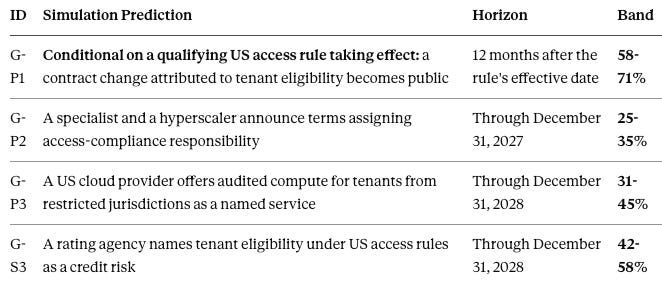
G-P1 applies only if a rule takes effect. The chance that a general rule takes effect by the end of 2027 is a separate Simulation Prediction in the companion paper, P-2 (30-49%).
🇺🇸 United States: Washington gets the most from a rule that names verification evidence American hyperscalers and American specialists can both produce. A standard only the largest providers can meet concentrates the market, and a country list sends restricted demand to American soil where no operator has to verify the tenant.
🏛️ Policymakers: Siting rules keyed to measured burden and access rules keyed to verified tenancy both ask operators for evidence. Host governments in Asia and the Gulf should expect access terms to follow the tenant, whatever their own siting rules say.
💼 Corporate strategists: Operators and AI builders across the United States, Asia and the Gulf should decide now whether to build tenant verification, buy it or leave it to a partner. A partnership signed for financing today carries the compliance duty once a rule arrives.
⚖️ Counsel: Host and operator agreements need tenant-eligibility terms beside approval-delay terms. An access rule or a targeted BIS letter can strand a contracted tenant as surely as a permit halt strands a site.
📊 Global investors: Power and approval keep deciding site value through 2027. Once a rule arrives, returns depend on which party holds the customer margin and which carries construction, debt and depreciation.
II. The Access Gate Joins Three Gates the Series Already Mapped
The specialized compute series located one tier of AI load that fails three gates at once. AI Data Center Authorization + Clean Energy, the Mid-Scale Squeeze and the Specialized Compute Landscape (2026) named the market gate, the grid gate and the approval gate. The present paper adds a fourth gate, covering tenants, to that framework.
Nuclear and geothermal suppliers set minimum contract sizes the middle tier cannot meet. Utility flexibility programs start at 20 to 50 megawatts. State and county hearings judge mid-scale projects as campuses. Hyperscalers pass all three by scale.
The series modeled a domestic market in which every tenant could use the compute. Remote-access rules break that assumption. A license now applies to advanced chips exported to China-headquartered entities wherever they sit, while remote computation on operator-owned hardware remains largely outside any rule. A remote-access statute or rule would add a gate that binds on tenants.
The access gate earns independent standing only if it changes outcomes the other three gates already explain. Two alternatives compete with it. In the baseline case, power economics and site approval keep explaining market structure, and access rules add compliance cost without changing who wins. In the contraction case, access rules shrink the pool of cross-border demand and leave less business for every operator class.
The test is concrete. The access gate has independent force only if a qualifying access rule changes a documented capacity investment, operator selection, contract or site location that power and grid constraints would not have changed. Absent such a change, the baseline case holds.
The baseline case is the most likely outcome through 2027. A qualifying instrument is less likely than not before 2028, as the companion paper finds, and without one the access gate changes no capacity decision. G-P1 tests whether the gate matters once an instrument does take effect.
The contraction case fails over the same period. Restricted demand moves to operators outside American reach rather than shrinking. The Runtime Global Data Market: When Stolen AI Interactions Become a Strategic Technology Supply Chain(2026) found the same pattern in model extraction, where enforcement shifts acquisition channels more than volume. Contraction stays possible after 2028 if Chinese labs begin training flagship models on domestic chips, the substitution outcome the companion paper sets out.
Takeaway: Power, grid and approval keep deciding the market until an access rule arrives. Restricted demand reroutes rather than shrinks through 2027.
III. Which AI Workloads Can Actually Move
Latency, cluster size and data law decide which AI work can cross borders. The Clean Compute Match: Which Clean Power Pairs With Which AI Compute, And What Stays On Fossil (2026) found that batch work and mid-scale training follow available power while real-time inference stays near users. Frontier-scale training moves less freely because it needs one large cluster at one site, and Tencent’s lease shows that constraint yielding when chips are unavailable at home.
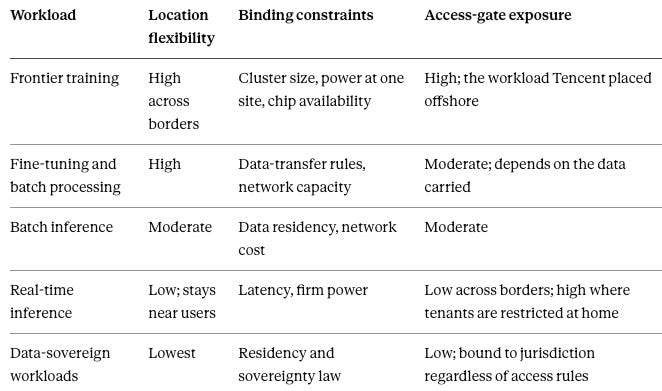
Chinese training demand moves offshore because Beijing has kept licensed H200 imports near zero. The Beijing Summit Validation: Geopolitical Ripples for the AI Industry Across the Three-Layer Equilibrium (2026) forecast H200 deliveries to approved Chinese buyers below 5% of licensed capacity, and Nvidia’s disclosures bear the forecast out.
Tencent’s lease fits the top row. Tencent executives said the leased capacity goes first to training larger Hunyuan modelsand then to running them. AI Data Center Edge Computing, Ship the Workload Not the Power (2025) set the principle that flexible workloads follow energy and community trust. Frontier training now also goes wherever the tenant can lawfully rent the chips.
The table narrows where a tenant rule would bind. Most of the access exposure concentrates in frontier training and batch work for tenants from restricted jurisdictions. Real-time inference and data-sovereign workloads stay bound to their home jurisdictions for reasons unrelated to export control.
Takeaway: Frontier training carries most of the access-gate exposure. A tenant rule would bind the frontier training and batch work of restricted tenants, not the whole market.
IV. Host Jurisdictions Gate Power and Water, and Physical Chips
Host jurisdictions for cross-border compute face their own approval constraints, and Malaysia illustrates them. Johor held about 580 megawatts of data center capacity in 2025 with 5,800 megawatts planned. Officials slowed approvals as power and water strained.
Johor’s state vetting committee rejected about 30% of applications by late 2024 for failing to show sustainable water and energy practices. Authorities also raised water tariffs for data centers. Johor tightened approvals on water and power burden, the same measures American counties weigh.
Malaysia’s chip rule addresses goods rather than tenants. In July 2025 its trade ministry required permits for exports, transshipment and transit of high-performance US-origin AI chips. The rule governs physical movement and does not address who may compute on chips installed in Malaysian facilities.
The United Kingdom shows the grid gate binding on a specialist that also carries access exposure. Microsoft is anchor tenant at Nscale’s flagship Essex site, which cannot connect to the grid in time to open as planned. Reported delays run into the 2030s.
ByteDance supplied nearly 75% of Nscale’s 2025 sales. Nscale therefore faces grid delay on its Microsoft capacity and possible tenant restrictions on its ByteDance revenue. Nscale’s lenders carry both risks at once.
Takeaway: Host states gate power, water and the physical movement of chips. No host rule found so far gates tenants on remote compute, which leaves tenant rules to Washington.
V. Verification Requires Three Evidence Systems, Not One
Each gate asks for evidence, but the evidence comes from different systems. One verification capability does not clear every gate. The table separates what each gate requires from what operators can reuse.
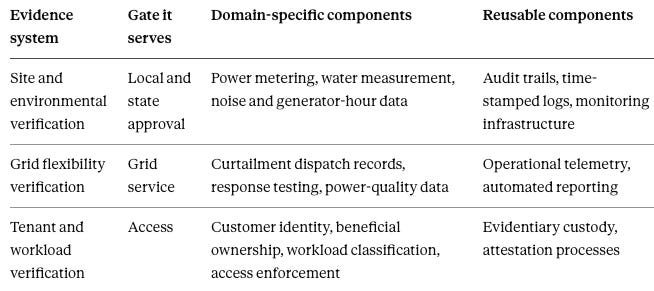
Audit trails, logging infrastructure and attestation processes carry across all three systems, a real but modest overlap. Tenant verification depends mainly on identity governance and security controls, which sit outside the site and grid systems specialists already run. The Runtime Export Problem: Anthropic’s 151 Million-Exchange Distillation Record, Advisory AA26-251A, and the Question Commerce Cannot Yet Answer (2026) found that Commerce’s open question is operationalization: telling an extraction campaign from ordinary use. Tenant and workload logs are the evidence that question requires.
Verification carries a fixed cost, and in game-theoretic terms the operator class that spreads it over the most customers or gates gains the advantage. Hyperscalers spread identity governance across thousands of customers, while specialists spread site and grid evidence across a few large tenants.
Anthropic, Alibaba, and the Runtime Theft Problem: How Attribution Cost Moves Frontier-AI Distillation Enforcement From the Courtroom to the Statute (2026) found that high attribution cost pushes enforcement away from courts and toward identity gating and cross-provider reporting. Operators then carry the evidence burden, and Chinese labs answer by routing through intermediaries.
Takeaway: Operators can reuse the audit and logging layer across gates. Tenant verification itself depends on identity and security capability that hyperscalers already hold at scale.
VI. Financing Drives Partnerships Now, and a Provider Duty Would Make Hyperscalers Responsible for Verifying Tenants
Three operating models could serve restricted tenants under an access rule, and current evidence supports each. Each model carries its own falsifier.
Specialist advantage. Smaller operators serve narrower workloads, already document power and water use for approvers and can add authorized capacity at lower cost. A specialist that already documents burden and curtailment could buy tenant verification from identity and compliance vendors. Evidence: specialists such as Crusoe and Nscale already serve frontier training demand.
Falsifier: no specialist buys or builds tenant verification within a year of a qualifying rule.
Hyperscaler advantage. Compliance complexity raises the minimum efficient scale of serving restricted tenants. Large providers spread identity governance across thousands of customers and hold government relationships specialists lack. Evidence: Oracle holds a government-accepted audit role over a China-linked counterparty as security partner for the TikTok joint venture, which closed on January 22.
Falsifier: hyperscalers cede customer contracts to specialists under a tenant rule.
Partnership. Hyperscalers hold the customer contract and tenant compliance while specialists supply sites, power and physical infrastructure. Evidence: Microsoft’s anchor tenancy at Nscale’s Essex site already takes this form.
Falsifier: specialists finance capacity with concentrated restricted tenancy at unchanged terms and without hyperscaler anchors.
The MindCast simulation keeps all three models alive and assigns each to different conditions. With no access rule, partnerships form for financing reasons. Under a duty on providers, the hyperscaler side of the partnership holds compliance. Specialist independence remains possible but unobserved, since no specialist has yet bought tenant verification as a service.
Financing drives partnership formation before any rule exists. Lenders facing grid delay and concentrated restricted tenancy ask specialists for hyperscaler anchors, and the Essex tenancy shows the pattern. A later access duty raises the strategic value of those partnerships without having caused them. Most compliance-allocation terms would still come from access events rather than from financing (G-P2).
The three models also differ in who owns each asset and obligation, and ownership decides who captures value and who carries risk. The table shows a representative arrangement, and actual allocations vary by agreement.
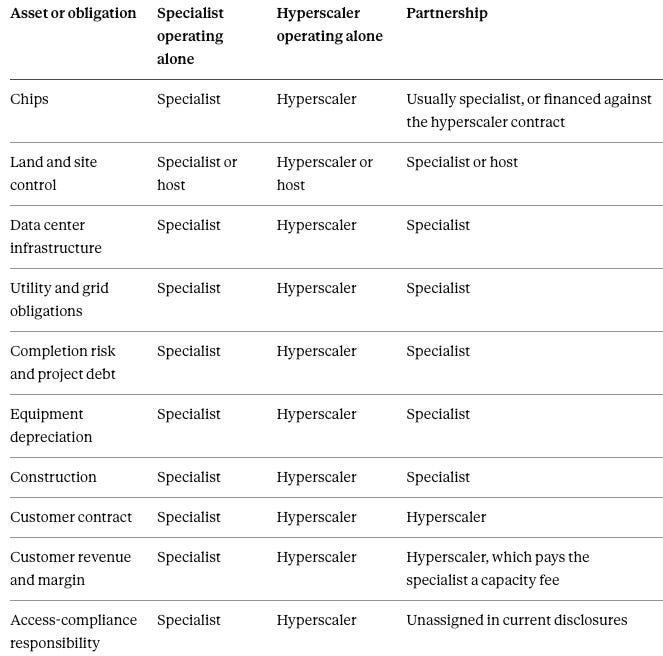
A specialist inside a partnership gives up customer economics. The specialist still carries construction, completion risk, project debt and the grid obligation. Equipment depreciation stays with the specialist too, while the hyperscaler holds the customer and the margin above the capacity fee.
In the representative structure, a partnership’s existence says little about which participant earns the better return. The hyperscaler earns a customer margin on capacity it did not finance. The specialist earns a contracted fee whose value depends on the hyperscaler’s credit and on the term of the anchor contract.
The party that bears tenant compliance decides the remaining difference. A contract that assigns compliance to the hyperscaler protects the specialist’s fee from a tenant rule. A contract that leaves compliance unassigned leaves both parties exposed and gives lenders a reason to tighten terms.
The models carry different exposure to the same rule. A tenant-verification rule raises the fixed cost of serving restricted tenants, which favors hyperscalers unless specialists can buy verification as a service. A country-list rule shifts demand toward operators outside listed jurisdictions. Specialists with US-sited capacity gain under that rule, since American soil stays open.
Regulators trust operators they already know, a salience effect behavioral economics predicts. The TikTok precedent makes Oracle salient to every agency drafting an access rule. Specialists such as Crusoe and Nscale hold no comparable audit role with any US agency.
Takeaway: Financing builds partnerships now, and a provider duty would make the hyperscaler partner responsible for verifying tenants. Specialist independence stays possible but needs a verification market that does not yet exist.
VII. What Changes for American Clean Energy Hosts
American clean energy hosts compete for location-flexible training against offshore jurisdictions as well as domestic regions. Where the Clean Energy Host Advantage Holds and Where It Breaks in AI Data Centers (2026) found that a host’s advantage survives county review and breaks first at the utility or the state. Every site faces five determinations: utility service, state permits and local land use, then lender treatment and contract terms. Tenant eligibility now joins the determinations any host serving foreign tenants must clear.
A host’s exposure depends on who operates on its site. A host leasing to a hyperscaler inherits the hyperscaler’s tenant controls. A host leasing to a specialist with foreign tenants inherits the specialist’s access exposure, which the five site determinations cannot reveal.
The rule’s test decides whether American hosts gain or lose. A tenant-based rule raises the value of capacity whose operator can document tenancy, which favors hosts paired with verified operators. A country-list rule leaves American soil off the list, so domestic hosts could attract restricted demand barred from listed hubs. Hosts winning that demand would also draw enforcement attention.
Federal rules for grid equipment have already made the same choice. Federal Grid-Security Rules Are Doing to American AI Data Centers What China Could Not (2026) found that the August 26 grid-equipment order regulates control topology rather than country of manufacture, and The Trump Administration’s Grid-Equipment Emergency Order Hands Taiwan an AI Data Center Supply Market (2026) traced the supply market the order creates.
A targeted BIS action reaches hosts without any general rule. A public letter conditioning one operator’s China-parented tenancy would give hosts and lenders a precedent to write into new agreements. Hosts most likely disclose tenant-eligibility terms only once a rule or a lender requires them (G-S2).
Frontier training revenue is the national stake for American hosts. Clean energy hosts on American soil that pair with operators able to verify tenants become sites where restricted tenants can train while a US operator knows who they are and what they run. Such hosts keep frontier training revenue in the United States under either rule test.
Takeaway: A host’s access exposure follows its operator. A country-list rule would turn American hosts into destinations for restricted demand, while a tenant rule favors hosts paired with verified operators.
VIII. MindCast Foresight Simulation Predictions
The paper sets out six MindCast Foresight Simulation Predictions. G-P marks a Primary Simulation Prediction and G-S a Secondary Simulation Prediction. G-P1 and G-S1 are conditional on a qualifying US access instrument and void if none takes effect by December 31, 2027. Each band gives the likelihood range the simulation assigns, and the regulatory outcomes come from the companion paper’s P-2 and P-3.
G-P1 · Within 12 months of a qualifying US access instrument taking effect, a contract change attributed to tenant eligibility becomes public (58-71%).
Qualifying changes are an amended host or operator agreement, a terminated tenancy or a new eligibility clause. Qualifying channels are securities filings, company releases, regulatory dockets and major press reports. The prediction tests whether the access gate changes contracts that power and grid constraints would not.
Falsifier: no such public disclosure within 12 months of the instrument.
G-P2 · A specialist operator and a hyperscaler or cloud provider announce an arrangement assigning tenant-eligibility or remote-access compliance responsibility to one party by December 31, 2027 (25-35%).
Existing anchor tenancies without such terms do not qualify.
Falsifier: no such announcement by December 31, 2027. Verification: company releases; securities filings.
G-P3 · At least one US cloud provider offers audited or attested compute for tenants from restricted jurisdictions as a named service by December 31, 2028 (31-45%).
Falsifier: no named service by December 31, 2028. Verification: product announcements; filings.
G-S1 · The first qualifying US access instrument names tenant identity or workload logging as acceptable compliance evidence (65-79%).
Conditional on an instrument taking effect by December 31, 2027.
Falsifier: the instrument names neither tenant identity nor workload logging. Verification: instrument text.
G-S2 · At least one US modular or clean energy host publicly discloses tenant-eligibility terms in a host or operator agreement by December 31, 2027 (22-31%).
Falsifier: no such disclosure by December 31, 2027. Verification: securities filings; company releases.
G-S3 · A published rating-agency report on a data center operator, project financing or asset-backed transaction names tenant eligibility under US remote-access or export rules as a credit risk by December 31, 2028 (42-58%).
Qualifying agencies are Moody’s, S&P, Fitch and KBRA. General export-control language without tenant eligibility does not qualify.
Falsifier: no qualifying report by December 31, 2028.
Takeaway: Contract changes are likely within a year of any rule, but compliance-specific partnerships and host disclosures stay unlikely before 2028. Credit analysts are as likely as not to treat tenant eligibility as a credit risk by 2028.
IX. How Exposure Reaches Capital, and Risk Mitigation
Access exposure reaches capital through the tenant rather than the site. A site’s value equals the cash flows its tenants can lawfully generate, less compliance and interruption costs, plus the value of re-leasing the capacity if a tenant leaves. Strong demand for compute keeps redeployment value high, which limits the loss from any single tenant.
Exposure reaches capital in four ways. A rule can delay cash flows from signed leases, cut margins through compliance cost, make refinancing harder if tenants stop paying and lower resale value if buyers cannot serve restricted tenants. The actions below are analytic options rather than legal, investment or fiduciary advice.
Near Term Through 2027: Power, Grid and Partnership Terms
Power, grid and approval decide near-term value, because an access rule is unlikely to take effect before 2028. Cash-flow timing on cross-border compute sites depends on interconnection dates and approval holds, as the Essex grid delay and the Texas pause on data center environmental permits ordered on September 21 show.
Private credit lenders, infrastructure funds and insurers’ investment arms meet the near-term triggers first. Their decision is whether to require hyperscaler anchors and tenant representations now, before any rule names acceptable evidence. Specialists with concentrated restricted tenancy face the tightest terms.
Corporate strategists face the near-term decision in partnership contracts. A specialist signing a hyperscaler anchor should assign access-compliance responsibility in writing, since compliance-specific terms remain unlikely to appear in announced deals before 2028 (G-P2).
Long Term Through 2028: Access Rules, Credit Terms and Control of the Customer
Access rules decide long-term value once they arrive. Within a year of a qualifying rule, a contract change attributed to tenant eligibility is likely to become public (G-P1). Rating agencies are as likely as not to name tenant eligibility as a credit risk by the end of 2028 (G-S3).
Sovereign wealth funds, global macro funds and conglomerates meet these triggers through refinancing and terminal value. A campus whose operator can attest to tenant identity keeps value under a tenant rule. A campus financed against restricted tenancy without such controls loses value under either test.
Global corporate strategists face the long-term decision in who holds the customer. An operator that cedes the customer to a hyperscaler partner gives up margin in exchange for a fee backed by the hyperscaler’s credit. A named audited-compute service from a US cloud provider by the end of 2028 is somewhat less likely than not (G-P3), which leaves room for specialists that build verification early.
Exposure by Simulation Prediction
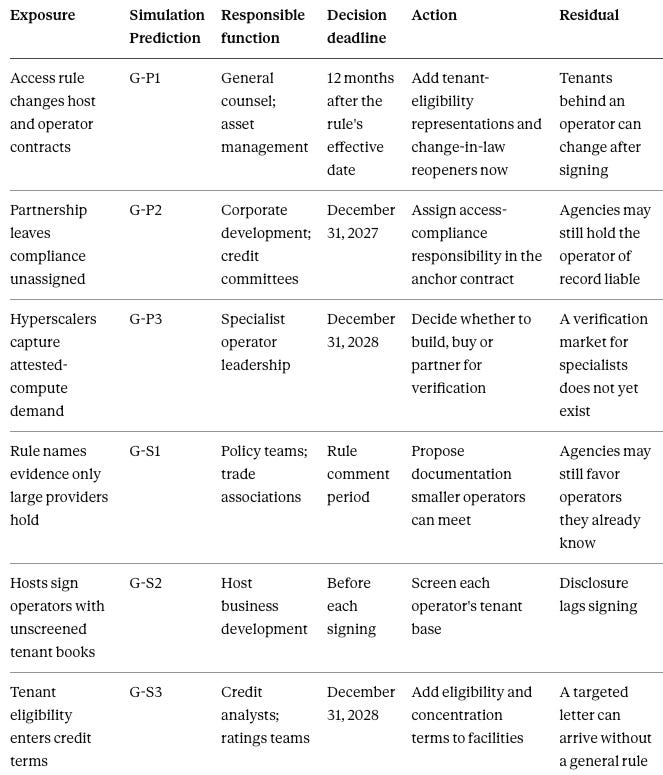
Capital Posture by Trigger
Wait applies to specialist positions with concentrated foreign tenancy until the first rule states its test. Stage applies to host and operator positions once the rule names acceptable evidence, with commitments keyed to the operator’s ability to meet it.
Commit applies when a site holds its decisive approvals and an operator with established tenant controls. Exit applies when a rule removes the tenant class a position depends on.
Takeaway: Power and partnership terms decide value through 2027. Access rules and credit terms decide it after a rule arrives, and the party holding the customer margin is not always the party carrying the risk.
X. What to Watch
Seven dated observables separate the competing outcomes in this paper. The dominant fork is whether the first access instrument imposes a duty on providers or lists hub countries.
Defense authorization conference, before January 3, 2027. Remote-access text in the conference report is a preliminary signal. G-P1 and G-S1 begin only when a qualifying instrument takes effect.
The first US remote-access rule, through 2027. The rule’s effective date starts the 12-month window for G-P1, and its text resolves G-S1.
Access-compliance allocation, through 2027. A specialist-hyperscaler agreement that assigns tenant-eligibility responsibility to one party would resolve G-P2.
Host agreement terms, through 2027. A publicly disclosed tenant-eligibility clause in a host or operator agreement would resolve G-S2.
Named audited-compute services, through 2028. A US cloud provider launching audited compute for tenants from restricted jurisdictions would resolve G-P3.
Rating-agency reports, through 2028. A presale or sector report naming tenant eligibility would resolve G-S3.
Grid curtailment below 20 megawatts. A utility approval of curtailable service for small loads would open the grid gate to specialists whatever the access rule says.
Takeaway: The defense authorization conference is the first signal, and a rule’s effective date is the trigger. Contract changes after the rule show which operator model is winning.
XI. Conclusion: Power Decides Until a Rule Arrives, and the Rule’s Test Decides Whether Hyperscalers or US-Sited Specialists Gain
The series showed mid-scale AI load failing three domestic gates at once and found that operators clear them by documenting their power, water and grid burden. Tencent’s lease shows training workloads crossing borders and points to a fourth gate that judges tenants. Hosts from Johor to Essex already face the original three.
Power, grid and approval keep deciding the market until an access rule takes effect, and such a rule is unlikely before 2028. Specialists and hyperscalers are already forming partnerships for financing reasons, so a later rule would raise their value rather than explain their formation. A duty on providers would make hyperscaler partners responsible for verifying tenants, while a country-list rule would send restricted demand toward US-sited capacity.
American AI leadership gains under either test if American operators write the tenant-verification standard first. Compute with verified tenants and logged workloads then becomes a service American clouds and hosts sell to allies and to tenants whose home markets cannot supply frontier chips.
The six Simulation Predictions in Section VIII set out what to expect from operators, hosts and lenders through 2028. The first test comes within a year of any qualifying rule, when public contract changes show whether a tenant rule changed anything power and grid constraints would not have.
Working With MindCast
Host Advantage Test with tenant determination. For clean energy hosts: the five site determinations plus tenant eligibility, run against each candidate operator before signing and keyed to G-S2.
Operator model assessment. For modular operators and corporate strategists: a build, buy or partner analysis for tenant verification against each rule outcome, keyed to G-P2 and G-S1.
Capital posture review. For infrastructure, private credit and sovereign wealth funds: a posture determination for each compute site or operator position, keyed to G-P1 and G-S3.
Contact mcai@mindcast-ai.com.
Sources
MindCast works.
AI Data Center Authorization + Clean Energy, the Mid-Scale Squeeze and the Specialized Compute Landscape (2026). Source of the market, grid and approval gates.
The Clean Compute Match: Which Clean Power Pairs With Which AI Compute, And What Stays On Fossil (2026). Source of the mobility sort behind the workload matrix.
AI Data Center Edge Computing, Ship the Workload Not the Power (2025). Source of the principle that flexible workloads follow energy and trust.
Modular AI Data Center Specialists and the Integrated Offerings That Turn Small Sites Into Authorized Operating Capacity (2026). Source of the specialist operating model.
Where the Clean Energy Host Advantage Holds and Where It Breaks in AI Data Centers (2026). Source of the five site determinations.
The Beijing Summit Validation: Geopolitical Ripples for the AI Industry Across the Three-Layer Equilibrium (2026). Source of the H200 delivery forecast that explains why Chinese training demand moves offshore.
The Runtime Export Problem: Anthropic’s 151 Million-Exchange Distillation Record, Advisory AA26-251A, and the Question Commerce Cannot Yet Answer (2026). Source of the operationalization question that tenant and workload logs answer.
Anthropic, Alibaba, and the Runtime Theft Problem: How Attribution Cost Moves Frontier-AI Distillation Enforcement From the Courtroom to the Statute (2026). Source of the finding that attribution cost moves the evidence burden onto operators.
The Runtime Global Data Market: When Stolen AI Interactions Become a Strategic Technology Supply Chain (2026). Source of the finding that enforcement shifts channels more than volume.
Federal Grid-Security Rules Are Doing to American AI Data Centers What China Could Not (2026). Source of the control-topology test in federal grid-equipment rules.
The Trump Administration’s Grid-Equipment Emergency Order Hands Taiwan an AI Data Center Supply Market (2026). Source of the supply-market effect of the grid-equipment order.
Tencent, Oracle, and the Remote-Access Gap in US AI Chip Export Controls (2026), companion paper. Source of the authority map and the regulatory outcomes this paper takes as inputs.
External sources. The Next Web, “Tencent leases 100,000 AI chips from Oracle in a $7bn deal, FT reports”, October 2026; “Britain’s flagship AI data centre can’t get the power to switch on”, July 14, 2026. IET, “UK’s largest AI supercomputer delayed to 2030s due to grid issues”, 2026. CO/AI, “Malaysia’s AI data center boom strains power grid and water supply”, August 18, 2025; “Malaysia restricts US AI chips for Chinese data centers”, September 12, 2025. W.Media, “Malaysia imposes curbs on exports of US-origin AI chips”, July 15, 2025. Axios, “TikTok divestiture deal closes”, January 23, 2026. Holland & Knight, “Texas Governor Halts Data Center Environmental Permitting”, September 22, 2026.