
Related works: Federal Grid-Security Rules Are Doing to American AI Data Centers What China Could Not | Anthropic, Alibaba, and the Runtime Theft Problem | The Beijing Summit Validation | The TSMC China License and the Limits of Hardware Export Controls
Executive Summary
Winning a market and keeping its value are different things. A supplier can clear every American security requirement and surrender the capability that clearing them was meant to reward.
The Trump Administration declared a national emergency over foreign-made grid equipment in August 2026. Restricting one set of suppliers creates a market for the rest, and Taiwanese manufacturers are among the clearest beneficiaries.
Access to that market is conditioned on qualification. Qualification increasingly interacts with North American localization pressure, and the two are not the same test. Building in North America moves capability out of Taiwan.
MindCast reaches its conclusions by building Cognitive Digital Twins (CDT) of the regulators, suppliers and buyers involved, then running them forward against one another. Conventional analysis reads the rule and names who gains. A MindCast AI Proprietary Cognitive Digital Twin Foresight Simulation (MP CDT FS) simulates how each actor responds to the others under pressure.
Game theory supplies the payoff structure and selects among equilibria. Behavioral economics supplies the decision rules and the salience effects that determine which payoffs actors actually perceive. Game theory and behavioral economics together generate the predicted behavior, and neither produces it alone.
The paper proceeds in eight analytical moves, then the simulation. It sets out what the order changed and why qualification is not value capture. It shows why two American policy logics run on separate tracks and which layers move when a factory does.
It then explains why the market pays for a certainty it cannot buy and why Taiwan’s replaceability differs between transformers and chips. A final section sets out why Taiwan supplies the buildout rather than hosting it. Sixteen MindCast Foresight Simulation Predictions follow, with bands, falsifiers and settlement sources.
The Simulation Predictions That Matter Most
Two policy tests survive rather than one. Federal implementation preserves security eligibility based on control and access risk alongside a distinct federal domestic-manufacturing preference. Band: 84–93% by June 30, 2027. Suppliers face two markets with different entry rules rather than one contested standard.
Localization proceeds without control-layer migration. At least two Taiwanese suppliers add North American capacity while keeping core research, development and design authority in Taiwan. Band: 76–87%. Geography moves and control is contested.
Taiwan gains as supplier and not as host. No American hyperscaler announces a Taiwan artificial intelligence training campus at 500 megawatts or above. Band: 85–93%. Supply is the stronger position and the only one available.
Leading-edge fabrication does not relocate. A majority of advanced accelerator wafer output remains fabricated in Taiwan through 2027. Band: 82–92%. Substitution is real in transformers and absent one layer up.
Delivery protection appears before it is priced. Schedule protection tied to an energization milestone shows up somewhere in the supply or financing stack at 58–72%, while delivery certainty carrying identifiable consideration remains absent from disclosed instruments at 70–84%. The gap between those numbers is an unpriced market.
What Each Audience Should Conclude
🏛️ Policymakers. Security rules and procurement rules are separate instruments doing different work. Control-based criteria can preserve market access without requiring every capability layer to relocate. Location-based criteria admit only relocation, and relocation takes years the grid does not have.
💼 Executives. Localization pressure is rising and paying it does not settle the bill. The layers that survive a factory move are the layers the new rules make most valuable, and the expansion negotiation is a principal point at which their allocation is determined.
⚖️ Counsel. Prepare for provenance obligations to appear first in procurement and interconnection contracts rather than in statute. Substitution rights, firmware representations and delivery-linked schedule provisions are negotiated at renewal or not at all.
📊 Investors. American revenue growth at a qualified supplier is a poor proxy for retained value. A firm can grow the top line while transferring the capability that produced the margin, and no current disclosure separates the two.
I. A New American Rule Created a Market for Trusted Grid Equipment
On August 26, 2026 the President declared a national emergency over foreign-produced equipment used in the American bulk-power system. The order authorizes the government to prohibit or condition the purchase and installation of covered equipment. It reaches beyond hardware into software, firmware, maintenance services and remote-access capabilities.
The reasoning behind it is straightforward. Large transformers, switchgear and control systems are the components that connect a generating plant or a large customer to the transmission grid. A transformer that fails takes months or years to replace, because the units are custom-built and the global order book is long. Equipment carrying software an adversary can reach is therefore a strategic exposure rather than a procurement detail.
Artificial intelligence data centers made the exposure larger. A hyperscale campus connects at transmission voltage rather than at the distribution level that serves houses, which puts it on the same equipment as a power plant. Rapid growth in that class of customer means more covered equipment installed faster, and the order says so directly.
Restricting one set of suppliers creates a market for the rest. A utility that cannot buy from a covered vendor must buy from somebody, and the field of somebodies narrows to firms whose ownership, software and service arrangements can be shown to be clean.
Taiwanese manufacturers enter that opening with position rather than ambition. Exports of transformers and related heavy electrical equipment to the United States ran $1.56 billion in 2024, nearly half of Taiwan’s exports in the category, and reached 53.8 percent through October 2025. Fortune Electric reported in June that artificial intelligence data center transformer orders exceeded NT$20 billion, with the United States its largest market and order visibility extending through 2029.
Access to that market carries conditions. Meeting them increasingly involves building in North America, and building in North America moves capability out of Taiwan.
Takeaway. The premium is real. Keeping it is a separate problem, and the rest of this paper measures the difference between the two.
II. What the August Order Actually Covers
Scope matters more than intent here, because the boundary of the order determines which suppliers face it and which do not.
The regime applies above the distribution line. Reported coverage at 69 kilovolts and above includes substation transformers, reactors and capacitors, which are the components that step voltage up and down and manage power quality on the transmission network. Grid-connected inverters and battery storage fall inside, as do generators including backup units.
Control equipment is covered alongside the hardware. Industrial control systems, protective relays and metering are all inside the inquiry. So are associated software and firmware, along with digital services, maintenance services and remote-access capabilities. Facilities used for local distribution of electric energy sit outside.
The practical effect for a data center is upstream of the building. A campus can hold land-use approval and a signed utility service agreement and still wait on a transformer, because the equipment that energizes it is now subject to a security review that did not exist a year ago.
Three things remain unresolved, and each matters more to a supplier than the scope does. The list of covered entities is unpublished, so no firm knows with certainty whether a component supplier will be restricted. The qualification criteria are unwritten, so no firm knows what clearing the review will require.
How implementation allocates between prohibition, mitigation and prequalification is the third, and the Department of Energy has been directed to write the implementing rules.
Prequalification is the difference between a market a supplier can enter and one it cannot. A prohibition regime excludes by category. A prequalification regime lets a supplier demonstrate that its equipment and its control arrangements meet a standard, which converts an exclusion into an application.
Readers wanting the American authorization consequences of the order should read the companion analysis. The remainder of this paper concerns the supply side.
Takeaway. The order created a market and has not yet written the rules of entry. The drafting window is the operative fact for any supplier, because criteria written once tend to govern for years.
III. Winning the Market Does Not Guarantee Keeping Its Value
Qualification grants access. Access does not settle who keeps the economic value that access was supposed to deliver, and the distinction is easy to lose in a rising revenue line.
Consider what qualification is likely to require. A supplier must document ownership and control, show that firmware and update authority sit in trusted hands, and demonstrate that maintenance and remote diagnostics run through channels a reviewer can inspect. Those are documentation burdens rather than relocation demands.
Alongside that, and separately, American procurement policy favors domestic manufacture. A supplier that wants federal work, or that wants to reassure a utility buyer anticipating future rules, builds capacity in North America.
The two pressures produce different bills. Documentation costs money once. Localization costs capital, duplicates service infrastructure, and moves people and process out of the home market permanently.
A Taiwanese firm can therefore double American revenue while relocating enough manufacturing, testing, firmware authority and service control that Taiwan retains far less of the premium than the revenue implies. Market-access success and strategic-value leakage occur together, and the headline conceals the second.
The net-capture test. Start with the gross premium the qualified-supplier market creates. Subtract localization capital expenditure, qualification and compliance expense, and the cost of running duplicated service infrastructure on two continents. Then subtract the control value transferred rather than retained. Design authority, firmware, qualification and type-testing all belong in that line.
What remains is net value capture. An expansion that fails the test may preserve market access while transferring more economic and control value than it captures, and the shortfall is visible before the announcement rather than after it.
The test is a measurement framework and not a demonstrated finding. No public disclosure separates retained from transferred control value, and the simulation puts the odds at 52–68% that none will inside the horizon. A firm can run the calculation on its own numbers. An outside analyst currently cannot.
Takeaway. Revenue measures access and nothing currently measures retention. The gap between them is where the strategic question lives, and it is invisible in every public filing.
IV. American Policy Runs Two Separate Tests and Suppliers Must Pass Both
Two threat models sit behind American infrastructure policy, and they ask different questions with different answers.
The first asks who controls the equipment. Ownership determines part of the answer. Firmware and update authority determine the rest, along with remote diagnostics and lifecycle maintenance. A component built anywhere can be trusted if the entity able to change its behavior is trusted and auditable. Independently controlled allied suppliers sit in a comparatively favorable position under that test.
The second asks where capacity is concentrated. Under that framing the risk is not who owns a factory but that too much of the world’s supply sits in one place, exposed to one disruption. Geographic concentration fails that test regardless of ownership, and much of the localization pressure now visible follows from it rather than from provenance alone.
The two logics cannot be satisfied by the same action. Control can be verified continuously from a distance through audit, inspection and disclosure. Concentration can only be relieved by moving physical capacity, which takes years.
Neither logic displaces the other. The simulation resolves implementation toward two surviving tests: security eligibility resting on control and access risk, and a domestic-manufacturing preference confined to federal procurement. Domestic manufacture does not become a universal prerequisite for non-federal bulk-power transactions.
The consequence for a supplier is a change of question. The simulation expects both logics to persist, so a firm should plan against two tests rather than wager on one displacing the other. The operative question becomes which market a firm is entering, since the security track and the procurement track admit different companies on different terms.
Takeaway. A supplier optimizing for a single American standard will optimize for a test that does not exist. Two tests exist, they reward different things, and the addressable market differs between them.
Contact mcai@mindcast-ai.com to partner with us on Predictive Game Theory AI in Law and Behavioral Economics. We specialize in predictive simulations for Complex Litigation, Innovation Economics, Geopolitical Risk Intelligence and Legacy Innovation. See more about MindCast series at our new website MindCast Corporate.
To test our predictive simulation AI system, in 2026 we simulated the Super Bowl and the World Cup. See 🏈 Super Bowl LX — AI Simulation vs. Reality | ⚽ The 2026 World Cup Final Simulation Validation
To deep dive on MindCast works upload the URL of this publication into any LLM (preferably Google AI mode) and prompt ‘reconstruct MindCast framework with three degrees of cited sub links.’ See Live-Fire Game Theory Simulators, Runtime Predictive Infrastructure, MindCast Foresight Prediction Simulations, Synthesizing Behavioral Economics + Game Theory.
Working With MindCast
MindCast runs two service lines on one method. Qualification exposure intelligence assesses a supplier against the two tests American policy now applies separately: control and access risk on the security track, and manufacturing location on the federal procurement track. Value retention intelligence measures what an expansion keeps and what it transfers, layer by layer, across design authority, firmware, update authority, type-testing and long-duration service.
💼 Equipment manufacturers and their boards can commission a net-capture assessment on a specific expansion: which capability layers the proposed structure transfers, what the localization and duplicated-service costs total against the addressable premium, and where the retention terms have to sit in the agreement. The register prices selective localization without control migration at 76–87% through December 31, 2027, which means the pattern is available and not automatic.
📊 Investors and lenders holding supplier positions can commission a retention screen across a named portfolio: which holdings are growing American revenue while transferring the capability behind the margin, and what current disclosure does and does not reveal. The register prices continued disclosure opacity at 52–68%, so the assessment has to be built from expansion structures rather than read off a filing.
🏛️ Ministries, trade bodies and regulators can commission a criteria-exposure review ahead of the American implementing rulemaking: which control attributes are auditable and documentable now, which equipment classes face the sharpest covered-entity risk, and what a domestic large-load framework would do to standing as a reference jurisdiction. The register prices dual-track survival at 84–93% and a Taiwanese framework at 45–62%.
⚖️ Counsel can commission an expansion-terms review against the layer taxonomy: where design authority, firmware control and type-testing sit in existing joint-venture and licensing documents, which retention terms are achievable at the next negotiation, and how provenance-change substitution rights are drafted before a component becomes covered. The register prices control-topology representations reaching a filed American instrument at 49–64%.
Data center developers and their lenders can commission a delivery-exposure quantification: what a compute or equipment slip costs against a fixed power obligation, and what a priced delivery commitment would be worth on that number. The register prices continued absence of a separately priced delivery product at 70–84%, which is the gap the quantification sizes.
The Simulation Predictions in this paper apply the authorization method to the supplier side of the American buildout. Every engagement above runs on the same methodology, with dated falsifiable outputs. Contact mcai@mindcast-ai.com.
V. Which Capabilities Move With a Factory and Which Do Not
Localization pressure is rising, and fighting it fights the stated purpose of the policy. The productive question is narrower. When a manufacturer opens a North American plant, what actually leaves the home country?
Capabilities that travel with the factory. Final assembly, where components become a finished unit. Routine testing that certifies each unit against a standard. Warehousing and field service dispatch. Over a longer horizon, fabrication of the components themselves.
Capabilities that stay unless the expansion structure transfers them. Research and development. Design authority, meaning who decides what the next product does. Firmware and control software, and the authority to issue updates to equipment already installed.
Also qualification standards and type-testing authority, meaning who certifies that a design meets a specification. And long-duration service contracts, which is where the recurring margin sits.
The second list is the list the new rules make most valuable. Provenance policy prices exactly those attributes, because they determine who can change a machine’s behavior after it is installed. A supplier can therefore concede the capabilities that resilience policy wants relocated while retaining the ones that security policy rewards.
Retention is not automatic. High-value control layers remain in Taiwan unless the expansion structure transfers them, and an announcement silent on design authority does not demonstrate that the supplier retained it. Joint-venture terms, licensing arrangements and customer requirements can all move authority without any explicit decision to move it.
Takeaway. The factory and the capability are separable, and the expansion negotiation is a principal point at which the allocation is determined. Reading a capacity announcement tells a reader where the building is and nothing about where the value went.
VI. Developers Buy Authorization Certainty and Delivery Certainty Is Not Yet Separately Priced
Infrastructure markets pay more for certainty than for a low price. A high and fixed obligation beats a low one subject to reversal, because an underwriting committee can model the first and cannot model the second.
American data center developers can now buy authorization certainty. States and utilities offer large-load tariffs carrying long contract terms, collateral requirements and exit charges. A developer accepting those terms converts political risk into contractual terms, and an expensive obligation that holds beats a light one that can be reopened.
The reviewed market does not yet show an equivalent separately priced delivery-certainty product. Power commitments of ten to fourteen years bind at the moment of interconnection. The computing hardware that justifies the commitment arrives on shorter cycles from a narrow set of suppliers, and delays of a quarter or more are ordinary.
Take-or-pay is the term that makes the mismatch expensive. Under a take-or-pay obligation the customer owes the contracted amount whether or not it uses the power, which is the provision that lets a utility finance the transmission and generation the customer requested.
The simulation strongly expects the utility tariff not to absorb that risk, and the reason is structural rather than adversarial. A long-duration tariff exists precisely to keep the utility and its ratepayers from carrying the customer’s completion risk. Excusing payment when hardware fails to arrive would push stranded-investment risk straight back onto ratepayers, which is the outcome the tariff was written to prevent.
The hedge therefore has to sit somewhere else. A supplier offering delivery certainty matched to a customer’s energization schedule is selling risk transfer against a fixed liability rather than selling hardware, and the customer can already compute what the exposure is worth.
The public instruments reviewed do not show delivery certainty being separately priced as a commercial product. Schedule protections appear inside supply agreements without visible consideration attached, which is not the same as a product with a price.
Takeaway. The certainty premium exists on both sides of the same transaction and is priced on one. The unpriced side is the clearest commercial opening in this analysis, and it is available to a supplier rather than to a utility.
VII. Taiwan Is Replaceable in Transformers and Not in Chips
Discussions of Taiwanese exposure usually treat the island as a single supplier. Doing so produces a wrong answer, because Taiwan occupies opposite positions in two businesses that the new rules touch at the same time.
Heavy electrical equipment is a contestable market. Korean, German, Indian and American manufacturers all build transformers and grid equipment. Each is qualifying for the same American demand.
Switching is not costless. A utility qualifying a new transformer supplier runs engineering review, factory audits and type-testing, and lead times run long enough that a buyer plans years ahead. Those frictions raise the cost of moving and do not prevent it.
Leading-edge semiconductor fabrication is not contestable inside this horizon. Building a facility capable of producing advanced accelerator chips takes years and tens of billions of dollars, and the process knowledge does not transfer with the equipment. Announced offshore capacity is real and is small relative to the installed base.
The distinction changes how much leverage Taiwan actually holds in each business. A transformer position is commercial standing that a better-qualified competitor can take. An advanced-node position is a dependency that American policy is actively trying to reduce and cannot reduce quickly.
Conflating the two produces errors in both directions. Assuming Taiwan is indispensable in transformers overstates its bargaining position and invites a complacency that competitors will punish. Assuming Taiwan is replaceable in chips understates a dependency that will persist through the horizon of this paper and beyond it.
Takeaway. Taiwan’s replaceability differs by an order of magnitude between two businesses usually discussed as one, and every strategic conclusion depends on which one is under discussion.
VIII. Why Taiwan Supplies the Buildout Instead of Hosting It
Every jurisdiction with capital and ambition has considered hosting artificial intelligence data centers. Taiwan has the capital and the technical base, and inside the simulation horizon its stronger position is supplier rather than host.
Endowment explains most of it. Hosting hyperscale computing requires firm power delivered on a date certain, at a scale that only a few places can offer. Taiwan holds adequate capital and scarce generation capacity, and no policy instrument manufactures generation inside a physical limit. Jurisdictions in that position capture high-value, low-megawatt work such as inference serving and regulated data, and they do not capture large training campuses.
The simulation carries that conclusion at high confidence. No American hyperscaler is expected to announce a Taiwan training campus at 500 megawatts or above inside the horizon.
Supply carries a wider base in any case. A host jurisdiction captures construction spending, tax revenue and site employment within its own borders. A supplier of the binding input earns on campuses built anywhere, and the American buildout alone is larger than anything Taiwan could host.
Taiwan nonetheless faces the demand growth it is helping to create elsewhere. The Ministry of Economic Affairs now folds artificial intelligence data centers and semiconductor expansion into its electricity outlook and projects roughly 2.5 percent average annual demand growth to 2035. Domestic semiconductor expansion alone raises load in a system that already runs tight.
Taiwan also defends critical infrastructure under sustained pressure. The National Security Bureau reported an average of 2.63 million cyberattacks per day against key infrastructure in 2025. Sustained defense at that volume strengthens the case for resilience investment and hardened operating practice. It does not by itself establish the security qualification of any individual supplier or component, and presenting it that way invites a correction.
One structural advantage follows from how Taiwan is governed. A single regulator and a state utility can write a coherent large-load framework, where the United States distributes the same task across six regional grid operators and fifty state commissions.
Moving first could improve Taiwan’s standing. A jurisdiction that has written large-load rules for its own grid argues as a peer to the commissions writing them elsewhere rather than as a vendor to the developers subject to them.
Takeaway. Taiwan’s strategic value inside the horizon rises through equipment and compute supply rather than through hosting. Solving its own load problem could position it as a reference jurisdiction as well as a supplier, and the window for moving first is open now.
IX. Sixteen MindCast Foresight Simulation Predictions
The simulation built Cognitive Digital Twins of eight actors. Three sit on the Taiwan side: the sovereign and its state utility, the heavy-electrical industry, and advanced-node and packaging supply. Three sit on the American side: the federal executive and the Department of Energy, hyperscalers and developers, and utilities and grid operators. Two sit outside both: an allied competing supplier bloc covering Korea, Germany and India, and capital providers.
Each twin was run forward against the others under contested rules. Geostrategic Exposure Vision governs the run, with Infrastructure Authorization Vision, Coase Vision and Regulatory Vision routed alongside it. Predictions below reconcile two independent executions of the same register.
Every entry carries a band, a falsifier, a settlement source and a deadline. Bands are event probabilities and are never aggregated, because correlated entries would make any portfolio figure false.
Family One — Two Tracks, Not One Standard
SP-1. Dual-track qualification survives implementation. Federal implementation preserves security eligibility based principally on control and access risk alongside a distinct federal domestic-manufacturing preference, through June 30, 2027. Domestic manufacture does not become a universal prerequisite for non-federal bulk-power transactions.
Band: 84–93%. Falsifier: implementation collapses the tests into a single manufacturing-location standard, or a manufacturing prerequisite becomes universal for non-federal bulk-power transactions. Settlement: Federal Register and Federal Acquisition Regulation issuances.
SP-2. Geography enters procurement independently of control. At least one federal procurement rule, federal solicitation standard or publicly filed utility procurement instrument disadvantages offshore assembly or manufacture independently of covered-entity control, by December 31, 2027.
Band: 72–84%. Falsifier: no such instrument in the period. Settlement: Federal Register, Federal Acquisition Regulation, state and Commission filings.
SP-3. Federal prequalification becomes operational. The Department of Energy publishes or operationalizes a vendor or equipment prequalification, mitigation, licensing or equivalent clearance pathway for at least one class of covered foreign-produced bulk-power equipment, by December 31, 2027.
Band: 76–86%. Falsifier: no such pathway published or operationalized. Settlement: Federal Register and Department of Energy issuances.
Family Two — Localization Without Control Migration
SP-4. Selective localization proceeds. At least two major Taiwanese heavy-electrical suppliers serving the American grid or data center market announce or complete additional North American assembly, testing, service or manufacturing capacity while continuing to locate core research and development, design authority or equivalent high-value engineering control primarily in Taiwan, by December 31, 2027.
Band: 76–87%. Falsifier: fewer than two suppliers satisfy both the North American localization condition and the Taiwan-retained-control condition by the deadline. Settlement: company announcements and Taiwan Stock Exchange filings.
SP-5. Allied competition prevents a Taiwan-only equilibrium. At least two non-Taiwan allied heavy-electrical suppliers from Korea, Europe, India or the United States announce or materially expand North American capacity aimed at the same demand, by December 31, 2027.
Band: 74–86%. Falsifier: fewer than two such announcements. Settlement: company announcements and trade press.
SP-6. Control-topology representations reach a filed instrument. At least one publicly filed American utility procurement, interconnection or large-load instrument expressly requires representations concerning firmware, remote access, maintenance control, beneficial ownership or equivalent lifecycle-control attributes for covered equipment, by December 31, 2027.
Band: 49–64%. Falsifier: no such requirement in any filed instrument. Settlement: state commission and Commission filings.
Family Three — Market Position Holds
SP-7. The United States remains the dominant export market. The United States accounts for at least fifty percent of Taiwan’s exports of transformers and related heavy electrical equipment for full-year 2026.
Band: 76–86%. Falsifier: full-year share below fifty percent. Settlement: Taiwan customs statistics and Chung-Hua Institution for Economic Research reporting.
SP-8. Share holds as localization grows. The United States accounts for at least forty-five percent of Taiwan’s transformer and related heavy electrical exports for full-year 2027.
Band: 65–78%. Falsifier: full-year 2027 share below forty-five percent. Settlement: Taiwan customs statistics and Chung-Hua Institution reporting.
Family Four — Supplier Rather Than Host
SP-9. No hyperscale training campus in Taiwan. No major American hyperscaler announces a new Taiwan artificial intelligence training campus with planned power demand of at least 500 megawatts, through December 31, 2027.
Band: 85–93%. Falsifier: any such announcement. Settlement: company announcements and Taiwanese permitting or interconnection records.
SP-10. Advanced node does not substitute. A majority of global wafer capacity at 5 nanometer and below, measured in monthly wafer starts, remains located in Taiwan through December 31, 2027.
Band: 82–92%. Falsifier: Taiwan holds less than half of installed capacity at 5 nanometer and below at the measurement date. Settlement: TrendForce quarterly foundry capacity reporting. Where TrendForce does not publish installed capacity at 5 nanometer and below for the measurement quarter, settlement falls to the capacity disclosures of the three largest leading-edge foundries by revenue, aggregated. The rule is fixed here and does not change at settlement.
Family Five — The Certainty Gap
SP-11. Utility obligations continue to ignore delivery failure. No instrument in the settlement corpus provides automatic relief from minimum-payment or take-or-pay obligations solely because computing hardware or critical equipment arrives late, through December 31, 2027. The corpus is fixed here: large-load tariffs and special contracts filed with the Federal Energy Regulatory Commission in the six regional transmission dockets, together with large-load tariffs and special contracts approved by state commissions in jurisdictions carrying an approved large-load tariff as of August 2026.
Band: 78–89%. Falsifier: any filed instrument granting such relief. Settlement: state commission and Commission tariff filings and publicly filed special contracts.
SP-12. Delivery protection appears upstream. At least one publicly disclosed equipment-supply, procurement, insurance or financing arrangement for an American data center project uses a delivery-window commitment, reserved allocation, substitution right or equivalent protection tied to an energization or power-commitment milestone, without extinguishing the underlying utility payment obligation, by December 31, 2027.
Band: 58–72%. Falsifier: no such arrangement disclosed. Settlement: securities filings, publicly filed contracts and financing documents.
SP-13. Delivery certainty is not separately priced. No publicly disclosed instrument prices delivery certainty as a distinct commercial term carrying identifiable consideration, as opposed to including a schedule protection inside an existing agreement, by December 31, 2027.
Band: 70–84%. Falsifier: any disclosed instrument carrying identifiable consideration for a delivery guarantee. Settlement: securities filings and publicly filed contracts.
SP-12 and SP-13 test different objects rather than opposite outcomes. Using a term and pricing one are separate events, and a reserved allocation buried inside a supply agreement settles the first without falsifying the second. An instrument doing both would falsify SP-13 and confirm that the commercial opening has been taken.
SP-14. Capital prices the covariance jointly. At least one major ratings methodology, publicly disclosed data center financing document or infrastructure-credit analysis explicitly combines long-duration power obligations with critical-equipment delivery or provenance-replacement delay as a distinct completion or credit-risk factor, by December 31, 2027.
Band: 59–73%. Falsifier: no methodology, document or analysis combining them. Settlement: ratings methodologies and actions, securities filings and offering documents.
Family Six — Taiwan’s Own Moves
SP-15. Taiwan creates a dedicated large-load framework. Taiwan’s Ministry of Economic Affairs, Taipower or the competent regulator publishes or implements a dedicated large-load or data center interconnection or tariff framework containing at least two of the following, by December 31, 2027: capacity reservation, customer security or collateral, network-upgrade contribution, minimum demand or purchase commitment, curtailment or flexibility requirements, staged energization.
Band: 45–62%. Falsifier: no framework meeting the two-element test. Settlement: Executive Yuan and Ministry of Economic Affairs issuances. Qualified forecast.
SP-16. Value transfer remains opaque. No Taiwanese supplier disclosure permits a reliable retained-versus-transferred comparison of American-market revenue against engineering, design, firmware or equivalent control activity, by December 31, 2027.
Band: 52–68%. Falsifier: any disclosure permitting the comparison. Settlement: annual reports and exchange filings. Qualified forecast.
Structural Findings
Two findings are structural rather than event-settleable. They carry no band and never enter a probabilistic aggregate.
Qualification is not value capture. Clearing American security requirements grants market access and does not determine how much of the premium stays in Taiwan. Net value capture is a measurement framework rather than a validated finding, because no public disclosure separates retained from transferred control value. The finding breaks if a disclosure regime makes the separation observable and shows no divergence.
The model resolves to selective localization. Neither execution resolves toward Taiwan winning or toward American reshoring. Both resolve toward geography moving while control layers remain contested, which is a narrower and more useful answer than either headline.
X. Risk Mitigation
Every entry below states an exposure in a unit the stakeholder controls, names actions carrying an owner function and a deadline, and closes with the residual that survives full mitigation.
Each action is available unilaterally. Drafting, filing, budgeting and documenting all qualify. So do qualifying a supplier and conditioning signature, and none depends on a regulator or counterparty agreeing.
Severity and probability are separate axes. A low-band entry with severe exposure can justify more spend than a high-band entry with trivial exposure. Bands are not aggregated across entries, because correlated forecasts would make any portfolio figure false.
Nothing here constitutes legal, investment or fiduciary advice. Actions are presented for evaluation against each organization’s specific commercial and regulatory position.
Routing
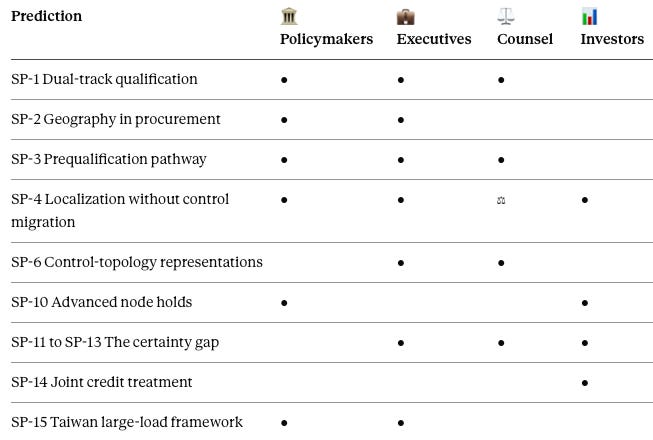
SP-1 and SP-3 · Dual-Track Qualification and the Prequalification Pathway · Bands 84–93% and 76–86%
🏛️ Policymakers. Exposure: criteria drafted without allied input govern market access for years, and a jurisdiction absent from the record inherits terms written by others. Actions: the responsible ministry files comment in the Department of Energy implementing rulemaking before the docket closes. Trade representation documents auditable control attributes for the equipment classes at issue this quarter. Residual: the scope is set by the United States government, and comment shapes without controlling it.
💼 Executives. Exposure: a firm qualified against one track and not the other forfeits whichever market it neglected, measured in addressable revenue by segment. Actions: compliance maps the product line against both tests separately before the instrument publishes. Security documents firmware, update-authority and remote-access pathways across the installed base this quarter. Residual: neither test is final until the rules issue, so early qualification work carries rework risk.
⚖️ Counsel. Exposure: existing supply and service agreements written before the order carry no substitution right, leaving no contractual remedy when a component becomes covered. Actions: transactions makes provenance-change substitution a required negotiating position at the next renewal cycle. Compliance builds a covered-entity screening step into the procurement approval workflow before the instrument publishes. Residual: executed agreements cannot be reopened unilaterally.
SP-4 and SP-6 · Localization Without Control Migration · Bands 76–87% and 49–64%
💼 Executives. Exposure: an expansion that transfers design authority, firmware control or type-testing surrenders the layers the new rules price, and the loss appears as margin compression rather than as a line item. Actions: strategy documents which capability layers an expansion transfers and which it retains before the investment decision. Engineering fixes the location of design and update authority in the expansion structure before capital commitment. Residual: customer and regulatory requirements can force transfers no internal decision prevents.
📊 Investors. Exposure: a position underwritten on American revenue growth misprices a supplier that is growing the top line while transferring the capability behind the margin. Actions: diligence adds a capability-location question to the template before the next commitment. Research reads localization announcements for what they say about design authority rather than for capacity figures. Residual: no current disclosure answers the question, so the assessment rests on inference until reporting changes.
⚖️ Counsel. Exposure: an expansion agreement silent on control layers allocates them by default rather than by intention. Actions: transactions makes retention of design, firmware and type-testing authority an express term in expansion and joint-venture documents at the next negotiation. Residual: counterparties resist the term, and the achievable version may be narrower than the drafted one.
SP-11, SP-12 and SP-13 · The Certainty Gap · Bands 78–89%, 58–72% and 70–84%
💼 Executives. Exposure: a supplier absorbing delivery risk without pricing it converts a customer’s problem into its own, measured in reserve capacity committed against no consideration. Actions: commercial establishes whether delivery commitments are priced or given away in current agreements this quarter. Operations sizes the reserve capacity a delivery commitment would consume before any commitment is offered. Residual: pricing delivery certainty requires holding the risk, which no structure eliminates.
⚖️ Counsel. Exposure: a schedule commitment without defined remedies is an unbounded obligation. Actions: transactions defines triggering conditions and remedy limits for any delivery commitment before it is offered. Residual: a remedy cap reduces exposure and does not remove reputational consequence.
📊 Investors. Exposure: a financing structure treating power obligations and delivery delay as separate risks understates correlated loss, and the error shows up as basis-point mispricing across the book. Actions: credit builds a joint stress case combining a delivery interruption with a continuing payment obligation before the next engagement. Residual: ratings methodology moves on its own schedule, and no single participant accelerates it.
SP-10 and SP-14 · Concentration and How Capital Reads It · Bands 82–92% and 59–73%
📊 Investors. Exposure: a portfolio holding both American infrastructure obligations and exposure to concentrated advanced-node supply carries a correlation that neither position discloses. Actions: portfolio identifies holdings exposed to both legs before the next allocation. Research prepares the analytic case for ratings dialogue rather than waiting for methodology change. Residual: the correlation is structural and diversification within the sector does not remove it.
🏛️ Policymakers. Exposure: policy assuming advanced-node capacity will relocate inside a policy cycle plans against a timeline fabs do not run on. Actions: energy and industrial planning staff test infrastructure timelines against fab construction timelines rather than against procurement timelines, before the next planning cycle. Residual: relocation timelines are set by firms rather than by governments.
SP-15 · A Taiwanese Large-Load Framework · Band 45–62%
🏛️ Policymakers. Exposure: demand growth arriving before allocation rules produces the disorderly correction other jurisdictions have already experienced, measured in reserve margin and in delayed interconnection. Actions: the competent regulator publishes draft allocation criteria before the next planning cycle rather than after the queue clears. Residual: publishing criteria does not create generation, and the physical constraint persists.
💼 Executives. Exposure: a domestic framework written without industry input can price large loads in ways that raise Taiwanese operating cost while American demand is rising. Actions: industry associations file position papers during any consultation window. Residual: a framework may not open for consultation at all, which is what the band reflects.
XI. Conclusion
American security policy created a market for trusted suppliers and has not yet written the rules of entry. Taiwanese manufacturers enter it with position, order visibility and an operating record under sustained pressure.
Entry is conditioned. Qualification runs alongside localization pressure rather than reducing to it, and presence moves capability either way. The highest-value control layers do not necessarily move with the factory, and that separation determines how much of the premium Taiwan retains.
Two American logics run side by side and neither will displace the other. Security eligibility rewards verifiable control. Procurement preference rewards location. A supplier that reads them as one contest will optimize for the wrong test.
The unpriced gap sits underneath all of it. Power obligations bind on a fixed schedule while the compute that justifies them arrives on a variable one, and no reviewed instrument prices the hedge.
Winning the market was the easier problem. Keeping what it pays is the one still open.
Sources
MindCast AI
Federal Grid-Security Rules Are Doing to American AI Data Centers What China Could Not. The companion analysis. Traces how the August 26 order converts into American authorization cost and time-to-power, which is the demand side of the market this paper examines from the supply side.
Foreign Capital, Host Competition, and the American Data Center Equilibrium. Establishes that infrastructure markets pay more for certainty than for a low price, which is the premium Section VI shows has no supply-side counterpart.
How Export Control, Investment Screening, and Cable Geopolitics Reprice Data Center Capital. Establishes sovereign authorization operating outside the host permitting system, the layer the bulk-power order now occupies.
The TSMC China License and the Limits of Hardware Export Controls. Establishes that physical custody does not define the capability boundary, which is the basis for treating control attributes and geography as separate tests in Section IV.
The Two-Gate Game. Establishes that permission from one sovereign and acceptance by another are separate gates, the general form of the dual-track finding.
US Insourcing: Where Foreign Firms Can Enter America’s AI-Quantum Stack. Establishes that foreign entry runs by layer and that compliance conditions alter value without foreclosing access, which Section V extends to the specific layers a factory move carries.
US Outsourcing: What Leaves America’s AI-Quantum Buildout When the Megawatts Stay. Establishes that control and service layers move differently from physical capacity, the distinction Section V rests on.
AI Data Center Developers Are About to Disclose What State Power Approval Costs. Establishes that authorization uncertainty becomes valuation and financing exposure, the channel through which the certainty gap in Section VI reaches capital.
AI Data Center Moratoriums Are Forecastable and They End in Pricing Rules, Not Bans. Establishes that political conflict over infrastructure resolves into pricing instruments rather than prohibition, the pattern Section II expects the implementing rules to follow.
External
Chung-Hua Institution for Economic Research. “Strategic Positioning of Taiwan’s Heavy Electrical Industry Amid Geopolitical Energy Security Risks” (2026). Source for the export figures in Section I.
Fortune Electric. Order disclosure on artificial intelligence data center transformers, June 2026.
Taiwan Ministry of Economic Affairs. National electricity supply and demand report, August 2026.
Taiwan National Security Bureau. Annual report on cyberattacks against critical infrastructure, 2025.
The White House. Executive order declaring a national emergency to secure the United States bulk-power system, August 26, 2026.
United States Department of Energy. Action of October 23, 2025 initiating the federal large-load interconnection proceeding. The instrument’s precise form requires verification against the Federal Register before citation in any derivative work.
MindCast AI · Predictive Law and Behavioral Economics + Game Theory Foresight Simulation firm · Data Center Global Regulatory Economics and Innovation · Bellevue, Washington · mcai@mindcast-ai.com