

Companion to The Authorization Price as an Exchange Rate, which defines the authorization spread and grades ten foreign jurisdictions against a United States reference case. The present paper takes up the variable that publication named as its decisive uncertainty and declined to forecast.
Related works: AI Data Center Developers Going Public in America Must Disclose Foreign Ownership and Control | AI Data Center Credit Risk — Permitting, Curtailment, and the Cost of Capital · The MindCast AI Data Center Record (August 2026) · The Authorization Market: Standardized Bargaining, Rationed Power, and the Competition to Build America’s AI Infrastructure (2026) · The Data Center Authorization Price: A 50-State Baseline (2026) · Capital Is the New Computing: Financing the Next Era of AI Infrastructure, 2025–2045 (November 2025) · Power Brokers & Digital Real Estate: How CRE Firms Are Building the AI Infrastructure Backbone (November 2025)
Critical references: The Model AI Infrastructure Authorization Code · The Data Center Authorization Market: A 50-State Regulatory Atlas
Executive Summary
Washington sets an authorization price on advanced compute infrastructure built anywhere in the world.
A campus in Riyadh can hold every domestic permit, complete construction, energize its substation, and still not run. Advanced compute reaches it only under a United States export license, and no Saudi instrument governs the decision. Host authorization determines whether a building goes up. A second authorization, set thousands of miles away, determines whether the building does the work it was built for.
Two authorization prices govern advanced compute infrastructure, and the two answer different questions. The site authorization price covers permission to site, connect, power, and operate — statute, tariff, commission order, and local ordinance, graded across fifty American states and ten foreign jurisdictions in the companion publication. The strategic sovereign authorization price covers controls over technology access, ownership, capital movement, and strategic connectivity: export licensing, investment screening, outbound investment rules, and submarine cable landing approval.
Site Authorization Price + Strategic Sovereign Authorization Price = Total Authorization Exposure.
Separating the two functionally rather than geographically matters, because a single government often holds both. The United States sets site authorization in Ohio and strategic authorization over a project in Riyadh, and the two decisions run through different agencies on different logic. Capital pricing only the first term is pricing part of the risk.
The strategic price falls unevenly, and the unevenness maps cleanly. A Canadian pension fund investing in Ohio faces one instrument. A Gulf sovereign investing in the same asset faces several, with two material ones — investment screening and export licensing for downstream access — originating in a single American strategic posture and moving together.
The same Gulf allocator funding a campus in Vietnam adds Vietnamese ownership rules, a currency and repatriation regime, and its own government’s outbound rules. Decomposing the strategic price by instrument produces the Sovereign Exposure Stack, which identifies routing incentives that expected-return analysis alone misses.
Geopolitical pressure changes how capital is structured before it changes how much capital moves. Conventional analysis expects tension to reduce cross-border flows. The mechanism runs the other way first. When access to American technology becomes less certain, a sovereign allocator has more reason to hold American assets, not less, because ownership sits closer to the technology. Domestic buildout accelerates at the same time as a hedge. Both legs speed up, and volume falls only after structure has exhausted its options.
Four structures carry that adaptation, and one of them changes what states can do. Debt in place of equity, platform intermediation, dedicated on-site generation, and powered-shell underwriting each reduce a foreign allocator’s exposure to host regulatory action. Three affect visibility. The fourth affects power.
Bring-your-own-generation moves the binding authorization instrument away from the standard large-load queue, and the queue is the principal rationing instrument in the grid-adequacy corrections examined here. Alberta rations with it. Quebec allocates with it. Ireland’s four-year Dublin closure ran entirely through it.
Leverage does not vanish when a project leaves the queue. A project supplying dedicated generation still touches transmission, standby service, generation siting, and emissions approval, so leverage migrates to instruments held by different bodies on different timetables. Ireland and Alberta both adopted bring-your-own-generation as their correction, transferring the adequacy problem to the applicant and dispersing their own leverage across instruments they had not been using to ration.
Powered-shell underwriting works in the same direction. An asset engineered to yield a real estate return without advanced chips lowers the cost of delayed compute eligibility, which changes how an allocator responds to licensing uncertainty. Utilization, tenant demand, and valuation all differ sharply from an operating AI facility, so the structure buys time rather than immunity.
The same instrument means opposite things on opposite sides of the study. Where a grid delivers, dedicated generation bypasses queue-based rationing and shifts leverage to instruments held by other bodies. Where a grid cannot supply underwritable firm power on the required timetable — Brazil, and parts of India and Vietnam — dedicated or contractually firm generation becomes an entry condition rather than a bypass. One instrument, two meanings, decided by whether the grid can deliver.
Five Predictions Carry the Argument
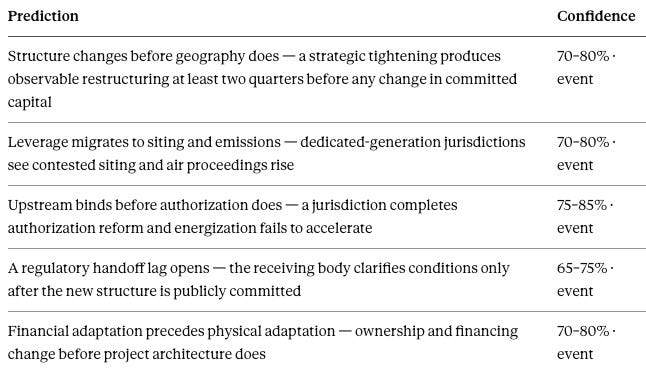
Naming the deeper mechanism: authorization-instrument substitution. The companion publication showed capital responding to a higher authorization price by changing where an asset sits. The present paper shows capital responding by changing what the asset legally and economically is — equity to debt, direct to intermediated, grid-served to self-generated, compute-dependent to powered shell. Each change moves which government instrument still binds.
Jurisdictional substitution and structural substitution are the two substitution margins available in response to a price increase, and only the first shows up in siting data. Cancellation remains the third response, and the scenario weights in Part VIII carry it.
The conclusion for American jurisdictions is concrete. Geopolitical pressure should produce structural substitution before it produces large-scale geographic substitution, because changing a deal structure is faster and cheaper than moving a site. A state that writes a bring-your-own-generation pathway without asking where leverage migrates has changed the negotiation without noticing.
What Each Stakeholder Gets
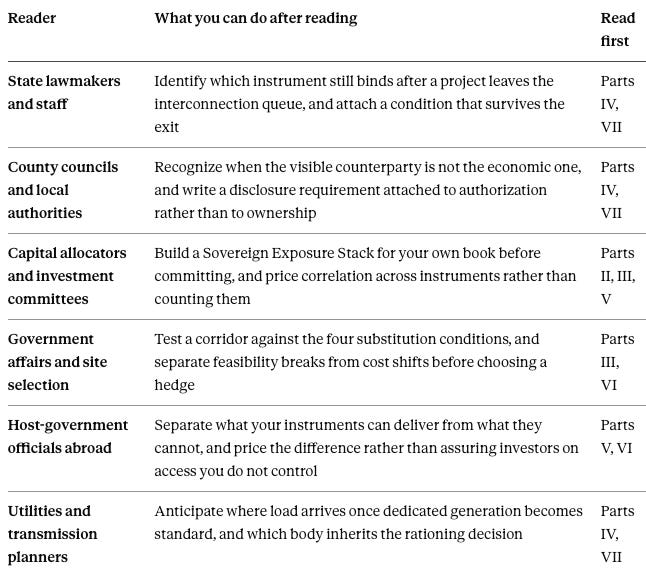
Parts I through III build the instrument. Parts IV and V examine each leg of the flow. Parts VI and VII set out what follows for capital and for policy. Part VIII releases the prediction register.
I. Two Authorization Prices
Advanced compute infrastructure requires two permissions answering two different questions, and most analysis prices only one.
Site authorization answers whether the facility may exist and operate. Statute sets the conditions, tariff sets the cost allocation, a commission order sets the terms of service, and a local ordinance sets whether the project may occupy the ground. The companion publication defines the authorization spread on exactly those four components, conditional on power delivery timing, technology access, and tenant credit quality.
Strategic sovereign authorization answers whether the facility may do the work it was built for, under the ownership contemplated, connected to the markets intended. Advanced compute moves under export license. Foreign ownership of infrastructure moves under investment screening. Capital moving across borders increasingly moves under outbound rules. Submarine cables reaching a landing point move under separate security review.
Ordinary enterprise and colocation facilities carry little strategic exposure. Facilities built for frontier compute carry a great deal, which is why the distinction matters now and did not a decade ago.
A host government frequently sets the first price and cannot set the second. Riyadh can grant every permit a campus requires and cannot license a single accelerator into it. Hanoi can approve a project in weeks and cannot guarantee the silicon that makes the project economic.
The asymmetry is the subject of this paper. A jurisdiction competing on authorization terms competes on a variable it controls, against a constraint it does not, and capital prices both together.
II. The Sovereign Exposure Stack
Decomposing the strategic sovereign price by instrument produces an exposure topology. For any allocator and any destination, the Sovereign Exposure Stack lists the distinct strategic instruments that can materially alter the position — controls over technology access, ownership, capital movement, and connectivity — together with the degree to which those instruments move as a bloc.
Site authorization sits outside the stack. Ordinary permitting, tariff, and ordinance risk belongs to the companion publication’s spread, and the two combine only at the level of total exposure.
Depth matters, and correlation can dominate depth. Instruments originating in one government under one strategic posture move together, so an allocator facing four correlated instruments carries a different risk than an allocator facing four independent ones.
The stack maps exposure rather than pricing it. Three instruments are not automatically riskier than one, because a single instrument with wide discretion and severe consequence can dominate several narrow ones. A fully specified version would weight depth against correlation, decision severity, and reversibility, and no such weighting has been validated against outcomes.
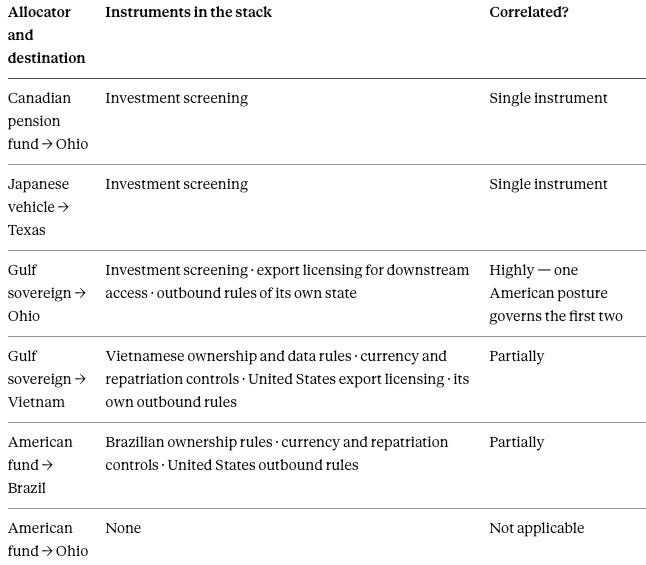
Stack topology surfaces behavior that return alone leaves unexplained. The model implies that an allocator facing a single instrument optimizes for yield, while an allocator facing three correlated instruments optimizes for structure first and yield second — which would explain why Gulf capital and Canadian capital behave differently in the same asset at the same price. P3 tests the implication directly.
Construction requires published rules and no proprietary data, so any allocator can build the stack for its own book before committing.
III. Five Vectors
Geopolitical events reach data center capital through five channels. Each operates differently, and treating them as one undifferentiated risk produces the wrong hedge.
Export licensing and chip eligibility. Advanced accelerators reach a destination only under license, and eligibility varies by country and by end user. A campus is a real estate asset until the silicon arrives, at which point the asset becomes compute. Licensing therefore governs the conversion, not the construction.
Investment screening, inbound and outbound. Foreign acquisition of American infrastructure draws review that varies by structure and by acquirer identity. Sovereign vehicles draw the most scrutiny in every structure. Outbound rules, newer and expanding, govern American capital moving into foreign technology assets.
Submarine cables and landing rights. Cable geography determines which markets a facility can serve, and landing approval is a sovereign decision subject to security review. Cable damage in contested waters closes routes outright. A substitution corridor requires physical connectivity as a precondition, and cable geopolitics is the only instrument in this set that can close a corridor completely rather than raise its price.
Upstream concentration. Advanced packaging, high-bandwidth memory, large power transformers, grain-oriented electrical steel, and critical minerals each concentrate in few suppliers and few jurisdictions. Concentration converts an ordinary procurement question into a geopolitical one, and transformer lead times already govern energization schedules independently of any authorization decision.
Sovereign AI as industrial policy. National programs across the European Union, India, Japan, and the Gulf direct capital toward domestic capability for reasons that are not commercial. Programs of that kind move capital against price signals, which makes them a genuine competitive factor and an unreliable one.
Two classes of constraint sit inside the five vectors, and the distinction governs how an allocator should hedge.
Feasibility constraints create binary breaks. Export licensing and cable landing access can each stop a project that has satisfied every host requirement, and neither is hedgeable through pricing.
Cost and timing constraints shift expected value. Investment screening, upstream concentration, and sovereign industrial policy change what a position costs, when it delivers, and against whom it competes, and each can be priced.
Confusing the two produces the wrong instrument. A feasibility break requires optionality — structure, staging, alternative use. A cost shift requires a spread.
Working With MindCast
MindCast AI is a predictive law and behavioral economics firm in Bellevue, Washington. The practice models institutions and firms as decision systems — Cognitive Digital Twins carrying objective functions, constraint stacks, and failure modes — then runs them forward to produce time-bound predictions with named falsifiers and settlement sources. Every forecast MindCast publishes can be graded against a public record by a stated date.
Two verticals now run on the same instruments. Authorization intelligence grades statute, tariff, commission order, and local ordinance across all fifty states and ten foreign jurisdictions, and supplies the AI Infrastructure Authorization Series and the 50-State Authorization Price Atlas. Geopolitical exposure intelligence, introduced in the present paper, maps the controls over technology access, ownership, capital movement, and connectivity that condition an asset after the host has already approved it.
Published research grades jurisdictions and mechanisms in general terms. A specific position requires specific work.
MindCast produces market-specific and counterparty-specific analysis on request:
Sovereign Exposure Stack for a named allocator across a defined destination set
Authorization-spread assessment for a cross-border pipeline or a single site
Jurisdictional authorization profile for any American state, county, or foreign jurisdiction in the study
Structural substitution review — which instrument becomes binding under a proposed deal structure, and which body holds it
Multi-jurisdiction comparison for a site-selection or capital-allocation decision
Government affairs teams, investment committees, developers, utilities, and legislative staff each receive the same underlying instruments applied to their own facts.
Contact MindCast AI at mcai@mindcast-ai.com.
IV. Capital Into the United States
Foreign capital entering American data center assets faces the host’s own apparatus, and the companion publication names the four exposures: cost-allocation reversal, local veto latency, queue-position value decay, and regulatory exposure correlated by capital origin.
Structure is the primary response, and four structures recur.
Debt in place of equity. A senior secured position absorbs a valuation shock differently from an equity position. A commission order reallocating transmission cost after commitment reduces equity value directly, while a lender retains claims on land, improvements, and routing.
Platform intermediation. Capital placed alongside an established domestic manager reaches assets through a counterparty that already operates in the relevant regulatory forums. Intermediation changes which entity appears before a utility commission or a county board.
Dedicated on-site generation. A project supplying its own generation does not depend on the utility’s standard interconnection queue for firm power.
Powered-shell underwriting. A facility engineered to return on real estate fundamentals — shell, substation, cooling, fiber — holds value if advanced compute arrives late or not at all.
Three of the four change what a state can see. The third changes what a state can do, and Part VII takes up the consequence.
Structural adaptation of this kind is ordinary optimization rather than evasion. Different structures carry different review treatment under published rules, and allocators respond to published rules. Naming the response as ordinary keeps the analysis usable by both sides of a negotiating table.
V. Capital Into the Ten Foreign Jurisdictions
Capital moving into the United Arab Emirates, Saudi Arabia, Singapore, Japan, Canada, Ireland, France, India, Vietnam, or Brazil carries three risks the inbound American leg does not.
Chip eligibility is set by a third party. An allocator funding a campus in Hanoi or Hyderabad faces a licensing question that neither Vietnam nor India can control. Host authorization policy, however well designed, does not address the dominant risk. A host government can shorten its approval timeline to weeks and change nothing about whether the facility receives accelerators.
Permission itself can be withdrawn. American commissions reallocate cost and rarely revoke permission. Chile’s courts unwound a granted permit over groundwater, and any jurisdiction whose judicial or environmental review retains reversal power quotes a certainty it cannot guarantee.
Currency, capital controls, and repatriation price into Brazil, India, and Vietnam and price into none of the American exposure. A return denominated in a currency subject to control is a different asset from the same return in dollars.
Against those risks, dedicated generation reverses meaning. Where a grid cannot supply underwritable firm power on the required timetable — the condition in Brazil, and in parts of India and Vietnam — dedicated or contractually firm generation becomes an entry condition rather than a regulatory bypass. Bring-your-own-generation routes around an instrument in a jurisdiction whose grid delivers and substitutes for the grid in a jurisdiction whose grid does not.
The reversal explains a pattern that otherwise reads as inconsistency. An allocator can adopt the same structure in Alberta and in Bahia for opposite reasons — in one case to move outside a rationing instrument, in the other to substitute for a grid that will not deliver.
VI. What the Combination Produces
Two legs and five vectors interact, and three consequences follow that neither leg produces alone.
Chip eligibility becomes an explicit underwriting input. Accelerator availability is often modeled as a supply or procurement input. Strategic eligibility requires separate treatment, because eligibility is a sovereign determination varying by destination and by end user, and no standard instrument exists for measuring it.
Capital adapts through structure before it adapts through geography. Separating what is observed from what the model implies matters here, because the two carry different weight.
Observed: deal structures differ measurably in exposure and in review treatment under published rules.
Implied: rising strategic pressure should therefore produce structural adaptation — debt, intermediation, dedicated generation, powered shell — before it produces volume contraction, because changing a transaction is faster and cheaper than moving or cancelling a project.
Testable: whether deal-form migration precedes any decline in capital flow. Part VIII scores the sequence as P1 and P8.
Host assurances on technology access face an incentive problem worth testing.
Observed: chip eligibility is a sovereign determination of the exporting state, and host governments hold no instrument that binds it.
Implied: a jurisdiction competing for capacity therefore has an incentive to assure investors on access it cannot secure, and allocators have reason to discount such assurances.
Testable: whether host assurances systematically precede licensing outcomes the host does not control.
Together the three consequences point one way. Geopolitical pressure reorganizes the form capital takes before it reduces the amount, and form is exactly what host authorization law regulates least well.
VII. What Follows for American Jurisdictions
Geopolitical pressure reaches American jurisdictions as a structural problem before it reaches them as a geographic one. Changing a deal structure takes months. Moving a site takes years, and for latency-bound workloads may be infeasible at any price.
The interconnection queue is the principal rationing instrument in the grid-adequacy corrections examined here.Alberta rationed 19,565 megawatts of requests against a 1,200 megawatt limit using nothing but queue position. Quebec restricted allocation the same way. Ireland’s four-year Dublin closure operated entirely through connection policy, with no statute and no vote.
A dedicated-generation pathway moves leverage rather than destroying it. Ireland and Alberta both adopted bring-your-own-generation as their correction, transferring the adequacy problem to the applicant. A project outside the standard large-load queue cannot be rationed by the body running that queue, and the same project still requires transmission service, standby arrangements, generation siting approval, emissions permitting, fuel supply, and water.
Leverage therefore migrates to instruments held by different bodies on different timetables, and the receiving bodies are frequently the ones with the least practice using them for this purpose.
Dedicated generation solves a real adequacy problem and solves it well. The question a jurisdiction should ask on adopting the pathway is narrower and answerable: which instrument becomes binding once the queue no longer is, and does the body holding it know that it now sets the price?
Powered-shell underwriting shifts the federal lever in the same way. An asset returning on real estate fundamentals lowers the cost of a licensing delay, so a project proceeds on shell economics and the technology question resolves on a later timetable under different pressure.
Three propositions follow for state and county decision-makers.
Count what you still control after each exemption. An authorization regime is only as strong as the instrument that survives the most common structure used to route around it, and the surviving instrument is usually held by a different agency than the one that wrote the exemption.
Visibility is a policy variable. Debt and intermediation are lawful and ordinary, and both reduce what a commission or a council knows about the party behind a project. A disclosure requirement attached to authorization rather than to ownership survives structural adaptation.
Foreign competition remains the smaller and slower risk. The companion publication holds that latency-bound American serving capacity does not migrate at material scale, and nothing in the geopolitical layer changes the finding. Training and batch workloads are mobile and do move; the capacity serving American users is not, and structural adaptation arrives long before either.
VIII. The Foresight Register
Twenty-one predictions follow from a thirty-one CDT register run against a common August 12, 2026 observation record. Every entry carries a deadline, a falsifier, a named settlement source, and a confidence band with a class label. Event-class entries resolve against an observable occurrence. Interpretive-class entries express confidence in a structural read and never pool with event probabilities.
VIII.1 Primary Register
Eight primary predictions test the mechanisms this paper introduces. Each would fail if the underlying theory were wrong.
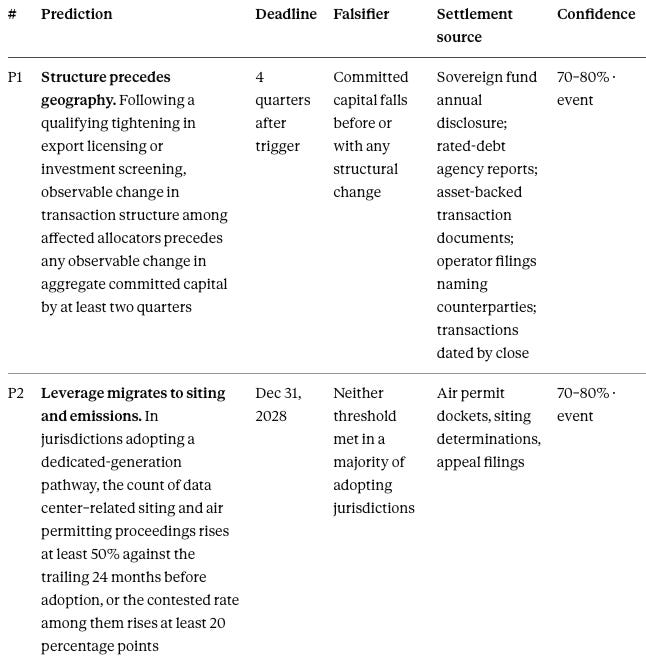
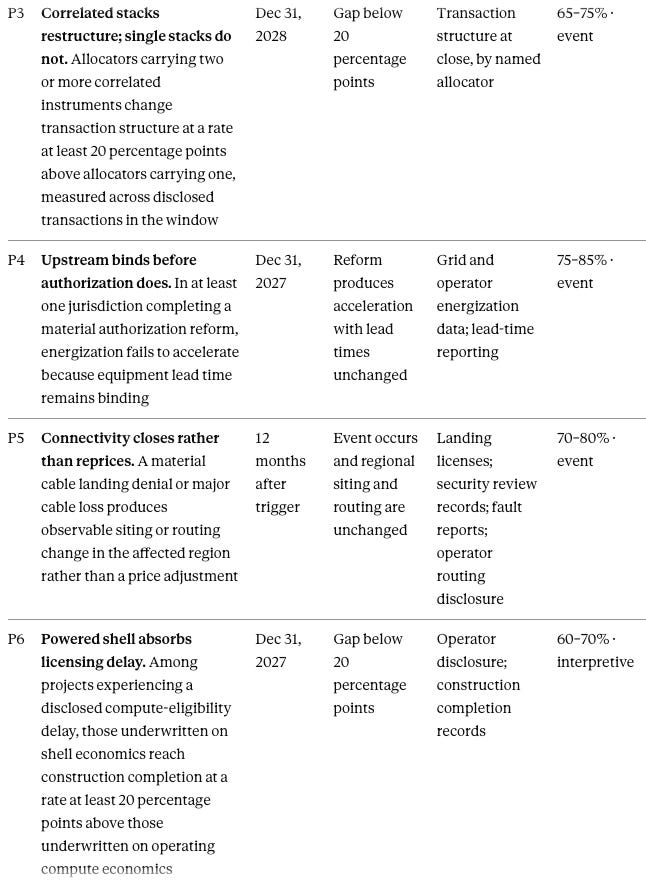
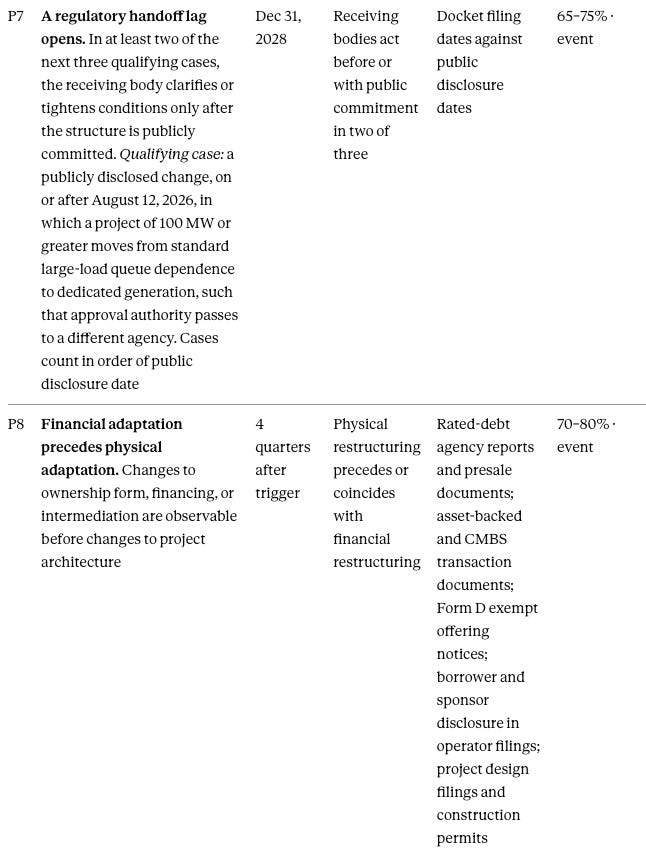
Settlement resolves in three states, and the third is narrow by design. Private structures disclose late, so P1, P3, and P8 carry real observation risk. Handling that risk by exempting non-observation from disconfirmation would produce an asymmetric rule in which evidence can confirm a prediction and absence can never falsify it.
HIT — the predicted event is observed under the registered definition. MISS — adequate settlement data exist for the window and the predicted event is not observed. UNRESOLVED — the named settlement source was unavailable or affirmatively incapable of resolving the question.
Ordinary non-observation counts as a MISS. UNRESOLVED requires an affirmative showing that the source failed, not merely that the event went unrecorded.
Three primary entries resolve against a quantitative threshold rather than a binary occurrence: P2, P3, and P6, each carrying its threshold in the entry itself. P2 additionally carries a distribution on the increase in contested siting or air proceedings — P10 20% · P50 45% · P90 75%. Quantiles are model-implied scenario values rather than calibrated statistical estimates.
VIII.2 Secondary Register
Thirteen secondary predictions test individual instruments and jurisdictions. Each resolves against a single named source and on a shorter clock, which makes the secondary entries the early-warning layer for the primary ones. Falsifiers and settlement sources for the secondary entries are maintained in the technical record and available on request; the table below carries the claim, the deadline, the class, and the band.
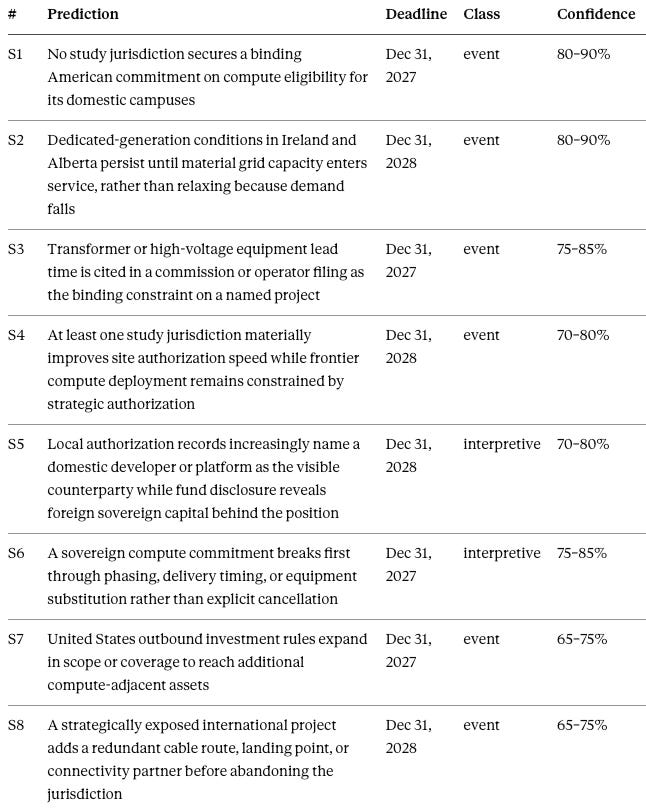
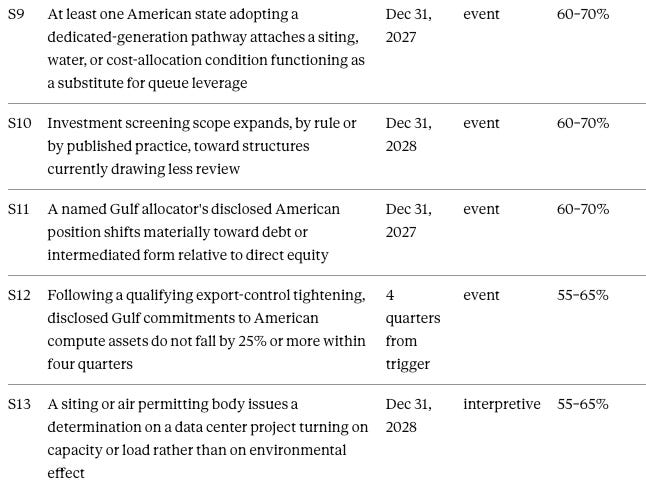
Four entries resolve within roughly four quarters — S3, S7, S11, and S12 — and each tests a different instrument. Early movement across all four would corroborate the primary register well ahead of its own deadlines.
VIII.3 Scenario Weights and Decisive Uncertainty
Three routes carry the modal analysis, weighted by share of surviving model branches rather than by calibrated market probability. Structural adaptation without geographic relocation runs 55–65%. Structural adaptation followed by partial geographic rebalancing runs 25–35%. A strategic feasibility break admitting no structural workaround runs 10–20%.
Timing and magnitude of the next material licensing or screening action remain exogenous. Neither is forecastable from the routed function set, and P1, P3, S10, S11, and S12 all condition on a trigger this analysis does not predict.
The response window is a different question, and the register does forecast it. Once a trigger arrives, P1 sets the interval between structural change and any change in committed capital at two quarters or more. P7 sets the interval between a structure becoming public and the receiving body tightening conditions. P8 sets the order in which adaptation occurs.
Together the three describe how long an allocator has to act and how long a regulator takes to respond — the part of the sequence that repeats regardless of which trigger fires.
Predicting the day a restriction lands is a different exercise from predicting what happens in the four quarters afterward, and only the second is a structural question.
IX. Method and Scope
Findings and predictions above derive from a thirty-one CDT register: the twenty-three jurisdictional and firm-side CDTs built for the companion publication, plus eight covering sovereign instrument-holders, allocator classes, and the bodies that receive migrated leverage. Two independent executions ran the register against a common observation record.
Three limits bound the analysis.
Rules move faster than publication. Export-control and screening rules change on their own schedule, so every characterization here reflects published rules as of August 12, 2026.
Private structures disclose late. Structural adaptation is observable only where disclosure requires it, and private credit and unlisted vehicles report incompletely. The aggregate shift toward debt and intermediation is therefore directionally supported rather than precisely measured, and Part VIII names the entries carrying the resulting false-negative bias.
The Sovereign Exposure Stack lists instruments rather than weighting them, because no weighting has been validated against outcomes.
The three limits constrain measurement precision and settlement observability. None alters the causal mechanisms the model generates, which rest on published rules and on completed corrections settled against public record.