

Related works: AI Data Center Credit Risk — Permitting, Curtailment, and the Cost of Capital · The Authorization Market — Standardized Bargaining, Rationed Power, and the Competition to Build America’s AI Infrastructure · The Data Center Authorization Price: A 50-State Baseline · Three Competing Governance Equilibria for AI Infrastructure · Why MindCast Is Filing a Public Comment with the DoE · The Two-Ledger Data Center Bargain · The Federal-State AI Infrastructure Collision
Critical references: The Model AI Infrastructure Authorization Code · The Data Center Authorization Market: A 50-State Regulatory Atlas
Executive Summary
On November 16, 2025, MindCast AI published a forecast describing what would follow the Department of Energy’s directive treating hyperscale computing as a matter of interstate grid reliability. Federal regulators would move fast. State regulators would object that federal authority was intruding on their jurisdiction. Companies would pursue their own generation. Transmission cost responsibility would become the central economic fight.
Thirty-nine days later, the outside world produced the first confirmation. Over the following eight months it produced four more. The sequence below runs in the order the evidence arrived.
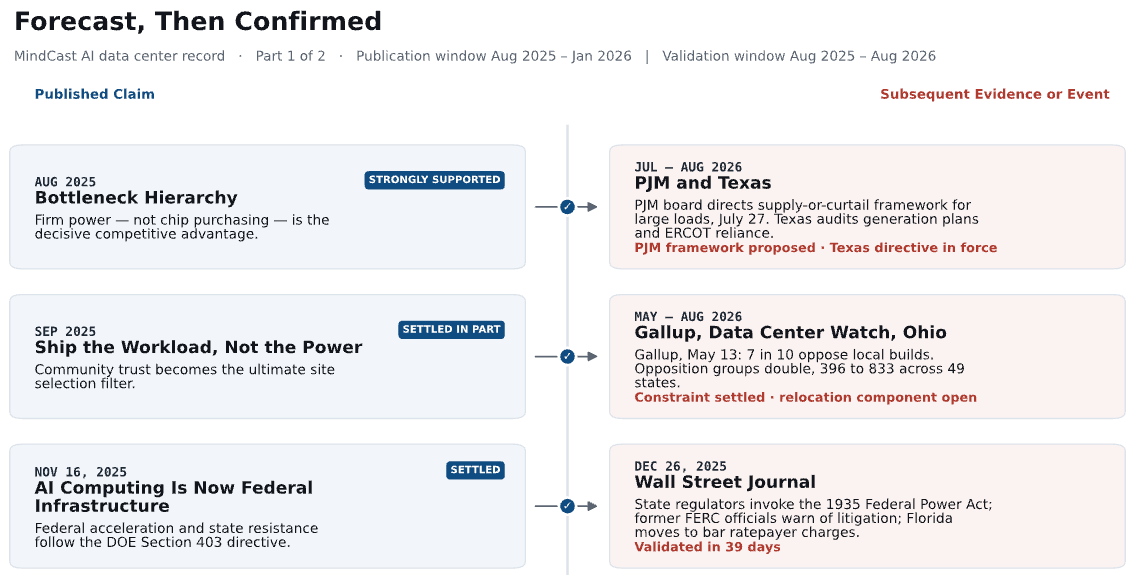
December 26, 2025 — thirty-nine days. The Wall Street Journal reported state regulators invoking the 1935 Federal Power Act, former federal energy officials warning of litigation, and Florida moving to bar utilities from charging households for hyperscale development. Three of the four predicted dynamics appeared in a single article.
May 13, 2026 — community consent. Gallup found roughly seven in ten Americans oppose an AI data center in their area. MindCast named community trust as the decisive site-selection filter in September 2025, before the first state moratorium and before any national polling existed on the question. Opposition groups have since more than doubled to 833 across 49 states, and both major-party nominees for governor of Ohio have pledged a moratorium.
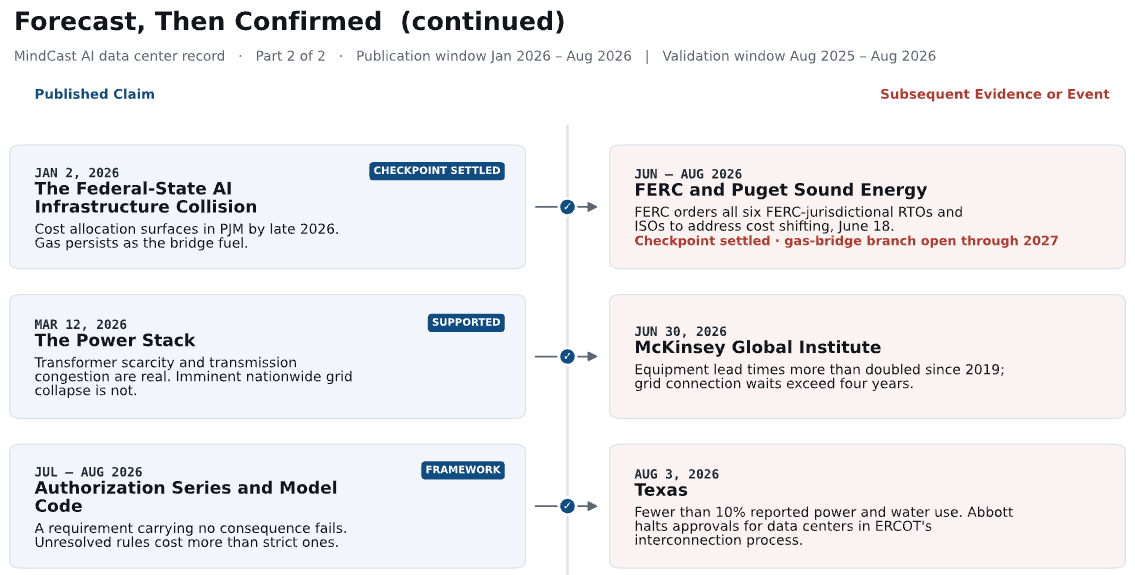
June 18, 2026 — cost allocation. The Federal Energy Regulatory Commission ordered all six FERC-jurisdictional regional grid operators to justify or reform how large loads connect to the grid, naming cost shifting and transmission cost transparency explicitly. The January 2, 2026 checkpoint required cost allocation to surface in PJM or MISO by late 2026. Confirmation arrived five months early.
June 30, 2026 — physical constraints. The McKinsey Global Institute reported equipment lead times more than doubled since 2019 and grid connection waits exceeding four years. MindCast identified transformer scarcity and transmission congestion as documented constraints in March 2026, while separating them from unsupported claims of imminent nationwide grid collapse.
July 27 and August 3, 2026 — grid access shifts toward supply-or-curtail. PJM’s board directed filings under which new large loads that neither bring new generation nor otherwise secure supply would face curtailment during capacity shortages. Texas began auditing generation plans and ERCOT reliance days later. MindCast named secured electricity as the decisive competitive advantage in August 2025, in its first data center study.
MindCast published that first study on August 21, 2025 — before the opposition wave, before the first moratorium, before Gallup measured the public. Twelve months of dated claims now meet a public record anyone can check. The pages below set each claim against what happened and name an outside source for every event.
Forecasts, structural reads, frameworks, corrections, and open claims are graded separately in Section I.
I. How Foresight Predictions Are Graded
Grading requires a rule stated before the evidence. Five categories cover every entry, and each entry names its category at the top.
To maintain institutional modeling standards, the record separates forecasts from frameworks. A forecast names a time-bound, testable event and either occurs or does not. A framework states a structural rule that subsequent activity illustrates, evaluated by explanatory fit rather than forecast settlement.
Counts refer to the entries graded in this publication, not the complete MindCast corpus.
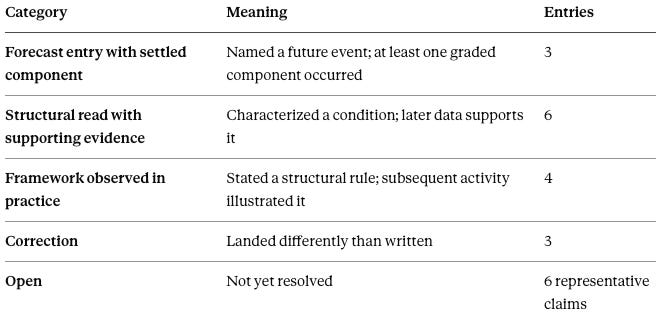
Several forecast entries carry more than one component, and components settle at different times. Where a claim has settled in part, the entry names the settled part and the open one.
II. Five Events of 2026, and What Bears on Them
Data center coverage this year has turned on a handful of events. Each traces back to a MindCast publication that addressed the underlying mechanism, and the category of each claim appears alongside it.
FERC orders all six FERC-jurisdictional grid operators to justify or reform large-load rules — June 18, 2026. The orders reach PJM, MISO, SPP, CAISO, ISO New England, and NYISO, and require each to address cost shifting and transmission cost transparency. Bears on The Federal-State AI Infrastructure Collision (January 2026). Checkpoint settled.
Texas halts approvals for data centers in ERCOT’s interconnection process — August 3, 2026, after fewer than ten percent of facilities reported power and water use. Bears on The Model AI Infrastructure Authorization Code (2026). Framework observed in practice.
PJM directs filings on a supply-or-curtail framework — July 27, 2026. New large loads that neither bring new generation nor otherwise secure supply by June 1, 2027 would face curtailment during capacity shortages, ahead of measures affecting other customers. Bears on The Bottleneck Hierarchy (August 2025). Structural read.
Puget Sound Energy proposes roughly five gigawatts of new gas — August 2026, drawing public objection from Washington legislative leaders. Bears on the physics-dominant branch of The Federal-State AI Infrastructure Collision(January 2026). Branch indicator supported; branch open through 2027.
Gallup finds roughly seven in ten Americans oppose local construction — May 13, 2026, with both Ohio gubernatorial nominees pledging moratoriums. Bears on Ship the Workload, Not the Power (September 2025). Constraint settled; relocation component open.
Four of the five events arrived within eleven months of the publication addressing them. Texas illustrates a scoring rule rather than confirming a prediction, and appears here because the rule predicted the failure that produced the pause.
III. Community Consent
Local resistance now shapes data center siting more than any other single variable. MindCast identified the mechanism a year before the current wave.
Ship the Workload, Not the Power (September 2025) — Forecast Entry with Settled Component
We said. Community trust would become the ultimate site selection filter, governing not merely whether a data center could be built but how quickly it scales and at what cost. Computing work would migrate toward places where power and public acceptance already existed.
What happened. Gallup reported on May 13, 2026 that roughly seven in ten Americans oppose construction of an AI data center in their area. Data Center Watch counted opposition groups rising from 396 to 833 across 49 states, with more than 300 state bills filed in the first six weeks of 2026. Both major-party nominees for governor of Ohio pledged a moratorium. In Washington, Cle Elum adopted an emergency moratorium three days after a $200 million project was announced.
Grade. Community consent settled as a governing constraint; workload migration remains open pending documented project movement.
The same study rated four regions. Northern Virginia was marked amber to red with advice to prepare to slow or relocate capacity, and the rating held. Eastern Washington was rated favorable, and Section IX records the correction.
IV. Which Constraints Are Real
Public argument about AI and the electricity grid has produced both documented shortages and considerable exaggeration. Separating the two carries practical consequences, because a developer, a utility commission, and a legislature all price risk differently depending on which constraints they believe.
The Power Stack (March 2026) — Structural Read with Supporting Evidence
We said. Transformer scarcity, transmission congestion in Northern Virginia and Phoenix, and cooling limits are documented constraints, each supported by procurement filings, published queue data, or operator disclosures. Claims of imminent nationwide grid destabilization are unsupported: utilities warning of collapse had not increased their own transmission spending, announced projects cited connection timelines contradicting their stated urgency, and weather volatility and industrial load shifts remained available as alternative explanations.
What happened. The McKinsey Global Institute reported on June 30, 2026 that lead times for generators, chillers, transformers, and switchgear have more than doubled since 2019, with some exceeding three years, and that average grid connection waits exceed four years and reach a decade in some markets. Both constraints named in March were confirmed by outside measurement within four months.
The Power Stack, on Strategic Behavior (March 2026) — Structural Read with Supporting Evidence
We said. Where computing demand outruns infrastructure by this margin, companies stop competing on price and compete instead to lock up scarce access — reserving positions in the interconnection queue, signing exclusive power contracts, buying land beside substations, and setting proprietary equipment standards that impose switching costs on later entrants.
What happened. FERC’s June 18, 2026 orders direct all six regional grid operators to address cost shifting, transmission cost transparency, co-location arrangements, and behind-the-meter generation. FERC’s orders confirm that queue administration, co-location, and behind-the-meter arrangements became formal regulatory issues within six months of publication. The exclusive-contract, land-strategy, and proprietary-standard components remain ungraded here.
Regulators and outside analysts confirmed both readings within four months of publication, on evidence the March study named in advance.
Contact mcai@mindcast-ai.com to partner with us on Predictive Game Theory AI in Law and Behavioral Economics. We specialize in predictive simulations for Complex Litigation, Innovation Economics, Geopolitical Risk Intelligence and Legacy Innovation. See more about MindCast series at our new website MindCast Corporate.
To test our predictive simulation AI system, in 2026 we simulated the Super Bowl and the World Cup. See 🏈 Super Bowl LX — AI Simulation vs. Reality | ⚽ The 2026 World Cup Final Simulation Validation
To deep dive on MindCast works upload the URL of this publication into any LLM (preferably Google AI mode) and prompt ‘reconstruct MindCast framework with three degrees of cited sub links.’ See Live-Fire Game Theory Simulators, Runtime Predictive Infrastructure.
V. Firm Power
Electricity supply has moved from an operating cost to a condition of service. Grid operators and state officials now ask whether a facility brings its own generation before asking anything else.
The Bottleneck Hierarchy in U.S. AI Data Centers (August 2025) — Structural Read with Supporting Evidence
We said. The AI infrastructure race would be decided by whoever secures reliable electricity, builds the right network connections, and designs cooling communities will accept — not by whoever buys the most computer chips. Firms holding secured firm power would outbuild rivals waiting on congested grids.
What happened. PJM’s board directed FERC filings on July 27, 2026 under which new large loads that neither bring new generation nor otherwise secure supply by June 1, 2027 would face curtailment during capacity shortages, ahead of Pre-Emergency Load Management affecting other customers. Large loads are not barred from connecting; they are served on a supply-or-curtail basis. Texas made self-supply an audit criterion in a directive now in force, and named companies committed to comply with the state’s standards, which require disclosure of generation plans, reduced ERCOT reliance, and water measures.
Grade. Strongly supported. The PJM board’s directive establishes supply-or-curtail as the operational threshold for large-load access, executing the mechanics described in August 2025. Final tariff approval rests with FERC.
VI. Federal and State Authority
Two governments claim authority over the same decisions, and the boundary between them determines what a developer must satisfy and who ultimately pays. MindCast has tracked the boundary since the Department of Energy first asserted jurisdiction in October 2025.
AI Computing Is Now Federal Infrastructure (November 16, 2025) — Forecast Entry with Settled Component
We said. Four consequences would follow the Department of Energy’s October 23, 2025 directive under Section 403: accelerated federal rulemaking on large-load interconnection, state regulators objecting that federal authority intrudes on their jurisdiction under the Federal Power Act, companies pursuing their own generation to bypass the queue, and transmission cost responsibility becoming the dominant economic fight.
What happened. Thirty-nine days later, on December 26, 2025, the Wall Street Journal documented state regulators invoking the 1935 Federal Power Act against federal oversight of large-load connections, litigation warnings from former FERC officials, and Florida moving to prohibit utilities from charging residents for hyperscale development.
Corporate self-generation is visible in Texas, where named companies committed to comply with the state’s data center standards requiring disclosure of generation plans and reduced ERCOT reliance.
The rulemaking chain ran as modeled. The October directive produced a FERC advance notice, roughly 200 stakeholder comments, and on June 18, 2026, six show cause orders under Section 206 of the Federal Power Act.
Grade. Three dynamics are documented. Corporate self-generation is supported by announced company plans and remains short of settlement.
One Settled Checkpoint and One Supported Branch Indicator from The Federal-State AI Infrastructure Collision (January 2, 2026) — Forecast Entry with Settled Component
We said. Nine checkpoints were published with dates and explicit failure conditions. Two are graded here. Cost allocation disputes would surface explicitly in PJM or MISO proceedings by late 2026, with dormancy stated as the failure condition. Separately, within the physics-dominant branch, natural gas would remain the dominant bridge fuel longer than public discussion acknowledged, on a horizon running through 2027.
What happened, on cost allocation. FERC’s June 18, 2026 orders require each regional operator to address cost-shifting concerns and provide greater transparency into how costs of serving large loads are identified, allocated, and communicated, with responses due August 17, 2026. Cost allocation became the explicit subject of a formal proceeding across all six FERC-jurisdictional regional grid operators, five months ahead of the checkpoint date.
What happened, on gas. Puget Sound Energy purchased six gas turbines and proposed roughly five gigawatts more, alongside converting the Centralia coal plant to gas, while Williams Companies announced Northwest pipeline expansion. Washington legislative leaders objected publicly on August 8, 2026 that the state’s clean electricity law was written to move off fossil fuels, not to build new gas plants.
Grade. Cost allocation settled five months early. The gas-bridge indicator is supported; the national branch remains open through 2027.
The Shape of Federal Authority — Structural Read with Supporting Evidence
We said. Federal authorities would win control over the process of connecting to the grid, while states retained authority over siting and over who pays.
What happened. FERC has proceeded through Section 206 tariff proceedings governing interconnection procedure, network upgrade cost recovery, and transmission service. Retail rates remain set by state commissions. H.R. 9419 creates a federal standard under the Public Utility Regulatory Policies Act and requires state regulators to consider and determine whether to adopt it, rather than imposing a retail rate directly — the federal-process, state-decision pattern the January analysis described.
Three Competing Governance Equilibria for AI Infrastructure — Framework Observed in Practice
We said. The contest resolves not along a single axis from permissive to restrictive, but into one of a small number of stable arrangements, and a jurisdiction can move on more than one dimension at once.
What happened. Texas paused approvals for data centers in ERCOT’s interconnection process on August 3, 2026 while continuing to court investment. President Trump called the pause a mistake and Governor Abbott defended it, with the Governor’s office citing an ERCOT-tracked surge in peak demand. Restriction and recruitment ran together inside one administration, under public federal pressure.
Federal and state authority now interact through formal proceedings rather than rhetoric, which makes the boundary observable and the next moves forecastable.
VII. Washington State
Washington concentrates the national question in one jurisdiction. Eastern counties host the load, western counties hold the legislative majority, and a 2019 clean electricity statute binds every utility in the state to a shared timetable.
Washington’s Clean Energy Advantage — Structural Read with Supporting Evidence
We said. Washington’s clean electricity requirements would function as a competitive asset or a competitive burden depending on institutional design.
What happened. Puget Sound Energy proposed roughly five gigawatts of new gas capacity in 2026, and legislative leadership objected publicly that the clean energy law was not written to produce new gas plants. Washington’s data center debate has become a fight over amending the statute, five months before the 2027 session convenes.
Under RCW 19.405, each utility carries obligations tied to its own retail load, so a large new customer in Grant County raises Grant PUD’s compliance burden directly. Cost reaches western Washington households through two indirect channels — competition for the same regional non-emitting resources, and carbon allowance pricing — and quantifying either requires evidence beyond the scope of this record.
New York’s Data Center Moratorium — Structural Read with Supporting Evidence
We said. A moratorium reaching only new applications and a moratorium reaching operating facilities are materially different instruments, and public debate routinely collapses the distinction.
What happened. The distinction became operative in Washington. Cle Elum’s emergency moratorium may not reach the project that prompted it, because the site sits under a development agreement the city approved in 2002 and the city’s attorneys are examining whether the older agreement controls.
Washington’s 2027 session will test both entries at once, since the state must resolve its clean energy obligations and its siting authority in the same drafting cycle.
VIII. What Permission Costs
Building a data center requires electricity, land, water, and capital. Before any of that, it requires permission — from a utility, a regulator, a county, and a state. MindCast treats permission as a good with a price, and the 2026 record has repeatedly demonstrated how that price gets set.
The Authorization Market (2026) — Framework Observed in Practice
We said. Permission to build, power, and operate a data center is scarce, unevenly distributed across states, and increasingly the binding constraint. Unresolved rules cost a developer more than strict ones, because a strict rule can be priced into a project and an unresolved one cannot.
What happened. Texas paused ERCOT-process approvals in August 2026 without a stated end date. Cle Elum adopted a moratorium while the legal effect of a 2002 agreement remains undetermined. Neither cost arises from the severity of a rule.
The Model AI Infrastructure Authorization Code (2026) — Framework Observed in Practice
We said. Any data center law can be scored on three things: what it obligates a company to do, what happens if the company does not comply, and how many projects it reaches. A requirement carrying no consequence scores low regardless of how strongly it is worded.
What happened. Texas asked data centers to report power and water use, and the Governor’s office reported that fewer than ten percent complied. On August 3, 2026 Governor Abbott halted approvals for data centers in ERCOT’s interconnection process and made the audit a condition of grid access, attaching a consequence to a request that previously carried none.
The Two-Ledger Data Center Bargain — Framework Observed in Practice
We said. Communities count what a data center brings — jobs, property tax, construction spending — and rarely count what it consumes: transmission capacity, water allocation, tax abatements, and grid headroom a future employer might have used.
What happened. Ohio’s Republican gubernatorial nominee proposed that data center companies cover the electricity bills of nearby residents. Texas’s August 2026 audit examines which facilities received state tax incentives, grants, or abatements. Both jurisdictions moved to make the second ledger visible, and neither has published a method for measuring it.
Permission pricing now drives outcomes in Texas, Ohio, and Washington simultaneously. The 50-State Baseline and the 50-State Regulatory Atlas score every jurisdiction on the same instrument, and Washington’s 2027 session will supply the first full test of the baseline’s central claim.
IX. Corrections
Three claims landed differently than written. Each appears below with the correction now carried forward.
Eastern Washington rated favorable, September 2025. Miss. The favorable regional rating did not hold after Cle Elum and Spokane adopted moratoriums in 2026. The rating scored host-county receptiveness and omitted the cost borne by ratepayers outside the host jurisdiction. Subsequent state-level modeling scores both variables.
Interconnection delays estimated at twelve to thirty-six months, September 2025. Miss on magnitude. The estimate materially understated delays now averaging more than four years and reaching a decade in some markets.
Texas forecast to accelerate, January 2026. Miss on tempo. The January analysis projected that Texas would accelerate recruitment as a beneficiary of federal standardization. Governor Abbott instead paused ERCOT-process approvals on August 3, 2026 while continuing to court investment. Future actor forecasts will test electoral-cycle proximity as a variable, since the scoring method carried no term for it.
Each correction now runs in the models that produce the 2027 state-level forecasts.
X. Open Foresight Predictions
Six open claims tracked in this record remain unresolved. Each carries the condition that settles it.
Antitrust attention migrates to the energy layer. Settles on a federal or state enforcement action, or a formal investigation, directed at interconnection access, exclusive supply, or queue position.
Patent leverage emerges in cooling and power equipment. Settles on a filed infringement action or a disclosed licensing dispute involving liquid cooling, power conversion, or grid-interface software at hyperscale.
Physics-dominant branch. Settles against the published 2027 horizon on whether dispatchable generation, equipment supply, and skilled labor fail to scale at the pace hyperscale demand implies.
Workload migration toward available power and consent. Settles on documented relocation or distribution of computing capacity away from constrained jurisdictions.
Washington closes the gap between enacted and proposed rules. Settles against legislation enacted in the 2027 regular session.
Hardware competition divides on infrastructure constraints. Settles on published market share at the 2030 horizon.
Appendix — The Publications
Every study referenced above, grouped by subject.
A. The Authorization Series (2026)
The Authorization Market: Standardized Bargaining, Rationed Power, and the Competition to Build America’s AI Infrastructure — Permission to build, power, and operate a data center treated as a good with a price.
The Data Center Authorization Price: A 50-State Baseline — All fifty states scored on the same instrument.
B. Standalone Reference Instruments
The Model AI Infrastructure Authorization Code — A scoring instrument grading any data center law on obligation, consequence, and reach.
The Data Center Authorization Market: A 50-State Regulatory Atlas — The full state-by-state regulatory record, maintained as a standing reference resource.
C. Governance and Public Benefit
Three Competing Governance Equilibria for AI Infrastructure — Three stable arrangements the contest can settle into, and what each requires to hold.
The Two-Ledger Data Center Bargain — What a data center brings measured against what it consumes.
New York’s Data Center Moratorium — Moratoriums reaching new applications compared with moratoriums reaching operating facilities.
D. Federal and State Authority
AI Computing Is Now Federal Infrastructure (November 2025) — Institutional response to the Department of Energy’s Section 403 directive.
The Federal-State AI Infrastructure Collision (January 2026) — Nine checkpoints with dates and explicit failure conditions.
AI Infrastructure Priority Under Scarcity — Who gets served first when power is insufficient, and who decides.
Why MindCast Is Filing a Public Comment with the Department of Energy — Entering the federal record on the 2026 National Transmission Needs Study.
E. Energy, Capital, and Competition
The Power Stack (March 2026) — Why shortages persist, and which constraints the evidence supports.
The AI Infrastructure Energy Opportunity Landscape — Investment concentrating in facilities while upstream shortages stay underfunded.
The AI Infrastructure Energy Antitrust Landscape — Competition enforcement moving toward control of electricity and grid access.
The AI Infrastructure Energy Patent Landscape — Licensing leverage arising once installed equipment makes redesign impossible.
F. Infrastructure Futures (2025)
The Bottleneck Hierarchy in U.S. AI Data Centers (August 2025) — Electricity, network topology, and cooling as the three governing constraints.
VRFB’s Role in AI Energy Infrastructure (August 2025) — Storage matched to twenty-year infrastructure horizons.
Nvidia’s Moat vs. Infrastructure-Customized Competitors (August 2025) — Infrastructure limits reshaping competition in AI hardware.
Ship the Workload, Not the Power (September 2025) — Community trust as the decisive site filter, with dated regional ratings.
G. Washington State
Washington’s Clean Energy Advantage — Clean electricity requirements as competitive asset or competitive burden.
H. Method
Predictive Institutional Cybernetics and Cybernetic Foundations — Institutions as decision systems that respond with measurable delay.
Constraint Geometry and Institutional Field Dynamics — Where physical and legal constraints allow development.
Chicago School Accelerated and Antitrust Enforcement Foundations — Why correction arrives after damage becomes structural.