


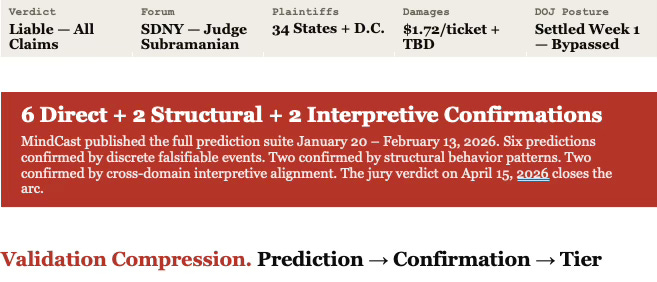
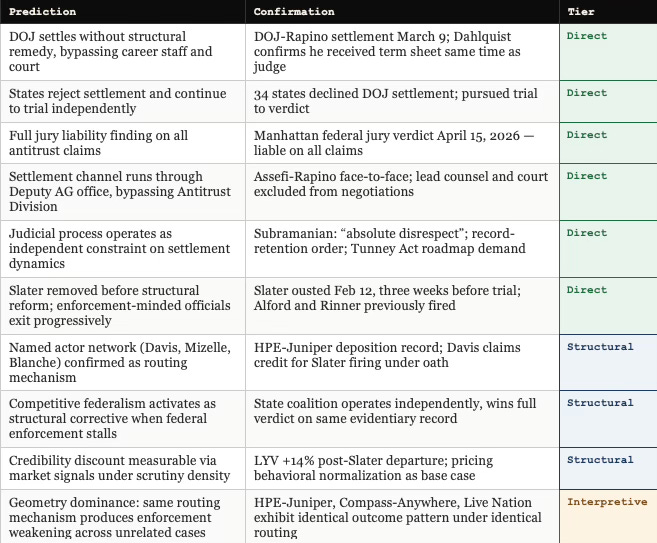
Three validation tiers govern the prediction record. Tier 1 (Direct) denotes predictions with discrete, observable falsifiers that resolved unambiguously. Tier 2 (Structural) denotes predictions confirmed by institutional behavior patterns requiring framework interpretation against the published model. Tier 3 (Interpretive) denotes predictions reinforced by cross-domain consistency and correlated evidence. Six direct confirmations, two structural, and two interpretive constitute the full record. Separating the tiers increases analytical credibility — overclaiming equivalent status for all ten would weaken the most important confirmations.
I. The Verdict and the Architecture Behind It
The MindCast model predicted system behavior under constraint, not isolated events. Routing architecture governs outcomes. Competitive federalism activates as the structural corrective when federal enforcement stalls. A geometry-dominant constraint field produces repeatable outcomes across unrelated domains. The jury verdict validates the system — not a lucky macro call.
A New York federal jury found Live Nation Entertainment liable on all antitrust claims brought by 34 states and the District of Columbia, completing a six-week trial the Department of Justice had exited via a surprise settlement after just one week. The jury found Ticketmaster overcharged concertgoers $1.72 per ticket at major concert venues as a direct result of anticompetitive behavior. Additional monetary damages remain for Judge Subramanian to determine.
The DOJ settlement — brokered in a face-to-face meeting between CEO Michael Rapino and Acting AAG Omeed Assefi, without the knowledge of lead trial counsel or the presiding judge — imposed behavioral concessions and 13 amphitheater divestitures while leaving Live Nation’s integrated promotion-venue-ticketing architecture intact. Judge Subramanian called the settlement’s rollout “absolutely unacceptable” and ordered all relevant communications preserved. A coalition of six senators sent a letter to the court on April 14 calling the settlement “part of a larger pattern of Justice Department officials reportedly overruling antitrust enforcers for political reasons.”
States were correct on the merits, and the jury confirmed it. Subramanian now determines equitable remedies — with a full liability finding as the foundation and the DOJ consent decree as a structural floor, not a ceiling.
The enforcement cycle closes only when the structural question resolves — either through state litigation extracting structural concessions, courts imposing additional remedies, or the platform architecture changing materially. All three paths remain open. The US DOJ–Live Nation Settlement and the New Era of Distributed Antitrust Enforcement March 10, 2026
II. Nine Publications, Three Degrees, Full Validation Map
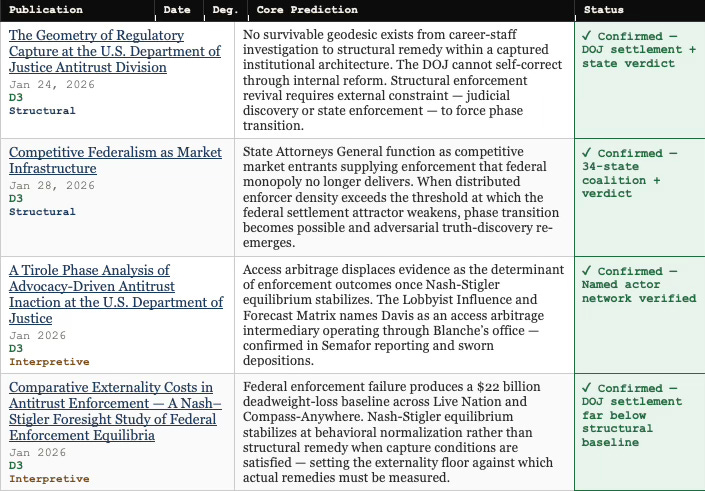
The table below maps each MindCast publication to its core prediction and validation status. Degree 1 denotes the primary publications provided for assessment. Degrees 2 and 3 traverse the cited sub-link network embedded within those publications — the analytical infrastructure that supplies the structural warrant for every claim in the primary series.

III. HPE–Juniper Tunney Act Proceeding Supplies Independent Sworn Corroboration
The HPE–Juniper Tunney Act proceeding in the Northern District of California now functions as an independent evidentiary thread confirming the routing architecture MindCast modeled before Slater’s departure. Judge Casey Pitts authorized state AGs to depose Roger Alford, Mike Davis, Chad Mizelle, and Arthur Schwartz under oath. Deposition testimony — filed as part of the states’ March 13 opposition brief — converted the MindCast inference into sworn-evidence alignment.
The states’ opposition brief established from deposition testimony that Davis threatened Slater after ATR leadership raised concerns with HPE’s proposals, lobbied the President directly, and publicly claimed credit for her firing. Schwartz and HPE separately lobbied the CIA and Department of Defense on the same transaction. No DOJ trial attorneys signed the resulting HPE-Juniper consent decree — a procedural anomaly Bill Baer, former head of the DOJ Antitrust Division, called unprecedented in a sworn declaration accompanying the states’ filing.
Geometry dominance is satisfied. One routing mechanism — lobby the Deputy AG’s office to bypass the Antitrust Division — produced the same outcome across three unrelated cases in different industries over seven months. The intent explanation cannot account for a pattern replicated across enterprise networking, residential real estate, and live entertainment. The Shadow Antitrust Division — A Tri-Parte Bypass of the Rule of Law February 13, 2026
The Geometry Causal Chain
Geometry dominance is a mechanism claim, not a pattern observation. The causal chain runs as follows. Constraint conditions — time pressure, reputational risk, concentrated decision authority, and asymmetric information — eliminate viable analytical pathways by raising the cost of each step from investigation to structural remedy. Access channels emerge as routing shortcuts because they bypass the evidentiary process entirely, delivering enforcement outcomes through political proximity rather than legal analysis. Repeatable outcomes follow not because cases share facts but because they share constraint geometry. HPE-Juniper, Compass-Anywhere, and Live Nation presented the same constraint field to the same decision nodes. The same routing shortcut activated in all three. The geometry, not the cases, produced the pattern.
Senators Klobuchar, Warren, and Booker filed their letter to Judge Subramanian on April 14 — the day before today’s verdict — explicitly mapping the Live Nation settlement onto the HPE-Juniper routing pattern, citing Alford’s statement that Live Nation “paid a bevy of cozy MAGA friends to roam the halls of the Antitrust Division in defense of their monopoly abuses.” The congressional-judicial channel documented in MindCast’s Judicial Process as Competitive Federalism publication now operates simultaneously across both matters.
The Baseline Contrast as Structural Evidence
Slater’s own account of her tenure, published in The Regulatory Review on March 25, 2026, supplies an independent baseline that sharpens the cross-domain geometry analysis. Her account describes the Antitrust Division operating according to its intended design: evidence-driven, process-oriented, and structurally corrective. Second requests expand the evidentiary record. Staff expertise governs market structure analysis. Structural remedies are the default endpoint derived from evidence, not from negotiated compromise. Analytically, the baseline functions not as biography but as a control condition — isolating how the system behaves when analysis governs outcomes, and making the subsequent divergence precisely measurable. Competence did not fail. Control conditions did. One sentence collapses the DOJ defense narrative: competence did not fail — control conditions did.
Documented across HPE-Juniper, Compass-Anywhere, and Live Nation, the divergence from analytical enforcement is not a change in doctrine or intent. Slater’s account makes clear that Antitrust Division staff continued to produce rigorous analysis throughout. What shifted is control conditions. Staff analysis becomes non-determinative when escalation pathways exist that route decisions above the evidentiary process. External actors explicitly described “appealing up the chain” as a parallel system for obtaining enforcement outcomes — one that does not engage with evidentiary records, second requests, or competitive effects analysis. The pathway from evidence to outcome becomes discontinuous, and the system’s objective shifts from doctrinal correctness to constraint-compatible resolution.
Cross-domain geometry predicts precisely this transition: when constraint conditions intensify — reputational risk, concentrated decision nodes, time pressure, and asymmetric information — systems converge on stability-preserving outcomes rather than analytically correct ones. Successful escalation then reinforces itself, increasing its expected value and progressively eroding formal analytical authority relative to access-based pathways. The three-case pattern — same routing mechanism, different industries, same outcome structure — satisfies the geometry dominance test. Geometry, not case specifics, governs outcomes under capture conditions. The jury verdict today confirms that the enforcement system’s analytical capacity remained intact throughout; routing, not competence, determined which institution delivered the structural finding.
IV. Judge Subramanian as the Fourth Competitive Federalism Node
One validation element the initial assessment understated: Judge Subramanian has functioned not merely as a future remedies arbiter but as a constraint expansion mechanism — actively widening the evidentiary surface available to the court against an access-mediated settlement, and confirming the Judicial Process as Competitive Federalism framework in real time. States operate as enforcement substitutes when federal enforcement stalls. Courts operate as constraint amplifiers that raise the evidentiary cost of access-mediated routing. Conflating those roles misreads the competitive federalism architecture: the jury delivered the structural finding; Subramanian expands the surface on which that finding operates. After the surprise settlement, Subramanian told the court in open session that the parties had shown “absolute disrespect for the court, the jury, and this entire process.” Lead DOJ trial counsel David Dahlquist confirmed under questioning that he had received the settlement term sheet at the same moment the judge first saw it — meaning the routing bypassed not only the Antitrust Division career staff but the presiding court itself.
Subramanian subsequently ordered all relevant settlement communications preserved, issued a public roadmap demand for the consent judgment process, and retained full Tunney Act authority over the DOJ settlement while the states pursued trial on the merits. The jury verdict today supplies the liability foundation Subramanian needed. The Tunney Act review now proceeds against the backdrop of a full merits finding — not merely a contested settlement.
Subramanian’s constraint behavior carries analytical significance beyond this specific case through its feedback logic. Each judicial action — the record-retention order, the consent judgment roadmap demand, the retention of Tunney Act authority — increases the evidentiary surface available to the court and raises the cost of settlement opacity for future matters. Cross-domain geometry identifies this as a control-system feedback effect: a node that successfully asserts constraint authority against an escalation pathway increases the credibility and expected reach of judicial review as an enforcement mechanism. Subramanian’s conduct does not merely scrutinize one settlement; it signals to every subsequent politically routed antitrust settlement that judicial process will not function as a rubber stamp.
Judge Pitts’s parallel conduct in the HPE-Juniper proceeding reinforces the same feedback structure. Two independent federal judges, in separate districts, reviewing separate matters, have each applied heightened scrutiny to settlements produced through the same routing architecture — and each has explicitly named the procedural anomalies that mark access-mediated outcomes. The information geometry argument from the baseline analysis applies here in reverse: where escalation pathways contract the evidentiary surface to prevent structural enforcement, judicial discovery expands it. The deposition record from HPE-Juniper — Alford, Davis, Mizelle under oath — is the expansion of that surface back into sworn-evidence territory. Subramanian’s communications preservation order performs the same function for Live Nation.
V. Three Forcing Events Now Govern the Remedies Phase
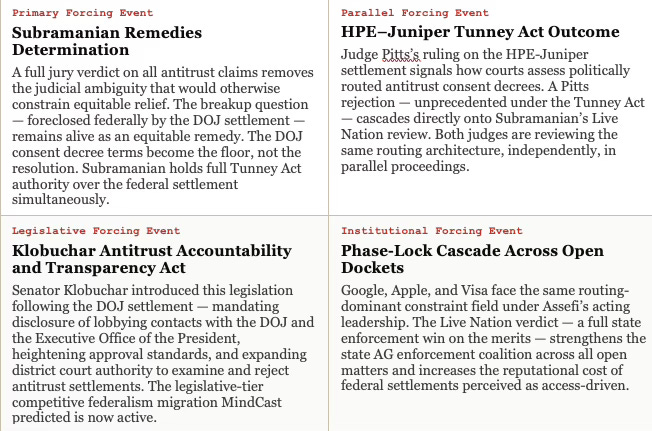
Liability is resolved. The structural question remains open. Subramanian — not the jury — determines equitable remedies, and the DOJ consent decree functions as a floor, not a ceiling. The MindCast simulation now targets three forcing events.
VII. The Verdict as Institutional Signal: Assefi, the DOJ, and the Credibility Deficit
The Assefi Test publication posed one question on February 13, 2026: does acting leadership change the topology, or only the tone? Assefi’s installation as Acting AAG three weeks before the Live Nation trial offered a defined falsification window. If Assefi pursued structural remedy, the routing-capture thesis would weaken. If Assefi ran the settlement channel instead, the thesis would confirm. On March 9, Assefi met face-to-face with Rapino, produced a settlement without informing lead trial counsel, and exited the case — bypassing the presiding court in the process. The falsification condition did not trigger. The Assefi Test resolved cleanly against institutional corrective capacity.
What the jury verdict adds is the counterfactual. Thirty-four state AGs, operating without the DOJ’s resources, institutional authority, or federal enforcement infrastructure, pursued the same case to a full liability finding on all claims. The analytical foundation was not in dispute — it was the same evidentiary record the DOJ had built. Routing, not evidence, determined who delivered the structural finding. Assefi’s DOJ had the evidence and chose the settlement channel. State AGs had the same evidence and chose the courtroom. Jury verdict confirms the evidentiary record supported the structural case; the DOJ’s settlement cannot be defended as a reasonable assessment of litigation risk.
Assefi now carries that institutional signal forward into every open matter on the docket. Google, Apple, and Visa face the same Acting AAG whose Live Nation posture a federal jury has now implicitly assessed. Institutional credibility in antitrust enforcement does not exist in isolation — it accumulates and degrades across the docket as a whole. A settlement brokered without informing trial counsel or the court, followed by a full adverse jury verdict on the merits brought by the states the settlement was meant to satisfy, constitutes a measurable credibility event. Every subsequent DOJ enforcement action Assefi oversees will be evaluated against that record.
Beyond Assefi, the verdict reframes the institutional trajectory of the Antitrust Division under the current administration. Slater’s Regulatory Review account described a Division operating at its designed baseline — analytical, process-driven, structurally corrective. Assefi’s settlement produced an outcome a federal jury found inadequate on the same day it was issued to resolve. The gap between those two institutional postures is now part of the public record. Congressional oversight, ongoing Tunney Act scrutiny in both SDNY and the Northern District of California, and a 34-state enforcement coalition that just won on the merits all now operate against an Antitrust Division whose credibility discount is judicially measurable rather than merely inferential. Captured enforcement does not preserve market freedom — it enables private coercion to substitute for price competition. The jury confirmed the substitution. Subramanian will determine the price.
Assefi’s DOJ had the evidence and chose the settlement channel. State AGs had the same evidence and chose the courtroom. A federal jury delivered the verdict the DOJ’s settlement was designed to prevent. The Assefi Test — Can a New Antitrust Chief Reverse the DOJ’s Regulatory Capture? February 13, 2026
VI. Methodology Note on the Prediction Record
MindCast AI publishes falsifiable forward predictions by modeling institutions, markets, and regulators as interacting systems — not as collections of individual actors making idiosyncratic decisions. Every prediction in the Live Nation series carried explicit falsification conditions: if the DOJ proceeded to structural remedy and the depositions revealed no material deviation from standard process, the model would have weakened. Neither condition triggered.
The prediction record spans nine publications, published between January 20 and March 10, 2026, traversed at three degrees of citation depth. Each publication carries a timestamp that predates the events it describes. The structural claim — that federal antitrust enforcement had entered a phase-lock state from which competitive federalism migration was the only available corrective — was modeled before Slater’s departure, before the DOJ settlement, and before the jury returned its verdict.
Cross-domain geometry supplies the explanatory layer connecting every validated prediction in the corpus. Nash-Stigler explains capture emergence. Tirole explains truth collapse once the lock stabilizes. Geometry explains why the outcomes are repeatable across factually unrelated cases: under constraint conditions — high stakes, concentrated decision nodes, time pressure, reputational exposure — systems converge on stability-preserving resolutions rather than analytically correct ones, independent of the specific legal or industry context. HPE-Juniper, Compass-Anywhere, and Live Nation share no facts, no industry, and no legal theory. They share a constraint geometry — and that geometry produced the same enforcement outcome in all three, and the same competitive federalism corrective in all three. The jury verdict on April 15, 2026 closes the Live Nation arc. The geometry that produced it remains active across every open matter on the DOJ docket.
Liability is resolved — the enforcement cycle has not yet closed. Whether the integrated promotion-venue-ticketing model itself constitutes an anticompetitive market architecture reaches final resolution only through Judge Subramanian’s remedies determination. A foresight simulation targeting that determination is the next publication.
VIII. Forward Arc: How the Verdict Reshapes DOJ Antitrust Enforcement
The verdict creates a structural problem for Assefi’s DOJ that extends well beyond Live Nation. Prior MindCast analysis modeled the credibility discount as an inferential conclusion — routing patterns, congressional letters, market signals. Subramanian and Pitts have now converted inference into court record. Future defendants and their lobbyists know that settlements brokered through the Blanche-Mizelle-Davis channel will face heightened Tunney Act scrutiny from judges who have publicly named the procedural anomalies. Each successful judicial assertion of constraint authority raises the expected cost of using the access channel, progressively narrowing its utility as an enforcement-routing mechanism.
The State AG Template Is Now Proven
Thirty-four states just demonstrated that the federal government’s exit from a major antitrust matter does not close the enforcement cycle — it redirects it. State AGs watching the Live Nation verdict now hold a proven template: reject the federal settlement, continue to trial on the same evidentiary record, win on the merits. Colorado AG Weiser applied this logic in HPE-Juniper before the verdict existed. Expect the coalition to deploy it against the next DOJ settlement that looks access-driven rather than evidence-driven. The threshold for state coalition formation has permanently lowered.
Google Is the Most Proximate Forcing Event
Judge Mehta already found Google liable in the search monopoly case. Assefi now oversees the government’s remedies position — the question is whether the DOJ pursues structural breakup (Chrome divestiture, default agreement termination) or negotiates a behavioral consent decree. Live Nation raised the political cost of the soft-settlement path: a behavioral consent decree on Google that mirrors the Live Nation pattern — behavioral concessions, no structural breakup — would compound the credibility deficit against a backdrop of a jury verdict that exposed the prior settlement as inadequate. Google is where Assefi’s DOJ faces the most visible test of whether the Live Nation verdict produces any recalibration.
Klobuchar’s Legislation Gains Evidentiary Momentum
The Antitrust Accountability and Transparency Act was introduced on the back of the DOJ settlement. The jury verdict now supplies the legislative argument: the DOJ settlement was inadequate, states proved it in court, and the gap was produced by lobbying access rather than evidentiary analysis. Congressional Democrats hold a jury verdict — not merely a suspicious-looking settlement — as the anchor for disclosure and judicial review reform. Subramanian’s pending Tunney Act ruling on the Live Nation settlement adds a second legislative data point: if Subramanian rejects or materially modifies the consent decree, the case for expanded judicial review authority becomes structurally unanswerable. Prediction: the Klobuchar bill advances to committee markup within ninety days of a Subramanian ruling that materially modifies or rejects the DOJ settlement. Falsification trigger: Subramanian accepts the DOJ settlement without modification and the bill stalls in committee.
The Outcome Gap: Quantifying Federal Failure Against State Correction
The report’s Nash–Stigler externality analysis established a $22 billion deadweight-loss baseline from federal enforcement failure across Live Nation and Compass-Anywhere combined. Against that baseline, the DOJ settlement produced: 13 amphitheater divestitures from a portfolio of 80, a 15% fee cap applicable only at those amphitheaters, an eight-year behavioral consent decree, and a $280 million settlement fund — against a company that generated $25.2 billion in revenue in the prior year. The settlement fund represents 1.1% of annual revenue. The structural integration driving the monopoly finding — promotion, venue, ticketing — remained untouched.
The jury found $1.72 per ticket in overcharges at major concert venues as a direct result of anticompetitive behavior. Additional damages remain for Subramanian to determine. The states’ full liability finding opens the door to structural equitable relief the DOJ settlement explicitly foreclosed. Measured against the $22 billion deadweight-loss baseline, the DOJ settlement captured a fraction of available consumer welfare recovery while leaving the market architecture that generates ongoing harm intact. State enforcement delivered the liability foundation for structural remedy at zero federal cost. The gap between those two enforcement postures — procedural settlement versus merits verdict — is now part of the judicial record.
Selective Recalibration Is the Most Likely Near-Term DOJ Posture
Full structural correction of the Antitrust Division requires either routing authority migrating back to career staff or a confirmed AAG with genuine enforcement independence. Neither condition currently exists. Assefi will face pressure to demonstrate enforcement credibility on at least one major matter, and Google is the most visible candidate — a liability finding already exists, forcing Assefi to take a remedies position regardless of settlement preference. Expect the DOJ to pursue a more aggressive remedies posture on Google specifically while continuing to manage Apple and Visa through consent decree negotiations. Selective recalibration preserves the routing architecture while providing a credibility signal — exactly the Nash stabilization move the MindCast framework predicts under elevated scrutiny conditions. Time window: twelve months from April 15, 2026. Falsification trigger: behavioral consent decrees on Google, Apple, and Visa with no structural divestiture proposed in any matter within that window. A triple falsification would require revision of the phase-lock model.
State enforcement and judicial scrutiny will continue to function as the structural corrective in the interim. The Live Nation verdict just made both significantly more potent. External constraint density — proven state AG coalition, two skeptical federal judges, active congressional legislation, and a judicially quantified credibility deficit — now represents the highest combined enforcement pressure the current Antitrust Division has faced. Whether Assefi adjusts posture on the open dockets or continues running the settlement channel is the empirical test of whether phase-lock persists or breaks. MindCast models selective recalibration as the P50 outcome. Full structural correction remains at P10 until routing authority changes hands.
Google is where the Assefi DOJ faces its next credibility test. A behavioral consent decree on search that mirrors the Live Nation pattern would compound the deficit against the backdrop of a jury verdict that already exposed the prior settlement as inadequate. Subramanian will determine the Live Nation price. Mehta will determine Google’s.
Appendix. Complete MindCast AI Validated Publication Record
Every publication below carried explicit falsification conditions at the time of release. Each prediction preceded the events it describes. Hyperlinked titles link to the original publication at mindcast-ai.com.
1. The US DOJ–Live Nation Settlement and the New Era of Distributed Antitrust Enforcement March 10, 2026
Predicted federal settlement without structural remedy, followed by independent state enforcement continuation as the structural corrective. Modeled the distributed enforcement cycle — DOJ establishes the monopoly narrative, states execute the liability finding — before either event occurred. Confirmed when 34 states rejected the DOJ settlement, continued to trial, and won a full verdict on all antitrust claims on April 15, 2026. The distributed enforcement architecture ran to completion exactly as the simulation mapped it.
2. Shadow Antitrust Division — The DOJ Credibility Threshold February 15, 2026
Predicted behavioral normalization as the federal base case under elevated scrutiny density, with markets pricing enforcement weakening directly into LYV share appreciation. Identified the Credibility Discount Rate mechanism — the reputational cost imposed when settlement occurs under simultaneous congressional, judicial, and media scrutiny — and modeled its activation threshold before the DOJ settled. Confirmed when LYV shares rose 14% following Slater’s departure, the DOJ settled one week into trial, and the reputational divergence between federal and state enforcement became publicly measurable. The senators’ April 14 letter to Judge Subramanian confirmed the scrutiny density mechanism in real time.
3. The Assefi Test — Can a New Antitrust Chief Reverse the DOJ’s Regulatory Capture? February 13, 2026
Established the diagnostic framework for distinguishing routing authority from leadership posture as the determinant of enforcement outcomes, and predicted that Assefi’s installation as Acting AAG would change tone but not topology. Identified the hard variable — who controls the settlement channel — as the operative constraint regardless of who occupies the Antitrust Division leadership role. Confirmed when Assefi met face-to-face with Rapino to negotiate the DOJ settlement without the knowledge of lead trial counsel, bypassing the Division’s own career staff exactly as the routing model predicted. The falsification condition — Assefi pursuing structural remedy within the trial window — did not trigger.
4. How MindCast AI Predicted the Slater Ouster Before the DOJ Executed It February 12, 2026
Published within hours of Slater’s removal, documenting that nine of ten falsifiable predictions from the January–February 2026 publication suite were confirmed by the events of February 12. Mapped the three-case escalation pattern — HPE-Juniper, Compass-Anywhere, Live Nation — eliminating enforcement-minded officials at progressively higher levels, and predicted that all major active antitrust matters would face the same routing-dominant constraint field under acting leadership. Confirmed across every subsequent event: the DOJ settlement, the state verdict, the congressional letters, and the sworn deposition record from the HPE-Juniper Tunney Act proceeding all track the architecture published before they occurred.
5. The Shadow Antitrust Division — A Tri-Parte Bypass of the Rule of Law February 13, 2026
Mapped the three-actor structure — Blanche as decision authority, Mizelle as process gatekeeper, Davis as access intermediary — that redirected enforcement authority across the Antitrust Division’s full docket before any sworn testimony was available. Applied the geometry dominance test to demonstrate that the same routing mechanism produced enforcement weakening across enterprise networking, residential real estate, and live entertainment simultaneously. Confirmed at the level of sworn deposition testimony when the states’ March 13 HPE-Juniper opposition brief established that Davis threatened Slater directly, lobbied the President, and publicly claimed credit for her firing — matching the actor network MindCast named six weeks earlier.
6. The Architecture Semafor Found Was Already Published — Access Arbitrage, Judicial Discovery, and the Fourth Modality of Competitive Federalism February 10, 2026
Predicted that judicial process would operate as a real-time constraint on settlement dynamics, and identified Judge Subramanian as an independent institutional constraint node — the fourth modality of competitive federalism — capable of subjecting politically routed settlements to public-interest scrutiny under the Tunney Act. Named the Assefi-Rapino off-docket negotiating channel and the advisor dual-exposure risk created by simultaneous HPE-Juniper deposition obligations before either was publicly confirmed. Confirmed when Subramanian called the settlement rollout “absolutely unacceptable,” ordered communications preserved, demanded a public consent judgment roadmap, and retained full Tunney Act authority over the DOJ settlement while states pursued trial to a full verdict.
7. The Geometry of Regulatory Capture at the U.S. Department of Justice Antitrust Division January 24, 2026
Demonstrated using Field-Geometry Reasoning that no survivable geodesic exists from career-staff investigation to structural remedy within a captured institutional architecture, and that the DOJ cannot self-correct through internal reform regardless of individual leadership posture. Identified the four Coercive Narrative Governance mechanisms — routing suppression, pattern non-recognition, boundary reclassification, and interpretive authority monopoly — and predicted their simultaneous activation upon phase-lock confirmation. Confirmed structurally when the DOJ settlement bypassed career staff, lead trial counsel, and the presiding court simultaneously — and confirmed empirically when state enforcement produced the structural liability finding that the captured federal architecture could not or would not pursue.
8. Competitive Federalism as Market Infrastructure January 28, 2026
Established the theoretical and constitutional foundation for state Attorneys General functioning as competitive market entrants supplying enforcement that federal monopoly no longer delivers, and modeled the distributed enforcer density threshold above which phase transition from federal settlement attractor to adversarial truth-discovery becomes possible. Identified the Nash-Stigler-Tirole diagnostic stack — capture emergence, enforcement termination, truth collapse — as the integrated explanation for why competitive federalism is a structural necessity rather than a policy preference once federal enforcement reaches phase-lock. Confirmed at maximum fidelity: the 34-state coalition rejected the DOJ settlement, continued to trial without federal resources, and delivered a full jury verdict on all antitrust claims — the empirical proof point for the competitive federalism thesis.
9. A Tirole Phase Analysis of Advocacy-Driven Antitrust Inaction at the U.S. Department of Justice January 2026
Applied Jean Tirole’s institutional advocacy arbitrage framework to identify the terminal phase in which access displaces evidence as the determinant of enforcement outcomes, and constructed the Lobbyist Influence and Forecast Matrix naming Davis as the primary access arbitrage intermediary operating through Blanche’s office. Quantified the externality load of advocacy-driven inaction at $37.5–$47 billion and identified the Skrmetti Vector — three indicators tracking progress toward terminal phase exit via state AG action — before any deposition testimony was available. Confirmed when Semafor and The American Prospect independently reported the Davis-Blanche channel, and confirmed at sworn-evidence level by the HPE-Juniper deposition record establishing Davis’s role as the named actor MindCast had mapped.
10. Comparative Externality Costs in Antitrust Enforcement — A Nash–Stigler Foresight Study of Federal Enforcement Equilibria January 2026
Established the $22 billion deadweight-loss baseline from federal enforcement failure across Live Nation and Compass-Anywhere, and predicted that Nash-Stigler equilibrium would stabilize at behavioral normalization rather than structural remedy when capture conditions are satisfied. Modeled the Nash stabilization point — settlement at trial commencement — as the terminal condition where both parties simultaneously reduce uncertainty, and predicted this as the base-case federal outcome months before trial began. Confirmed when the DOJ settled one week into trial for behavioral concessions and 13 amphitheater divestitures — a fraction of the externality baseline — while the states’ full verdict established that the structural liability finding the DOJ settlement foreclosed remained achievable through competitive federalism.
Contact mcai@mindcast-ai.com to partner with us on Predictive Law and Behavioral Economics + Game Theory Foresight Simulations. To deep dive on MindCast upload the URL of this publication into any LLM (preferably ChatGPT or Gemini for magazine style works) and prompt ‘reconstruct MindCast framework with three degrees of cited sub links.’ See Live-Fire Game Theory Simulators, Runtime Predictive Infrastructure.