


Executive Summary
MindCast AI applies Nobel Prize–winning frameworks in economics and game theory — including John Nash’s equilibrium theory, George Stigler’s regulatory capture model, and Jean Tirole’s institutional advocacy analysis — to predict how regulators, corporations, and enforcement coalitions behave before outcomes are publicly known. The Live Nation settlement is the latest confirmed prediction in that record.
Federal antitrust enforcement no longer resolves through a single regulator. The settlement announced March 9, 2026 confirms the distributed enforcement architecture predicted across the MindCast AI framework library — and validates the behavioral normalization prediction registered in Shadow DOJ Antitrust Credibility.
The DOJ extracted behavioral concessions and limited structural divestitures while avoiding a breakup of the Live Nation–Ticketmaster integration. Twenty-six states plus the District of Columbia immediately rejected the settlement and announced independent continuation. Colorado AG Phil Weiser publicly characterized the settlement as the product of improper lobbying and pay-for-play politics — language that maps directly onto the access-channel dynamics documented in Shadow DOJ Antitrust Credibility. Washington AG Nick Brown issued a parallel statement affirming ongoing state commitment.
The enforcement cycle has not closed. Federal agencies establish the monopoly narrative while states, courts, and private actors continue the structural inquiry. The HPE–Juniper depositions, scheduled March 23–27, now represent the most proximate forcing event: sworn testimony from the named intermediaries in the reported access channel will either confirm or weaken the structural inference that applies across all four concurrent matters.
The March 2 trial opening deadline has now closed. The prediction registered in Antitrust Enforcement Foundations — federal settlement without structural remedy, followed by state continuation — confirmed within hours of trial commencement.

Why This Settlement Was Predictable
The settlement did not surprise the MindCast framework. Four structural conditions, identified before the trial began, pointed toward behavioral resolution rather than structural breakup.
Discovery risk peaks at trial onset. Once evidence enters the court record, both parties face maximum exposure. Live Nation confronted the prospect of internal communications, exclusivity contracts, and retaliation practices becoming publicly visible. The DOJ confronted the risk that a judge would reject the government’s monopolization theory and weaken future enforcement. Settlement at trial commencement is the Nash stabilization point where both parties reduce uncertainty simultaneously — a pattern the Nash–Stigler framework predicted as the terminal condition for this matter.
The DOJ’s credibility objective was satisfied by complaint. Federal regulators achieve institutional credibility by filing and litigating to the courthouse steps — not necessarily by winning at trial. The complaint established the monopoly narrative. The trial established that the government was prepared to litigate. Settlement with meaningful concessions completes the credibility objective without absorbing the variance of an adverse judicial ruling.
Political access displaced structural enforcement pressure. Twelve congressional letters, the Gail Slater departure on February 12, and reporting by Semafor and The American Prospect on access-channel engagement above the Antitrust Division formed the scrutiny density basis documented in Shadow DOJ Antitrust Credibility. Under the credibility threshold model, elevated scrutiny does not produce structural remedies — it produces risk-minimizing settlements that preserve institutional optionality while performing accountability.
Competitive federalism was already activated. Forty state attorneys general co-filed the original complaint. The 26-state rejection of the federal settlement was not a reaction to the settlement — it was the predictable continuation of an enforcement coalition that had independent grounds to proceed regardless of federal posture. Competitive Federalism as Market Infrastructure modeled this dynamic: when federal enforcement stabilizes at procedural sufficiency, state enforcement activates as the structural corrective.

The Distributed Enforcement Cycle
Federal settlement activates rather than terminates the enforcement architecture. The diagram below maps the institutional flow: the DOJ establishes the monopoly narrative, settlement distributes enforcement pressure to three independent actors operating simultaneously, and compounding pressure lands on the infrastructure platform from multiple directions.

The enforcement cycle closes only when the structural question resolves — either through state litigation extracting structural concessions, courts imposing additional remedies, or the platform architecture changing materially. All three paths remain open. None of them required the DOJ to win at trial.
I. The Structural Context
Live Nation operates across multiple layers of the concert ecosystem — promotion, venue ownership, and ticketing through Ticketmaster. Vertical integration across those layers creates a feedback loop in which control of one layer reinforces dominance in the others. That architecture produces the type of infrastructure market power that repeatedly triggers antitrust scrutiny, because competitors cannot bypass the infrastructure layer.
The DOJ filed a monopolization case alleging anticompetitive practices related to venue contracts and ticketing dominance. Shortly after trial began on March 2, federal regulators reached a settlement imposing behavioral restrictions and limited structural concessions — 13 amphitheater divestitures, ticketing exclusivity reform — while leaving the integrated monopoly architecture intact.
The core structural question — whether the integrated promotion–venue–ticketing model itself constitutes an anticompetitive market architecture — remains unresolved. Because that question persists, enforcement pressure continues through additional actors and legal venues.
II. Antitrust Enforcement Foundations: A Distributed Architecture
Modern antitrust enforcement functions through a distributed architecture of federal regulators, state attorneys general, courts, and private litigants — a jurisdictional structure the Antitrust Enforcement Foundations brief built the warrant for across four concurrent matters, keying action items to the March 2 trial opening as the first deadline. That deadline has now closed with the predicted outcome: federal settlement, state continuation.

Federal regulators initiate enforcement actions that define the legal narrative of monopoly conduct. State attorneys general pursue stronger remedies once the federal government establishes that narrative. Courts determine the boundaries of structural remedies. Private litigants seek damages and additional discovery.
The Live Nation settlement demonstrates this layered system in real time. The federal government negotiated concessions. Twenty-six states plus the District of Columbia announced independent continuation. Colorado AG Weiser’s statement explicitly invoked the access-channel concern: the settlement was reached through improper lobbying and pay-for-play politics. Washington AG Brown issued a parallel commitment to ongoing enforcement.

Contact mcai@mindcast-ai.com to partner with us on Predictive Cognitive AI in Law and Behavioral Economics. To deep dive on MindCast work in Cognitive AI upload the URL of this publication into any LLM and prompt ‘reconstruct MindCast framework with three degrees of cited sub links.’ See Live-Fire Game Theory Simulators, Runtime Predictive Infrastructure.
Recent projects: The Cybernetic Foundations of Predictive Institutional Intelligence, MindCast AI Emergent Game Theory Frameworks, MindCast AI Investment Series, Field-Geometry Reasoning — Structural Constraint Modeling in Predictive Cognitive AI, Comment of MindCast AI on Potential US DOJ | FTC Updated Guidance Regarding Collaborations Among Competitors, Super Bowl LX — AI Simulation vs. Reality.
III. Shadow DOJ Antitrust Credibility: The Credibility Threshold Confirms
The DOJ’s behavioral settlement — conduct restrictions, limited divestitures, integrated architecture intact — is exactly what the credibility–risk payoff matrix predicted as the dominant strategy once Gail Slater’s February 12 departure removed the structural enforcement advocate from the Antitrust Division. The credibility–risk payoff matrix is a decision model that maps how regulators choose between enforcement risk and institutional credibility under different scrutiny conditions; under elevated public pressure, it consistently selects risk-minimizing settlement over structural litigation. Shadow DOJ Antitrust Credibility identified that outcome as the terminal condition. Live Nation shares rose on the news, consistent with the market pricing behavioral normalization as the base case — the same signal documented when LYV gained 14% over six trading days following Slater’s departure.
The access-channel reporting that surrounded this matter formed the evidentiary basis for the scrutiny density thesis. Semafor reported that Live Nation executives and lobbyists negotiated with senior DOJ officials outside the Antitrust Division, with some of those talks sidelining Slater. The American Prospect reported on success-fee arrangements connecting political intermediaries to multiple antitrust settlements. Senator Klobuchar’s February 15 letter to AG Bondi — signed by six senators — explicitly named Live Nation, HPE–Juniper, and Compass as matters where Antitrust Division staff were repeatedly sidelined by DOJ leadership.
Colorado AG Weiser’s March 9 statement — characterizing the settlement as the product of “improper lobbying and pay-for-play politics” — represents the first on-record statement by an enforcement official that directly affirms the access-channel concern. Weiser filed that statement the same day the settlement was announced, before any investigation of the settlement’s provenance had been conducted. His characterization rests on the same pattern of reporting that formed the scrutiny density basis in the February 15 publication.
The Tirole Advocacy Arbitrage Phase Analysis explains why structural enforcement was institutionally unavailable before any political intervention occurred. Jean Tirole, the 2014 Nobel laureate in economics, established that truth discovery in regulatory proceedings depends on adversarial competition between advocates with equal access to decision-makers. When private lobbying channels displace that open competition, the information-revelation function of the regulatory process collapses — outcomes are shaped by access rather than evidence regardless of what career staff recommend.
The companion publication, The Geometry of Regulatory Capture at the DOJ Antitrust Division, maps this in structural terms: no available institutional path existed from Antitrust Division investigation to structural remedy once front-office override of career staff findings reached the documented frequency.
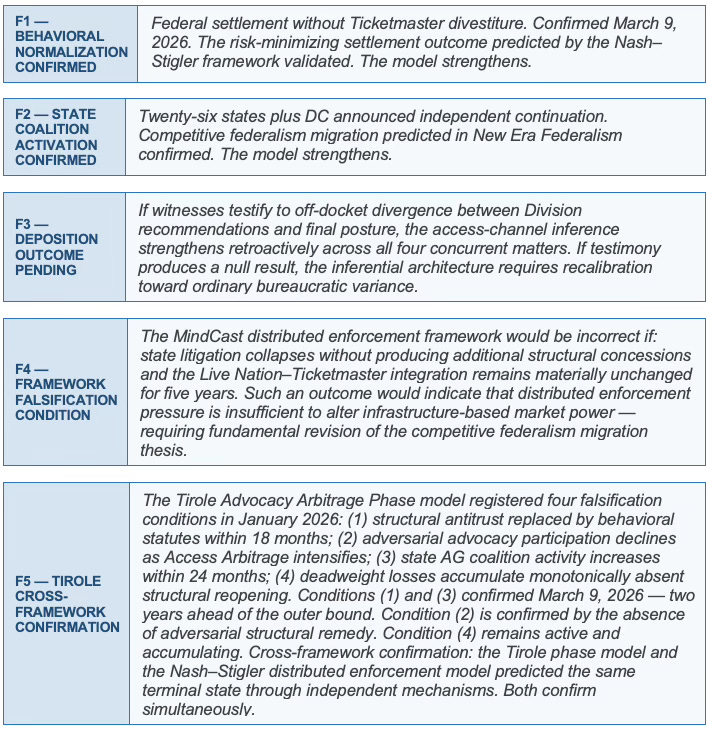
The settlement was not a policy choice made at trial onset — it was the only outcome the decision architecture permitted. Colorado AG Weiser’s “improper lobbying and pay-for-play politics” characterization, filed the same morning as the settlement, describes this institutional collapse in enforcement language without knowing the framework. The Tirole falsification conditions registered in January — state AG coalition activation within 24 months and behavioral statutes substituting for structural remedies within 18 months — have both confirmed on March 9, 2026: two years ahead of the outer bound.
Whether the access-channel reporting reflects institutional capture, policy disagreement, or ordinary bureaucratic variance remains a question the March 23–27 HPE–Juniper depositions will address under oath. The framework holds under all three explanations: the credibility threshold model predicts behavioral settlement under elevated scrutiny regardless of the source of that scrutiny. The Tirole framework adds a sharper inference: if depositions confirm the access-channel pattern, the settlement does not merely reflect elevated scrutiny — it reflects a structural condition that cannot be corrected by replacing individuals within the current institutional architecture.

IV. New Era Federalism: The 26-State Coalition Confirms the Migration
Twenty-six states plus the District of Columbia rejecting the federal settlement and announcing independent structural litigation within hours is not an improvised response — it is a payoff-matrix shift that Competitive Federalism as Market Infrastructure predicted as the predictable equilibrium outcome when centralized enforcement stabilizes at procedural sufficiency. State enforcement activates not as a supplement to federal recovery but because the incentive structure changes: states face different payoff functions, hold independent discovery authority, and answer to different political constituencies.
Twenty-six states plus the District of Columbia refusing to join the settlement is that payoff-matrix shift. The enforcement literature discusses state AG independence in the abstract. The Live Nation coalition makes it concrete: over half the original co-plaintiffs rejected the federal deal and committed to independent structural litigation within hours.
The two-speed enforcement system has formally activated. Federal regulators established the monopoly narrative and extracted concessions. States now determine whether stronger structural remedies remain necessary. The result is a distributed regulatory network applying compounding pressure through independent discovery, additional court filings, and state-law antitrust claims that survive the federal settlement entirely.
Watch for coalition durability as the $280M per-state payment functions as a separation mechanism. States that accept the payment likely settle. States that reject it preserve their structural claims. The payment converts political alignment into financial calculation — and the states that hold will define the structural outcome.

V. Nash–Stigler Equilibrium: Why the Cycle Persists After Settlement
Federal settlement does not close the Live Nation enforcement cycle — it changes who holds enforcement authority. The Nash–Stigler framework — combining John Nash’s equilibrium theory, which identifies the point at which no party gains by changing strategy, with George Stigler’s regulatory capture model, which explains how enforcement authority is systematically acquired by the industries it regulates — explains the persistence. (Nash–Stigler: Live Nation–Compass Externality Study. Settlement stabilizes the federal–corporate relationship without resolving the structural question that sustains state litigation.
Nash Stability: The settlement represents a stable equilibrium between Live Nation and federal regulators at trial onset — the precise moment where discovery risk peaked for both parties. Federal regulators demonstrated enforcement credibility. Live Nation avoided Ticketmaster divestiture. The stabilization holds between those two actors — but it does not eliminate the incentives of 26 state attorneys general who face different payoff structures.
Stigler Incompleteness: The underlying economic inquiry into vertical integration across promotion, venues, and ticketing remains unresolved. The settlement does not answer whether the integrated architecture itself constitutes anticompetitive infrastructure capture. Because the inquiry remains incomplete — because regulatory capture stabilized the federal proceeding before structural questions were adjudicated — enforcement pressure continues through state litigation, private damages claims, and ongoing judicial review.
Nash stability between federal and corporate actors, combined with Stigler incompleteness on the structural question, is precisely what sustains multi-actor enforcement cycles after federal settlements. The Live Nation case resolves — if it resolves — when state litigation either extracts structural concessions or is defeated on the merits.
Why Settlement Occurred at Trial Onset
Antitrust cases frequently reach negotiated resolution immediately after trial begins because discovery risk peaks at that moment. Evidence introduced into the court record can rapidly alter each party’s assessment of litigation outcomes.
From Live Nation’s perspective, trial exposed internal communications, exclusivity contracts, and retaliation practices to the public record. From the DOJ’s perspective, trial introduced the risk of an adverse judicial precedent weakening future monopolization theories. Settlement at trial commencement represents the Nash stabilization point where both sides reduce uncertainty simultaneously.
Federal regulators achieved the credibility objective — establishing the monopoly narrative through complaint and litigation — while avoiding the institutional risk of an unpredictable court ruling. Continued litigation by 26 states signals that the Stigler component — whether the industry structure requires deeper remedy — remains unresolved and will not close through the federal settlement alone.
VI. Infrastructure Gateway Parallels: Live Nation and Compass
Live Nation and Compass–Anywhere exhibit the same enforcement pattern through the same structural mechanism: control over the infrastructure node through which transactions must pass. Both generate federal procedural termination followed by state and private escalation — a parallel identified before either enforcement cycle reached its current inflection point in the Nash–Stigler: Live Nation–Compass Externality Study.
In live entertainment, ticketing platforms and venue networks determine access to audiences. In residential real estate, listing networks determine access to property visibility. Infrastructure control allows firms to shape the conditions under which transactions occur. That type of market power triggers sustained antitrust scrutiny because competitors cannot bypass the infrastructure layer.
The gateway control mechanism unifies both markets analytically: the firm that controls the infrastructure node through which transactions must pass can extract rents, suppress rivals, and resist structural challenges without ever explicitly excluding competitors from the nominal market. Behavioral remedies that modify conduct leave the gateway intact. Structural remedies that separate infrastructure from market participation eliminate the rent-extraction architecture entirely.
AG offices tracking Compass should note that every state that signed onto the Live Nation enforcement coalition and has significant Compass market presence holds the factual predicate for parallel investigation using the same coordination infrastructure capture theory.
VII. Strategic Implications for AG Enforcement Planning
The Live Nation settlement resolves one federal proceeding and opens three enforcement fronts simultaneously. The implications for AG offices are sequenced by deadline — each window below closes in a defined order.
Federal Settlements Now Function as Intermediate Steps
Federal settlements in infrastructure monopoly cases function as intermediate steps rather than final resolutions. State attorneys general possess both the legal authority and institutional incentives to pursue stronger remedies independently. The Live Nation coalition demonstrates that this is not theoretical: 26 sovereigns acted within hours of the federal announcement.
Infrastructure-Based Monopolies Remain Primary Targets
Platforms that control access to markets generate sustained political pressure from consumers and competitors, increasing the likelihood of multi-actor enforcement. The Antitrust Enforcement Foundations brief identified four concurrent matters — Compass, Live Nation, HPE–Juniper, Netflix–WBD — exhibiting the same enforcement pattern. The Live Nation settlement confirms the pattern. Apply the same enforcement posture analysis to the remaining three matters.
Paramount–Skydance–WBD: Redirect Pre-Positioning Now
The Netflix–WBD transaction is dead. Netflix declined to raise its offer on February 26, collected a $2.8 billion breakup fee from Paramount Skydance, and co-CEO Ted Sarandos stated it is “unlikely” Netflix pursues another studio acquisition in the next 6–12 months. Paramount–Skydance acquired WBD for $111 billion — the entirety of the company, including legacy linear cable networks that Netflix had specifically excluded from its bid. The combined entity carries Fitch junk-rated debt as of March 2 and faces DOJ review with a projected close of September–December 2026. AG offices that built analytical infrastructure around Netflix–WBD should redirect that posture toward Paramount–Skydance–WBD: same infrastructure capture theory, same distributed enforcement architecture, new actors and a heavier debt load that compresses the window for remedies before integration locks in.
The Deposition Window Opens March 23
The HPE–Juniper depositions represent the most proximate enforcement decision point. AG offices that filed Tunney Act objections should have pre-drafted responses to both the confirmation scenario (Scenario A: witnesses testify to documented divergence between Division recommendations and final posture coinciding with access-channel engagement) and the null scenario (Scenario C: witnesses describe the settlement as routine). The credibility threshold model updates differently under each outcome — and those updates apply to the Live Nation state litigation record immediately.
VIII. Platform Infrastructure Antitrust: The Broader Pattern
The Live Nation dispute highlights a category of competition conflicts increasingly visible across the modern economy: infrastructure platforms that control market access rather than merely competing on price. When firms control the infrastructure layer that determines how buyers and sellers meet — ticketing systems, listing networks, cloud platforms, logistics gateways — market power emerges through access control rather than traditional price dominance.
Competitors may technically exist while facing structural barriers to reaching customers. The regulatory question is therefore not whether a competitor could theoretically enter the market, but whether the infrastructure layer itself has been captured to control the conditions of entry.
Federal regulators confronted that question in the Live Nation case and resolved it through behavioral remedies without addressing the vertical integration architecture. States will now resolve it through independent litigation. Courts will ultimately determine whether behavioral remedies that modify platform conduct are sufficient, or whether structural separation of infrastructure from market participation becomes necessary.
How state litigation proceeds over the next 24–36 months will define the structural precedent for infrastructure platform antitrust enforcement across the U.S. economy.
The enforcement cycle visible in the Live Nation matter — consumer harm signal, DOJ investigation, corporate settlement, state escalation, court determination — is not a sequence of isolated decisions. Friedrich Hayek established in 1945 that markets operate as distributed information-processing feedback systems, where signals coordinate decentralized knowledge without central direction. MindCast AI extends that insight to legal and regulatory institutions: courts, agencies, and state coalitions process enforcement signals through the same feedback architecture. The Live Nation settlement did not terminate the enforcement signal — it routed it. Twenty-six states received that signal simultaneously and activated independent enforcement as the corrective response. The MindCast Predictive Cybernetics Suite formalizes this feedback architecture across three runtime modules, documenting how the same Cognitive Digital Twin (CDT) methodology — a behavioral modeling approach that constructs predictive profiles of institutional actors based on their observed constraints, incentives, and decision patterns — that predicted the settlement outcome before trial commencement operates across antitrust enforcement, legislative modeling, and regulatory strategy.
IX. Forward Outlook and Falsification Conditions
Forward Prediction
If the current enforcement architecture persists, the Live Nation conflict converges toward one of two outcomes within the next several years: (1) additional structural separation requirements affecting venue ownership, promotion, or ticketing exclusivity, extracted through state litigation; or (2) regulatory rules that substantially weaken the ability of vertically integrated ticketing platforms to impose exclusivity contracts on venues.
The HPE–Juniper depositions introduce a third path: if sworn testimony confirms the reported access-channel pattern, state AGs gain retroactive grounds to challenge the Live Nation settlement as a consent decree that does not reflect the considered professional judgment of Antitrust Division career staff — the Tunney Act standard. That path does not exist in the current public record. It becomes available March 23.
Falsification Conditions
Conclusion
Modern antitrust enforcement operates as a distributed institutional system rather than a single federal decision point. The Live Nation settlement confirmed the prediction. Federal regulators established the monopoly narrative and extracted concessions. Twenty-six state attorneys general immediately continued structural inquiry. Enforcement authority propagates through multiple actors rather than terminating with a federal settlement.
The Nash–Stigler framework explains the resulting equilibrium. Strategic stabilization occurred between Live Nation and federal regulators at trial onset. Stigler incompleteness on the structural question sustains state litigation as the continuation mechanism. The reported access-channel pattern — named explicitly by Colorado AG Weiser on the day of settlement — faces sworn-testimony accountability beginning March 23.
AG offices that act within the March 23–27 deposition window shape enforcement outcomes. Those that wait respond to outcomes already determined. The full CDT foresight simulation — with probability bands, actor mapping, and scenario trees — runs after the deposition window closes and evidentiary inputs stabilize. Watch for that publication at MindCast Active Issues.
Primary Sources and Framework References
Primary Reporting
CNN — Live Nation Settles Antitrust Lawsuit with DOJ (March 9, 2026): cnn.com/2026/03/09/business/live-nation-ticketmaster-doj-settlement
California AG Bonta — State Coalition Statement (March 9, 2026): oag.ca.gov/news/press-releases/attorney-general-bonta-and-state-attorneys-general-carry-fight-against-live
Washington AG Brown Statement (March 9, 2026): atg.wa.gov/news/news-releases/ag-brown-vows-continue-case-against-live-nation-illegally-monopolizing-live
MindCast AI Framework References
Tirole Advocacy Arbitrage Phase Analysis (Jan 23, 2026): www.mindcast-ai.com/p/tirole-advocacy-arbitrage
Geometry of Regulatory Capture at DOJ (Jan 24, 2026): www.mindcast-ai.com/p/antitrust-regulatory-capture-geometry
Antitrust Enforcement Foundations (Feb 21, 2026): www.mindcast-ai.com/p/antitrust-enforcement-foundations
Shadow DOJ Antitrust Credibility (Feb 15, 2026): www.mindcast-ai.com/p/shadow-doj-antitrust-credibility
Competitive Federalism as Market Infrastructure (Jan 28, 2026): www.mindcast-ai.com/p/new-era-federalism
Nash–Stigler: Live Nation–Compass Externality Study (Jan 21, 2026): www.mindcast-ai.com/p/nash-stigler-livenation-compass
Harm Clearinghouse (Jan 2026): www.mindcast-ai.com/p/stigler-harm-clearinghouse
MindCast Predictive Cybernetics Suite — Runtime Module (Mar 2026): www.mindcast-ai.com/p/cybernetics-umbrella