
Compass’s repeated campaign produces documents that every institution it targets can compare. The open question is whether those documents change the decisions those institutions make.
Three mechanisms carry the analysis. Cross-forum contradiction: Compass’s November 2024 letter supported submission to the MLS without dissemination, and its 2026 demand seeks public marketing with no submission at all. Narrative inversion: Compass frames MLS rules as limits on seller choice, while CRMLS and Unlock frame the dispute around broker cooperation and a buyer’s chosen representation. Self-induced exposure: each suit can advance a rule change while handing the next defendant Compass’s statements, pleadings and accommodations.
Three outcomes can hold at once. Compass keeps campaigning against other MLSs. CRMLS keeps the procedural advantage it bought by filing first. Buyer access stays outside the litigated issues. The simulation’s most likely path combines all three.
Where the contradictions move decisions. The simulation shows the documentary evidence working in the litigation layer. Rule 13(a) pulls Compass’s claims into New York, and Compass’s own letter can carry more weight with a court than an opponent’s account of a meeting. The weight depends on admissibility and context. Compass’s pleadings face a narrowing set of arguments that avoid contradicting earlier filings.
Where they do not yet. The simulation does not support a forecast that other MLSs will follow CRMLS into court. Two public refusals are observations, not a tipping point. MindCast’s state attorney general (AG) coalition work explains the gap. How State Attorney General Coalitions Form, Grow, and Hold (MindCast Lex Vision, September 5, 2026) finds that coalition size can reflect low participation costs rather than strong institutional commitment. Letters and amicus briefs draw far more members than funded complaints, and a second suit against Compass is the funded vehicle.
What the evidence cannot show yet. CRMLS’s allegations that buyers had to drop their agents to tour Compass listings come from one party. A missing offer of cooperation is not proof that any buyer was refused a showing. Showing logs, offer logs and signed buyer accounts would test the claim, and no forum has examined them.
Takeaway. The defensible claim is documented inconsistency with consequences in court. Demonstrated harm to buyers and a cascade among MLSs remain questions, and the letter treats them as questions.
Foundation 1: CRMLS Broke the Compass Playbook by Suing First in New York
Compass Runs the Same MLS Playbook Against CRMLS That It Ran Against NWMLS (MindCast Lex Vision, October 6, 2026). The paper dates the playbook and shows how CRMLS broke it.
The filing. CRMLS filed No. 1:26-cv-08796 in the Southern District of New York on October 5, one day before Compass’s deadline. The complaint seeks declarations that Rules 7.9 and 7.9.1 comply with the Sherman Act and California’s Cartwright Act. CRMLS held back the seven claims its general counsel listed on September 30.
Why Manhattan matters. Ninth Circuit PLS.com v. NAR stops binding the court. The case sits in the district that denied Compass’s injunction against Zillow in February 2026. Compass’s claims against CRMLS likely become compulsory counterclaims in a court Compass did not choose.
Exhibit D, stated precisely. Robert Reffkin’s November 2024 letter offered CRMLS three options. All three supported “mandatory submission to the MLS, but not mandatory marketing through the MLS.” The 2026 demand drops submission. Compass can distinguish the letter, and the distinction is the point: the move runs from submission without dissemination to no submission.
Four differences cut against Compass. CRMLS’s rule is less restrictive than NWMLS’s former rule, with a non-exclusive route and a Coming Soon Limited Exposure status built partly at Compass’s request. Compass accepted submission from NWMLS eight days before demanding its removal from CRMLS. The pleaded injury is fines, eight of CRMLS’s 89 Rule 7.9 fines in 2025. CRMLS enforces the National Association of REALTORS (NAR) Clear Cooperation Policy, which the Justice Department has said is not anticompetitive standing alone.
Takeaway. CRMLS bought a forum and a narrow question. Compass now explains its 2024 letter in every court where it sues.
Foundation 2: Compass Listings Are Now Public, and Access Is the Antitrust Question
Compass Private Listings Are Now Public and Access Is the Antitrust Question (MindCast Economics Vision, October 2, 2026). The paper separates who can see a listing from who can show it.
Visibility versus access. Compass now advertises office exclusives on a public website, which answers the old complaint about hidden homes. Visibility decides which buyers learn a home is for sale. Access decides which brokers may tour it and present an offer. An advertised office exclusive carries no offer of cooperation to other brokers, which raises the access question without proving any refusal.
Behavioral economics. Hidden homes were the salient harm, so a reform anchored on visibility looks finished once a listing appears online. Unrepresented buyers follow the default and call the name beside the listing. Enforcers discount a competitor’s complaint, so MLS evidence lands better with commercial interest disclosed first.
Game theory. A brokerage that sells to its own buyer keeps both sides of the commission, and the gain grows with local listing share. Compass decides when a lawsuit ends. Compass does not decide whether an attorney general asks for documents.
Six questions a state office can ask. Each question produces a number from listing histories, showing logs and offer logs. The questions cover share and routing, information parity and access, and representation and outcome. The first step is a preservation demand, which commits no office to a filing.
Takeaway. Public advertising resolved visibility and opened access, where the evidence sits in logs that age out under ordinary retention.
Foundation 3: California Can Regulate Broker Conduct Without Mandating MLS Submission
California Private Listing Law After Washington SSB 6091 (MindCast Economics Vision, October 2, 2026). The paper drafts the conduct rule Washington did not reach.
The gap. Washington’s SSB 6091 bars marketing a home to a limited group unless the broker markets it to the public and every other broker at once. The statute stops at visibility. California has no statute specifically governing concurrent public marketing of privately held listings. Each MLS writes its own rule, and antitrust suits decide what survives.
The foundation. Civil Code section 1088 already lets a seller keep a listing out of the MLS. A conduct rule leaves that right alone and governs what a broker may do once public marketing begins. A seller can choose privacy, but cannot advertise a home and then deny other brokers’ buyers the same information and chance to compete.
Three protections. Public information defines marketing and public marketing, which Washington left open. Showing and offer access bars disadvantaging a buyer because another brokerage represents the buyer. Representation independence bars conditioning access on ending a buyer’s representation.
Six limits. Documented safety exceptions and the absence of a written opt-out close the first workarounds Washington exposed. Function governs over product labels, and a dated marketing log plus annual reporting to the Department of Real Estate (DRE) close the rest.
Takeaway. The drafting request decides whether California’s first bill goes beyond Washington. Access language added later costs a hearing or a legislative year.
Foundation 4: Compass Told Each Audience a Different Story
Compass’s Cross-Forum Contradictions (February 28, 2026) and its companion The Compass Narrative Inversion Playbook (February 4, 2026). The pair catalogued Compass’s positions across forums before any California filing.
Court versus legislature. In its federal suit against Zillow, Compass alleged that restricting listing visibility harms consumers. In Olympia in January 2026, a Compass witness described private listings as seller choice that protects privacy.
Investors versus clients. Reffkin told investors in 2025 that private exclusives carry “no downside.” Compass’s own seller disclosure warns the strategy “may reduce the number of potential buyers.”
Legislature versus marketing. Compass testified about privacy and safety. A Compass agent’s social post in February 2026 advertised the absence of days-on-market and price-history data as a benefit.
Narrative inversion defined. Compass describes a restraint it imposes as a freedom, and the same restraint imposed by others as harm. The Playbook predicted that the pattern would hold only while legislators heard each argument in isolation. Washington’s hearings put the arguments side by side, and SSB 6091 passed 49–0 and 92–1.
Takeaway for California. CRMLS’s complaint is the first federal pleading to hold two of these positions in one filing. Unlock’s letter adds a third forum.
Foundation 5: Washington Turned Testimony and Pleadings Into One Public File
How Compass’s State Legislative Testimony Undermined its Federal Antitrust Claims (January 31, 2026) and The Compass–Zillow Antitrust Litigation Arc Is Closed (March 18, 2026). The two works show what happened when Compass’s positions met a legislature and a federal court.
In the legislature. Compass’s witness said the model works “specifically with the amendments” that would have added a seller opt-out. Asked by the committee chair what happens without them, the witness did not answer. Compass’s federal filings treat data access as essential infrastructure, while its House testimony disparaged the “data-scraping interests” of tech platforms.
In federal court. Compass sued Zillow on June 23, 2025. The Southern District of New York denied its preliminary injunction on February 6, 2026, finding no direct evidence of an anticompetitive agreement at that stage. Compass dismissed the case on March 18, 2026, after 268 days. Reffkin’s sworn testimony that 94 percent of Compass’s three-phase listings reach Zillow remains on the docket.
What the two forums share. Each heard Compass’s argument next to Compass’s earlier positions. Neither outcome rested on contradiction alone, and each gave the deciding institution less reason to accept Compass’s framing.
Takeaway for California. A legislative hearing creates the same comparison file as a court. Lawmakers can build it before any bill passes.
Foundation 6: The NWMLS Agreement Kept Submission
The Compass–NWMLS Settlement Changed the Private Governor After Washington Changed the Governing Law(September 1, 2026) and The Motion Compass Filed and the Architecture It Could Not Address (April 25, 2026). The two works trace the end of the Washington case.
The motion. Compass’s April 23 motion against NWMLS’s counterclaims left three items unanswered: its internal label “negative insights” for days-on-market and price data, the counterclaim’s account of Compass’s knowledge of SSB 6091, and the gap between its earnings-call statements and its seller disclosure.
The agreement. Compass and NWMLS resolved No. 2:25-cv-00766-JNW by agreement on August 31, 2026, with trial set for June 2027. Compass won a 21-day First Look window. Every listing still enters NWMLS and reaches more than 30,000 brokers. Compass called its objective “fully realized.” Eleven weeks earlier it had called itself “fully compliant” with the same statute, a reading the bill’s sponsor rejected within a day.
What MindCast got right and wrong. The paper validated MindCast’s March forecast of the case’s architecture. The same paper logged a miss: an 80–90% forecast that the parties would not reach agreement in 2026 failed on August 31.
Takeaway for California. Compass accepts mandatory submission when litigation cost rises. CRMLS pleads exactly that at paragraph 61.
MindCast Simulation Predictions: The Case Stays Narrow and the Campaign Continues
Ten Simulation Predictions set the forward view: three new from the October 9 simulation and seven carried from the October papers. P marks a Primary Simulation Prediction and S a Secondary one. Court dockets and party announcements verify each.
New Simulation Predictions
P-1. The Unlock complaint skips Compass’s own praise (54–70%). Compass’s first complaint against Unlock MLS cites the NWMLS August 31 agreement or the scale of MLSs permitting public marketing, and does not address its March 2026 praise of Flex, by December 31, 2026. Falsifier: the complaint addresses the praise directly. Void if no complaint is filed by that date.
P-2. CRMLS v. Compass does not end early (80–91%). No stipulated dismissal, settlement or announced resolution ends CRMLS v. Compass before March 31, 2027. Falsifier: any such resolution inside the window.
P-3. Compass argues seller choice, not inadequate alternatives (60–74%). Compass’s first substantive New York filing frames the dispute as seller choice and does not argue that Rule 7.9’s non-exclusive route or Limited Exposure status fails as an alternative, by December 31, 2026. Falsifier: the filing argues those alternatives are inadequate.
Carried Simulation Predictions
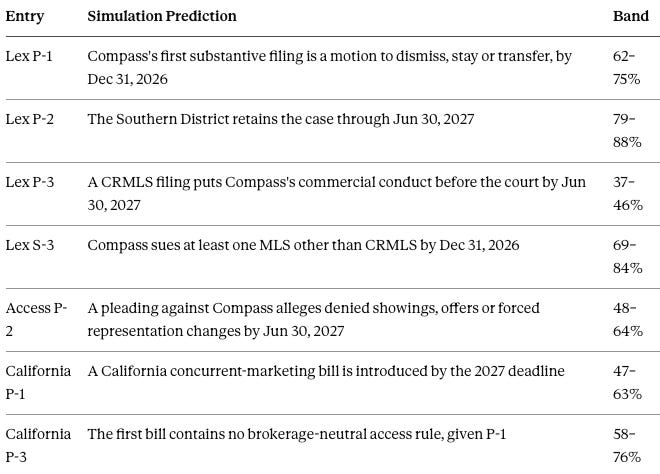
What the simulation declines to forecast. The evidence does not yet support a forecast that a second California MLS will sue Compass.
Takeaway. The forward view points to a narrow case in New York and a continuing campaign, with Compass’s own documents shaping each new argument.
What MindCast Can Help Each Institution Decide
The briefing describes the contest from public evidence. A commissioned simulation builds one institution’s Cognitive Digital Twin from its own rules, budget and correspondence, then replays the contest against that institution’s options.
CRMLS Leadership
Filing first bought CRMLS a forum and a narrow question, and it left the counterclaim decision open: amend with reserved claims, pursue conduct discovery or hold the narrow counts. MindCast can model each option against Compass’s likely response and the fund’s real depth before Compass files.
CRMLS Counsel
The Exhibit D argument rests on the distinction between submission without dissemination and no submission. NWMLS pursued buyer-capture variables in Washington discovery that match CRMLS’s preservation notice. MindCast can map which Compass positions survive comparison across New York, Texas and Washington.
Other California MLS Executives
Every board holding a Compass letter faces the decision CRMLS and Unlock faced, and each board decides alone. CRMLS plays a role analogous to a lead institution in an AG coalition: it absorbs initial litigation and evidence-development costs that other MLSs can avoid duplicating. Unlock built the Flex accommodation and still refused, which shows the refusal holds across MLS rule types. The analogy stops at coordination. Agreements among MLSs on how to answer Compass carry group-boycott exposure under the Sherman Act. Joint petitioning of a state official stays protected under Noerr-Pennington, the doctrine that shields petitioning of government from antitrust liability. MindCast can test a board’s options against Compass’s release-and-feed offer and the board’s own member economics.
California Lawmakers and Committee Staff
Washington’s statute reaches visibility, and California’s dispute concerns showings and representation. Civil Code section 1088 lets a conduct rule reach access without mandating submission. MindCast can test draft language against the opt-out and privacy-exception requests Washington drew. State AG Coalitions in the Landscape of Emerging Federalism(MindCast Lex Vision, September 4, 2026) maps how state offices carry enforcement that federal action leaves open. California’s AG recurs among the lead offices in multistate actions.
Working With MindCast
A commissioned simulation builds your institution’s Cognitive Digital Twin (CDT) from its own rules, budget and correspondence with Compass. MindCast then replays the contest against your options and Compass’s likely responses. Engagements typically cover three questions:
Litigation posture: which Compass positions survive comparison across New York, Texas and Washington, and which counterclaim or discovery path carries the most leverage.
Board decisions: how a board’s answer to Compass’s demand plays out against its member economics and Compass’s release-and-feed offer.
Rules and legislation: how draft MLS rules or statutory language hold up against the opt-out and privacy-exception requests Washington drew.
Each engagement produces Simulation Predictions with probability bands and falsifiers, so your institution can test the analysis against events as they unfold.
Contact mcai@mindcast-ai.com for more info.