
Super Bowl LX · 2026 FIFA World Cup Final · 2026 US Open Men’s and Women’s Finals. A recap across three sports and one method
Companion to the underlying reports: 🏈Super Bowl LX — AI Simulation vs. Reality, ⚽The 2026 World Cup Final Simulation Validation, 🎾The 2026 US Open Finals Simulation Validation.
🎯 I. The Finding Up Front
Three 2026 simulations ran on three different mechanisms. Super Bowl LX turned on multi-regime survivability, the World Cup final on Recursive Pressure, and the US Open on the Doctrine Identifiability Theorem in its first live deployment.
Sports carry the program because they resolve adaptive competition quickly. A knockout can test a forecast in hours where litigation or institutional change may take years.
MindCast represents each competitor through a Cognitive Digital Twin (CDT) built from Predictive Behavioral Economics + Dynamic Game Theory: behavioral economics supplies the decision rules, and game theory the payoff structure. The three sports change the competitive environment the architecture reads.
Football sets two team systems against each other. The World Cup tests competing tactical systems across a tournament. The US Open reduces the problem to individual players.
Each shifts the unit modeled and how much decision data the sport exposes: sixty snaps a game with most opponents seen once in football, tournament-scale interactions in soccer, and hundreds of point-level decisions a match in tennis. The same Cognitive Digital Twin re-fits to each without changing the underlying theory.
🏟️ II. One Method, Three Championships
Three championships tested the method across three different games in 2026, and each ran a different mechanism. The three below run in the order they resolved, from the Super Bowl in February to the US Open in September, and each pairs the mechanism the forecast named with the game that tested it.
🏈 Super Bowl LX: Multi-Regime Survivability
MindCast favored Seattle, and the mechanism it named was multi-regime survivability. A competitor has multiple regimes when it can win the game in more than one way. Seattle could win three ways: by opening the game up, by grinding it down, or by forcing New England into mistakes. New England could win only the grinding version, so once Seattle set the shape of the game, New England’s single path could close.
Seattle won 29–13 and held New England without a point for forty-seven minutes and twenty-seven seconds. Seattle opened in the grinding, low-event version through three quarters and controlled the clock behind field goals and defensive pressure, then opened the game up once it was safe to. New England reached its own preferred low-event shape and could not convert it, producing zero points and zero red-zone trips through the shutout window.
Kenneth Walker III carried the ground game to 135 yards, Jason Myers converted five field goals, and Sam Darnold committed zero turnovers while Drake Maye absorbed six sacks and three turnovers. Seattle’s sixteen-point margin exceeded the projected four-to-ten-point range, and the separation arrived earlier than the one-possession fourth quarter the forecast expected.
⚽ World Cup Final: Recursive Pressure
MindCast favored Spain through Recursive Pressure, the mechanism its Cognitive Digital Twin of Spain named. Recursive Pressure is distributed control: Spain keeps the ball and keeps generating fresh chances until one converts, depending on no single player or move. Argentina’s Cognitive Digital Twin named the opposite mechanism, Tempo Governance: Argentina controls the match’s rhythm and strikes in the windows that control creates, most of all through Lionel Messi.
The final showed which mechanism held. Spain beat Argentina 1–0 after extra time, the winner arriving at 106 minutes when substitute Ferran Torres finished a Nico Williams header. Spain held roughly two-thirds of possession and restricted Argentina to zero shots across all ninety minutes of regulation, and it kept opening fresh attacking channels through its substitutes, as The 2026 World Cup Final Simulation Validation documents. By Enzo Fernández’s dismissal at 90+3, Spanish control and the Argentine shot drought had already held for ninety minutes at eleven a side.
Argentina’s Cognitive Digital Twin operated through Tempo Governance, which needs the match to stay level and then accelerate through Messi in the closing windows. The mechanism reached the level, goalless state but never the acceleration, because Spain never let the windows open. Argentina’s late-recovery threat was real from earlier knockout rounds, yet Spain’s suppression left it no window. MindCast’s late-state weighting put Spain at 39% in extra time and favored Argentina there; Spain won that state.
🎾 US Open Finals: When Opponent History Discriminates
The US Open provided the first live test of MindCast’s Doctrine Identifiability Theorem. The theorem asks whether a competitor’s underlying doctrine (a player’s serve patterns, shot selection, and risk posture) can be recovered from the decisions visible in public play. A doctrine is easy to recover when it diverges sharply from the nearest rival’s and hard to recover when the two sit near parity, because near-identical decision patterns cannot be told apart from behavior alone. MindCast applied the theorem through Shadow Playbook Reconstruction, and tennis went first because hundreds of point-level decisions a match make a player’s doctrine leak fastest.
Alexander Zverev’s 5–0 record against Ben Shelton, four of the wins in straight sets, is the high-divergence case. A one-sided history means the two players’ decision patterns pull far apart, so the doctrine is identifiable and the read holds. Zverev won 6–3 7–6(2) 5–7 6–2 for his first US Open title and second major of the year, and five of the six men’s predictions held. Zverev took 43% of Shelton’s second-serve points against a projection above half.
Aryna Sabalenka’s 10–7 series against Elena Rybakina across seventeen meetings is the near-parity case. When two players have split their meetings that evenly, their decision patterns overlap, and the theorem predicts the doctrine will blur: behavior alone will not recover which player wins. Rybakina won 6–4 5–7 6–2 for her first US Open title and the world No. 1 ranking, ending a 99-week Sabalenka reign, and MindCast had favored Sabalenka. One of the five women’s predictions held.
The blur showed in the serve-ceiling condition. Rybakina landed only 47% of first serves and won 85% of the points behind them, so a single first-serve-availability threshold marked a false failure where the two players’ play would not separate.
🧭 Reading the Three Together
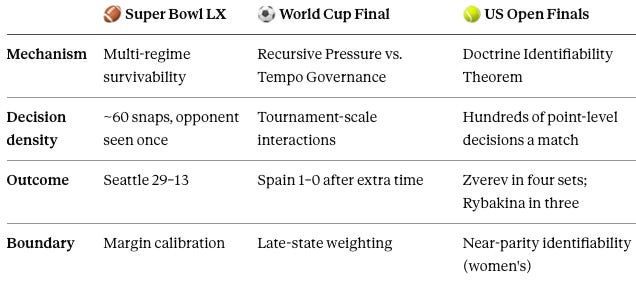
The named mechanism produced the winner in the Super Bowl, the World Cup, and the men’s US Open final. Each variance exposed a different boundary: margin calibration in the Super Bowl, late-state weighting in the World Cup, and near-parity identifiability in the women’s US Open final. The three events shared no single mechanism. What they shared was the method: a Cognitive Digital Twin built for each competitor and run forward under the sport’s own decision environment.
🔭 III. The Forward Test and the Slower Arenas
The forward test is whether pre-match identifiability predicts which calls hold. Across the coming Grand Slam season, near-parity finals (a head-to-head series inside roughly 55–45) should stay the low-confidence reads, and a doctrine-recovery call in those finals should not beat a history-only baseline. The falsifier is clear: if near-parity calls match or beat the identifiable ones across a season of qualifying finals, identifiability does not predict recovery difficulty.
Sport is a validation surface, not the domain. The same identifiability question runs in MindCast’s litigation and technology-policy work: which of a party’s hidden decisions leak through the public traces they leave. An outcome there takes quarters or years rather than an afternoon.
📚 Appendix: MindCast Works
Super Bowl LX — AI Simulation vs. Reality. Super Bowl LX across strategic range, game-state transitions, and final margin.
Seahawks vs. Patriots, 2026 Super Bowl LX. The parent Super Bowl forecast carrying the multi-regime survivability thesis and underlying predictions.
The 2026 World Cup Final Simulation Validation. The World Cup final across Recursive Pressure, Tempo Governance, and opponent suppression.
FIFA World Cup Final Foresight Simulation — Spain vs Argentina. The parent World Cup forecast, the two Cognitive Digital Twins, and the 54% final read.
The 2026 US Open Finals Simulation Validation. The US Open finals across discriminating and near-parity opponent history.
The 2026 US Open Finals Simulation Predictions. The parent US Open forecast carrying the eleven predictions and the two evidence regimes.
MCAI Sports Vision: Reverse Engineering Sports Playbooks with Cognitive Digital Twins + Dynamic Predictive Game Theory — Proven on Star Wars Lightsaber Forms. The Doctrine Identifiability Theorem and Shadow Playbook Reconstruction, deployed first at the US Open.
MindCast AI 2026 Prediction-Venue Comparison. The cross-event Super Bowl and World Cup comparison.
MindCast Predictive Game Theory + Behavioral Economics Cognitive Digital Twin Foresight Simulations in the World Cup and Super Bowl. The laboratory charter for why sports supply the fast, public validation environment.