


Post final validation report The 2026 World Cup Final Simulation Validation🇪🇸 🇦🇷
MindCast 2026 FIFA World Cup Collection
Cultures Under Shared Rules — The Seattle Lab at FIFA World Cup 2026
Foresight Simulations Round of 16 | Quarterfinals | Semifinals
Validation Reports I | II | III | IV — Round of 16 | V — Quarterfinals | VI — Semifinals
Special Series: World Cup Championship Index 2026 | Predictive Game Theory + Behavioral Economics Cognitive Digital Twin Foresight Simulations in the World Cup
🎯 I. Executive Summary
Spain has not trailed for a single minute of this World Cup. Six clean sheets in seven matches, and the only goal Spain conceded before the semifinal arrived when Belgium equalized a quarterfinal Spain already led.
Argentina has trailed, recovered and won twice. Three unanswered goals against Egypt from two down. Against England, two goals in the final six minutes, both assisted by Messi, the winner headed home by a substitute at 90+2.
Ten separate readings ran across both teams — what each side does under pressure, what it does the moment it concedes, how it uses its bench, how it handles space, how it handles the clock. All ten share the same underlying portraits of Spain and Argentina, so their agreement is coherence rather than ten independent confirmations. They agree on this:
Spain owns recurrence. Argentina owns recovery. Spain is favored because recurrence governs more of the match; Argentina stays near even because recovery governs the states in which finals are most often decided.
Spain–Argentina is the first knockout tie of the MindCast World Cup run in which both teams carry a renewable mechanism, so neither depends on the single mortal carrier that killed France’s transition once Spanish suppression forced Mbappé deep, or England’s correction once Rice left at 82. Spain’s Mechanism Survival Index reads 92 against Argentina’s 93 — the smallest mortality gap of the tournament, and the reason the final is not another durable-versus-mortal matchup but a conversion contest between two systems that both survive.
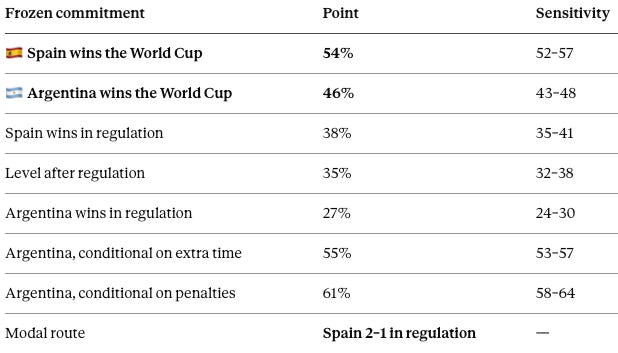
The 54–46 uncertainty arises primarily from which temporal state the match reaches before one renewable system converts, with each team’s Cognitive Digital Twins’ (CDTs) own classification error and the unresolved availability picture contributing the remainder.
Freeze status. The 54% is frozen and published. Medical, referee, lineup and weather information arriving after publication logs as scored shock evidence and does not revise the number. Section XIV maps conditional states without revising the commitment.
The commitment is therefore narrow but not timid. Spain sits four points above even and eight points ahead of Argentina — still close to nothing in a single match. The lead is small primarily because the systems peak in different phases, not because their operating-system identities are unclear; both teams’ CDTs are the strongest the model has built.
🔧 II. What Report VI Changed
Validation Report VI graded the semifinal cross-match slate at a Brier score of 0.359 against an uninformative 0.50 baseline of 0.250 — a Brier skill score of −0.434. The same round’s match-level advancement calls scored a Brier of 0.207 and beat that baseline. Five of seven lines published at 75% or higher failed, and no shrinkage factor rescued them.
Report VI closed with three publication constraints, and its calibration review adopted a further set of operational corrections. The final is the first simulation to run under all of them, and it tightens one.
The three publication constraints govern what may carry a number at all. Structural mechanism claims publish as reads rather than scored probabilities, because the semifinal’s mechanism reads graded two-for-two while the probabilities attached to them returned that skill score of −0.434. Numbers attach only where settlement is objective, the provider is named, and the measurement window freezes at commitment. And no event probability publishes above 75%, under a new prospective rule the final adopts here.
The cap is an extension of Report VI’s finding rather than a restatement of its rule. Report VI found that five of seven lines published at 75% or higher failed, and those failures crossed categories: structural, route, margin, possession and coherence.
Two of the five settle objectively from the match record rather than through analyst judgment. Both matches finish regulation within one goal published at 78% and failed; no regulation winner by more than one goal published at 76% and failed. A cap confined to any single class of prediction would leave the categories containing most of those failures untouched, so the final caps every event probability regardless of settlement type — an extension of the calibration finding, not an exception carved for a favored class.
The operational corrections each trace to a specific semifinal failure rather than to a preference. Proper scoring now applies to every probability, each carrying one frozen point estimate that Report VII scores against the baseline. Route begins with the first decisive replacement rather than each side’s strongest phase, because both semifinal routes anchored to the strongest phase and both matches resolved before reaching it.
Active-regime control receives a definition it previously lacked — FIFA first-half possession, measured at halftime, and nothing else. Every trigger now carries a consequence, because the semifinal committed that Argentina’s call would weaken under first-hour sterility, the condition activated, and the forecast never said how far the number should fall. Habit modifies coherence wherever a state contradicts demonstrated in-tournament behavior, and recognition and causation grade on separate lines. Every slate line publishes a frozen resolution rule with an unambiguous time anchor, and the Mechanism Survival Index publishes without pricing anything.
Two confidence types appear below, and the distinction is the fix.
Event probability estimates whether a specified observable event occurs, settles through a named provider, and scores with the Brier score. Interpretive confidence states confidence in a structural read, and never enters the probabilistic aggregate unless an objective settlement rule freezes before kickoff. Section XII therefore carries the event probabilities, while Section XIII carries the interpretive reads that Report VII discusses without scoring.
A dozen rules for one match may look like bureaucracy. Each rule exists because the semifinal validation exposed a specific weakness, and a framework that survives its own validation report by ignoring those weaknesses is not a framework. The same discipline applied over four rounds explains something larger than the rules, and something a reader checking the cited sub-links will notice immediately: MindCast’s own pre-tournament index picked the other team.
🔄 III. Why Spain, When the Index Picked Argentina
A reader following the cited sub-links finds MindCast’s own tournament-level architecture pointing the other way, and the discrepancy deserves an answer rather than silence.
The World Cup Championship Index 2026, published June 14, ranked Argentina the most likely champion and Spain fourth. France led raw capability at 97 and trailed Argentina on alignment. Spain carried the highest Cultural Signal Integrity of any nation at 95, identity and execution aligning unusually tightly, and the Index docked it for exactly one thing: a thinner environmental profile is the only thing separating it from the leaders.
The Index therefore made two separable claims about Spain. Spain’s coherence was the best in the field. Spain’s environment was the thinnest among the contenders. Everything downstream turns on what the tournament did to each claim, and the tournament graded both.
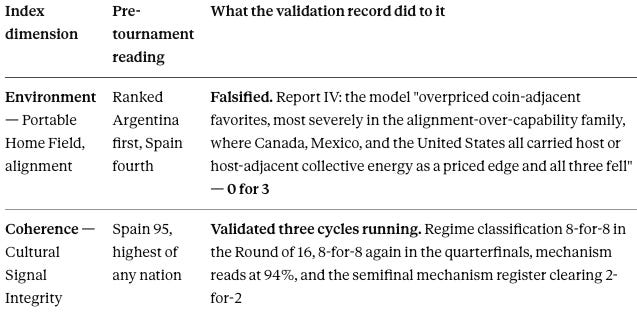
The two dimensions moved in opposite directions, and the movement is the answer. The dimension that placed Spain fourth failed in public, in the exact family the Index weighted most heavily against her. The dimension where Spain already led the entire field validated in every cycle since. Spain arriving as the final’s marginal favorite is consistent with an evidence-weighted update to the Index’s dimensions, not a repudiation of them.
Argentina’s pick is not refuted either, and the distinction matters more than the scoreboard. The Index projected Argentina to the final, and Argentina is in the final. What changed is not whether Argentina’s edge exists, but where the model can see it.
Pre-tournament, the Index attributed Argentina’s championship profile to ambient alignment — the Portable Home Field, cultural presence detaching from geography and operating through diaspora networks that no Elo input can price. Four knockout rounds later, the same edge carries a name, a location and a measurement: Tempo Governance, a chase-state coherence of 94–97 under an explicit habit override, and a designed-replacement instrument that has decided two ties through one substitute.
Argentina has won every knockout narrowly and late — Cape Verde 3–2 in extra time, Egypt 3–2 from two down, Switzerland 3–1 in extra time, England 2–1 at 90+2. The environment did not vanish from the model. The Cognitive Digital Twin absorbed it at the layer where it can be graded.
The update doctrine permits precisely this and forbids the alternative. Operating-system labels, action language, decision architecture and relational structure stay invariant across the tournament. Coherence values, transition velocity, stability reserve, mechanism survival and opponent-specific failure conditions update when evidence reaches them. No probability moves without a stated evidentiary trigger, and no result converts into causal evidence merely because it followed a prediction.
One number makes the whole arc visible. Spain’s advancement call has fallen every round — 70 in the Round of 16, 60 in the quarterfinal, 55 in the semifinal, 54 today — and cleared every time it was graded. Argentina’s has fallen alongside it: 67, then 60, then 54, and 46 now. Neither twin grew stronger on paper as the tournament progressed. The bands narrowed because the opposition improved, and the model published its shrinking confidence rather than hiding behind the Index’s original ranking.
Stated plainly: the Index asked which culture innovates best across seven consecutive rounds and answered Argentina, which reached the final exactly as projected. The final asks a different question — which system converts one match against this specific opponent — and answers Spain at 54%. A tournament-level prior and a conditional head-to-head are different objects, and Report VII grades the second without retiring the first.
⚙️ IV. Simulation Pipeline
Every prediction below is an output of the stage above it, and outcome sits last on purpose. A model that begins with the winner and reasons backward will find a mechanism to justify whatever number it already liked; the pipeline runs the other way.
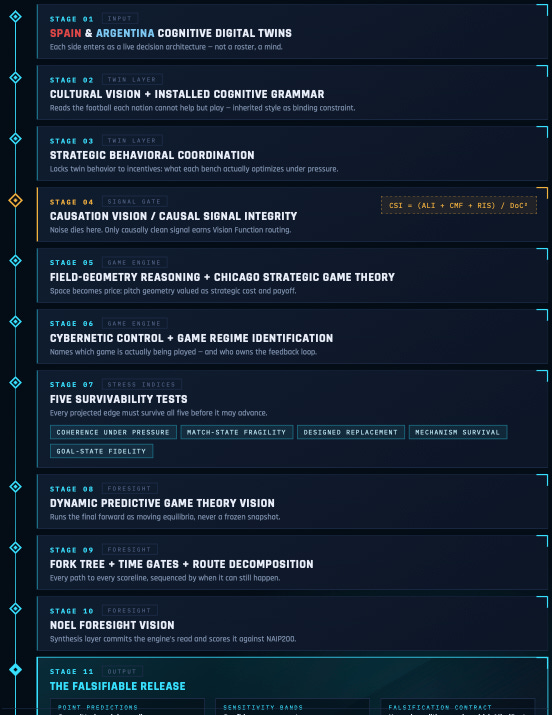
Outcome sits last by design, subordinate to mechanism and route.
Reading the pipeline top to bottom explains why the final’s forecast looks different from the semifinals’. The twins changed very little. The rules governing what the twins are allowed to claim changed a great deal.
Contact mcai@mindcast-ai.com to partner with us on Predictive Game Theory AI in Law and Behavioral Economics. We specialize in predictive simulations for Complex Litigation, Innovation Economics and Geopolitical Risk Intelligence.
To test our predictive simulation AI system, in 2026 we simulated the Super Bowl and the World Cup. See Super Bowl LX — AI Simulation vs. Reality | Predictive Game Theory + Behavioral Economics Cognitive Digital Twin Foresight Simulations in the World Cup| The World Cup Is the First Mass-Market Stress Test for Prediction Markets | Susquehanna Is Building the Institutional Market the CFTC Does Not Require — but Still Needs
To deep dive on MindCast works upload the URL of this publication into any LLM (preferably Google AI mode) and prompt ‘reconstruct MindCast framework with three degrees of cited sub links.’ See Live-Fire Game Theory Simulators, Runtime Predictive Infrastructure.
For fun, upload the URL for this publication to Google during the World Cup final, then prompt Google AI to adjust the simulations with real time data.
🧬 V. Finalist Cognitive Digital Twins
A Cognitive Digital Twin (CDT) models how a decision-making system behaves under pressure — its decision architecture, installed responses, and named failure conditions — rather than compiling a statistical profile of its outputs. Each twin represents its subject as a strategic agent inside a patent-pending simulation architecture: candidate causal relationships must pass an upstream Causal Signal Integrity validation gate before entering simulation, governing rules can mutate mid-run, and no simulation terminates until behavioral and institutional equilibria both converge. MindCast filed a U.S. Provisional Patent Application on the full architecture on April 18, 2026, establishing a priority date for the ordered combination of causal validation, adaptive model governance, and dual-equilibrium foresight prediction. The World Cup series functions as the architecture's live-fire validation environment: the CDTs below publish frozen predictions, named falsifiers, and scored outcomes because the system is engineered to be graded, not admired.
The final requires no new CDTs, because the quarterfinals and semifinals already validated both, and rebuilding a team after seeing a result would let post-hoc interpretation replace foresight. The twins below preserve each behavioral identity and revise only the components the new evidence actually reached.
🇪🇸 Spain — Recursive Pressure. Spain makes pressure cumulative. Rodri stabilizes the center, the midfield recycles failed entries, the fullbacks alter width, and Lamine Yamal manufactures asymmetry without carrying the entire terminal burden. Spain’s system survives the loss of one attacking channel because creation, recovery and finishing stay distributed.
Dallas validated the system and exposed a measurement contract rather than a modeling error. France arrived with the tournament’s most feared attack and produced 0.30 expected goals with zero big chances. Spain controlled the match behaviorally while holding only 51% of the ball.
🇦🇷 Argentina — Tempo Governance. Argentina compresses event volume until it chooses the acceleration. Messi selects the terminal channel, but Enzo, Mac Allister, Álvarez, Lautaro, De Paul, Montiel and the bench distribute the correction. Atlanta validated the operating system and forced an upward correction to Argentina’s one-goal chase-state coherence: the old twin priced that state at 73–79 on fatigue, and Argentina conceded first, stayed coherent, and scored at 85 and 90+2.
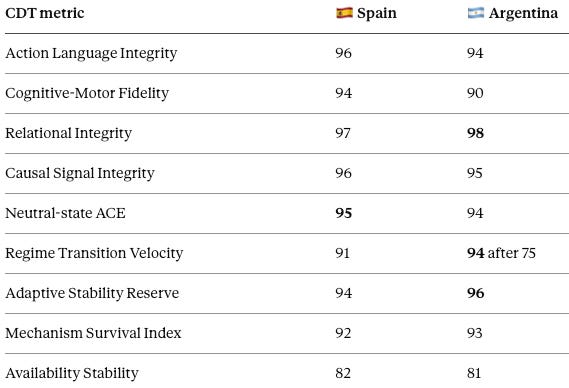
The 0–100 CDT scores are internal diagnostic indices rather than probabilities: an Adaptive Coherence Equilibrium of 95 does not mean 95%, and the indices never enter the Brier aggregate.
Spain owns the more repeatable opening system and the better freshness-adjusted execution, while Argentina owns the stronger emotional-relational reserve and the more strongly demonstrated late correction. The near equality of the Mechanism Survival Index removes the mortality asymmetry that governed both semifinals and left the model a simpler question than it had at Dallas or Atlanta.
Availability. Yamal avoided serious injury after leaving the semifinal with visible discomfort, and Porro carries a minor muscular issue. Spain’s winger depth stayed thin behind Yamal all tournament. Argentina carries the heavier cumulative load after consecutive extra-time knockouts, and Messi has played nearly every decisive minute at 39.
Two numbers in that table carry the whole final. Spain’s 92 and Argentina’s 93 on Mechanism Survival mean the model cannot resolve the match by asking which edge dies, the question that resolved both semifinals. The functions below had to find a different question.
👁️ VI. Vision Function Outputs
Ten functions ran, and reporting them individually would bury the reader in the machinery rather than the finding. The table condenses each to its question and its output, and the two functions that constrain what the rest of the run may claim get isolated underneath.
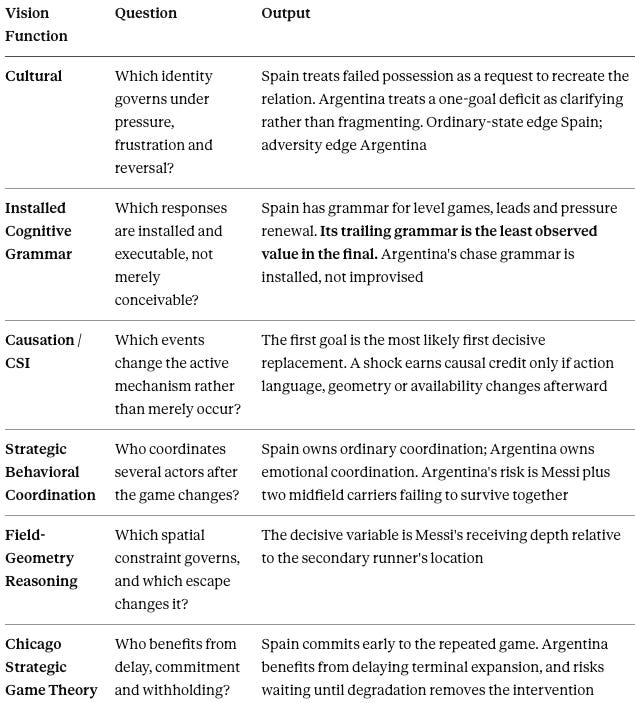
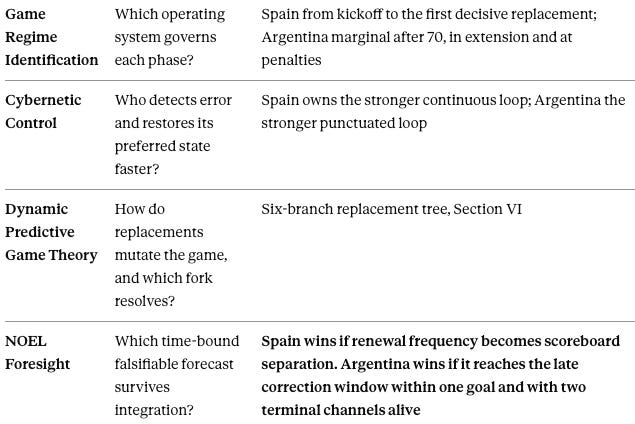
Two function outputs deserve isolation before the replacement tree, because both constrain how much the rest of the run can claim.
The Installed Cognitive Grammar Vision names the simulation’s weakest value. Spain can add vertical force when trailing, but a late deficit may convert recursion into urgency and lower relational fidelity, and interpretive confidence in the Spain-trails-after-70 read therefore runs 62–72% — deliberately the lowest figure anywhere in the canvas, because the state is unobserved while every other Spanish state carries confidence in the eighties or nineties.
The Causation Vision separates recognition from credit before the match rather than after. A shock earns causal credit only when the observed action language, geometry or availability changes afterward, which means the first major causal test is not whether Messi receives the ball deep but whether a secondary runner remains available once he does.
Every function points the same direction, and the direction is temporal rather than qualitative. No function finds Spain better in a way that holds for ninety minutes, and none finds Argentina better in a way that holds from kickoff. The replacement tree below is where that split becomes arithmetic.
♟️ VII. Dynamic Predictive Game Theory — The Replacement Tree
R1 · Argentina escapes the counterpress twice before halftime. Spanish territorial pressure becomes a two-way transition game, and Spain’s pressure is creating Argentine chances rather than suppressing them. Argentina moves from 46% to 54% (52–55). The earliest branch that moves Argentina above even without a goal.
R2A · Spain scores first before minute 60. Argentina accelerates against a Spain that continues keeping the ball rather than retreating into a block. Spain rises to 69% (66–71) — a smaller rise than the old Argentine failure ACE would have implied, because Argentina’s chase state is now validated rather than assumed.
R2B · Argentina scores first before minute 60. Spain adds vertical force without immediately abandoning circulation. Argentina rises to 64% (61–66), and no higher, because Spain’s chase coherence is inferred to remain strong. Branch R2B carries the simulation’s largest unpriced uncertainty. Spain has not trailed for a single minute of this tournament, so its trailing coherence is inferred from the operating system rather than observed. The last time MindCast inferred a chase state from structure instead of evidence, it priced Argentina at 73–79 and Argentina chased and won.
R3 · Level after minute 70. Spain’s renewal frequency meets Argentina’s demonstrated late habit. Argentina becomes the marginal state favorite at 53% (51–55).
R4 · Designed replacement. Spain benefits if Rodri preserves the base while a new penalty-area or vertical channel enters. Argentina benefits if Messi stays advanced and the substitute creates an independent terminal target.
R5 · Level after regulation. Spain’s freshness meets Argentina’s extension experience. Argentina 55% (53–57).
R6 · Level after extra time. Collective operating systems yield to isolated execution. Argentina 61% (58–64).
The Spain-first and Argentina-first branches describe conditional states rather than an exhaustive partition. A first goal may also arrive after minute 60, or never arrive at all — the canvas prices the match level at halftime in 58% of runs — so the integrated 54% championship forecast folds in scoreless-first-hour and later-first-goal branches that neither conditional above represents.
The tree’s shape is the forecast’s honest shape. Spain’s branches pay well and arrive early; Argentina’s pay well and arrive late; and the branch nobody has observed is the one that would decide the match if it fires. Coherence values underneath explain why each branch pays what it pays.
🧠 VIII. Coherence Under Pressure
Coherence tables answer one question: how well does a system hold together in a state it did not choose? The states below run from the ordinary to the extreme, and the two that matter most are the two the tournament has not shown us.
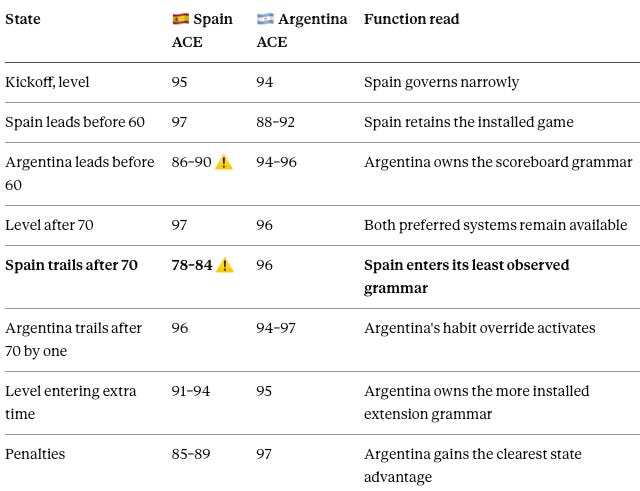
A Spanish lead is powerful without being terminal, whereas an Argentine late lead produces the strongest non-penalty state advantage in the match, because possession scarcity and urgency can convert Spanish recursion into hurried terminal action.
⚠️ Untested-state flag. Both Spanish trailing rows are inferred, not observed. Argentina’s chase rows carry the habit override and rest on two completed comebacks. Report VII grades the Spanish trailing rows only if the state occurs, and a miss there costs the coherence register exactly what Atlanta’s miss cost it.
Read the trailing rows and the penalty row together and the final’s asymmetry stops being abstract. Spain’s worst observed state is comfortable. Spain’s worst inferred state is the second-lowest number in the table, and Argentina’s best state sits directly across from it.
🎛️ IX. Designed Replacement and Mechanism Survival
Both benches have decided exactly two knockout ties, each through one substitute. Merino came on at 85 against Portugal and scored at 91; he scored again at 88 against Belgium. Lautaro Martínez finished at 120+1 against Switzerland and headed the winner at 90+2 against England.
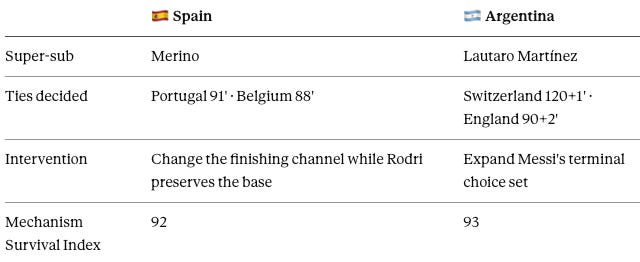
Argentina owns the stronger demonstrated intervention, while Spain owns the stronger chance that its underlying system reaches the intervention intact — a distinction that keeps the model from confusing proven late conversion with guaranteed future availability.
Mortality requires compound failure on both sides. Killing Spain’s mechanism takes Rodri withdrawn or limited, or Yamal and Porro simultaneously limited, or repeated Argentine escapes that force the rest defense into recovery running. Killing Argentina’s takes Messi limited or trapped in permanent defensive depth, or fatigue removing two midfield carriers before the substitution window, or Spain preventing any secondary runner from becoming an independent terminal target. One ordinary substitution produces neither, so the Mechanism Survival Index publishes without pricing anything, exactly as the deferral firewall requires.
Merino and Lautaro are the same instrument pointed in opposite directions, and the tournament has given each exactly two proofs. No prior tie in this series offered that symmetry, which is why the designed-replacement term cannot break the tie the way it broke Atlanta.
🌡️ X. Venue and Final-Specific Replacements
The final kicks off at 3 p.m. in an open-air stadium in East Rutherford, with early forecasts near 28 degrees Celsius and a thunderstorm risk, under mandatory hydration breaks. Dallas warmed its pitch through glass walls despite a closed roof, and Atlanta held a true 20 degrees. The final runs neither, and the heat-as-late-suppressant hypothesis the registry has carried since Miami gets its cleanest test against two systems that both decide late. Weather remains too unstable to price.
Reports indicate the halftime show may extend the interval materially beyond the ordinary fifteen minutes, with the operative timing still uncertain. A longer pause would create a final-specific exogenous replacement, as muscle temperature falls, tactical instruction expands, emotional momentum resets, and re-entry after the break becomes less continuous. The effect cuts both ways: Spain benefits from a longer tactical reset while Argentina may benefit from the physical recovery, and Yamal, Porro and Messi each carry enough recent exposure that the re-warmup protocol matters. The canvas records the hypothesis and prices it at zero until FIFA confirms the operative interval.
Neither environmental factor moves a number, and both belong on the record anyway. The registry exists so that a hypothesis can be named before it matters rather than discovered afterward, and a heat effect or a thirty-minute interval would land on precisely the minutes both finalists have built their tournaments around.
📝 XI. Integrated Interpretive Prose
Spain should begin as the active-regime holder, because Recursive Pressure requires less permission from the opponent than Tempo Governance does: Spain can circulate, isolate, recover and repeat without waiting for a particular score state. Argentina can accept that appearance of Spanish control, because its own system never required early event dominance. The opening question is therefore not whether Spain possesses the ball, but whether each Spanish possession makes the next Argentine release worse.
If Spain’s counterpressure holds, Argentine attacks become isolated rather than cumulative: Messi may receive, but he receives behind the ball, the secondary runner arrives late or through a predictable lane, and Spain resets before the escape becomes a chance. The branch produces the Spanish regulation advantage, and the most likely Spanish scoring action inside it begins through width, recycling or a second-phase recovery rather than a long central transition.
Argentina does not need to win the possession game; Argentina needs to disprove accumulation. Spain can absorb one clean escape without consequence, but two high-value central escapes before halftime would reveal that Spanish pressure is manufacturing Argentine transition rather than suppressing it — the earliest branch capable of moving Argentina above even without a goal.
The first goal changes the burden without automatically killing the trailing mechanism. A Spanish goal activates a chase state the semifinal proved materially stronger than the old twin allowed, and Spain should keep the ball afterward rather than becoming the passive opponent England became. An Argentine goal creates the final’s most uncertain branch, because Spain’s structure implies circulation survives an early deficit while its late chase state remains inferred rather than observed.
If the final remains level after minute 70, the state space narrows toward Argentina, because Spain may remain coherent and physically fresher while Argentina holds the stronger conversion habit and the stronger designed replacement. Extra time therefore tilts narrowly Argentine despite Spain’s freshness, and penalties tilt further still, since the collective advantage of Recursive Pressure disappears once the contest becomes a sequence of isolated executions.
The forecast is consequently asymmetric across time rather than across quality: Spain is more likely to be the better team and the regulation winner, while Argentina is more likely to win from a late-level or extended state.
Stated plainly, the model expects Spain to be the better team and Argentina to be the more likely winner of the game Spain fails to finish. Every number below descends from that sentence.
🔢 XII. Frozen Settlement Board — Event Probabilities
Every line carries one frozen point estimate, which is the number Report VII scores. Sensitivity bands record uncertainty and never enter scoring. No line publishes above 75%, structural or objective, under the extension Section II states.
Scoring families matter more than line count. Several predictions below are complements, three-way partitions, nested events or conditionals, so averaging every row into one undifferentiated Brier score would double-count the same underlying uncertainty. Complementary, nested and duplicate lines receive no separate weight in the aggregate, and conditional predictions are void unless their conditioning state occurs.
Family 1 — Championship · scored once

Argentina at 46% is the complement, reported for readers and never scored separately.
Family 2 — Regulation result · one multiclass Brier score

The three outcomes partition regulation and sum to 100, so Report VII scores them as one multiclass forecast against a uniform one-third reference rather than as three binaries against 0.250. Match reaches extra time is the same event as level after regulation and therefore derives from this family rather than scoring again.
Family 3 — Active-regime control · one primary, one diagnostic

The band line nests inside the threshold line, so only the primary enters the aggregate, scored against the 0.250 binary reference.
Family 4 — Independent events · individual Brier scores
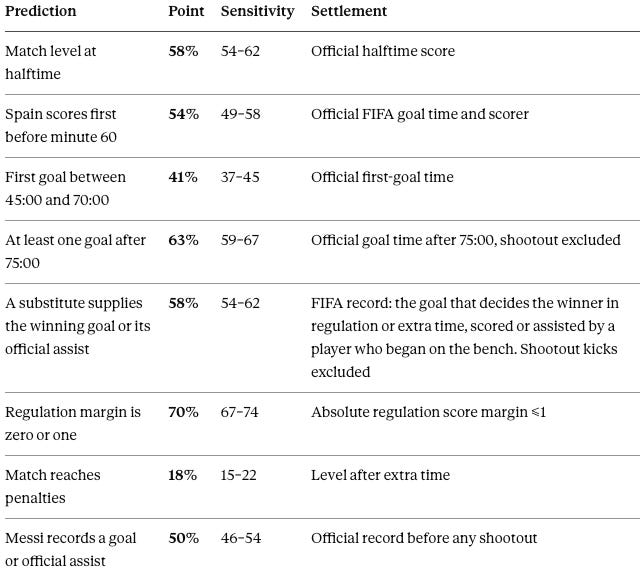
Family 5 — Conditional · void unless the state occurs

Route hierarchy, published as a ranking rather than as scored events, since only the first and last name an exact final score: Spain 2–1 in regulation · Spain 1–0 in regulation · 1–1 with Argentina advancing · Argentina 2–1 through late correction.
One line was removed rather than published. The canvas priced first major designed substitution before extra time at 74%, but no provider records whether a substitution is “major” or “designed,” and nearly every match contains a regulation substitution, which makes the number uninterpretable. The designed-replacement instrument already has an objective test on the board — a substitute supplying the winning goal or assist — so the looser line moved to Section XIII as an interpretive read.
MindCast repriced the margin line downward. Regulation margin zero or one published at 76% in the semifinals, failed, and produced one of the five high-confidence failures behind the −0.434 skill score. Across the six knockout ties, regulation margins complied four times and breached twice — a base rate of 67%. The line publishes at a 70% point rather than the 77–84% a fresh read suggested, because a number above its own base rate is what Report VI just finished diagnosing.
Eleven unconditional scoring units publish across the first four families, plus two conditional lines that score only if their activating state occurs — fewer than the semifinals published, and considerably fewer than a fresh read would have offered. Publishing fewer numbers is the correction, not a symptom of reduced conviction.
💭 XIII. Interpretive Confidence — Excluded From Scoring
Published because the reads carry the reasoning. Excluded from the aggregate because no provider publishes a taxonomy that settles them, and Report VI prohibits retrospectively adjudicated claims from entering the primary score. Report VII discusses each and scores none.
Spain continues circulating after taking a lead rather than retreating: 81–88%
Argentina remains emotionally coherent through a one-goal deficit if Messi and one secondary channel remain: 85–91%
Spain restricts Argentina to no more than one high-value central escape before halftime: 64–72%
Spain’s best scoring route begins through recycling, width or second-phase recovery rather than a long central transition: 66–74%
A goal rather than an exogenous shock produces the first decisive state change: 68–75%
Spain is the behavioral winner across the ordinary match: 74–82%
Both primary mechanisms operate before either materially degrades: 80–87%
The final is decided by conversion rather than complete mechanism death: 76–84%
A major designed substitution enters before extra time: 70–75% — moved off the board because no provider codes “major” or “designed”
If Spain trails after minute 70, execution becomes less relational and more urgent: 62–72% — deliberately the lowest confidence in the run, because the state is unobserved
Excluding these reads costs the aggregate nothing and costs the argument nothing, because the reasoning survives without the decoration. A number that cannot be settled is not a forecast; it is an opinion wearing a decimal point.
❌ XIV. Conditional State Map — Not Revisions to the Frozen 54%
Every trigger carries a consequence, per the rule Report VI adopted after the semifinal’s weakening condition activated without one. The states below describe what the model would believe under conditions that have not occurred. None revises the frozen 54%, and each logs as scored evidence if it lands.
Spain weakens: Porro materially limited, −2 to −4 points. Yamal materially limited, −4 to −6. Rodri unavailable or materially limited, −8 to −12, and Argentina becomes the behavioral favorite. Argentina produces two high-value central entries before halftime, Spain falls to 45–48%. Spain records under 54% first-half possession without leading, the active-regime read fails and Spain falls 3–5 points.
Argentina weakens: Messi materially limited, −9 to −13 points. Two of Enzo, Mac Allister, De Paul or Paredes limited, −5 to −8. Spain leads at halftime with at least 58% possession and no Argentine shot on target, Argentina falls to 27–32%. Argentina reaches minute 70 trailing by two, the habit override lapses and Argentina falls below 10%.
Twin falsification. The Spain twin fails if Argentina repeatedly beats the counterpress through the same central route and Spain cannot recreate territorial pressure — the trigger its failure state names and no opponent has fired. The Argentina twin fails if it abandons Tempo Governance for undirected direct play within fifteen minutes of conceding while Messi and a secondary channel remain available.
Route falsification. The Spain 2–1 regulation modal fails on a two-goal margin, a dismissal or major injury creating the decisive state before the forecast window, an unresolved 0–0 after minute 75, or extra time. Route credit remains separate from shock recognition and exact score.
Publishing the conditional map before kickoff is what makes the frozen number honest. A forecaster who states in advance what would change his mind, and by how much, cannot later claim he knew all along — and cannot quietly move the number when the trigger fires.
📒 XV. Frozen Ledger Setup
Validation Report VII grades this simulation on July 19 and closes the tournament series. Registers grade independently: outcome, behavioral mechanism, mechanism survival recognition, shock handling, route, margin, exact score, and the settlement board.
Board lines score by family rather than by row, published whether they beat their reference or not. Binary lines compare against the 0.250 Brier reference generated by an uninformative 0.50 forecast. The regulation family uses a uniform one-third reference and reports its multiclass Brier score separately, because a three-way forecast and a binary forecast do not share a scale — a uniform three-way reference scores 0.667 raw against the binary reference’s 0.250, and averaging the two would compare incompatible units. Any cross-family comparison therefore uses Brier skill scores rather than averaging raw binary and multiclass scores.
The championship scores once. Regulation scores once as a multiclass forecast. Possession scores its primary line only. The eight independent events score individually. Conditional lines score only if their conditioning state occurs and mark void otherwise. Complementary, nested and duplicate lines carry no separate weight, because a slate that counts the same uncertainty twice produces an aggregate that measures nothing. Interpretive reads receive discussion and no score.
Unresolved at commitment, each logging as scored shock evidence if it lands and none moving the frozen number: Yamal and Porro medical and training status; Messi’s recovery and training load; Argentina’s midfield recovery; confirmed suspensions; the appointed referee and card profile; confirmed starting shapes and Lautaro’s bench status; and the official weather, lightning, hydration and halftime-duration protocols.
The tournament’s open question arrives at the final in its sharpest available form. No opponent has made Spain chase. Argentina has been made to chase twice, and won both. One of those facts stops being true on July 19, or neither does and the match goes the distance.
Validation remains the objective, and calibration remains the discipline.
Forthcoming:

Finals simulation validation and 2026 World Cup Game Theory + Behavioral Economics review July 20-21