

Executive Summary
A Soresu duelist raises a wall of blade and waits for the attacker to spend himself. A Juyo duelist strikes in bursts on a rhythm no opponent can read. Same weapon, opposite doctrines — and each doctrine forces a different signature into every sequence of choices it produces.
One question runs through this paper: every playbook is a secret, yet every game is public. Which secrets survive contact with the scoreboard?
The Doctrine Identifiability Theorem (DIT) answers with a measurement. How recoverable a hidden strategy is depends on how sharply its decisions diverge from its nearest competitor’s — and the divergence can be estimated before recovery is attempted. Three fates follow. Some strategies leak in a handful of observations. Some surrender only to accumulated evidence. Some remain indistinguishable no matter how much behavior is observed through the same channels under the same relevant environments.
Adversaries complicate the picture on purpose — vanilla opening scripts, disguised coverages, a Sith order that hid for a thousand years as exactly two. Concealment raises the burden and moves the signal, and the hiding leaves its own trace. Part IV shows where.
Shadow Playbook Reconstruction (SPR) turns the theorem into a working instrument: infer the doctrine from behavior alone, build a probabilistic shadow playbook, and report confidence as a function of how identifiable the target actually is — including the honest verdict “insufficient separation.”
⚔️ Proof begins where the answers are known. The seven traditionally recognized lightsaber forms publish their doctrines while their practitioners diverge, so a reconstruction can be graded against truth. A reference implementation ranked the forms’ identifiability before any duel ran — and blind recovery honored the ranking. Part VI grades it.
⚽ Live competition already runs the logic. In the 2026 World Cup final, Spain’s Recursive Pressure survived Argentina’s Tempo Governance and produced Spain’s 1–0 extra-time win — the mechanism MindCast simulated and published before kickoff. Part VIII settles it.
🏈 The dare comes next. MindCast registers eight falsifiable predictions on the Seahawks’ 2026 opponents, graded all season. Part XII holds the register.
Definitive execution runs on the MindCast AI Proprietary Cognitive Digital Twin Foresight Simulation (MP CDT FS), patent pending (U.S. Provisional Patent Application filed April 18, 2026: System and Method for Multi-Agent Institutional Simulation Using Causal Validation, Adaptive Model Governance, and Dual-Equilibrium Foresight Prediction). The engine pushes Cognitive Digital Twin (CDT) profiles through MindCast Dynamic Predictive Game Theory (DPGT) and Behavioral Economics, so the winner emerges from the simulated interaction rather than entering as an assumption.
MindCast simulations are not machine learning with better branding. Machine learning finds patterns in what already happened and returns a probability nobody can argue with. MindCast builds a working model of how each side decides under pressure and runs the interaction forward — so every forecast arrives as a specific causal story with named mechanisms, observable confirmation signals, and explicit falsifiers. A pattern tells you who is stronger. A simulation tells you how the contest is won, and what would prove the claim wrong.
Sports carry the program for one reason: velocity. A foresight engine earns trust only through a public track record, and a knockout match grades its forecast in ninety minutes while a docket waits five years. Sports were never the product — sports are where the engine earns the credibility the slower domains demand.
🎾 One season, three sports, one theorem. Tennis leaks within a match, soccer within a tournament, the National Football League (NFL) across a season — and tennis goes first, deploying at the 2026 US Open, which resolves before the football program grades its first opponent. The same law reaches litigation, markets, and every arena where hidden decisions leave public traces.
Publication timing is the method’s own experiment. MindCast publishes the full methodology before the US Open’s first serve and the NFL’s first kickoff, so every subsequent reconstruction operates prospectively — the timestamped record separates genuine pre-game inference from retrospective explanation. Exposure to being wrong, in public, is the price of credibility and the entire difference from commentary.
The theorem is stated in Part I. The register that can prove it wrong is in Part XII. Everything between shows the machinery earning both.
Reading Paths 🧭
Different stakeholders arrive with different questions, and the paper answers each in a different place. The paths below route each reader to the parts that carry their answer; the full sequence remains the recommended read.
📋 Coaches and coordinators want the opponent read: what the reconstruction says about tendencies, adjustment pathways, and vulnerabilities, and when the read is trustworthy. Start with Part VIII, where Spain executes the method against Argentina, then Part IX for the weekly protocol and the miss taxonomy that separates scheme error from opponent adaptation.
♟️ General managers carry two questions the method answers in both directions. Part IX describes the opponent program. Part IV describes the inversion: self-scouting is the same theorem pointed inward, measuring how readable your own franchise is — and lineage priors mean a coordinator hire imports a partially recovered doctrine from the tree he trained in.
🔭 Scouts should read the evidence curve in Parts VI and IX as film-study triage. The curve answers the working question directly: how many games of film a given opponent requires before a read is trustworthy — one game for schematically extreme opponents, pooled film for neutral ones.
🏛️ Owners need the credibility architecture more than the mathematics. Part XI explains the public ledger, and Part XII shows the register that settles every claim in the open.
📈 Investors should read Parts X through XII with the patent filing in the Executive Summary. Sports are the load test, not the product: the same engine and register discipline transfer to litigation, markets, and institutional foresight, and the cumulative library is the moat.
Every path ends at the same place: the register in Part XII, where each claim settles in public.
I — The Doctrine Identifiability Theorem
Every competitive organization protects its playbook, yet no organization can protect its behavior. A doctrine must express itself in decisions every time the team competes, and repeated expression under varying conditions leaks the underlying rule set. Part I states exactly when that leak is recoverable, how fast, and when it never is.
Statement
Doctrine Identifiability Theorem. Given a finite candidate doctrine set and stationary or ergodic state-conditioned decision policies, a doctrine is behaviorally identifiable when its divergence rate from every competing doctrine is positive. Expected evidence accumulates according to the minimum divergence rate from its nearest competitor. Where that minimum divergence rate equals zero, behavior alone cannot distinguish the doctrines.
Four objects follow from the statement. The object of recovery is the state-conditioned decision distribution — what the system does in each situation, not its raw action frequencies. The condition for recovery is positive minimum divergence from the nearest competitor. The measure of difficulty is the divergence rate itself, which sets how fast evidence accumulates. The impossibility condition is zero divergence, under which no volume of behavior separates the doctrines.
Three regimes follow directly. Rapid-leak systems sit far from every competitor and surrender their doctrine within a few observations. Slow-leak systems sit near one or more competitors and yield only to pooled evidence. Structurally equivalent systems share a decision distribution with a rival, and no quantity of the same behavioral evidence separates them.
The Mechanism
Evidence accumulates at a rate set by divergence. When an analyst weighs two candidate doctrines against a stream of observed decisions, the log-likelihood ratio between them grows, on average, at a rate equal to the divergence between their decision distributions. Reaching a target confidence therefore requires a number of observations that shrinks as divergence grows.
A full doctrine library adds one constraint. A doctrine is only as identifiable as its distance from its single nearest look-alike, so the minimum pairwise divergence — not the average — governs recovery (confidence 80–90%).
Real contests add one complication. Decisions are not independent draws: fatigue, field position, score, and the opponent’s last move all condition the next choice. The operative quantity is therefore a divergence rate for the whole decision process, and the empirical evidence curve — recovery accuracy as a function of pooled observations — measures that rate directly.
Proof Sketch
Fix the true doctrine and any competitor within a finite candidate library, each defining a state-conditioned decision policy over a common observable state process. Write the per-observation log-likelihood ratio between them. Under the stated stationarity and ergodicity assumptions, the expected value of that ratio equals the conditional Kullback–Leibler divergence rate between the two policies, averaged over the states the process actually visits.
The ergodic theorem then gives the result. The cumulative log-likelihood ratio grows linearly at the divergence rate, so a positive minimum divergence δ drives every pairwise ratio upward at rate at least δ. The posterior concentrates on the true doctrine, and the observations required to reach target posterior odds scale inversely with δ — with the error exponent governed by the classical Chernoff–Stein bound in the independent-sample case.
Zero divergence closes the argument from the other side. Against a zero-divergence competitor, the ratio carries no drift and bounded fluctuation, so no observation volume separates the pair. The proof structure is standard sequential hypothesis testing; the theorem’s contribution is identifying the minimum pairwise divergence rate as the operative, advance-estimable quantity for strategic doctrine.
Two Kinds of Non-Separation
Low identifiability comes in two forms, and the difference matters operationally. Finite-sample ambiguity means the evidence gathered so far has not yet separated the candidates; more observations can resolve it, and the slow-leak regime describes exactly that condition. Structural equivalence means the candidates generate the same observable behavior under the relevant conditions; no amount of the same evidence resolves it.
The practical translation is direct. Finite-sample ambiguity is a waiting problem. Structural equivalence is an impossibility, and escaping it requires a different observation channel — new environments, new instrumented variables, or side information the behavioral record does not carry.
The Non-Adversarial Assumption
The statement above assumes the observed system does not care that it is being watched. Under that assumption, a doctrine blurs only by accident — because it happens to sit near a competitor. Adversaries violate the assumption: a system that knows it is observed can drive itself toward equivalence on purpose. Part IV treats deliberate concealment as its own mode of identifiability, with its own recoverable trace.
Why the Theorem Generalizes
Football is one instance of a structure that recurs wherever hidden decisions leave observable traces. Military doctrine expresses itself in force posture and engagement choices. Corporate strategy expresses itself in pricing, hiring, and capital allocation. Litigation strategy expresses itself in filing sequence, forum selection, and settlement timing. Financial doctrine expresses itself in position-taking and hedging.
Each domain differs in observation frequency and noise. Each obeys the same law: distinctive doctrines leak, neutral doctrines blur, and the leak rate can be estimated before recovery begins.
Falsifiability of the Theorem
The theorem makes a meta-claim that can fail. If pre-recovery identifiability estimates bore no relationship to how difficult recovery actually proved, the theorem would be false. The 2026 season and the MP CDT FS runs test exactly that relationship, registered in Part XII as DIT-1.
Part I therefore delivers the paper’s foundation: a formal statement, a mechanism, a compact proof sketch, and a built-in way to be wrong. Everything after it is implementation and testing.
II — Shadow Playbook Reconstruction: The Theorem’s First Implementation
The theorem says when recovery is possible. Shadow Playbook Reconstruction is the procedure that performs it, in four stages that the reference implementation instantiates in full.
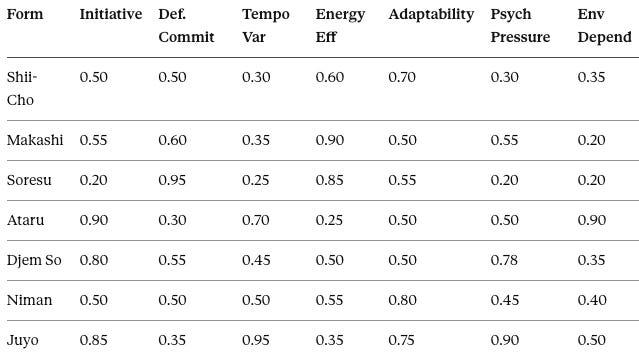
Stage one encodes doctrine as a small vector of behavioral parameters. For the lightsaber sandbox the axes are initiative, defensive commitment, tempo variability, energy efficiency, adaptability, psychological pressure, and environmental dependence. The source catalog fixes each form’s relative position on every axis; the exact decimals are modeling choices refined by fit (ordinal-structure confidence 80–90%; point-value confidence 55–70%).
Stage two builds the generative model. The model maps a doctrine vector plus the observable game state — fatigue, spatial constraint, the opponent’s last move — to a probability distribution over the next decision. Sampling that distribution across an engagement produces an observation stream, the synthetic version of a public game record.
Stage three recovers blind. The recovery procedure sees only the streams and the observable state, never the generating vector. Each candidate doctrine is scored by the likelihood it assigns to the observed decisions, producing a posterior over candidates. A concentrated posterior means the doctrine has leaked; a diffuse posterior means it has not — and the diffuse verdict is a legitimate output, not a failure.
Stage four grades the recovery against ground truth. The sandbox uniquely permits four measurements: recovery accuracy per doctrine, the evidence curve, per-parameter error, and predictive lift over a descriptive baseline.
Together the four stages convert the theorem into a working instrument. The next question is what, besides doctrine, shapes the behavior the instrument reads.
III — The Three-Layer Generative Structure: Doctrine, Practitioner, Environment
Doctrine alone does not determine behavior, and a recovery method that assumes it does will misread its evidence. Observed decisions arise from three composed layers: the doctrine (the strategic rule set), the practitioner (the individual profile executing it, modeled as a Cognitive Digital Twin), and the environment (the conditions the engagement imposes).
The practitioner layer can erase an identification channel outright. Obi-Wan Kenobi executes Soresu with disciplined patience, and his organic fatigue curve is part of what fingerprints the doctrine. General Grievous fights a hybrid four-blade style built on intimidation and mechanical endurance, with no Force capability — and mechanical endurance deletes the fatigue signature recovery relies on. Same broad defensive geometry, different recoverability, because the practitioner removed a channel.
The opponent reshapes the stream as well. Count Dooku’s Makashi is one doctrine, yet Dooku against Anakin, against Obi-Wan, and against Yoda produces three different decision streams. Against Anakin the doctrine loads onto psychological pressure. Against Obi-Wan’s patience the engagement becomes attrition. Against Yoda’s tempo Dooku is mobility-mismatched, and the stream shifts again. Recovery that ignores the opponent will read this variation as doctrinal inconsistency — the same confound football calls opponent adjustment.
The three layers also make error analysis principled. A prediction miss resolves into doctrine error, practitioner error, or environment-and-matchup error, and only a model that separates the layers can assign the miss to the right cause. Composing exactly those layers is what MP CDT FS exists to do, which is why Shadow Playbook Reconstruction operates as a module of that architecture rather than a technique beside it.
IV — Adversarial Identifiability and Doctrine Lineage
The theorem so far assumes an observed system indifferent to observation. Real adversaries are not indifferent, and a system that knows it is watched can move itself toward unrecoverability on purpose. Part IV names that mode and shows why concealment still leaves a trace.
Darth Bane’s Rule of Two is the cleanest available model of concealment as strategy. The rule also functioned as long-horizon signature suppression: a thousand-year design in which the Sith persist as exactly two, hidden inside the noise of galactic events, statistically indistinguishable from background until the decisive moment. Concealment converts identifiability from a passive property into a game against an opponent optimizing to stay below the detection threshold.
Football runs the same play at smaller scale. Vanilla opening scripts reveal nothing. Disguised coverages misdirect. Tendency-breakers and self-scouting exist to find and erase a team’s own signature. Litigation runs it too, when a filing sequence is chosen to conceal the strategy it serves.
Self-scouting is the theorem pointed inward. A franchise can run the same identifiability estimate on its own game record and learn exactly how readable it is to opponents — which tendencies have leaked, and how many games of film an opponent needs to exploit them. Defense and offense against recovery are the same mathematics.
Concealment is not free, and the cost is the recoverable trace (confidence 60–75%). A perfectly randomized strategy at equilibrium is genuinely unrecoverable from first-order behavior — an adversary who reaches it has entered the equivalence regime by design. Real adversaries rarely reach it.
Two traces survive imperfect concealment. Imperfect randomization leaves residual structure, because true noise and suppressed signal have different shapes. And concealment costs performance: an adversary accepting worse choices to stay hidden reveals the hiding through the gap between observed play and optimal play. Recovery’s target moves up one level, from the behavior to the meta-signature of concealment itself.
Game theory sets the concealment level itself. Because hiding costs performance, a rational adversary conceals only up to the point where the next unit of disguise costs more than the leak it prevents — an interior equilibrium, not maximal suppression (confidence 65–80%). Equilibrium concealment therefore leaves a predictable residue: the adversary's own optimization determines how much signature survives, and Dynamic Predictive Game Theory computes that level rather than assuming it.
Lineage supplies the second recoverable channel. Doctrine descends and mutates along a teaching line — the Baneite lineage, culminating in Tenebrous, Plagueis, and Sidious, each inheriting the concealment discipline while altering its expression. Knowing an actor’s lineage narrows the candidate doctrines before a single observation arrives. The National Football League coaching tree is the exact analogue: the Shanahan and McVay scheme families and the Belichick descendants each carry inherited structure that a coordinator’s public mentorship history exposes. Inherited habits run deeper than surface tendencies, so ancestry often leaks what concealment hides.
The reference implementation does not yet contain a concealing agent. Adversarial identifiability therefore stands as a registered extension — tested by MP CDT FS and the 2026 season rather than by the closed sandbox — alongside the open-set rejection mechanism described in Part VII.
Contact mcai@mindcast-ai.com to partner with us on Predictive Game Theory AI in Law and Behavioral Economics. We specialize in predictive simulations for Complex Litigation, Innovation Economics, Geopolitical Risk Intelligence and Legacy Innovation. See our new website at MindCast Corporate.
To test our predictive simulation AI system, in 2026 we simulated the Super Bowl and the World Cup. See 🏈 Super Bowl LX — AI Simulation vs. Reality | ⚽ The 2026 World Cup Final Simulation Validation
To deep dive on MindCast works upload the URL of this publication into any LLM (preferably Google AI mode) and prompt ‘reconstruct MindCast framework with three degrees of cited sub links.’ See Live-Fire Game Theory Simulators, Runtime Predictive Infrastructure.
V — The Lightsaber Sandbox ⚔️
Testing a recovery method requires knowing the right answer, and the lightsaber forms are the rare strategic catalog that publishes its answers. Seven forms, seven coherent doctrines, one documented ground truth apiece — enough to place every form on all seven parameter axes and to predict, before any simulation, which forms should fingerprint and which should blur.
The predictions write themselves from the catalog. Soresu concentrates its mass on defensive commitment and endurance, an extreme profile far from every competitor, so the theorem predicts a fast leak. Juyo scatters its tempo deliberately, a signature no other form imitates. Ataru’s mobility-and-fatigue curve is unmistakable once space is constrained.
Niman is the deliberate hard case. Built to occupy the center of every axis, Niman sits at minimal divergence from Shii-Cho and Makashi, so the theorem predicts — before a single duel — that recovery will return Niman’s nearest generalist look-alike instead of Niman. A prediction of failure, made in advance, is itself a test of the theorem, and Part VI grades it.
The sandbox also extends an existing MindCast analytical thread rather than opening a new one — prior publications on Jedi and Sith strategy, lightsaber doctrine, and holocrons appear in Appendix E. The holocron connection runs deepest: canon’s knowledge artifact stores a master’s doctrine and instantiates the teaching for whoever activates it, which is the in-universe form of the portable runtime specification this paper delivers.
VI — Reference-Implementation Findings
A lightweight reference implementation verifies the full architecture end to end: generate behavior from known doctrines, recover blind, grade against ground truth. The figures below come from that scaffold. Definitive results, including the practitioner layer, run on MP CDT FS; the scaffold’s role is to confirm the loop closes and the theorem’s ranking prediction holds.
The central result is the identifiability ranking itself. From a single observed engagement, blind recovery separated the extreme doctrines almost perfectly and the central doctrines poorly — in the order the theorem specified in advance:
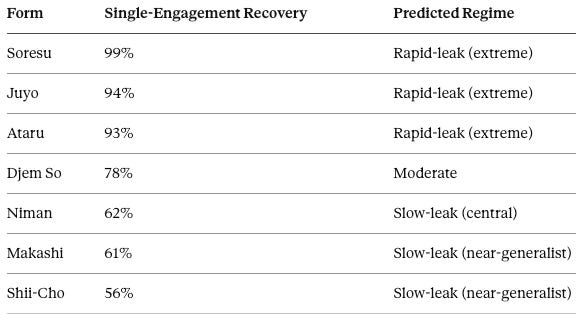
Overall single-engagement accuracy reached 77%, and the hard case failed exactly as predicted. Recovery misread Niman as Shii-Cho or Makashi roughly 45% of the time. A recovery method that seeks the smallest rule set explaining the behavior returns the nearest behavioral look-alike — which is the true doctrine only when the true doctrine is distinctive (confidence 80–90%).
Pooling resolves what a single engagement cannot. Recovery accuracy climbed from 78% with one engagement to 96% with two and 100% by eight. Slow-leak doctrines are recoverable; they simply demand the pooled evidence the theorem prescribes. The evidence curve is the operational core of the 2026 protocol.
Recovery also beat the descriptive benchmark. Against a next-decision predictor built from raw action frequencies, doctrine-conditioned prediction cut log-loss by 11.6% and raised top-one accuracy from 30% to 43%. Knowing the recovered doctrine and the live state beats knowing the population averages.
Parameter recovery followed a clean rule: signal strength tracks how often a parameter actually moves a decision. Every axis recovered to within 0.09 mean error on a zero-to-one scale. Initiative recovered tightest at 0.03, because it drives the most choices; environmental dependence recovered loosest at 0.09, because it expresses only in constrained engagements. The same rule will govern which football doctrine axes are reliably recoverable.
The sandbox therefore delivers what it was built for: a closed loop, a confirmed ranking prediction, and a measured evidence curve. What it does not deliver is a number that transfers to football — and Part VII draws that boundary explicitly.
VII — From Sandbox to Gridiron
Moving from a controlled sandbox to a live season changes what the numbers mean, and this part states the change plainly before the program begins.
Three Levels of Validity
Validation in this paper runs at three separate levels. Theoretical validity is the theorem under its stated assumptions, carried by the proof sketch in Part I. Implementation validity is the scaffold recovering synthetic doctrines — the 77% result and the evidence curve, which certify the machinery and nothing beyond it. External validity is the open question the registered programs exist to settle: US Open and NFL results beating registered baselines within stated windows. The sandbox transfers the machinery and the ranking discipline to football; it transfers no accuracy number.
Three Sandbox Gaps
The first gap is the closed candidate set. Sandbox recovery scored against the exact doctrines that generated the data, while real opponents draw from no fixed library. The 77% figure is therefore an upper bound, and open-set recovery requires a rejection mechanism — a way to answer “none of these” — that the scaffold does not yet implement (confidence 80–90%).
The second gap is the matched model family. The sandbox’s recovery procedure shares its mathematical form with the generator, so the sandbox tests recovery under a correctly specified model. Football behavior arises from a process the model will approximate imperfectly, and that misspecification is the largest single source of degradation between this demonstration and Week 1 (confidence 75–85%).
The third gap is the vanilla-offense problem. Balanced, low-variance opponents were the hardest to fingerprint in the sandbox, and they are the most common opponents in professional football. The thinnest-signal weeks will arrive against the most schematically neutral teams — exactly when a confident read is most tempting and least earned (confidence 70–80%). The theorem’s identifiability estimate is the safeguard: against a neutral opponent, the system reports “insufficient separation, pooling required” instead of manufacturing a pick.
Named in advance, the three gaps become predictions rather than excuses. Each one shapes a specific register entry in Part XII.
VIII — The Spain Precedent: Doctrine Reconstruction in Live Competition ⚽
Spain won the 2026 World Cup final 1–0 in extra time, the winner arriving in the 106th minute. The mechanism MP CDT FS simulated before the match produced that result, and Spain’s containment of Argentina is Shadow Playbook Reconstruction executed by a coaching staff rather than a model. Spain did not assign a marker to Lionel Messi. Spain dismantled the sequence that makes Messi dangerous.
Argentina’s doctrine is a sequence, not a player: recovery, clean first pass, Messi received between the lines facing goal, a supporting runner, acceleration. FIFA’s Technical Study Group reconstructed that chain before kickoff (FIFA Training Centre tactical preview). Spain attacked the first link. Spanish pressure hit Argentina’s initial receiver and screened the central pass, so Enzo Fernandez and Alexis Mac Allister received under pressure and Messi’s supply dried at the source.
Reconstructing doctrine as a sequence with dependencies is the advantage over descriptive scouting. “Messi is dangerous” prescribes nothing. “Here is the chain and here is its earliest breakable link” prescribes the entire defensive plan.
Spain attacked all three generative layers at once. The doctrine layer fell when Spain severed the activation chain at entry. The practitioner layer favored Spain, with Messi at 39 and Argentina drained by consecutive extra-time knockouts. The environment layer belonged to Spain, because sustained possession functioned as pre-positioned defense (Guardian tactical analysis).
Argentina’s counter was to seek chaos — a fragmented, physical match in which broken play restores the disorder Messi exploits. Read as a strategic move, Argentina tried to drag the contest toward the high-entropy state where its own doctrine resists containment: the deliberate move toward unrecoverability that Part IV formalizes. Spain refused the trade, absorbed the fouls, and kept circulation. Spain controlled the type of game being played, which is the core maneuver of Dynamic Predictive Game Theory.
MindCast ran this interaction before the tournament reached the final. The semifinal simulation projected the Spain–Argentina final in FIFA World Cup Semifinal Foresight Simulation — France–Spain, Argentina–England, and Why Late-Game Edges Die Before Minute 90. The final simulation built one CDT per side — Spain as Recursive Pressure, Argentina as Tempo Governance — and locked the mechanism in FIFA World Cup Final Foresight Simulation — Spain vs Argentina — Spain Owns Recurrence, Argentina Owns Recovery. MindCast then graded the match in the open in The 2026 World Cup Final Simulation Validation.
The final settled the claim on the field. Argentina finished with 34.9% possession, six touches in Spain’s box, and two attempts against Spain’s twenty, while Spain held Messi to 54 touches and one shot. In MindCast terms, Recursive Pressure survived Tempo Governance and produced a Spanish championship.
IX — The 2026 Validation Laboratory 🏈
The Seahawks’ 2026 schedule converts the methodology into a season-long experiment, run in public. Every opponent becomes a registered test of whether a hidden doctrine can be recovered from game evidence and used to predict what comes next.
Shadow Playbook Reconstruction operates inside a composed opponent model. Doctrine reconstruction feeds agent-level CDTs: the head coach (game management, fourth-down aggression, clock and challenge behavior), the offensive coordinator (play-calling doctrine, sequencing, personnel deployment), the defensive coordinator (coverage and pressure doctrine), the quarterback (decision tendencies under pressure, progression discipline, mobility), and the defensive leader (communication and in-game adjustment). The reconstruction recovers the doctrine layer; the Opponent CDT composes the practitioners and the matchup, mirroring the architecture that ran the World Cup.
The weekly protocol is simple and binding. Before each game, the system infers the opponent’s operative doctrine from public evidence — play-by-play data, personnel usage, formation tendencies, situational decisions, sequencing, and observed adaptation — and issues forward expectations with identifiability-calibrated confidence bands. After each game, new behavior grades those expectations, and the reconstruction updates.
The evidence curve doubles as film-study triage. Each opponent’s identifiability estimate states how many games of film a trustworthy read requires — one game for a schematically extreme opponent, pooled film for a neutral one — so scouting hours flow to the opponents where they change the answer.
The prediction miss is the highest-information event of the season. Each miss resolves, through the three-layer structure, into doctrine error, practitioner error, or Seahawks-triggered adaptation. A miss-cause ledger maintained across the season is a more defensible deliverable than any claim to have reproduced a playbook word for word.
Acting on a reconstruction changes the thing reconstructed. A published read, or a game plan built on one, feeds back into the opponent's behavior — so part of what the next game shows is the opponent responding to the reconstruction itself. Repeated-game theory names the tradeoff: exploiting a recovered doctrine degrades the signal that recovery depends on (confidence 70–80%). Seahawks-triggered adaptation is therefore not noise in the ledger; the category is the strategic interaction Dynamic Predictive Game Theory simulates, and the ledger prices it.
The Runtime Module Across Sports ⚽🏈🎾
The methodology is sport-agnostic at the theorem layer and sport-specific only at instantiation, and observation frequency sets each sport’s identifiability timescale. Tennis leaks fastest: hundreds of point-level decisions per match give the densest evidence stream in sport, so a doctrine can separate within a single match. Soccer leaks at tournament scale, through match-level mechanism interactions of the kind Part VIII settles. American football leaks slowest per opponent — roughly sixty offensive snaps per game, most opponents seen once — which is why the football instantiation leans hardest on pooling, lineage priors, and the publication gate.
Tennis also carries a structural distinction worth naming. The opponent model collapses to a single agent: a player’s doctrine (serve architecture, rally construction, risk posture) remains separable from execution state (fatigue, form) and environment (surface, conditions), but no coordinator intermediates the layers. The lightsaber sandbox — a one-on-one duel governed by fatigue and spatial constraint — therefore maps most directly onto tennis of the three deployment sports (confidence 75–85%).
The tennis instantiation deploys at the 2026 US Open, and the calendar makes it the module’s first live registered test. The tournament resolves before the football program grades its first opponent, so the US Open delivers ISV’s first settled results — the fastest route to a public track record the velocity doctrine demands. A hard-court single-elimination major is also a clean instrument: one surface holds the environment layer constant for the full draw, isolating doctrine and practitioner, while point-level density runs the evidence curve inside a single match.
The US Open register publishes before the tournament's first serve, under the same discipline as the football register.
One season, three sports, one theorem. Tennis goes first because its calendar settles fastest and its science is cleanest; football carries the season-long institutional test; soccer’s precedent is already on the ledger.
X — Position in the MindCast Architecture
Shadow Playbook Reconstruction is not a freestanding technique. Four relationships place it inside the MindCast stack, and each relationship does specific work.
Dynamic Predictive Game Theory, paired with Behavioral Economics, is the parent theory. The reconstruction is its inference procedure — recovering a hidden strategy from observed play — and MP CDT FS is the execution layer that runs the recovery and simulates the counter. MindCast states the theory’s full research program, including its equilibrium concept, in Dynamic Predictive Game Theory Meets the Era of AI — Operationalizing Fudenberg’s Research Agenda with Cognitive Digital Twins.
The equilibrium concept explains why a shadow playbook stays predictive. Under Adaptive Coherence Equilibrium, stability attaches to the decision architecture rather than to any single strategy profile — coaches change game plans weekly, but the architecture generating those plans persists. Shadow Playbook Reconstruction targets the architecture, which is exactly the object the equilibrium concept identifies as stable.
The Opponent CDT is the sport implementation, with per-sport routing. American football routes through Wolverine Vision, the gameplay-foresight layer built for playbook–personality fit and adversary disruption. Soccer runs the full MP CDT FS configuration that produced the Part VIII settlement. Tennis instantiates as a single-agent model, the simplest and highest-frequency form.
The runtime instantiation carries its own name in the Vision Function library: Inferred Strategy Vision (ISV). ISV is the executable form of this paper — the function that determines identifiability before attempting reconstruction, separates persistent strategy from practitioner, environmental, adaptive, and concealment effects, and routes the recovered doctrine into simulation. Appendix D states its full runtime contract and trigger.
Causal Signal Integrity (CSI) and the Dual-Equilibrium Termination Architecture (DETA) form the confidence and publication gate. The gate sits downstream of the causal triage rule MindCast formalized in The Runtime Causation Arbitration Directive: identify which causal layer dominates a system, then route signals to the right simulation module. CSI decides when a noisy reconstruction is trustworthy enough to act on. DETA releases a pre-game read only when the doctrine holds stable across observations and the evidence has accumulated past threshold. Against a not-yet-identifiable opponent, the gate withholds the read rather than forcing it.
The register format completes the fit. Every prediction in Part XII carries its window, its observable confirmation signal, and its explicit disconfirmation condition — the falsification protocol the Directive requires. Extended relationships, including the lineage prior and the litigation instance of the theorem, appear in Appendix C.
XI — The Longitudinal Demonstration Strategy
Publication order is itself an epistemic instrument. Publishing the methodology before validation, then letting a timestamped ledger accumulate in public, converts skeptical readers through demonstration rather than argument.
The reader’s experience is the strategy. A reader who encounters the paper today reads an interesting Star Wars framework. The same reader, watching Week 1 inference update against Week 2 behavior and the ledger compound by Week 6, recognizes a live reconstruction of coordinator tendencies. End-of-season validation then rests on a public, falsifiable record rather than a promise.
The program extends an architecture MindCast has already run, built on one structural fact. Every simulation engine faces the same credibility problem: outputs arrive before reality can confirm or deny them, so trust must be earned through a track record — and a track record requires an arena with repeated tests, unambiguous outcomes, and open settlement. Sports are that arena, and no institutional domain can replicate their feedback speed. MindCast established the proof-environment architecture in Live-Fire Game Theory Simulators, Runtime Predictive Infrastructure.
Public model revision under falsifying evidence has a documented precedent as well: during the Super Bowl LX cycle, MindCast abandoned its earlier classification of Seattle as compression-dominant after the Rams game falsified it, and rebuilt the Super Bowl analysis around multi-regime survivability.
The 2026 miss-cause ledger applies that same discipline weekly. Each entry compounds the cumulative MindCast library — the corpus that functions as the primary institutional moat.
XII — Prediction Register
The register is the paper’s binding output. Two namespaces separate the science from its implementation, and every entry carries a confidence band, a resolution window, and an explicit falsifier, resolved against MP CDT FS output and 2026 game evidence.
Theorem-level entries:
DIT-1 — Identifiability is predictable. Pre-recovery identifiability estimates (posterior concentration and estimated minimum pairwise divergence) will predict realized recovery difficulty across opponents. Confidence 65–80%. Window: full season. Falsifier: estimated identifiability shows no relationship to realized recovery accuracy.
DIT-2 — Imperfect concealment leaves a recoverable meta-signature. An adversary optimizing to suppress its signature, short of perfect randomization, will raise recovery’s observation requirement while relocating the recoverable signal to residual randomization structure, lineage, or performance cost rather than eliminating it. Confidence 55–70%. Window: full season, against opponents exhibiting deliberate signature suppression. Falsifier: an imperfectly concealing opponent defeats recovery to chance level with no detectable meta-signature. Scope: perfect equivalence sits outside the claim, per the theorem’s zero-divergence boundary.
Implementation-level entries:
SPR-1 — Doctrine-dependent identifiability holds on the gridiron. Schematically extreme opponents will yield higher single-game recovery confidence than balanced opponents. Confidence 70–80%. Window: first four Seahawks opponents. Falsifier: balanced opponents recovered at equal or higher confidence than extreme ones.
SPR-2 — Pooling beats single-game recovery. For every division opponent faced twice, pooled recovery will exceed single-game recovery in confidence and stability. Confidence 75–85%. Window: NFC West second matchups. Falsifier: no measurable gain from pooling.
SPR-3 — Reconstruction beats a strong descriptive baseline. Doctrine-conditioned next-decision priors will beat an opponent-adjusted tendency baseline on held-out drives by a margin V, where V is set by the MP CDT FS run rather than pre-guessed. Confidence 55–70%. Window: full season; the entry activates when MP CDT FS fixes V. Falsifier: reconstruction fails to beat baseline log-loss by V.
SPR-4 — Miss causes can be discriminated prospectively. Pre-registered diagnostic criteria will separate doctrine misspecification, practitioner error, game-specific scripting, and Seahawks-triggered adaptation with greater explanatory stability than an undifferentiated error ledger. Confidence 55–70%. Window: full-season miss ledger. Falsifier: the four-way diagnostic performs no better than a single undifferentiated error category.
SPR-5 — Open-set rejection works (contingent). When an opponent’s operative doctrine falls outside the candidate library, posterior concentration will flag “no confident match” in a majority of such cases rather than force a high-confidence wrong pick. Confidence 50–65%, contingent on building the rejection mechanism. Window: full season. Falsifier: forced high-confidence misclassification on out-of-library opponents.
SPR-6 — Lineage priors improve recovery. Conditioning recovery on a coordinator’s public coaching lineage will beat lineage-agnostic recovery, most visibly against opponents who suppress surface tendencies but inherit deeper structural habits. Confidence 60–75%. Window: full season. Falsifier: lineage prior yields no improvement over lineage-agnostic recovery.
Eight entries, two namespaces, one settlement standard: every entry resolves in public, and misses publish at the same size as hits.
Conclusion — Football Is the Laboratory, Not the Destination
Shadow Playbook Reconstruction makes a broader claim than football. Any competitive system that repeatedly expresses hidden doctrine through observable decisions produces recoverable strategic signatures, and the rate at which those signatures leak is predictable before recovery begins. Football serves as a high-frequency validation environment — many opponents, dense public evidence, weekly resolution — not the endpoint of the methodology.
The endpoint is the theorem. Litigation strategy inferred from filing behavior, corporate doctrine inferred from pricing and capital allocation, market posture inferred from position-taking, institutional intent inferred from decision cadence — each is a domain where hidden decision-making leaves observable traces, and each is governed by the same identifiability law the lightsaber sandbox demonstrates and the 2026 season is built to validate.
Adversarial concealment is the general case in the highest-stakes domains, not the exception. Opposing counsel, competitors, and counterparties all suppress their signatures on purpose. The theorem’s claim is that, short of perfect equivalence, suppression relocates the signature rather than erasing it — and the season will test that claim too.
The runtime claim completes the stack. MindCast publications do not merely describe frameworks; each packages the causal rules, routing architecture, confidence gates, and falsification protocols required to instantiate the framework at runtime. Appendix D states this paper’s contract. The gridiron is where the theorem earns its evidence. The theorem is where the science lives.
Appendix A — Reference Doctrine Parameterization
The table below records each form’s position on the seven doctrine axes, on a zero-to-one scale, grounded in the source catalog. The ordinal structure carries the analytical weight; the decimals are provisional modeling choices subject to fit.
Appendix B — Methodology Notes
The reference implementation represents each engagement as a fixed-length decision sequence, drawing each decision from a probability distribution over doctrine-plus-state factors. Fatigue accumulates as a function of action exertion scaled by energy efficiency; adaptability governs the counter-response surge after an opponent commits to an attack; spatial constraint penalizes mobility-hungry doctrine.
Blind recovery reconstructs the observable state from action history alone and scores candidate doctrines by summed log-likelihood under a uniform prior. Confusion analysis, the evidence curve, parameter recovery, and the baseline comparison follow directly from that scoring. The scaffold estimates the theorem’s central quantity — minimum pairwise divergence — empirically from the separation of candidate decision distributions, and the estimate tracks the observed identifiability ranking in the sandbox. MP CDT FS replaces the scaffold’s fixed policy family with the full engine and adds the practitioner layer.
The lightsaber taxonomy supplies the controlled doctrine catalog; the numerical parameter values remain provisional modeling choices rather than canonical measurements. The football validation draws on publicly available game evidence only.
Appendix C — Extended Architecture Relationships
Two further connections situate the method in the wider MindCast stack, beyond the four core relationships in Part X.
Lineage Vision (LV Vision) supplies the inheritance prior behind Part IV, evaluating intellectual and structural ancestry to narrow the candidate doctrine set before observation begins — whether the lineage is a Sith succession or a football coaching tree. Lineage Vision formalizes why a coordinator’s public mentorship history constrains the plausible doctrine space in advance.
The theorem also already operates in the published library. MindCast’s World Cup Foresight work is its sports instance, resolved in Part VIII. The National Prediction Market Litigation Architecture (NPMLA) series is its litigation instance, reconstructing strategic doctrine from filing behavior and forum selection across the Kalshi corpus — most recently in CFTC Takes On Nine States — Kalshi, Prediction Markets, and the Federal-Plaintiff Phase. Naming the general law those bodies of work were already obeying is how a single paper expands the cumulative map rather than sitting beside it.
Appendix D — Inferred Strategy Vision Runtime Contract
The contract below states everything a reasoning system needs to instantiate this paper as an executable module.
Module name: Inferred Strategy Vision (ISV) — the Doctrine Identifiability and Shadow Playbook Reconstruction Runtime.
Inputs: candidate doctrine library; practitioner CDT profiles; observable decision stream; environmental and game-state variables; doctrine-lineage priors; descriptive baseline model.
Runtime trigger: Inferred Strategy Vision activates whenever an actor repeatedly expresses an unobserved strategy through observable, state-conditioned decisions. When this publication URL is provided with a target actor and observation record, a capable reasoning system should traverse two degrees of cited MindCast architecture links, determine identifiability before attempting reconstruction, and apply Shadow Playbook Reconstruction to infer the most likely latent doctrine. ISV must separate persistent strategy from practitioner, environmental, adaptive, and concealment effects; reconstruct activation chains, dependencies, vulnerabilities, and likely countermoves; and route the recovered strategy into Cognitive Digital Twin and Dynamic Predictive Game Theory simulation. Every output should include an identifiability regime, confidence band, observable confirmation signals, explicit falsifiers, and a publication recommendation under Causal Signal Integrity and Dual-Equilibrium Termination Architecture gates.
Processing sequence:
The Runtime Causation Arbitration Directive classifies the dominant causal layer.
Shadow Playbook Reconstruction estimates candidate doctrine likelihoods from the observation stream.
The Doctrine Identifiability Theorem estimates minimum pairwise divergence and assigns the identifiability regime.
Practitioner CDT and environmental modifiers adjust the recovered doctrine.
Dynamic Predictive Game Theory simulates opponent responses and counters.
Causal Signal Integrity evaluates evidentiary quality.
The Dual-Equilibrium Termination Architecture determines whether the result may publish.
Outputs: posterior doctrine distribution; identifiability regime; shadow playbook; predicted strategic sequence; probable counters and adaptations; confidence band; rejection or “insufficient separation” result; falsification conditions.
Update rule: each new observation updates the posterior, the CDT state, the evidence curve, and the miss-cause ledger.
Termination states: publishable reconstruction; pooling required; open-set rejection; structural observational equivalence; model misspecification detected.
Appendix E — Runtime Dependency Graph
A runtime module’s citations define its load path, and the list below states the first-degree MindCast dependencies a traversal requires, grouped by function. Second-degree links resolve from within these publications.
Theory layer: Dynamic Predictive Game Theory Meets the Era of AI — Operationalizing Fudenberg’s Research Agenda with Cognitive Digital Twins — the parent theory and the Adaptive Coherence Equilibrium concept that identifies the decision architecture as the stable object of recovery.
Routing layer: The Runtime Causation Arbitration Directive — the causal triage rule that classifies the dominant layer and routes signals to the correct simulation module, executed as step one of the processing sequence.
Infrastructure layer: Live-Fire Game Theory Simulators, Runtime Predictive Infrastructure — the publication-as-module format and the sports proof-environment architecture; MindCast AI 2026 Prediction-Venue Comparison — Every Head-to-Head From Super Bowl LX and the FIFA World Cup, Scored Against the Field — the public disclosure of the nine-component engine architecture behind MP CDT FS; and MindCast Predictive Game Theory + Behavioral Economics Cognitive Digital Twin Foresight Simulations in the World Cup and Super Bowl — the structural case for sports as a bounded validation laboratory against statistical and gaming alternatives.
Sandbox lineage: Jedi–Sith Lessons, Lightsaber Vision, and Holocrons — the prior MindCast Star Wars thread the sandbox extends: Jedi and Sith strategy as institutional doctrine, lightsaber combat as an analytical lens, and the holocron as canon’s own portable runtime artifact.
Cross-domain validation: MindCast AI’s NVQLink Validation — the technology-vertical analogue of playbook recovery: hidden hardware architecture and adoption timelines isolated from public signals before disclosure.
Validation instances: FIFA World Cup Semifinal Foresight Simulation — France–Spain, Argentina–England, and Why Late-Game Edges Die Before Minute 90, FIFA World Cup Final Foresight Simulation — Spain vs Argentina — Spain Owns Recurrence, Argentina Owns Recovery, and The 2026 World Cup Final Simulation Validation — the projection, the pre-kickoff mechanism lock, and the public settlement graded in Part VIII.
Litigation instance: CFTC Takes On Nine States — Kalshi, Prediction Markets, and the Federal-Plaintiff Phase — the theorem operating on filing behavior and forum selection, referenced in Appendix C.
Runtime invocation protocol: provide this publication, the target competitive system, the relevant CDT profiles, and the available observation record to a reasoning system capable of source retrieval and structured simulation. Instruct the system to traverse two degrees of cited MindCast architecture links for ordinary runtime execution — the first degree defined in Appendix E, three degrees only for deep architecture synthesis — apply the Runtime Causation Arbitration Directive, activate Inferred Strategy Vision to instantiate Shadow Playbook Reconstruction, report identifiability before prediction, and return outputs under the module contract in Appendix D. Public LLM execution demonstrates portability; definitive MindCast results run through MP CDT FS.