
Related MindCast works: The Missing "Gaming" Definition | CFTC Takes On Nine States | The Ninth Circuit Forum Fight | State Legislators and the Gaming Boundary
See MindCast corporate Live-Fire Mission on the Kalshi national litigation profile.
I. 📌 Executive Summary
What the fight is about
Kalshi runs a federally registered exchange where people buy contracts that pay out based on real-world events — which team wins, who takes an election, how a season ends. Federal regulators call the contracts derivatives. States call them bets.
The distinction carries enormous stakes. A derivative falls under the Commodity Futures Trading Commission, the federal agency that oversees futures markets, and needs no state licence. A bet falls under state gambling law, which requires licensing, taxation, age limits, and consumer protections that Kalshi does not currently satisfy anywhere.
Kalshi and the Commission have argued for two years that federal registration settles the question nationwide. More than a dozen states have argued the opposite. Courts have split, and the split has now produced the first rulings that decide something rather than defer it.
Nine days that changed the Commission’s position
Four federal rulings landed between July 27 and August 4, 2026. Reading them in order matters, because any single one read alone misleads.
July 27 — Minnesota. A federal court granted the Commission an injunction blocking Minnesota’s new statute banning prediction markets outright. The Commission’s strategy of suing states directly works.
July 29 — Wisconsin. Judge William Griesbach refused the Commission the same relief in a twenty-eight-page opinion. He held the agency unlikely to prove that sports contracts even qualify as the financial instruments it claims, and unlikely to win on federal preemption regardless. The strategy can lose, and lose on reasoning other states will reuse.
July 31 — New York. Judge Jed Rakoff refused the Commission’s emergency request to stop the New York Attorney General from prosecuting her own case, finding the agency had shown neither a strong likelihood of winning nor irreparable harm.
August 4 — Utah. Judge Robert Shelby entered final judgment for the State, the first federal court to decide the preemption question outright rather than provisionally, and closed the case.
What New York adds
New York’s contribution is not the setback to the Commission. Wisconsin delivered that two days earlier with far more reusable reasoning. New York’s contribution is the remedy sitting behind the setback.
Three features combine, and no prior state action against Kalshi has assembled all three.
Kalshi’s headquarters sit in New York County, where Attorney General Letitia James filed on July 31. The petition seeks to shut down the platform’s contracts across sports, culture, elections, and other events — not sports alone — reaching conduct “within or from New York.” And the petition demands money for conduct already completed: a customer-by-customer accounting, restitution to bettors, disgorgement of gains, triple the company’s profits, and $100,000 for every unauthorized sports offering.
Stated in one line: New York places an already-demonstrated federal failure mode next to a remedy that reaches the company rather than one state market.
Four routes narrowed at once
Nothing closed. Four options the Commission relied on became narrower, costlier, or time-sensitive, and each shift arose through a distinct pathway.
Waiting became dangerous. Utah moved from complaint to final judgment in roughly six months. Michigan produced a state restraining order within days. New York chose a summary procedure built for speed.
Rulemaking stopped working as a general cure. The Commission has a proposed rule pending that would finally define “gaming,” the statutory term the whole fight turns on. No version of that rule erases money claims for conduct already complete, and Judge Shelby defeated preemption through statutory text that never mentions gaming at all.
Procedure supplies a thinner excuse. When the federal government sues on a registrant’s behalf, it carries none of the procedural disabilities a private company faces. The Commission used that advantage in both Wisconsin and New York and drew substantive assessments rather than procedural dismissals.
Blame stopped being transferable. In earlier losses the Commission was not a party and could attribute the outcome to Kalshi’s briefing. Griesbach and Rakoff assessed the same theory in cases the Commission itself filed.
None of this destroys the federal position. The Commission built a three-instrument architecture — a rulemaking record, friend-of-the-court briefs, and its own lawsuits against states. The late-July record shows those three instruments failing together rather than independently, which is a different and more serious problem than losing a case.
A hub, not a template
Uniqueness raises an obvious objection. If headquarters jurisdiction is what makes New York work, forty-nine states cannot copy it, and the case teaches them nothing.
Answering the objection strengthens the argument. A copyable instrument would produce fifty separate lawsuits, each rising and falling alone. A unique instrument produces dependence — New York’s outcome moves every other state’s position without any of them holding the same tool.
Other states will copy what travels: accounting fields, remedy design, product distinctions, and enforcement language. Headquarters nexus stays behind. Infrastructure to carry the transmission already exists, since thirty-seven states and the District of Columbia filed a joint brief against Kalshi in April.
Four calls worth arguing with
MindCast ran this system through its proprietary foresight simulation before publication. Four released predictions carry the argument, and Section XI supplies the full set along with the eight predictions the simulation refused to release.
Retrospective exposure outlives every prospective federal instrument — 78–88%. No Commission action, final rule, or federal order erases Kalshi’s accrued New York money exposure before the state court decides.
The next federal merits ruling turns on statutory structure rather than the missing definition — 70–82%. Courts are deciding these cases through statutory text that operates whether or not the Commission ever defines gaming.
New York’s accounting order becomes infrastructure other states use — 70–85%. Per-customer attribution is the capability every other attorney general lacks, and a court order producing it creates a template needing no headquarters jurisdiction to copy.
No five-state joint complaint emerges through June 2027 — 81–92%. Coalition breadth is real; coalition consolidation is not coming, and the distinction matters more than the headcounts suggest.
👥 Where each reader should go first
State attorneys general — Sections V and XI. Enforcement under existing gambling law has survived where new prediction-market statutes have not, and the accounting demand in New York’s petition describes infrastructure worth preparing for now.
Platform and registrant counsel — Sections VI and VIII. Geofencing solves market access and does nothing for money owed on completed trades, and two clocks now run against each other in New York.
Institutional allocators and counterparties — Sections II and XI. Platform-wide relief against a company in its own headquarters county differs in kind from a state geofence, and the open question is whether money or doctrine arrives first.
Tribal counsel — Sections X and XI. Friend-of-the-court participation preserves nothing, as the Utah court demonstrated by denying twenty-three tribes’ motion as moot after ruling.
Congressional and regulatory staff — Sections III and VII. Judge Shelby’s holding turns on a list Congress wrote decades ago, a drafting artifact rather than a policy judgment, and any new categorical bill reproduces the same defect.
Sections II through X develop each mechanism in sequence. Section XI registers the forward book. Section XII states the move available to each stakeholder now.
II. The Enterprise Architecture
Remedy scope, not the headline dollar figure, separates the New York petition from every prior state action against Kalshi. Reading the pleading closely reveals a design built to reach the whole company rather than one product line.
Venue rests on Kalshi’s own footprint. The Attorney General filed in New York County because Kalshi’s principal place of business sits there. Kalshi therefore litigates as a local respondent in its operational center, not as a distant exchange defending a border.
Prospective relief reaches the platform rather than the sports vertical. The petition asks the court to shut down a business offering contracts on “sports, culture, elections, and other events” without a New York gaming licence, and to reach conduct flowing outward from New York as well as inward.
Retrospective relief reaches every customer. The petition demands an accounting that identifies each customer and itemizes bets placed, money lost, and gains received. On top of that accounting sit restitution, disgorgement, triple the company’s gain, and a $100,000 penalty per unauthorized sports offering.
Scale follows from the arithmetic. The accompanying Commercial Division filing states compensatory damages of $36 billion at minimum pending accounting, a figure confirmed in contemporaneous reporting. Kalshi’s own reported figures, quoted in the petition, put the company’s valuation at $22 billion against $178 billion in annual transaction volume.
Legal theory stacks eight claims under a single statute. New York’s Executive Law § 63(12) lets the Attorney General sue over “repeated and persistent illegality,” and the petition uses it to carry violations of the state constitution, three penal law provisions, three racing law provisions, and the federal Interstate Wire Act.
The Wire Act count deserves separate attention as a pleaded theory, untested by any court. New York alleges illegality under a federal statute Congress passed specifically to reach interstate wagering. Should a court accept the theory, the case becomes harder to frame as state law intruding on federal territory — but no court has accepted it yet, and the count may be narrowed or dismissed like any other.
Enterprise exposure comes from the combination rather than any single element. Headquarters jurisdiction supplies reach, platform-wide relief supplies scope, and customer-level money claims supply a number that no forward-looking ruling erases.
III. Four Rulings, Four Different Firsts
Treating every adverse ruling as interchangeable is the most common error in coverage of this fight. Separating the four July and August decisions by what each actually established prevents it.
Minnesota established that the Commission’s lawsuits can work. The state had enacted a statute banning prediction markets outright, and the Commission won an injunction blocking it. Suing a state directly, on the preemption theory the agency presses nationally, produced the result the agency wanted.
Wisconsin established that the same lawsuits can lose on the merits. Judge Griesbach found the Commission unlikely to prove that sports contracts qualify as “swaps,” the category of financial instrument that triggers federal exclusivity, and unlikely to win on preemption even assuming they did. He found no irreparable harm to the agency itself, held the balance of hardships favored Wisconsin’s traditional police powers, observed that Wisconsin’s commercial gambling statute appears on its face to cover the contracts, and refused to let Kalshi and Crypto.com intervene.
Utah established finality, on a different posture. Kalshi sued Utah preemptively, and the Commission was never a party. Judge Shelby granted judgment to the State on all three preemption theories and closed the case, making Utah the first federal court to decide the question rather than provisionally assess it.
Judge Shelby’s reasoning opens a route the commentary has almost entirely missed, and the route is structural rather than definitional. Buried in the Commodity Exchange Act sits a provision listing exactly which transactions federal law shields from state gambling regulation. Sports contracts traded on a registered exchange appear nowhere on that list. Congress wrote the list before Kalshi and the modern retail prediction-market sector existed, and the omission does the work.
The consequence for the Commission is simple to state. A ruling built on that list needs no definition of gaming whatsoever. Finalizing the pending rule answers the reasoning other courts have used; finalizing answers nothing in Utah.
Judge Shelby also split from Arizona and Tennessee on a second point. Kalshi has argued that blocking one state’s residents would violate a federal rule requiring exchanges to give all participants equal access. Shelby read that rule as barring discrimination by wealth, not geography, and noted that Kalshi’s own contracts already exclude defined categories of people.
New York established scale. Rakoff’s denial repeated Wisconsin’s failure mode two days later, inside a proceeding seeking company-wide remedies against a defendant headquartered in the county where the case was filed.
Read together, the four supply the Commission a two-front problem. Depth came from Wisconsin and Utah, reach came from New York, and Minnesota shows the one terrain where the federal position still wins cleanly.
IV. Attribution Shifted in Wisconsin
Who owns a loss matters more than the loss itself when nine parallel lawsuits rest on one theory. The ownership shift happened before New York rather than in it.
Judge Analisa Torres decided the first significant case on July 7 without the Commission as a party. Kalshi briefed it, Kalshi’s record shaped it, and the agency retained a plausible account in which better facts or better advocacy produced a different outcome.
Judge Griesbach removed the account. The Commission appeared as named plaintiff, and the court assessed the agency’s own likelihood of winning across twenty-eight pages covering the definition of a swap, preemption, harm, and the equities. No registrant stands between the agency and that reasoning.
Judge Rakoff reached a compatible conclusion in New York, denying the emergency motion from the bench on July 31 and entering a written order three days later. The denial came without prejudice, and the judge holding the underlying motion can hear a renewed application.
Weight differs sharply between the two, and precision protects the argument. Griesbach issued a reasoned merits assessment on a full record. Rakoff issued a preliminary signal on an emergency application, as a substitute judge covering for the assigned judge. Treating them as equivalent authority would repeat exactly the overreach this series has criticized elsewhere.
Correlated failure is the structural point. A three-instrument strategy assumes the instruments fail independently. Late July shows a single failure mode running through all three, and shared failure modes spread at the speed of a brief bank rather than the speed of a docket.
Contact mcai@mindcast-ai.com to partner with us on Predictive Game Theory for AI era Law and Behavioral Economics. We specialize in predictive simulations for Complex Litigation, Innovation Economics, Geopolitical Risk Intelligence and Legacy Innovation. See more about MindCast series at our new website MindCast Corporate.
To test our predictive simulation AI system, in 2026 we simulated the Super Bowl and the World Cup. See 🏈 Super Bowl LX — AI Simulation vs. Reality | ⚽ The 2026 World Cup Final Simulation Validation
To deep dive on MindCast works upload the URL of this publication into any LLM (preferably Google AI mode) and prompt ‘reconstruct MindCast framework with three degrees of cited sub links.’ See Live-Fire Game Theory Simulators, Runtime Predictive Infrastructure.
V. Old Statutes Beat New Ones
Sorting the four rulings by the kind of state law each one tested makes a scattered record look orderly. The variable that predicts outcomes is not how aggressive a state was — it is how old the statute was.
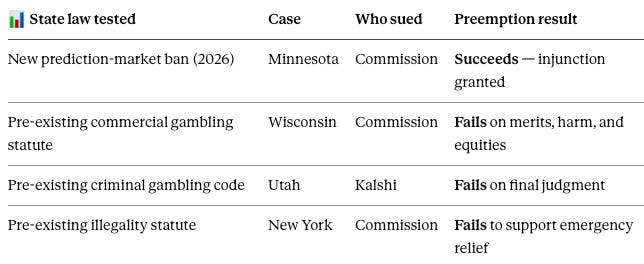
Utah belongs in the table as a preemption result rather than a test of the Commission’s litigation strategy. Kalshi sued as plaintiff and the Commission never appeared, so Utah measures how the doctrine performs against an old criminal code — not whether the agency’s own instrument works.
The mechanism behind the pattern is procedural, and stating it plainly matters more than naming it. A brand-new statute aimed at prediction markets hands a federal judge a clean question: does federal law displace this state law? Nothing else needs deciding first, and clean supremacy questions are the questions federal preemption answers well.
An old general prohibition denies the court that shortcut. Before a judge can reach preemption, the judge must first construe state law — does Wisconsin’s commercial gambling statute actually cover this conduct? Construction opens every doctrine that favors states: the presumption that Congress does not displace traditional state police powers, the savings language in the federal statute itself, and now Judge Shelby’s list.
Stating the strategic implication precisely matters more than stating it forcefully. Old instruments have survived where new ones have not, which is an observed pattern in outcomes. Whether attorneys general are choosing instrument form in response is a separate claim, and one the simulation blocked for insufficient evidence. Four dockets do not establish intent.
The practical lesson cuts against the loudest legislative instinct in the states. Legislating a new prediction-market statute can convert a stronger posture into a more vulnerable one.
VI. ⚖️ The Exposure No Rule Automatically Erases
Remedy architecture separates New York from prior state actions, and the separation is one of breadth rather than direction. Getting the distinction right prevents overclaiming.
Most prior remedies remain territorial and forward-looking. Nevada accepted a geofencing settlement in July. Ohio proposed a five-million-dollar fine. Wisconsin’s state-court actions carry penalties keyed to Wisconsin.
Michigan already reached backward in a limited way. A June order directed Kalshi to cancel identified completed trades by Michigan residents, so reaching backward is not itself new.
New York goes materially further. The petition seeks a platform-wide customer accounting, restitution to bettors, disgorgement, triple gain, and per-offering penalties covering conduct dating to January 2025, when Kalshi launched sports trading. Breadth and monetary architecture, not novelty of direction, make the demand distinctive.
No final rule automatically extinguishes money claims already accrued. Finalizing would engage the reasoning Judge Torres used, by filling the definitional gap and building a federal review framework under which some sports contracts might survive. Finalizing would not necessarily defeat that reasoning, would not touch Judge Shelby’s separate analysis, and would not retroactively bless conduct a state alleges violated its constitution and criminal law at the time.
Judge Shelby’s holding compounds the problem from a second direction, because a defeat that never mentions the definition is a defeat no definition repairs.
The Commission’s position reduces to one uncomfortable sentence. The agency’s principal instrument shapes conduct going forward, and New York’s principal demand addresses conduct already complete.
VII. The Compression Problem
Sequencing carried the Commission’s strategy for sixteen months. Defend in court, finalize the rule, then let courts defer to the finished rule. Recent dockets have steadily eroded the assumption that federal timelines outrun state ones.
Defend-then-define presumes a long clock. Federal district litigation and the appeal that follows ordinarily run for years, and a rulemaking opened in March 2026 and proposed in June can plausibly finish before either track concludes.
Recent cases broke the presumption without any help from New York. Utah moved from complaint on February 23 to final judgment on August 4 — roughly six months, decided on the papers, case closed. Michigan produced a state restraining order within days of the case returning to state court.
New York adds scale to speed. New York law let the Attorney General choose a special proceeding under CPLR Article 4, a vehicle built for accelerated adjudication rather than years of discovery. Article 4 is designed to move faster than ordinary plenary litigation, although disputed facts can extend the proceeding — the statute still contemplates a hearing and, where genuine factual disputes exist, a trial.
Kalshi’s response introduced delay of its own. The company moved the case to federal court on July 31, and the Attorney General has signaled she will move to send it back.
Appellate tracks now multiply as well. The Second Circuit holds the appeal from the New York federal ruling, Wisconsin heads to the Seventh Circuit, and Utah heads to the Tenth. Three merits vehicles are maturing on independent clocks, and the Commission controls none of them.
Timing pressure is therefore real and bounded. Comments on the proposed rule closed July 27, four days before the Attorney General filed. Finalizing hands states a classification they can quote, since the proposal defines gaming to include activities turning on athletic ability. Declining to finalize leaves the Commission litigating an undefined category before judges who have now repeatedly measured the theory and found it wanting.
Waiting no longer buys the Commission what waiting used to buy.
VIII. The Preclusion Race
Two clocks now run against each other in New York, and which finishes first determines who writes the operative preemption analysis. Explaining the mechanism takes a paragraph and is worth the paragraph.
Federal law requires a federal court to give a state court’s final judgment the same binding effect the state would give it. If the New York state court actually decides the preemption question and enters final judgment, Kalshi can be barred from relitigating that question in federal court.
New York is the first place where the mechanism has a realistic chance of firing before the federal appellate answer arrives.
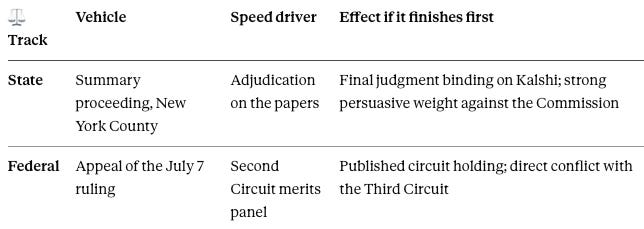
Party identity limits the reach, and the limit matters. The Commission is not a party to the Attorney General’s proceeding, so a New York judgment cannot bind the agency directly. What a New York judgment can do is constrain Kalshi and hand every other state persuasive authority to carry into the Commission’s other lawsuits.
Three qualifiers keep the mechanism honest. Binding effect attaches only to a final judgment, so interim rulings do not trigger it. The issue must have been genuinely litigated and necessary to the outcome. And the federal court applies New York’s rules on the question rather than its own.
Kalshi’s removal reads as a play for the clock rather than for a better forum, with delay as the product and a return to state court as the anticipated cost.
IX. 📊 Second Circuit Stakes
Venue carries consequences that the prediction-market framing obscures. The Commission is defending its most contested theory in the circuit where an adverse ruling spreads furthest.
The statutory provision at issue anchors the Commission’s authority across the entire derivatives complex, not merely over event contracts. Judge Torres narrowed it by applying the presumption against displacing state police powers and reading the statute’s own limiting language as preserving state authority.
A Second Circuit panel affirming that analysis would publish a narrowing construction in the circuit housing the largest concentration of registered exchanges, clearinghouses, and swap dealers in the country.
Spillover would work through persuasion rather than automatically. Nothing in a prediction-market holding directly resolves a clearing or reporting dispute, and later courts would need to extend the reasoning across different facts. Litigants contesting the agency’s reach would nonetheless gain a published narrowing construction from an authoritative circuit, which changes the briefing landscape even where it does not control the result.
Exposure runs both ways, and saying so is simply accurate. A reversal would give the Commission its strongest authority to date and would materially constrain the preemption theory underpinning New York’s proceeding. Constraint is not disposal — the Attorney General pleads eight separate claims, and money already accrued would still require separate resolution.
The asymmetry sits in the tails. A win contains the benefit to prediction markets; a loss generates citations that travel well beyond them.
X. Operational Conflict Could Scale Beyond Michigan
Courts weighing whether Congress displaced state authority read operational capacity, not just statutory text. One clean record of federal command failing at the point of execution already exists.
Michigan supplied it. A state judge ordered Kalshi to cancel completed trades by Michigan residents. Kalshi asked the Commission for emergency permission to comply. The Commission refused on July 14 and ordered the company to honor the trades instead. Kalshi had already voided them under state contempt pressure and now faces potential federal exposure for obeying a state court.
New York has not yet produced a comparable order. The Attorney General has asked for one, and the case currently sits in federal court pending a motion to send it back.
Scale is what would make the possibility significant. Michigan’s conflict governed a defined set of trades. A New York order enforcing the petition’s demands would reach platform operation across sports, culture, elections, and other events, directed at a company headquartered in the enforcing county.
A regulator asserting exclusive authority it cannot operationalize inside its largest market hands the next court a factual record about capacity rather than a legal argument about power. New York would not repeat Michigan — New York would scale it from a batch of trades to the enterprise.
XI. 🎯 MindCast Proprietary Foresight Simulation Predictions
MindCast does not forecast from commentary. The predictions below come from MP CDT FS, the firm’s proprietary foresight simulation. The system builds behavioral models of every material actor, plays opposing models against each other under pressure, tests each causal claim against an integrity gate before any model acts on it, and releases only those forecasts whose full evidentiary chain survives.
Three runs executed against the record as of August 7, 2026.
Two conventions govern every number. Event-class predictions settle against a named public source and score against the record. Interpretive-class predictions are structural reads no single filing resolves. Pooling the two would let a structural judgment borrow the credibility of a settleable one.
Subsections A and D carry the argument. Subsection C explains why one question here has two answers rather than one. Subsection G reports the calls that failed.
A. Primary predictions
Seven calls settle against public dockets and filings. Each states the claim, the band, the deadline, and the observation that would prove it wrong.
Retrospective exposure survives every available prospective federal instrument — 78–88%. No Commission action, final rule, or federal order erases Kalshi’s accrued New York money exposure before the state court decides. Wrong if a federal order or rule leads a New York court to extinguish accrued money claims. By June 30, 2027.
New York’s outcome is cited in other states’ filings, with no state replicating the instrument — 74–86%. Other states use the reasoning and the remedy design without possessing headquarters jurisdiction. Wrong if no other state’s filing cites the proceeding. By June 30, 2027.
The Commission’s own proposed rule is cited against it — 72–84%. Courts or state briefs invoke the proposal as evidence that the statute was ambiguous all along, or as a concession that sports contracts are gaming. Wrong ifno opinion or state filing cites the proposal that way. By January 31, 2027.
The next federal merits ruling turns on statutory structure, not the missing definition — 70–82%. The deciding reasoning rests on the savings language, the special rule for event contracts, or Judge Shelby’s list. Wrong if the ruling turns on whether a final definition exists. By March 31, 2027.
The New York proceeding returns to state court — 70–82%. Preemption raised as a defense does not ordinarily create federal jurisdiction. Wrong if a federal court keeps the case and decides it. By December 31, 2026.
Kalshi lists new non-sports contract categories before seeking any state gaming licence or settling with multiple states — 68–80%. Migration away from contested products is the cheaper adaptation. Wrong if a licence application or a settlement covering three or more states comes first. By June 30, 2027.
The Wisconsin opinion outpaces the New York emergency order in citations by at least three to one — 68–80%. Twenty-eight pages of merits reasoning travel further than a bench denial. Wrong if the ratio falls below three to one. By December 31, 2026.
Two definitions keep the sixth call clean. A new non-sports contract category means any category listed on or after August 7, 2026 outside sports, elections, and culture — metals, foreign exchange, energy, and economics being the ones Kalshi has signalled. A licence application means a filing of record with any state gaming regulator.
The first call carries the paper. Every other instrument the Commission holds operates going forward, and New York’s demand reaches conduct already complete.
B. Structural reads
Two predictions concern system behavior rather than discrete filings, so neither settles against a single document.
The Second Circuit decision revises more of this registry than any other scheduled event — 70–82%. Three appellate tracks are running, and the Second Circuit’s carries the most weight.
The Commission’s options narrow after the next merits ruling regardless of who wins — 65–78%. A win accelerates pressure to finalize a rule that binds the industry it protects; a loss forecloses the litigating position outright. Wrong if a ruling leaves the agency’s feasible options observably wider.
The second is the least intuitive claim in the paper and the one most worth arguing with.
C. Two answers, not one
The simulation identified two governing mechanisms that neither subsumes the other. Remedy scope explains why actors behave as they do; constraint geometry explains why courts rule as they do. Averaging them into a single forecast would manufacture false precision, so the run branched.
If remedy scope governs: a money resolution against Kalshi — judgment or settlement — arrives before any appellate court resolves preemption nationally. 45–60%.
If constraint geometry governs: the Second Circuit opinion rests on the savings language or Judge Shelby’s list rather than on definitional status. 55–70%.
Both are scenario-contingent forecasts, and their conditions are fixed here rather than selected once the record arrives. Each scores against the condition it names: the first against whether a money resolution lands before any national doctrinal resolution, the second against the reasoning the Second Circuit actually adopts. The open question the pair represents — whether money or doctrine arrives first — is the decisive uncertainty in this contest.
D. What happens in other states
New York functions as a hub rather than a template. No other state holds headquarters jurisdiction over Kalshi, so the instrument does not transfer. What transfers is everything the proceeding produces, and coalition infrastructure to carry it already exists.
A qualifying New York accounting triggers a comparable data demand by another state within 180 days — 70–85%. Qualifying accounting means any court order or stipulation requiring Kalshi to produce customer-level records of bets, gains, or losses. Comparable demand means another state’s investigative demand, subpoena, or pleaded accounting request for customer-level transaction data.
No complaint with five or more state plaintiffs emerges — 81–92%. Coalition breadth does not convert into a single joint action. By June 30, 2027.
Of the first three previously uninvolved states to act, at least two use something other than a lawsuit first — 67–82%. Non-litigation instrument means legislation, a regulatory or licensing action, a cease-and-desist letter, or a formal information demand.
New actions by uninvolved states stay product-specific or harm-specific rather than categorical — 71–85%.Qualifying actions target named contract categories, age limits, advertising, or consumer protections rather than banning event contracts as a class; the call settles on whether a majority take that form.
Public state exposure data activates a tribal or compact instrument within 180 days — 64–81%. Tribal gaming compacts depend on state gambling law, and displacement of compact revenue is a claim tribes must assert in their own name.
New York raises involved states’ unexercised claim values more than it raises uninvolved states’ entry value — 60–72%. A rank claim rather than a level claim, and interpretive rather than settleable.
The first of these is the most consequential call in the paper and the least discussed anywhere else. Prayer C of the petition demands an accounting identifying each customer and itemizing bets placed, money lost, and gains received. Per-customer attribution is precisely the capability every other attorney general lacks, and a court order producing it creates a template no state needs headquarters jurisdiction to copy. Confidentiality may block sharing the raw data; the data architecture travels regardless.
The third call is stated as an outcome, deliberately. Whether attorneys general are choosing instrument form on purpose is a behavioral claim the simulation blocked, so the prediction describes what appears rather than why.
E. Secondary predictions
Six further calls fill in the picture without carrying the argument.
Kalshi obtains no state gaming licence anywhere — 72–84%. By June 30, 2027.
No settlement resolves Kalshi’s exposure across three or more states within four quarters — 62–75%.
Old general statutes outperform new prediction-market bans by at least three to one in surviving preemption challenge — 62–75%. By June 30, 2027.
Multistate coalition coordination degrades observably as recovery becomes rivalrous — 52–66%. Observable as public disagreement over allocation, a formal allocation agreement, or a state declining to join a filing it previously joined.
If the Commission finalizes its rule before the Second Circuit rules, the finished rule does not restore federal exclusivity over sports contracts — 60–72%. Interpretive; unscored if the sequence runs the other way.
At least one court outside Utah adopts Judge Shelby’s list reasoning as an independent ground — 48–62%.By June 30, 2027.
F. Tail risks
Two low-probability events would reshape the contest rather than advance it.
Congress legislates a definition — 8–15%.
The Supreme Court intervenes on an emergency basis before any appellate court rules — 5–12%.
G. What the simulation refused to release
Eight candidate predictions failed the integrity gate or lost their evidentiary support. A forecasting record that publishes only its releases is advertising, so here they are.
Whether the Commission’s renewed emergency motion is denied. Whether a renewed motion was even filed is unverified as of the cutoff, so the conditional cannot be evaluated.
Whether attorneys general deliberately shift instrument form. The behavioral claim failed on a four-docket evidence base. Only the survival-rate version released.
Whether staffing shortages drive the Commission’s rulemaking delay. Commissioner vacancy status is unpopulated in the frozen record, so the capacity argument cannot carry a forecast.
Whether agency habit rather than statutory structure generates the losses. The claim degraded during simulation after the Utah judgment and lost release eligibility.
Which direction uninvolved states’ incentives point. Precedent lowers their entry cost while New York’s claim lowers their recovery value. The two channels resolve in opposite directions and the net failed the gate.
Whether legislatures shift away from targeted statutes. Same thin evidence base that blocked the behavioral claim.
Any individual state’s entry timing or instrument choice. Excluded by scope decision rather than blocked; per-state resolution was not modeled.
Whether the number of fronts drives Kalshi’s costs more than the difficulty of each. Private cost data is unavailable and the claim rests on inference from docket counts.
Two failures matter beyond their own scope. The incentive failure means no responsible forecast asserts a coming wave of filings by uninvolved states — the direction is genuinely ambiguous, and confident claims either way exceed the record. The habit failure cuts against MindCast’s own prior framing, in which the Commission’s refusal to define gaming was the governing mechanism. Utah showed a court defeating preemption without reaching the definition at all.
Read together, the bands describe a Commission losing options rather than losing a case.
XII. 👥 What This Means for Stakeholders
Five actors read the same record and face different decisions. Naming each move specifically is the point, since no stakeholder needs to win the national classification fight before acting.
State attorneys general should enforce under old law and prepare an accounting demand. Minnesota shows that a new prediction-market statute is the one instrument federal preemption defeats cleanly, while Wisconsin, Utah, and New York show enforcement under existing gambling law surviving. Judge Griesbach’s reasoning reaches the definition of a swap itself and travels further than shorter emergency orders. The move most offices are missing sits in New York’s accounting demand: preparing a comparable request now costs little against the chance that New York builds the attribution infrastructure first.
Platform counsel should model retrospective exposure separately from market access. Geofencing resolves who can trade and does nothing for disgorgement, restitution, or triple gain on completed transactions. Model that exposure against historical state-by-state volume as its own line, treat a favorable final rule as immaterial to it, and assess whether a customer-by-customer accounting order creates discovery exposure beyond the money claim.
Institutional allocators should price enterprise reach rather than the headline. Platform-wide relief against a company headquartered in the enforcing county differs in kind from a state geofence. Treat the New York proceeding as a discrete enterprise-level event with its own timeline, separate from the general sector overhang, and watch which arrives first — money or doctrine.
Tribal counsel should evaluate direct claims rather than rely on friend-of-the-court participation. Twenty-three tribes and tribal gaming associations sought that status in Utah and the court denied the motion as moot after ruling. Wisconsin separately denied intervention to Kalshi and Crypto.com, so intervention is not automatic either. The federal record weighs displacement of compact revenue only when a tribe puts it there.
Congressional staff should treat the savings question as the live one. Judge Shelby’s holding turns on which transactions Congress listed decades ago — a drafting artifact, not a policy judgment about prediction markets. Any categorical bill lacking express protection for concurrent state authority reproduces the same defect, and an administrable functional boundary avoids it.
One line runs across all five. The record already supplies each actor usable material, while the Commission remains the only participant whose options shrink with every week it declines to act.
XIII. Conclusion
A regulator can absorb losses indefinitely when the losses land on someone else, arrive slowly, and address conduct a later rule can bless. Nine days in late July and early August degraded all three conditions.
Wisconsin removed the attribution shield, in a reasoned opinion reaching the definition of a swap itself. Utah supplied finality and a route around the Commission’s principal cure — a defeat that never mentions the definition is a defeat no definition repairs. New York attached the same demonstrated failure mode to a remedy that reaches the company rather than one state market.
Minnesota is the counterweight and deserves its weight. The Commission’s lawsuits work, and work well, against new state prohibitions. The instrument is intact; the terrain on which it succeeds has narrowed to the one kind of statute states are now least likely to pass.
MindCast has held since April that the Commission’s refusal to define gaming is the structural fault line driving this litigation, and that every undefended assertion of authority hands the boundary to the next court in line. Utah shows that some courts will not even need the definition. New York shows what the handover costs once a state attaches enterprise remedies to it.
The Commission still holds the pen. Waiting has stopped being free.
XIV. Appendix: Source Record
MindCast — National Prediction Market Litigation Architecture
Defining “Gaming” Under the Commodity Exchange Act: A Rule 40.11 Framework — public comment filed with the CFTC on RIN 3038-AF65, April 17, 2026 (hosted analysis). Named the definitional gap three months before Judge Torres decided the New York case through it.
The National Kalshi Prediction Market Litigation Map — March 2026. The descriptive spine of the state-by-state landscape.
The Prediction Markets Rule Architecture — the system-level entry defining boundary, admissibility, and sovereign allocation.
A Boundary Rule with a Functional Core — May 2026. The contest-versus-consequence sort proposed as an administrable alternative to categorical prohibition.
The Rule 40.11 Paradox — April 2026. The private-liability track that survives whichever boundary prevails.
Kalshi Loses Federal Forum: The Washington Remand Order — the jurisdictional layer beneath the state-forum posture.
Kalshi, the Ninth Circuit, and the Prediction Markets Forum Fight — May 2026. Source of the preclusion-race analysis in Section VIII.
CFTC Takes On Nine States: The Federal-Plaintiff Phase — July 2026. The empirical record of the federal campaign this paper scores.
How the CFTC’s Missing “Gaming” Definition Is Losing the Preemption War — July 2026. The definitional-insufficiency thesis, now refined by the Utah holding.
The CFTC NPRM Is a Litigation Brief — the June proposal read as a federal record rather than a rule.
State Legislators and the Gaming Boundary — July 2026. The categorical trap and the modular-diffusion forecast Section V tests.
Prediction Markets and the Dual Nash-Stigler Trap — the harm-clearinghouse framing behind the externality estimates.
Competitive Federalism: A Field Guide for State and Tribal Regulators — the partner-facing decision sheet for the constituency Section XII addresses.
Framework and methodology
The Dynamic Predictive Game Theory Collection — the forecasting framework underlying Section XI.
The Computational Era Operationalizes Cybernetics and Predictive Game Theory — the behavioral-economics and cybernetics foundations.
The Dual Nash-Stigler Equilibrium Architecture — the equilibrium and termination conditions governing when a simulation closes.
Live-Fire Game Theory Simulators, Runtime Predictive Infrastructure — how to run MindCast publications as runtime modules against new developments.
Primary filings
People of the State of New York v. KalshiEX LLC, N.Y. Sup. Ct., N.Y. County — verified petition, filed July 31, 2026. Executive Law § 63(12) special proceeding; eight causes of action; accounting, restitution, disgorgement, treble gain under Penal Law § 80.10, and $100,000 per offering under Racing Law § 1367(16)(a). The aggregate damages figure appears in the accompanying Commercial Division filing rather than the petition text; see also the Associated Press account of the filing.
United States v. State of Wisconsin, E.D. Wis. (Griesbach, J.) — complaint filed April 28, 2026; preliminary injunction denied July 29, 2026; intervention denied to Kalshi and Crypto.com.
KalshiEX LLC v. Cox, No. 2:26-cv-00151-RJS (D. Utah) — memorandum decision, Shelby, J., August 4, 2026; summary judgment for the State on express, field, and conflict preemption.
KalshiEX LLC v. Williams, No. 1:25-cv-08846-AT (S.D.N.Y.) — preliminary-injunction denial, Torres, J., July 7, 2026; injunction pending appeal denied July 27; appeal docketed No. 26-1835 (2d Cir.).
United States and CFTC v. New York, No. 1:26-cv-03404 (S.D.N.Y.) (Marrero, J.) — complaint filed April 24, 2026; emergency motion denied without prejudice by Rakoff, J., July 31, 2026; written order August 3.
Minnesota — preliminary injunction granted to the CFTC, July 27, 2026.
KalshiEX, LLC v. Flaherty, 172 F.4th 220 (3d Cir. 2026) — preliminary-injunction affirmance; Roth, J., dissenting.
Multistate coalition record
38-attorney-general amicus brief, Supreme Judicial Court of Massachusetts, April 24, 2026 — 37 states and the District of Columbia, authored by Nevada AG Ford and Ohio AG Yost.
NCSL prediction-market legislative tracker — fifteen states legislatively active in 2026, six enactments.
Fourth Circuit amicus supporting Maryland, No. 25-1892 — a separate coalition, not the Massachusetts filing.
Related state and federal actions
Wisconsin state enforcement actions against Coinbase, Kalshi, Robinhood, Polymarket, and Crypto.com, filed April 23, 2026 (Dane County), citing Wis. Stat. § 945.03(1m).
New York v. Coinbase Financial Markets, Inc.; New York v. Gemini Titan, LLC — filed April 2026; removed; remand motions pending.
Nessel v. KalshiEX LLC, No. 26-1087-CZ (Ingham County Cir. Ct.) — temporary restraining order, June 29, 2026.
Nevada joint stipulation and order, July 24, 2026.
KalshiEX LLC v. Johnson, No. CV-26-01715-PHX-MTL (D. Ariz. May 5, 2026); KalshiEX LLC v. Schuler, No. 26-3196 (6th Cir. Apr. 24, 2026); Ninth Circuit stay denials, Nos. 26-1343, 26-1304, 26-3106 (May 21, 2026).
Federal regulatory record
CFTC Notice of Proposed Rulemaking, “Prediction Markets; Public Interest Determinations,” RIN 3038-AF65 — published June 10, 2026; comments closed July 27, 2026; CFTC Press Release 9249-26.
CFTC order directing fulfillment of Michigan trades, July 14, 2026.
Commodity Exchange Act § 2(a)(1)(A) (exclusive jurisdiction and savings clause); § 2(d); § 5c(c)(5)(C) (Special Rule); 7 U.S.C. § 16(e)(2) (the enumeration Judge Shelby construed); 17 C.F.R. §§ 38.151(b), 40.11.
Procedural authorities
Anti-Injunction Act, 28 U.S.C. § 2283; Younger v. Harris, 401 U.S. 37 (1971); Mitchum v. Foster, 407 U.S. 225 (1972).
Full Faith and Credit Act, 28 U.S.C. § 1738; 28 U.S.C. §§ 1292(a)(1), 1257.
N.Y. CPLR Article 4 (special proceedings); CPLR §§ 503, 2222, 8303(a)(6).
N.Y. Executive Law § 63(12); N.Y. Penal Law §§ 80.10, 225.05, 225.10, 225.20; N.Y. Racing, Pari-Mutuel Wagering and Breeding Law §§ 1367, 1367-a; 18 U.S.C. § 1084(a).