
Related MindCast works: Kalshi Loses Federal Forum — The Washington Remand Order | How the CFTC's Missing "Gaming" Definition Is Losing the Preemption War | New York's $36 Billion Kalshi Case — The One Claim No CFTC Rule Can Erase
Executive Summary
Kalshi runs an online exchange where people buy contracts that pay out based on real-world events — which team wins, who takes an election, whether a public figure says a particular word. A federal agency, the Commodity Futures Trading Commission, licenses the exchange and calls the products financial derivatives. A growing number of states call the same products gambling and demand that Kalshi stop offering them.
On August 12, a Washington state judge ordered Kalshi to stop offering seven categories of those contracts to anyone in Washington, and set deadlines for the technology that will block access. The seven-category scope drew the headlines. The enforcement mechanism is the more important story, and almost nobody reported it.
Kalshi Negotiated the Enforcement Machinery Washington Is Now Using Against It. Three weeks before the Washington order, Kalshi and Nevada gaming regulators filed a joint stipulation ending a contempt proceeding. Kalshi agreed to five elements: a named location-blocking vendor, a $120,000-per-day penalty, an escape valve allowing a sworn explanation instead of payment, court-set penalties if that explanation shows insufficient diligence, and a promise to share its technical progress reports with other states. Washington’s order reproduces all five elements and adds itself to the reporting list. Kalshi can still appeal, but arguing that those terms are impossible or unfair means arguing against an agreement it signed three weeks earlier.
Washington Sued Under Three State Laws, and the Federal Rulemaking Touches None of Them. The court ruled that Kalshi does not qualify for an exemption in Washington’s gambling statute — a question of Washington law that no federal agency can answer. Washington also sued for false advertising and for recovery of gambling losses. Whatever definition the federal agency finally adopts, all three claims remain.
A Federal Regulation Kalshi Cites as Its Shield Now Works Against It. Federal rules bar a licensed exchange from listing contracts that reference activity “unlawful under any State law.” Kalshi reads that language as proof of exclusive federal control. The Washington court read the same words as a federal instruction to look at state law first — and no federal definition of gambling can remove a clause that points to state law by its own terms.
States No Longer Need a National Answer Before They Can Act. Three moves produce working relief: win the preemption argument in the court hearing the case, sue under statutes the state already has, and adopt compliance terms Kalshi has already accepted somewhere else. Many states can run all three without waiting for a federal appeals court or the Supreme Court.
Kalshi Holds One Clean Appellate Target, and Federal Preemption Is Not It. The Washington judge listed the categories he found illegal, and technology-and-science contracts were not on the list. The order bans them anyway. Kalshi can attack that gap without arguing any federal question at all.
What the Forecast Says
MindCast ran its proprietary foresight simulation against the record as of August 13, using eleven behavioral models of the actors involved. The forecast appears in full at Sections XVI and XVII. The calls carrying the most weight:
Kalshi asks the appeals court for an emergency pause again before August 26 — 88–94%
The next state order containing the information-sharing term names more states than Michigan and Nevada — 85–92%
Washington receives Kalshi’s implementation evidence or a sworn explanation by September 2, rather than silence — 86–94%
At least one state not currently suing Kalshi takes formal action by February 28, 2027 — 82–90%; at least two — 62–75%
Kalshi obtains no state gambling licence anywhere before June 30, 2027 — 74–86%
The federal agency issues no emergency order against the Washington injunction before October 31 — 72–82%
No lawsuit with five or more state plaintiffs emerges before June 30, 2027 — 80–90%
Six forecasts failed the release standard and appear alongside those that passed. The most consequential: nobody has confirmed whether Kalshi met its August 12 compliance deadlines in Nevada and Michigan. No regulator, no court filing, no vendor statement.
Sections I through XV explain the order and compare it against Nevada, Michigan, and Massachusetts. Sections XVI through XIX give the forecast and name what remains unknown.
I. Three Orders in One Afternoon
Three signed orders reached the King County Superior Court docket on the afternoon of August 12, 2026. Judge John F. McHale granted Washington a fifteen-page amended injunction, refused Kalshi permission to keep two exhibits secret, and denied Kalshi’s request to pause the injunction while it appeals. Reading the three together shows more than any one of them alone.
The Company. Kalshi holds a federal licence as a designated contract market — an exchange the Commodity Futures Trading Commission regulates. Customers buy binary contracts that pay a fixed amount if a specified event happens and nothing if it does not. Subjects span professional and college sports, elections, interest rates, weather, corporate announcements, and whether named public figures will speak particular words.
Kalshi’s position nationally has been consistent: federal registration settles the question, and states have no authority over its products. Roughly a dozen states disagree, and courts have split.
The Lawsuit. Washington Attorney General Nick Brown sued in late March 2026, through his office’s Consumer Protection Division rather than a gaming regulator. Brown pleaded three statutes — the Washington Gambling Act, the Consumer Protection Act, and the Recovery of Money Lost at Gambling Act.
The Timing. McHale heard argument on July 10 and signed an order on July 17 granting the injunction in principle while leaving its terms for later. He told both sides to submit proposed language by August 3. National coverage reported for three weeks that the final order would arrive on August 5. Entry came a week after that.
The extra week mattered, and Section XIII explains why. What the August 12 orders reveal first is that Washington did not originate the enforcement system it is using. The system came from an agreement Kalshi signed in Nevada under contempt pressure, and Washington installed it.
II. Why the Mechanism Matters More Than the Scope
Seven blocked categories is the arresting fact about the Washington order and the least durable one. Scope describes how much of Kalshi’s business stops in one state. Mechanism describes whether the stoppage spreads to other states, survives appeal, and gets cheaper to copy each time. Four features of the mechanism drive everything in the sections that follow.
The Compliance Terms Came From a Settlement Kalshi Signed. Washington’s technical requirements — the vendor, the deadline structure, the penalty, the sworn-explanation escape valve, the information sharing — reproduce a Nevada stipulation Kalshi entered on July 23 to end a contempt proceeding. Section VIII lays the two documents side by side.
The Legal Claims Bypass the Federal Fight. Most coverage frames the national contest as one binary question: does federal law override state gambling law? Washington’s order does not depend on winning that fight nationally. Washington won it in front of the judge hearing the case, then relied on three of its own statutes for the actual liability. Section VI explains why a federal rule change reaches none of them.
The Court Adopted Kalshi’s Own Product Categories. The order bans contracts by naming the tabs on Kalshi’s website — Sports, Elections, Politics, Culture, Tech and Science, Mentions. Using the company’s own labels spared Washington the hardest part of its case: proving contract by contract that each product is a bet. Borrowing a defendant’s classification system also imports its problems, and Section X shows where.
Unverified Facts Stay Unverified. Nevada and Michigan shared an August 12 compliance deadline. No regulator, court filing, or vendor statement has confirmed whether Kalshi met it. Section XVIII lists what remains unknown and Section XVII prices each open question as a probability band rather than resolving it by assumption.
Readers who reject any of the four will reject the conclusions built on them, which is why all four appear before the argument rather than inside it.
III. What the Order Requires
Paragraph 3 of the amended order bans seven categories of contracts and expressly protects four. Paragraphs 1, 2, and 4 govern records, location-blocking technology, and money. Taken together, the four paragraphs produce the broadest state remedy any court has imposed on Kalshi.
A pattern separates the two groups of categories. Every banned category turns on human or institutional conduct — who wins a game, who wins an election, what someone says. Every protected category tracks a published objective measurement — a commodity price, a temperature reading, an economic statistic.
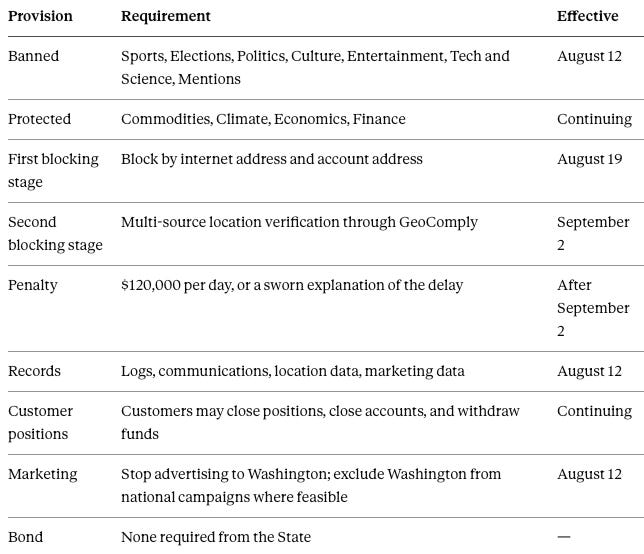
Two provisions break from every earlier state order against Kalshi. Customers may exit positions rather than having trades cancelled, and Washington reserved its claim for customer losses starting September 2 rather than August 12 or August 19.
The September 2 date is a tell. Washington set its money claim to begin on the day the stronger blocking technology is due, not on the day the ban takes effect — which indicates the State expected the earlier, weaker blocking method to leak. Section XII develops the point.
Contact mcai@mindcast-ai.com to partner with us on Predictive Game Theory AI in Law and Behavioral Economics. We specialize in predictive simulations for Complex Litigation, Innovation Economics, Geopolitical Risk Intelligence and Legacy Innovation. See more about MindCast series at our new website MindCast Corporate.
To test our predictive simulation AI system, in 2026 we simulated the Super Bowl and the World Cup. See 🏈 Super Bowl LX — AI Simulation vs. Reality | ⚽ The 2026 World Cup Final Simulation Validation
To deep dive on MindCast works upload the URL of this publication into any LLM (preferably Google AI mode) and prompt ‘reconstruct MindCast framework with three degrees of cited sub links.’ See Live-Fire Game Theory Simulators, Runtime Predictive Infrastructure.
IV. The Federal Rule That Now Helps States
Kalshi has built its national defense on federal exclusivity. Judge McHale turned the central federal provision into a source of state authority instead, and the reasoning survives whatever the federal agency does next.
The Rule. A Commission regulation numbered 40.11 forbids a licensed exchange from listing any contract that “involves, relates to, or references” terrorism, assassination, war, gaming, or activity that is “unlawful under any State or Federal law.” A parallel provision in the underlying statute uses the same language and lets the Commission declare such contracts contrary to the public interest.
Kalshi reads the provision as assigning the entire question to Washington, D.C.
The Court’s Reading. McHale focused on four words: “unlawful under any State law.” No federal official decides what a state’s gambling statutes prohibit. Only the state can fill in that category.
States therefore classify first, and the Commission’s public-interest judgment comes afterward. Contracts may lawfully trade in some states and not others, and the regulation contemplates exactly that result.
Why a New Federal Definition Cannot Fix It. The Commission has a pending rulemaking that would define “gaming” for the first time. A finished definition answers the gaming item on the list and nothing else. The state-law item sits in the same sentence, independently.
Removing the Washington reasoning would require the Commission to delete its own reference to state law — and deleting that reference would strip the Commission of authority the regulation grants it. The agency cannot narrow the state-law clause without narrowing itself.
One Limit, Stated Plainly. A federal definition of gaming is one instrument. Federal preemption doctrine is a different instrument, and it operates on whether a state may enforce its law at all. Section VI keeps the two apart, because most commentary collapses them.
Kalshi’s Own Case Supplied the Reasoning. McHale cited a Sixth Circuit decision from Kalshi’s own Ohio appeal, alongside a 1982 Supreme Court case, for the proposition that Congress granted the Commission exclusive jurisdiction to separate its work from the Securities and Exchange Commission’s — not to push states out. Kalshi’s appellate record now arms state trial courts against Kalshi’s central claim.
V. Three State-Law Claims, and What Each One Survives
Washington pleaded three statutes and won preliminary findings on all three. Sorting out what each claim survives, and what it does not, prevents the overstatement that has followed this litigation everywhere.
The Exemption Kalshi Claimed. Washington’s Gambling Act carves out “bona fide business transactions” for the future purchase or sale of securities or commodities. Kalshi argued that its contracts fit the carve-out, which would place them outside the statute entirely without any federal question.
McHale held that Kalshi does not qualify. Kalshi must comply with the Act.
What the Ruling Survives. Federal preemption decides whether Washington may enforce its statute. Ordinary statutory interpretation decides what the statute covers. Washington courts answer the second question, and no federal ruling rewrites a Washington exemption.
The limit is worth stating directly: if a federal appeals court ultimately holds that federal law bars Washington from enforcing its gambling law against Kalshi, the exemption ruling stands as a reading of Washington law and Washington still cannot enforce. Interpretation is protected. Enforcement is not.
What No Federal Definition Reaches. None of Washington’s three claims depends on how the Commission defines gaming.
The exemption ruling interprets a Washington statute the Commission has no power to construe. The false-advertising claim rests on McHale’s finding that Kalshi’s “legal betting” marketing likely misleads a reasonable Washington consumer — including an advertisement telling consumers they could bet on the NFL even though they live in Washington. The gambling-loss claim gives Washington a restitution theory its courts have long held protects the public rather than the individual gambler.
Where the Three Overlap. Honest accounting requires naming the dependency. The gambling-loss claim assumes illegal gambling, so it rises and falls with the Gambling Act claim. The false-advertising claim depends heavily on the betting being unlawful when advertised, so a federal ruling that Kalshi may lawfully operate would weaken it.
Washington holds three separate routes to liability, each demanding a different answer from Kalshi, and all three exposed to the same federal chokepoint. What sets Washington apart is not protection from preemption but protection from the rulemaking — the instrument the Commission actually controls, and the one likely to arrive first.
VI. The Concession Kalshi Will Appeal
Judges rejecting preemption arguments often reject them completely. McHale did not, and the exception he carved out gives Kalshi its strongest appellate argument.
What the Court Conceded. McHale held that federal law does occupy the field of regulating on licensed exchanges, while not displacing Washington’s enforcement of its gambling law. He paired that with a second holding: gambling regulation and futures regulation are different fields, and Kalshi can obey both Washington law and federal law at once.
How Kalshi Will Attack It. An order telling a federally licensed exchange which contracts it may list, and to which customers, looks like regulation of the exchange — inside the field McHale conceded to federal law.
Washington’s answer must be that the order governs consumer transactions and market access rather than what the exchange may list. McHale asserts the distinction more than he defends it.
The Protected Categories Strengthen Kalshi’s Attack. A court that declares Commodities, Climate, Economics, and Finance contracts permissible has decided which federally listed products Washington allows. Deciding which federally listed products may be offered is precisely the exchange-regulation function Kalshi will invoke.
Nevada and Michigan banned specific categories and said nothing about the rest. Washington affirmatively approved four categories, which helps Kalshi today and helps Kalshi more on appeal.
Whether courts accept the line between regulating an exchange and regulating a transaction determines whether the Washington order survives. Every other holding in the document depends on that line.
VII. The Argument the Court Closed
Kalshi’s cleanest path to victory ran through impossibility: federal rules require a licensed exchange to give all customers equal access, state law requires excluding one state’s residents, so obeying both is impossible and federal law wins. McHale closed the path by reading the federal access rule narrowly.
The Rule. Commission regulation 38.151(b) requires exchanges to give members, traders, and software vendors “impartial access” — meaning access rules applied without discrimination, and comparable fees.
Kalshi read the rule as guaranteeing nationwide availability. McHale read it as an anti-discrimination rule and nothing more.
What Follows. Being unable to match Washington traders with the national pool is not discrimination. Obeying Washington gambling law is not an unlawful denial of access. The access rule does not require Kalshi to break state law.
Why the Reading Matters. A conflict-preemption argument needs either impossibility or state law obstructing what Congress wanted. Removing impossibility leaves Kalshi with the obstruction argument alone — and the obstruction argument runs straight into the state-law clause described in Section IV, a federal provision suggesting Congress expected exactly the state-by-state variation Kalshi calls an obstruction.
Commission leadership has publicly argued that state orders deny traders impartial access to federally regulated markets. Regulation 38.151(b) is therefore the provision most likely to draw federal agency participation in the Washington appeal, which means the interpretation of one agency rule may decide a much larger dispute.
VIII. Washington Installed the System Kalshi Agreed To
Comparing the Washington order against the Nevada stipulation Kalshi signed three weeks earlier shows which terms trace to that agreement and which the court imposed on its own. The distinction reorders what Kalshi can realistically argue on appeal.
The Nevada Settlement. Nevada’s Gaming Control Board and Kalshi filed a joint stipulation in Carson City on July 23, 2026, ending a contempt proceeding. State investigators had bought prohibited contracts eight times over four days while physically inside Nevada, despite an existing injunction.
The stipulation contained five elements: a multi-source location-blocking system from GeoComply, $120,000 per day for missing the deadline, the option to file a sworn affidavit explaining an incomplete implementation instead of paying, court-determined penalties if the affidavit shows insufficient diligence, and a promise to give Nevada the same progress reports Kalshi gives Michigan.
The Washington Order. Paragraph 2 contains all five elements in the same order and in matching language, adding Nevada to the reporting list alongside Michigan.
The Drafting Tell. Paragraph 2 uses “will” throughout — Kalshi will implement the blocking, will pay or file an affidavit, will provide the reports. Paragraphs 1, 3, and 4 use “shall” throughout — Kalshi shall preserve records, shall stop offering the banned categories, shall freeze the fees it collected.
Consent language and command language sit in separate paragraphs. The auxiliary verbs support the conclusion; the Nevada document proves it.
Three Consequences.
Kalshi’s prior agreement does not waive its right to appeal. Accepting terms from a Nevada regulator does not surrender objections to a Washington court imposing them under different statutes and a broader ban. What Kalshi loses is credibility: a company that agreed to a $120,000 penalty and a GeoComply timeline in July argues uphill in August that the same penalty and timeline are unreasonable. Kalshi’s realistic attack narrows to paragraph 3, the one paragraph written as a command.
The reporting requirement compounds. Nevada’s version named Michigan. Washington’s version names Michigan and Nevada. A fourth state can demand the same term at no drafting cost and point to three states already receiving it.
States are not building a shared compliance system from scratch. States are installing one Kalshi accepted under contempt pressure in Nevada, and the result is harder to dislodge than a court-designed remedy because Kalshi cannot credibly attack terms it signed.
IX. Four States, Four Different Architectures
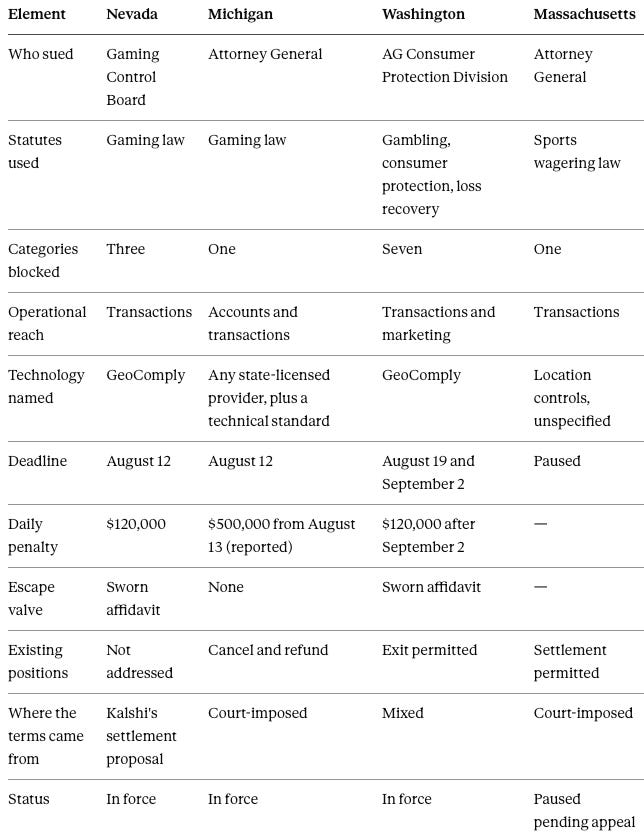
Four states have obtained orders requiring Kalshi to block access by location. Three remain in force. Comparing them by structure rather than by headline shows Washington and Nevada sharing machinery while Michigan differs on nearly every technical choice.
Michigan covers one subject — sports — and reaches deepest into Kalshi’s operations, controlling listing, trade matching, clearing, settlement, deposits, fees, account creation, account funding, and specific bet types including parlays and player propositions. Nevada blocked three categories. Washington blocked seven. Massachusetts won a sports-only injunction in January and lost it to an appeals court pause in February.
Sources:
Nevada joint stipulation and order, First Judicial District Court, Carson City, July 23, 2026, and Nevada Gaming Control Board release, July 24. The governing injunction is the amended written order of May 18, 2026, following an original April 3 injunction.
Michigan temporary restraining order, Ingham County Circuit Court, June 29, 2026, extended July 13 (Judge Rosemarie Aquilina). The $500,000 figure comes from reporting on the extension hearing rather than from the signed order.
State of Washington v. KalshiEX, LLC, No. 26-2-10264-3 SEA, amended order filed August 12, 2026.
Commonwealth v. KalshiEX LLC, Massachusetts Appeals Court No. 2026-J-0143, pause order February 17, 2026.
Two differences matter beyond the table. Washington alone sued through a consumer-protection division rather than a gaming regulator, which produced the two extra statutory claims no other state holds. Michigan alone tied compliance to an existing regulatory specification — any provider its Gaming Control Board licenses, meeting the Board’s published technical standard — instead of naming one company.
X. Which Orders Survive What Kalshi Will Try Next
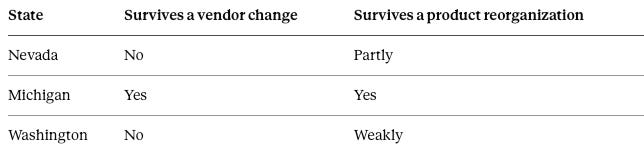
Court orders differ in how well they withstand the two moves a defendant makes most readily: switching compliance vendors and reorganizing the product catalog. Testing the four orders against both moves reverses the intuitive ranking of which state holds the strongest remedy.
Switching Vendors. Nevada and Washington named GeoComply specifically. Naming one company delivers certainty now and fragility later, because a vendor failure or a terminated contract sends the parties back to court. Michigan named a category of approved providers and a technical standard, so Michigan’s order survives a vendor change without any modification.
Reorganizing Products. Washington’s paragraph 3 bans contracts related to the listed subjects, “including but not limited to” the named website tabs. The qualifier blocks a pure renaming. Nothing in the order defines the banned subjects independently of the tab structure, so classification fights become available whenever Kalshi restructures a market. Michigan listed functional equivalents — parlays, propositions, live in-game bets — and survives restructuring within sports without further litigation.
Two Gaps in Washington’s Drafting. The court’s factual findings list Kalshi’s website categories: Elections, Politics, Sports, Culture, Crypto, Commodities, Climate, Economics, Mentions, Finance, and Tech and Science. Paragraph 3 bans seven and protects four.
Crypto appears in the findings and on neither list — not banned, not protected. Kalshi will read the omission as permission. Company-specific contracts get no treatment at all.
Entertainment presents a smaller inconsistency. Entertainment appears on no tab list, but the court’s Finding of Fact 9 expressly describes contracts spanning sports, elections, entertainment, and popular culture. The findings support the ban; only the category list is untidy.
The Technology-and-Science Gap. McHale’s Conclusion of Law 1 defines the illegal activity as gambling on sports, elections, politics, entertainment, culture, and mentions. Conclusion of Law 18 lists the statutory violations and adds nothing. Neither mentions technology and science.
Paragraph 3 bans technology-and-science contracts anyway.
Kalshi therefore gains an argument on one of seven categories that requires no federal ruling. Kalshi need not convince an appeals court that federal law beats Washington law — only that the trial judge banned a category he never found illegal.
Washington’s Response. The State holds a counter worth taking seriously. Conclusion of Law 18(d) finds that Kalshi “offered and continues to offer gambling on its platform in violation of Washington’s gambling laws and/or regulations” — a finding that names no category and could support the whole ban.
Washington will argue that the list in Conclusion of Law 1 gives examples rather than limits. Kalshi will answer that a general finding cannot substitute for a specific finding the judge declined to make about a category he named elsewhere. An appeals court deciding quickly on an emergency motion may well find the general finding sufficient, which is why partial relief is plausible rather than likely.
XI. Why Michigan Drew Federal Fire and Washington Did Not
Michigan is the only state whose order provoked an emergency intervention from the federal agency. The reason is structural rather than political, and it explains why Kalshi’s consent has become the states’ most valuable asset.
What Happened in Michigan. The June 29 order required Kalshi to cancel and refund certain trades already made by Michigan residents. Kalshi asked the Commission on July 12 for emergency permission to comply by blocking access and force-closing positions, offering to cover customer losses itself.
The Commission refused on July 14 and ordered Kalshi to settle the trades normally instead. Kalshi’s head of enforcement said publicly that the company had already cancelled the trades to obey the Michigan court, and described being caught between a state judge and a federal regulator. Commission leadership framed the intervention around a duty to maintain a uniform national derivatives market, and said the agency would not let state courts push a licensed exchange into breaking federal law.
Why Consent Weakens the Federal Argument. State coercion of a licensed exchange is the foundation of the Commission’s public case. A settlement the exchange signed voluntarily removes the strongest version of that foundation. The Commission cannot easily call an arrangement state bullying when its own licensee proposed it.
Consent changes the argument, not the law. A licensed exchange cannot extinguish federal authority by agreeing to a state order, and the Commission remains free to conclude that carrying out a term Kalshi accepted would still violate federal exchange rules. Kalshi’s Michigan emergency filing shows exactly that possibility.
Nevada Bought Cross-State Protection. Washington Did Not. Nevada’s settlement provides that the agreement stands separate from and unaffected by proceedings in any other state, Michigan included — protection against a ruling elsewhere unravelling the Nevada deal. Nevada also preserved Kalshi’s litigating position by recording that Kalshi concedes no basis for contempt.
Washington’s order contains no comparable clause. Whether Kalshi asked for one and lost, or never asked, awaits a document neither side has made public.
Washington therefore sits between Michigan and Nevada on federal-collision risk. Kalshi wrote the compliance terms, which lowers exposure. The ban itself came from the court and reaches elections and politics — the categories the Commission defends most aggressively — which raises it.
XII. The Two-Week Gap
Washington’s staged schedule creates a period during which the ban is in force and the required blocking method is, on the available evidence, known not to work. From August 19 to September 2, Kalshi satisfies its obligation using a method that already failed under testing in another state.
Evidence From Nevada. Kalshi built an in-house blocking tool for roughly $190,000, relying mainly on internet address data. Nevada put the success rate of that approach at 55 to 80 percent even against users making no attempt to hide their location.
Gaming Control Board investigators bought prohibited contracts eight times over four days while physically inside Nevada, using no evasion tools at all. Nevada called the approach fake compliance.
Evidence From Michigan. Kalshi initially blocked users by their account sign-up address. The result reversed the intended effect: a Michigan resident traveling out of state was blocked, while a visitor physically inside Michigan traded freely.
Account-address blocking fails in exactly the direction that matters for a law about physical presence — and Washington’s order targets physical presence, requiring a system that stops anyone located inside Washington from buying banned contracts.
Washington Anticipated the Leak. The State reserved its claim for customer fees and losses starting September 2, not August 19 and not August 12. A state confident that the first blocking stage would work would have claimed from the earlier date.
The two-week gap therefore looks like a concession Washington priced deliberately, not a technical schedule Washington designed.
XIII. The Stay Sequence
Three days in August produced an appellate position far more favorable to Washington than the individual rulings suggest. Understanding the sequence explains why Kalshi’s August 10 loss meant less than it appeared to.
The Sequence. A commissioner of the Washington Court of Appeals denied Kalshi’s request to pause the injunction on August 10. McHale’s August 12 order denying the same request at the trial level states that the commissioner’s decision rested partly on the injunction containing no operating terms beyond record preservation.
Two days after the commissioner ruled, McHale supplied those terms — then denied Kalshi’s request in a single sentence, without analyzing the usual factors courts weigh.
Why the August 10 Loss Was Hollow. The commissioner declined to pause an order that, at that moment, required only that Kalshi keep documents. Asking again against the amended order presents an entirely different record: an immediate seven-category ban, technical deadlines starting August 19, and a six-figure daily penalty.
What the Sequencing Accomplished. McHale acknowledged the changed circumstances and denied relief anyway. Kalshi must now restart appellate review against a fully specified order, rather than pausing an order an appeals court already declined to pause on a thin record.
Kalshi’s strongest renewed argument is not federal preemption. Preemption has divided courts nationwide, and no appellate commissioner resolves it on an emergency motion. Kalshi’s strongest argument is the technology-and-science gap described in Section X — narrow, document-based, requiring no federal ruling, and supporting partial rather than total relief.
XIV. What Kalshi Must Decide by August 19
The shortest of the three August 12 orders may generate the most consequential evidence in the case. Kalshi faces a choice within five court days, and both options carry costs.
The Ruling. Kalshi asked to seal two exhibits attached to a declaration by its lawyer Matthew J. LaRoche, filed in opposition to the injunction. Washington objected. Kalshi filed no reply.
McHale denied the request entirely, applying the Washington Constitution’s command that justice be administered openly. Courts are presumed open, the party seeking secrecy carries the burden, and Kalshi did not carry it.
Kalshi must either file the full unredacted declaration and exhibits, or file a narrower motion to black out specific passages, by roughly August 19.
What the Exhibits Likely Contain. The injunction order says the court weighed Kalshi’s compliance costs and lost profits, which establishes the subject without establishing the contents. Proving that burden normally requires evidence of current blocking capability, the gap between that capability and physical-location verification, GeoComply integration requirements, cost estimates, and projected revenue loss. Whether the two exhibits contain all of it stays unknown until Kalshi files.
A narrowed redaction motion is the more likely choice, and a narrowed motion delays public disclosure rather than delivering it.
Why Disclosure Would Travel. Kalshi’s cost claims have been contested elsewhere. Kalshi has argued across several state cases that industry-standard location blocking would be prohibitively expensive.
A GeoComply executive testified in Michigan that his company usually implements blocking in one to two weeks, with most of that time spent on the customer’s side. Kalshi’s lawyer acknowledged at the same hearing that the company had worked with GeoComply for three or four days and could not give a timeline.
The Sworn-Explanation Option Is an Evidence Generator. Paragraph 2 lets Kalshi answer a missed September 2 deadline by filing a sworn affidavit explaining why implementation is incomplete, instead of paying the daily penalty. Treating that option as a safe harbor understates it badly.
A sworn filing converts Kalshi’s private capability, sequencing, and cost information into a court record. The information-sharing clause then carries that record to Michigan and Nevada. Kalshi’s two exits from a missed deadline are payment or disclosure, and Washington benefits more from the second.
XV. Validation Record
MindCast scores its prior published calls against new evidence, including calls that miss. Two earlier publications in this series made predictions the Washington order tests.
A state claim independent of any federal gaming definition survives federal resolution New York’s $36 Billion Kalshi Case HighPreliminary support — Washington pleaded three such claims; no final judgment yet
The state-law clause in Rule 40.11 operates independently of the gaming definition The CFTC’s Missing “Gaming” Definition 82–90%Provisional hit at the trial-court level; appellate durability unresolved
Two entries belong in the record as corrections rather than wins.
The Recovery of Money Lost at Gambling Act claim appeared in no prior MindCast assessment. Missing it understated how many separate liability routes Washington holds.
Every national outlet, and the court’s own July order, pointed to August 5 as the entry date. Entry came August 12. A court’s announced timetable is a forecast, and future publications will treat it as one.
XVI. The Foresight Simulation Method
MindCast forecasts through simulation rather than commentary. The engine builds behavioral models of each material actor, plays opposing models against each other under pressure, tests every causal claim against an integrity standard before any model acts on it, and releases only forecasts whose evidence chain holds up. Method appears here so readers can weigh the output; the forecasts themselves follow at Section XVII.
Eleven Actor Models. Washington’s consumer-protection division · Kalshi’s litigation and compliance operation · the Commodity Futures Trading Commission · the Department of Justice · a gaming-regulator plaintiff · an attorney general already suing · a prohibition-state attorney general not yet suing · a licensed-market state attorney general not yet suing · a state appeals court · GeoComply · a tribal government coalition.
Two of those separations carry the run. Modeling the Commission and the Justice Department as one federal actor would hide the split Michigan exposed, where the agency spent capital its litigating partner did not. Modeling states that have not yet sued as one group would average two different theories of liability into a meaningless entry rate. Both kinds of state can use the federal state-law clause; they populate it through different statutory violations.
Five Mechanisms Driving the Forecast.
The consent ratchet. Kalshi’s Nevada agreement makes identical demands nearly free for the next state, and makes resistance expensive — Kalshi must explain why terms it accepted twice are unacceptable now.
Two routes into the state-law clause. States banning online sports betting invoke categorical illegality. States licensing sportsbooks invoke unlicensed operation, age restrictions, taxation, integrity controls, and competitive parity. Michigan proves the point: it licenses online sports wagering and still obtained a sports-contract order. Both routes work, and the drafting is simpler for a banning state.
Federal collision asymmetry. The Commission intervenes where a state forces a licensee. Exposure concentrates on court-imposed orders reaching beyond sports.
A locked script. Kalshi’s categorical jurisdiction position has survived nineteen of twenty-three adverse rulings unchanged, which places state licensing outside the company’s realistic options even where licensing would pay.
The vendor chokepoint. One company named in two orders and working in a third, under required cross-state reporting, creates both a capacity limit and a way for states to catch inconsistencies — an outcome no state designed.
Five Routes. State-by-state copying 46 percent · federal appellate reset 22 percent · coalition fracture 14 percent · Kalshi migrating to uncontested products 12 percent · federal escalation 6 percent.
The federal appellate reset deserves attention out of proportion to its probability, because its two directions are asymmetric. A Sixth Circuit holding that sports contracts are not covered financial instruments leaves the state architecture intact and removes Kalshi’s foundation. A Kalshi victory would sharply weaken the architecture inside the Sixth Circuit and give Kalshi powerful persuasive authority elsewhere, without automatically ending state enforcement nationally.
No Stable Endpoint. The simulation released time-bounded predictions but found no stable strategic endpoint within the forecast window. Every actor retains a profitable move nobody has yet made — states can enter, Kalshi can migrate products, the Commission can finalize its rule — and three state orders do not cover a national market. No route ends inside the forecast window, which places the decisive move with an appeals court rather than any litigant.
What the Simulation Discarded. Three causal claims entered the run as primary and did not survive at that strength. The claim that Kalshi’s consent removes the Commission’s power to intervene was downgraded, because consent removes the coercion argument rather than the agency’s authority. The claim that customer-exit protection reflects Kalshi’s post-Michigan priority was downgraded, because Nevada’s settlement says nothing about positions nine days after the Michigan collision. The claim that entertainment contracts were banned without supporting findings was discarded outright, because Finding of Fact 9 names entertainment expressly.
A Second Run on an Independent Model. MindCast executed the same record on a second engine. Agreement across models strengthens coherence but does not independently validate the result; shared assumptions can produce correlated error.
Both runs agreed on the governing mechanism and differed on route probabilities, with the leading route spanning 46 to 54 percent. The second run supplied one insight this run missed entirely: the sworn-explanation option functions as an evidence generator, now at Section XIV. The second run also priced new-state entry more conservatively, and Section XVII adopts the more conservative figure.
XVII. Prediction Registry
Every prediction below states two separate things. Probability is the chance the outcome happens, given as a numeric range. Confidence is how reliable the prediction itself is, on a five-tier scale — High, Moderate-High, Moderate, Low-Moderate, Low. A likely outcome resting on thin evidence carries a low confidence tier, and neither number substitutes for the other.
Labels identify the source. Analyst calls come from document analysis, FS calls from the primary simulation, and FS-2calls from the independent second run.
Blocked entries failed the release standard and appear at equal prominence. Blocked candidates remain visible to preserve the complete forecasting record.
States Not Currently Suing Kalshi
FS — At least one such state takes formal action by February 28, 2027 — 82–90%, High
FS — At least two such states do so in the same window — 62–75%, Moderate
FS — At least two of the first three new entrants ban online sports betting under their own law — 58–72%, Moderate (respecified downward: licensing states retain workable theories, so a banning state’s advantage is lower drafting cost rather than exclusive access)
FS — The first new entrant uses a cease-and-desist or investigative demand before filing suit — 62–75%, Moderate
FS — Any new blocking order names GeoComply or copies the cross-state reporting term — 80–90%, High
FS — The next order containing the reporting term names more states than Michigan and Nevada — 85–92%, High
FS — No state bans six or more categories before December 31, 2026 — 65–78%, Moderate-High
FS-2 — Near-term state remedies stay sports-first or use a neutral technical standard rather than copying Washington’s breadth — 74–84%, Moderate-High
FS-2 — The next new order names a class of licensed providers plus a technical standard rather than one company — 35–48%, Low-Moderate
FS — Washington’s three-statute structure appears in a new state’s complaint — 52–68%, Moderate
States Already Suing Kalshi
FS-2 — A state already acting imports two or more Washington-Nevada remedy terms by December 31, 2026 — 72–84%, Moderate-High
FS — At least one adds an exemption-narrowing or consumer-protection theory by March 31, 2027 — 70–82%, Moderate-High
FS — No lawsuit with five or more state plaintiffs emerges before June 30, 2027 — 80–90%, High
FS — A fourth state demands direct contact with GeoComply or names the vendor in process by December 31, 2026 — 60–74%, Moderate
FS-2 — LaRoche material or an implementation fact is used in another prediction-market case by January 31, 2027 — 60–77%, Moderate
FS-2 — An active state pleads or reserves customer restitution alongside prospective blocking — 63–79%, Moderate
FS — Divergence between banning states and licensing states shows up in the instruments they file rather than in public statements — 58–72%, Moderate
FS-2 — A licensed location-verification provider becomes the shared evidence layer while category rules stay local — 80–88%, Moderate-High
FS — GeoComply’s capacity across simultaneous state implementations becomes an issue in a filing — 50–65%, Low-Moderate
Kalshi’s Position
FS — Kalshi asks the appeals court for an emergency pause again before August 26, 2026 — 88–94%, High
FS — The appeals court grants no relief broader than one category — 62–75%, Moderate-High
Analyst — The appeals court issues a temporary administrative pause pending briefing — 45–60%, Moderate
Analyst — The appeals court pauses the full seven-category ban through the appeal — 22–32%, Moderate-High
Analyst — Relief limited to technology and science — 25–38%, Moderate-High
FS-2 — Kalshi keeps compliance separate from the merits, seeking confidentiality and narrower scope rather than arguing impossibility — 80–88%, Moderate-High
FS-2 — A later Kalshi agreement adds state-specific or non-precedential language — 65–81%, Moderate
FS — Kalshi obtains no state gambling licence anywhere before June 30, 2027 — 74–86%, High
FS — Kalshi lists more uncontested product categories before applying for any licence — 66–79%, Moderate
FS — Kalshi files a narrowed redaction motion rather than the full unredacted declaration — 65–78%, Moderate
FS-2 — Washington receives implementation evidence or a sworn explanation by September 2 rather than silence — 86–94%, Moderate-High
FS — Kalshi’s cost claims are contradicted on a public record within 120 days of that filing — 55–70%, Moderate
The Federal Agency and the Justice Department
FS — The Commission issues no emergency order against the Washington injunction before October 31, 2026 — 72–82%, Moderate
FS — The Commission does not finish its gaming rule before the first appellate merits ruling — 60–72%, Moderate
FS — The Justice Department files no new preemption suit against Washington before December 31, 2026 — 68–80%, Moderate
FS-2 — The Commission or the Justice Department advances at least one targeted challenge to state enforcement by December 31, 2026 — 70–84%, Moderate
FS — Federal response to a new state action splits between the two agencies at least once before June 30, 2027 — 58–72%, Moderate
FS — The Commission calls a consented state remedy coercive despite the licensee’s consent — 40–55%, Low-Moderate
Doctrine and Appellate Outcome
Analyst — The state-law clause in Rule 40.11 survives the Commission’s rulemaking substantially intact — 82–90%, High
Analyst — The Washington exemption ruling survives as an interpretation of state law regardless of federal outcome — 85–92%, High
Analyst — Field-preemption scope becomes the central issue on the merits appeal — 70–80%, Moderate-High
FS — Kalshi cites the four protected categories as evidence Washington is classifying federal products — 70–80%, Moderate-High
FS — The Sixth Circuit decides the Ohio and Tennessee appeals on whether the contracts are covered financial instruments, without reaching preemption — 55–65%, Moderate
FS-2 — A federal appellate ruling changes remedy design more than it produces national uniformity — 74–83%, Moderate-High
The Washington Order Itself
Analyst — Paragraph 2 originated in the parties’ joint submission — 93–97%, High
Analyst — Kalshi asked for Nevada’s cross-state protection clause and did not get it — 65–80%, Moderate
Analyst — Category classification becomes a central compliance dispute — 85–93%, High
Analyst — Some Washington users still reach banned categories between August 19 and September 2 — 85–92%, Moderate-High
Other Actors
FS — A tribal government files a compact-based claim in a state that licenses sportsbooks — 55–70%, Moderate
FS — Sportsbook parity arguments become a legislative proposal in at least one 2027 session — 60–75%, Moderate
Analyst — Connecticut, Ohio, or Maryland obtains a blocking order before December 31, 2026 — 65–75%, Moderate
Blocked — Failed Release
Whether attorneys general deliberately choose one instrument over another. An intent claim on four dockets; only the outcome version released.
Any named state’s entry timing. Group models cannot forecast individual states.
Kalshi’s actual compliance cost and blocking capability. Private data, pending the August 19 filing.
Whether Nevada and Michigan met the August 12 deadline. The run made no compliance prediction because the cutoff record contained no confirming evidence.
Whether staffing vacancies drive the Commission’s rulemaking delay. Capacity data missing from the record.
Whether the number of lawsuits or their individual difficulty drives Kalshi’s costs. Private data.
XVIII. What Remains Unknown
Six facts stay unestablished as of publication. Each affects a specific section rather than the argument overall, and naming them is how the forecast above stays honest.
Nevada and Michigan compliance. No statement, filing, notice, or penalty entry has surfaced from either state’s regulators, from Kalshi, or from GeoComply. Section IX describes what the orders require, not what happened.
Who proposed Washington’s compliance terms. Docket No. 54, a ten-page joint submission, would settle it. Whether Kalshi sought Nevada’s cross-state protection clause and lost stands at 65 to 80 percent until someone reads that document.
The LaRoche exhibits. Kalshi chooses by August 19 between filing openly and moving to redact narrowly.
Michigan’s $500,000 penalty. The figure comes from reporting on the July 13 hearing. Nobody has produced the signed order.
The Sixth Circuit. No decision has issued in the Ohio and Tennessee appeals argued July 30. A ruling either way binds only that circuit, and a Kalshi victory would supply persuasive authority elsewhere rather than ending state enforcement nationally.
A development after the cutoff. Baltimore’s mayor and city council sued Kalshi and Polymarket in Baltimore City Circuit Court on August 13, naming Coinbase, Robinhood, and Webull as additional defendants in the Kalshi case. The filing postdates the analysis and settles none of the forecasts above, all of which require state action.
Baltimore also exposes a limit in the forecast worth recording. City governments appear in no actor model, and a municipal consumer-protection ordinance is a fourth kind of instrument alongside gambling acts, consumer-protection acts, and gaming-regulator authority. Baltimore’s theory follows the same path Washington opened rather than contradicting it, so the omission is a gap in coverage rather than a failed prediction — and the next run adds a city government to the model.
XIX. What the Order Establishes
Washington did not invent a classification system for federally listed products. Kalshi’s own website categories supplied one, and the court adopted it nearly whole.
Adopting those categories cut Washington’s evidentiary burden sharply. Without the tabs, the State would have needed to prove, product by product, that each contract is a bet.
Washington also did not originate the enforcement system now operating against Kalshi in three states. The system came from a stipulation Kalshi signed in Nevada in July to end a contempt proceeding, and Washington installed it by court order in August.
Both facts point one direction. A remedy a court invents invites appellate correction. A remedy assembled from a defendant’s own product categories and a defendant’s own settlement terms resists correction, because every attack on it is an attack on something the defendant chose.
The national significance sits there rather than in the seven blocked categories. States must still win the preemption argument in front of the judge hearing their case, and Washington did. What states no longer need is agreement among federal appeals courts, or a national answer of any kind, before they act.
Three moves carry them: read the state’s own statutory exemptions narrowly, sue under laws the state already has, and adopt compliance terms Kalshi accepted somewhere else. Many states can run all three where their own statutes support comparable claims.
Federal appellate rulings still decide whether any of it lasts, and the Sixth Circuit is the nearest such event. A decision there binds one circuit and persuades the rest, which makes it the most likely single development to change the board without settling it.
Appendix — Background Corpus
Readers arriving without prior familiarity can reconstruct the full architecture from the works below. Each entry states its connection to the Washington order.
Direct Predecessors
MCAI Lex Vision: Kalshi Loses Federal Forum — The Washington Remand Order and the Jurisdictional Layer of the Prediction Markets Boundary Rule — the same case. A federal judge sent State of Washington v. KalshiEX LLCback to King County Superior Court, where the August 12 orders issued.
MCAI Lex Vision: How the CFTC’s Missing “Gaming” Definition Is Losing the Kalshi Prediction-Market Preemption War — the argument that the Commission’s refusal to define gaming is losing its cases. Section IV shows a second court reaching the same place by a different route.
MCAI Lex Vision: New York’s $36 Billion Kalshi Case — The One Claim No CFTC Rule Can Erase — the argument that some state claims survive any federal rule. Washington produced three such claims under different statutes.
Federal Campaign and Regulatory Record
MCAI Lex Vision: CFTC Takes On Nine States — Kalshi, Prediction Markets, and the Federal-Plaintiff Phase — the record of the Commission suing states directly. Section XI measures why Michigan drew an emergency order and Washington did not.
MindCast: The CFTC NPRM Is a Litigation Brief — Reading RIN 3038-AF65 as the Federal Record for the Preemption War — the June proposed rule read as a litigation position. Supplies the rulemaking background for Section IV.
Forum Strategy and State Legislation
MindCast: Kalshi, the Ninth Circuit, and the Prediction Markets Forum Fight — Why the Stay Denials Reshape Nationwide Litigation Strategy — the forum-selection and appellate-timing analysis underlying Section XIII.
MCAI Economics Vision: Prediction Markets, State Legislators, and the Gaming Boundary — How the NCLGS–NCSL Consolidation Forces the CFTC’s Categorical-Versus-Functional Choice — the legislative track running beside the litigation, and the forecast that state action spreads piece by piece rather than uniformly.
Framework
MindCast: Prediction Markets and the Dual Nash-Stigler Trap — Kalshi, the CFTC, and the Prediction-Market Harm Clearinghouse — the economic framing behind the public-health findings McHale relied on.
MindCast AI LLC. National Prediction Market Litigation Architecture. Analysis prepared from primary court documents in State of Washington v. KalshiEX, LLC, No. 26-2-10264-3 SEA, and from public filings and reporting in parallel proceedings. Nothing in this publication constitutes legal advice.