


Guiding publications: MindCast Predictive Game Theory AI vs. Market Predictive AI— Structural Foresight in Institutional Systems | MindCast Cybernetic Game Theory | MindCast Predictive Cybernetics Suite
Game theory models strategic interaction within a fixed system. MindCast AI models the system itself — across forums, information layers, time delays, and structural constraints — as the strategic object. Once the system becomes the object, equilibrium is no longer the output. The output is trajectory.
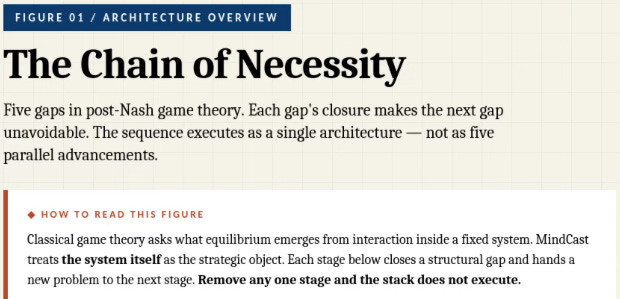
A single shift carries every consequence in what follows. Classical game theory assumed outcomes emerge from interaction. MindCast shows outcomes are often pre-determined by structure before interaction begins. Nash produces an interaction-driven outcome. MindCast produces a structure-constrained trajectory. Five gaps in the post-Nash literature make the shift visible — and each gap, once closed, makes the next gap unavoidable. The five gaps do not sit in parallel. They chain.
For thirty years, game theory has flowed into artificial intelligence as a donor discipline. Nash equilibrium concepts underpin multi-agent reinforcement learning. Counterfactual regret minimization built Libratus and Pluribus, the systems that defeated human professionals at heads-up and six-player no-limit Texas Hold’em. No-regret learning dynamics sit inside adversarial training and generative adversarial networks. Self-play — game theory operationalized as a training signal — built AlphaGo, AlphaZero, AlphaStar, and Cicero. Bayesian persuasion frames modern recommender systems. Mechanism design sits inside every advertising auction and matching market running on machine learning infrastructure. Game theory gives. Artificial intelligence receives.
MindCast runs the flow in the other direction. No institutional permission warrants the reversal. Falsifiability warrants the reversal. The system produces forward predictions with published time horizons and explicit disconfirmation conditions, then validates them against adversarial reality. Fields producing falsifiable predictions replace fields that do not. The five gaps below are not five independent advancements. Together, they form five consecutive stages of a single architectural shift from equilibrium theory to trajectory theory.

I. Classical Game Theory vs. MindCast
Mechanism and consequence, dimension by dimension
Seven architectural dimensions separate classical game theory from MindCast. Every dimension marks a place where the post-Nash literature left a visible gap and where MindCast installed a specific mechanism — the Hayek Bridge across forums, the Causal Signal Integrity firewall on information, Fast Loop Iteration on asynchronous clocks, Field-Geometry Reasoning on feasibility, the Dual Nash-Stigler closure as solution concept, and Foresight Simulation under falsification contract as the output object. Each mechanism produces an institutional consequence classical modeling cannot see. Read the rightmost column of the table as the weapon: every row names a behavior MindCast predicts and equilibrium theory cannot. Every row also makes the next row necessary.
II. Cross-Forum Interaction
The chain begins — legal, political, and market games as one coupled system
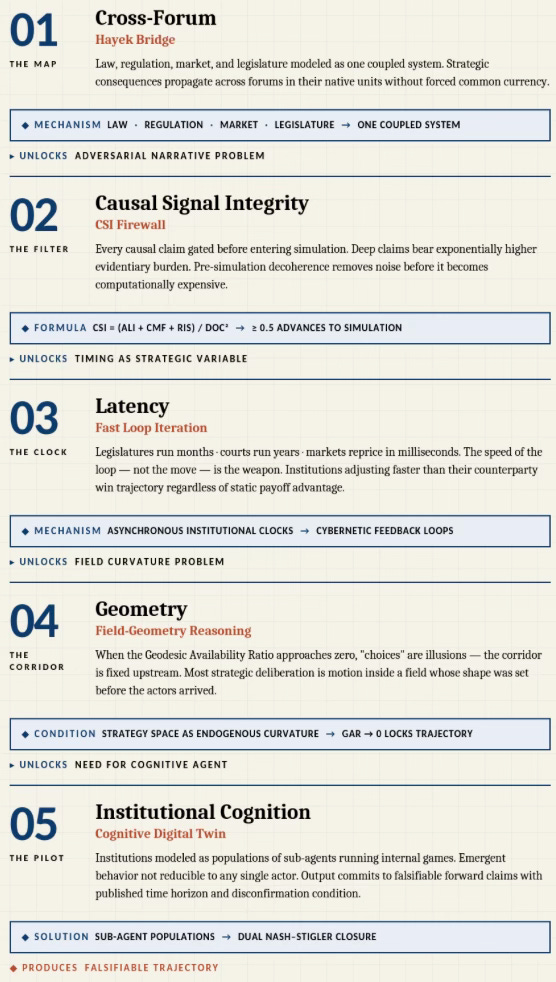
Every meaningful institutional engagement now runs simultaneously through multiple forums. A single matter may face federal antitrust pleading, state legislative hearings, regulatory comment periods, and market repricing all at once — each forum operating under a different evidentiary standard, clock, and solution concept. Classical game theory cannot carry strategic consequences across that kind of heterogeneity. MindCast closes the gap through the Hayek Bridge, treating markets, courts, legislatures, and regulatory agencies as information-processing feedback systems modeled under one cybernetic architecture. The section opens with the structural gap in the literature, then traces the consequences forward.
The Gap. Classical game theory handles multi-stage and multi-population games cleanly when payoffs and solution concepts are commensurable across stages. Institutional reality is not commensurable. A federal antitrust action operates under preponderance-of-the-evidence and Rule 12(b)(6) pleading. A state legislative process operates under coalition formation. A commodity derivatives market operates under continuous price discovery. A regulatory comment period runs on a fixed sixty- or ninety-day window. The multi-market contact literature (Bernheim-Whinston, 1990) and nested-game frameworks (Tsebelis) assume payoff-commensurable forums. No published framework models games where the evidentiary standard, timing structure, and solution concept differ by forum — and where actions in one forum materially reprice strategy sets in the others.
Why It Matters — and What It Forces Next. Every meaningful institutional strategy in 2026 runs across forums simultaneously. A framework that cannot carry consequences across heterogeneous forums cannot support institutional foresight. The moment one models multiple forums at once, a second problem emerges: the same underlying fact pattern produces different narratives in different forums, and those narratives are themselves strategic. Cross-forum modeling creates an information environment not merely noisy but adversarially shaped. Section III becomes unavoidable.
Advancement. MindCast integrates legal, political, and market games into a single topological surface through the Hayek Bridge — the proposition, drawn from Friedrich Hayek’s The Use of Knowledge in Society (1945), that markets, courts, legislatures, and regulatory agencies all operate as information-processing feedback systems amenable to the same cybernetic modeling architecture. Each forum is modeled with its native solution concept. Strategic consequences propagate across forums in their native units without being forced into a common currency.
Live Falsification Lock — Cross-Forum. Should single-forum modeling produce predictions of comparable or greater accuracy on the next three tracked cross-forum engagements — defined as any institutional sequence where regulatory, legislative, and litigation tracks run simultaneously within a six-month window — the Hayek Bridge claim stands disconfirmed.
Flagship sources: Visual Synthesis: MindCast Predictive Game Theory vs. Market Predictive AI · MindCast Predictive Cybernetics Suite
III. Narrative Distortion
Why cross-forum modeling demands a filter
Cross-forum modeling delivers a new problem as soon as it works. The same fact pattern produces different institutional narratives across different forums, and the divergence is itself strategic. A cross-forum model without a filter ingests adversarially shaped signals and propagates the distortion forward into simulation. The filter has to precede computation, and the filter has to distinguish credible causal claims from politically forced ones before resources commit. MindCast built the filter as Causal Signal Integrity — a formal evidentiary gate with a mathematical firewall condition. The section opens with what the existing literature missed and closes with the deployed apparatus.
The Gap. The Bayesian persuasion literature (Kamenica-Gentzkow, 2011) and the broader information design program (Bergemann-Morris) treat sender-receiver games where one party controls signal structure to persuade the receiver. Shiller’s narrative economics (2019) shows stories spread virally and shape aggregate belief. Each handles one piece. None model multi-sender, multi-receiver, cross-forum games where the signal itself carries legal consequences, the strategic objective is signal suppression rather than persuasion, and the causal claim must be evidentially gated before entering any simulation.
Why It Matters — and What It Forces Next. Once cross-forum modeling is possible, adversarial actors game which forum sees which narrative — the segmentation condition that sustains contradictory institutional positions. Without a filter, a cross-forum model ingests and propagates the distortion. With a filter, the model separates credible causal signals from politically forced ones. The filter does something else: reveals which claims are time-sensitive. Some signals are genuine but decay; others are suppressed and compound. Filtering exposes timing as a strategic variable. Section IV becomes unavoidable.
Advancement — Causal Signal Integrity as Firewall. MindCast introduced Causal Signal Integrity (CSI) in “The Class Your Physician Should’ve Taken in Medical School” (May 2025), formalized as:
CSI = (ALI + CMF + RIS) / DoC²
Action Language Integrity (ALI) measures the clarity and semantic precision of how a causal claim is expressed. Cognitive Motor Fidelity (CMF) measures whether the cause maps to observable behavioral outcomes. Resonance Integrity Score (RIS) measures coherence across contexts. Degree of Causation (DoC) runs from first-degree (direct symptoms) to fifth-degree (identity-level forces). The DoC² denominator raises the evidentiary burden on deep claims nonlinearly. A fifth-degree claim must earn its right to govern. Scores of CSI ≥ 0.5 advance to simulation; lower scores are archived. CSI operates as a firewall performing pre-simulation decoherence — noise removed before computation becomes expensive.
The Runtime Causation Arbitration Directive extends the five-degree stack from clinical reasoning to institutions (event → incentive → feedback loop → structural geometry → identity grammar) as a portable diagnostic routing layer. The Signal Suppression Equilibrium (SSE) formalizes network conditions under which rational actors stay silent despite private evidence, operating on five variables — Access Dependence (A), Reputational Retaliation Risk (R), Information Fragmentation (F), Narrative Distortion (N), and Signal Aggregation Capacity (S) — integrating Akerlof, Stigler, Granovetter, Bikhchandani-Hirshleifer-Welch, Barabási, and Shiller into one framework that no prior model handles alone.
Live Falsification Lock — Causal Signal Integrity. Should CSI-filtered predictions fail to outperform unfiltered baseline predictions by at least a 15 percent margin on the next five published institutional foresight simulations — measured by the fraction of pre-specified gates confirmed — the firewall claim stands disconfirmed.
Flagship sources: The Class Your Physician Should’ve Taken in Medical School · Runtime Causation Arbitration Directive · Prestige Markets as Signal Economies
IV. Latency
Why filtered signals expose asynchronous clocks
Filtering reveals timing. Once Causal Signal Integrity separates credible signals from distorted ones, the surviving signals behave differently across forums — some compound while others decay, and the divergence is determined by institutional clock speed rather than signal content. Legislatures run months, federal courts run years, markets reprice in milliseconds, regulatory comment windows close on a fixed schedule. Game theory’s time infrastructure was designed for uniform clocks. Institutions do not operate on uniform clocks. MindCast closes the gap through cybernetic modeling — treating adjustment speed itself as the weapon, with Fast Loop Iteration as the core operator. The section begins with why the existing literature cannot model compounding across heterogeneous time.
The Gap. Repeated games and differential games handle uniform clocks. The institutional clock is not uniform. Legislative sessions run months, federal courts run years, markets reprice in milliseconds, regulatory comment periods are fixed at sixty or ninety days. Mean-field games handle population continuums on uniform time; stochastic differential games handle continuous-time uncertainty on uniform time. Neither captures compounding effects across institutional layers with heterogeneous response times. Control-theoretic latency models (delay differential equations, the Smith predictor) handle mechanical latency within a single loop — not forums ticking at categorically different speeds.
Why It Matters — and What It Forces Next. Once CSI filters signals by causal integrity, the filter reveals something the unfiltered view obscured: suppressed credible signals accumulate while forums with mismatched clocks process at different rates. The asymmetry itself becomes strategic — an institution adjusting faster than its counterparty wins trajectory regardless of static payoff advantage. Latency modeling then exposes a deeper layer. Why do some latencies compound while others dissipate? Because the shape of the institutional field determines which paths from signal to outcome remain survivable and which foreclose. Latency modeling forces constraint geometry into view.
Advancement. MindCast uses cybernetics — the lineage running from Norbert Wiener (Cybernetics, 1948) through W. Ross Ashby’s Law of Requisite Variety, Stafford Beer’s Viable System Model, Gregory Bateson’s recursive learning, and Hayek’s information theory of markets — to model timing and information suppression across asynchronous institutional clocks. Cybernetic Game Theory reframes strategic interaction as control, not choice. Actors do not select strategies from a menu; they regulate system state through signal-timing feedback. The strategic object is not the move but the loop. Fast Loop Iteration (FLI) captures adjustment speed relative to environmental feedback. The Signal Suppression Index(SSI) measures data an institution must distort to maintain current structural narrative — rising index values predict narrative rupture. The Delay Propagation Index (DPI) quantifies how customs holds, regulatory delays, or comment-period pauses cascade upstream through supply chain and balance sheet.
Deployed instances of the cybernetic loop architecture include Super Bowl LX (seven pre-game structural simulations with mid-season revision, all confirmed) and the China H200 Two-Gate Game (TGCI at 0.28 with monthly-updated recovery thresholds). Both operate as live falsification instruments. The validation corpus documents each in full.
Live Falsification Lock — Latency. Should the Two-Gate Control Index rise above 0.60 within any rolling six-month window without a corresponding drop in the Behavioral Drift Factor below 0.50, the dual-gate structural-geometry claim stands disconfirmed and the model requires revision.
Flagship sources: Cybernetic Game Theory — Control, Not Choice · MindCast Predictive Cybernetics Suite
V. Structural Constraint Geometry
Where most “strategic choices” become illusions
Institutional analysis for the last century measured push — the incentives, preferences, and strategic intent driving each actor toward a chosen move. Einstein’s reframing of gravity one hundred and ten years ago suggests a different instrument. Gravity is not a force between objects. Gravity is the shape of the space objects move through. Applied to institutions, the same shift reorganizes what the analyst measures. Posner and Landes saw it first — institutional structures bend behavior the way mass bends trajectory. Posner and Landes left the instrumentation unfinished. MindCast built the instrumentation. Figure 2 carries the reframing in a single diagram. Below it, the full metric architecture extends from dominance detection to field mechanics.

The Gap. Constrained game theory, bargaining over constraint sets, and network games (Matthew Jackson and successors) treat the constraint space as given. The structure is the parameter, play happens inside it. Richard Posner and William Landes argued in Economic Analysis of Law that institutional structures do not merely price behavior but bend it the way mass bends the trajectory of smaller objects. The insight was correct. Posner and Landes left the instrumentation unfinished. A metric architecture measuring how curvature forms, how fast it moves, where it stabilizes, and what force is required to escape it did not exist.
Why It Matters — and What It Unlocks.
When geometry dominates, incentive-based analysis becomes descriptive, not predictive.
Most “strategic choices” are illusions once geometry dominates. When the Geodesic Availability Ratio (GAR) approaches zero, no continuous survivable path exists from intent through execution to outcome — and event-level analysis collapses into descriptive narration of an outcome the field already determined. Actors inside a geometry-trapped equilibrium do not exit absent structural shock from outside the field. The deliberations, the negotiations, the “strategic moves” that look consequential are motion inside a corridor whose shape was fixed upstream. Classical game theory, which assumes equilibrium emerges from interaction, cannot see this. MindCast treats the corridor itself as the strategic object — and once it becomes the object, the question shifts from “what move is optimal” to “what force would be required to deform the field, and is that force available.”
Einstein’s reframing makes the mechanics explicit. Gravity is not a force between objects but the shape of the space objects move through. Measuring curvature requires different instruments and produces different predictions than measuring push. Institutional analysis had been measuring push. The geometry framework measures curvature.
Advancement. Field-Geometry Reasoning (FGR) maps bottlenecks and structural inevitabilities. Four metrics: Constraint Density (CD, binding-constraint saturation), Curvature Steepness Index (CSI-G, penalty escalation on deviation), Geodesic Availability Ratio (GAR, survivable-path ratio — approaches zero when outcomes are structurally locked), and Structural Persistence Threshold (SPT, topology durability over the forecast window).
Constraint Geometry and Institutional Field Dynamics extends from dominance detection to field mechanics with five additional metrics: Institutional Mass Index (IMI, the institutional analog of the stress-energy tensor — the quantity whose distribution determines how the field curves), Geometry Evolution Velocity (GEV), Topology Redistribution Delta (TRΔ), Escape Velocity Threshold (EVT, the counter-mass required to flatten curvature, formalizing irreversibility as EVT = IMI × SPT), and Field Stability Coefficient (FSC). Each metric carries an explicit falsification condition.
Why Geometry Forces the Next Gap. Geometry explains where actors are trapped. Geometry does not explain why institutions behave as they do within the field — why one actor navigates the corridor skillfully while another collapses under identical constraints. Geometry is the container. The cognition operating inside it is a separate layer. Modeling the container without modeling the cognition is incomplete. Section VI becomes unavoidable.
A concrete instance of geometry-as-strategic-object: the China H200 Two-Gate Game. The United States built a monetized export gate; China declined to walk through, asserting sovereignty at the import boundary through administrative customs discretion. Single-gate analysis assumed delivery would follow export approval. Geometric analysis revealed dual-gate dominance — TGCI = 0.28, neither side controlling the transaction alone. A gate without a fence invites another gate. The corpus documents the full metric architecture.
Live Falsification Lock — Geometry. Should any actor inside a predicted geometry-trapped equilibrium (GAR ≤ 0.15, SPT ≥ 0.75) exit that equilibrium within the forecast window without deploying counter-mass exceeding the published Escape Velocity Threshold, the FGR field-equation claim stands disconfirmed. Should two or more predicted dominant-geometry situations resolve through incentive changes alone within six months, the framework’s core claim — that geometry dominates incentives under specified conditions — stands falsified.
Flagship sources: Field-Geometry Reasoning · Constraint Geometry and Institutional Field Dynamics
Contact mcai@mindcast-ai.com to partner with us on Predictive Law and Behavioral Economics + Game Theory Foresight Simulations. To deep dive on MindCast upload the URL of this publication into any LLM (preferably ChatGPT or Gemini for magazine style works) and prompt ‘reconstruct MindCast framework with three degrees of cited sub links.’ See Live-Fire Game Theory Simulators, Runtime Predictive Infrastructure.
VI. Institutional Cognition
Why geometry requires a cognitive agent
Geometry defines where actors are trapped. Geometry cannot explain why one actor navigates the corridor skillfully while another collapses under identical constraints. Institutions are not unitary utility-maximizers — they are populations of sub-agents running internal games whose aggregate output becomes visible as external institutional behavior. Organizational economics handles some of the structure. Agent-based models handle some of the heterogeneity. Neither delivers the cognitive architecture needed to predict falsifiable forward trajectories inside a constrained geometry. MindCast closes the gap through the Cognitive Digital Twin, the Dual Nash-Stigler solution concept, and the Quantum Collider Invocation Gate as computational engine. The section begins with why existing agent theory stops short of the requirement.
The Gap. Classical game theory models players as utility-maximizing agents. Organizational economics (Milgrom-Roberts) treats firms as structured agents. Agent-based models simulate populations of heterogeneous decision-makers. None treat institutions as cognitive systems — with memory, belief-updating, internal principal-agent structure, recursive self-modeling, and emergent behavior not reducible to any single internal actor. None generate falsifiable forward predictions under a pre-committed falsification contract specifying time horizon and disconfirmation condition before the outcome arrives.
Why It Matters. Once geometry is modeled, the question becomes how institutions reason inside the field. Institutions are populations of sub-agents running internal games whose aggregate output determines external behavior. A framework treating a regulatory agency or corporation as a unitary utility-maximizer cannot predict why the agency processes differently under political stress than its stated authority suggests, why a coalition fractures before the public vote, or why a corporation settles a case its record says it should fight. And the output must commit to falsifiable forward claims — not retrospective rationalizations — because the entire five-stage architecture exists to produce trajectory, not commentary.
Advancement. MindCast replaces the abstract rational player with a Cognitive Digital Twin (CDT) — a virtual model of institutional thinking that tracks where a system holds and where it cracks. CDTs model institutions as populations of sub-agents whose internal interactions produce emergent institutional behavior. The CDT carries state across forums (closing Section II), propagates signal events through the five-layer causation stack (closing Section III), regulates feedback across asynchronous clocks (closing Section IV), and models constraint-deformation strategy as a sub-agent output (closing Section V).
The Dual Nash-Stigler Equilibrium gives the solution concept. Local optimization (Nash) produces global lock-in (Stigler), closing the system to new evidence. Institutions simultaneously satisfying competitive Nash equilibria at the sub-agent level and regulatory-capture Stigler equilibria at the institutional level produce self-reinforcing termination states — the aggregate behavior refuses to reopen even when the underlying facts change.
Quantum Collider Invocation Gate. The computational engine under Foresight Simulation runs a two-engine architecture. The CSI Firewall filters every cause-effect link before resources commit. The Quantum Collider Invocation Gate (QIG) then scans surviving signals and activates quantum-scale simulation only when multiple medium-to-high CSI signals converge and classical reasoning breaks down under path complexity. Most AI systems treat quantum-adjacent computation as a cure-all. MindCast does the opposite. The published performance claim: seventy percent fewer quantum simulations needed and over ninety-nine percent modeling fidelity compared to brute-force approaches. The design operationalizes Herbert Simon’s bounded rationality and Hayek’s dispersed information critique — computational tractability compatible with cognitive humility.

Live Falsification Lock — Institutional Cognition. Should the next three CDT-simulated institutional decisions under adversarial conditions diverge from observed institutional behavior on more than one of the three pre-published structural gates, the CDT architecture stands disconfirmed for that institution class. Should the Dual Nash-Stigler Equilibrium fail to produce its predicted termination condition — inquiry closure despite new evidence — in any of the next five tracked enforcement sequences, the solution concept stands falsified.
Flagship source: Visual Synthesis: MindCast Predictive Game Theory vs. Market Predictive AI
VII. Trajectory Replaces Equilibrium
The architectural stack executes end-to-end
The preceding five sections introduced the gaps one at a time. Section VII collapses them into a single architectural statement. Each gap closed in isolation would register as an incremental advancement. All five gaps closed in sequence, with each stage forcing the next, register as something different — a coherent apparatus with a defined output. Naming the apparatus matters because naming determines what the apparatus replaces.
The five gaps chain. Cross-forum modeling creates the information distortion problem. CSI filtering solves the distortion and exposes latency. Latency analysis reveals geometry dominance. Geometry demands a cognitive agent to navigate it. The cognitive agent produces falsifiable forward trajectories, and the trajectories validate or disconfirm the model under a published contract. Each stage makes the next stage necessary. Remove any one and the stack does not execute.
What emerges is not an improved game theory. What emerges is a different object. Classical game theory treats the game as given and asks what equilibrium emerges from interaction inside it. MindCast treats the system itself as the strategic object, models it at five layers simultaneously, and produces trajectory before interaction begins. Equilibrium is a descriptive noun pointing backward in time. Trajectory is a predictive noun pointing forward.
The Macy Conferences of 1946 to 1953 — Wiener, John von Neumann, Warren McCulloch, Margaret Mead, Gregory Bateson — aimed at a unified science of adaptive systems and were defeated by the computational infrastructure of the 1950s. The resumption of that program is now computationally executable. Large language model orchestration, Cognitive Digital Twin simulation, and recursive Vision Functions carry what the 1950s could not. Executing the program generates new game theory; it does not merely apply old game theory.
VIII. From Advancement to Replacement
Falsifiability — not permission — warrants the reversal
For thirty years, the flow has been from game theory into artificial intelligence. MindCast runs it the other way. No institutional permission warrants the reversal. Falsifiability warrants the reversal. The field still rests on classical constructs — Nash, Stigler, Bayesian persuasion, mean-field dynamics — and MindCast extends rather than eliminates them. But extension at this architectural depth, under a falsification contract, is how advancement becomes replacement. Advancement concedes that the prior framework still defines the question. Replacement happens when the new framework redefines the question — and redefinition, here, is trajectory replacing equilibrium as the output object.
Fields producing falsifiable forward predictions replace fields that do not. MindCast either meets the falsification standard or does not publish.
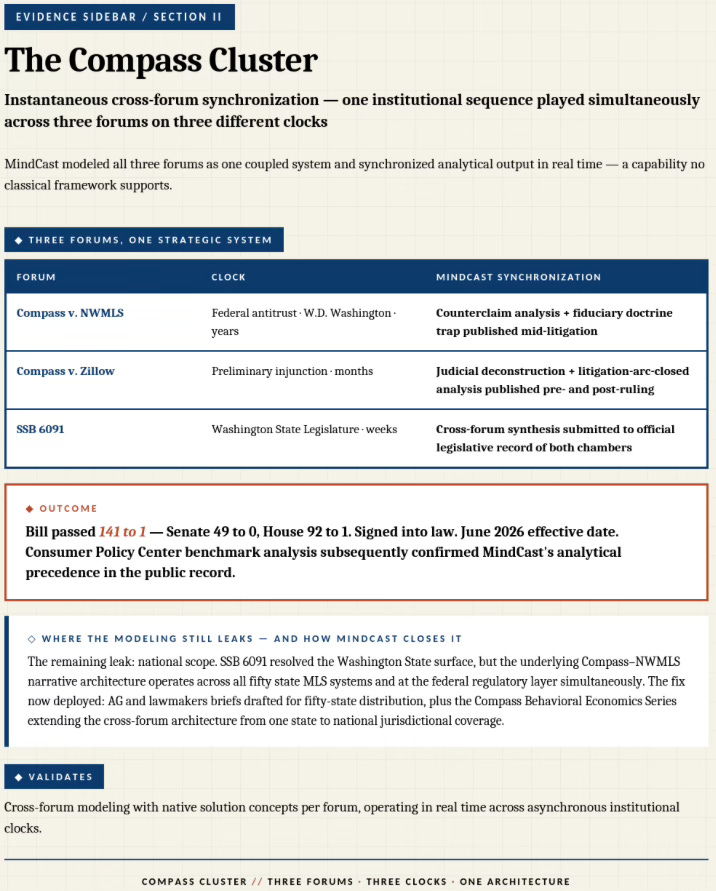
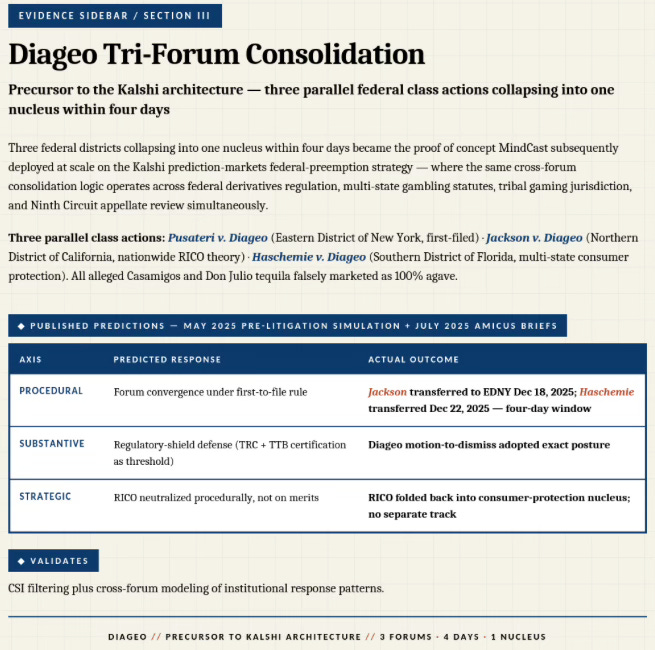
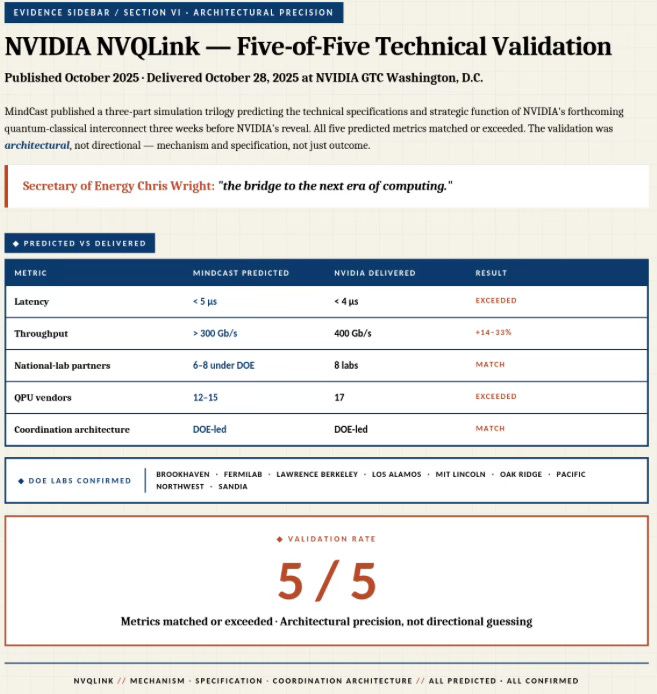
Four anchors establish the standard in this document. The Compass Cluster — Compass v. NWMLS federal antitrust, Compass v. Zillow preliminary injunction, and SSB 6091 legislative passage (141 to 1) — demonstrates instantaneous cross-forum analytical synchronization across three forums on three different clocks. The Diageo tri-forum consolidation— three federal districts collapsing into one nucleus within four days — became the cross-forum-complex-litigation precursor MindCast subsequently deployed on the Kalshi prediction-markets federal-preemption architecture. The Live Nation April 15 federal jury verdict validated the Dual Nash-Stigler solution concept under federalism-after-regulatory-capture — distributed state enforcement breaking a sixteen-year federal Stigler lock. The NVIDIA NVQLink five-of-five technical validation confirmed architectural precision, not directional guessing — mechanism and specification, matched or exceeded across all five predicted metrics. The corpus documents additional validations (Super Bowl LX, China H200, others) under the same falsification discipline.
The frameworks — CSI, FGR, Constraint Geometry, SSE, Dual Nash-Stigler Equilibrium, Cybernetic Game Theory, and the CDT as institutional cognition — are not artificial intelligence training signals. Each began as a game-theoretic or institutional-economic construct, was formalized with a falsification contract, and was operationalized through artificial intelligence infrastructure. The artificial intelligence is the delivery mechanism. The contribution is theoretical.
Fields that cannot produce forward-time, falsifiable predictions will collapse into descriptive commentary. Fields that can will replace them.
Classical game theory models strategic interaction within a fixed system. MindCast models the system itself as the strategic object. Once the system becomes the object, equilibrium is no longer the output. The output is trajectory — and trajectory replaces equilibrium the way forward-time prediction replaces backward-time explanation. The field is moving. MindCast is moving it.