
Meta · Boeing · Starling Bank · TikTok · Wells Fargo · Standard Chartered · Federal Trade Commission · Federal Reserve · Financial Conduct Authority · Department of Justice
Foresight-to-Duty Conversion Series Introduction: Meta Foresight-to-Duty Conversion Across Privacy, Child Safety and Scam Ads · Meta and Bank of America Foresight-to-Duty Conversion: Revenue-Funded Versus Cost-Funded Deferral · Consent Order Remedies at Meta, Boeing, Starling and Wells Fargo: Verified Correction Versus Recurrence
Related Works: Bank of America $1.2 Billion Money Laundering Penalty and the Compliance System That Knew Too Much · The Foresight-to-Duty Conversion — Measured Governance Debt Becomes Evidence When Institutions Keep the Gap They Found
Foundational Works: The Duty to Foresee, AI Deployment Readiness as Prospective Governance, and the Arrival of Agentic Duty of Care · AI Governance Equilibrium · Decision Modeling and Foresight Simulation
Executive Summary
Enforcement can resolve a violation without changing the decision architecture that produced it. Effective assessment requires a timely corrective response and an operative consequence. External verification alone does not establish durable correction.
Thesis: A remedy changes the decision rule when a finding reaches someone who must respond on a fixed timetable and a consequence attaches if the response fails. The Federal Reserve lifted Wells Fargo’s asset cap on June 3, 2025 after third-party review and its own assessment. It terminated the 2018 action on March 5, 2026. Meta’s 2019 order supplied independent testing and agency oversight tools, and the corrective response stalled.
Boeing breached its 2021 deferred prosecution agreement, Starling breached a 2021 restriction on high-risk accounts, and TikTok agreed in August 2026 to pay $400 million to resolve alleged violations of its 2019 order.
What distinguishes the MindCast approach: The Foresight-to-Duty Conversion: Measured Governance Debt Becomes Evidence When Institutions Keep the Gap They Found (2026) showed that the clock on inadequate governance starts when knowledge reaches an actor with authority. The present paper shows that a consent order can deliver that knowledge in writing, so a later stall on the specified deficiencies runs against a documented receipt. Bank of America $1.2 Billion Money Laundering Penalty and the Compliance System That Knew Too Much (2026) supplies the live checkpoint through its S-2 entry on whether supervisors report detection-effectiveness results by October 13, 2028 (55-68%).
MindCast AI applies Predictive Behavioral Economics + Dynamic Game Theory through the MindCast AI Proprietary Cognitive Digital Twin Foresight Simulation (MP CDT FS) system. Behavioral economics explains why attestation fails: the function that writes the report answers to the authority that deferred. Game theory explains why order compliance raises the stakes: every report filed under an order becomes the next measurement file if the gap persists.
What the paper does: The paper classifies remedies by the powers they confer and the link where they stall, then dates knowledge under an order. It examines four firms that stalled again under supervision and one monitored bank whose later resolution tests the classification. It contrasts Wells Fargo’s relocated verification, defines a persistence test after oversight ends and closes with four Simulation Predictions and a Risk Mitigation Layer.
Simulation Prediction highlights: The forecast set carries four MindCast Foresight Simulation Predictions: two primary and two secondary. The lead entry forecasts that an enforcement action against a firm other than Meta cites that firm’s order compliance or assessor reports as knowledge evidence by December 31, 2028 (50-79%). The band is wide because the number of firms under order that will face a new action is uncertain.
🏛️ Policymakers: Remedies that pair effectiveness testing with a consequence the verifier’s finding triggers bind growth to correction. The Wells Fargo asset cap did so.
💼 Executives: Risk and compliance leaders: every assessment filed under an order dates knowledge for its recipients. Revenue owners: a remedy that leaves approval with your line leaves the decision rule intact. Boards: the link of the response chain a remedy leaves to management is where the next stall will sit.
🤖 AI deployment leaders: A launch gate with an assessor who can withhold sign-off attaches the consequence directly. A gate that only reports leaves the consequence to a regulator’s later action.
⚖️ Counsel: Compliance reports are future exhibits. A post-order action can cite them as evidence of knowledge for the recipients the order names.
📊 Investors: Termination of an order is an exit milestone, not proof of correction. New findings in the same domain during the three years after termination show which remedies held.
Across audiences the implication is the same. A remedy’s value lies in the response it compels and the consequence it attaches, not in the reports it produces.
I Remedies Fix Conduct, and Some Also Relocate Verification
A remedy names conduct and requires its cessation. Most remedies add a reporting obligation, and the firm’s own compliance function writes the report. Verification stays inside the authority that deferred.
A smaller class of remedies moves verification outside the firm and gives the verifier powers. Five powers matter. Independence from the firm and scope to test effectiveness come first. Access to evidence, escalation rights to the regulator and an enforcement consequence complete the set.
External location without those powers is attestation at a distance.
Available powers and delivered response are different things. Meta’s 2019 order installed an independent assessor with testing scope, reporting to a board privacy committee, agency oversight tools and penalties for false certification. The assessor found program gaps and reported them, and the agency’s response took the form of a 2023 modification proposal that the agency itself stayed in July 2025.
Classification follows two axes: the powers a remedy confers and the link in the response chain where it stalled. Meta held the powers and stalled at response. Boeing and Starling relied on reporting and the firm’s own controls.
Takeaway: The five powers describe what a remedy makes possible, and the response chain shows whether anyone used them in time.
II Consent Orders Change Deferral Payoffs Through Whom They Name, So Firms Fight Over Scope
A consent order changes the payoff of deferral more through its reporting terms than through its penalty. Before an order, an enforcer must prove that someone with authority received a finding. After an order, the instrument names the recipients and fixes the filing dates, so receipt of the deficiencies it specifies no longer needs separate proof.
The deferral inequality from the companion paper shows the mechanism. Deferral holds while the salience-weighted expected sanction stays below the cost of correction, and the expected sanction includes the probability that an enforcer proves knowledge from the file. An order pushes that probability toward certainty for the deficiencies it names. Deferral that was rational before the order stops being rational for those deficiencies, while deficiencies outside its scope keep their old odds.
Game theory therefore predicts where firms will spend their resistance. A firm facing an order gains more from narrowing its scope than from trimming its penalty, because scope sets the probability term for every later year. Meta’s contest of the Federal Trade Commission’s authority to modify its order fits the prediction, since the dispute concerns what the order may require rather than what Meta must pay.
TikTok’s August 2026 resolution fits it more sharply. TikTok agreed to pay $100 million more once its 2019 order is vacated, on top of $300 million for the alleged violations. Ending the order’s obligations carried a cost of its own, which is what the payoff structure predicts a firm will accept.
Behavioral economics explains why reporting terms bite before any enforcer acts. A finding addressed to a named committee or officer stops being a diffuse institutional fact and becomes a dated item in a specific person’s file. Salience rises for the person who must decide whether to fund the fix. Delaware oversight claims turn on whether a finding reached the board, as Bingle shows, so an order that routes findings to the board also routes exposure there.
The effect has limits the public file must respect. An order establishes notice only of the deficiencies it specifies, subject to its admissions and findings. A later assessor finding on a new gap starts its own interval when it reaches the recipient the order names, and a deficiency outside the order returns the enforcer to proving receipt from scratch.
AI deployers inherit the same structure. A launch gate or an order that names who receives evaluation findings converts each evaluation report into dated notice to a named person. The deployer then faces post-order odds on every finding the gate requires it to report.
Takeaway: An order changes deferral payoffs through whom it names and what it requires, so the fight over scope predicts how firms resist.
III Compliance Reports Become the Next Measurement File
Meta’s independent assessor found program gaps under the 2019 order, and the Federal Trade Commission’s 2023 modification filing relied on them. The report written to show compliance became the exhibit that showed its absence. The agency stayed its show-cause proceeding on July 30, 2025, and Meta contests the agency’s authority in federal court to modify a judgment the court entered.
Bank of America’s order sets up the same game for its peers. The order requires an independent review of the program. A bank under such terms can fund review capacity or narrow its documentation, and narrowing below what the review requires breaches the order’s terms.
Firms under order respond to the reports’ evidentiary value. A firm can describe process, meaning policies adopted and trainings completed. It can instead describe effectiveness, meaning detection rates and gaps closed. Process reports date knowledge of less, so a firm that keeps its decision rule drifts toward them.
Regulators counter by writing effectiveness testing into the order itself. Bank of America’s order requires an independent review of the program, and Section VIII treats the basis of the next follow-up as the live test of that contest. The balance between process reporting and effectiveness testing decides how much each report can later prove.
The reports also accumulate. A firm that files under an order for three years builds a dated series, and a plaintiff reads the series as a timeline of what the named recipients knew and when. P-1 forecasts whether an enforcement action against a firm other than Meta uses such a series as knowledge evidence.
Takeaway: Each report a firm files under an order can date knowledge for the next enforcer, so firms drift toward process reporting and regulators push back with effectiveness testing.
IV Four Firms Stalled Again Under Supervision
The paper separates three kinds of post-remedy event. New misconduct is conduct that began after the remedy. A continuing deficiency is a gap the remedy named that stayed open. Newly discovered historical conduct predates the remedy and says little about whether it worked.
The table classifies each remedy across the five links of the response chain, then names the stalled link and the type of post-remedy event.
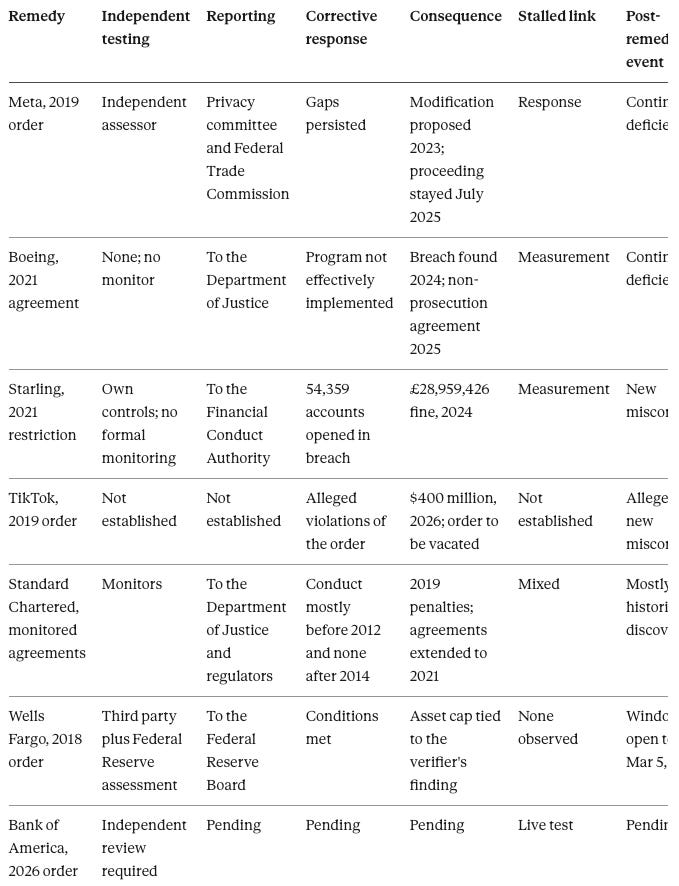
Meta operated under an order from 2012 and a second from 2019. Assessor findings under the 2019 order showed continuing deficiencies, and the 2023 modification filing rested on them. The failed link was the corrective response, which has taken more than three years without a consequence attaching.
Boeing entered a deferred prosecution agreement in January 2021 without a monitor. On May 14, 2024 the Department of Justice found a breach for failing to design, implement and enforce a compliance program to prevent and detect fraud. The breach is a continuing deficiency in the required program, and the January 2024 door-plug failure brought scrutiny to it without itself constituting the breach.
The Boeing sequence continued after the breach. A court rejected a plea agreement in December 2024, a non-prosecution agreement followed in May 2025 and the court dismissed the charge in November 2025. The Fifth Circuit denied the victims’ challenges in 2026.
Starling Bank accepted a restriction on September 17, 2021 barring new accounts for high-risk customers. The Financial Conduct Authority’s September 27, 2024 final notice found that Starling opened 54,359 accounts for 49,183 such customers in breach of the restriction and fined it £28,959,426. The breach is new misconduct under a remedy the bank’s own controls enforced, and the notice found no formal program monitoring compliance with the restriction.
TikTok operated under a 2019 consent order entered against its predecessor Musical.ly. The Department of Justice sued in August 2024 for violating the order, and on August 21, 2026 TikTok agreed to pay $300 million plus $100 million once the 2019 order is vacated. The resolution includes no injunctive relief, so the order’s specific obligations end on vacatur while ordinary statutory enforcement continues.
Takeaway: Each second stall sits at a named link, and the classification separates new misconduct from continuing deficiency.
V A Monitored Bank Tests the Classification
Standard Chartered shows why the classification matters. The bank’s April 9, 2019 resolution of sanctions violations with U.S. and U.K. authorities extended its deferred prosecution agreements to April 2021. The bank stated that the vast majority of the conduct predated 2012 and none occurred after 2014, and both monitorships had ended by March 2019.
Most of that conduct is newly discovered historical conduct, which says little about the monitored remedy. The portion that continued into 2014 overlapped the period of supervision. A remedy with an embedded verifier can therefore coexist with ongoing violations for a time, and durability still has to be tested after exit.
Takeaway: Monitored remedies also require testing after oversight ends, and the classification keeps historical discovery from counting as recurrence.
VI Wells Fargo Shows Relocated Verification With a Consequence
capped assets until the board improved governance and risk management and a third party confirmed the improvements. The Board reviewed the third-party assessments and ran its own assessment before lifting the cap on June 3, 2025. It terminated the action on March 5, 2026 while other regulators’ orders continued.
The consequence was large in the currency management cared about. The Federal Reserve held Wells Fargo at $1.95 trillion in assets for about seven years, while Bank of America and Citigroup each grew total assets by 44% and JPMorgan Chase by 76%. The cap cost growth rather than cash, and growth was the metric on every senior executive’s line.
Behavioral economics explains why the design worked where fines had not. A fine lands once and spreads across shareholders, while a growth cap stays salient every quarter it binds. The verifier’s finding controlled the one consequence management could not budget around.
The case also limits the claim. The cap lifted after third-party and Federal Reserve assessments verified remediation, but durability after termination stays untested until the window in Section VII closes. Internal correction before an enforcer arrives remains a hypothesis, because no comparator on the public file documents it with enough precision.
Takeaway: Wells Fargo paired verification with a consequence denominated in growth, and the durability of that correction still awaits its post-termination window.
VII Persistence After Oversight Ends
Three endpoints require separate assessment. Procedural compliance covers policies, attestations and reports. Verified operational correction covers evidence that the deficiency closed. Durable institutional correction covers correction that persists after supervision recedes.
The test asks whether the remedy changed budget authority, escalation obligations or control performance, beyond adding an assessor. A remedy that changed none of the three left the decision rule intact.
The window is three years after the enforcement action terminates. Wells Fargo’s window runs from March 5, 2026 to March 5, 2029. Other provisions of the 2018 action stayed in force after the asset cap lifted, so the cap date does not start the window. Ordinary supervision continues through the window, and the test reads for findings classified as new misconduct or continuing deficiency.
Absence of a new action does not establish durability. Detection intensity falls after termination, and a gap can persist unobserved. Durability reads from two signals together: no classified finding in a covered domain within the window, and a disclosed change in budget authority or escalation obligation that survived termination.
Takeaway: Durability is tested after the action terminates, on classified findings and surviving structural changes, not on silence.
VIII Bank of America Is the Live Test
The Bank of America paper’s S-2 entry serves as the checkpoint: supervisors report detection-effectiveness results on remediation by October 13, 2028 (55-68%). A hit shows verified operational correction. It does not show durable correction, which requires the window in Section VII.
An effectiveness-based follow-up places Bank of America on the Wells Fargo path. An attestation-based follow-up places it with the firms in Section IV and tells peer banks that documentation suffices. Termination of the order would supply an exit milestone and start the window, not end the test.
Agency publication practice limits what the public file can show. Office of the Comptroller of the Currency terminations appear in monthly listings without narrative, and FinCEN releases rarely describe the testing behind a termination. Verified correction may occur without any public statement saying so.
Takeaway: The basis of the next supervisory follow-up classifies the remedy, though the public file may not show it.
IX Remedy Design for Regulators and AI Deployers
The cases in this installment support three design rules, each tied to the link where a remedy failed. Boeing and Starling relied on the firm’s own controls, so the first rule requires effectiveness testing by someone outside the firm. Meta’s assessor reported gaps that persisted for years, so the second rule sets a deadline for the corrective response to each finding.
Wells Fargo’s cap bound growth to the verifier’s finding, so the third rule attaches a consequence the finding triggers without a separate proceeding. The Wells Fargo case also shows the consequence works best when it lands on the metric management tracks.
The rules carry different costs. Effectiveness testing raises the cost of each order for the regulator. Deadlines raise the cost of delay for the firm, and verifier-triggered consequences shift bargaining power for the remedy’s whole life, which is why Section II predicts firms will resist them hardest.
For AI deployers the third rule takes the form of a deployment-readiness gate. The Federal Trade Commission’s 2023 proposal sought an assessor’s sign-off before new product launches at Meta, the control The Duty to Foresee: AI Deployment Readiness as Prospective Governance, and the Arrival of Agentic Duty of Care (2026) described for autonomous systems. A gate works when the verifier can withhold sign-off directly, as the Federal Reserve’s control of Wells Fargo’s growth did.
Takeaway: Each design rule answers the link where a case failed, and a launch gate carries the third rule into AI deployment.
X Response and Consequence Compete With Verifier Powers as Explanations of Durability
The cases above admit three readings of why some remedies last. Each appears below as a hypothesis with its falsifier, and the comparison that would choose among them follows.
Hypothesis A: response and consequence predict durability: Remedies with a response deadline and an operative consequence show lower same-domain recurrence after termination. Falsifier: such remedies recur at the same rate as reporting-only remedies.
Hypothesis B: verifier powers alone predict durability: External verification with independence, scope and access is enough. Falsifier: remedies with full verifier powers recur when the response stalls, as Meta’s sequence suggests.
Hypothesis C: detection intensity drives observed recurrence: Recurrence reflects how closely regulators look rather than how well remedies work. Falsifier: recurrence rates stay stable across periods of differing supervisory intensity.
The comparative recurrence test remains open without a band. Among remedies imposed between 2019 and 2024 on the firms named here, none combines every link of the response chain with a completed three-year post-termination window, so the comparison group is empty until more cases close.
XI MindCast Simulation Predictions
The forecast set carries four Simulation Predictions: two primary (P) and two secondary (S). One secondary entry is conditional and prints as P(A given B). Verification sources and partial-outcome rules for each entry appear in Appendix B.
P-1 · An enforcement action against a firm other than Meta cites that firm’s order compliance or assessor reports as knowledge evidence by December 31, 2028 (50-79%)
A citation of the firm’s pre-order internal testing does not count. Falsifier: no such citation by the deadline.
P-2 · The Meta order modification resolves with a product-launch gate requiring independent assessor sign-off by December 31, 2028 (14-23%)
Withdrawal of the modification, a ruling barring it or no resolution by the deadline counts as a miss. Falsifier: no launch gate by the deadline.
S-1 · Wells Fargo faces a new federal enforcement finding of new misconduct or continuing deficiency in a domain its 2018 action covered by March 5, 2029 (17-32%)
Findings on conduct corrected before termination do not count. Falsifier: no classified finding by the deadline.
S-2 · Given termination of the Bank of America order by December 31, 2029, the termination statement describes effectiveness testing (17-33% given termination)
No termination by the deadline leaves the entry unresolved. Falsifier: termination without a statement describing effectiveness testing.
The four entries test the compliance-report mechanism and the durability window. P-1 tests whether reports filed under an order become evidence elsewhere. P-2 tests the launch gate, and S-1 and S-2 test Wells Fargo’s window and Bank of America’s exit.
Takeaway: The forecasts test whether reports become evidence and whether remedies hold after exit.
XII Risk Mitigation Layer
Exposure appears in a unit each stakeholder controls, with severity and probability stated separately.
Regulators · P-2 (14-23%), S-2 (17-33% given termination): Severity: high. Exposure: a reporting-only remedy signals to the regulated population that documentation suffices.
Action 1: write effectiveness testing and a verifier-triggered consequence into each new order, owner the enforcement division, at the next order in the domain.
Action 2: set a response deadline for each assessor finding, owner the enforcement division, same deadline.
Action 3: publish the testing basis when an order terminates, owner the enforcement division, at each termination.
Residual: a verifier with powers raises the cost of each order and lowers the number the agency can carry.
Boards of firms under order · P-1 (50-79%): Severity: high. Exposure: a plaintiff reads the series of compliance reports as a timeline of deferral.
Action 1: fund the correction each report describes before the next report issues, owner the board committee the order names, each reporting cycle.
Action 2: change the approval authority the report identifies as well as the control, owner the committee chair, before termination.
Residual: the earlier reports remain dated knowledge of the period before correction.
Monitors and assessors · P-2 (14-23%): Severity: moderate. Exposure: findings without a response deadline or consequence become exhibits in a later action rather than corrections in the current one.
Action 1: negotiate response deadlines and consequence terms into the engagement, owner the monitor, at engagement.
Action 2: report effectiveness results rather than process compliance in each cycle, owner the monitor, each cycle.
Residual: a regulator may decline the terms.
Consumer groups and public-interest researchers · P-1 (50-79%): Severity: moderate. Exposure: a recurring harm without a named approver and a dated finding stays a complaint rather than an accountability claim.
Action 1: request the assessor reports and compliance certifications filed under each relevant order and map each reported gap to the recipient the order names, owner the research lead, before the next filing cycle.
Action 2: classify each remedy in the domain by the response-chain link it supplied and publish the classification, owner the research lead, within two quarters.
Residual: sealed assessor reports leave the recipient column open.
Investors · S-1 (17-32%), S-2 (17-33% given termination): Severity: moderate. Exposure: termination read as proof of correction understates risk during the three-year window when detection intensity falls.
Action 1: hold the governance risk flag at its pre-termination level until a classified finding or a clean window resolves it, owner the governance analyst, at termination.
Action 2: request disclosure of surviving budget-authority and escalation changes, owner the stewardship lead, before the first post-termination annual meeting.
Residual: a clean window under reduced detection intensity still leaves an unobserved gap possible.
The actions share one direction. Each attaches a deadline or a consequence to a finding that would otherwise stay a report.
Takeaway: A remedy holds when the finding it produces can trigger action without a second proceeding.
Conclusion
Supervisory interventions at Meta, Boeing, Starling and TikTok preceded renewed stalls at different links of the response chain. Wells Fargo shows the alternative: a remedy that paired verification with a consequence the verifier’s finding controlled. Standard Chartered shows that even a monitored remedy needs testing after exit.
Correction still needs a durability test. Wells Fargo entered its three-year window on March 5, 2026. A classified finding in a covered domain before March 5, 2029 would move it from correction to recurrence. Bank of America’s next supervisory follow-up places it on one path or the other.
P-1 tests whether compliance reports filed under an order become evidence of knowledge: an enforcement action against a firm other than Meta cites that firm’s order compliance or assessor reports as knowledge evidence by December 31, 2028 (50-79%). Remedy durability rests on the persistence test in S-1.
What to Watch
Checkpoints fall on January 21, 2027 and on October 23 of 2027 and 2028. A final checkpoint falls on December 31, 2029. The dominant fork is the basis of the first Bank of America supervisory follow-up.
Each signal maps to an entry. The first post-order action citing compliance reports at a firm other than Meta resolves P-1. Any ruling or lifted stay in the Meta modification moves P-2. A classified Wells Fargo finding resolves S-1, and a Bank of America termination activates S-2.
Working With MindCast
Published analysis can classify remedies by the link where they stalled. It cannot tell a firm under order whether its own remedy changed the decision rule, or tell a regulator whether a remedy it is drafting will hold after exit. The answers sit in the order’s terms, the assessor’s reports and the firm’s approval chain, as the series introduction sets out.
MindCast builds Cognitive Digital Twins (CDTs) of the firm under order and its verifier. It ingests the reporting history and reruns the enforcement environment against the firm’s actual options before oversight ends.
For the question this installment asks, the engagement is a durability review for firms under order, their boards and their monitors. The review tests whether the remedy changed budget authority, escalation obligations or control performance, and it locates the link where the next stall would sit. Regulators and assessors can commission the same test on a draft remedy before it issues.
AI deployers face the remedy question as a launch-gate design question. A review-capacity simulation tests whether a gate would hold under the firm’s own evaluation volume, and whether the assessor’s sign-off carries a consequence or only a report.
Commissioned work delivers three outputs. The first is a map of open findings by stage of conversion. The second is a set of exposure scenarios with low, median and high cases. The third is a set of monitoring thresholds keyed to this installment’s Simulation Predictions: a post-order action citing compliance reports (P-1), the Meta modification (P-2) and the Wells Fargo window (S-1).
MindCast takes one bounded next step at a time, and no engagement proceeds without a named decision to resolve. Contact mcai@mindcast-ai.com or visit www.mindcast-ai-simulation.com to schedule the diagnostic session.
Takeaway: The installment classifies remedies from the public file, and a durability review tests one remedy before oversight ends.
Sources
The works below support the facts and frameworks cited above. MindCast works come first, then primary sources, then secondary reporting.
MindCast Works
The Foresight-to-Duty Conversion: Measured Governance Debt Becomes Evidence When Institutions Keep the Gap They Found (2026). Supplies the interval that dates a stall from receipt by an authority and the finding that measurement can become evidence against the institution that measures.
Bank of America $1.2 Billion Money Laundering Penalty and the Compliance System That Knew Too Much(2026). Supplies the S-2 checkpoint and the peer game.
The Duty to Foresee: AI Deployment Readiness as Prospective Governance, and the Arrival of Agentic Duty of Care (2026). Supplies the deployment-readiness gate.
Primary Sources
Board of Governors of the Federal Reserve System, release of June 3, 2025 lifting the Wells Fargo asset cap, and release of March 5, 2026 terminating the 2018 action.
United States Department of Justice, United States v. The Boeing Company case page: deferred prosecution agreement (January 7, 2021); breach determination (May 14, 2024); non-prosecution agreement (May 29, 2025); dismissal (November 6, 2025).
Financial Conduct Authority, Final Notice to Starling Bank Limited, September 27, 2024.
Standard Chartered, press release of April 9, 2019 on resolution of legacy sanctions conduct.
Financial Crimes Enforcement Network, release on the Bank of America consent order, October 13, 2026.
Secondary Reporting
Federal Trade Commission, In re Facebook, Inc. case page: 2019 stipulated order; 2023 Order to Show Cause; July 30, 2025 stay. Federal court contest as reported by MediaPost, February 16, 2026.
United States Department of Justice resolution with TikTok and ByteDance, August 21, 2026, as summarized by Hunton Andrews Kurth.