
Bank of America · TD Bank · USAA · Capital One · Danske Bank · Westpac · Commonwealth Bank of Australia · HSBC · SolarWinds · Uber · Equifax · General Motors · Toyota · Boeing · PG&E · UnitedHealth · Cruise · Meta · Proterial Cable · FinCEN · OCC · DOJ · SEC · AUSTRAC · Delaware Court of Chancery · Frontier AI laboratories · Enterprise AI agent deployers
Companion publications: Bank of America $1.2 Billion Money Laundering Penalty and the Compliance System That Knew Too Much (2026) · The Duty to Foresee, AI Deployment Readiness as Prospective Governance, and the Arrival of Agentic Duty of Care (2026) · AI Governance Equilibrium (2026) · AI Accountability, When AI Promises Meet the Courts (2026) · Decision Modeling and Foresight Simulation (2026)
Related series: AI Governance Economics · Competition for AI Governance (2026) · Anthropic, Mythos, and the NSA, The First Sovereign Governance-Scarcity Event (2026) · AI Repricing Cycle 2026 (2026) · How Mozart Predicts Game Mutation (2026)
Thesis
Foresight-to-Duty Conversion is the process by which an institution’s measurement of a governance gap becomes evidence of whether the institution fulfilled an existing duty. It runs in three stages: receipt of the measurement by an actor with corrective authority, a funded decision, and verified closure. Where conversion completes, the measurement file shows diligence. Where it stalls at any stage, foreseen governance debt accumulates and the same file becomes evidence of inadequate governance under whatever standard governs the conduct.
Institutional foresight creates evidence of awareness. The institution’s response determines whether that awareness becomes evidence of inadequate governance, and the governing legal standard determines whether the evidence supports liability. The Hand formula states when precaution is due, the measurement supplies its terms, and the three stages decide whether the institution acts on them.
Bank of America identified a monitoring deficiency in 2022 and did not implement a correction sufficient to close it. Measurement establishes what an institution knew. An inadequate response can turn that knowledge into stronger evidence of a governance failure under an existing legal duty.
I. Executive Summary
Institutions that measure their own control gaps and keep them produce the evidence an enforcer later reads against them. Bank of America narrowed detection to the investigators it funded and kept a threshold its 2022 test showed failing; USAA deployed a replacement system that failed its parallel test and overwhelmed its review capacity. Both carried a measured gap, both reached a willfulness finding, and the legal duty in each case existed before the test. The test changed what the enforcer could prove.
Four audiences need the paper now. Bank boards and compliance leaders hold validation files the October 13, 2026 order shows regulators will read, and counsel must reconcile public control statements with those files. Investors need remediation cost beyond the penalty line. Artificial intelligence deployers face the same decision structure at every scale-up gate, and the precedent tier for them is still empty.
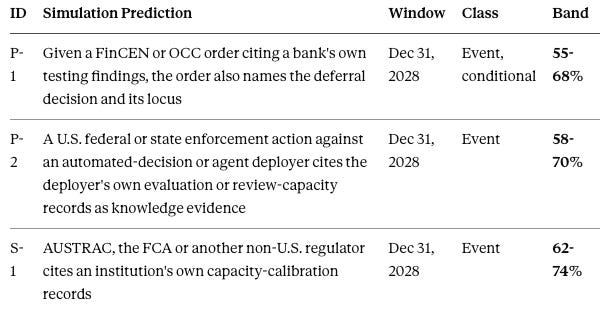
Prediction highlights. Six Simulation Predictions in total: three primary (P, Primary Simulation Prediction) and three secondary (S, Secondary Simulation Prediction). The three highest-value entries follow; Section IX carries all six with triggers, falsifiers and verification sources.
The companion paper to Bank of America $1.2 Billion Money Laundering Penalty and the Compliance System That Knew Too Much (2026) generalizes that case into a framework, Foresight-to-Duty Conversion. The Bank of America paper asked why one bank kept a threshold its own tests showed failing. The present paper asks what happens inside any institution once its own measurement puts a number on a governance gap. It then asks why the response produces the same evidentiary outcome across banking, cybersecurity, product safety and artificial intelligence.
MindCast’s distinction is the state transition the prior series lacked. AI Governance Equilibrium (2026) modeled governance debt as one balance. The Duty to Foresee, AI Deployment Readiness as Prospective Governance, and the Arrival of Agentic Duty of Care (2026) separated the duty to look from the duty to act.
Neither named the point at which carried knowledge becomes exposure. The present paper supplies it as an extension of the Hand formula, with the measurement supplying the inputs the formula needs.
MindCast AI applies Predictive Behavioral Economics + Dynamic Game Theory through MindCast AI Proprietary Cognitive Digital Twin Foresight Simulations (MP CDT FS). Behavioral Economics supplies the decision rules. Game Theory supplies the payoff structure. Predictive simulations emerge from the combination.
Behavioral economics explains why foreseen debt gets carried: the salient metric is the one the budget tracks. Game theory explains why the carry holds: the deferred cost falls diffusely and late while the remediation cost falls on one budget now.
The paper states the framework formally with its eight tests and names the three stages at which conversion stalls. It runs sixteen cases and two controls, derives the framework from prior MindCast work and extends it to agents. It then carries the six Simulation Predictions with a Risk Mitigation Layer.
🏛️ Policymakers. Every enforcement order that cites an institution’s own test file teaches the next examiner where to look. Naming the deferral decision in each order converts one case into practice, and the first action against an automated-system deployer decides whether the same reading reaches agents (P-1, P-2).
💼 Executives. A validation report your organization writes is a dated statement of knowledge. Fund the correction it reveals, or document a risk-based reason for declining that survives a reckless-disregard reading. The budget cycle that carries the gap renews the decision every year, and the next order that names a deferral decision names its locus (P-1, P-3).
⚖️ Counsel. The conversion is evidentiary, not statutory. A test creates no new duty and proves no violation by itself, so the defensible position reconciles every public control or artificial-intelligence governance statement against open internal findings before a plaintiff does (S-2, S-3).
📊 Investors. Remediation disclosures carry more information than the penalty line. An institution that discloses added review capacity after a measured gap has paid for the carry it declined; one that discloses spending without demonstrated detection results has not yet shown the gap closed (P-3).
II. Recurring Incentives Sustain the Carry as an Equilibrium
An institution that keeps a gap its own tests have sized is responding to recurring incentives that can sustain an equilibrium of inadequate correction until an enforcer arrives. Bank of America supplies the anchor fact, sixteen comparative cases supply the population, and ten actor classes supply the Cognitive Digital Twins that model the carry.
A. Bank of America Measured the Gap and Kept the Threshold
On October 13, 2026, the Financial Crimes Enforcement Network (FinCEN) assessed a $1.2 billion penalty against Bank of America under a consent order that rests willfulness on a course of conduct including repeated unaddressed internal warnings. The bank’s 2022 testing showed that an unconstrained monitoring threshold would surface 85.4% of suspicious activity in sampled below-the-line activity against 20.2% under the existing rule. Management kept the threshold and named investigation volume as the concern. A 2024 lookback sized the deferred staffing at roughly 750 people and 16,000 added monthly investigations.
The order applies a civil standard that requires no improper motive. Footnote 13 treats documented warnings left unaddressed as satisfying reckless disregard. The Bank of America paper develops those facts in full, and the present paper uses them as the anchor without restating the enforcement chronology or the six Simulation Predictions that paper carries.
On October 14, 2026 the bank’s chief financial officer told analysts that the bank had “staffed up overtime” and was “meeting all the obligations in that consent order at this point.” The bank also said it had “dedicated thousands of employees to combat financial crime” (PYMNTS). The statements describe staff dedicated and obligations met, not new investigators hired or detection results demonstrated. Staffing and spending show the carry has been funded; verified closure is the separate fact the framework’s third stage requires.
B. One Question Across Four Channels Through 2028
When an institution’s own measurement puts a number on a governance gap, how do its subsequent decisions change the economics of precaution, the evidence available to enforcers and the persistence of governance debt? The target system covers regulated institutions that run detection or review systems sized to funded capacity. It includes banks under Bank Secrecy Act supervision, public companies making control representations and product manufacturers with safety engineering files. It also includes enterprises deploying artificial intelligence agents whose evaluations precede deployment.
The horizon runs through December 31, 2028. Criminal exposure of individuals and the merits of any pending matter sit outside scope.
C. Behavioral Economics Explains Why a Measured Gap Gets Carried
Behavioral economics explains why a measured gap gets carried. Investigation staff carry a fixed budget, and case volume is the salient metric the budget tracks. The cost of a missed report stays invisible until an examiner surfaces it. Bounded rationality then leads managers to optimize yield per case while coverage goes unmeasured, and the measured gap becomes one more line item deferred to the next cycle.
Reference points complete the mechanism. The institution compares the correction cost against the current budget, not against the enforcement cost it has never paid. Loss aversion operates on the visible budget line and not on the latent exposure. Narrative analysis treats the carry as negligence; behavioral economics treats it as the predictable output of a salience structure every regulated institution shares.
The validation function carries a second decision rule. The function’s findings are the exhibit against its own employer, and the function it measures sets its budget. Professional standards pull toward complete findings; the salience of the next budget cycle pulls toward narrower scope. Which pull dominates after a peer’s order lands predicts the population’s response better than the observation that executives defer costly remediation.
D. Game Theory Explains Why the Carry Holds Until It Breaks
Game theory explains why the carry holds until it breaks. The institution, its regulator, its counterparties and its shareholders play a repeated game in which the deferred cost falls diffusely and late while the remediation cost falls on one budget now. Counterparties, insurers and investors can impose costs on their own, but those costs rarely arrive concentrated enough to outweigh the remediation line.
Recurring incentives can sustain the carry as an equilibrium of inadequate correction. It persists until a regulator arrives, a representation fails or a competitor’s enforcement order changes what examiners read.
Actors update on each new order. Every order that cites an institution’s own test file raises the cost of keeping such files unaddressed for every peer that holds them. Peers then choose between funding capacity and narrowing documentation, and willful-blindness doctrine raises the cost of the second route. A static estimate of enforcement risk misses the active problem: which equilibrium the population selects after each order lands.
Predictive behavior emerges from combining the two disciplines. Behavioral economics supplies the decision rule that produces the carry. Game theory supplies the rising cost of ignoring what the files show. Neither alone predicts when a given institution converts its measured gap into evidence.
E. Ten Actors and Four Competing Explanations
Ten actor classes become Cognitive Digital Twins (CDTs). The table states each actor’s objective, constraints and update trigger from the supported facts.
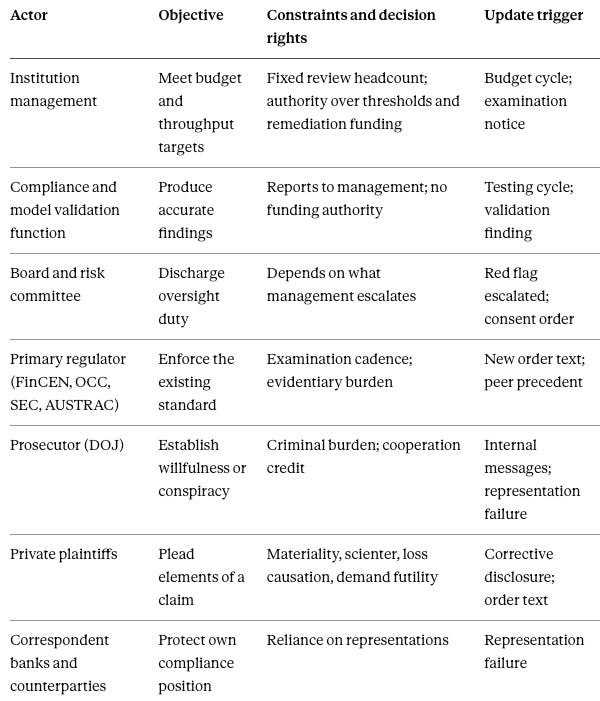
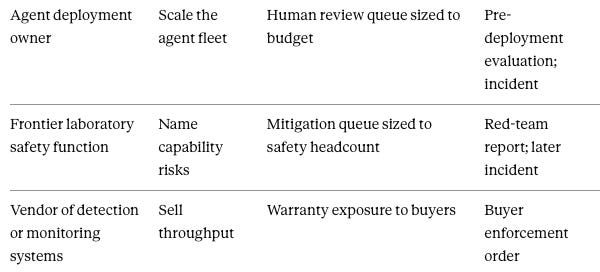
Four explanations compete, each with its own falsifier, and the cases in Section VI test them before any Simulation Prediction prints.
Concentrated immediate cost. Correction is deferred because its cost lands on this year’s budget while the harm stays dispersed and delayed. Falsifier: a measured gap stalls after the budget asymmetry is removed, for example where the correction is already funded and still does not close.
Failed control feedback. The institution received adequate information and its correction loop did not close at execution or at routing. Falsifier: verified closure follows every instruction in the case set, so no gap persists between an order to fix and a fix.
Institutional persistence. Decentralized incentives sustain the carry even where no single decision-maker prefers it. Falsifier: behavior does not change when the escalation topology changes while resources stay constant.
Enforcement selection, the null route. Internal findings carry no incremental evidentiary weight beyond the underlying violation, so documentation describes which cases enforcers pick rather than how institutions behave. Falsifier: matched cases with and without internal measurement reach different outcomes under otherwise similar conduct.
The first three explain why the carry is chosen; the three stalls in Section V explain how the gap persists.
The carry is a predictable equilibrium sustained by recurring incentives, with a defined population and ten actors. The validation function is the actor to watch: its response to a peer’s order decides whether the population funds capacity or narrows what it measures.
💼 Executives. The validation function’s reporting line is a governance decision, not an organizational detail, because the function that sets its budget also sets how much it can see.
III. Measurement Changes the Evidence of Governance Debt
Governance debt the institution has sized behaves differently in every dimension that matters from debt it has not. AI Governance Equilibrium modeled governance debt as the balance that accrues when pressure on an organization outruns its control, and the balance needs a second dimension: whether the institution has measured it.
A. Latent Debt Must Be Proven from Outside
Latent governance debt accrues without a measurement. The institution’s detection or review capacity falls behind the risk it faces, and no internal document states the size of the gap. An enforcer who finds latent debt must prove the deficiency from the outside: missed reports, unmonitored volume, failed outcomes. Knowledge must be inferred from circumstances, and the institution can argue that it did not know.
Latent debt carries exposure bounded by what the enforcer can reconstruct. Capital One’s 2021 penalty rested in part on regulator notices from 2006 forward and on an indicted customer in 2008, because the institution’s own files supplied less. The enforcer proved knowledge from external warnings, and the institution’s own measurement played a smaller role.
B. Foreseen Debt Dates Itself and Converts in Two Steps
Foreseen governance debt exists once the institution has measured the gap. The measurement dates the earliest documented institutional knowledge, which may follow the first awareness, and is discoverable in examination and litigation. It states the gap in the institution’s own units and names the correction the institution then chose to defer. Bank of America’s 2022 test did all four at once, and FinCEN’s order quoted the bank’s own concern that yield “may exhaust the investigation resources.”
Foreseen debt converts in two steps. The measurement is the first transition: from that moment the file is evidence of awareness, and nothing the institution does afterward un-dates it. The stalled response is the second transition: an authorized decision to leave a feasible correction unfunded makes the same file evidence of inadequate governance. A prolonged inadequate response can support findings of reckless disregard or willful blindness under the governing standard, and oversight doctrine treats a red flag that reached the board and went unaddressed the same way.
The enforcer does not create the exhibit; the enforcer finds it. The measurement changes the institution’s accountability position before any enforcer acts, and the response decides how much.
C. One Bank Shows the Inverse Configuration and Proterial Shows the Response Closing
USAA is a positive enforcement analogue that proves the two states are separable from the opposite direction. FinCEN’s March 2022 consent order states that the bank “elected to implement” a replacement transaction-monitoring system in the first quarter of 2021 “after only two months of parallel testing.” During the test the new system “failed to flag over 1,300 cases flagged by the legacy system,” representing “at least 160 filed SARs.” The bank launched it anyway. By the end of 2021 the system had produced a backlog of about 90,000 unreviewed alerts and 6,900 unreviewed cases. The order finds the bank “was fully aware of its AML program deficiencies since 2017.”
USAA ran the inverse of Bank of America. Detection outran review capacity rather than being narrowed to it, and debt accrued without any decision to shrink the signal. The measurement that mattered was the parallel test, and the stall was a go-live decision made against it.
The contrast isolates the variable. Both institutions carried foreseen debt. Bank of America chose the carry by narrowing detection to capacity, and USAA accumulated the carry by deploying detection past capacity. Enforcement reached both, the willfulness finding in each rested on knowledge rather than on the direction of the mismatch, and foreseen debt converted regardless of whether the institution shed burden or absorbed it.
Proterial Cable America supplies the control case from the other direction. An internal audit surfaced sixteen years of false safety certifications, the company self-disclosed within weeks and remediated, and the DOJ Fraud Section declined to prosecute. The audit established knowledge of longstanding misconduct, which is the first transition in Section III. The response within weeks meant no period of inaction followed, so the second transition never occurred.
The same file that would have shown awareness in a prosecution showed diligence in a declination, within the limits Section VI.E states.
Measurement moves debt from the latent state to the foreseen state and fixes the date. The institution’s response determines whether awareness evidence becomes evidence of inadequate governance, and USAA and Proterial show the response running each way.
⚖️ Counsel. The date of the first measurement is the date discovery will start from, whatever the institution decided afterward.
IV. Measurement Makes the Cost of Precaution Assessable
The Hand formula becomes assessable in an institution’s own units the moment the institution measures, because the file supplies evidence from which the institution can estimate the formula’s inputs. Not every measurement establishes all three quantities, but each one narrows what the institution can claim not to have known. The framework describes an evidentiary conversion under an existing legal standard. It creates no duty, and a measurement proves no violation by itself.
A. Measurement Makes the Formula’s Terms Assessable
Judge Learned Hand’s formula in United States v. Carroll Towing Co. (1947) states when precaution is due. Let B be the burden of the precaution, P the probability of the harm and L its magnitude. Precaution is due when B < P × L, and P × L counts only the harm the precaution would prevent.
The Duty to Foresee applied the formula prospectively: foresight simulation estimates P and L before deployment, so the duty to look is the duty to supply the formula’s terms. Before measurement the institution holds no reliable estimate of P, L or B. The gap is latent governance debt, and the formula cannot be assessed from inside. A measurement at time t₀ supplies inputs from which the institution can form estimates of the three terms, and the framework states those estimates as per-period rates: h for the expected harm per period that the precaution would prevent and b for the annualized burden of the precaution.
Bank of America’s 2022 test supplied a coverage ratio, 85.4% against 20.2% on the sampled activity, which bounds P without being it. The 2024 lookback supplied detected-and-delayed activity above $4 billion, which bounds L without being expected loss. The staffing estimate of roughly 750 investigators is a capacity figure, and converting it to b requires a staffing-cost model the order does not supply. The measurement made the terms assessable; it did not compute them.
The economic incentive for precaution accrues as the cumulative excess of expected harm over the burden of the precaution, from the measurement forward:
D(t) = ∫ from t₀ to t of [ h − b ]⁺ ds
The integral is a conditional model. It computes only where h and b are expressed in comparable units per period, and the bracket takes the positive part, so D accrues only in periods when the institution’s own numbers say precaution is due and the gap stays open. D measures the incentive the institution declined; it measures foreseen governance debt itself only where an institution-specific conversion supplies those units. Where the units are absent, the three intervals in Section V are the operational measure of foreseen debt and D stays a description.
Conversion completes at the time t* when the gap is verified closed, and D stops accruing.
The stall has a private rationale that behavioral economics and game theory supply. Let q be the probability that an examination occurs and proves knowledge from the file, the product of an examination probability and a proof probability given examination. Let F be the sanction as a function of D, and s the salience the institution assigns to a cost it has not yet paid. The institution defers while
s × q × F(D) < b < h
The right inequality is the Hand condition: precaution is due. The left is the private condition: the discounted enforcement cost looks smaller than the budget line. The wedge between them is the carry, and each budget cycle re-evaluates the left inequality with a larger D.
The inequality is a conceptual incentive relationship; to compute it, the expected sanction is expressed per period over the same horizon as b. Decision Modeling and Foresight Simulation (2026) separated decision integrity at formation from survivability under pressure, and the renewed carry fails the second test every cycle it continues.
The measurement changes two terms at once. It raises the proof factor inside q, because the institution’s own file now supplies the knowledge element an enforcer would otherwise prove from outside; it does not by itself raise the probability that an examination occurs. It makes F a function of D, because the lookback that sizes the sanction is the same calculation the institution could have run.
Once an examination occurs, the examination factor is no longer the variable. The institution updates F and s, and the left inequality reverses when the product crosses the budget line; the institution’s own numbers then say what the enforcer will say.
The shortfall accrued after authority receipt is dated separately. Let tₐ be the time the measurement reaches an actor with corrective authority:
D_c(t) = ∫ from tₐ to t of [ h − b ]⁺ ds
D measures the shortfall since the earliest documented knowledge; D_c measures the shortfall since someone who could act knew. Neither measures culpability, which the applicable legal standard assigns.
Under a negligence standard the Hand inequality itself carries the weight. Under reckless-disregard and willful-blindness standards the file’s statement that b < h supplies knowledge, and D_c supplies the duration of the course of conduct. Under fiduciary oversight doctrine, board-level attribution depends on the applicable standard and on what reached the directors, which is why Bingle found no oversight liability where the measurement stopped below the board.
B. Five Conditions Decide Whether a Carry Converts
The input is the institution’s measurement file. A test, a validation finding, a red-team report or a whistleblower memo qualifies when it sizes a concrete gap and names an available correction. Decision-makers learn the harm and the remedy, and they learn the cost and implementation time of closing the gap.
The decision is the carry: management remedies the gap, defers it, limits it or knowingly accepts the residual exposure. The carry converts only when five conditions coincide: actionable knowledge and decision authority, a feasible precaution and an inadequate response, and an applicable duty. A decline by someone without authority, or against a remedy that did not exist, does not convert.
The output is a date, three intervals and a condition. The date is the earliest documented knowledge, fixed by the measurement file. The intervals run from that date to verified closure, and each is a limit of integration in Section IV.A. The condition is the external event that compares the institution’s findings with its actions and representations: examination, prosecution, litigation or a market correction.
C. Eight Tests Keep the Framework Falsifiable
The framework survives only if it distinguishes a stalled conversion from ordinary enforcement. Eight tests do that work, and Section VI applies them to each case.
Knowledge specificity. Did the institution know a concrete gap with a size, or only a general possibility?
Precaution feasibility. Was a remedy technically and operationally available at a proportionate cost?
Decision authority. Who could authorize correction, and what did that person receive?
Response adequacy. What did the institution do, by when, and with what demonstrated effect?
Legal channel. Which pre-existing duty governs the conduct? Statutory, fiduciary, tort and disclosure duties each carry different elements.
Evidentiary bridge. How do the internal documents bear on knowledge or recklessness, and on causation or oversight?
Counterfactual. Would timely reasonable action have materially changed the outcome?
Selection bias. Are the best-documented cases prosecuted more often, independent of underlying conduct?
A case passes when tests one through six resolve in the enforcer’s favor from the institution’s own files. A case fails when the enforcer proved knowledge from external sources, when the remedy was unavailable, or when the files showed a measured gap corrected in reasonable time. It also fails on effective substitution: the institution rejected the recommended fix and implemented a different control that reduced the same harm. The eighth test governs the population claim: if documentation predicts prosecution independent of conduct, the framework describes enforcement selection rather than institutional behavior.
D. The Paradox Resolves on the Response, Not the Measurement
Better internal evidence raises both the institution’s ability to prevent harm and the evidence available to later enforcement. Poorly designed incentives reward avoidance of knowledge. A framework that treated every internal warning as a liability trigger would push institutions toward not looking, which is the outcome the duty to foresee exists to prevent.
The paradox resolves on the response, not on the measurement. The measurement is not legally neutral where a testing obligation exists, and a decision not to measure can itself breach a duty; the framework reads the decision after a measurement. Legal standards that distinguish timely correction from carry preserve the incentive to look.
D dates awareness, D_c dates the stall under someone with authority, and the legal standard decides what each supports.
🏛️ Policymakers. An order that states D_c, the interval after authority receipt, gives the institution a number to close and gives a later reset less to strike.
V. Conversion Stalls at Three Stages and Each Stall Has a Duration
Foresight-to-Duty Conversion stalls at three stages, and each stall runs an interval an enforcer can read from the institution’s own chronology. The stalls are the pathways by which foreseen debt persists.
A. Suppression, Deferral and Failed Execution
Suppression stalls the first stage, deferral the second and failed execution the third. Deliberate deferral is the anchor pathway: an authorized decision-maker knows the gap and declines to fund the correction. Bank of America, TD Bank and Toyota run on it. Failed execution is the second: authority orders the correction and the organization never verifies that it closed, as Equifax did with a patch instruction issued and unverified.
Information suppression is the third: the measurement never reaches the layer with authority to act, or that layer withholds it from the party entitled to receive it. Boeing runs on it toward the regulator and Bingle runs on it toward the board. The stalls describe how the response fails; the five conditions in Section IV still decide whether conversion occurs and against whom.
B. The Second Clock Starts at Authority Receipt
Each stall is one interval running long. The suppression interval runs from measurement to receipt by an actor with corrective authority. The deferral interval runs from that receipt to a funded decision. The execution interval runs from the decision to verified closure.
The three sum to the knowledge-to-correction interval, and an order’s chronology usually states where the time went. D accrues across all three; D_c accrues across the second and third, because the clock that matters for inadequate governance starts when someone who could act knew.
C. Each Stall Turns on One Test
The stalls map onto the eight tests. Failed execution turns on response adequacy: an instruction is not a correction until the gap is verified closed. Information suppression turns on decision authority, and it converts only against the layer that held the knowledge. Boeing converted against the company because its technical pilots held both the knowledge and the duty to inform; Bingle did not convert against the directors because the knowledge stopped below them.
Whether suppression corrects itself is an open question the cases do not resolve. Officer-level liability gives the officer who holds the knowledge a reason to escalate. Employment dependence, retaliation exposure and limited authority give the same officer reasons not to. The paper claims neither route.
The interval that starts at authority receipt is the paper’s differentiating variable, because it separates the stalls in a way the existence of a warning cannot.
📊 Investors. An order’s chronology states where the time went, and the stage that ran longest tells you whether the fix is headcount, verification or escalation rights.
VI. Sixteen Cases Show Where the Framework Holds and Where It Stops
Sixteen enforcement cases and two controls test the framework’s four elements: a measurable signal, institutional knowledge, a decision that preserved or weakened the control and a consequential outcome. Each entry rests on a primary or authoritative public source linked in the sentence that states the fact.
The cases are grouped by legal channel, because the channel determines which test carries the weight. Banking supervision reads the file for program effectiveness and awareness. Securities and regulatory-disclosure channels read it against a specific statement. Product safety reads it for foreseeability and a declined fix, and automated-decision cases read it for knowledge of a tool’s error rate.
A. Banks That Sized Their Own Gaps Converted on Deferral
TD Bank (2024). On October 10, 2024, TD Bank pleaded guilty to conspiring to fail to maintain a compliant anti-money laundering program and to money laundering. It agreed to pay over $1.8 billion to the Department of Justice (DOJ). About 92% of transaction volume went unmonitored from 2018 to April 2024, roughly $18.3 trillion in activity.
Senior executives enforced a budget mandate the bank called the “flat cost paradigm,” and employees described the bank as an “easy target” for the “bad guys.”
TD Bank passes every test on the deliberate-deferral pathway. The gap was sized internally and the decision was a budget rule. The employees’ own messages supplied the knowledge evidence.
Danske Bank (2022). On December 13, 2022, Danske Bank pleaded guilty to one count of conspiracy to commit bank fraud and agreed to a criminal forfeiture of $2.059 billion. The DOJ stated that at least since February 2014 the bank knew some non-resident customers’ transactions were highly suspicious and that the Estonia branch’s compliance program fell below the parent’s standards. The bank then gave U.S. correspondent banks false information about its monitoring capabilities.
Danske is the strongest case for the representation channel: the carry became fraud when the bank described a control it knew had failed.
Capital One (2021). FinCEN assessed $390 million on January 15, 2021 for failures in the Check Cashing Group from 2008 to 2014. Regulators had notified Capital One of deficiencies in acquired banks’ programs from 2006, and a Check Cashing Group customer was indicted in 2008. The willfulness finding rests largely on prior awareness from external notices, so Capital One passes tests one through six on external knowledge and sits between the latent and foreseen states.
Westpac (2020). Westpac agreed to an AUD 1.3 billion penalty with the Australian Transaction Reports and Analysis Centre (AUSTRAC) in 2020 for contraventions numbering in the millions, centered on unreported international funds transfer instructions.
Commonwealth Bank of Australia (2018). Commonwealth Bank agreed to an AUD 700 million penalty for 53,506 late threshold transaction reports covering about AUD 625 million between November 2012 and September 2015. The agreement also covered three years of monitoring failures on 778,370 accounts. AUSTRAC’s release attributes the failures to inadequate risk assessment of intelligent deposit machines.
USAA (2022). Covered in Section III.C as the inverse configuration to Bank of America.
B. In Securities Law the Specific Statement Carried the Claim
SolarWinds (2024). On July 18, 2024, Judge Paul A. Engelmayer dismissed most of the Securities and Exchange Commission (SEC) complaint against SolarWinds and its chief information security officer, and the claims based on the website Security Statement survived.
The court described the access-control deficiency as “long-standing, well-recognized within the company, and unrectified over time” and found that the officer’s knowledge from internal assessments supported scienter. The internal-controls, risk-factor and post-incident disclosure claims were dismissed.
SolarWinds is both a positive case and a partial negative control. The specific-statement theory survived dismissal: a public statement contradicted by internal assessments stayed in the case, which is survival of a pleading and not a finding of falsity, scienter or liability. The broader theory failed: the court refused to read internal accounting controls to cover cybersecurity, treated general statements as puffery and found the risk factors adequate. In that case the measured gap survived in the pleading only against the specific statement it contradicted.
Uber (2022, affirmed 2025). A jury convicted Uber’s former chief security officer of obstruction in 2022 and the Ninth Circuit affirmed on March 13, 2025. Hackers took data on 57 million users in 2016 and demanded payment.
The officer treated the intrusion as a bug-bounty submission, paid $100,000 and had the hackers sign a nondisclosure agreement while the Federal Trade Commission (FTC) was examining Uber’s security. The panel wrote that illegal conduct “could not be laundered through an NDA.”
Uber shows the representation channel with the measurement fully known to the decision-maker with authority. The breach was the measurement, the characterization to the regulator was the carry, and the interval between knowledge and disclosure ran about a year. The conviction attached to the characterization rather than to the breach.
Equifax (2017). The Government Accountability Office’s August 2018 report on the breach found that Equifax failed to identify and patch the Apache Struts vulnerability on one portal and failed to update a security certificate that would have flagged the unusual traffic. The 2019 resolution with the FTC and states reached up to $700 million. Equifax had identified the vulnerability and directed a patch before the intrusion, and the instruction did not reach verified closure.
Equifax is the failed-execution pathway. An instruction issued and not verified is a correction that did not close, so the case tests response adequacy without any decision to defer.
C. Product Safety Converts on the Declined Fix and the False Timeline
Toyota (2014). Toyota entered a deferred prosecution agreement on one count of wire fraud on March 19, 2014 and paid a $1.2 billion penalty. Internal tests had shown that unrecalled vehicles carried the same floor-mat entrapment features as recalled ones, and individuals inside the company hid the sticky-pedal problem from the regulator in the weeks before Toyota’s late-2009 public statements. In early 2010 the company told the public, its regulator and Congress that it had learned of the sticky pedal in October 2009 and fixed it within 90 days, when its own investigation had begun by August 2009.
Toyota passes every test on the deliberate-deferral pathway and adds the interval as evidence. The internal tests dated knowledge, the limited recall was the carry, and the false timeline was an attempt to shorten the interval on paper. The prosecution charged the misstatement about the interval, not the defect.
General Motors ignition switch (2015). General Motors forfeited $900 million under a 2015 deferred prosecution agreement that charged a scheme to conceal material facts from its regulator, the National Highway Traffic Safety Administration, from the spring of 2012 through February 2014.
The company had compensated claimants for 124 deaths. The company held meetings about the switch problem as early as 2005, and a proposed fix was declined as costly and time-consuming. The Valukas report found no cover-up and attributed the delay to engineers’ failure to understand how the car was built.
General Motors tests knowledge specificity for the years before 2012 and runs on the suppression pathway after. Fragments of the gap sat in different engineering files, and no single measurement stated the size of the harm until litigation assembled them. From the spring of 2012 the charged conduct is nondisclosure to the regulator, which is suppression toward the party entitled to the knowledge.
The framework would reach the 2005 decision only on a finding specific enough to state the harm and a named decision-maker with authority to fund the fix, and the public summaries of the Valukas report identify neither. The classification is the framework’s, not a conclusion of law. Foreseen debt requires a document that states the gap, not a set of documents from which the gap can be reconstructed.
Boeing 737 MAX (2021). Boeing entered a deferred prosecution agreement in January 2021 on one count of conspiracy to defraud the United States, with payments exceeding $2.5 billion for the deception of the FAA Aircraft Evaluation Group.
The court rejected a proposed plea in December 2024 and the Department reached a non-prosecution agreement in 2025. The case was dismissed on November 6, 2025. On May 22, 2026 the Fifth Circuit’s amended opinion denied the mandamus petitions and stated that Boeing’s 2024 breach had ended the binding effect of the original agreement. Two flight technical pilots deceived the evaluation group about changes to the flight-control system, and key information was left out of the Flight Standardization Board report and pilot training materials.
Boeing is the information-suppression pathway in a product-safety setting. Knowledge sat with two employees whose job was to inform the regulator, so decision authority and the evidentiary bridge run through them rather than through a budget decision. The case supports information suppression and disclosure failure, not an institution-wide decision to withhold a funded safety correction. Employee knowledge, corporate attribution through the 2021 agreement’s admissions and the procedural disposition that ended without a conviction are three separate facts, and the framework reads only the first two.
PG&E Camp Fire (2020). PG&E pleaded guilty on June 16, 2020 to 84 counts of involuntary manslaughter after a 97-year-old hook on the Caribou-Palermo line wore through and failed on November 8, 2018. The company had been warned in 1987 that its tower hooks could wear and fail in high winds and in 2006 about extreme winds in the canyon.
PG&E relied on helicopter and walking patrols rather than climbing inspections, and a 2014 inspection report copied findings from a prior inspection. The district attorney said the company “rather than respond to the known threat, took shortcuts when it came to inspections.”
PG&E tests precaution feasibility against cost. The warnings were general (hooks can wear) rather than specific (this hook has worn), so the measurement was coarse. The carry was the inspection method chosen, which could not see the wear the warning described. The case shows a measurement that was feasible and declined, which is the carry at the level of the sensor itself.
D. Automated Systems Write Their Own File
UnitedHealth nH Predict (2025). On February 13, 2025, Judge John R. Tunheim of the District of Minnesota allowedbreach-of-contract and implied-covenant claims to proceed against UnitedHealth in Estate of Lokken v. UnitedHealth Group and dismissed five other counts as preempted by the Medicare Act.
Plaintiffs allege the insurer applied an algorithmic tool to post-acute care determinations in place of physicians and knew the tool’s inaccuracy because more than 90% of denials were reversed on appeal. The company denies using the tool, and the court treated the allegations as allegations.
UnitedHealth is the mirror image of capacity-calibrated detection: a denial threshold alleged to hold because appeal volume stayed low. If discovery confirms the reversal rate and the knowledge, the appeal statistics are the measurement and each cycle the threshold held is the carry. The surviving claims run through the plan documents, which say decisions are made by clinical staff and physicians, so the representation channel again carries what the statute does not.
Cruise (2024). Cruise entered a three-year deferred prosecution agreement on November 14, 2024 and paid a $500,000 criminal fine after admitting it submitted a false report to influence a federal investigation into an October 2023 incident in which its vehicle dragged a pedestrian about 20 feet. The NHTSA separately imposed a $1.5 million penalty for omitting crash details. Cruise’s narrative omitted the dragging, the video did not play on its call with the regulator the next morning, and the company provided the video later that day without correcting the report.
Cruise is a representation case with the interval compressed to days. The measurement was the vehicle’s own telemetry and the carry was the decision about what to submit. Automated systems produce a complete file of their own conduct, so the deployer’s representation about that file carries all the exposure.
Meta (2023). Thirty-three attorneys general filed a federal complaint on October 24, 2023 alleging that Meta’s internal data showed users experienced harm at far higher rates than its public statements suggested. The complaint alleges that Meta set and tracked time-spent goals for teen users while saying it did not, and that its chief executive vetoed a proposed ban on plastic-surgery image filters despite internal pushback. Meta already carries a MindCast prediction set in the platform-liability series and enters here only as a comparator for internal research beside public safety statements.
E. Two Controls Bound the Framework
A framework that fits every case explains nothing. Two control types bound it, and each has a verified instance.
Measured and corrected. Proterial Cable America (Section III.C) received a DOJ Fraud Section declination in 2024. An employee raised sixteen years of false brake-hose certifications during an internal audit and the company self-disclosed within weeks.
Proterial terminated the employees involved, rebuilt its compliance program and paid $15.1 million in disgorgement. The declination cited timely self-disclosure and remediation.
The audit finding dated knowledge, no carry followed, and the file became evidence of diligence.
The comparison has limits. A criminal declination under the Corporate Enforcement Policy and a civil banking penalty run under different statutes, different conduct and different enforcement policies, so Proterial contrasts with Bank of America rather than controlling for it. The declination cannot isolate remediation from cooperation and self-disclosure as the cause of the outcome. Non-enforcement leaves no public trace in most sectors, which makes declinations the clearest observable class of measured-and-corrected cases and leaves the matched comparison open.
Warned and not reached. On September 6, 2022, Vice Chancellor Glasscock dismissed the shareholder oversight suit against SolarWinds directors in Construction Industry Laborers Pension Fund v. Bingle. Plaintiffs alleged a weak password, a third-party alert to the IT team, executive warnings before the public offering and a committee briefing on cybersecurity. The court found that none reached the board as a particularized red flag, that cybersecurity practice was a business decision, and that a “subpar” reporting system was not an “utter failure” to oversee.
Bingle is information suppression read from the board’s side, and it fixes the decision-authority test in the fiduciary channel. Facts overlapping those that supported scienter against the chief information security officer in the SEC case did not support oversight liability against the board, because the claims and standards differed and the measurement never reached the body with authority to act. Foreseen debt held by the wrong layer does not convert against the layer above it.
The framework holds where the institution’s own file sized the gap, the gap persisted by one of the three stalls and the interval ran until an enforcer read the file. It weakens where knowledge was fragmentary (General Motors), external (Capital One), general (the dismissed SolarWinds securities claims) or held below the layer with authority (Bingle). Proterial shows the measurement without the carry. The eight tests sort the cases.
⚖️ Counsel. The cases that failed to convert did so on authority or on statement specificity, which are the two variables counsel controls before any enforcer arrives.
VII. Seven Prior MindCast Works Supply the Framework’s Parts
Foresight-to-Duty Conversion assembles from six mechanisms that seven prior MindCast publications supplied, each tested against a case in Section VI. The lineage is structural: each prior work supplies a term, a stage or a stall, and the companion names what the prior work did not.
Governance debt gains a second state. AI Governance Equilibrium defined governance debt as the balance that accrues when pressure on an organization outruns its control. The companion adds the dimension the ratio lacked: whether the institution has measured it. TD Bank’s 92% unmonitored volume was sized internally under the flat-cost paradigm, Capital One’s gap was sized by regulators from 2006 forward, and only the first carried D.
The two duties gain the process between them. The Duty to Foresee separated the duty to look from the duty to act and warned that foresight manufactures discoverable knowledge. The companion supplies the three stages between the two duties and the three ways they stall. Bank of America stalled at the decision, Equifax at verification and Boeing at receipt by the regulator entitled to the knowledge.
The forcing function gains a self-generated type. AI Accountability, When AI Promises Meet the Courts (2026) traced a sequence from signal to substrate to the forcing function that tests one against the other, with the forcing function external. The companion adds the institution’s own measurement as a forcing-function type. In SolarWinds and Uber the file that forced the gap into view was the institution’s own, and the surviving claims attached to the specific statement the file contradicted.
The decision gains a renewal clock. Decision Modeling and Foresight Simulation separated integrity at formation from survivability under pressure and treated a decision as one event. The companion treats the carry as a decision renewed each budget cycle under a rising D, so survivability is tested repeatedly. Toyota’s inaccurate timeline was an attempt to shorten the interval on paper, and the prosecution charged the timeline.
The control loop gains legal weight. The Cybernetic Foundations of Predictive Institutional Intelligence (2026) supplied the control-loop view of institutions. The companion treats an open correction loop as a legal object with three measurable intervals. PG&E shows the loop opened at the sensor: the inspection method chosen could not see the wear the 1987 warning described, so the measurement itself was the declined precaution.
The optimizer’s blindness gains a sequel. What Goethe’s Faust Reveals About the AI Alignment Problem (2026) argued that no optimizer can audit its own objectives from inside. Why AI Commoditizes Raw Prediction, Why Governance Stays Scarce, and How MindCast Prices the Gap Between Them (2026) named governance as the scarce input.
The companion starts where both end: the institution has seen the gap, and the scarce input is the review capacity the measurement says it owes. USAA and Proterial show the two things that happen next.
The framework adds one thing to each of six prior mechanisms, and the addition is the same in each case: the institution’s own measurement, and what the institution did in the interval after it.
🏛️ Policymakers. Each prior mechanism already governs an enforcement channel; the companion supplies the variable, the interval, that an order can state in a number.
VIII. Agents Can Accelerate the Rate of Conversion, Not Change the Framework
Agents can accelerate the rate at which foreseen debt accrues. The framework that reads it does not change. Four failure shapes follow from the mechanism, and P-2 in Section IX carries the one Simulation Prediction the section produces.
Detection becomes low cost and review stays scarce. Under the framework, an agent that surfaces more findings than the human review queue can clear produces foreseen debt at machine speed. Every unreviewed finding is a dated measurement, and the carry renews with each scale-up gate rather than each budget cycle.
Four failure shapes follow from the mechanism. First, agents learn which alerts rarely produce referrals and suppress them, reinforcing capacity calibration algorithmically. Second, a more sensitive model moves the bottleneck from detection to verification, reproducing the USAA configuration.
Third, an autonomous compliance platform produces convincing documentation faster than control performance improves, so the file describes a program that does not exist. Fourth, shared vendor models produce correlated blind spots across institutions, so one enforcement order reads as evidence against the population.
The duty to foresee already covers the first half: pre-deployment evaluation is the measurement. UnitedHealth and Cruise show two early forms of the file an automated system writes about itself, an appeal statistic and a telemetry log. The present paper covers the second half: what the evaluation file becomes once the fleet scales past the queue the evaluation said it needed. The Bank of America order shows how an enforcer reads that file, and no agentic case has yet reached an order.
When one does, a specific public statement about the system’s testing offers the enforcer or plaintiff a clearer channel than a free-standing duty, which is why P-2 and S-2 run together.
Measurement can arrive faster and the response can renew more often, and P-2 tests whether the first action against a deployer reads the evaluation file as knowledge evidence.
💼 Executives. A scale-up gate is a budget cycle at machine speed; every gate passed with the review queue below the tested error rate renews the carry.
IX. MindCast Simulation Predictions
Six MindCast Foresight Simulation Predictions follow with the scenario structure that generates them and the limits that bound them. Three are primary (P, Primary Simulation Prediction) and three are secondary (S, Secondary Simulation Prediction). None overlaps the six Simulation Predictions the Bank of America paper carries.
Prediction date October 14, 2026 · Data cutoff October 14, 2026 · Source: MP CDT FS of October 14, 2026.
Three scenarios frame the set. In the base scenario, enforcers who cite an institution’s own file move toward naming the deferral decision and deployers of automated systems meet the same reading. Peer banks fund bounded capacity and document scope.
In the secondary scenario, the representation channel carries the exposure while direct-duty channels lag, so complaints tied to specific statements survive where general governance claims fail. In the tail scenario, enforcers read outcomes alone and the measurement file carries no incremental weight, which is the null route the eight tests exist to detect.
A. Three Primary Simulation Predictions
Each headline carries the claim, the window and the band. The paragraph beneath states the forecast, the trigger and verification source, the falsifier and the exposure.
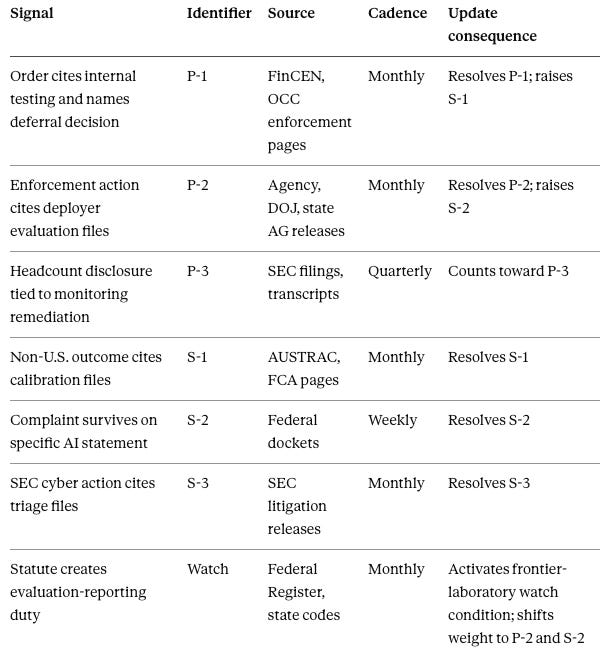
P-1 · Given a FinCEN or OCC Bank Secrecy Act order by December 31, 2028 that cites a bank’s own testing or validation findings, the order also identifies the decision to defer remediation and the body or function that made it (P(A given B) = 55-68%)
The band is conditional on the qualifying order occurring; if no qualifying order issues by the window, P-1 resolves as not triggered rather than as a miss. A FinCEN or OCC order against a U.S. insured depository institution that cites internal threshold testing or model validation findings also states which management body or function declined or deferred the remediation and when.
Trigger: an authority defense of the Bingle type raised in any Bank Secrecy Act matter, which pushes enforcers to name the locus. Verification source: order text on the FinCEN and OCC enforcement pages, checked monthly. Falsifier: a qualifying order cites the testing findings without identifying the deferral decision or its locus. Exposure falls on peer management committees and chief compliance officers, whose minutes can become the named exhibit.
P-2 · A U.S. federal or state enforcement action against a deployer of an automated decision system or artificial intelligence agent cites the deployer’s own pre-deployment evaluation or review-capacity records as evidence of knowledge by December 31, 2028 (58-70%)
A federal agency, the DOJ or a state attorney general brings an enforcement instrument against a deployer. The instrument may be an order, a consent decree, a complaint or a deferred prosecution agreement. Platform operators covered by the platform-liability series are excluded. The action cites the deployer’s own evaluation results, test findings or review-queue sizing as showing knowledge of the system’s error rate or risk.
Trigger: discovery in Lokken reaching the appeal-reversal statistics, or a second automated-reporting matter after Cruise. Verification source: agency and attorney general releases and filed complaints, checked monthly. Falsifier: no qualifying action, or an action resting on outcomes alone without citing the deployer’s own evaluation or capacity records. Exposure falls on agent deployment owners and their general counsel, whose scale-up gate files become discoverable.
P-3 · At least three of the ten largest U.S. bank holding companies by total assets at June 30, 2026 disclose added financial-crimes investigative headcount or review capacity tied to transaction-monitoring remediation in a public filing or earnings call by December 31, 2027 (48-60%)
The population is fixed as the ten largest U.S. bank holding companies by total consolidated assets on the Federal Reserve’s holding-company list as of June 30, 2026, and does not change with later mergers. Three or more of the ten disclose an increase in financial-crimes investigative staffing or review capacity in a periodic filing, proxy or earnings transcript. The disclosure ties the increase to transaction-monitoring remediation rather than to general risk spending.
Trigger: an examination finding on monitoring scope at any of the ten, or P-1 resolving true early. Verification source: SEC filings and earnings transcripts, checked quarterly. Falsifier: fewer than three qualifying disclosures by the window, or disclosures attributing remediation to technology alone. Exposure falls on investors reading remediation cost through the penalty year and on chief compliance officers choosing between funding and scope.
B. Three Secondary Simulation Predictions
The three secondary Simulation Predictions resolve on different actors. S-1 turns on a non-U.S. supervisor, S-2 on a court reading a specific statement, and S-3 on the SEC’s use of its cyber disclosure rule. Each ties to a primary route.
S-1 · AUSTRAC, the U.K. Financial Conduct Authority or another non-U.S. financial regulator issues an enforcement outcome citing an institution’s own capacity-calibration, alert-threshold or validation records as knowledge evidence by December 31, 2028 (62-74%)
The outcome follows the P-1 route in a non-U.S. channel. Trigger: a public finding of monitoring thresholds tuned to review capacity in any AUSTRAC or FCA matter. Verification source: AUSTRAC and FCA enforcement pages, checked monthly. Falsifier: no qualifying outcome, or outcomes citing program absence or results only.
S-2 · A securities or derivative complaint against a public company ties a specific public artificial-intelligence governance, safety or testing statement to a contradictory internal evaluation and survives a motion to dismiss on that statement by December 31, 2028 (40-52%)
The outcome follows the P-2 route through the representation channel, and filing alone does not qualify. Trigger: a corrective disclosure following an artificial-intelligence incident at a public company. Verification source: federal dockets, checked weekly. Falsifier: no complaint survives on a specific statement, or dismissals rest on puffery or generic risk-factor grounds only.
S-3 · An SEC enforcement action under the 2023 cybersecurity disclosure rule cites a registrant’s internal alert-suppression, triage-capacity or unreviewed-alert records as evidence bearing on a disclosure’s accuracy by December 31, 2028 (33-45%)
The outcome follows the P-2 route in the cyber disclosure channel. The 2023 rule requires disclosure of material incidents on Form 8-K Item 1.05 and of cybersecurity risk management and governance under Regulation S-K Item 106. A qualifying action cites triage records as bearing on either disclosure; an action resting on the timing of an 8-K alone does not qualify.
Trigger: a material-incident 8-K followed by litigation discovery of triage records. Verification source: SEC litigation releases, checked monthly. Falsifier: no qualifying action.
C. Four Scenarios Await Their Gating Events
Four further scenarios carry no Simulation Prediction and no identifier; each gains one when its gating event occurs. A prediction-market venue’s surveillance tuning cited by the CFTC or a state attorney general activates on any enforcement matter against a venue that reaches its surveillance program. A frontier laboratory’s red-team report cited by a regulator or court activates on a statute or rule creating an evaluation-reporting duty, or on a civil action in which such a report is produced.
A pharmacovigilance threshold decision cited by the FDA or DOJ activates on any warning letter or matter citing adverse-event signal thresholds. Escalation-rights disclosures for validation or security officers enter the set after two further resolved matters at the officer layer.
D. What Would Weaken the Set
P-3 carries the widest uncertainty in the set. A bank that funds quietly without disclosure counts against it while confirming the mechanism, so its band sits closest to even.
Three questions discriminate the mechanisms and bound every prediction. Remove the budget asymmetry: if correction still stalls, concentrated cost alone is insufficient. Remove the verification gap: if effective correction follows, failed feedback is supported. Change the escalation topology while holding resources constant: if behavior changes, institutional persistence adds explanatory power.
Three contrary routes would weaken the set. Institutions measure and correct promptly, so no interval runs and the file shows diligence. Courts and regulators decline to attribute knowledge to the actor with authority or treat the challenged statement as nonactionable, which bears on P-1 and S-2. Enforcers select cases for reasons independent of internal testing, so the apparent conversion is a documentation effect, which is the null route and bears on P-2 and S-1.
An enforcement action that relies on outcomes alone where the institution’s own measurement file was available to the enforcer challenges the framework’s generalization. Each Simulation Prediction resolves on its own falsifier. A new statute creating an evaluation duty shifts weight toward P-2 and S-2 without falsifying anything.
Six Simulation Predictions test future enforcement and disclosure practice across banking, cybersecurity disclosure and automated systems. Each resolves against a named public source, and product safety supplies comparative evidence rather than a forward prediction. P-1 and P-2 carry the paper’s thesis: the first tests whether banking enforcement separates the deferral decision from the measurement, and the second tests whether the same reading reaches automated systems.
Working With MindCast
Published analysis can state the framework and run the cases. It cannot tell a specific institution which of its open findings has already converted, what the carry has cost to date, or which budget cycle closes the exposure. The answers depend on the institution’s own measurement files, staffing models and the representations it has made against them.
MindCast builds Cognitive Digital Twins of the institution’s measurement, decision and representation system. It ingests the testing history and reruns the enforcement environment against the institution’s actual options.
Commissioned work delivers three outputs. The first is a governance-capacity assessment of the client’s own detection or review system. The second is a set of exposure scenarios with low, median and high cases, and the third is a set of monitoring thresholds that tell the client which scenario has begun.
Three engagements follow from the prediction set. For boards and compliance functions, a measurement-file audit identifies which open findings carry exposure under P-1 and what capacity closes them. For disclosure counsel, a representation audit identifies which public control or artificial-intelligence statements a specific internal finding contradicts (S-2). For artificial intelligence deployment leaders, a review-capacity simulation tests whether the human queue can absorb what the evaluation surfaced before P-2’s precedent lands.
MindCast takes one bounded next step at a time. Contact mcai@mindcast-ai.com or visit mindcast-ai-simulation.com to schedule the diagnostic session. No engagement proceeds without a named decision to resolve.
X. Every Audience Holds One Lever on the Interval
Every audience holds one lever on the interval, and the six Simulation Predictions say when to pull it. Section X.A states what the findings mean for each audience; Section X.B states what each can do and what exposure remains. Severity and probability stay separate axes. The entries describe decision considerations and not legal, investment or fiduciary advice.
A. What the Findings Mean for Each Audience
🏛️ Policymakers. Orders that name the deferral decision give institutions a condition they can meet and give later deregulatory resets less to strike. P-1 is the observable that shows supervisory practice moving to that reading, and S-1 shows whether non-U.S. supervisors move first.
💼 Executives. The decisive lever is the budget cycle, because each cycle that leaves a measured gap unfunded extends the interval the enforcer will read (P-1, P-3). A validation function whose budget is set by the function it measures sees less each cycle.
⚖️ Counsel. The conversion runs through the evidentiary bridge, so every public control or artificial-intelligence governance statement is a candidate exhibit wherever an open internal finding contradicts it (S-2, S-3). Statements already published during an open finding stay exposed.
📊 Investors. Remediation disclosures answer whether the institution added review capacity or technology alone, and P-3 states the population and window on which that question resolves. Spending language without a detection result leaves the question open, because validated technology can close a gap that headcount alone would not.
B. Risk Mitigation Layer
Entry 1 · P-1 · Peer bank chief compliance officers.
Prediction and band. Given a qualifying order, it names the deferral decision and its locus. 55-68% conditional.
Exposure. Where an examination or proceeding reaches the institution, its scope can expand from validation reports to management committee minutes and budget decisions since the first open finding, and the named body’s members can become individual witnesses. Severity: high. Probability: 55-68% given the trigger.
Mitigating actions. The compliance function inventories every open validation finding with its decision history within 30 days. The management committee minutes a funded decision or a risk-based decline naming the residual exposure for each within 90 days. The chief compliance officer presents the inventory to the board risk committee before the next examination cycle.
Residual exposure. Decisions already made and minuted stay discoverable, and a documented decline confirms the authority receipt that starts the second interval.
Entry 2 · P-2 · Agent deployment owners.
Prediction and band. An enforcement action cites the deployer’s own evaluation or review-capacity records. 58-70%.
Exposure. Every pre-deployment evaluation, scale-up gate approval and review-queue sizing decision since first deployment becomes discoverable, and the gap between tested error rate and funded review capacity becomes the knowledge exhibit. Severity: high. Probability: 58-70%.
Mitigating actions. The deployment owner sizes the human review queue to the tested error rate before each scale-up gate, starting with the next gate. The governance function documents a funded response or a risk-based decline for every open evaluation finding before production approval. Counsel reviews each public statement about the system’s testing against the evaluation file within 60 days.
Residual exposure. Novel failure modes outside the tested scenarios remain, and a documented evaluation raises what the deployer is shown to have known while the governing duty stays external to the evaluation. Entry 5 of the Bank of America paper’s Risk Mitigation Layer covers the same decision gate for bank deployers; credit is claimed there.
Entry 3 · P-3 · Investors in large U.S. bank holding companies.
Prediction and band. Three of the ten largest disclose added investigative capacity tied to monitoring remediation by December 31, 2027. 48-60%.
Exposure. Recurring staffing commitments persist beyond the penalty year as an operating line, while temporary remediation expenditure does not, and an institution that does not separate the two in its disclosures leaves the investor to carry the deferred headcount as unknown. Severity: medium. Probability: 48-60%.
Mitigating actions. The analyst function adds the deferred review capacity to the operating-cost line of the valuation model as a recurring cost, not a reserve, before the next earnings date. The model releases that cost only on a disclosure that states a detection result, not a spending figure, and the research function sets that release rule in writing within 30 days.
Residual exposure. A bank that funds quietly leaves no disclosure to read, so the model understates closure for institutions that remediate without stating it.
Entry 4 · S-1 · Non-U.S. bank chief compliance officers.
Prediction and band. A non-U.S. regulator cites an institution’s own capacity-calibration records. 62-74%.
Exposure. Alert-threshold and tuning decisions become the knowledge exhibit in AUSTRAC or FCA proceedings, and the remedy is sized to the institution’s own volumes. Severity: high. Probability: 62-74%.
Mitigating actions. Model risk management runs a below-threshold sample against each live alert threshold within 90 days and documents the yield. The compliance function funds investigation of what the sample surfaces before the next supervisory visit.
Residual exposure. A self-directed sample that surfaces activity creates reporting obligations, and the yield figure becomes discoverable.
Entry 5 · S-2 · Disclosure counsel at public artificial-intelligence deployers.
Prediction and band. A complaint ties a specific artificial-intelligence governance statement to a contradictory internal evaluation and survives dismissal. 40-52%.
Exposure. Every public statement describing the system’s testing, safety or governance becomes a candidate misstatement wherever an internal evaluation contradicts it, and the surviving claim fixes the discovery scope to that statement. Severity: medium to high. Probability: 40-52%.
Mitigating actions. Disclosure counsel reconciles each public artificial-intelligence governance statement against open evaluation findings within 60 days. For each discrepancy, the engineering owner determines within 30 further days whether the evaluation or the statement is wrong, so that a revision corrects the right one. Revisions route through the disclosure committee, which avoids an unreviewed admission.
Residual exposure. Statements already published during an open evaluation finding stay exposed, and a revision invites scrutiny of the prior version.
Entry 6 · S-3 · Chief information security officers at registrants.
Prediction and band. An SEC action under the cyber disclosure rule cites alert-suppression or triage-capacity records. 33-45%.
Exposure. Suppression rules and triage-queue sizing become evidence bearing on a material-incident disclosure, and the officer who approved them becomes the knowledge witness after Sullivan and SolarWinds. Severity: high. Probability: 33-45%.
Mitigating actions. The security function preserves the suppression log within 30 days, which protects the evidence. The same function re-tests every alert-suppression rule against current threat data within 90 days and retires rules that suppress on capacity rather than on signal, which corrects the deficiency. The disclosure committee reviews the triage-capacity decision before each 8-K that describes detection capability.
Residual exposure. Preserved logs document the suppression they contain, and officer-level exposure remains wherever the officer held both the knowledge and the disclosure duty.
Placement. Entries sit in this standalone layer with the posture matrix above. The trade-off is one page of distance from Section IX against a reader who can act on every entry without paging back.
The regulator holds the remedy, the executive holds the budget cycle, counsel holds the statement and the investor holds the disclosure. Each mitigation shortens an interval the enforcer would otherwise read.
What to Watch
The dominant fork is whether the next enforcement order that cites an institution’s own file names the decision behind the gap (P-1), because the same reading then reaches automated systems (P-2). Five dated observables follow, each tied to an identifier.
Through December 31, 2027: periodic filings and earnings transcripts of the ten largest U.S. bank holding companies, for investigative headcount tied to monitoring remediation (P-3).
Through December 31, 2028: FinCEN and OCC order text, for citation of internal testing and a named deferral decision (P-1).
Through December 31, 2028: federal and state enforcement releases and complaints against automated-decision deployers, for citation of evaluation or review-capacity files (P-2).
Through December 31, 2028: AUSTRAC and FCA enforcement outcomes, for citation of capacity-calibration records (S-1).
Through December 31, 2028: federal dockets and SEC litigation releases. The dockets resolve complaints tying a specific artificial-intelligence governance statement to an internal evaluation, and the releases resolve actions citing triage files (S-2, S-3).
Conclusion
Institutions that measure their control gaps and carry them write the evidence an enforcer later reads. The measurement supplies the Hand formula’s inputs in the institution’s own units and dates awareness. The response stalls at authority, decision or verification and renews each budget cycle, and each renewal converts the dated measurement into evidence of inadequate governance under a duty that existed before the test.
Bank of America, TD Bank, Danske Bank and Toyota show the conversion stalled and read. USAA shows the state reached from the other direction. Proterial shows the measurement without the carry, and Bingle and General Motors show where the framework stops.
Stakeholders act now on open findings and on the representations made against them. Boards fund or document, counsel reconcile, and investors read remediation disclosures for capacity. What they wait to learn is whether the next order that cites an institution’s own file names the decision behind the gap (P-1), and whether the first action against an automated-system deployer reads the evaluation file the same way (P-2).
Sources
MindCast Works
Bank of America $1.2 Billion Money Laundering Penalty and the Compliance System That Knew Too Much(2026). The anchor case; supplies the measured gap, the carry decision and the six Simulation Predictions the present paper does not restate.
The Duty to Foresee, AI Deployment Readiness as Prospective Governance, and the Arrival of Agentic Duty of Care (2026). Supplies the two duties, the prospective Hand formula and the warning that foresight manufactures discoverable knowledge; the companion supplies the three stages between the duties.
AI Governance Equilibrium (2026). Supplies governance debt as a ratio of pressure to control; the present paper restricts it to the measured part, D, and adds the latent and foreseen states.
AI Accountability, When AI Promises Meet the Courts (2026). Supplies the signal, substrate and forcing-function sequence; the present paper adds self-generated evidence as a forcing-function type.
Decision Modeling and Foresight Simulation (2026). Supplies decision integrity versus survivability; the present paper treats the carry as a decision renewed each cycle.
Why AI Commoditizes Raw Prediction, Why Governance Stays Scarce, and How MindCast Prices the Gap Between Them (2026). Names governance as the scarce input.
What Goethe’s Faust Reveals About the AI Alignment Problem (2026). Explains why the gap goes unseen; the present paper starts where the gap has been seen.
Competition for AI Governance (2026). Population-level debt accumulation; the present paper supplies the institution-level trigger.
Anthropic, Mythos, and the NSA, The First Sovereign Governance-Scarcity Event (2026). Correction arrives sized to the unmanaged interval.
AI Repricing Cycle 2026 (2026). Moves the duty to foresee to the capital-allocation representation.
How Mozart Predicts Game Mutation in Predictive Behavioral Economics + Dynamic Game Theory (2026). Forecasts governance becoming a condition of market access.
The Cybernetic Foundations of Predictive Institutional Intelligence (2026). Control-loop view; the present paper treats the open correction loop as a legal object.
Primary Enforcement Documents
FinCEN consent order and release in the matter of Bank of America N.A. (October 13, 2026). The anchor enforcement action.
DOJ, “TD Bank Pleads Guilty to Bank Secrecy Act and Money Laundering Conspiracy Violations in $1.8B Resolution” (October 10, 2024). Unmonitored volume and the flat cost paradigm.
FinCEN consent order in the matter of USAA Federal Savings Bank (March 17, 2022). Parallel testing, go-live decision and backlog figures.
FinCEN, “FinCEN Announces $140 Million Civil Money Penalty Against USAA Federal Savings Bank” (March 17, 2022). Penalty and notice findings.
DOJ, “Danske Bank Pleads Guilty to Fraud on U.S. Banks in Multi-Billion Dollar Scheme to Access the U.S. Financial System” (December 13, 2022). Plea, forfeiture and the February 2014 knowledge finding.
FinCEN assessment of civil money penalty in the matter of Capital One N.A. (January 15, 2021). Summarized in Proskauer, “FinCEN’s $390 Million Case Against Capital One”.
AUSTRAC, “AUSTRAC and CBA agree $700m penalty” (June 2018). Threshold transaction reports and monitoring failures.
AUSTRAC, “AUSTRAC and Westpac agree to proposed $1.3bn penalty” (September 2020), and AUSTRAC’s enforcement actions page. Penalty and contraventions.
SEC v. SolarWinds Corp., No. 1:23-cv-09518 (S.D.N.Y. July 18, 2024). Summarized in Harvard Law School Forum on Corporate Governance, “Court Dismisses Most of SEC’s Claims Against SolarWinds”.
DOJ page on United States v. General Motors with the deferred prosecution agreement and $900 million forfeiture (September 17, 2015). Concealment from NHTSA, 2012 to 2014.
DOJ, “Justice Department Announces Criminal Charge Against Toyota Motor Corporation and Deferred Prosecution Agreement” (March 19, 2014). Wire fraud, concealment and the false timeline.
DOJ release “Boeing Charged with 737 Max Fraud Conspiracy and Agrees to Pay over $2.5 Billion” (January 7, 2021) and the DOJ case page carrying the 2024 and 2025 dispositions.
People v. PG&E, Butte County Superior Court plea (June 16, 2020). Reported by NBC Bay Area, “PG&E Admits Guilt in Camp Fire”.
United States v. Sullivan (9th Cir. March 13, 2025). Reported by Courthouse News, “Ninth Circuit Upholds Conviction of Ex-Uber Security Chief”.
DOJ Fraud Section declination, Proterial Cable America (2024). Summarized in Mintz, “Another Declination from DOJ’s Criminal Division Emphasizes the Continued Focus on Voluntary Self-Disclosure”.
DOJ release “Cruise Admits Submitting False Report to Influence Federal Investigation and Agrees to Pay $500,000” (November 14, 2024). The false report and the omitted dragging.
California Attorney General, “Attorney General Bonta: Unredacted Federal Lawsuit Against Meta ‘Damning’” (November 27, 2023). Pleaded allegations only.
GAO-18-559, “Data Protection: Actions Taken by Equifax and Federal Agencies in Response to the 2017 Breach” (August 2018), reported by ExecutiveGov.
Cases and Doctrine
Estate of Lokken v. UnitedHealth Group, No. 23-cv-3514, Memorandum Opinion and Order (D. Minn. Feb. 13, 2025). Surviving contract claims; allegations only on the reversal rate.
Construction Industry Laborers Pension Fund v. Bingle, C.A. No. 2021-0940-SG (Del. Ch. Sept. 6, 2022). Summarized in Harvard Law School Forum on Corporate Governance, “Chancery Court Addresses Board Responsibility Under Caremark for Cybersecurity Risk”.
United States v. Carroll Towing Co., 159 F.2d 169 (2d Cir. 1947).
Gary S. Becker, “Crime and Punishment: An Economic Approach,” 76 Journal of Political Economy 169 (1968).