
Management Consulting Firms · Systems Integrators · Audit Firms · Third-Party Claims Administrators · General Counsel and Risk Partners · Professional-Liability Underwriters · Insurance Carriers That Outsource AI Work · Investors
Why now: AI claims suits against UnitedHealth and Humana already reach the vendor behind the disputed tool, class-certification briefing runs into spring 2027, and professional-liability underwriters now ask firms who checks the AI.
Companion to Who Answers for AI Claims Decisions — Insurers, Consultants and Auditors in the Second Seat · How Plaintiffs Turn Insurers’ AI Governance Standards Into Evidence · How Insurers Defend AI Claims Decisions When Their Own Governance Standards Become Evidence · When AI Agent Liability Meets Common Law and Statute
Value proposition · MindCast Predictive Game Theory Simulation of Mixed Time Horizon Insurance Carrier Second Seat Exposure
I. Executive Summary
The paper forecasts how liability for AI agents moves from clients to the consulting and audit firms that run them, and who bears it among the client, the firm and the firm’s insurer. Claims algorithms run under established law, so those forecasts reach through 2027 with firm bands, while agent liability waits on its first ruling and reaches one step ahead.
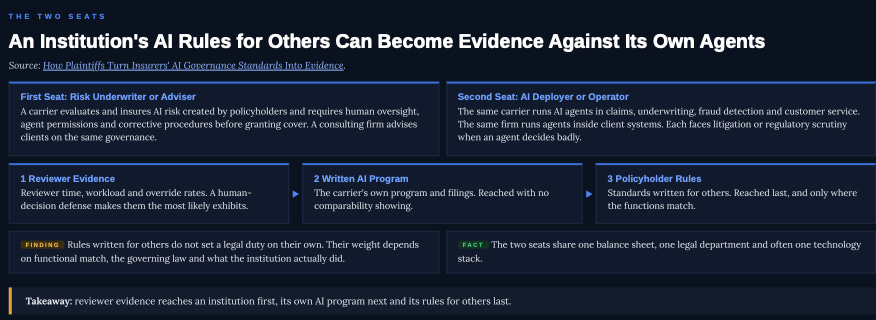
Consulting and audit firms now sit in two seats. In the first they advise clients on how to govern AI, often by writing the very oversight standards those clients adopt. In the second they run AI agents themselves: inside a client’s claims platform, its modernization program or their own audit tools. MindCast calls the second position the Second Seat, a term the series first applied to insurance carriers that both underwrite AI risk and run AI agents of their own.
The thesis. A firm defends an agent it runs only where its own reviewers had the time, information and authority to intervene. The engagement letter may call the work advisory, but permission logs, change-control entries and review workload show who actually controlled the agent. Once a loss occurs, opponents will look past the contract to that evidence, because the AI claims suits against insurers have already taught them where it sits.
Those suits supply the template. A federal magistrate judge in Minnesota ordered broad discovery into UnitedHealth’s AI-assisted coverage decisions on March 9, 2026, including oversight practices. Humana then answered that physician Medical Directors made the disputed denials and that it does not own the nH Predict tool. On September 29, 2026 the plaintiffs moved to add naviHealth as a defendant, the vendor behind the tool.
The question in each filing has shifted from whether a machine decided to whether a human could have.
The tools in those suits are claims algorithms rather than autonomous AI agents. Even so, they set the evidence routes any automated decision will meet. Extending those routes to firms that run agents for clients is MindCast’s analysis, not a judicial finding.
The MindCast distinction. MindCast AI applies Predictive Behavioral Economics + Dynamic Game Theory through MindCast AI Proprietary Cognitive Digital Twin Foresight Simulations (MP CDT FS). Behavioral Economics supplies the decision rules that predict how firms, clients, underwriters and regulators act under pressure. Game Theory supplies the payoff structure that decides which moves pay. Predictive simulations emerge from the combination.
What MindCast Foresight Simulation finds. A firm holds up to four positions on one engagement: adviser, builder, operator and buyer of professional-liability cover. The operating position carries the exposure, and the advisory label does not shield it. Audit firms meet the same test under professional standards, and EY has publicly accepted it. Professional-liability cover already reaches AI output errors, yet no insurer has tied cover for a firm’s autonomous agents to documented agent governance.
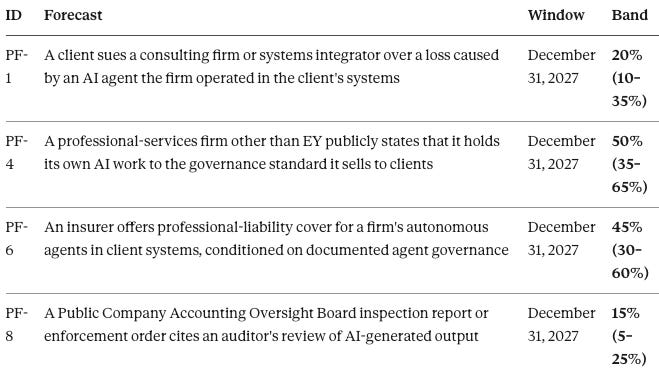
Forecast highlights. Eight MindCast Foresight Simulation Predictions test how the firm-side contest develops through December 31, 2027. PF marks professional-firm forecasts, and the four below lead the set. Insurers and regulators are more likely than client lawsuits to make a firm’s operating control visible first.
Stakeholder readout
💼 Executives. At consulting firms and integrators, every agent run inside a client system needs a named owner, a permission log and reviewer capacity matched to its decision volume. At audit firms, sign-off on AI-assisted work defends the firm only where review time stands behind it.
⚖️ Counsel. Engagement letters that call the work advisory will not survive logs showing operating control. Draft decision-ownership terms now, before a client dispute tests the liability cap.
🏛️ Policymakers. Audit regulators and insurance examiners can test effective review of AI-assisted work before courts do.
📊 Investors. Firms that sell AI governance while running client agents carry exposure their fee mix does not show. Watch whether professional-liability renewals start asking for agent governance evidence.
Takeaway. A firm that staffs review for the agents it runs protects itself more than one that rewrites its engagement letter, because opponents will read the logs before the contract.
II. Firms That Advise on AI Governance Now Run the Agents They Advise On
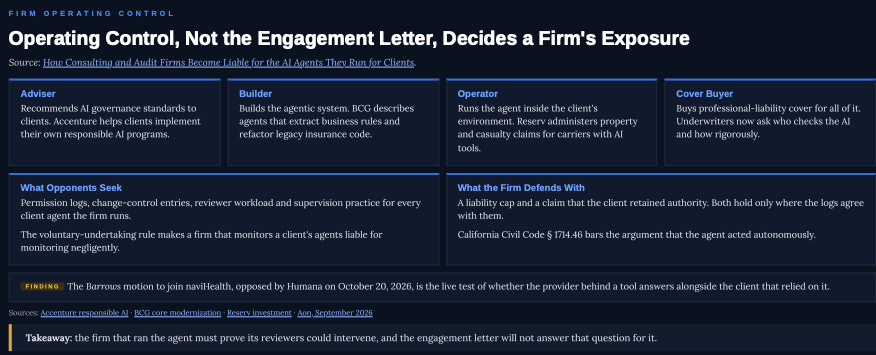
The line between advising on AI and operating it has blurred inside a single engagement. A consulting firm can recommend governance standards to a client, build the agentic system, run it inside the client’s environment and buy professional-liability cover for all of it. Each position carries a different duty. The adviser owes competent advice, the builder owes a sound system, and the operator owes the care of whoever controls a running agent.
Insurance modernization shows the overlap clearly. Boston Consulting Group (BCG) describes in “How Agentic AI Can Power Core Insurance IT Modernization” (January 12, 2026) agents that extract business rules, refactor legacy code and generate tests. BCG adds that strong human architectural oversightx remains necessary. A defect in that work would raise one question first: whose review authority was effective, the carrier’s team or the integrator’s?
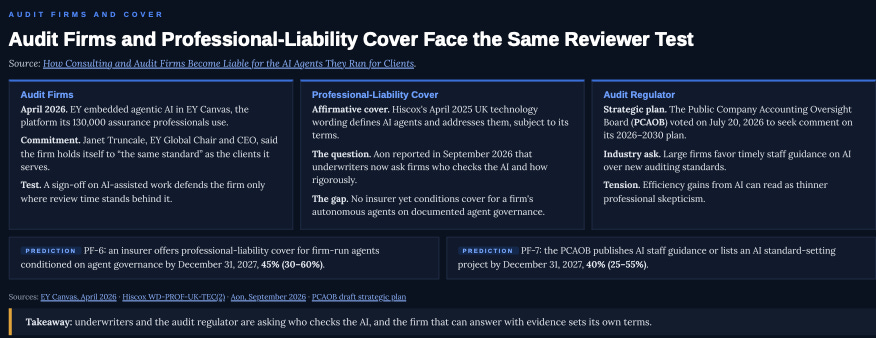
Audit firms have moved the same way. In April 2026 EY embedded agentic AI in EY Canvas, the platform its 130,000 assurance professionals use. Janet Truncale, EY Global Chair and CEO, said the firm holds itself to “the same standard” as the clients it serves. The statement makes EY’s own governance a benchmark opponents can cite.
Source: The Insurance Carrier’s Second Seat Value Proposition
Stakeholder callouts.
💼 Executives. Map every engagement by position. Advisory work and operating work belong in separate scopes, with separate staffing and separate logs.
⚖️ Counsel. The operating position sets the duty, so review engagement terms against what the firm’s people actually do inside client systems.
Takeaway. Once a firm runs the agent, it inherits an operator’s duty, whatever position the engagement letter assigns it.
III. Insurer Lawsuits Built the Test Firms Will Face
The AI claims suits against health insurers matter to firms because they show how opponents attack automated decisions. Four suits define the field: Lokken against UnitedHealth, Kisting-Leung against Cigna, Barrows against Humana and Huskey against State Farm. Across all four, plaintiffs seek the same material: AI decision processes, oversight practices and reviewer workload.
Defendants answer by placing a human at the decision. Humana’s answer in Barrows says physician Medical Directors made the adverse determinations. The move defeats the claim that a machine decided, but it invites a sharper one. Did the reviewer have the time, information and discretion to decide?
The distinction runs between formal and effective authority. Formal authority lives in policies, contracts and approval rights. Effective authority shows in reviewer time per decision, override rates, escalation use and verified corrections. A defense resting on formal authority alone turns review metrics into the plaintiff’s best exhibit, while effective authority turns the same metrics into proof of care.
The Lokken court refused to limit discovery to whether nH Predict was used, which keeps that evidence in scope. Cigna had produced about 2.1 million pages by August 2026, and the Kisting-Leung plaintiffs moved to certify a class of about three million members on October 30, 2026. Discovery at that scale reaches whoever ran the review, inside the carrier or outside it.
Stakeholder callouts.
💼 Executives. Measure reviewer time and override rates for every agent the firm runs, because opponents will measure them later.
⚖️ Counsel. Expect discovery requests modeled on the Lokken order, aimed at the firm’s oversight practice rather than its deliverables.
Takeaway. The insurer suits turned “a human decided” into a question about reviewer capacity, and any firm that supplies the reviewers or the agent inherits that question.
IV. Operating Control, Not the Engagement Letter, Decides a Firm’s Exposure
A firm that runs an agent inside a client’s systems holds operating control, whatever its engagement letter calls the work. When the agent causes a loss, the client or a third party will seek the firm’s permission logs, change-control entries and supervision practice. The firm will then defend on two grounds: its liability cap and its claim that the client retained authority. Both turn on what the logs show.
Barrows already tests the vendor’s position. naviHealth built nH Predict, Optum acquired naviHealth in 2020, and plaintiffs allege that both UnitedHealth and Humana used the tool. Humana denies owning it, and plaintiffs moved on September 29, 2026 to join naviHealth as a defendant. Humana opposed on October 20, so the ruling will show whether a court lets plaintiffs reach the provider that ran the tool alongside the client that relied on it.
Carriers that outsource AI claims work face the mirror image. A carrier that hands claims operations to a consultant, integrator or third-party administrator remains answerable for the decision. Plaintiffs then seek the outsourcing contract, its permission and change-control terms and the carrier’s oversight of the provider. A carrier can defend by allocating review duties in the contract and auditing the provider, but delegation terms showing the provider set the review targets defeat that defense and push the loss back toward the firm.
Common law points the same direction. The voluntary-undertaking rule of Restatement (Second) of Torts §§ 323 and 324A makes a firm that undertakes to monitor a client’s agents liable for monitoring negligently. An alert nobody answers then becomes evidence of breach.
Where control splits between client and provider, plaintiffs tend to sue every layer. California Civil Code § 1714.46 has barred the argument that an AI system acted autonomously since January 1, 2026, which leaves a firm to litigate who controlled the agent.
Source: The Insurance Carrier’s Second Seat Value Proposition
Stakeholder callouts.
💼 Executives. Every client agent the firm runs needs an owner who can intervene and the capacity to do so at the agent’s decision volume.
⚖️ Counsel. Liability caps and retained-authority clauses hold only where the logs agree with them. Align the contract with practice, not the reverse.
📊 Investors. One provider serving many clients links their losses, as the alleged use of nH Predict by two carriers shows.
Takeaway. The firm that ran the agent will be asked to prove its reviewers could intervene, and the engagement letter will not answer that question for it.
V. Audit Firms Face the Same Test Under Professional Standards
Audit firms meet the operating question through professional standards rather than contract. An auditor using agentic tools signs off on work that AI helped produce. The sign-off defends the firm only where effective review stands behind it: enough time, enough information and real authority to reject the output.
EY’s public commitment raises the stakes. By holding itself to “the same standard” as its clients, the firm invites comparison between the governance it audits and the governance behind its own AI-assisted audit work. Any gap between the two becomes the first thing a regulator or litigant would examine.
The test also runs through efficiency. Agentic tools promise faster audits, while professional skepticism requires time to question what the tools produce. When review time per item falls as AI output rises, the efficiency gain can become evidence that skepticism thinned.
Stakeholder callouts.
💼 Executives. Track review time per AI-assisted audit area so the firm can show skepticism kept pace with automation.
🏛️ Policymakers. Inspection programs can test whether review capacity matched AI output before a failed audit tests it instead.
Takeaway. For audit firms, faster AI-assisted work defends the firm only where the evidence shows reviewers still had time to doubt it.
Source: The Insurance Carrier’s Second Seat Value Proposition
VI. Professional-Liability Cover Does Not Yet Require Agent Governance
Professional-liability insurers already cover AI output errors, and some have gone further. Hiscox’s April 2025 UK technology wording defines AI agents and affirmatively addresses claims arising from them, subject to its insuring agreement and exclusions. Counterpart has also affirmed AI cover in professional lines. Cover for any given claim still depends on the policy’s terms.
Underwriters are starting to ask the right question. Aon reported in September 2026 that professional-indemnity underwriters now ask insured firms who checks the AI and how rigorously. Yet no insurer has made cover for a firm’s autonomous agents in client systems conditional on documented agent governance.
The gap matters in both directions. Firms that build decision-ownership evidence now will hold what underwriters ask for once conditions arrive. Firms that wait may find the condition written into renewal terms on the insurer’s schedule rather than their own.
Stakeholder callouts.
💼 Executives. Prepare the answer to Aon’s question before the next renewal: who reviews each agent, how often and with what authority.
📊 Investors. A first governance-conditioned agent cover would signal that underwriters can now evaluate firm-side agent risk.
Takeaway. Underwriters have started asking who checks the AI, and the firm that can answer with evidence will set its own terms when conditions arrive.
VII. Predictive Behavioral Economics and Dynamic Game Theory Explain Why Firms Move Slowly
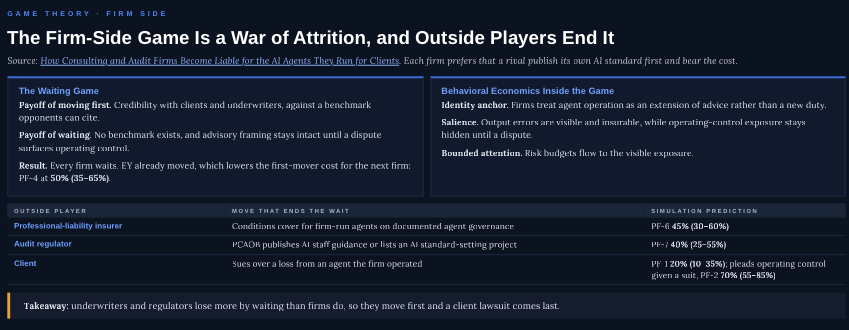
Behavioral economics supplies the decision rules. Firms anchor on their advisory identity, so leaders treat agent operation as an extension of advice rather than a new duty. Output errors are salient and easy to insure, while operating-control exposure stays invisible until a dispute surfaces it. Bounded attention therefore flows to the visible risk.
Game theory supplies the payoff structure. A firm that publicly holds its own AI work to the standard it sells gains credibility with clients and underwriters, but it also hands opponents a benchmark. Each firm prefers that a rival move first, so public alignment stalls until a dispute, a regulator or an underwriter changes the payoff.
Predictive behavior emerges from the combination. Firms will keep advisory framing and private remediation until an external event makes operating control visible. The first client suit that pleads operating control, or the first renewal that conditions cover on agent governance, would reset the payoff for every firm at once.
Takeaway. Firms wait because the risk they underweight is also the one no rival has yet made costly to ignore.
VIII. MindCast Simulation Predictions — Operating Control Decides Firm Exposure
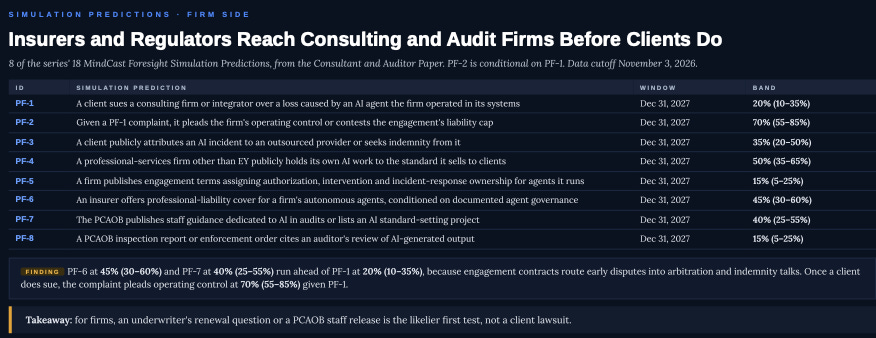
The set below states eight firm-side forecasts with a named actor, outcome, window and falsifier for each. PF marks the professional-firm forecasts, and PF-2 is conditional on PF-1. Data cutoff is November 3, 2026. Two carrier forecasts from the companion papers, CS-5 and CS-6, carry over with their bands because they resolve the evidence template firms will face.
VIII.A Three Competing Explanations
Explanation 1. Operating control reaches court. Firm exposure arrives through client disputes that plead the firm’s control of an agent, and reviewer evidence decides them. Falsified if no client complaint pleads a firm’s operating control of an AI agent by December 31, 2027.
Explanation 2. Contracts absorb the loss. Liability caps, indemnities and professional-liability cover absorb agent losses privately, so disputes stay in arbitration and renewal negotiations. Falsified if a public complaint contests a firm’s liability cap on operating-control grounds.
Explanation 3. Regulators move first. Audit regulators reach AI-assisted work through inspection before any litigant does. Falsified if the Public Company Accounting Oversight Board (PCAOB) takes no public action on AI in audits by December 31, 2027.
The simulation favors Explanations 2 and 3 through 2027. Professional-liability insurers (PF-6 at 45% (30–60%)) and the PCAOB (PF-7 at 40% (25–55%)) are more likely to make operating control visible than a client lawsuit is (PF-1 at 20% (10–35%)), because engagement contracts route most early disputes into arbitration and indemnity negotiations.
PF-1. A client sues a consulting firm or systems integrator over a loss caused by an AI agent the firm operated in the client’s systems (20% (10–35%)). Window: December 31, 2027. Falsified if no such complaint is filed in a U.S. court within the window.
PF-2. Given a PF-1 complaint, the complaint pleads the firm’s operating control or contests the engagement’s liability cap. P(PF-2 given PF-1) 70% (55–85%). Window: December 31, 2027. Falsified if every qualifying complaint rests on advisory negligence alone.
PF-3. A client publicly attributes an AI incident to an outsourced provider or seeks indemnity from it (35% (20–50%)). Window: December 31, 2027. Falsified if no public filing, disclosure or statement makes that attribution.
PF-4. A professional-services firm other than EY publicly states that it holds its own AI work to the governance standard it sells to clients (50% (35–65%)). Window: December 31, 2027. Falsified if no such statement appears from a firm other than EY.
PF-5. A firm publishes engagement terms that assign authorization, intervention and incident-response ownership for agents it runs in client systems (15% (5–25%)). Window: December 31, 2027. Falsified if no firm publishes such terms.
PF-6. An insurer offers professional-liability cover for a firm’s autonomous agents in client systems, conditioned on documented agent governance (45% (30–60%)). Window: December 31, 2027. Falsified if no filed form, product announcement or broker report shows such a condition.
PF-7. The PCAOB publishes staff guidance dedicated to AI in audits or lists an AI standard-setting project (40% (25–55%)). Window: December 31, 2027. Falsified if neither appears on the PCAOB’s public agenda or guidance pages.
PF-8. A PCAOB inspection report or enforcement order cites an auditor’s review of AI-generated output (15% (5–25%)). Window: December 31, 2027. Falsified if no such report or order issues.
VIII.C Carried Carrier Forecasts
CS-5. Cigna or Humana opposes class certification on individualized human review as a material ground (85% (70–95%)). Window: April 30, 2027. Carried from How Insurers Defend AI Claims Decisions When Their Own Governance Standards Become Evidence.
CS-6. A plaintiff filing in Lokken, Kisting-Leung or Barrows presents reviewer evidence from discovery (80% (70–90%)). Window: June 30, 2027. Carried from How Plaintiffs Turn Insurers’ AI Governance Standards Into Evidence.
Takeaway. The firm-side forecasts ask one question in eight forms: does operating control become visible through a lawsuit, a contract, an insurer or a regulator first?
Source: The Insurance Carrier’s Second Seat Value Proposition
IX. What Each Stakeholder Should Do and What Exposure Remains
Each entry routes one forecast to one audience. Severity and probability stay separate, and each entry carries its band. The entries sit as a standalone section so each audience can read its own.
Consulting and integration executives: PF-1 and PF-2.
Forecast and band: a client suit over a firm-operated agent at 20% (10–35%) for PF-1. Once filed, the complaint pleads operating control at 70% (55–85%) for PF-2.
Exposure: the engagement’s liability cap becomes contested, and discovery reaches permission logs and reviewer workload across every client running the same agent.
Mitigating actions: the delivery lead assigns a named owner with intervention authority to each client agent before the next engagement renewal. The risk function logs reviewer time and overrides per agent from the first quarter of 2027.
Residual exposure: agents deployed before ownership was assigned remain undocumented for that period.
General counsel: PF-5.
Forecast and band: a firm publishes decision-ownership engagement terms at 15% (5–25%) for PF-5.
Exposure: once one firm publishes such terms, clients and courts can measure every other firm’s contracts against them.
Mitigating actions: counsel drafts decision-ownership schedules for authorization, intervention and incident response before the next master services agreement renewal. Counsel aligns retained-authority clauses with actual staffing in the same cycle.
Residual exposure: legacy contracts that call operating work advisory stay in force until renegotiated.
Audit firm leadership: PF-7 and PF-8.
Forecast and band: PCAOB staff guidance or an AI standard-setting project at 40% (25–55%) for PF-7. An inspection finding on AI-generated output carries 15% (5–25%) for PF-8.
Exposure: inspection findings in the areas where AI output rose fastest, measured in engagements requiring remediation.
Mitigating actions: the quality function measures review time per AI-assisted audit area before the 2027 inspection cycle. Engagement partners document skepticism steps on AI output in the working papers.
Residual exposure: areas where review time already fell cannot be documented retroactively.
Professional-liability underwriters and investors: PF-6.
Forecast and band: governance-conditioned cover for firm-operated agents at 45% (30–60%) for PF-6.
Exposure: for underwriters, agent losses absorbed under wording written for output errors; for investors, firm earnings that carry unreserved operating exposure.
Mitigating actions: underwriters add agent-ownership questions to renewal submissions at the next renewal cycle. Analysts ask firm management how client-agent operations are reviewed at the next earnings or partner briefing.
Residual exposure: policies already bound carry the current wording to expiry.
Takeaway. Each audience can act before the bands arrive, and the lowest-cost move for every one of them is documenting who could intervene.
What to Watch — The naviHealth Joinder Ruling Is the Dominant Fork
The dominant fork is the court’s ruling on the Barrows plaintiffs’ motion to join naviHealth. A grant would show a court letting plaintiffs reach the provider behind an AI tool alongside the client that relied on it. A denial would keep vendor exposure in separate suits and contract disputes.
November 5, 2026. Barrows class-certification motion due.
Pending. Ruling on the September 29, 2026 motion to join naviHealth, opposed by Humana on October 20.
January 1, 2027. Colorado SB 26-189 begins allocating developer and deployer liability by comparative fault, with enforcement stayed pending rulemaking.
January 11, 2027. Cigna’s class-certification opposition due in Kisting-Leung, the first test of CS-5.
March 15, 2027. Kisting-Leung reply due.
Each professional-liability renewal. Whether underwriters ask for agent-ownership evidence, the first sign of PF-6.
Takeaway. The naviHealth ruling will show firms whether running a client’s tool brings them into the client’s lawsuit.
Conclusion — The Firm That Runs the Agent Answers for It
Liability for client agents moves from the client toward the firm that ran the agent, and the firm keeps it unless its logs, its contract or its insurer move it back.
Consulting and audit firms now run the agents they advise on. The insurer suits have already taught plaintiffs to ask whether a human could decide, and the Barrows joinder motion shows them reaching the provider behind the tool. For a firm, the answer lives in permission logs and reviewer workload, not in the engagement letter.
Firms that document who could intervene will hold the evidence courts, regulators and underwriters ask for. Firms that rely on advisory framing will find the logs speaking first. The first client suit that pleads operating control will set the terms for every firm that runs agents for others.
Working With MindCast
A firm’s exposure depends on which agents it runs, for which clients and with what review capacity, and only the firm can see all three. MindCast simulates how clients, plaintiffs, underwriters and regulators would test that exposure. The simulation runs on Cognitive Digital Twins (CDTs), simulated versions of those institutional actors.
A complimentary pilot comes first. Inputs are public filings, the firm’s published AI standards and one anonymized client-agent workflow shared under a mutual nondisclosure agreement. The pilot delivers a decision-ownership map, a reviewer-capacity assessment and banded forecasts with windows and falsifiers.
Retained engagements follow the decision each stakeholder faces.
💼 Consulting and Integration Firms. A decision-ownership map allocates control of each agent the firm runs inside a client system.
⚖️ Counsel. An engagement-terms review tests liability caps and retained-authority clauses against operating practice.
💼 Audit Firms. A review-capacity test measures skepticism against AI output by audit area ahead of the 2027 inspection cycle.
📊 Professional-Liability Underwriters. A submission framework evaluates firm-side agent governance at renewal.
The MindCast Predictive Game Theory Simulation of Mixed Time Horizon Insurance Carrier Second Seat Exposuredetails each engagement. Each forecast in this series resolves on the MindCast Prediction Scorecard. Contact mcai@mindcast-ai.com to scope a pilot, or see predictive game theory simulations at www.mindcast-ai-simulation.com.
Appendix A. Selected MindCast Works
The series rests principally on four works: When AI Agent Liability Meets Common Law and Statute, Agentic Foreseeability and the Modern Duty of Care for AI Agents, Who Writes AI Insurance Coverage Conditions and The Calculus of Predictive Game Theory Evolution and Mutation. The remaining works support specific mechanisms.
Tier 1. Core — Liability, Coverage and Capital
1. When AI Agent Liability Meets Common Law and Statute — Predictable Doctrines, Unsettled Allocation(November 3, 2026) URL: https://www.mindcast-ai.com/p/agentic-common-law-statutory-liablity-allocation Relevance: The anchor work supplies the four doctrines that structure liability allocation once agents act. The paper’s foreseeability paradox shows how an unanswered auditable finding can support an inference of notice in tort and bear on prior-knowledge provisions in coverage. P18 (subrogation at 12%) and P19 (carrier AI tools challenged outside health insurance, 45%) give the carrier-facing forecasts, under their published identifiers.
2. Agentic Foreseeability and the Modern Duty of Care for AI Agents (October 29, 2026) URL: https://www.mindcast-ai.com/p/agentic-foreseeability Relevance: Supplies the foreseeability test that decides what a deployer should have known once its agents act. The paper shows how courts can find foreseeability from evaluation results before loss data accumulates.
3. Who Writes AI Insurance Coverage Conditions — Procurement, Enforcement Decrees, Partner Terms and the Two-Axis Condition (October 30, 2026) URL: https://www.mindcast-ai.com/p/agentic-insurance-controllable-lossesRelevance: Names who supplies the evidence that makes coverage conditions writable: procurement, consent decrees and partner terms. The analysis complements BCG’s case for narrow first-generation products.
4. Who Absorbs Correlated AI Loss — Reinsurance Aggregation, Industry Pools, the Public Backstop and the Liability Shield (October 30, 2026) URL: https://www.mindcast-ai.com/p/agentic-insurance-capital Relevance: Examines pooled capacity and public backstops, including levy-funded pools of the Flood Re type that BCG’s June 2026 white paper proposes. The paper argues that corrective duties should accompany public support. The paper’s number-of-occurrences analysis bears on correlated AI loss.
5. FTC Investigation of Anthropic and OpenAI — State Subpoenas Came First, and the Theory of Harm Decides the First Federal Order on Frontier Model Safety (October 31, 2026) URL: https://www.mindcast-ai.com/p/ftc-anthropic-openai Relevance: Sets out the federal enforcement baseline. A coverage condition written before any order becomes the market term the order later confirms, so carriers move ahead of the regulator.
6. OpenAI State Attorney General Lawsuits — Two Pleading Templates Across Ten State Courts (October 30, 2026) URL: https://www.mindcast-ai.com/p/ag-coalition-v-openai-snapshot Relevance: Shows the state enforcement channel moving without a federal order or an insurance market. Liability reaches AI developers through consumer law before any coverage dispute.
Tier 2. Foresight-to-Duty Conversion Series
7. Foresight-to-Duty Conversion in AI Governance, Series Introduction (October 24, 2026) URL: https://www.mindcast-ai.com/p/foresight-to-duty-conversion-series Relevance: States the governing question behind this paper: when an institution knows, what makes it act and what establishes that the correction worked.
8. Who Sets the Agentic Standard of Care — Common Law, State Legislation and Federal Coordination (October 30, 2026) URL: https://www.mindcast-ai.com/p/agentic-institutional-controls Relevance: Answers which institution writes the agentic standard of care that carriers apply at renewal. Courts, legislatures and federal coordination compete for the role, and carriers borrow whichever standard arrives first.
9. Consent Order Remedies at Meta, Boeing, Starling and Wells Fargo — Verified Correction Versus Recurrence(October 24, 2026) URL: https://www.mindcast-ai.com/p/consent-remedies-correction-v-recurrence Relevance: Supplies the verified-correction test behind answerable monitoring. The Unified Agentic Core article embeds human-in-the-loop gates, and the paper shows that gates without verified correction produce recurrence rather than care.
10. Meta and Bank of America Foresight-to-Duty Conversion — Revenue-Funded Versus Cost-Funded Deferral(October 24, 2026) URL: https://www.mindcast-ai.com/p/meta-boa-revenue-v-cost-funded-deferrals Relevance: Explains why institutions defer corrections their own systems measured. Carriers deploying a unified agentic core face the same deferral choice on every flagged claim decision.
11. Meta Foresight-to-Duty Conversion Across Privacy, Child Safety and Scam Ads (October 24, 2026) URL: https://www.mindcast-ai.com/p/meta-span-of-duties Relevance: Shows one platform facing several regulators at once over the same measured gaps. The case parallels a carrier’s agent fleet, where a single ontology spreads one finding across many lines of business.
12. Bank of America $1.2 Billion Money Laundering Penalty and the Compliance System That Knew Too Much(October 14, 2026) URL: https://www.mindcast-ai.com/p/boa-foreseeable-aml-penalty Relevance: Provides the clearest precedent for imputed knowledge from automated systems. BCG’s unified core propagates insights across agents automatically, which is the “system that knew too much” pattern applied to insurers.
Tier 3. Method and Framework
13. Predictive Game Theory Evolution and Mutation — Short Horizon Games Branch Wide and Resolve Shallow(November 3, 2026) URL: https://www.mindcast-ai.com/p/predictive-game-theory-calculus-short-horizon Relevance: Uses agentic AI liability as its worked tree and shows why firms can act before deep forecasts arrive. The point supports writing bounded risks now by showing which liability terms move at which renewal.
14. The Calculus of Predictive Game Theory Evolution and Mutation (November 3, 2026) URL: https://www.mindcast-ai.com/p/predictive-game-theory-calculus-intro Relevance: States the governing calculus: strategic clarity can run ahead of structural certainty. BCG’s “velocity mismatch” between actuarial and model clocks is a horizon problem the calculus addresses directly.
15. Predictive Game Theory Evolution and Mutation — Long Horizon Games Resolve Deep Because Their Branches Hold (November 3, 2026) URL: https://www.mindcast-ai.com/p/predictive-game-theory-calculus-long-horizonRelevance: Shows what stability adds once a game holds, using the Bank of America tree. The paper marks the conditions under which agentic coverage could graduate from narrow products to broad cover.
16. Dynamic Predictive Game Theory — From Nash Equilibrium to Adaptive Coherence Equilibrium (October 23, 2026) URL: https://www.mindcast-ai.com/p/bridge-to-dynamic-game-theory Relevance: Supplies equilibrium selection and delay dominance. BCG tells carriers not to wait, and delay dominance explains when waiting is rational and when it fails.
17. Predictive Game Theory Simulations Through War Gaming (November 1, 2026) URL: https://www.mindcast-ai.com/p/predictive-behavioral-economics-dynamic-game-thoery-war-gaming Relevance: Separates Simulation Snapshots from full Foresight Simulations by the stability of the game. The distinction explains why the agentic liability work carries short-window forecasts.
18. How Mozart Predicts Game Mutation in Predictive Behavioral Economics + Dynamic Game Theory (October 11, 2026) URL: https://www.mindcast-ai.com/p/mozart-economics Relevance: Frames when a structural change crosses an operative threshold, the test for whether a unified-core migration changes the rules or only the evidence carriers hold.
19. MindCast Predictive Game Theory Simulation of Mixed Time Horizon Insurance Carrier Second Seat Exposure (November 2026) URL: https://magazine.mindcast-ai.com/agentic-insurance-carrier-second-seat-value-proposition Relevance: Translates the series into engagements for carriers, reinsurers, consulting and audit firms, claims vendors and counsel.
Appendix B. External Sources
Court filings
Estate of Lokken v. UnitedHealth Group, Inc., No. 23-cv-3514 (D. Minn.), Order on Motion to Compel Discovery(March 9, 2026).
Estate of Lokken v. UnitedHealth Group, Inc., Memorandum Opinion and Order on Motion to Dismiss (February 13, 2025), dismissing five of seven counts and allowing the breach of contract and implied covenant claims to proceed.
Barrows v. Humana Inc., No. 3:23-cv-00654 (W.D. Ky.), Amended Answer (August 26, 2026), Scheduling Order(July 17, 2026) and Scheduling Order (October 15, 2026; class-certification motion due November 5, 2026).
Kisting-Leung v. Cigna Corp., No. 2:23-cv-01477 (E.D. Cal.), Joint Stipulation (August 24, 2026), and Minute Order (August 26, 2026).
Huskey v. State Farm Fire & Casualty Co., No. 1:22-cv-07014 (N.D. Ill.), case summary and docket, Civil Rights Litigation Clearinghouse.
Law360, “Cigna Patients Seek Hefty Class In Cigna Auto Denials Suit” (October 30, 2026).
Barrows v. Humana Inc., Health Care Litigation Tracker case page, Georgetown Law.
Industry research (Boston Consulting Group): primary
“The Case for the Unified Agentic Core in Insurance” (October 21, 2026), Fabrizio Pessina, Roberto Bosisio, Nicolás López Polo, Christoph Fritsch, Nicolas Guglielmi and Riccardo Pallozzi.
“Your Agents Are Ready. Is Your Insurer?” (June 2026), Raphael Troitzsch, Nadine Moore and Coralie Ming. White paper, announced on BCG’s insurance LinkedIn page; no stable public URL.
“Always-On Portfolio Management: How Agentic AI Can Give a Lasting Edge to Commercial P&C Insurers”(June 30, 2026), Erdem Altay, Semih Durmus, Nadine Moore, Michael Schachtner and Victor Zhou.
Industry research (Boston Consulting Group): supporting
“How Agentic AI Can Power Core Insurance IT Modernization” (January 12, 2026), Fabrizio Pessina, Roberto Bosisio, Nicolás López Polo, Christoph Fritsch and Nicolas Guglielmi.
“Agentic AI’s Advantage for Health Insurers: Faster Decisions, Lower Costs, Better Care” (September 4, 2026), Konstantin Storms, Juliane Burgdorf, Matthias Becker, Swayamjit Mishra, Alessandra Catozzella and Kazim Zaidi.
“Are Insurers’ Talent Models Ready for AI?” (July 22, 2026), Nathalia Bellizia, Isabelle Cox, Megan Mirabella and Nadine Moore.
Rules, regulation and standard forms
NAIC, “Implementation of NAIC Model Bulletin: Use of Artificial Intelligence Systems by Insurers”.
Cozen O’Connor, “Claims Notes: October 2026” (October 19, 2026), reporting 29 adopting jurisdictions.
Gallagher, “ISO Introduces Generative AI Exclusion in Commercial General Liability Policies: What Construction Companies Should Know” (May 28, 2026), naming ISO endorsement CG 40 47 01 26.
Mark Rosanes, “ISO’s Generative AI Exclusion Is Already on Thousands of CGL Policies”, Insurance Business(September 16, 2026), reporting that CG 40 47 01 26 became available for carrier attachment in January 2026 alongside CG 40 48 and CG 35 08.
Professional services and AI
EY, “EY launches enterprise-scale agentic AI to redefine the audit experience for the AI era” (April 7, 2026).
Hiscox, “Professional Indemnity for Technology Companies, Policy Wording WD-PROF-UK-TEC(2)” (April 2025).
The Insurer, “MGA Counterpart Adds Affirmative AI Cover to Professional Liability Policies” (November 24, 2025).