

Companion frameworks: AI Data Center Developers Are About to Disclose What State Power Approval Costs | The AI Data Center Authorization Price — A 50-State Baseline · The Authorization Market — Standardized Bargaining, Rationed Power, and the Competition to Build America’s AI Infrastructure · Why MindCast Is Filing a Public Comment with the Department of Energy · New York's Data Center Moratorium · The Two-Ledger Data Center Bargain · The Federal-State AI Infrastructure Collision · The AI Infrastructure Power Stack
Executive Summary
America is no longer debating whether AI infrastructure should be built. It is competing over which governance architecture will authorize it.
The evidence arrived in Congress this year. Senator Bernie Sanders introduced the Artificial Intelligence Data Center Moratorium Act in March 2026; Representative Alexandria Ocasio-Cortez introduced the House companion in June. Together, S.4214 and H.R.9442 — the most aggressive AI infrastructure bill in American history — would halt construction of every large AI data center in the country until Congress passes sweeping safeguards covering jobs, electricity prices, water, privacy, and community consent. Most coverage frames the bills as a binary choice: pause AI infrastructure or accelerate it. The framing misses the real event.
Three governance systems now compete for control of that question, and each is winning somewhere. The Moratoriumequilibrium — pause deployment until safeguards exist — dominates county boards and one state capital, but cannot pass Congress. Pure Acceleration — permit quickly with minimal conditions — dominates federal executive policy, but keeps colliding with state and local resistance. Conditional Acceleration — keep building, but make developers pay the public costs they create — is emerging as the system’s dominant coordination equilibrium, with both parties now writing versions of it into law.
Two findings drive the analysis. First, conditional acceleration will prevail — not because it polls better, but because the system’s own feedback loops push every conflict toward it. Second, and more surprising: the moratorium bill’s most powerful effect is strengthening the equilibrium it opposes. A credible pause threat gives developers a reason to negotiate, utilities a reason to build dedicated rate structures, and communities leverage to demand enforceable terms — all of which are conditional acceleration in action.
MindCast tested the thesis by running its proprietary Cognitive Digital Twin Foresight Simulation engine — computerizing behavioral economics and dynamic predictive game theory — across the full institutional field. The simulation confirmed both findings and sharpened the first: conditional acceleration is not a compromise between the poles but a coordination equilibrium — the arrangement that lets institutions with incompatible objectives keep authorizing infrastructure through priced, divisible obligations instead of ideological agreement. Headline results:
⚖️ Conditional acceleration becomes America’s dominant practical governance architecture through July 2028 (85–92%)
🔌 Federal acceleration channels projects into state and local bargaining rather than eliminating it (86–93%)
📜 Large-load tariffs and cost-allocation frameworks standardize across major AI markets (82–90%)
🏗️ Governance capability becomes a competitive differentiator — by 2028, at least two hyperscale developers compete publicly on governance architecture itself (80–89%)
Twelve falsifiable predictions — five primary, seven secondary — form the paper’s register, each with a deadline, a confidence band, and a public condition that proves it wrong. The analysis is written for the people who will operate inside this system — hyperscale developers, state and federal lawmakers, and data center strategists — and it does more than forecast: Section IX translates the findings into moves for each seat at the table, and Section XII redesigns the moratorium bills under the paper’s own framework, a legislative blueprint for the conditional-acceleration center.
One claim differentiates the analysis from conventional policy debate, and it frames everything below: governance equilibria compete through institutional adaptation, not legislative victory. Bills matter for how they shift every other institution’s incentives, not for whether they pass. A second contribution follows from the first: federal and state proposals are complements, not substitutes — Congress contests the quantity of AI infrastructure while states set its price — and conditional acceleration is the architecture that links those nested layers into one functioning system.
The Three Equilibria at a Glance
One table organizes the entire contest. Three governance architectures now compete for AI infrastructure, and each reduces to a decision rule, a mechanism, and a trajectory:
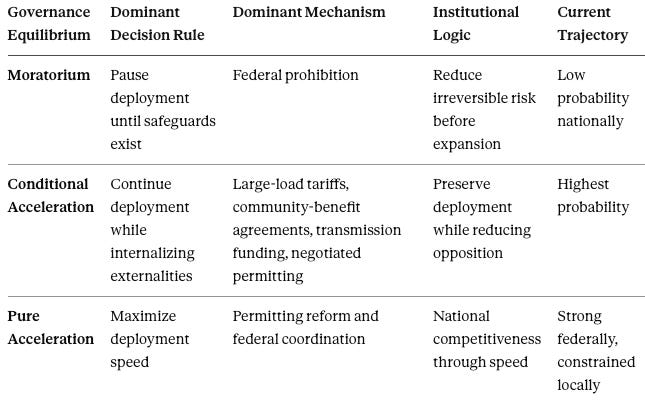
Carry the map forward: each row is a complete governance architecture, already operating at the level of government where it is strongest.
What This Paper Is — and Is Not
Written for readers on every side of the moratorium debate, the paper advocates for no bill and against no bill. The analysis does not argue that AI infrastructure should proceed without governance, and it does not argue that nationwide moratoria represent the optimal governance architecture. The task is different: evaluating competing institutional mechanisms for reconciling AI competitiveness with the increasingly visible public costs of hyperscale infrastructure. The central question is predictive rather than ideological — which governance architecture is most likely to sustain both innovation and political legitimacy over time?
The forecasts are built to be falsifiable, and the falsifiability is the invitation. Readers who believe a different architecture will prove more stable — a stronger federal backstop, a faster federal track — can test that belief against the prediction register, where every entry carries a deadline, a confidence band, and a public condition that proves it wrong. Engagement on mechanisms and forecasts, rather than on positions, is what the paper asks of every reader.
I. Governance Has Become the Competitive Arena
America’s AI debate changed subject in 2026, and the change happened faster than most observers registered. Regulators stopped asking software questions — what do the models do, who do they harm — and started asking infrastructure questions: how much power does the facility draw, whose water does it use, whose electric bill rises.
Earlier MindCast analyses tracked the shift in two stages. Governments began regulating AI’s physical production — electricity, transmission, water, land use, environmental review — with the legal machinery built for power plants, not software. The political negotiation then narrowed to a single question: not whether AI gets built, but who bears the costs of building it. New York’s statewide permitting pause, Seattle’s data center freeze, and more than one hundred county moratoria all answer that question locally, each on its own terms.
The Moratorium Act reveals a third stage. Competing institutions no longer fight over individual policies; they fight to establish entire governance architectures — complete systems of rules, prices, and veto rights that, once established, reproduce themselves. Understanding those architectures, rather than handicapping any single bill, is the work of the rest of the paper.
II. Institutions Optimize Different Problems
Conflict over AI infrastructure looks chaotic until each institution is viewed through its own optimization problem. Viewed that way, the chaos resolves into five rational actors solving five different problems on the same board.
The Federal Executive optimizes national competitiveness: every month of permitting delay reads as strategic ground ceded to China. Congressional moratorium advocates optimize precaution and democratic oversight: irreversible harms, in their model, justify pausing before building. Hyperscale developers optimize speed and certainty: delay costs more than concessions. Utilities optimize reliability and cost recovery: growth must not destabilize existing customers or shift costs onto them. State and local governments optimize both sides at once: capture the investment, protect the residents, survive the next election.
None of these objectives is irrational. They are simply different — and because each institution holds real power over some part of the approval pathway, each pushes the whole system toward a different governance equilibrium. The architecture that ultimately governs will therefore emerge from continuous adaptation among these institutions, not from any single legislative outcome. Section III names the three equilibria those adaptive pressures produce.
III. Three Governance Equilibria
Three complete governance architectures now compete for American AI infrastructure, and each can be stated as a one-line decision rule. The table at the opening of the paper summarizes them; the paragraphs below make each one concrete.
The Moratorium equilibrium pauses first and asks questions later. The Sanders–Ocasio-Cortez bills carry it federally, New York’s Executive Order 62 carries it at the state level, and a wave of county and city freezes carries it beneath them. Grievance politics fuels the equilibrium: residents weigh feared losses — higher bills, drained aquifers — roughly twice as heavily as promised gains, and a pause is the only instrument that removes every feared loss at once. Local strength and national weakness share the same source: a county board answers directly to those residents, while a federal moratorium must overcome labor opposition, the China-competitiveness argument, and the constitutional reality that land use belongs to states.
The Conditional Acceleration equilibrium preserves deployment by converting uncompensated externalities into negotiated obligations. Every instrument in its toolkit manifests that single principle: cost-causation tariffs convert grid impacts into payments, dedicated large-load rate classes convert ratepayer exposure into insulation, community-benefit agreements convert local harms into escrowed and independently monitored commitments, and financial assurances convert stranded-infrastructure risk into posted guarantees. The coalition crosses party lines: New York’s Democratic governor demands a grid fund, a Republican congressman from data-center country demands full cost payment and water recycling, and twenty-seven state legislatures are drafting between them.
The Pure Acceleration equilibrium clears the road. Federal instruments power it: a 2025 executive order that streamlines environmental review, opens federal land, and fast-tracks projects above 100 megawatts, plus federal energy regulators pressing all six regional grid operators to speed large-load connections. The limit is structural rather than political: federal orders cannot erase state zoning or county land-use power, so every project acceleration delivers another facility to a local government that acceleration cannot compel.
Read as a set, the three equilibria are not competing bills awaiting a vote. They are adaptive governance systems, each already operating at the level of government where it is strongest — and Section IV shows what happens when they interact.
IV. Adaptive Competition
Governance regimes rarely defeat one another outright. They adapt — and in AI infrastructure, every institutional decision changes the incentive landscape facing every other participant.
Concrete examples run in every direction. Federal permitting acceleration pushes more projects into state review at once, which drives states to negotiate conditions rather than issue blanket prohibitions. State bargaining pushes developers to finance transmission, private generation, and community investments before opposition organizes. Utility cost allocation redraws developer site-selection maps. Community resistance reshapes utility tariffs. Congressional moratorium proposals redraw the political boundaries inside which everyone else negotiates.
Two feedback loops carry the whole system, and both deserve explicit statement. The concession loop runs: infrastructure demand raises grid stress; grid stress forces utilities to allocate costs; visible costs fuel local resistance; resistance extracts developer concessions; concessions buy political acceptance; acceptance restores deployment. The channeling loop runs: federal acceleration raises deployment velocity; velocity intensifies state bargaining; bargaining spreads conditional-acceleration frameworks — which simultaneously drain political energy from a nationwide moratorium and constrain pure acceleration from below.
Both loops end in the same place, and the convergence is the paper’s structural core. Conditional acceleration is not merely the most likely outcome; it is the system’s attractor — the state both feedback loops push toward regardless of where a conflict starts. A moratorium fight feeds the concession loop and produces negotiated terms. An acceleration push feeds the channeling loop and produces state conditions. Either way, the system lands on priced, negotiated deployment.
No equilibrium will win nationally, because each controls a different layer of government — a conclusion that deserves plain statement. Acceleration governs federal permitting, conditioning governs state and utility policy, and pauses govern a growing share of counties — and for any given project, the strictest rule that no higher authority has overridden controls the outcome. The national result is a composite, not a victory. Section V maps the layers formally, because the map resolves what otherwise looks like national incoherence.
Contact mcai@mindcast-ai.com to partner with us on Predictive Game Theory AI in Law and Behavioral Economics. We specialize in predictive simulations for Complex Litigation, Innovation Economics, Geopolitical Risk Intelligence and Legacy Innovation. See more about MindCast series at our new website MindCast Corporate.
To test our predictive simulation AI system, in 2026 we simulated the Super Bowl and the World Cup. See 🏈 Super Bowl LX — AI Simulation vs. Reality | ⚽ The 2026 World Cup Final Simulation Validation
To deep dive on MindCast works upload the URL of this publication into any LLM (preferably Google AI mode) and prompt ‘reconstruct MindCast framework with three degrees of cited sub links.’ See Live-Fire Game Theory Simulators, Runtime Predictive Infrastructure.
V. The Governance Stack: Why Federal and State Proposals Play Different Games
Federal and state proposals look contradictory at first read — Congress debates pausing the very industry twenty-seven state legislatures are busy pricing. Read as rivals for the same authority, the record is incoherent. Read as layers of a governance stack, it snaps into focus: federal and state proposals are adaptive responses at different levels of the system, solving different optimization problems.
Five layers structure the stack, and each asks its own question:
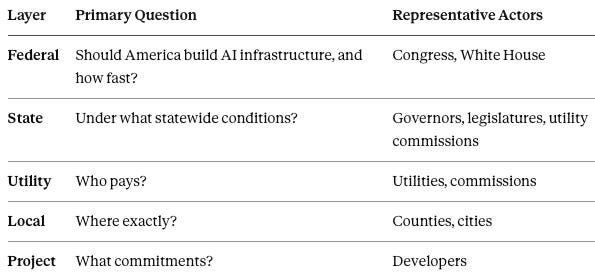
Every layer governs a different margin. Federal institutions primarily determine the national pace of deployment. States determine the economic conditions under which deployment occurs. Utilities determine cost allocation. Local governments determine project legitimacy. Developers determine whether the accumulated conditions remain economically acceptable.
Reduced to economics, the division is quantity versus price. Congress contests how much AI infrastructure America wants — the moratorium bills argue for less now, federal acceleration argues for more, faster. States set the authorization priceof whatever quantity arrives: grid funds, large-load tariffs, water obligations, community consent. Different questions explain otherwise puzzling behavior — the same hyperscaler opposes the federal pause while testifying in state hearings that it will pay full infrastructure costs, without contradiction, because the two proposals tax different margins.
Congress determines how much AI infrastructure America wants. States determine its authorization price.
The layers do not merely coexist; they continuously rewrite one another’s bargaining leverage. A live federal pause debate raises the expected cost of resisting state terms, so developers concede more at state tables — federal threat becomes state leverage. Enacted state frameworks then let Congress point to functioning governance, draining urgency from the national moratorium — state success becomes federal deflation. Failed state bargaining — a rate spike, a water controversy — refuels it. The full chain runs recursively: federal proposals change state incentives, states change developer behavior, developer behavior changes federal politics, and federal politics changes the next round of state legislation. Governance evolves recursively, not hierarchically.
The recursion produces a structure the three-equilibrium framework alone cannot name: a Nested Governance Equilibrium. Within it, the federal government pursues acceleration as industrial policy; states specialize in allocating infrastructure costs and defining statewide conditions; utilities operationalize those conditions through tariffs, interconnection rules, and cost recovery; local governments negotiate place-specific legitimacy through zoning and community-benefit agreements; and developers optimize across all four public layers by treating governance capability as core competitive capital.
Conditional acceleration then becomes more than one equilibrium among three. It becomes the coordinating architecture that links the nested layers into a functioning system — the explanation for why different levels of government can pursue apparently conflicting policies while collectively producing a stable national outcome. The moratorium bills’ role inside that recursion is the subject of the next section.
VI. The Moratorium’s Strategic Importance
The Moratorium Act will almost certainly never govern American AI infrastructure — and it still matters more than most bills that pass. Understanding why requires separating the legislation’s text from its function.
The text is brief and maximal. The bills define a covered facility by physical signature — twenty megawatts of draw, twenty-kilowatt racks, liquid cooling, with commonly owned sites counted together — and freeze construction and upgrades on enactment.
The freeze lifts only when Congress passes a safeguard package spanning federal pre-market review of AI products, job-loss prevention, wealth sharing, guaranteed non-increase of consumer bills, binding community approval, subsidy prohibition, and union labor. No Congress can plausibly deliver that package as one act, so the pause would run indefinitely. Nine House Democrats cosponsored at introduction; neither chamber has scheduled a vote, and none is likely.
The function is bargaining power, distributed to everyone except the sponsors. A credible pause threat gives developers a stronger incentive to negotiate terms rather than resist them. Utilities gain cover to build dedicated rate structures. States gain political support for requiring infrastructure contributions. Communities gain leverage to demand enforceable commitments instead of press-release promises. Every one of those effects strengthens conditional acceleration — the equilibrium the bill’s sponsors reject.
The bill’s own text concedes the endgame. Buried in its exit conditions sits the requirement that new facilities prove they raise no consumer’s electric bill — a cost-internalization rule wearing moratorium clothing. Both parties have already converged on that principle; they disagree only about pausing while it gets written.
Two provisions will likely outlive the vehicle entirely. Export controls on AI hardware to countries without comparable safeguards serve a national-security agenda far larger than the pause coalition, and the bill’s quarterly facility-transparency reports — water, energy, emissions, noise, subsidies — match the monitoring architecture that durable local bargains require. Expect both to resurface in other bills under other sponsors, because pressure movements that cannot win their headline demand reliably migrate to their strongest severable ones.
VII. Why Conditional Acceleration Occupies the Institutional Center
Neither pole can hold the country, and the reasons are symmetrical. Pure acceleration keeps colliding with local resistance over electricity prices, transmission capacity, water, and financing — resistance no federal order can override. Comprehensive moratoria collide with equally hard limits: delayed investment, lost jobs, and a national-competitiveness argument that peels away every marginal vote.
Converting externalities into obligations is why conditional acceleration absorbs pressure from both directions: the conversion gives every major participant most of what it wants. Projects proceed, which satisfies developers and the federal executive. Communities receive enforceable compensation, which defuses the grievances that fuel moratoria. Utilities recover costs through dedicated rate classes, which protects existing customers. Developers trade higher costs for something more valuable: permitting certainty and durable local acceptance.
The equilibrium also reframes the industry’s real challenge. The question is no longer whether AI infrastructure should exist. The question is whether developers can construct enough political legitimacy — through payment, protection, and enforceable commitment — to sustain deployment for a decade. Conditional acceleration is simply the name for governance that makes legitimacy purchasable on known terms.
VIII. From Static Regulation to Adaptive Governance
Behind the specific contest sits a conceptual shift that outlasts it. Traditional regulatory analysis assumes a sequence: governments set rules first, markets respond second. AI infrastructure demonstrates the reverse — markets, utilities, governments, and communities adapt to one another continuously, and no rule stays settled long enough to be a fixed starting point.
Evidence accumulates weekly. Every permitting decision changes the next negotiation’s baseline. Every tariff filing influences the next quarter’s site selection. Every community agreement resets expectations in the next county. Governance has become an evolving strategic process rather than a fixed framework, and the institutions that thrive are those that adapt fastest without losing their identity.
Recursive adaptation, not centralized design, is now the operating system of American AI infrastructure policy — which is why the next section forecasts emergence rather than enactment.
IX. Implications for the Next Decade
No single congressional vote will decide the future of American AI infrastructure. The outcome will emerge from thousands of interconnected negotiations running simultaneously across federal agencies, state governments, utilities, county commissions, developers, and local communities.
Each institution will keep optimizing its own objectives, and each adaptation will reshape the incentives facing every other participant. Emergent order of that kind favors the architecture that asks the least total sacrifice — and conditional acceleration holds that position, because it partially satisfies every major participant without requiring any of them to achieve complete victory.
The implications land differently in each seat at the table — but two syntheses hold across all of them.
Policymakers at every level: governance durability depends less on choosing between acceleration and restriction than on designing institutions that allocate infrastructure costs transparently, protect affected communities, and preserve long-term investment incentives.
Developers of every scale: long-term deployment depends as much on authorization capability as on engineering capability — firms that secure durable authorization through credible commitments, utility coordination, and community engagement will deploy more predictably than firms relying on capital or federal acceleration alone.
The seat-specific moves follow.
Hyperscalers and developers: governance capability now compounds like compute — build the bargaining function, deliver enforceable terms before opposition organizes, and treat durable authorization as an asset to acquire.
State lawmakers: conditional acceleration is yours to standardize, and the state that writes the model large-load framework first sets the template competitors copy.
Federal lawmakers: neither the pause nor preemption can pass, but cost-allocation standards and transmission reform can — legislate where the bipartisan center already exists, and Section XII shows how to redesign the moratorium bills into that center.
Data center strategists and investors: price authorization risk jurisdiction by jurisdiction, because the strictest surviving local rule, not the federal posture, decides each project.
The practical forecast follows directly. Expect negotiated conditions to spread faster than either pauses or unconditioned fast-tracks; expect the price of a megawatt to include, increasingly, the price of local legitimacy; and expect the moratorium movement’s real legacy to be the enforceable terms its threat extracted. Section X reports what MindCast’s simulation found, and the prediction register puts each expectation on a public clock.
X. What the Simulation Found
MindCast tested the three-equilibrium thesis by running its proprietary Cognitive Digital Twin Foresight Simulation engine — computerizing behavioral economics and dynamic predictive game theory — across the full institutional field: the federal executive, the congressional moratorium coalition, hyperscale developers, utilities and grid operators, and state and local governments, each modeled as an adaptive behavioral system rather than a stakeholder holding positions. Six findings emerged, and each sharpens the paper’s argument.
Conditional acceleration is a coordination equilibrium, not a compromise. The simulation’s central result reframes the middle path. Compromises require participants to abandon objectives; coordination equilibria let participants keep incompatible objectives and transact anyway. Conditional acceleration holds the strongest coordination integrity in the field because it runs on divisible transactions — a tariff here, a water guarantee there, a community fund at the next site — rather than on ideological agreement anyone must sign.
The governing game shifts in sequence. The simulation shows the contest moving from Build-versus-Block to Price-and-Condition, and ultimately toward standardized public bargains — template frameworks that make the price of authorization knowable before a project is announced.
Authority fragments; it does not concentrate. No single forum — Congress, the federal executive, energy regulators, statehouses, county boards — captures control of the authorization pathway. Governance capability, not forum capture, therefore decides outcomes, because the winning institution must transact across every forum at once.
Authorization throughput, not compute, constrains innovation. Durable national AI advantage depends on how fast the system can convert applications into authorized, accepted capacity. A country that accumulates chips faster than permissions stalls exactly where the United States is stalling now.
Every actor holds adaptive fallbacks, not fixed objectives. The moratorium coalition falls back to disclosure, worker protections, and community compensation when the pause loses viability. Developers fall back to private generation and geographic diversification when costs rise. The fallback ladders — not the headline positions — determine where the system settles.
Adaptive coherence favors hyperscalers and utilities. Evaluated for which institutions preserve coherent decision-making as the game changes, hyperscalers and utilities score strongest, because both convert changing constraints into repeatable bargaining mechanisms rather than fighting each constraint anew. Governance capability functions as productive capital — and the competitive frontier shifts from acquiring compute to acquiring durable authorization.
The last finding deserves more than a paragraph, because it moves the paper beyond policy analysis into innovation economics. Section XI elevates it, and the prediction register puts every finding on a public clock.
XI. Governance Capability Becomes Competitive Capital
One simulation finding deserves promotion from result to thesis: governance capability is becoming productive capital — an asset that compounds, differentiates competitors, and earns returns, exactly as compute did before it.
Under pure acceleration, competitive advantage derives from capital, technology, and deployment speed. Under conditional acceleration, another asset becomes scarce: the ability to obtain durable authorization. Developers no longer compete only on capital, land, electricity, and GPUs. They increasingly compete on authorization, community bargaining, utility negotiation, infrastructure finance, and governance architecture itself.
The conversion mechanism is concrete. Developers capable of negotiating durable community agreements, financing infrastructure credibly, allocating public costs transparently, and repeating authorizations across jurisdictions convert governance itself into productive capital. Authorization stops functioning as a compliance obligation and starts functioning as a competitive capability — one that prices like a portfolio asset, because a performed agreement in one county lowers the discount the next county applies to every promise, while a breach raises it everywhere at once.
AI infrastructure therefore begins rewarding institutional competence alongside engineering competence. The developer who can repeat a credible public bargain holds an advantage no GPU allocation can replicate — and unlike chips, governance capital cannot be bought on a spot market; it must be built, performed, and defended deal by deal.
Prediction TGE-4 puts the claim on a clock: by 2028, expect at least two hyperscale developers to compete publicly on governance architecture itself.
XII. Improving the Moratorium Framework
The Artificial Intelligence Data Center Moratorium Act correctly identifies an emerging governance problem, and the diagnosis deserves to be separated from the mechanism. Hyperscale AI infrastructure imposes increasingly visible demands on electricity systems, transmission networks, water resources, and surrounding communities — externalities of that scale require governance, not neglect. On the diagnosis, the sponsors are right. The legislation, however, adopts prohibition as its coordination mechanism, and the simulations show why prohibition cannot become the dominant national equilibrium: it attempts to resolve a bargaining problem through suspension rather than structured negotiation.
Three design principles convert the bills into durable governance.
Principle one: replace prohibition with authorization conditions. Instead of pausing new AI data centers, Congress could let projects proceed upon satisfying objective criteria: demonstrated cost causation for new transmission and distribution infrastructure, protection against residential ratepayer subsidization, water-management and recycling plans suited to local conditions, financial assurance for long-lead investments, transparent reporting of electricity, water, and community commitments, and enforceable community-benefit agreements where appropriate. Authorization conditions deliver every public protection the moratorium promises — without the pause.
Principle two: standardize governance instead of negotiating every project from scratch. Project-by-project bargaining raises developer uncertainty while consuming institutional capacity that states and counties do not have. A federal framework of predefined performance standards — with states and utilities retaining implementation flexibility, and compliant projects earning greater permitting certainty — lowers transaction costs without eliminating state and local authority, the constitutional lane the courts have left open.
Principle three: maximize authorized infrastructure, not infrastructure. The legislative objective should be neither to maximize nor to minimize AI infrastructure but to maximize authorized infrastructure — capacity that proceeds with durable political legitimacy, transparent cost allocation, and repeatable governance mechanisms. Infrastructure authorized on those terms outvalues both infrastructure delayed indefinitely and infrastructure accelerated without sustainable consent.
The redesign changes what the paper offers its readers. Sponsors keep their diagnosis and gain a mechanism that can actually pass; developers, utilities, congressional staff, and governors who reject the equilibrium forecast still receive concrete design principles grounded in the same framework. The register below then puts the framework’s expectations — redesigned or not — on a public clock.
Prediction Register — TGE
MindCast publishes forecasts the way an exchange lists contracts: each entry carries a deadline, a confidence band, and a condition that proves it wrong. Every entry below resolves from public records — statutes, utility-commission dockets, municipal records, corporate disclosures, and the Congressional Record — and the register stays live through July 2028, with resolutions published as they land.
Primary Predictions
TGE-1. Conditional acceleration becomes the dominant practical U.S. governance architecture for AI infrastructure. Deadline: July 2028. Confidence: 85–92%. Falsifier: statewide moratoria pass in five or more states, or states enacting large-load cost frameworks fail to outnumber states enacting statewide moratoria by at least three to one.
TGE-2. Large-load tariff and cost-allocation frameworks standardize across major AI markets. Deadline: July 2028. Confidence: 82–90%. Falsifier: large-load terms remain predominantly bespoke, project by project, across the Virginia, Texas, Georgia, and Ohio corridors.
TGE-3. Moratorium policy payloads — hardware export controls, facility transparency mandates, worker and community protections — migrate into narrower legislative and regulatory vehicles. Deadline: July 2028. Confidence: 76–86%.Falsifier: no payload appears in a vehicle outside the moratorium coalition’s sponsorship.
TGE-4. Governance capability becomes a competitive differentiator: by 2028, at least two hyperscale developers publicly compete on governance architecture — standardized community-benefit agreements, transmission funding, water commitments, or similar authorization frameworks — rather than relying solely on technical or financial advantages. Deadline: July 2028. Confidence: 80–89%. Falsifier: fewer than two hyperscale developers publicly deploy standardized governance frameworks as competitive differentiators, and community strategy remains housed in public relations across the top operators.
TGE-5. Federal acceleration channels projects into downstream state and local bargaining rather than eliminating it. Deadline: July 2028. Confidence: 86–93%. Falsifier: Congress enacts a federal siting preemption statute, or federally fast-tracked projects bypass state and local terms at scale.
Secondary Predictions
TGE-6. Utilities become the primary operational regulators of AI infrastructure, with rate cases and interconnection terms deciding more outcomes than zoning fights. Deadline: July 2028. Confidence: 72–84%. Falsifier: contested sitings resolve primarily in land-use and environmental forums, with utility terms incidental to outcomes.
TGE-7. Local moratoria increasingly function as bargaining mechanisms rather than permanent prohibitions — enacted, negotiated against, and lifted on terms. Deadline: July 2028. Confidence: 70–82%. Falsifier: a majority of local moratoria harden into permanent prohibitions rather than expiring into negotiated frameworks.
TGE-8. Political language shifts from “whether to build” toward “under what conditions projects are authorized.” Deadline: July 2028. Confidence: 68–80%. Falsifier: hearing records, party platforms, and campaign materials in data-center jurisdictions remain dominated by build-versus-block framing.
TGE-9. Republican and Democratic jurisdictions converge on similar cost-allocation mechanisms despite different rhetoric. Deadline: July 2028. Confidence: 72–84%. Falsifier: enacted cost-allocation mechanisms cluster overwhelmingly in one party’s jurisdictions.
TGE-10. Fragmented bargaining drives demand for standardized governance templates — model frameworks, uniform tariff structures, multi-state coordination. Deadline: July 2028. Confidence: 74–85%. Falsifier: no model frameworks or standardization efforts emerge, and terms remain fully bespoke as volume grows.
TGE-11. A major reliability, ratepayer, or water controversy temporarily strengthens moratorium rhetoric without producing a lasting national pause. Deadline: July 2028. Confidence: 65–78%. Falsifier: such a controversy produces an enacted, durable national or multi-state permanent pause.
TGE-12. Authorization markets emerge: developers begin competing for jurisdictions on authorization throughput rather than electricity prices and tax incentives alone, while states begin competing by advertising faster authorization, standardized governance, repeatable permitting, and predictable community-benefit frameworks. Deadline: July 2028. Confidence: 74–86%. Falsifier: site-selection announcements and state recruitment materials continue to feature only power costs and tax incentives, with no authorization-throughput or governance-certainty marketing.
Scoring is public by design. Each resolution will publish as it lands — hits and misses at the same level — because a register that hides its misses is marketing rather than foresight.
Conclusion
Congress introduced a moratorium; history will record a bargaining position. The Artificial Intelligence Data Center Moratorium Act is best understood not as legislation likely to pass but as evidence that AI infrastructure governance has entered a new phase — one where institutions compete to establish entire governance architectures rather than individual rules.
Three architectures now run simultaneously. One prioritizes precaution through delay and holds the counties. One prioritizes speed through federal coordination and holds the executive branch. One aligns private incentives with public costs — and holds the center, the feedback loops, and the future. Linked through the governance stack, the three form a nested equilibrium: apparently conflicting policies at different layers of government, collectively producing one stable national outcome.
History supplies the precedent. Railroads, interstate pipelines, electric transmission, telephone networks, and broadband each began with unconditioned private buildouts, provoked public backlash over who paid, and settled into governance architectures that priced public externalities rather than permanently prohibiting investment. AI infrastructure is entering the same historical pattern — which makes conditional acceleration not a momentary political compromise but the latest instance of a recurring American governance trajectory.
The introduction of the Artificial Intelligence Data Center Moratorium Act demonstrates that the governance debate has entered a new phase. The central policy question is no longer whether AI infrastructure requires governance, but which governance architecture can most effectively align innovation, public legitimacy, and durable authorization. Conditional acceleration is this paper’s answer — the most likely, not the only conceivable — and the prediction register is a standing invitation: policymakers who believe another architecture will prove more stable can test that proposition against the same mechanisms and deadlines. For the companies racing to deploy, meanwhile, the frontier has already moved: the first generation of AI winners acquired compute, and the next will acquire durable authorization.
Appendix A — MindCast Proprietary CDT Foresight Simulation Register
MindCast evaluated the three-equilibrium contest through its proprietary Cognitive Digital Twin Foresight Simulation engine, computerizing behavioral economics and dynamic predictive game theory. Each institutional twin is specified on an eight-field schema — mental model, objectives, constraints, relationships, decision variables, observables, adaptation rules, and dynamics created — so that every actor functions as a behavioral model generating decisions, not a stakeholder holding positions.
Full state specifications remain internal; simulation outputs are analytical projections rather than observed outcomes. Section X reports the integrated findings; the register below records the twins.
CDT-1 — Federal Executive. Mental model: AI compute is strategic infrastructure; time lost is strategic disadvantage. Adaptation rules: opposition rises → negotiated mitigation rises; China narrative strengthens → acceleration rises; grid instability rises → infrastructure funding rises.
CDT-2 — Congressional Moratorium Coalition. Mental model: unchecked deployment creates irreversible externalities. Adaptation rule: when the moratorium loses viability, the demand ladder shifts to disclosure → worker protections → environmental safeguards → community compensation. The ladder generates prediction TGE-7.
CDT-3 — Hyperscaler. Mental model: delay is expensive; negotiation is cheaper than prohibition. Adaptation rules: opposition rises → voluntary commitments rise; power costs rise → dedicated generation; regulation fragments → geographic diversification.
CDT-4 — Utility and Grid Operator. Mental model: growth must not destabilize existing customers. Adaptation rules: demand accelerates → dedicated rate classes; backlash rises → cost allocation tightens.
CDT-5 — State and Local Government. Mental model: AI investment creates prosperity and political risk simultaneously. Adaptation rules: opposition rises → developer obligations rise; interstate competition rises → incentives rise.
System CDT — Governance Equilibrium Competition. The system twin simulates regimes rather than organizations: each regime carries its Section III decision rule plus a response set and an influence set, and regime viability is endogenous to the five institutional twins’ adaptive behavior. The two loops in Section IV form the register’s state-transition backbone.
Appendix B — External Sources Cited
External sources below ground every factual claim in the paper; none is required reading to follow the argument.
Congress.gov, S.4214 (introduced Mar. 25, 2026) and H.R.9442 (introduced June 24, 2026), Artificial Intelligence Data Center Moratorium Act, 119th Congress.
The White House, Executive Order 14318, “Accelerating Federal Permitting of Data Center Infrastructure” (July 2025).
FERC, large-load show-cause orders to all six regional grid operators (June 2026).
N.Y. Executive Order 62, statewide data-center permitting pause (July 14, 2026).
Rep. Michael Baumgartner, Power and Water for Families Act (2026).
Murphy v. NCAA, 584 U.S. 453 (2018) — limits on federal preemption of state law.
Appendix C — MindCast AI Works Cited
Prior MindCast analyses supply the frameworks this paper extends. Each stands alone; relevance to the present argument is stated for every entry.
Foundational
New York’s Data Center Moratorium — How States, Cities, and Counties Now Regulate AI Data Center Development — Direct predecessor. Establishes the reclassification of AI as regulated infrastructure, the vertical governance stack and its “strictest non-preempted layer” rule, the incumbent-windfall mechanics of grandfathered pauses, the “charge them, don’t pause them” position, and the AIRC-III prediction register this paper’s TGE entries extend.
The Two-Ledger Data Center Bargain — Why Federal Acceleration Makes Local Cost-Benefit Negotiation the Binding Constraint — Supplies the negotiation engine beneath conditional acceleration: loss-aversion weighting, the portable-grievance effect, the pre-coalition timing window, the Federal Acceleration Paradox, and the TLSM register. Section IV’s feedback loops formalize dynamics first surfaced in its simulation.
Predictive Game Theory Meets the Era of AI — Operationalizing Fudenberg with Cognitive Digital Twins — The methodological foundation. Documents how MindCast computerizes behavioral economics and dynamic predictive game theory through Cognitive Digital Twins, including the game-replacement framework and the Adaptive Coherence Equilibrium concept that Section X applies to hyperscalers and utilities. See also its cited sub-links for the full method lineage.
Supporting
The Power Stack — How Energy Infrastructure Became the New AI Battleground — Sequenced the resource hierarchy (compute → capacity → power → transmission) that this paper’s bargaining layer now terminates, and forecast the trigger conditions for government intervention that New York’s order satisfied.
The AI Infrastructure Energy Opportunity Landscape — Supplies the deployment-path availability test — does a rule increase or decrease the number of places a project can viably be built — that separates conditional acceleration from the moratorium in Section VII.
The Federal-State AI Infrastructure Collision — Forecast partial federalization: federal control of process, state control of place and cost. Grounds the finding that pure acceleration is federally strong but subnationally self-limiting.
The Commerce Clause as America’s AI Advantage — Establishes the constitutional boundary on federal preemption — absorption, not erasure — behind prediction TGE-5 and the conclusion that no siting preemption statute passes.
Synthesis in National Innovation Behavioral Economics and Strategic Behavioral Coordination — Quantifies institutional throughput and the temporal mismatch between market, government, and infrastructure cycles, grounding Section X’s finding that authorization throughput, not compute, constrains innovation.
AI Repricing Cycle 2026 — Establishes the repricing-cycle framework in which authorization becomes the fourth scarce input, the market context for treating governance capability as productive capital.
Chevron–Microsoft Project Kilby and the Firm-Power Forecast — Documents jurisdiction selection as a regulatory routing strategy, the precedent for the developer fallback behaviors (private generation, geographic diversification) modeled in CDT-3.
Live-Fire Game Theory Simulators, Runtime Predictive Infrastructure — Describes the runtime simulation infrastructure behind the engine that produced Section IX’s findings and the register’s confidence bands.
Registry namespace: TGE. Predictions carry explicit confidence bands and falsifiers, resolving against public records through July 2028.