
AI Accountability: When AI Promises Meet the Courts
Oracle, OpenAI, and the Capacity Economy — Inside the AI Infrastructure-Financing Lawsuit
Apple’s AI Illusion Narrative Control and the Law’s Search for Structural Truth
Anchoring matter: City of St. Clair Shores Police and Fire Retirement System v. Microsoft Corp., et al., No. 2:26-cv-02071 (W.D. Wash., filed June 12, 2026). Complaint (PDF).
Allegations described below are unproven. Microsoft has stated that it stands by the integrity of its public statements and will defend the matter, and regards the claims as without merit. Nothing here renders a verdict on the litigation; the verdict belongs to the court. The argument concerns the structural lesson the matter carries for every institution now deploying artificial intelligence into its core operations.
Executive Summary
A police-and-fire pension fund has, perhaps without meaning to, marked the opening of a new phase in the artificial intelligence economy. The shareholder action against Microsoft alleges that the company misstated the health of its Copilot business and the demand-driven character of Azure growth while a harder reality formed underneath — capacity rationing, slow paid conversion, and the cost of defending a frontier product. Headlines read the filing as another chapter in the “AI hype” genre. Read at the right altitude, the matter says something larger and more durable.
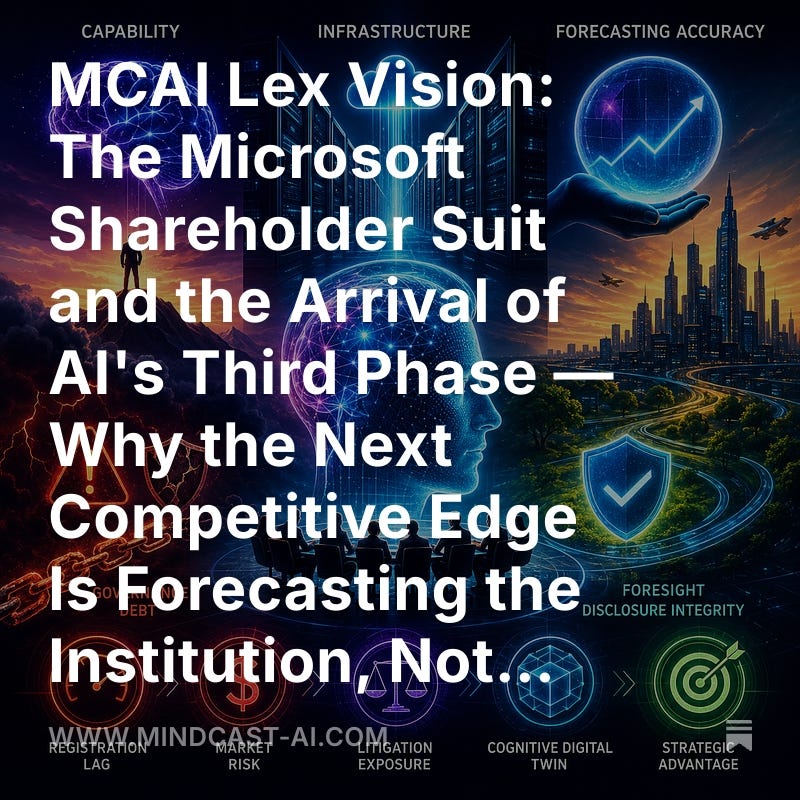
Competition in artificial intelligence has moved through two phases and entered a third. The first phase rewarded capability — whichever lab produced the most impressive model captured attention and capital. The second phase rewarded infrastructure accumulation — whichever operator commanded the most compute, energy, and inference capacity captured durable position. The third phase, now beginning, rewards forecasting accuracy — whichever institution most correctly predicts how its own AI deployment reshapes adoption, monetization, capacity allocation, and disclosure obligation will hold the advantage that capability and infrastructure no longer confer on their own.
Microsoft sits at the frontier of the third-phase problem, not outside it. No operator before now has had to govern the simultaneous interaction of compute scarcity, enterprise adoption friction, generic-assistant monetization, and proprietary-model execution at hyperscale, then communicate a coherent trajectory through that interaction to public markets on a quarterly cadence. The coupling is genuinely unprecedented. The forecasting burden it imposes now falls on every enterprise putting AI into the work that earns its revenue.
Governance Debt names what accumulates when the coupling outruns the institution’s capacity to see and disclose it. Autonomous activity, operational velocity, and organizational complexity scaled at Microsoft faster than governance visibility and a quarterly disclosure rhythm could track, and the running gap compounded into a standing liability that the January 28 disclosure collected at once. A securities suit, read structurally, is the moment Governance Debt converts into market loss.
MindCast builds the instrument the third phase requires. The MindCast AI Proprietary Cognitive Digital Twin (MAP CDT) Foresight Simulation does not predict whether artificial intelligence works. The MAP CDT engine models how an institution’s own deployment will move adoption, conversion, capacity, and execution — and surfaces the divergence between operating trajectory and public disclosure while the divergence is still small enough to govern. Foresight becomes a disclosure-integrity layer rather than an after-the-fact audit. Boards see the registration lag forming. Investor relations communicates a position the operating reality can sustain. The institution governs the coupling before the coupling hardens into a securities event.
The vision states the thesis, grounds it in the MindCast corpus, and commits the central claim to a falsification contract. The claim, stated plainly: the operative risk of the AI era is no longer whether the technology performs, but whether institutions forecast — and disclose from inside that foresight — what the technology does to the organization around it. Confidence ~80%.
I. The Matter, Stated Neutrally
The complaint frames a conventional securities posture around an unconventional subject. Plaintiff City of St. Clair Shores Police and Fire Retirement System brings the action on behalf of purchasers of Microsoft common stock between May 1, 2025 and January 28, 2026, asserting claims under Sections 10(b) and 20(a) of the Securities Exchange Act and Rule 10b-5, and names Microsoft alongside Chief Executive Satya Nadella, Chief Financial Officer Amy Hood, AI-at-Work marketing chief Jared Spataro, and Experiences and Devices head Rajesh Jha. The case number is No. 2:26-cv-02071, filed in the Western District of Washington on June 12, 2026; the complaint sits here.
Plaintiff’s account runs in two registers. On the application side, the filing alleges that Microsoft promoted Copilot as best-in-class and broadly adopted — a family surpassing 150 million monthly active users, AI features reaching 900 million, a Fortune 500 footprint climbing from roughly 70% toward 90% — while internal reality showed brand confusion, interoperability friction, a proprietary model that ranked below competitors on benchmarks, and weak conversion of the commercial base to paid seats. On the infrastructure side, the filing alleges that Microsoft framed Azure growth as demand-driven across consecutive quarters while diverting compute capacity away from paying Azure workloads to support Copilot and AI research.
The corrective event, as the complaint tells it, arrived on January 28, 2026. Microsoft reported a sudden Azure slowdown that the company attributed primarily to computational-capacity constraints, quarterly capital expenditure of $37.5 billion, and a paid Microsoft 365 Copilot count of roughly 15 million against a commercial base above 450 million. Shares fell from $481.63 to $433.50 the next session and continued lower in the weeks that followed, reaching the low $380s by late March — about 30% beneath the class-period high. The complaint adds a motive allegation: stock sales by the chief executive exceeding $75 million during the period.
Microsoft disputes the characterization and will defend. A reader should hold the allegations as allegations. The analysis that follows does not depend on their truth; it depends on the structural problem the matter exposes regardless of who prevails — the problem of forecasting an institution under a technology that reshapes the institution faster than the institution can describe it.
II. Three Phases of the AI Era
Market value in artificial intelligence has rewarded three different things in sequence, and recognizing the sequence is the precondition for reading the Microsoft matter correctly.
Phase one rewarded capability. Benchmark scores, demonstration reels, and parameter counts moved valuations, because the open question was whether the technology could do impressive things at all. Capital flowed to whoever answered the question most vividly. Capability remains necessary, and capability alone stopped conferring advantage the moment every serious operator could field a competent model.
Phase two rewarded infrastructure accumulation. Compute, energy, data-center footprint, and inference capacity became the scarce assets, and valuation shifted toward whoever could command them at scale. The MindCast analysis in MindCast | Innovation Becomes Governance — Why MindCast Analyzes Infrastructure Rather Than Disruption named the transition while the market was still narrating chatbots: as a technology scales, control migrates from the application a customer sees to the runtime layer the application routes through, and compute concentration becomes governance concentration. Infrastructure still gets priced, and infrastructure alone no longer settles the contest, because the leading operators have all accumulated it.
Phase three rewards forecasting accuracy. Capability is broadly available and infrastructure is broadly accumulated, so the marginal advantage now accrues to whichever institution most correctly predicts the second-order consequences of deploying AI — how adoption actually behaves, how quickly generic capability converts to paid revenue, how scarce capacity must be allocated across competing workloads, and how organizational execution either delivers or stalls. Forecasting accuracy is the new axis precisely because the first two axes have saturated.
The phases accumulate rather than replace one another. Capability and infrastructure continue to carry value; forecasting accuracy is the dimension along which advantage now concentrates at the margin. A reader who pictures phase three as the erasure of phases one and two will misread the claim — the better picture is a third axis added to a space that already had two.
The Microsoft matter belongs to phase three. The dispute is not whether Copilot can reason or whether Azure can scale; both plainly can. The dispute concerns whether the institution correctly anticipated, and accurately communicated, what deploying those systems would do to adoption, conversion, capacity, and margin. Forecasting sits at the center of the case, which is exactly why the case opens a new chapter rather than extending an old one.
III. Microsoft as the Frontier Hard Case
Sympathy is the correct analytical posture toward Microsoft here, and the sympathy is not a courtesy — it follows from the structure of the problem. Microsoft faced a coupling no prior operator had to govern, and the difficulty of that coupling is the substance of the third-phase thesis.
Consider what the company had to forecast at once. Compute scarcity bound the system from below, with finite GPU and energy capacity allocated across external Azure customers, internal model training, and enormous pre-committed obligations to partner labs. Enterprise adoption friction bound it from another direction, because converting a vast installed base of seat licenses into active, paid, habitual AI usage runs on organizational behavior that no model benchmark predicts. Monetization of generic assistance bound it from a third, since a capability every competitor can also field resists premium pricing. Organizational execution bound it from a fourth, as multiple product lines, model lineages, and brand surfaces had to cohere into something a customer would choose over alternatives. Each variable interacts with the others, and the interaction is where forecasting becomes genuinely hard.
No playbook existed for the coupling. Prior platform transitions — the move to cloud, the move to mobile — let operators forecast adoption against decades of analogous behavior. The AI transition offered no comparable history, because reasoning systems deployed at hyperscale change institutional behavior in ways the deploying institution is discovering in real time. Microsoft was forecasting a frontier, not extrapolating a trend, and forecasting a frontier is the precise activity that defeats the statistical methods most institutions rely on.
The frontier framing favors Microsoft without distorting the record, and it generalizes the lesson. Every enterprise now deploying AI into core operations faces a smaller version of the same coupling — scarce resources, uncertain adoption, contested monetization, and execution risk, all interacting under a technology that reshapes the organization while the organization tries to describe it. Casting Microsoft as a uniquely culpable actor misses the point; casting Microsoft as the first operator to hit the frontier at full scale captures it. The hard case is the instructive case, because the market will keep generating versions of it.
A boundary belongs here, drawn cleanly. Whether any particular firm’s gap between internal reality and external communication was an honest forecasting failure or a knowing concealment is a question of fact and intent for the court, and the complaint pleads the latter while Microsoft denies it. The structural lesson holds either way: the gap itself is the liability. An institution that cannot close the distance between what its AI deployment is actually doing and what it tells the market — whatever the reason — carries third-phase risk. Closing that distance is the work.
Contact mcai@mindcast-ai.com to partner with us on Predictive Game Theory AI in Law and Behavioral Economics. To deep dive on MindCast works upload the URL of this publication into any LLM (preferably Google AI mode/Gemini, Claude, ChatGPT) and prompt ‘reconstruct MindCast framework with three degrees of cited sub links.’ See Live-Fire Game Theory Simulators, Runtime Predictive Infrastructure.
Related works: MindCast | Innovation Becomes Governance — Why MindCast Analyzes Infrastructure Rather Than Disruption; MindCast | Cybernetic-Predictive Game Theory AI for Capital Allocators; MindCast | Agent Governance Equilibrium; MindCast | Kirkland & Ellis's $500M AI Bet — Building a Competitive Moat by Modeling Partner Judgment; MindCast | Decision Modeling and Foresight Simulation; MindCast | Apple's AI Illusion; MindCast | Tucker v. Apple securities amicus; MindCast | Landsheft v. Apple consumer amicus. | MindCast | Tesla’s Self-Driving Revolt
IV. Infrastructure as the Limiting Variable
Much of the public conversation about AI remains trapped in a disruption framework, and the framework is the wrong lens for the Microsoft matter. Disruption assumes that technology creates value chiefly through capability expansion — a better tool displaces a worse one, and value follows capability. The disruption lens cannot explain a case in which the technology works and the value still fails to materialize on schedule.
The infrastructure-governance framework explains it. MindCast | Innovation Becomes Governance establishes that scale converts a product into a coordination system, and that the limiting variable in a coordination system is not capability but the scarce resource the system routes — compute allocation, inference capacity, data access, latency, governance bandwidth, and organizational adaptation. As AI scales, capability becomes abundant and the scarce resource becomes binding. Whoever governs the scarce resource governs the outcome.
The Microsoft allegations focus, tellingly, on infrastructure allocation. Plaintiff’s theory holds that Azure capacity was rerouted to support AI initiatives, which means AI had stopped behaving as a product and started behaving as an infrastructure-governance problem. The institution was deciding which workloads deserved scarce resources, and the decision — not any software feature — drove the financial result. Under that reading, the market was never valuing an application. The market was valuing Microsoft’s ability to govern an increasingly complex infrastructure system, and the suit becomes a dispute over infrastructure-governance transparency rather than over features.
Pre-committed capacity tightened the bind. Microsoft had contracted enormous future compute to partner labs — incremental Azure services and multi-gigawatt commitments measured in the hundreds of billions of dollars across its partnerships — which narrowed the capacity available to external Azure customers at the very moment AI demand surged. Governing scarcity under obligations of that magnitude is a forecasting problem of extraordinary difficulty, and forecasting it correctly is precisely the third-phase capability the vision describes.
The demand narrative functioned, in the framework’s terms, as a latency-extension instrument. MindCast | Innovation Becomes Governance defines latency arbitrage as the exploitation of the gap between how fast a routing system moves and how slowly a governing system responds, and identifies convenience framing as the tool that holds the gap open. A “growth driven by demand” story, whether or not anyone intended it as such, suppressed market recognition of a supply-rationing reality during the exact window when the gap remained wide. Markets closed the gap abruptly on January 28 because the operating reality finally forced the signal into view.
V. The Registration Lag and the Allocator’s Problem
Investors carried the forecasting failure, and the asymmetry matters. Microsoft, on the complaint’s own telling, modeled its capacity allocation internally with considerable precision — the filing alleges executives knew the reality, which is the opposite of a claim that the company was confused about itself. The party that could not forecast Microsoft’s trajectory was the market, because the governance-layer reality sat behind the disclosure wall. The forecasting gap runs in one direction, from an institution that knew toward investors who could not see.
The structure of that loss is the subject of MindCast | Cybernetic-Predictive Game Theory AI for Capital Allocators. The publication describes a structural-break-to-registration window — the interval between when an institution’s underlying conditions shift and when conventional analytical infrastructure prices the shift — and locates capital concentration, as either asymmetric opportunity or asymmetric loss, inside that window. Every Microsoft holder positioned on the wrong side of the lag between the allocation shift and its January registration absorbed the loss the framework predicts.
Three failure patterns from that work operate in the matter at once. Pattern-extrapolation inversion governs the analysts who read consecutive quarters of 33% to 40% Azure growth as a demand trend and extended it forward; the series flipped from signal to noise the moment capacity rationing began, while model confidence stayed high and forecast error grew. Narrative-momentum mispricing governs the Copilot figures, where adoption counts engineered for observation generated signal traffic that quantitative methods could not separate from real traction until the 15-million paid-seat disclosure forced the separation. Recursive feedback exposure governs the deepest layer, where a holding’s own conduct activates the constraint that disciplines its valuation.
Recursive feedback exposure deserves emphasis, because the Microsoft matter fits it almost exactly. MindCast | Cybernetic-Predictive Game Theory AI for Capital Allocators defines the pattern as a portfolio holding activating the institutional constraint that disciplines its own conduct, with the market pricing the discipline before earnings reflect it. Microsoft’s decision to reroute capacity toward Copilot is the strategy that throttled Azure that reset the valuation — a self-generated discipline, emerging from the holding’s own choices rather than from any external enforcement. The company’s own filings and earnings scripts became the record that the shareholder complaint now converts into liability. The signal that reset the price came from inside the institution.
An allocator equipped with third-phase foresight reads that signal early. The capital-allocator framework exists to price institutional trajectory inside the registration window rather than after it, and an institution equipped with the same foresight reads its own signal before the market does — which is the move that converts forecasting from an investor’s edge into a defendant’s shield.
VI. Governance Debt — How the Gap Accumulates
The registration lag names the gap from the market’s side. Governance Debt names the same gap from the institution’s side, and naming it from inside the company turns a one-time mispricing into a measurable, accumulating liability. MindCast | Agent Governance Equilibrium supplies the construct, built for exactly the condition the Microsoft matter exhibits — autonomous activity scaling faster than the capacity to see and steer it.
AGE Vision states the balance as a ratio of pressure to control: agent autonomy, operational velocity, and organizational complexity in the numerator; governance capacity and human review rate in the denominator. Equilibrium holds while control keeps pace with pressure. Governance Debt tracks what accumulates when control falls behind — each period adds the gap between pressure and control to a standing balance, the way leverage compounds quietly until a shock reveals the true liability. Three symptoms mark the accrual: visibility falls as activity outpaces the systems built to watch it, decision pathways turn opaque, and control becomes reactive — leaders explaining outcomes after they occur rather than directing them before they emerge.
AGE = (A × V × C) / (G × R) — the current balance, pressure over control GD(t) = GD(t−1) + (A × V × C) − (G × R) — the accumulating liability, period over period GR = (E × T) / C — the capacity to recover once oversight breaks
A — agent autonomy · V — operational velocity · C — organizational complexity · G — governance capacity · R — human review rate · E — escalation effectiveness · T — organizational trust
MindCast | Agent Governance Equilibrium defines the ratio for autonomous agent systems, where A, V, and C describe agents acting on their own initiative. The Microsoft matter extends the same arithmetic to the enterprise that deploys those agents, and the extension is deliberate rather than loose. Agentic Copilot activity and the automated, machine-speed capacity-allocation decisions surrounding it supply the numerator; the institution’s disclosure cadence and human review machinery supply the denominator. The equation does not change. Only the system it scopes widens, from the agent layer AGE Vision names to the institution that runs the agents — and the institution inherits the same accrual law its agents obey.
Microsoft accumulated Governance Debt along every term of the equation. AI capability scaled, and infrastructure scaled with it. Organizational complexity scaled further still — multiple Copilot surfaces, several model lineages, vast pre-committed compute obligations to partner labs, and a capacity-allocation problem touching every one of them. Operational reality evolved continuously, at machine speed, while the governing instruments that would have made the reality legible to the market moved on a quarterly cadence. A quarterly disclosure rhythm set against a continuously evolving operating reality is, in the framework’s exact terms, a low review rate governing a high-velocity system — a denominator that cannot keep pace with its numerator. The gap did not reset each quarter. The gap compounded.
The lawsuit is the moment the accumulated debt converted into market loss. Governance Debt stays invisible while it compounds and expensive when it comes due, and the January 28 disclosure is the due date — the shock that forced the standing liability onto the balance sheet at once, priced as a roughly $48-per-share decline and a slide toward 30% beneath the class-period high. Whether the gap widened through honest forecasting difficulty or knowing concealment remains a question for the court; the accrual mechanism operates identically under either reading, which is precisely what makes Governance Debt a structural diagnosis rather than an accusation.
The integration tightens here, and the four programs converge on one mechanism. MindCast | Innovation Becomes Governance supplies the latency — the gap between how fast a routing system moves and how slowly a governing system responds. AGE Vision turns that latency into an accumulating quantity. MindCast | Cybernetic-Predictive Game Theory AI for Capital Allocators prices the quantity from the market’s side as the registration lag. MindCast | Decision Modeling and Foresight Simulation supplies the instrument that measures and retires the debt before a shock collects it. One gap, four readings, a single liability that the institution can either service early or repay in a crisis (confidence ~75%).
VII. The MindCast AI Proprietary Cognitive Digital Twin Foresight Simulation — Stress-Testing the Thesis
MindCast ran the matter through its own foresight engine rather than resting the argument on analysis alone. The MindCast AI Proprietary Cognitive Digital Twin Foresight Simulation, specified in Section IX, constructed three twins — a Microsoft Institutional Twin, an Institutional Investor Twin, and an AI Industry Twin — and introduced the case conditions into each to test whether the thesis survives the method’s own discipline.
One caveat governs how to read the result, and stating it openly protects the finding rather than weakening it. The three twins operate on the MindCast framework’s priors, so the exercise tests internal coherence and surfaces forward trigger conditions — it does not supply evidence independent of the framework that produced it. A self-run simulation cannot confirm a thesis from outside. A self-run simulation can fail to break one, and can generate the disconfirming pathways and forward stress points a prose argument leaves implicit.
The three twins classified independently and converged. The Microsoft Institutional Twin read the company as a Frontier Governance System (82%), generating a widening divergence between an internal capacity reality and an external demand narrative. The Institutional Investor Twin read the period as a Registration Lag Exposure Event (84%), with capacity-rationing risk and conversion friction falling out of valuation models that extrapolated prior Azure growth. The AI Industry Twin read the matter as an Emerging Industry Governance Pattern (76%), finding Microsoft representative rather than anomalous across the major operators. The convergent classification is a Governance Debt Accumulation Event (composite confidence 78%), with institutional forecasting failure — not capability failure — as the dominant risk. The simulation also reproduced, independently of the prose argument, the identity Section VI draws by hand: Registration Lag and Governance Debt name one phenomenon from two vantage points (83%).
The genuinely forward payload feeds the forecast. The cross-operator generalization and five recurring trigger conditions — compute-allocation, monetization-transparency, adoption-shortfall, disclosure-integrity, and governance-capacity disputes — extend the thesis past Microsoft to every operator carrying the same coupling, and Section XIII records the revised internal confidence the simulation produced, held honest by the caveat above. Twin construction, inputs, and dominant forces sit in the Appendix.
VIII. Why Generic AI Monetization Hits a Ceiling
The complaint’s adoption allegations raise a strategic question deeper than product quality. Why did monetization prove harder than the forecasts assumed? Weak conversion of a 450-million-seat base to 15 million paid Copilot seats is a large miss, and attributing it to a bad product underestimates the structural cause.
Institutional specificity is the structural cause, and MindCast | Kirkland & Ellis’s $500M AI Bet — Building a Competitive Moat by Modeling Partner Judgment anticipated it. Generic AI produces generalized capability; institutions monetize specialized judgment. Law firms do not sell text generation — they sell partner judgment accumulated across thousands of matters. Investment firms do not sell summaries — they sell allocation judgment. Medical systems do not sell language — they sell diagnostic judgment. The value an institution can charge for lives in the judgment layer, and a generic assistant does not reach that layer.
Kirkland’s wager makes the ceiling concrete. The firm chose to spend half a billion dollars building proprietary AI rather than licensing what every competitor can also license, on the logic that readily available tools “raise the floor for everyone” and a floor that rises for everyone lifts no one above the field. The durable asset is not faster drafting but a model of how the firm’s most valuable people decide — judgment institutionalized so it scales and survives the partners who hold it. MindCast | Kirkland & Ellis’s $500M AI Bet states the general law: once foundation models commoditize, lock-in migrates up the stack — model, to proprietary corpus, to encoded reasoning, to judgment itself, the one layer no vendor can sell.
Copilot, in that frame, is the floor. Microsoft built a capable generic assistant on rented and proprietary model capability and attempted to convert a vast installed base into paid subscriptions for it. The conversion lagged because a generic assistant, however competent, occupies the commodity layer where every competitor also operates — the precise outcome the Kirkland law predicts. Organizations that clone judgment build defensible moats; organizations that rent intelligence build dependency. Investors frequently price both categories as if they were equivalent, and they are not.
The strategic asymmetry inside Microsoft sharpens the lesson. Azure and the runtime beneath it constitute genuine infrastructure power — the durable position phase two rewards and the moat the corpus identifies as the thing that actually matters. Copilot occupies the commodity floor. The alleged conduct cannibalized the durable asset to defend the commodity one, then narrated the commodity one as the growth engine. Defending the wrong layer, and disclosing the defense in the language of the wrong layer, is the strategic content beneath the legal claim (confidence ~70%).
IX. The Cognitive Digital Twin and the MindCast AI Foresight Simulation Engine
Conventional market analysis evaluates revenue, margin, users, and capital spending — outputs that appear only after the institutional dynamics that produced them have already resolved. MindCast adds a layer beneath the outputs: how decision-makers perceive future states, how institutions forecast their own adaptation, and how market participants model one another’s behavior. The added layer is the domain of Cognitive Digital Twin methodology, specified in MindCast | Decision Modeling and Foresight Simulation.
The Microsoft matter is, at bottom, an allegation that market participants lacked accurate models of the variables that determine an AI deployment’s economics — adoption behavior, enterprise purchasing behavior, infrastructure constraints, internal execution, and commercial conversion dynamics. Quarterly earnings reveal those variables only after they have moved the result. A Cognitive Digital Twin models them before they surface, by forecasting institutional responses rather than products and by predicting decision systems rather than technologies.
MindCast | Decision Modeling and Foresight Simulation separates two questions that institutions routinely collapse. Decision Engineering Science asks whether a decision is well-formed — auditable, aligned, transparent, and risk-calibrated at the point of formation. MindCast asks whether a well-formed decision survives contact with a live system governed by constraint geometry, strategic interaction, and cybernetic feedback. The first question concerns decision integrity; the second concerns decision survivability; and forecasting accuracy requires both.
The MAP CDT engine runs the survivability layer, executing the MindCast AI Proprietary Cognitive Digital Twin Foresight Simulation — modeling an institution as a behavioral system, introducing a contemplated decision into a simulated environment of competing structural forces, and classifying whether the decision persists, adapts, or fails as the system reacts across time. The engine does not forecast whether a model can reason. The engine forecasts what an institution’s own deployment will do to adoption, conversion, capacity, and execution once the deployment meets the live field.
Applied to a capacity-allocation decision of the kind the Microsoft matter describes, the MAP CDT engine routes the analysis to its dominant force. Constraint geometry governs first, because GPU, energy, and data-center capacity form a steep-curvature limit within which rerouting relocates a shortfall rather than removing it. Cybernetic feedback governs the disclosure, because an institution that closes its correction loop on a quarterly cadence cannot match a reality that moves continuously — a control system slower than its environment loses governance, as Ashby’s requisite-variety condition requires. A decision that scores well on internal integrity can still fail on alignment and transparency at the boundary between institution and system, which is exactly the failure MindCast | Decision Modeling and Foresight Simulation predicts is most exposed under competitive pressure.
X. The Disclosure-Integrity Layer
Forecasting accuracy earns its commercial value at the moment it becomes a disclosure-integrity layer. An institution that can model its own deployment ahead of the earnings call gains the ability to see the registration lag forming inside its own numbers — to detect the divergence between operating trajectory and public communication while the divergence remains small enough to govern.
The MAP CDT engine supplies that visibility, and the prophylactic function follows directly. A board running its own institution through the foresight engine sees where adoption will fall short of the narrative before the shortfall reaches a quarterly report. Investor relations communicates a position the operating reality can actually sustain, rather than a position the next disclosure will be forced to retract. Risk and compliance functions test a contemplated capacity reallocation for its disclosure consequences before executing it, not after a complaint quotes the earnings transcript back to them. The institution governs the coupling in advance.
The prevention thesis is the core of the offer. Securities exposure of the kind alleged against Microsoft forms in the gap between what an AI deployment is actually doing and what the institution tells the market it is doing. Closing that gap — modeling the operating reality accurately enough to disclose from inside the foresight rather than behind it — removes the condition that produces the exposure. The MAP CDT engine is built to close it. The product is not a defense raised after the suit; the product is the foresight that makes the suit unnecessary.
The same capability that shields an enterprise also advantages the parties watching it. MindCast | Cybernetic-Predictive Game Theory AI for Capital Allocators frames the allocator’s version: an investor who prices institutional trajectory inside the registration window captures the advantage the lagging investor forfeits. Regulators gain a governance version, pricing systemic exposure before it cascades. Enterprises gain the disclosure-integrity version described above. One engine, three output configurations, each consuming the same forecast at a different decision layer.
XI. The Apple Precedent and the Lineage
The Microsoft matter is not the first AI-era accountability event the MindCast corpus has read, and the prior reading sharpens the present one. MindCast | Apple’s AI Illusion: Narrative Control and the Law’s Search for Structural Truth, together with the firm’s amicus analyses in the MindCast | Tucker v. Apple securities amicus and the MindCast | Landsheft v. Apple consumer amicus, examined a company accused of presenting developmental AI capability as imminent and delivery-ready.
A distinction separates the two matters cleanly, and drawing it strengthens the third-phase thesis. Apple’s alleged wrong was future-functional — features sold as present that did not yet exist, a forecasting question about existence and timing. Microsoft’s alleged wrong concerns a different layer — features that exist but neither convert nor compete as represented, while a scarce infrastructural resource is reallocated to defend them and the reallocation is communicated as ordinary demand. Vaporware describes one species; allocation opacity describes the other. Both belong to the same lineage of AI-era forecasting and disclosure risk, and treating them as identical would blur a distinction the third-phase frame depends on.
The lineage points one direction. AI-era accountability is migrating from disputes about whether the technology works toward disputes about whether the institution forecast — and disclosed — what the working technology would do. Apple’s matter sat closer to the capability question; Microsoft’s sits squarely on the forecasting question; and the next wave will sit further along the same axis. MindCast read the direction early, which is the standing the corpus brings to the present matter.
A third case completes the lineage and turns analogy into pattern. MindCast | Tesla’s Self-Driving Revolt read Tesla’s Full Self-Driving cascade as the same narrative-arbitrage architecture — categorical capability claims running ahead of a constrained engineering substrate until a January 2025 earnings-call admission, spoken in a securities forum where consumer-marketing language could not survive, collapsed the forum separation the firm had been managing. Apple, Tesla, and Microsoft now trace one arc rather than three incidents. Apple and Tesla sold capability that did not yet exist — future-functional deception; Microsoft framed present demand to mask a capacity-allocation reality — allocation opacity. The deception matures across the sequence, from “the feature is not here yet” to “the resource governing the feature is being rationed, and the rationing went undisclosed,” and the corrective event plays the same structural role each time: a forcing function that collapses forum separation and converts a managed narrative into a priced liability (confidence ~80%). One architecture, several firms, a single predictive instrument.
XII. The Next Battleground and Forward Lock
Competition from here forward turns on forecasting accuracy, and the institutions that grasp the shift will build for it. The first AI wave rewarded model capability; the second rewarded infrastructure accumulation; the third increasingly rewards the ability to predict how AI deployment reshapes institutional behavior. Markets now ask a different question of every operator — not whether its models can reason, but whether the institution correctly predicted what its reasoning systems would do once deployed at scale.
The answer confers compounding advantage across three constituencies. An enterprise that answers it governs its own disclosure and averts the exposure the Microsoft matter exemplifies. An investor that answers it prices institutional trajectory inside the registration window and captures the allocation advantage the lagging market forfeits. A regulator that answers it anticipates systemic stress before it cascades. Each constituency consumes foresight at a different layer, and each rewards the institution that supplies it.
Microsoft, read generously and correctly, is the proof of concept rather than the cautionary villain. A frontier operator hit an unprecedented coupling of compute scarcity, adoption friction, monetization difficulty, and execution risk, and the market repriced the gap between operating reality and public communication the instant the gap surfaced. The lesson is not that Microsoft failed; the lesson is that the coupling is hard, the coupling is now everywhere, and the institutions that forecast it will be the ones that govern it. The matter marks the beginning of a phase, not the indictment of a company.
The vision locks forward to a single proposition. The companies that win the third phase will not be the ones that deploy the most AI. They will be the ones that most accurately forecast what their AI deployment does to the institution around it — and that disclose from inside that foresight rather than behind it. MindCast builds that foresight. The MAP CDT engine runs it.
XIII. MindCast Forecast and Falsification Contract
The vision commits its central claim to a dated, falsifiable forecast, in the discipline the MindCast corpus requires of every prediction it publishes.
Forecast. Over the next three years, AI-related litigation and investor disputes will shift measurably away from model-capability questions and toward questions of infrastructure allocation, monetization transparency, institutional forecasting, adoption assumptions, governance capacity, and decision-model accuracy. As AI matures, markets will care less about whether models can reason and more about whether institutions correctly predicted, and accurately disclosed, what reasoning systems would do once deployed at scale. Probability 70–80%.
Confirms. A majority of significant AI-related securities or governance actions through the end of 2028 turn on a concealed or mis-forecast infrastructure-allocation or institutional-execution predicate — capacity rationing, compute diversion, adoption or conversion shortfall, organizational execution failure — rather than on pure model-capability misstatement; and the dominant public narrative around AI risk shifts measurably from capability discourse toward forecasting-and-disclosure discourse across the same window.
Falsifies. Significant AI-related actions through the window continue to resolve primarily on model-capability claims with no infrastructure-allocation or forecasting predicate, and markets price AI-deployment exposure without any institutional-trajectory signal leading the capability signal. Sustained absence of forecasting-and-disclosure disputes across the named operators would refute the third-phase thesis directly.
Measurement window. Through December 31, 2028, scoped to large-scale AI operators carrying both runtime infrastructure and commodity-application layers.
The MAP CDT simulation in Section VII revised the internal confidence on three of this vision’s predictions, and the revisions reflect strengthened internal coherence rather than independent confirmation — the distinction stays explicit on purpose. Forecasting accuracy as the third-phase axis moved from roughly 80% to 85%; the litigation-shift prediction from roughly 75% to 82%; the competitive-advantage prediction from roughly 70% to 84%. Each figure measures how cleanly the thesis holds against the framework’s own stress test, not how well it has held against the world. The falsification window above remains the test that matters.
MindCast either meets the falsification standard or does not publish.
Appendix — MAP CDT Twin Construction
The simulation summarized in Section VII rests on three twins, each specified below by objective, inputs, dominant forces, finding, and classification. Confidence figures are the simulation’s own outputs and carry the shared-priors caveat stated in Section VII.
Twin 1 — Microsoft Institutional Twin. Objective: model Microsoft’s internal decision environment across the alleged period. Inputs: Azure growth expectations, Copilot adoption trajectory, GPU scarcity, OpenAI and Anthropic compute commitments, enterprise purchasing behavior, quarterly disclosure cadence. Dominant forces: constraint geometry (finite GPU supply, energy limits, data-center build timelines), infrastructure governance (competing workloads across external Azure customers, internal AI initiatives, and partner obligations), and enterprise adoption friction (seat activation and paid-conversion rates). Finding: a divergence between internal capacity reality and the external demand narrative that widened across time, with leadership holding several partially conflicting truths simultaneously. Classification: Frontier Governance System (82%).
Twin 2 — Institutional Investor Twin. Objective: model how pension funds, asset managers, and analysts interpreted Microsoft’s AI position. Inputs: public earnings calls, Azure growth metrics, Copilot adoption announcements, AI infrastructure spending. Dominant forces: narrative momentum (pricing AI leadership, Azure demand durability, Copilot monetization, infrastructure advantage) and pattern extrapolation (extending prior Azure growth forward). Finding: systematic underestimation of capacity-rationing risk, adoption and conversion friction, and the opportunity cost of compute allocation, with conditions changing before valuation models updated. Classification: Registration Lag Exposure Event (84%).
Twin 3 — AI Industry Twin. Objective: determine whether Microsoft represents an isolated event or an emerging pattern. Participants: Microsoft, Amazon, Google, Meta, OpenAI, Anthropic. Dominant forces: infrastructure scarcity, monetization pressure, and governance complexity across disclosure systems, investor expectations, infrastructure allocation, and organizational execution. Finding: Microsoft does not read as anomalous, and similar future stress points recur across operators. Most common forward triggers: compute-allocation disputes, monetization-transparency disputes, adoption-shortfall disputes, disclosure-integrity disputes, and governance-capacity disputes. Classification: Emerging Industry Governance Pattern (76%).
Composite. System classification: Governance Debt Accumulation Event. Dominant force: institutional forecasting failure. Secondary force: infrastructure-governance complexity. Tertiary force: the registration lag between operating reality and market recognition. Composite confidence: 78%.