


Executive Summary
Narratives function as control signals within institutional systems — not passive stories transmitted through culture, but active inputs that alter perceived constraints, shift payoff calculations, and drive convergent behavioral responses. Existing academic frameworks establish that narratives influence behavior but fail to model how institutional actors strategically deploy them, how feedback loops amplify or suppress them, and how they stabilize into durable equilibrium outcomes that persist well past the point where disconfirming evidence has accumulated.
The Narrative Control Runtime (NCR) addresses that gap by embedding narrative into a closed-loop cybernetic system with a game-theoretic spine. NCR models how narratives enter institutional environments, update actor beliefs, select among competing equilibria, propagate through feedback mechanisms, and either dissipate or lock into stable behavioral and cognitive outcomes. The module generates falsifiable predictions by quantifying three core dynamics — feedback capture, response latency, and behavioral lock-in — across institutional domains including regulation, litigation, markets, and platform competition.
The central contribution: NCR resolves the cheap talk anomaly in information economics. Standard theory predicts that non-binding communication should be ignored in equilibrium because senders face no credible commitment constraint. NCR explains why institutional narratives work despite this — they generate common knowledge that coordinates actor expectations, collapsing equilibrium uncertainty without requiring verifiable claims. Narrative operates as a belief-coordinating signal that selects among multiple equilibria and, when embedded in feedback systems, generates persistent path-dependent institutional outcomes.
NCR connects to the Signal Suppression Equilibrium (SSE) framework — formalized in Prestige Markets as Signal Economies: A Model of Signal Suppression and Institutional Failure (MindCast AI, 2026) — at its terminal state. Where NCR models the approach path — injection, belief update, equilibrium selection, lock-in — SSE models the destination: the stable condition in which actors suppress outward signals despite privately observing contrary evidence. Together, the two modules trace the full institutional arc from narrative deployment to durable behavioral silence.
Cognitive Digital Twin (CDT) simulations confirm the core mechanism: narrative control operates through belief coordination rather than persuasion. Actors do not need to believe a narrative to act on it. Actors need only believe that other actors will act on it. Shared belief produces convergence. Convergence produces equilibrium. Feedback loops then stabilize that equilibrium until structural constraints or competing signals disrupt it. Strategic actors exploit latency differences across institutions, deploy narratives across multiple forums, and reinforce signals through repeated behavioral confirmation. Control emerges when narrative signals close the loop faster than competing signals can disrupt it.
I. Failure of Existing Narrative Frameworks
Narrative economics offers the most developed academic treatment of how stories drive institutional outcomes, but the framework carries a structural limitation that prevents it from serving as an operational tool. Treating narratives as epidemic-like phenomena — spreading through populations, influencing behavior at the aggregate level — describes outcomes without modeling the mechanism. The result is a body of literature that identifies narrative influence but cannot predict it.
Robert Shiller’s Narrative Economics (2019) models narratives as macroeconomic drivers that propagate through social transmission. Akerlof and Shiller’s Animal Spirits (2009) identifies psychological amplification channels. Both works confirm that narratives matter but treat them as diffusive and largely exogenous — entering systems from outside rather than being engineered within them.
Herman and Chomsky’s Manufacturing Consent (1988) and Klein’s The Shock Doctrine (2007) recognize narrative manipulation as a political tool but lack formal system modeling. Game theory defines equilibrium under strategic interaction but stops at formation — it does not model why equilibrium persists after disconfirmation, or how narrative engineers the belief environment that makes one equilibrium salient over alternatives. NCR fills that gap.
Four specific modeling failures motivate NCR’s architecture: the absence of strategic narrative deployment modeling; no treatment of institutional processing under constraint; no framework for feedback loop stabilization; and no theory of equilibrium lock-in after disconfirmation. The game-theoretic gap is equally specific — existing equilibrium theory cannot explain why actors coordinate on narrative-consistent behavior absent binding commitments, or why that coordination persists despite contradictory evidence. NCR’s architecture addresses both families of failure simultaneously.
II. System Definition: Narrative as Control Signal
NCR models institutional behavior as a function of three simultaneous inputs: the institutional state, the active constraint stack, and the narrative signal. Narratives do not operate alongside these inputs as external noise — they reparameterize the decision system itself, altering how actors perceive available actions and their expected payoffs. The formal system evolution equation establishes this:
B(t+1) = f(S(t), C(t), N(t))
Define the system variables as:
N(t): Narrative Signal at time t
S(t): Institutional State at time t
C(t): Constraint Stack — regulatory, legal, reputational, and coordination constraints
B(t): Institutional Behavior output
Becker’s The Economic Approach to Human Behavior (1976) provides the incentive foundation. Nash’s Non-Cooperative Games (1950) defines equilibrium behavior. Stigler’s The Economics of Information (1961) explains cognitive closure through information sufficiency. Schelling’s focal-point theory provides the missing mechanism — actors facing multiple equilibria coordinate on the one narrative has made cognitively salient, because each actor expects every other actor to do the same.
Narrative as Equilibrium Selection Mechanism
Most institutional environments contain multiple equilibria simultaneously. Narrative’s role is not simply to persuade; it is to collapse equilibrium uncertainty by generating common knowledge that makes one equilibrium cognitively focal. The mechanism runs through belief updating: each actor asks what other actors will do, narrative answers that question indirectly by shifting the shared belief structure, and actors best-respond to those updated beliefs. Behavioral convergence follows without any actor needing to independently verify the narrative’s factual accuracy.
Formally: let E = {e₁, e₂, ..., eₙ} denote the set of available equilibria. Narrative signal N(t) operates as a focal-point generator, assigning salience weights w(eᵢ | N(t)) to each equilibrium. Actors coordinate on the equilibrium with the highest salience weight. Deviation requires coordinating on an alternative focal point — a cost that rises with BLIC and the absence of a competing narrative of sufficient institutional reach.
Narrative as Cheap Talk That Works
Standard signaling theory — Crawford and Sobel’s cheap talk framework — predicts that non-binding communication should be discounted in equilibrium. Institutional narratives are canonical cheap talk: they carry no legal commitment and are deployed by actors with obvious strategic interests. Standard theory predicts they should not move behavior.
They do. NCR explains why. Institutional narratives achieve behavioral effect through common knowledge generation, not credibility in the signaling sense. A narrative achieving sufficient distribution creates a state in which each actor knows it, each actor knows other actors know it, and each adjusts expected behavior accordingly. The narrative works because it resolves coordination uncertainty, not because it transmits true information. Narrative effectiveness correlates with distribution reach and feedback capture rate, not with evidentiary quality.
Narrative-Geometry Dominance Condition
Narrative does not operate uniformly across institutional environments. The boundary condition is formalized in Constraint Geometry: Structural Determinism in Institutional Outcomes (MindCast AI, 2026): when constraints are binding, verifiable, and enforcement is certain — statutory bright-line rules, hard deadlines — constraint geometry dominates. When constraints are contested, interpretively ambiguous, or subject to enforcement discretion, narrative dominates.
Geometry dominates when: constraints are binding, verifiable, enforcement is certain
Narrative dominates when: constraints are ambiguous, contested, enforcement is discretionary
NCR’s predictive power is highest in ambiguous constraint environments. An important secondary application: NCR predicts the moment at which geometry shifts from ambiguous to binding — a statute’s passage, a court’s denial of injunctive relief — because that shift terminates narrative dominance and forces actors to either comply or escalate into new forums where ambiguity persists.
III. Cybernetic Narrative Loop
NCR operates as a closed-loop control structure grounded in Wiener’s cybernetic model of feedback-driven adaptation (Cybernetics, 1948). Each stage transforms the narrative signal and conditions the next cycle.
The loop runs in four stages. First, narrative injection: N(t) enters the institutional environment through strategic deployment or organic propagation. Second, institutional processing: actors update beliefs about other actors’ expected behavior, then best-respond — generating B(t+1). The belief-update step is what standard narrative frameworks omit. Third, observable outcomes: processed behavior generates O(t+1) — decisions, filings, statements, regulatory responses — that become feedback inputs. Fourth, feedback update: observable outcomes feed back into N(t+1), either reinforcing the focal point, modifying it, or enabling a competing narrative to challenge focal salience.
Three metrics govern loop performance:
Feedback Capture Rate (FCR): The degree to which institutional responses are incorporated into narrative evolution. High FCR means the narrative adapts in real time to counter-signals and maintains focal salience.
Feedback Latency Index (FLI): The time delay between narrative injection and measurable institutional response. High latency creates windows for competing narratives to establish alternative focal points.
Behavioral Lock-In Coefficient (BLIC): The probability that an institution repeats narrative-consistent behavior despite receiving contradictory signals. High BLIC produces path-dependent equilibrium persistence — the hysteresis effect that keeps actors on a narrative-selected equilibrium after the original coordination rationale has weakened.
High-performance narrative systems minimize FLI, maximize FCR, and drive BLIC toward one — converging toward closed-loop control. Nash establishes that such an equilibrium exists. NCR explains why it persists.
Cognitive Digital Twin (CDT) Foresight Simulation — Loop Classification Results
CDT simulations applied against documented institutional cases produce the following loop classifications. Each result is falsifiable against the observable behavioral record in the cited environments.
Cybernetic control classification: Closed-loop dominant under high feedback capture and low latency conditions. Feedback capture is high in environments with coordinated messaging and repeated behavioral reinforcement. Feedback latency is variable across institutional forums — regulatory environments exhibit higher latency than media environments, creating amplification windows. Behavioral lock-in is high when actors incur switching costs from deviating from narrative-consistent behavior. Systems converge toward narrative-driven control when feedback loops close faster than counter-signals propagate.
Constraint geometry classification: Structural constraints dominate when enforcement becomes binding and verifiable. Narrative dominates when constraints are ambiguous, delayed, or distributed across institutions. Transition occurs when perceived constraints diverge from objective constraints beyond the threshold that triggers enforcement. Narrative reshapes perceived action space but fails when constraint enforcement becomes immediate and unavoidable.
Strategic game classification: Multiple equilibria exist in every modeled institutional environment. Narrative selects the focal equilibrium by aligning expectations across players — firms, regulators, legislators, media, and market participants. Actors converge when narrative reduces uncertainty about others’ actions. The game is not a single coordination problem; it is a repeated game with incomplete information in which each forum processes the signal at different speeds and with different constraint stacks.
Cognitive grammar classification: Grammar rigidity is high in institutional environments with entrenched identity and prior commitments. Actors resist narrative reversal when identity alignment is strong. Narrative absorption is high when narrative aligns with existing cognitive frames. Narrative persistence increases when it matches installed cognitive grammar and decreases when it requires identity revision — the mechanism behind the Compass Identity Grammar finding in Section VIII.
Signal suppression classification: Suppression conditions are high when actors face reputational or coordination costs for deviating from the dominant narrative. Public silence increases after equilibrium forms. Private contradiction can increase while public signals remain aligned — the condition Prestige Markets as Signal Economies‘s A × R × F × N > S formalizes. Narrative dominance produces outward signal suppression even in the presence of internal disagreement, and that suppression is durable until an external aggregation event breaks cognitive equilibrium across the network simultaneously.
The suppression condition A × R × F × N > S defines the threshold at which rational silence becomes the dominant strategy for every actor in a prestige network. Access Dependence (A) measures how much an actor’s income, deal flow, or institutional standing depends on continued participation in the network. Reputational Retaliation Risk (R) measures the credibility and reach of punishment for breaking silence — the higher the network’s enforcement capacity, the higher R. Information Fragmentation (F) measures how dispersed the incriminating signal is across the network — each actor holds a fragment, no single actor holds the whole, and no aggregation mechanism assembles them into actionable evidence. Narrative Distortion Multiplier (N) measures how effectively the dominant narrative reduces the perceived credibility of any counter-signal that surfaces — reframing disclosure as disloyalty, exaggeration, or misunderstanding. Signal Aggregation Capacity (S) measures the strength of any external mechanism capable of collecting dispersed signals into a disclosure event — investigative journalism, multi-jurisdictional regulatory coordination, whistleblower infrastructure.
When the product of the four suppression variables exceeds aggregation capacity, silence is individually rational for every actor simultaneously, even when collective disclosure would serve the network’s interests. The condition breaks only when S rises sharply through external intervention — which is why high-suppression systems appear stable for years and collapse suddenly rather than gradually.
Contact mcai@mindcast-ai.com to partner with us on Predictive Cognitive AI in Law and Behavioral Economics. To deep dive on MindCast work in Cognitive AI upload the URL of this publication into any LLM and prompt ‘reconstruct MindCast framework with three degrees of cited sub links.’ See Live-Fire Game Theory Simulators, Runtime Predictive Infrastructure.
Related MindCast AI Research: Run-Time Causation — Causal-signal arbitration framework; institutional evaluation of competing causal narratives. Nash–Stigler Equilibria — Equilibrium concept explaining how institutional incentives stabilize inefficient outcomes. Predictive Institutional Cybernetics — Markets as feedback systems governed by signal processing, delay, and equilibrium stabilization. Cybernetics Foundations — Theoretical lineage from Wiener through Ashby, Beer, Bateson, and Hayek into MindCast’s CDT/Vision architecture. Double-Sided Rational Ignorance (DSRI) — How market participants fail to perceive aggregate harm when information remains fragmented.
IV. Strategic Narrative Warfare Layer
Strategic narrative deployment constitutes a dynamic game in which actors compete to define the belief structure that governs equilibrium selection. Coercive Narrative Distortion and Boundary Integrity. The four primary mechanisms are strategies in a repeated game with incomplete information, not merely rhetorical techniques.
Framing redefines the payoff matrix by relocating the interaction into a domain where the deploying actor holds coordination advantages. Framing is most powerful when it reclassifies the domain rather than merely adjusting the valence of a claim, because domain reclassification shifts which equilibria appear available to other actors.
Forum shifting exploits FLI differentials across institutional contexts. Simultaneous deployment across regulatory comment, litigation, legislative testimony, and media saturates the institutional response space — each forum generates behavioral outputs that function as coordination signals for other forums, raising the cost of deviation across all processing environments simultaneously.
Delay exploitation maximizes BLIC accumulation during high-FLI windows. Each confirmation cycle raises the coordination cost of switching to an alternative equilibrium.
Narrative reinforcement operates on FCR to prevent feedback from modifying the focal point, reframing contradictory evidence as confirmation or pre-categorizing predictable counter-moves as illegitimate.
Behavioral Profiles of Narrative Warfare Actors
CDT simulations identify five recurring actor roles that operate within narrative warfare environments. Each role corresponds to a distinct function in the feedback loop. Real actors often combine roles across different forums or cycle through roles as the loop state changes.
Architect. Designs narrative structure and selects framing strategy. Focuses on constraint reclassification and equilibrium targeting. Operates with high foresight and cross-forum awareness. Robert Reffkin functions as the Architect in the Compass case — the ‘seller choice’ framing, its multi-forum deployment architecture, and its calibration by audience all originate at this level. The March 20, 2026 LinkedIn carousel is the Architect role operating without managed messaging: fiduciary duty inversion, agent mobilization, and a dismantling pledge published directly to the permanent record the morning after the legislative defeat.
Amplifier. Distributes narrative across platforms and institutions. Maximizes feedback capture and reduces latency. Prioritizes repetition and visibility. Moya Skillman functions as the Amplifier in the SSB 6091 proceedings — distributing the Reffkin ‘seller choice’ framing through her Puget Sound Business Journal (PSBJ) quote, her February 26 social posts promoting the Redfin partnership and the $79M address-suppressed Triptych listing simultaneously, and her transaction-level routing architecture. The Skillman Moment is what happens when an Amplifier transmits a narrative into a forum with a different constraint stack without recognizing the FLI differential: the framing that works inside Multiple Listing Service (MLS) governance breaks in a statutory proceeding because the Amplifier role does not carry the Architect’s cross-forum awareness.
Enforcer. Maintains narrative discipline within the network. Suppresses deviation and reinforces behavioral lock-in through positional presence, reputational pressure, or institutional authority. High-BLIC systems require Enforcer activity to sustain equilibrium — deviation carries costs only when Enforcers make those costs real and observable. Cris Nelson, Compass’s Pacific Northwest Regional Vice President, functions as the Enforcer across both SSB 6091 hearings: present at both proceedings, monitoring testimony and signaling institutional weight, while declining to testify under oath himself. Presence without testimony is the Enforcer’s signature — it communicates accountability norms to other network participants without creating a sworn record. Nelson made the consumer welfare claims in trade media where cross-examination was unavailable, then declined to defend those claims in the forum where cross-examination was available and the transaction record was in evidence. Authority is asserted; accountability is withheld — the Enforcer architecture operating precisely as designed.
Arbitrageur. Exploits latency differences across forums. Moves narrative between institutions to avoid early disconfirmation. Gains advantage from timing mismatches — deploying arguments in low-FLI forums while high-FLI forums are still processing earlier signals. Brandi Huff, Compass’s named witness at both the January 23 and January 28, 2026 SSB 6091 hearings, functions as the Arbitrageur — carrying the ‘seller choice’ narrative into the legislative forum at the specific window when the SDNY preliminary injunction denial was still being processed by the press and the Zillow dismissal had not yet occurred. The Huff Moment documents the Arbitrageur role under stress: when the frame cannot answer a direct question about the business interest it serves without collapsing the consumer welfare argument, the Arbitrageur has no available move. Confirming the connection between ‘seller choice’ and dual-commission capture destroys the frame; denying it contradicts the transaction record. The deflection and reframing the Huff Moment documents is the behavioral signature of an Arbitrageur whose timing advantage has closed.
Adapter. Incorporates counter-signals into narrative. Reframes contradiction as confirmation. Maintains narrative coherence under pressure. Meta’s three narrative pivots — from self-regulation to free expression to content moderation reversal — represent the Adapter role operating at maximum FCR across a decade of regulatory pressure. An Adapter operating without an Architect produces narrative drift; with one, it produces resilience. The Compass case has not yet produced an Adapter operating effectively at the institutional level — the March 20 carousel is Architect behavior deployed in conditions that require Adapter behavior, which is the Identity Grammar failure the CDT simulation identifies as the primary constraint on Compass’s ability to reach Gate 4 of the behavioral pivot sequence.
V. Equilibrium Formation
Narratives stabilize when two distinct equilibrium conditions hold simultaneously — one governing strategic behavior and one governing information search. The dual-equilibrium architecture integrates Nash’s strategic equilibrium with Stigler’s informational equilibrium.
Strategic equilibrium (Nash, 1950) emerges when actors converge to stable strategies in response to the narrative signal. Deviation becomes individually costly because it requires coordinating on an alternative focal point. The narrative need only be sufficiently distributed that each actor assigns high probability to other actors treating it as their behavioral anchor.
Informational equilibrium (Stigler, 1961) emerges through the information-sufficiency mechanism. Actors cease inquiry when the narrative provides sufficient explanatory coherence to make additional search costly relative to its expected return. The narrative need not be accurate — it needs only to be coherent and broadly consistent with available signals.
The joint condition produces path-dependent equilibrium persistence that is structurally robust to disconfirmation. Contradictory evidence faces compounding disadvantages: it must overcome the coordination costs of behavioral defection (Nash layer) and the search-cost threshold of reopened inquiry (Stigler layer). The combination produces hysteresis — the system remains locked on the narrative-selected equilibrium past the point at which the original coordination rationale would independently sustain it.
VI. Competitive Narrative Dynamics
Real institutional environments feature multiple competing narratives operating simultaneously as strategic players. Narrative competition produces three observable states. In the fragmentation state, no single narrative achieves sufficient FCR and BLIC to establish a stable focal point — institutional behavior is inconsistent across forums. In the dominance state, one narrative achieves high FCR, low FLI, and rising BLIC — dominance is self-reinforcing as each behavioral confirmation raises the coordination cost of switching. In the contested persistence state, two or more narratives maintain partial equilibria across different forums simultaneously.
Displacement — when a dominant narrative loses focal salience to a competitor — requires three simultaneous inputs: a disconfirmation event sufficiently salient to trigger reopened inquiry; a competing narrative with distribution reach sufficient to offer a new focal point; and an FLI window short enough that the competing narrative achieves BLIC before the original narrative’s FCR mechanism can reframe the disconfirmation event. Meeting only two of these three conditions produces contested persistence, not displacement.
An important special case: the self-generated disconfirmation event. Actors operating a narrative-protected architecture across multiple forums risk generating their own displacement trigger when forum-specific arguments become publicly cross-referenceable. A legal complaint drafted to advance one forum can provide the vocabulary and definitional infrastructure that a competing actor or regulatory body deploys against the originating party. NCR labels this the Streisand Topology: the attempt to use one institutional forum to protect the narrative architecture generates the record that another forum uses to dismantle it.
VII. Cross-Industry Application: Narrative Warfare in Institutional Context
NCR’s architecture is domain-independent. The same loop mechanics — narrative injection, belief updating, equilibrium selection, feedback dynamics, and lock-in — operate across antitrust enforcement, aviation safety regulation, platform governance, and pharmaceutical distribution. The four cases below demonstrate the framework’s applicability across industries and institutional contexts, mapping each case to specific NCR mechanisms and observed metric signatures.
Each case is analyzed against the same six dimensions: the injected narrative and its focal-point function; the primary warfare mechanism deployed; the FCR, FLI, and BLIC signature; the disconfirmation event that tested the equilibrium; and the resulting loop state. The table reads as a falsifiability record — each case provides observable institutional behavior against which NCR’s predictions can be tested.
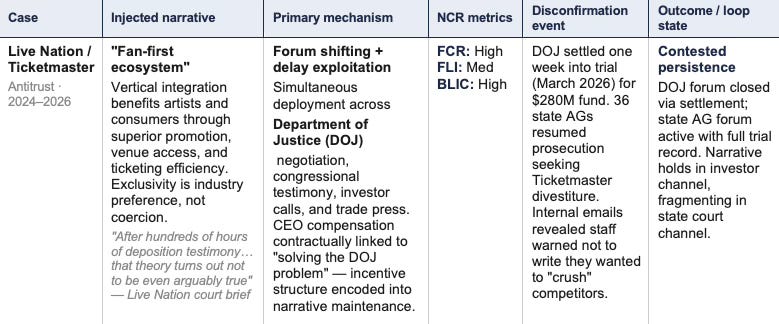
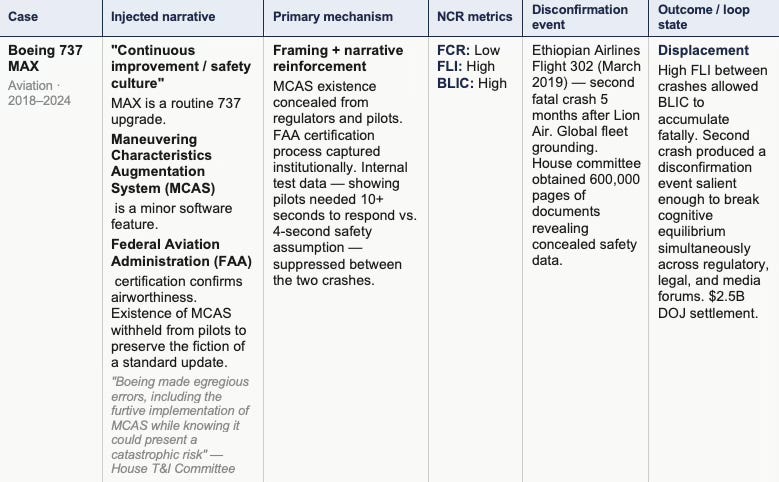
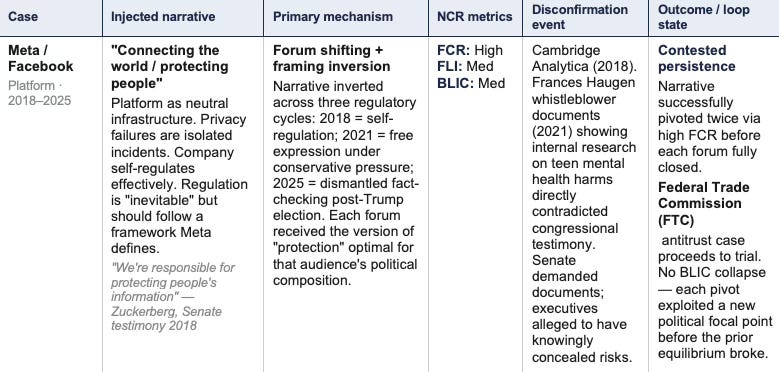
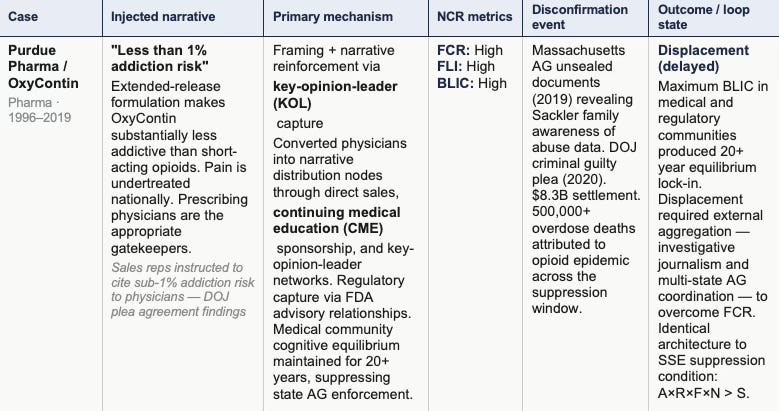
Three patterns emerge across the cases. First, high BLIC is the dominant predictor of equilibrium persistence duration — cases with maximum BLIC (Boeing, Purdue) produced the longest lock-in periods, with Purdue sustaining cognitive equilibrium for over two decades through physician network capture. Second, high FCR without high FLI produces the most durable narrative architectures — Meta’s ability to pivot the focal narrative across three distinct political audiences before each forum fully closed reflects maximum FCR operating under manageable latency conditions. Third, displacement consistently requires external aggregation when internal FCR remains high — neither Boeing nor Purdue experienced displacement through normal institutional channels; both required an exogenous aggregation event (a second crash; multi-state attorney general (AG) document unsealing) to break cognitive equilibrium simultaneously across the actor network — a pattern SSE’s prediction anticipates directly: signal suppression in high-access-dependence networks cannot be broken from within.
VIII. Empirical Anchor: Compass Holdings’ Narrative Control Architecture
The Compass Holdings narrative control architecture — documented in detail in The Cybernetics of Compass Holdings’ Narrative Control Architecture (MindCast AI, 2026) and tracking its real-time evolution through Washington State Senate Substitute Bill 6091 (SSB 6091)‘s enactment on March 19, 2026 — provides the framework’s deepest empirical test. Unlike the cross-industry cases, the Compass record is self-generated, timestamped, and cross-forum simultaneously. Every NCR mechanism can be mapped against documented behavioral outputs at specific dates, making this case ideally suited for falsifiability assessment.
The Three-Layer Control System
Compass’s narrative control architecture — documented in The Cybernetics of Compass Holdings’ Narrative Control Architecture — operates across three layers NCR’s system definition maps precisely. Layer 1 is operational: restrict listing exposure through staged visibility (Private Exclusive, Coming Soon, MLS), route buyer traffic through internal agent networks, and capture both commission sides when an in-house buyer arrives during the pre-market window. Layer 2 is linguistic: translate that restriction into consumer-facing language — seller choice, privacy, flexibility, innovation — so the constraint reads as empowerment. Layer 3 is institutional: calibrate the language by forum, so courts hear one account, legislatures hear another, investors hear a third, and consumers hear a fourth.
In NCR terms, Layer 2 is the narrative signal N(t). Layer 3 is the multi-forum deployment architecture that exploits FLI differentials. Layer 1 is the revenue mechanism the narrative protects. The system holds as long as the four forum audiences do not compare notes — precisely the audience-separation condition NCR’s competitive displacement framework identifies as the structural vulnerability.
Narrative Injection and Equilibrium Selection
CEO Robert Reffkin deployed the ‘seller choice’ narrative as a focal-point generator across regulatory comment, litigation, legislative testimony, investor communications, and press simultaneously — assigning maximum salience weight to the equilibrium in which Compass agents operate the pre-market routing window without constraint. The Skillman Moment is the canonical behavioral output of this dynamic. Moya Skillman’s Puget Sound Business Journal quote applied Reffkin’s MLS-targeted ‘seller choice’ framing to SSB 6091 — a state licensing statute — transmitting it into a forum where it could not survive scrutiny. In NCR terms, Skillman was best-responding to her belief about what the dominant narrative required: an agent operating inside a high-BLIC equilibrium does not independently evaluate whether the focal narrative applies to each new context.
The Streisand Topology — Self-Generated Disconfirmation
Compass filed federal antitrust complaints against the Northwest Multiple Listing Service (NWMLS) (April 2025) and Zillow (June 2025) to protect the pre-market routing window. Both complaints were public documents containing detailed consumer harm theories and market impact estimates. Every paragraph describing how restricted listing visibility harms consumers became primary source material for legislative staff and SSB 6091’s drafters. Washington’s legislature did not invent a regulatory framework. Compass filed one in federal court, and the legislature applied it 141-1. The FCR mechanism — which should have incorporated the litigation record back into the narrative to neutralize it — instead fed the competing signal. The Streisand Topology is the condition in which FCR amplifies the disconfirmation rather than suppressing it.
Self-Disclosure Trap as BLIC Measurement
The Compass record provides the cleanest available BLIC proxy across an institutional actor under increasing constraint pressure. The client Disclosure Form acknowledges private exclusive marketing ‘may reduce the number of potential buyers’ and may reduce ‘the final sale price.’ Reffkin’s public statement: ‘There is no downside.’ The SDNY complaint argues restricted visibility harms consumers. SSB 6091 legislative testimony argues it protects consumers. The March 20, 2026 LinkedIn carousel — published the morning after Governor Ferguson signed SSB 6091 — pledged to ‘dismantle any system that stands in the way.’ Each statement was produced for a different audience on the assumption those audiences would not compare notes. Assembled, they form the self-generated impeachment record that a maximum-BLIC actor produces when Identity Grammar cannot update in response to structural defeats.
Competitive Displacement and Contested Persistence
All three displacement conditions arrived within 72 hours in the period March 18–20, 2026. Compass voluntarily dismissed the Zillow lawsuit on March 18 — a salient disconfirmation event destroying the antitrust-victim narrative after 268 days and zero judicial relief. Governor Ferguson signed SSB 6091 on March 19, converting the legislative arena from ambiguous to binding. The competing narrative achieved BLIC in the legislative processing environment before Compass’s FCR mechanism could reframe the 141-1 vote. The result is contested persistence, not full displacement: the ‘seller choice’ narrative retains focal dominance in investor communications and Department of Labor (DOL)rulemaking environments where the binding constraint has not yet arrived.
SSE Integration — The Terminal State
The Compass case connects NCR’s loop architecture to the Signal Suppression Equilibrium (SSE) framework documented in MindCast’s Prestige Markets as Signal Economies: A Model of Signal Suppression and Institutional Failure. The SSE suppression condition — A × R × F × N > S — maps directly onto the Compass agent network architecture. Access dependence: agents depended on Compass listing inventory and referral networks for income. Reputational retaliation risk: contradicting the ‘seller choice’ framing risked network exclusion. Information fragmentation: three-tier audience separation ensured no single observer held enough cross-forum information to aggregate the contradictions. Narrative distortion multiplier: ‘seller choice’ vocabulary reduced counter-signal credibility by reframing transparency requirements as anti-consumer interference. NCR explains how the system arrived at the SSE state; SSE explains why it produced durable silence.
IX. Application Framework
NCR applies across institutional domains through a structured five-stage analytical process.
Stage 1 — Identify narrative signals: Map active signals in the target environment. Identify the injection point, deploying actor’s structural position, and forum architecture. Assess whether the constraint environment is binding-verifiable (geometry dominates) or ambiguous-contested (narrative dominates).
Stage 2 — Map institutional actors and belief structures: Identify which institutions are processing the signal, their characteristic FLI values, and current belief distributions about other actors’ expected behavior. High prior BLIC indicates actors have already internalized narrative-consistent behavior as the expected norm.
Stage 3 — Measure feedback metrics: Assess current FCR, FLI, and BLIC values. High FCR with high BLIC and low FLI indicates a narrative approaching closed-loop stability. High FLI with low BLIC indicates a competitive displacement window.
Stage 4 — Classify loop and competition state: Determine whether the system is in fragmentation, dominance, or contested persistence. Scan for Streisand Topology conditions — forums in which the deploying actor’s own filings provide vocabulary for a competing narrative.
Stage 5 — Predict equilibrium trajectory: Apply the four falsifiable predictions. For displacement analysis, assess whether all three displacement conditions hold simultaneously. For SSE integration — as modeled in Prestige Markets as Signal Economies — assess whether the loop has reached the terminal state in which A × R × F × N > S.
X. Falsifiable Predictions
NCR generates ten predictions falsifiable through observed institutional behavior. Predictions 1–4 constitute the core set derived from the feedback loop architecture. Predictions 5–10 extend the framework into actor behavior, displacement conditions, constraint clarity, narrative pivoting, and signal suppression dynamics — each derived from CDT simulation outputs. All ten connect specific metric values to predicted outcome patterns with observable markers. The measurement agenda following the predictions specifies operational definitions for each key term.
Prediction 1: High Feedback Latency Produces Narrative Fragmentation
When FLI is high, competing narratives proliferate before any single signal achieves behavioral confirmation. Observable marker: the number of distinct institutional framing patterns in press, regulatory comment, and litigation filings exceeds three within 90 days of a triggering event in high-FLI environments, versus one to two in low-FLI environments processing equivalent events.
Prediction 2: High Feedback Capture and Lock-In Produce Persistence After Disconfirmation
Narratives endure despite contradictory evidence when both FCR and BLIC are high. Observable marker: institutional actors maintain narrative-consistent behavioral outputs for more than 180 days after a documented disconfirmation event in high-FCR/high-BLIC environments, versus behavioral reversal within 60 days in low-FCR/low-BLIC environments.
Prediction 3: Weak Causal Validation Produces Narrative Proliferation
Low causal validation environments generate unstable competing narratives and slow convergence. Observable marker: domains with weak validation infrastructure (regulatory antitrust, complex litigation) exhibit higher variance in institutional framing across parallel forums than domains with strong validation (quantitative finance, engineering compliance), holding triggering event severity constant.
Prediction 4: Narrative-Geometry Boundary Shifts Predict Enforcement Timing
In ambiguous constraint environments, narrative dominance predicts enforcement timing better than statutory deadlines alone. Observable marker: in regulatory domains where enforcement is discretionary, the date on which a narrative achieves dominant focal status — operationalized as the point at which counter-narratives stop generating new institutional behavioral outputs — predicts enforcement action timing with higher accuracy than calendar-based models.
Extended Prediction Set — CDT Simulation Outputs
Predictions 5–10 are derived from CDT simulation classification results and extend the framework into actor-level dynamics, displacement conditions, and signal suppression.
Prediction 5: Cross-Forum Inconsistency Produces Self-Generated Disconfirmation
Actors deploying inconsistent narratives across forums increase the probability of exposure and narrative collapse once signals become jointly observable. Observable marker: a measurable rise in counter-narrative institutional adoption following documented aggregation of cross-forum contradictions — operationalized as the appearance of the deploying actor’s own prior-forum language in competing actors’ filings, legislative drafts, or enforcement documents within 180 days of the contradiction’s public aggregation. The Compass Streisand Topology is the reference case.
Prediction 6: High Behavioral Lock-In Produces Narrative Overextension
Actors with strong lock-in reuse the dominant narrative in mismatched institutional contexts, increasing the risk of credibility loss and accelerating displacement. Observable marker: narrative repetition across incompatible domains — applying a compliance argument to a statutory mandate, applying a market-competition frame to a licensing proceeding — preceding documented enforcement action or measurable reputational decline within the overextended forum. The Skillman Moment is the canonical instance.
Prediction 7: Narrative Displacement Requires Three Simultaneous Conditions
Displacement occurs only when disconfirmation salience, an accessible competing narrative, and a favorable FLI window co-occur. Meeting any two of the three conditions without the third produces contested persistence, not displacement. Observable marker: documented persistence of the original narrative across at least one institutional forum despite a salient disconfirmation event, confirmed absence of either a competing narrative with sufficient reach or a short FLI window in that forum.
Prediction 8: Constraint Clarity Accelerates Narrative Decay
Narrative dominance decays faster in environments with clear, enforceable constraints than in ambiguous enforcement environments. Observable marker: measurably faster behavioral shift following bright-line enforcement events — statutory enactment, court-ordered injunction, mandatory compliance deadline — compared to discretionary enforcement signals of equivalent institutional authority, measured by the interval between the enforcement event and the first documented behavioral reversal by the constrained actor.
Prediction 9: High Feedback Capture Enables Narrative Pivot Without Behavioral Change
Actors with high FCR can adapt narrative framing while preserving the underlying behavioral architecture, maintaining institutional equilibrium through language change while the revenue or operational mechanism continues unchanged. Observable marker: documented change in public-facing vocabulary — shift in terminology, rebranding of a mechanism, adoption of regulatory compliance language — without corresponding change in the institutional action the narrative was protecting, measurable against pre- and post-pivot transaction records or behavioral outputs.
Prediction 10: Signal Suppression Intensifies After Equilibrium Formation
Public dissent within a narrative-controlled network declines as equilibrium stabilizes, even when private disagreement among network participants rises. Observable marker: reduced frequency of public contradiction — whistleblower filings, defection statements, regulatory complaints — from network participants despite documented accumulation of disconfirming evidence, calibrated against pre-equilibrium baseline dissent rates in the same network. The Purdue physician network is the reference case for extended-duration suppression; the Compass agent network is the reference case for rapid-onset suppression.
Measurement Agenda
The prediction set requires operational definitions for four terms that remain qualitative in prior versions. Fragmentation is defined as three or more distinct institutional framing patterns appearing within a specified time window — 90 days as the default, calibrated to the FLI of the target forum. Disconfirmation is tiered by institutional authority: Tier 1 is a binding legal ruling or statutory enactment; Tier 2 is a regulatory enforcement action; Tier 3 is documented cross-forum contradiction without enforcement. Validation strength is assessed by causal attribution clarity — the degree to which observable outcomes can be directly attributed to the narrative-protected mechanism rather than to confounding variables. Latency thresholds are calibrated relative to each institutional forum’s documented response cycle, not against a universal benchmark.
XI. Integration with MindCast Architecture
NCR slots into the MindCast Predictive Institutional Cybernetics architecture as the narrative control layer.
The Cybernetics Umbrella: Toward a Unified Control Theory of Institutional Systems (MindCast AI, 2026) frames institutions as feedback-governed behavioral engines. NCR operationalizes narrative as a control-layer input, specifying the feedback dominance and loop closure principles the umbrella establishes at a general level. The game-theoretic spine — focal-point selection, belief updating, equilibrium hysteresis — provides the behavioral mechanism through which feedback dynamics produce institutional lock-in.
The Constraint Geometry: Structural Determinism in Institutional Outcomes (MindCast AI, 2026) establishes that outcomes follow structural constraints rather than intent or incentives. NCR’s narrative-geometry dominance condition operationalizes the boundary condition Constraint Geometry implies but does not model. The two modules form a complete predictive system — Constraint Geometry models hard structural determination; NCR models soft narrative determination; the dominance condition specifies which regime applies.
The Signal Suppression Equilibrium framework — Prestige Markets as Signal Economies — connects to NCR at the dual-equilibrium junction. SSE’s condition A × R × F × N > S is the terminal expression of NCR’s dual-equilibrium lock-in: when both strategic and cognitive equilibria hold, narrative distortion multiplier N is at maximum, suppression becomes individually rational for every network participant, and signal aggregation capacity S is insufficient to break the equilibrium from within. NCR governs the approach path; SSE governs the terminal state.
XII. Implications
NCR’s architecture produces implications across three institutional domains.
Markets: Asset pricing reflects narrative-driven equilibrium regimes that persist beyond their informational justification when BLIC is high. Markets correct narratives not when contradictory evidence accumulates but when FCR drops below the threshold needed to maintain cognitive equilibrium — typically triggered by a disconfirmation event salient enough to reopen inquiry simultaneously across the actor population.
Legal systems: Doctrinal outcomes often reflect narrative stabilization that occurred in the advocacy phase, prior to formal adjudication. Courts process narrative-shaped evidentiary records — the behavioral and cognitive equilibria NCR describes are established before the legal proceeding begins. The Compass Southern District of New York (SDNY)preliminary injunction arc illustrates this: the mandatory injunction classification identified that Compass was demanding a structural accommodation it had never had, not defending a right it possessed.
AI systems: Programmable narrative control layers become possible when AI systems can model institutional belief structures and feedback loop states in real time. The CDT architecture documented in Cybernetics Umbrella: Toward a Unified Control Theory of Institutional Systems is the operational implementation — CDTs model institutional decision systems as belief-updating agents whose Vision Functions generate gate-conditional behavioral predictions against the NCR loop state.
Conclusion
Narrative Control Runtime transforms narrative from descriptive artifact into an operational system variable with measurable feedback properties, game-theoretic equilibrium mechanics, and falsifiable predictive outputs. Institutions respond to narratives that survive feedback pressure, constraint processing, and behavioral convergence — not to narratives that are merely true. Models that exclude narrative as a control input cannot predict institutional behavior under conditions in which strategic actors are actively engineering the belief environment that governs equilibrium selection.
The framework’s central contribution is the integration of three previously separate bodies of theory. Shiller stops at spread. Nash and Schelling stop at equilibrium formation. Wiener’s cybernetics stops at feedback control. NCR stitches them: narrative is a belief-coordinating signal that selects among multiple equilibria, generates common knowledge that makes cheap talk behaviorally effective, and — when embedded in closed-loop feedback systems — produces path-dependent institutional outcomes that persist through disconfirmation via the hysteresis mechanism BLIC captures.
The cross-industry evidence base demonstrates that the mechanism operates identically across antitrust enforcement, aviation safety regulation, platform governance, and pharmaceutical distribution. Case-specific details differ; loop architecture does not. NCR generates outputs others have to respond to — not because the claims are bold, but because the architecture is complete enough to be wrong.
Standardized Academic Anchors
Narrative Economics: How Stories Go Viral and Drive Major Economic Events — Robert J. Shiller (2019)
Animal Spirits: How Human Psychology Drives the Economy, and Why It Matters for Global Capitalism — George A. Akerlof and Robert J. Shiller (2009)
Cybernetics: Or Control and Communication in the Animal and the Machine — Norbert Wiener (1948)
Non-Cooperative Games — John F. Nash (1950)
The Economics of Information — George J. Stigler (1961)
The Economic Approach to Human Behavior — Gary S. Becker (1976)
The Strategy of Conflict — Thomas C. Schelling (1960)
Cheap Talk with Two Audiences — Vincent P. Crawford and Joel Sobel (1982)
Manufacturing Consent: The Political Economy of the Mass Media — Edward S. Herman and Noam Chomsky (1988)
The Shock Doctrine: The Rise of Disaster Capitalism — Naomi Klein (2007)
Second-Order Extensions (2° Layer)
McCloskey establishes that economic reasoning is inherently narrative, reinforcing NCR’s treatment of narrative as a structural input. Arthur’s adaptive systems framework reinforces NCR’s feedback-loop modeling and path-dependent lock-in dynamics. Davenport and Beck’s attention economics supports NCR’s signal competition and focal-dominance dynamics — attention scarcity makes focal-point selection competitive rather than costless. Miller and Page provide computational grounding for institutions as adaptive agents within feedback systems, directly relevant to CDT Foresight Simulation development.
The Rhetoric of Economics — Deirdre N. McCloskey (1985)
The Economy as an Evolving Complex System — W. Brian Arthur (2015)
The Attention Economy: Understanding the New Currency of Business — Thomas H. Davenport and John C. Beck (2001)
Complex Adaptive Systems: An Introduction to Computational Models of Social Life — John H. Miller and Scott E. Page (2007)